Original Research Article
Study of oxidative stress and C-Reactive protein in type-2
diabetes mellitus
Shubhangi M. Dalvi
1*, Chandrakiran D. Hathial
2, Neelam Yeram
1, Mayuri Nalawade
3,
Vinayak W. Patil
1INTRODUCTION
Diabetes mellitus is a group of metabolic diseases characterized by hyperglycemia resulting from defects in
insulin secretion and insulin action or both. The prevalence of diabetes is rising all over the world due to population growth, aging, urbanisation, and the increase of obesity due to physical inactivity. When compared to the western 1Department of Biochemistry,2Department of Physiology, Grant Government Medical College and Sir J.J. Group of Hospitals, Byculla, Mumbai, India
3Department of Biochemistry, K. J. Somaiya College of science and commerce, Vidhyavihar, Mumbai, Maharashtra, India
Received: 23 July 2019
Revised: 05 August 2019
Accepted: 31 August 2019
*Correspondence:
Dr. Shubhangi M. Dalvi,
E-mail: [email protected]
Copyright: © the author(s), publisher and licensee Medip Academy. This is an open-access article distributed under the terms of the Creative Commons Attribution Non-Commercial License, which permits unrestricted non-commercial use, distribution, and reproduction in any medium, provided the original work is properly cited.
ABSTRACT
Background: Diabetes mellitus is a group of metabolic diseases characterized by hyperglycemia resulting from defects in insulin secretion and insulin action or both. T2DM is associated with chronic low grade inflammation, possibly through a pathway involving a cytokine-mediated acute-phase response to infection and other inflammatory processes. authors aim to study C-reactive protein (CRP) which is an acute-phase reactant produced primarily in the liver hepatocytes. Oxidative stress levels in newly diagnosed T2M patients were analysed with respect to malondialdehyde (MDA) and nitric oxide (NO).
Methods: Case-control study comprising of aged-sex matched subjects: newly diagnosed T2DM cases (n=30) and controls (n=30). The serum samples of subjects were analysed for levels of MDA by Buege and Aust method, while NO levels by Cortas and Wakid’s kinetic cadmium reduction method using spectrophotometer. CRP levels were analysed by using turbidimetry. Statistical analysis was done using Mini-tab 17 software with 95% confidence interval.
Results: Serum levels of MDA, NO and CRP in newly diagnosed T2DM patients were significantly increased as compared to healthy controls.
Conclusions: Authors concluded that the oxidative stress and inflammation plays a pivotal role in the aetiology of hyperglycemia in T2DM. Oxidative stress and inflammatory markers might help prognosis of T2DM in hyperglycemic individuals with the help of which precautionary measure can be taken to reduce the rate of disease progression. Treatment involving anti-oxidant and anti-inflammatory medications might help to rescue vital organs from damage.
Keywords: C-Reactive protein, Newly diagnosed type 2 diabetes mellitus, Malondialdehyde, Nitric oxide, Oxidative Stress
countries, where the older are most affected, diabetes in
Asian countries is higher in young to middle-aged people. All these complications have long-lasting adverse effects on a nation’s health and economy, especially for developing countries. As per estimate of the International Diabetes Federation (IDF), the total number of people in India with diabetes which was around 50.8 million in 2010 would be 87.0 million by 2030.1
The chronic hyperglycemia is associated with long-term damage, dysfunction, and failure of normal functioning of various organs. The onset of diabetes leads to several micro- and macrovascular complications. Long-term complications include retinopathy with a potential loss of vision, neuropathy with the danger of foot amputation, and nephropathy leading to renal function decline and dialysis.1,2 Subjects with diabetes are at increased risk for atherosclerotic cardiovascular disease, peripheral arterial disease, and cerebrovascular disease because of the coexistence of multiple cardiovascular risk factors, including hypertension and dyslipidemia, which are more prevalent in individuals having type 2 diabetes compared with subjects with normal homeostasis.2
T2DM is associated with chronic low grade inflammation, possibly through a pathway involving a cytokine-mediated acute-phase response to infection and other inflammatory processes. C-reactive protein (CRP) is an acute-phase reactant produced primarily in the liver hepatocytes under the stimulation of adipocyte-derived pro-inflammatory cytokines, including IL-6 and TNF-α.3 As a result, obese individuals who have more and larger adipocytes also have higher baseline serum CRP. Because diabetes is more common in obese individuals, an association is expected between serum CRP and diabetes. However, some studies found that obesity does not explain the association of CRP with diabetes completely, suggesting an independent role for CRP in the development of diabetes.4 Novel data further suggest that chronic adipose tissue inflammation and β-cell stress cause an activation of the adaptive immune system as well, which may also participate in the progression of the inflammatory response. Autoimmune and inflammatory mechanisms during hyperglycemia induced glucotoxicity could favor an increased expression of several b-cell antigens, thus increasing b-cell apoptosis through autoantibodies.2
Chronic hyperglycaemia leads to the generation of oxidative stress in pancreatic β-cells which are particularly vulnerable to the damaging effects of excessive ROS production because of their lower abundance of antioxidant defence enzymes, compared to other tissues.
Weak defence system is unable to counteract the enhanced ROS generation and as a result condition of imbalance between ROS and their protection occurs which leads to domination of the condition of oxidative
stress. Due to their ability to directly damage and oxidize DNA, protein and lipid ROS lead to β- cell dysfunction and death. In addition to macromolecular damage, ROS can activate a number of cellular stress sensitive pathways that have been linked to insulin resistance and decreased insulin secretion.1,5
Lipids are reported as one of the primary targets of ROS. Hydroperoxides have toxic effects on cells both directly and through degradation to highly toxic hydroxyl radicals. Peroxidation of lipids produces highly reactive aldehydes, including Malondialdehyde (MDA). MDA is a highly reactive nucleophilic agent generated by both lipid peroxidation and as a byproduct of prostaglandin and thromboxane synthesis that can attack macromolecules, including amino acid or sulfhydryl moiety of proteins leading to alterations in their functions.5 MDA has been documented as a primary biomarker of free radical mediated lipid damage and oxidative stress. Increased level of MDA in diabetics suggests that peroxidative injury may be involved in the development of diabetic complications. The increase in lipid peroxidation is also an indication of decline in defence mechanisms of enzymatic and nonenzymatic antioxidants.1
Early diabetic nephropathy in children and adolescents is caused predominantly by microangiopathy, representing functional and structural abnormalities in the microvascular system leading to microalbuminuria. A considerable body of evidence in humans indicates that microalbuminuria is strictly associated with a generalized endothelial vascular dysfunction. In this regard, a glucose dependent abnormality in nitric oxide (NO) production and action has become an attractive hypothesis for the pathogenesis of early diabetic nephropathy. In fact, vasodilation due to increase NO generation or action has recently been implicated in the pathogenesis of glomerular hyperfiltration and in the enhanced permeability to macromolecules that leads to microalbuminuria.6
In this study, we aim to study the role of oxidative stress
with effect of MDA and NO in newly diagnosed T2DM. Also, the involvement of CRP in the pathogenesis of T2DM is an important aspect to study. These parameters are thus correlated with each other for better understanding of T2DM aetiology.
METHODS
It was a Randomized case control study in which the participants were distributed in two groups: Healthy volunteers (Control group) and patients with newly diagnosed type 2 diabetes mellitus (Case group). The study was undertaken at Department of Biochemistry, Grant medical college and Sir J. J. groups of Hospitals, Mumbai.
The subjects recruited in the study groups were 30 healthy controls and 30 cases of newly diagnosed type 2 diabetes mellitus. Venous blood samples were collected using plain vacutainers. The serum samples were separated by centrifugation.
Inclusion and Exclusion criteria
Subjects of both the sex in age group of 30 to 60 years and willing to participate in the study were recruited. Newly diagnosed type 2 diabetes patients were included in the case group. Subjects with HIV/AIDS infected, diagnosed for malignancies, neurological or psychiatric disorders and tuberculosis were excluded from the study. Informed consent was taken from subjects. Ethical approval was taken from Institutional Ethics Committee of Sir J. J. Group of Hospitals & GGMC, Mumbai.
Serum samples were analyzed for Malondialdehyde (MDA), nitric oxide (NO) and C-Reactive protein (CRP).
MDA
The concentration of MDA was analysed by Buege and Aust method in which serum sample is first treated with 40% TCA (Trichloroacetic acid) for protein precipitation and then treated with 0.67% TBA (Thiobarbituric acid). The mixture is heated for 10 min in boiling water bath. One molecule of MDA reacts with two molecules of TBA. The resulting chromogen is centrifuged and
intensity of colour developed in supernatent was measured colorimetrically at 530nm.
NO
NO was analysed by Cortas and Wakid’s kinetic cadmium (Cd) reduction method. Nitric oxide is a highly unstable gas with half-life of ~5 sec. and is rapidly metabolized by reduction to stable nitrate (NO2-) and nitrite (NO3-2). This nitrate in serum was assayed by a modification of the Cd reduction method .The samples were deproteinized with somogyi reagents; the nitrate is reduced by Cu-coated Cd, in glycine buffer at pH 9.7. The nitrite produced was determined by diazotization of sulphanilamide and coupling to napthylethylenediamine. The colour formed by nitrite diazotization is then measured at 540 nm.
CRP
The concentration of CRP was estimated by turbidimetric photometry at 37℃ and 540 nm using CRP-Turbilatex kit. Latex particles coated with specific anti- human CRP were agglutinated when mixed with samples containing CRP. The agglutination caused an absorbance change, dependent upon the CRP content of the patient sample that could be quantified by comparison from a calibrator of known CRP concentration.
Statistical analysis
Statistical analysis (Mean and Standard Deviation) was done using Mini-tab 17 software with 95% confidence interval.
RESULTS
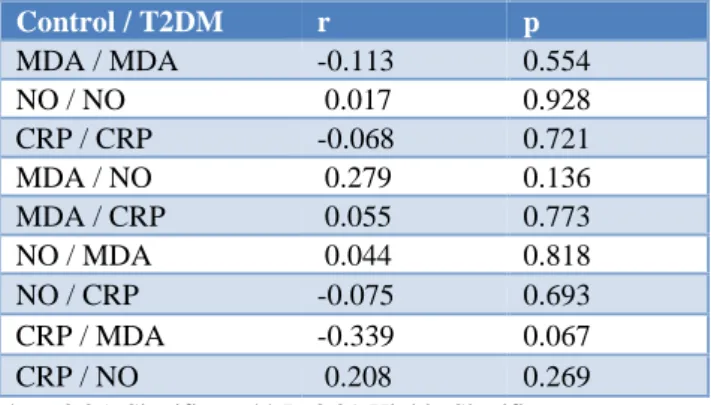
The serum levels of MDA, NO and CRP in the control and T2DM patients are represented in Table 1. Authors observe that the (Mean±SD) values of all the three parameters in T2DM group are significantly higher than in control group. Also, the age distribution of 30 subjects in each group is stated in Table 1. In Table 2, the correlation between MDA, NO and CRP in both the groups is represented which shows a positive correlation between NO levels in Control and T2DM groups.
Table 1: Biochemical parameters in control and T2DM.
Groups (n = 30) Age (years) MDA (nmol/ml) NO (µmol/L) CRP (mg/L)
Control (Mean±SD) 49.9±4 1.46±0.35 32.09±4.1 2.15± 0.701
Type 2 Diabetes (Mean ± SD) 49.4±9.6 3.19±0.54 70.45± 116.87 5.95±1.46
Conversely, significant negative correlation is observed between Control and T2DM group levels of MDA and
MDA of T2DM group. similarly, CRP of control group
shows a positive correlation with no and negative correlation with MDA of T2DM group. In case of control MDA, it shows a positive correlation with both no and CRP in T2DM group.
Table 2: Correlation between MDA, NO and C-Reactive Protein in Control and T2DM groups.
Control / T2DM r p
MDA / MDA -0.113 0.554
NO / NO 0.017 0.928
CRP / CRP -0.068 0.721
MDA / NO 0.279 0.136
MDA / CRP 0.055 0.773
NO / MDA 0.044 0.818
NO / CRP -0.075 0.693
CRP / MDA -0.339 0.067
CRP / NO 0.208 0.269
* p <0.05 -Significant ** P<0.01-Highly Significant
Thus, it is observed that the age group of both the groups is similar and the changes in the serum levels of MDA, no and CRP reflect the effects of disease condition.
DISCUSSION
Increased oxidative stress appears to be a deleterious factor leading to insulin resistance, β-cell dysfunction, impaired glucose tolerance, and, ultimately, type 2 diabetes mellitus. In our study, we have analysed the serum levels of MDA, which represent the level of lipid peroxidation as an effect of oxidative stress and serum levels of NO, which state the conditions of micro- and macro-vascular system in patients of T2DM. Obesity may play a role in the relationship between systemic oxidative stress and these conditions.9 Inflammation is also found to be effective in the disease progression which is monitored in this study by analysing the serum levels of CRP, an acute inflammatory marker. A number of prospective studies have described the association between circulating CRP levels and risk of incident T2DM. There is heterogeneity between studies, with some demonstrating an independently positive association of CRP with incident diabetes, while others show no association after adjustment for adiposity and insulin resistance. Differences in the association between CRP and diabetes by sex have also been reported.3 In our study, since authors have recruited the subjects which are age and sex matched, the confounding factor of age and sex has been ruled out.
The increase in lipid peroxidation is also an indication of decline in defence mechanisms of enzymatic and nonenzymatic antioxidants. Oxidized lipids are able to produce MDA as a decomposition product and the mechanism is thought to involve formation of prostaglandins, like endoperoxides, from polyunsaturated fatty acid (PUFA) with two or more double bonds. Increased
MDA level in plasma, serum, and many others tissues has been reported in diabetic patients. Ramesh et al. in 2012, reported that lipid peroxidation in diabetes induced many secondary chronic complications including atherosclerosis and neural disorders.1,10 Table 1 shows a significant increase in the serum levels of MDA in patients with T2DM as compared to normal healthy controls. This indicates increased oxidative stress due to the disease.
The serum NO data in T2DM patients that reported by different scientific literature is controversial. Some research articles reported increased NO levels in diabetes patients whereas others reported the opposite.8 Paradoxically, hyperglycemic conditions result simultaneously in both increased NO production and decreased NO availability. However, reduction in NO availability is the primary pathogenic factor that appears responsible for endothelial dysfunction and diabetic angiopathy. The molecular mechanisms behind this apparent paradox are as follows: superoxide anions, resulting from hyperglycemia, activate nuclear factor kB (NF-kB), which causes increased expression of inducible nitric oxide synthase (iNOS). This increase in iNOS results in amplified generation of NO. However, when superoxide anions are present at high concentration, they rapidly react with the newly created NO to form the strong oxidant peroxynitrite. The net result is an overall decline in the availability of NO to the endothelium and the formation of peroxynitrite, which is itself toxic to endothelial cells. Peroxynitrite exerts its toxic effect through oxidation of proteins, initiation of lipid peroxidation and nitration of amino acids.11 Our study results in Table 1 shows a significant increase in the serum levels of NO in diabetic patients when compared to the healthy control subjects. Table 1 Similar to our results, the study conducted by Shweta Bhatia et al., 2003 and Ahmet Aydın et al., 2001 shows elevated NO levels in patients with T2DM.12,13 authors can infer from these results that the NO levels increased in the newly diagnosed T2DM patients involved in this study, represent initial stage of amplified NO generation.
In Table 2, authors observe the correlation between MDA, NO and CRP in T2DM and control groups which show a link between the oxidative stress, systemic inflammation and hyperglycemia. In Table 2 authors observed that the oxidative stress marker, MDA is in positive correlation with the inflammatory marker, CRP in T2DM patients, which shows that both oxidative stress and inflammation go hand-in-hand when the disease progresses. NO levels are seen to be increased in the newly diagnosed cases of diabetes, while they are negatively correlated to MDA and CRP. This indicates the elevation of NO, as per the initial disease stage.
CONCLUSION
serum levels of MDA show substantial involvement of
ROS which leads to deterioration of vital organs in the body. The increased levels of NO thus, show the initiation of oxidative stress in newly diagnosed T2DM patients as a result of superoxide actions. Involvement of inflammation is apparent in T2DM as evident by elevated CRP levels in serum. Thus, these oxidative stress and inflammatory markers might help prognosis of T2DM in hyperglycemic individuals. Also, due to early diagnosis, precautionary measure can be taken to reduce the rate of disease progression. Treatment involving anti-oxidant and anti-inflammatory medications might help to rescue vital organs from damage.
Funding: No funding sources Conflict of interest: None declared
Ethical approval: Ethical approval was taken from Institutional Ethics Committee of Grant Government Medical College & Sir J. J. Group of Hospitals, Mumbai, India.
REFERENCES
1. Tiwari BK, Pandey KB, Abidi AB, Rizvi SI. Markers of oxidative stress during diabetes mellitus. J Biomarkers. 2013;2013.
2. Grossmann V, Schmitt VH, Zeller T, Panova-Noeva M, Schulz A, Laubert-Reh D, et al. Profile of the immune and inflammatory response in individuals with prediabetes and type 2 diabetes. Diabetes Care. 2015 Jul 1;38(7):1356-64.
3. Lee CC, Adler AI, Sandhu MS, Sharp SJ, Forouhi NG, Erqou S, et al. Association of C-reactive protein with type 2 diabetes: prospective analysis and meta-analysis. Diabetologia. 2009 Jun 1;52(6):1040-7.
4. Dehghan A, Van Hoek M, Sijbrands EJ, Stijnen T, Hofman A, Witteman JC. Risk of type 2 diabetes attributable to C-reactive protein and other risk factors. Diabetes care. 2007 Oct 1;30(10):2695-9. 5. Bigagli E, Lodovici M. Circulating Oxidative Stress
Biomarkers in Clinical Studies on Type 2 Diabetes and Its Complications. Oxidat Med Cellul Longev. 2019;2019.
6. Chiarelli F, Cipollone F, Romano F, Tumini S, Costantini F, di Ricco L, et al. Increased circulating
nitric oxide in young patients with type 1 diabetes and persistent microalbuminuria: relation to glomerular hyperfiltration. Diabetes. 2000 Jul 1;49(7):1258-63.
7. Tessari P, Cecchet D, Cosma A, Vettore M, Coracina A, Millioni R, et al. Nitric oxide synthesis is reduced in subjects with type 2 diabetes and nephropathy. Diabetes. 2010 Sep 1;59(9):2152-9. 8. Adela R, Nethi SK, Bagul PK, Barui AK,
Mattapally S, Kuncha M, et al. Hyperglycaemia enhances nitric oxide production in diabetes: a study from South Indian patients. PloS one. 2015 Apr 20;10(4):e0125270.
9. Park K, Gross M, Lee DH, Holvoet P, Himes JH, Shikany JM, et al. Oxidative stress and insulin resistance: the coronary artery risk development in young adults’ study. Diabetes care. 2009 Jul 1;32(7):1302-7.
10. Ramesh B, Karuna R, Sreenivasa RS, Haritha K, Sai MD, Sasis BR, et al. Effect of Commiphora mukul gum resin on hepatic marker enzymes, lipid peroxidation and antioxidants status in pancreas and heart of streptozotocin induced diabetic rats. Asian Pacific J Trop Biomed. 2012 Nov 1;2(11):895-900. 11. Wright Jr E, Scism‐Bacon JL, Glass LC. Oxidative
stress in type 2 diabetes: the role of fasting and postprandial glycaemia. Int J Clin pract. 2006 Mar;60(3):308-14.
12. Bhatia S, Shukla R, Madhu SV, Gambhir JK, Prabhu KM. Antioxidant status, lipid peroxidation and nitric oxide end products in patients of type 2 diabetes mellitus with nephropathy. Clin Biochem. 2003 Oct 1;36(7):557-62
13. Aydın A, Orhan H, Sayal A, Özata M, Şahin G, Işımer A. Oxidative stress and nitric oxide related parameters in type II diabetes mellitus: effects of glycemic control. Clin Biochem. 2001 Feb 1;34(1):65-70.