E. KeAnne Hoeg.Getting Social with Small North Carolina Manufacturers: An
Exploration of Attitudes Towards and Perceptions of Social Media for Marketing Use.A Master‘s Paper for the M.S. in L.S degree. July, 2011. 48pages.Advisor: Jeffrey
Pomerantz
This study is concerned with exploring how small manufacturers in North Carolina currently market their products and capabilities as well as their perception of social media in order to determine if social media could be a useful marketing strategy. Interviews were conducted with 7 manufacturers, three of whom currently use or are in the process of implementing social media. Findings indicate that the manufacturers using social media have achieved marketing successes and that there is great interest from all of the manufacturers in how social media could be applied to their business with the primary barrier to adoption being the business owner. Recommendations on how manufacturers can begin to implement social media are suggested.
Headings:
Online social networks.
Use Studies / Social Networks. Internet marketing.
MEDIA FOR MARKETING USE
by
E. KeAnne Hoeg
A Master‘s paper submitted to the faculty of the School of Information and Library Science of the University of North Carolina at Chapel Hill
in partial fulfillment of the requirements for the degree of Master of Science in
LibraryScience.
Chapel Hill, North Carolina July 2011
Approved by
Table of Contents
Introduction...2
Literature Review ...6
Marketing in the SME...6
Ebusiness and Internet Marketing...8
Social Networks and Networking ...10
Online Social Networks and Social Media...13
Methodology...16
Results...18
Marketing...19
Networks and Networking ...22
Social Media ...23
Marketing Challenges...29
Discussion...30
Recommendations for manufacturers………....34
Recommendations for service organizations……….36
Conclusion ...37
Appendix 1: Interview Guide ...38
Introduction
It is almost unthinkable for a consumer or industrial buyer to research a product or service and not utilize the Internet to aid information gathering. Even if information-gathering begins with a casual conversation with a friend or trusted resource—online or offline-- it is likely that one of the next steps will be to a search engine. For industrial buyers in particular, the days of perusing print catalogs and attending trade shows for potential suppliers are gone. The industrial buying process consists of 4 stages: Needs Awareness, Research, Consideration & Comparison, and Procurement. Industrial buyers rely heavily on online sources during all 4 of the stages with the top 3 sources being search engines, supplier websites and online catalogs (GlobalSpec, 2009; ThomasNet, 2009). If the searcher is relying upon the search engine to point them to relevant results, then it is a necessity that a business has an online identity that has been indexed by search engines and available to be returned as a result. However, for small- and medium-sized enterprises, including manufacturers, effective web exposure and emarketing is a problem.
Small businesses are structured differently from large businesses, and these differences impact their ability to market effectively. They have limited financial
the owner has expertise or an interest in technology and marketing, those functions suffer.
Despite claims to the contrary, manufacturing remains a robust contributor to North Carolina‘s Gross Domestic Product (GDP). Manufacturing creates 20% of the
state‘s GDP, employs 15% of its workers and leads the Southeast in manufacturing‘s contribution to the Gross National Product (GNP) (―Manufacturing Matters‖, 2009). The
Small Business Administration (SBA) defines manufacturers having 500 or fewer employees as small, with 2500 being the threshold for medium (2010). Using this
criterion, 75% percent of North Carolina‘s roughly 10,000 manufacturing establishments
are considered very small, employing 50 or fewer workers. Online marketing is essential to help these small manufacturers reach new markets, increase sales, retain current employees and hire new workers.
While marketing—online or offline-- may be a problem for small- and medium-sized manufacturers, the message about what will help manufacturing is clear: growth and that means sales, either domestic or even better, through exports. For years manufacturers have been focusing on bottom line improvement strategies such as lean manufacturing, ISO 9001 certification and Six Sigma to cut production costs and improve quality. While those strategies have been necessary, no matter how lean your plant floor is, you need sales in order to stay in business.
search engines. Blogs, for example, often rank higher in search results than a static website and provide major boosts to the sites to which they are attached due to the frequency and amount of new content to index as well as the power of incoming links (Lodico, 2010).
Search engines are indexing and including social references from Facebook and Twitter in results as well as counting the number of times a link is shared or tweeted as an indication of trust, raising a page rank (Bouchard, 2011). Google is focusing on Twitter while Bing is focusing on Facebook. Google has stepped up its indexing of tweets, making keyword-laden tweets one of the top search results. Search engine visibility is important and has few borders: global visibility will help companies reach new markets outside of the US, creating export opportunities. Exports will be a major contributor to the economy‘s recovery (Vigna & Shipman, 2010).
Social media seems tailored to the core competencies of a small business and especially a business with a B2B focus. With its emphasis on authenticity and
transparency, advice to corporate users to put a face to the nameless entity—the digital equivalent of small talk --social media encourages relationships. This emphasis is well-suited for the small business which finds itself better able both to form strong
marketing. Industrial buyers are increasingly using social media during their sourcing process. They list social tools such as blogs, Twitter, Facebook and online communities as top tools during the research phase of the industrial buying process.
While the use of social media for business promotion is a hot topic, there has been little academic attention paid to it. As well, most of the case studies available for
successful social media implementation involve consumer brands and products. While manufacturers produce a tangible product, they usually operate in a B2B sales
environment, with a particular manufacturer part of a supply chain to another
manufacturer. The B2B sales cycle differs from B2C in that it has smaller numbers of customers who spend more money as well as a longer sales cycle involving more than one decision maker; as a result, personal relationships are much more important. Though outside of academia, practicing B2B marketers argue that social media is tailored for B2B organizations. B2B marketing considers building awareness and cultivating word of mouth to be paramount, activities at which social media can excel. B2B marketing has always been about social networks; tools like Twitter and Facebook simply allow it to be done more quickly and publicly (Callahan, 2011).
Given the constraints many small manufacturers face in marketing due to a lack of resources, time and expertise but the potential appropriateness of social media, the purpose of this study is to explore whether social media would be a useful tool for small manufacturers to use to increase brand recognition, build relationships and ultimately increase sales. The research questions that this study will investigate are the following:
What are small manufacturers‘ current attitudes toward and current usage of
Are there barriers that exist that would prevent its adoption by small
manufacturers?
Can larger manufacturers‘ usage of social media be used to provide a process or
guidelines for smaller manufacturer
Literature Review
This literature review focuses on four areas in order to fully explore SME operations
as they relate to marketing as well as current research on social media and marketing: SME
marketing practices; SME technology adoption and Internet marketing; networks and
networking; and social media. Networking‘s importance to the SME as well as the
importance of word-of-mouth as a result of networking are major themes.
Marketing in the SME
The characteristics of SMEs impact their ability to market. They have limited financial resources or time and lack specialist knowledge in marketing. They are often owner operated, and the owner‘s own core competency tends to prevail. Unless the owner has expertise in technology and marketing, those functions suffer. The owner‘s
attitude or expertise is especially important with marketing becoming tied to technology in the case of email, websites and social media. As well, with emphasis on establishing the business and producing product, marketing is often the last competency to be obtained (Carson, 1990). As a result, small business marketing lacks the strategy,
market deficiently and inefficiently. Even if SMEs have an established marketing function, it is not well developed and lacks influence, especially if the business is B2B (Walsh & Lipinski, 2009).
Some researchers argue that SMEs should not be compared to large firms when their marketing practices are being evaluated and that they market in a way that reflects their capabilities, especially that of their proximity to their customer. Brooksbank, Kirby, Thompson & Taylor (2003) studied a group of UK manufacturers at two points (1987-1988 and 1997-1998) to determine marketing‘s impact on firm success and found that the more successful firms demonstrated that they understood and used 8 key
marketing principles such as self-generated market research, competition monitoring, and focus on maintaining positive company/brand reputation. However, the fact that not all 16 key marketing principles were used by successful manufacturers led the researchers to conclude that the model of marketing used by large firms is not applicable to SMEs and that SMEs may actually be using techniques tailored for the changing business
environment. Pacitto, Julien & Bizuel (2006) corroborated these findings in their study of international medium-sized manufacturers, finding that while not as robust as that in larger businesses, the manufacturers do have a definite market orientation that
emphasizes the customer. These highly-social SMEs favor activities that build and maintain those relationships, making them the ultimate relationship marketers (Coviello et al., 2000; Gilmore, Carson & Grant, 2001).
this is true for manufacturing SMEs as well. The National Association of Manufacturers‘ (NAM) 2006 report ―The Future Success of Small and Medium Manufacturers:
Challenges and Policy Issues,‖ lists marketing position and strategy, including product differentiation, customer relationships and market research as a key best practice to being a successful small-to-medium manufacturer. From a survey of 1200 manufacturers, Pelham (2000) found that market orientation had the strongest positive relationship w/ performance measures due to it enabling the manufacturer to quickly detect changes in customer preferences, fast response to negative customer feedback, creating value for customers and immediate response to competitor activities. This finding has been corroborated in other studies exploring success factors for small manufacturers (Bentley, 2003; Kim, Knotts & Jones, 2008) as well as small non-manufacturers (Berthon, Ewing & Napoli, 2008).
Ebusiness and Internet Marketing
As marketing becomes increasingly inseparable from the Internet, it is important to consider SME adoption of the Internet for business. Most of the research on SMEs and Internet marketing focuses on exploring factors or theories that govern ebusiness adoption with studies grouping email marketing, websites, ecommerce and online marketing with Internet adoption in general and not as it applies to a specific business application such as marketing and establishing what connotes successful usage
The literature appears to be converging around the term ―ebusiness‖ to describe
these Internet-enabled activities. Broadly, ebusiness refers to using the Internet and other technologies to increase business performance and success, including marketing,
communications with customers, suppliers and employees. Ultimately, ebusiness should lead to better relationships, resulting in increased loyalty, profits and competitive
advantage. Researchers are very enthusiastic about ebusiness‘ potential, with
declarations that companies cannot compete without an ebusiness strategy (Rodgers et al., 2002) to research demonstrating that SMEs using IT outperform other companies on profit (Bhardway, 2000).
While ebusiness adoption can be tied to profit performance, it is often discussed in terms of the relationships and networks it enables and the resulting competitive advantage (Zineldan, 2000; O‘Donnell et al., 2002; Fillis & Wagner, 2005). Further connecting ebusiness and networks, Parker & Castleman (2009) propose using Social Network Theory along with Diffusion of Innovation Theory to explain how the SME owner/manager‘s social networks contribute to adoption of ebusiness.
While researchers are enthusiastic about the benefits ebusiness can provide for SMEs, SMEs have been slower to adopt it due to the same barriers prohibiting the adoption of marketing strategy: limited resources (Ettlie, 1983; Lynn et al., 1999; Chappell et al., 2002; Darch & Lucas, 2002); owner/manager perception (Thong & Yap, 1995); sector influence (Martin and Matlay, 2001); and mistrust (Van akkeren and
al. (2003) suggested that SMEs focused on their market can use their websites to maintain a competitive advantage through customer, market and technological intelligence.
While available research primarily focuses on the adoption of basic websites and other Internet technologies, research on social media and SMEs is in its infancy not surprisingly. Chua, Deans and Parker (2009) explored types of SMEs that could possibly use blogs as a marketing tool with the point being to provide a research agenda for future research. The authors apply the challenges and characteristics of SMEs to suggested uses (managing reputation; building trust; niche marketing; promoting online presence; and market intelligence) for a blog. They are doubtful about the SME‘s ability to use a blog
for the suggested uses due to resource constraints but acknowledge that the SME could benefit from the increased traffic to their website and improved search-engine placement a blog can provide. It is interesting that they raise questions about SMEs ability to utilize blogs and other ebusiness tools and to reap any benefits when research shows that the more closely aligned with their market and customers, the more successful SMEs are.
contribute to the in-house adoption of Internet marketing, demonstrating that human resource constraints need not be insurmountable.
Social Networks and Networking
Small businesses are very social, and their owner/managers have very active networks, being highly influenced by family, friends and other businesses when making decisions. SMEs utilize their networks as a resource that makes up for the lack of resources inherent to the SME (BarNir & Smith, 2002; Butler et al., 2007; Gibbs et al., 2007). Gilmore, Carson & Grant (2001) consider networking to be a core marketing competency for a SME, noting that the SME‘s approach to networking mirrors their
overall approach to marketing: loose, spontaneous and informal.
In fact, marketing and networking appear to be related. Gilmore, Carson and Rocks (2006) found that there was a link between the high level of SME networking and the extent of marketing done and overall marketing sophistication. This outcome could be due to the fact that SMEs can use networks to obtain information and resources, improving their own competency in marketing and understanding of marketing‘s importance to the company‘s success. Networking can be used for proactive marketing
and is compatible with the characteristics of SMEs. There has been research on which type of tie—strong or weak—is more effective and beneficial. Granovetter‘s seminal 1973 study The Strength of Weak Ties found that weak ties are a necessity to expose an individual
to sources of new information whereas strong ties make that individual unlikely to learn new
information or opinions. A few researchers have examined tie strength and outcomes among SMEs that network with mixed findings. BarNir and Smith (2002) found that the number of interfirm alliances SMEs made was tied to the strength of ties in the owner‘s
network. Conversely, Watson (2006) found that weak ties were more important in influencing the ability of networks to contribute to SME survival and growth.
While most of the research focuses around face-to-face networking, there has been little research on the Internet-enabled networking. Haythornthwaite (2002) found that weak ties can be enhanced by computer-mediated communication (CMC) while latent
ties (ties that have not been activated) can be activated by CMC, especially if it is a common,
established means of communication (e.g. a tool such as Facebook or Twitter) established by
others. New media, if it enables communication among ties previous unable to communicate,
will nurture weak ties, allow latent ties to activate and encourage weak ties to become strong.
with face-to-face communication as part of the entire media ecology of networking methods, Ellis (2010) found that business owners utilized online networks to create customer opportunities through establishing links with many weak ties as well as to learn from other practitioners, suggesting that online networks can provide a way to fill a resource or knowledge gap just as offline networking can.
Interestingly, manufacturers‘ participation in networking is mixed. Dean, Holmes
and Smith (1997) discovered that Australian manufacturers participated less in networking as well as perceiving more inhibiting factors than service firms. Fewer manufacturers saw any benefit to networking, and their greatest concern with networking was information disclosure, suggesting that trust will be a major issue in cultivating networks. For these manufacturers, age mattered: younger manufacturing companies (1-5 years) were much more enthusiastic about networking, a finding that may have
relevance for manufacturers‘ attitudes toward and adoption of online social networks and
social media. This study maybe be an outlier or influenced by culture because other studies focusing entirely on manufacturers in the United States or including them in the sample demonstrate that manufacturers network actively and purposefully (BarNir and Smith, 2002; Gilmore, Carson & Rocks, 2006).
Online Social Networks & Social Media
Online social networks such as Twitter, Facebook, YouTube and LinkedIn have
become increasingly pervasive in everyday conversation, especially as targets for marketing.
Twitter has over 200 million registered accounts and averages of 140 million tweets a day
Statistics, 2011). In March 2011, LinkedIn achieved its 100 millionth user and of the
industries represented, manufacturing is 3rd at 10% (Qualman). With such large numbers, it is no wonder that companies want to utilize social media for marketing with perceived
benefits such as understanding customer sentiment, building customer relationships and
enhanced customer service.
According to Stelzner‘s ―2011 Social Media Marketing Industry Report‖, Facebook,
Twitter, LinkedIn and blogs are the top four social medial tools used for marketing. This
survey of more than 3300 marketers revealed that 93% are using social media for marketing
with 90% saying social media is important. Small business owners with more than 2
employees (66% of the responses) were more likely to strongly agree about social media‘s
importance for their business. The benefits cited are substantial: 88% indicated social media
has generated more business exposure. Two-thirds indicate a rise in search engine rankings
and more than 50% found that social media generated qualified leads. Consistently, the study
proved that SMEs reaped the greatest benefit from their social media efforts with 48%
achieving improved sales and 89.2% reporting greater exposure and awareness. Interestingly
the survey shows little support for forums, suggesting that branded forums may suffer in
comparison with established media such as Twitter, Facebook and LinkedIn.
While much content exists in trade publications about the ability to use social media
for marketing, there has been relatively little academic attention, which is not a surprise given
that social media is still in its infancy. What research exists, however, confirms the ability of
social media to match or even exceed the SME‘s reasons for and outcomes of use of offline
social networks. Early research focused on why people were using social media. Java,
Song, Finin and Tseng (2007) concluded in their study of Twitter that one of the primary
intentions in Tweeting is to share information, and their categorization of users included
Zhao and Rosson‘s 2009 study of Twitter motivations corroborated the previous
findings of using Twitter as a source of information, suggesting that users find value in its
ability to provide real-time, up-to-the-minute information, feedback and trends. While the
main point of their analysis was to speculate on Twitter‘s ability to influence workplace
communication, it is interesting to note that one of their interviews mentioned Twitter‘s
ability to provide connections to future opportunities. The interviewed users cited as one of
their reasons for Tweeting the opportunity to reach unknown beneficiaries, directly tying into
Granovetter‘s theory of weak ties. The motivation to seek information is not limited to
Twitter users: Bonds-Raacke and Raacke (2010) identified information seeking and sharing
as one of the user motivations for users of Facebook and MySpace.
More recent research has begun to focus on the network aspects of social media and
its great potential for influencing purchases (usually consumer goods) through
word-of-mouth (WOM) with research finding that WOM not only flourishes on social media but also
effectively challenges and even exceeds the impact of traditional marketing. Word of mouth
is essentially information conveyed from one person to another via their social networks and
heavily influences purchasing decisions. Positive word-of-mouth is considered the gold
standard in marketing, but it is very difficult for a company to influence it. Word-of-mouth
utilizing the Internet is called eWom and has been studied on websites, blogs and review
sites, with researchers concluding that while it may be less personal than face-to-face, it is
more powerful because of its immediacy, reach and accessibility (Hennig-Thurau et al.,
2004).
Though focused on consumer brands, Jansen, Zhang, Sobel and Chowdury‘s 2009
study of tweets about brands found that 19% of tweets mentioned an organization or brand
with 20% of those tweets expressing a discernible sentiment about that company, product or
for marketing and to influence eWom. Their study also corroborated earlier studies of
Twitter that concluded that Twitter users are using it to serve information—both information
seeking and providing information.
Research shows that members of a social network will be influenced not only by the
members of their own network but also that of members connected to other networks (Hill et
al., 2006). Trusov, Bucklin and Pauvels (2009) found that word-of-mouth referrals have a
strong impact on new customer acquisition on an anonymous online social network and that
it was more effective than traditional marketing. Rui, Liu and Whington (2010) found that
eWom on Twitter influenced movie box office revenue, suggesting that Twitter is a natural
environment to express purchase intent. More closely tied to my own research interest,
Fauser, Wiedenhoffer and Lorenz (2011) explored the influence of social media on
high-involvement purchase decisions and concluded that the social web can be used to influence
purchase decisions throughout the entire process. While Twitter and other microblogging
platforms are excellent for post-purchase communication, blogs and online social networks
are useful throughout the entire purchase decision process and are considered to be the most
influential due to providing quality information (blogs) and connectivity (social networks).
Methodology
Since the purpose of this study was to explore small manufacturer‘s attitudes
towards social media, the principal researcher decided to conduct interviews with a small number of manufacturers across North Carolina. Following data collection, the principal researcher used the participants‘ answers to perform qualitative content analysis to
In order to obtain relevant subjects for the study, the principal researcher used stratified purposive sampling in order to study a small subset of the larger group of small NC manufacturers (Babbie, 2002). The principal researcher began obtaining the sample by querying Dun & Bradstreet‘s Selectory Business Database using the following
criterion:
State: NC because the study is limited to North Carolina manufacturers MSA (Metro Region): Raleigh-Cary, Durham and Rocky Mount in order to
reduce the number of manufacturers to a manageable size
Number of employees: 10-99 in order to identify small manufacturers. While
the Small Business Administration uses a larger number (500) for its
definition of small, the majority of North Carolina manufacturers have fewer than 100 employees.
Sales: $1million-$10million
NAICS (North American Industry Classification System) Code:
Manufacturing is coded as 3x, allowing the query to return only manufacturers.
Type of Ownership: Single Location. It is necessary to identify manufacturers
Subsidiary Status: Non-Subsidiary because a subsidiary is a corporation that
is controlled by another corporation through stock ownership. As a result, a subsidiary may have less control over decision making.
This query returned 424 companies. The principal researcher contacted 20 manufacturers via phone or email to invite their participation. Via telephone, the principal investigator then conducted semi-structured interviews with 7 subjects who work for small
manufacturers in North Carolina. For the purposes of this study, the subjects were either directly responsible for marketing or top-level decision-makers within the organization who could discuss the manufacturer‘s approach to marketing since previous research in
this area found that small manufacturers may not have a defined marketing function.
Results
Seven employees of small manufacturers in North Carolina were interviewed to assess their marketing practices as well as their attitudes toward and perceptions of social media. The seven manufacturers represent different manufacturing sub-sectors as
Of the 7 manufacturers interviewed, 2 currently utilize social media for marketing, 4 do not and 1 is in the process of implementing several social media accounts.
TABLE 1 Manufacturers in sample with company size and social media usage
Manufacturer Size Social Media
Plastic molder 30 No
Metal fabricator 23 No
Metal fabricator 10 Yes
Laboratory safety devices 40 Yes
Office furniture 20 Yes, in process
Luxury home furnishings 9 No
Contract wire manufacturer 50 No
Marketing
TABLE 2 Marketing methods by manufacturer and social media usage
Manufacturer Marketing Methods Social Media
Plastic molder webpage, bough keywords, listed on ThomasNet, newspapers, Plastics News, Plastics Engineering, WOM
No
Metal fabricator brochure, not much print, updating content on website and have other
improvements planned
No
Metal fabricator website, email newsletters, email signatures with social
links, YouTube, Twitter, LinkedIn, fliers, blog, buy ad in NC State bball program-may try ad in football program in fall; also ECU program, Word of Mouth, Flickr
Laboratory safety devices website, trade shows—lead generation; pharmaceutical online (kind of like
ThomasNet); retain current clients
Yes
Office furniture independent reps; print; ―sophisticated‖ website; office supply catalogs for Staples, Office Max, etc., face-to-face
Yes, in process
Luxury home furnishings direct to homeowners, contractors and remodelers-have catalog on website, website
No
Contract wire manufacturer website, 2-sided pictorial of equipment, no print
No
Out of the 7 interviews, only 1 reported being part of a defined marketing group. The other 6 indicated that there was not a defined marketing function within the company and that often, marketing was part of multiple employees‘ responsibilities due to the size
One subject indicated that as the owner and president of the company, marketing fell in his area of responsibility.
When asked to describe marketing within the company, half of the respondents chose words or phrases that denoted the difficulty they had in marketing the company: ―haphazardly,‖ ―not enough strategic planning,‖ ―challenging‖ and ―when the time comes‖ due to the enormous difference in customers. One respondent selected ―targeted,‖ but his definition was unsophisticated, indicating they might read about a
certain company‘s need and then approach them. One respondent used ―multifaceted‖ to describe his company‘s marketing, suggesting more marketing sophistication and one of
the only responses not verging on negative.
Almost unanimously, all of the respondents defined their company‘s primary marketing goal as being to diversify and grow their customer base along with a secondary goal of increasing awareness of their brand. While they have similar marketing goals, their marketing methods differ greatly. All of the companies have a website and rely on the website heavily with only 2 of them using print marketing. Online marketing is prominent with the website being the home of any brochures they create. Three
respondents mentioned keywords and SEO, with two currently purchasing keywords and the other saying that SEO is possibly the next improvement to their website. Two of the manufacturers utilize industrial directory sites like ThomasNet. Interestingly the
these manufacturers‘ more sophisticated market orientation; market orientation is
considered to be a crucial for success for small enterprises.
When it came to disclosing what methods had been most successful, 4 indicated that relationships/networking had been the most successful, whether it was relationships with vendors, word-of-mouth or a sales process emphasizing highly personal selling. Only one respondent indicated that the company‘s website had been the most successful
method due to the effort they had put into it but explained it by noting that they succeed by not making a product available in any store but being something their customers would search for on the Internet. Similarly, one other respondent said that the online directory ThomasNet had been the most successful for his company, with it generating 3-4 inquiries per week as users searched on certain terms.
The primary influence on how the manufacturers marketed is varied. Three respondents identified the owner as the primary influencer. One respondent—the owner of the company-- indicated the end user provided the primary influence. One
manufacturer relied on evidence to determine what works while another relied upon himself and the fabricators who work for his father‘s company for input. Only one respondent did not identify an individual, revealing that time is their primary influence and that they market as they have the opportunity.
The majority of the manufacturers use the Internet to find out information about their competitors along with word-of-mouth. Surprisingly, three revealed a lack of concern about their competitors with responses ranging from ―they won‘t make or lose us money‖ to ―there‘s a lot of work to go around.‖ While the latter is a shocking statement
sub-sector is the 4th highest contributor to manufacturing‘s overall contribution to NC‘s GDP (NC State University IES, 2011). While the source of new product ideas ranges from owners to customers to technology, there is a strong sense of innovation. For example, two respondents believe that success lies in identifying and partnering with start-ups to establish lucrative relationships from the beginning. Another manufacturer indicated that they keep up with technology and what new machines are capable of and then ―let their minds run‖ to determine what new ideas are possible. Similarly, another
manufacturer studies new technology to think about how it will impact future furniture needs.
Networks and Networking
Surprisingly, the respondents participate in fewer business and professional networks than I anticipated. Only three mentioned being currently active in business and trade associations and revealed that their motivations were competitive intelligence, business development and product awareness as well as finding out important
information on standards such as green standards that the company then incorporated into their products. Of the three currently active in business and professional networks such as the Society for Plastics Engineers, American Chemical Society, American Industrial Hygiene Association, International Facility Management Association, American Marketing Association, International Society for Pharmaceutical Engineering, and Business and International Furniture Manufacturer‘s Association, only one definitively
mail lists acquired from associations. However, two of the three that do network utilize or are in the process of utilizing social media.
Of the 4 that do not currently participate in business and professional networks, two did not see any return for time and money previously invested; another cannot find one that he likes and the last one cannot participate due to time constraints due to his commute to his place of work.
Social Media
When queried about social media tools/sites such as Facebook, Twitter, blogs, YouTube, and LinkedIn, all 7 indicated that they were aware of them. Their perception of social media was surprisingly positive. Only 1 of the respondents was dismissive, declaring ―we don‘t have customers on Twitter and Facebook.‖ Another respondent
thinks social media is great for connecting with people but ―isn‘t 100% sure of the value for business.‖ The most effusive response came from the manufacturer in the process of implementing social media: business owners ―better embrace it‖ because interaction with
the client is critical and social media allows you to get real time, real feedback.
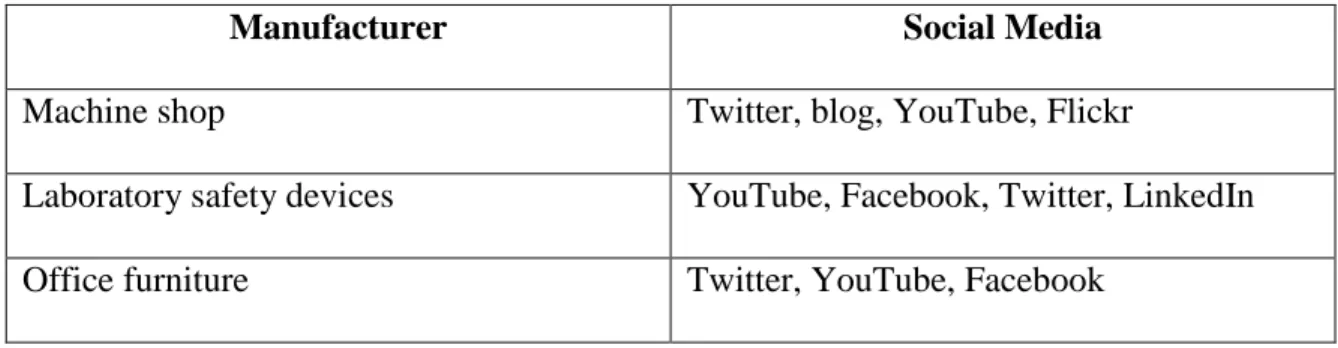
TABLE 3 Social media site breakdown
Manufacturer Social Media
Machine shop Twitter, blog, YouTube, Flickr
Laboratory safety devices YouTube, Facebook, Twitter, LinkedIn
Of the three manufacturers either currently using or in the process of using social media, all use Twitter and YouTube. Two use Facebook, and one uses Flickr. Only one manufacturer has a blog. Their reasons for implementing social media are similar: to increase awareness of their company, products and capabilities. The respondent from the machine shop takes pictures and short videos of the items being fabricated and posts them to Twitter, Flickr and YouTube as well as the blog. His company‘s foray into social media was initiated by the challenge to market their capabilities. The office furniture manufacturer in the process of implementing social media explained that all of their products move and that being able to take and post videos of how their products work will ―speak volumes.‖ The medical device manufacturer noted that trade show
attendance, a primary marketing method for them, was dropping because of the Internet, and social media became necessary to drive visits to their website and push their
message. The machine shop respondent also listed making contacts he wouldn‘t
otherwise make and the ability to do research as other reasons for using social media. Also, it‘s fun!
The two manufacturers currently using social media had success stories to share. The machine shop has obtained out-of-state business through the company‘s Twitter account; thanks to a humorous Dos and Don‘t video, the laboratory device manufacturer
discovered that it had increased brand recognition for the company at a trade show he attended. They both take full credit for initiating their companies‘ social media presences but dealt with skepticism. The machine shop‘s owner was skeptical but has become more
that his bosses are not completely sold yet. Twitter has been less successful for him and the company executives want him to kill off the account, but he won‘t because it is a
good way to share links and drive traffic to their website though he did not provide statistics on this outcome.
Three of the four manufacturers not using social media listed the owners and their demographic as the main reason they don‘t use social media with comments like ―old school attitudes‖, ―not their demographic‖ and ―generational differences in understanding smart tools.‖ One of the three was the president of his company and admitted that he had
never thought it was appropriate. The 4th manufacturer listed resource constraints in terms of personnel and time but not financial as his primary reason for not using social media. Interestingly, 2 of the 4 manufacturers told me that they were now thinking about using social media after their interview with me.
Six of the seven manufacturers use social media in their personal lives. Five use LinkedIn and 4 use Facebook though all 4 noted that their Facebook use is sporadic. Only one has a personal Twitter account that he doesn‘t update often, mainly because he
uses social media for work. The machine shop respondent does not have a personal Twitter account but tries to make the company account more personal because he thinks ―company accounts are boring if not personalized.‖ The furniture manufacturer in the
process of implementing social media attributed his family‘s use of Facebook as inspiring him to use it for his business when he received a call from his mother asking about an event his daughter posted on her Facebook page that he didn‘t have details on yet; as a
social media confessed that he is ignorant of how to use it and doesn‘t want to embarrass
himself.
TABLE 4 Professional versus personal use of social media and how each tool is used Manufacturer Professional Social
media
Personal social media
Usage/Approaches Machine shop Twitter, blog,
YouTube, Flickr
Facebook, LinkedIn Posts and tweets pictures/videos of fabricated items; tries to make corporate accounts more personal
Machine shop Facebook, LinkedIn Participates in
groups Laboratory safety devices YouTube, Facebook, Twitter, LinkedIn
LinkedIn, Twitter Videos on YouTube as well as links and articles on
Facebook, Twitter and LinkedIn to drive traffic to site. Office furniture YouTube,
Facebook, LinkedIn
Facebook Inspired to
implement social media for business after personal experience; wants to use Twitter for getting real-time info to sales force; Faceboook for interacting with customers; YouTube for demonstrating his products. Luxury home furnishings
Facebook Doesn‘t keep
Facebook updated Contract wire
manufacturer
None Embarrassed by his
ignorance but his family uses Facebook
LinkedIn usage is thought-provoking. Only one of the manufacturers using social media has a company profile on LinkedIn, but it became clear that he and two others respondents were using it for marketing through their personal profiles. The other manufacturer using social media uses his LinkedIn profile to list the capabilities of his company and has linked the company‘s blog, Twitter and Flickr accounts to his profile.
The manufacturer whose company does not use social media is personally active in several LinkedIn groups and has had success, stating he has been able to ―connect and reconnect with customers.‖ His company is currently working on projects with 2
LinkedIn connections. The manufacturer in the process of implementing social media doesn‘t think LinkedIn is useful for marketing and is ―more for hiring and recruiting.‖
When asked what they thought about larger NC manufacturers such as Cree, Caterpillar and Glen Raven using social media, the overwhelming response was curiosity. Two manufacturers not using social media wondered how they did it. Commented one:
How are they doing it? How does a company like Cree use it to create excitement about their product? Cree is not a consumer product like Caterpillar is.
The other manufacturer commented that he‘d love ―to see what they are doing and how effective it is. See some numbers on results.‖ One of the manufacturers currently using
social media wondered how personalized the messages coming from the larger manufacturers are, stating ―it‘s a turn off if it is not personal and two-way communication.‖ Three other manufacturers felt that it legitimized social media usage.
The manufacturer in the process of implementing social media commented, ―they have marketing prowess. They have probably given it lots of forethought and study‖ while the
could provide a good model on how to use social media for the smaller ones and that small manufacturers shouldn‘t be intimidated by the larger ones.
When asked what it would take for their company to begin using social media, all four manufacturers wanted more information. One of the three wanted examples and a plan, wondering how a manufacturer interacts with potential clients: ―is it truly interaction or just pushing?‖ Another one wondered if social media could be helpful
because manufacturers are starting to approach their end user as a way of increasing profits and cutting out intermediaries. By not using social media, his company ―might be missing an opportunity‖ to get to their end user. The third was the most skeptical, stating he‘d need to see results or customers demanding it and doesn‘t think his customers want anything other than ―good parts in a timely manner.‖ The fourth was unsure about the
costs involved.
TABLE 5 Concerns/needs voiced by manufacturers to the question what it would take to convert them to using social media in their business.
Manufacturer Concerns/Needs
Machine shop Need to see results or customers
demanding it
Plastics molder Unsure about costs
Luxury home furnishings Wondering if SM could be helpful. Manufacturers starting to get to end-user to increase sales; might be missing an opportunity
Contract wire manufacturer Some examples and a plan on how to use it-how a manufacturer interacts with potential customers. Is it truly interaction or just pushing?
said he would emphasize how easy it is to use social media and urge them to try it and get a feel for it. Also, ―follow us and use us as a learning tool.‖ Another respondent would give them data and information about the company‘s experience. The manufacturer in
the process of implementing social media commented:
I would tell them about the benefit of instantaneous transmission of information. These days, you need to be able to turn on a dime and be nimble.
Moreover, his company is thriving in a volatile market because they have the ability to customize or modify their product for the customer‘s needs, noting that agility is an
advantage for the smaller manufacturer who can adjust more quickly than a larger one. In order to survive, small manufacturers must listen to the market and modify their manufacturing accordingly; in his opinion, social media will help that.
Marketing Challenges
While the economy is certainly a challenge for the 7 manufacturers interviewed, especially for the luxury home product manufacturer, their primary marketing challenge is finding customers. One explained that they have 2 major customers and dozens of smaller ones and need to find one more, large customer to provide stability for the company but is unsure how to find that client. His company needs only one opportunity with a customer because they then develop a good relationship and become their exclusive provider; they typically obtain customers because a supplier screwed up on delivery or quality, but they don‘t know how to identify such opportunities. Another
easily do so. He isn‘t sure how social media would fit in with that: ―this industry is very
hands-on. You need to produce it first.‖ The manufacturer implementing social media expressed that their primary challenge is the ability to get clear, concise information to the customer about their product and how their product can help them. They rely heavily on WOM; the problem is adding a catalyst to it to speed it up, and he thinks social media can help with that.
In addition to the challenge of finding customers, two manufacturers mentioned innovation and new product development. One of the manufacturers using social media noted they needed to develop a niche product that would help strengthen their business. The other, a manufacturer of a niche product, noted that in this economy, one of the only things they can control is what they make and sell and that they need to keep ahead of the market and produce new things.
Discussion
Overall, my research corroborates previous research conducted into the marketing methods by the SME. Though the 7 interviewed manufacturers support the contention that SME marketing lacks structure and finesse, their awareness of their market, emphasis on their customers and relationships with them and goal to improve brand awareness demonstrates that they do understand and use key marketing principles, suggesting that as Brooksbank, Kirby, Thompson and Taylor (2003) conclude, SME marketing may be less understood than poorly done. The manufacturers‘ responses to the questions about
keeping up with competitors. There may be a connection between social media usage and participation in networks: one of the manufacturers currently using social media and the manufacturer in the process of implementing social media actively network. The other manufacturer using social media wasn‘t against in-person networking; he had time
constraints due to his commute to work.
All 7 manufacturers have websites, indicating they are aware of the necessity of having some sort of Internet presence. Even though all of the manufacturers used more than one method to market their business, the website was the first method mentioned in almost all cases and the primary marketing method with any marketing collateral created being placed on the website instead of printed and mailed. While all 7 manufacturers emphasized the importance of relationships to their business, only the ones using social media included in-person marketing methods along with the online methods. As well the ones using or in the process of using social media had an extremely diverse mix of marketing methods, using any method they could including print, online and in person, possibly suggesting a greater marketing sophistication than the other 5 manufacturers.
in terms of cost—were not an issue. If constraints were mentioned, it was in terms of time. The company‘s owners and their demographics were major influences on social
media adoption, however; for the companies not using social media to adopt it, someone within the company will need to champion it and convince the owners as has been done by the two manufacturers currently using social media.
I also formed the impression that at least 2 of the manufacturers not using social media could be converted fairly easily if they received training, mentors and examples for how it could be used. For example, two of the manufacturers not using social media indicated they had a need to identify new clients but weren‘t sure how to go about it.
They also mentioned that they especially wanted to target start-ups. There are a lot of start-ups and organizations nurturing start ups on Twitter and with a little research, it would be fairly easy to build that base.
The manufacturers provided different perceptions towards various social media platforms, especially Facebook, perceptions that could have implications on Facebook‘s
attempt to become entrenched as a business network. One stated that Facebook was not business-oriented. Another considered Facebook to be more consumer-oriented versus his business-to-business model. However, the manufacturer in the process of
implementing social media considers Facebook a must have for commercial entities, calling it ―solid gold.‖
Even if they aren‘t using social media for their businesses, a majority of them are using it personally and using it to market, even if they don‘t acknowledge that they are.
personally on LinkedIn and consider it to be a network, yet don‘t consider what they do
on it to be social media marketing, especially in the case of manufacturer who has connected and re-connected with clients and obtained business from it. While it may be years before the majority of manufacturers embrace social media as a viable method of marketing, it speaks to Rick Segal‘s belief that the line between our work and private
lives is evaporating, especially due to the rise of the smart phone: how we access information is no longer dependent on whether we‘re being paid to do so or on our own
time:
(Mobile) has changed the way we talk to business decision-makers. Being at work is no longer a place; it is a state of mind, a kind of continuing oscillation that people are making between their work life and their personal life. I think probably all three of us along the way for years have been saying at the end of the day business-to-business is person-to-person. But I think what's happened is a much more profound change, and that is we no longer contact places of business, we contact individual people (Callahan, 2011).
Ultimately, for these busy manufacturers, their perception and adoption of social media for their companies will be whether social media helps them to obtain business. While my research comprised a very small sample and comprised only two
suggesting that few marketing personnel need not be an impediment. Cost certainly would not be a constraint as monetary investment can be small due to the availability of free tools.
Recommendations for manufacturers
As a result of my research, I propose the following recommendations for small manufacturers considering implementing social media:
Talk to your customers. Ask them what social media sites they use and whether
they use it for purposes other than personal as well as what kind of information they would be interested in seeing.
Research. Do a Google search on how companies are using social media. There
are lots of case studies on how small businesses are using social media. As well, each tool has different advantages and disadvantages depending on what you want to do. If you are interested in researching markets and clients, Twitter is well-suited for that. Facebook is useful for interacting with others and building a community. YouTube is excellent for posting videos and would be a great way to show off your facility and your products.
Pick a platform: Decide which social platform you‘d like to begin with. You don‘t
Identify companies you would like to emulate. For example, the interviews
highlighted that there was a fascination with how Cree used social media because they are innovative and not a consumer product manufacturer. Google the
companies you identify (―Company Name Facebook‖ or ―Company Name Twitter‖ are useful searches) and study how they use social media. Do they post
daily? Do they post links to articles from other sources? How do they interact with other users in these platforms?
Exchange best practices/find a mentor. Discussing social media with other
manufacturers, especially those already using social media could be extremely helpful as you discover viewpoints different from your own and techniques to help you use it successfully.
Think outside the box. The great thing about social media is how it allows you to
Think inside the box. The reality is that though social media is new and shiny
right now, it in fact is not that new conceptually. Word-of-mouth and relationships are crucial for small manufacturers, and the ones I talked to considered them to be major components of their business. Social media is all about relationships and word-of-mouth. While the methods and tools are
different, the desired outcomes and nuances are the same. In other words, don‘t be afraid: you use these techniques every day!
Have fun. Social media is still somewhat like the Wild West. There are best practices but few hard and fast rules. Don‘t be afraid to make mistakes and
experiment.
Recommendations for service providers
Based on the interest the manufacturers displayed toward social media, there are opportunities for organizations that provide services to these companies to add social media services and consulting to their services. Organizations like the NC State University Industrial Extension Service, the Small Business and Technology
Development Center, and the state‘s 58 community colleges currently offer expertise in
organizations could also provide a hub around which these manufacturers could connect, helping them meet each other and exchange best practices.
This research comprised a very small sample of manufacturers, so it is impossible to generalize these findings to the larger population of small manufacturers across North Carolina as well as across the nation. More research needs to be done on the challenges facing small manufacturers, how they market and their attitudes towards social media in order to develop a fuller picture of whether social media would be useful. As well, more research needs to be done on the small manufacturers using social media to discover how they are using it as well as their success stories and negative experiences. Research into the practices of large manufacturers that use social media would be beneficial as well. It is clear that the smaller manufacturers consider the decisions they make to be legitimate and to carry weight, so it is possible that the lessons learned and methods of the larger manufacturers could be useful for smaller manufacturers.
Conclusion
Manufacturing doesn‘t have a glamorous image. Yet, it is vital to our economy
Appendix 1: Interview Questions
Questions about the company‘s marketing strategy
1. Does the company have a defined marketing function? a. If so, could you tell me more about its structure? b. If not, why not?
2. What one word describes marketing in the company? 3. What is the primary marketing goal?
4. How does the company market itself and its products?
5. What marketing methods have been the most successful and why? 6. What or who is the primary influence on how you market?
7. How does the company find out information about the following: a. Competitors
b. New product ideas c. Customer feedback
Questions about the company‘s use of networks and networking 1. Are you a member of any business or professional networks?
a. If so, which ones?
i. What are your primary reasons for networking?
ii. Does information obtained via your networks influence the decisions you make? If so, can you give me an example? b. If not, why not?
2. What role does networking play in marketing the company?
1. Have you heard of social media and the following tools: a. Facebook
b. Twitter c. blogs d. YouTube e. LinkedIn
2. What is your perception of social media? 3. If the company uses social media:
a. What social media sites have been the most successful and why? b. Can you tell me about any success stories?
c. Can you tell me about any negative experiences? d. Why did you start using social media?
4. If the company does not use social media: a. Why not?
5. Do you use social media in your personal life? a. If so, which ones?
i. Why? b. If not, why not?
6. Many companies are using social media to market their businesses, including manufacturers such as Cree, Caterpillar, and Glen Raven. What is your reaction to that information?
7. If you do not currently use social media to market the company, what would it take to change that?
a. If you use social media, what would you say to convince another manufacturer?
8. Does the company block or restrict Internet access, including access to social media sites, for employees?
Overall Challenges
References
Babbie, E. (2002). The Basics of Social Research (3d Edition). Belmont, CA: Wadsworth Barnett, E. (2011, March 15). Twitter breaks ‗1 billion tweets barrier‘on fifth
birthday. The Telegraph. Retrieved from
http://www.telegraph.co.uk/technology/twitter/8383044/Twitter-breaks-one-billion-tweets-barrier-on-fifth-birthday.html
BarNir, A. & Smith, K.A. (2002). Interfirm alliances in the small business: the role of social networks. Journal of Small Business Management, 40(3), 219-32. Bhardaway, A.S. (2000). A recourse based perspective on information technology
capability and firm performance: an empirical investigation. Management Information Systems Quarterly, 24(1).
Bentley, J. (2003, April). Manufacturing success stories. Manufacturing Engineer, 32-35. Berthon, P., Ewing, M., & Napoli, J. (2008). Brand management in small to medium-
sized enterprises. Journal of Small Business Management, 46(1). 27-45. Boase, J. (2008). Personal networks and the personal communication system: using
multiple media to connect. Information, Communication and Society, 11(4), 490-508.
Bonds-Raacke, J., & Raacke, J. (2010). Myspace and facebook: Identifying dimensions of uses and gratifications for friend networking sites. Individual Differences Research, 8(1), 27-33.
Bouchard, G. (2011, January 6). Using social media to boost search rankings. Retrieved from http://searchenginewatch.com/article/2066470/Using-Social-Media-to-Boost-Search-Rankings
Brooksbank, R.W., Kirby, D.A., Thompson, G., & Taylor, D. (2003). Marketing as a determinant of long-run competitive success in medium-sized UK manufacturing firms. Small Business Economics, 20, 259-272.
knowledge transfer in small businesses. Journal of Small Business and Enterprise Development, 14(2), 280-293.
Callahan, S. (2011, January 17). Us b2b marketing really obsolete? BtoB Magazine.Retrieved from
http://www.btobonline.com/article/20110117/FREE/301179978/is-b-to-b-marketing-really-obsolete
Cao, J., Knotts, T., Xu, J. & Chau, M. (2009). Word of mouth marketing through online social networks. Americas Conference on Information Systems 2009 Proceedings. Paper 291. San Francisco, CA.
Carson, D. (1990). Some exploratory models for assessing small firms‘ marketing performance. European Journal of Marketing, 24.
Chapell, C., Feindt, S. & Jeffcoate, J. (2002). Best practice in SME adoption of e-commerce: benchmarking. An International Journal, 9(2), 122-132. Constantinides, E. (2008). The Web 2.0 as marketing tool: opportunities for SMEs.
16th Annual High Technology Small Firms Conference, HTSF 2008, 21-23 May 2008, Enschede, The Netherlands. Retrieved from http://doc.utwente.nl/73741/
Coviello, N.E., Brodie, R.J., & Munro, H.J. (2000). An investigation of marketing practice by firm size. Journal of Business Venturing, 15, 523-545.
Chua, A., Deans, K., & Parker, C. (2009). Exploring the types of SMEs which could use blogs as a marketing tool: a proposed future research agenda.
Australasian Journal of Information Systems, 16(1), 117-136.
Darch, H. & Lucas, T. (2002). Training as an e-commerce enabler. Journal of Workplace Learning, 14(4), 148-155.
Dean, J., Holmes, S. & Smith, S. (1997). Understanding business networks: evidence from the manufacturing and service sectors in Australia. Journal of Small Business Management, 35, 78-84.
Docherty, A.J. & Simpson, M. (2003). In cyberspace, no one can hear you scream: e-commerce support and advice for UK SMEs. Proceedings of the 26th ISBA National Small Firms Policy and Research Conference, UK.
Ellis, R.M. (2010). Understanding small business networking and ICTs: exploring face-to-face and ICT-related opportunity creation mediated by social capital in East of England micro-businesses. Centre for Research in Economic Sociology and Innovation (CRESI) Working Paper 2010-01, University of Essex: Colchester
Academy of Management Journal, 26, 27-44. Facebook. (2011). Statistics. Retrieved from
http://www.facebook.com/press/info.php?statistics
Fauser, S., Wiedenhofer, J. & Lorenz, M. (2011). “Touchpoint social web”: an
explorative study about using the social web for influencing high involvement
purchase decisions. Problems and Perspectives in Management, 9(1), 39-45.
Fillis, I. & Wagner, B. (2005). E-business development: an exploratory investigation of the small firm. International Small Business Journal, 23(6), 604-634.
Gibbs, S., Sequeira, J. & White, M.M.. (2007). Social networks and technology adoption in small business. International Journal of Globalisation and Small Business, 2(1), 66-87.
Gilmore, A., Carson, D., & Grant, K. (2001). SME marketing in practice. Marketing Intelligence and Planning, 19(1), 6-11.
Gilmore, A., Carson, D., & Rocks, S. (2006). Networking in SMEs: evaluation its contribution to marketing activity. International Business Review, 15, 278-293. Gilmore, A., Gallagher, D., & Henry, S. (2007). E-marketing and SMEs: operational
lessons for the future. European Business Review, 19(3), 234-247.
GlobalSpec, Inc. (2011). Understanding the industrial buy cycle: how to align your marketing with your customers‘ buying process. Retrieved from
http://www.globalspec.com/wp/WP_BuyCycle_Maven
Granovetter, M. (1973). The strength of weak ties. The American Journal of Sociology, 78(6), 1360-1380.
Harris, L. & Rae, A. (2009). Social networks: the future of marketing for small business. Journal of Business Strategy, 30(5), 24-31.
Haythornthwaite, C. (2002). Strong, weak and latent ties and the impact of new Media. The Information Society, 18(5), 385-401.
Hennig-Thurau, T., Gwinner, K.P., Walsh, G., & Gremle, D.D. (2004). Electronic word-of-mouth via consumer-opinion platforms: What motivates consumers to
articulate themselves on the Internet? Journal of Interactive Marketing, 18(1), 38–52.
Jansen, B., Zhang, M., Sobel, K., & Chowdury, A. (2009). Twitter power: tweets as electronic word of mouth. Journal of the American Society for Information Science and Technology, 60(11), 2169-2188.
Java, A., Song, X., Finin, T., & Tseng, B. (2007). Why we Twitter: an analysis of a Microblogging community. Advances in Web Mining and Web Usage Analysis: Lecture Notes in Computer Science. Berlin, DE: Springer
Jones, C., Hecker, R., & Holland, P. (2003). Small firm Internet adoption: opportunities forgone, a journey not begun. Journal of Small Business and Enterprise
Development, 10(3), 287-98.
Kim, K., Knotts, T., & Jones, S. (2008). Characterizing viability of small manufacturing Enterprises (SME) in the market. Expert Systems with Applications, 34, 128-134. Lodico, J. (2010, May 24 ). The fastest way to increase your Google ranking.
Retrieved from http://www.socialmediaexaminer.com/the-fastest-way-to-increase-your-google-ranking/
Lynn, G.S., Maltz, A.C., Jurkat, P.M. & Hammer, M.D. (1999). New media in marketing Redefine competitive advantage: a comparison of small and large firms. The Journal of Services Marketing, 13(1), 9-20.
Martin, L. & Matlay, H. (2001). Blanket approaches to promoting ICT in small firms: some lessons from the DTI ladder adoption model in the UK. Internet Research: Electronic Networking Applications and Policy, 11(5), 399-410.
National Association of Manufacturers. (2006). The future success of small and medium Manufacturers: challenges and policy issues. Retrieved from
http://institute.nam.org/view/2001005257730793436/info
NC State University IES. (2011). Manufacturing Matters. Retrieved from http://www.ies.ncsu.edu/ncmanufacturing
O‘Donnell, A., Gilmore, A., Carson, D. & Cummins, D. (2002). Competitive advantage in small to medium-sized enterprises. Journal of Strategic Marketing, 10, 205-223.
Pacitto, J.-C., Julien, P.-A. & Bizeul, P. (2006). Marketing in the medium-sized
manufacturing firms: the state-of-the-art in France and in Quebec. International Entrepreneurial Management Journal, 3, 29-50.
Patton, M.Q. (2002). Qualitative Research and Evaluation Methods. Thousand Oaks, CA: Sage.
Pelham, A. (2000).Market orientation and other potential influences on performance in small and medium-sized manufacturing firms. Journal of Small Business Management, 38, 48-67.
Qualman, E. (2011). 100 million on LinkedIn – Infographic by country. Retrieved from h ttp://www.socialnomics.net/2011/03/28/linkedin-hits-100-million-breakdown-by-country-graphic/
Rodgers, J., Yen, D. & Chou, D. (2002). Developing e-business: a strategic approach. Information Management & Computer Security, 10(4), 184-192.
Rui, H., Liu, Y., & Whinston, A. (2010). Chatter matters: how Twitter can open the black box of online word-of-mouth. ICIS 2010 Proceedings. Paper 204. Simmons, G., Armstrong, G., & Durkin, M. (2008). A conceptualization of the
determinants of small business website adoption: setting the research agenda. International Small Business Journal, 26(3), 351-389. Stelzner, M. (2011, April). 2011 Social media marketing industry report.
Retrieved from http://www.socialmediaexaminer.com/social-media-marketing-industry-report-2011/
ThomasNet. (2009). August 2009 Industrial Purchasing Barometer Survey, 5(8). The Industrial Marketer. Retrieved from
http://www.thomasnet.com/industrial-marketer/Detailed_product_information.html
Thong, J.Y.L. & Yap, C.S. (1995). CEO characteristics, organizational characteristics and information technology adoption in small businesses. Omega, 23(4), 429-443.
Trusov, M., Bucklin, R.E., & Pauwels, K. (2009). Effects of word-of-mouth versus traditional marketing: findings from an Internet social networking site. Journal of Marketing (73), 90-102.
U.S. Small Business Administration. (n.d.). Summary of size standards by industry. Retrieved from http://www.sba.gov/content/summary-size-standards-industry. Van Akkeren, J.M. & Cavaye, A.L.M. (1999). Factors affecting entry level Internet
adoption by SMEs: an empirical study. Proceedings from the Australasian Conference on Information Systems, 2, 1716-1728.
Retrieved from http://www.marketwatch.com/story/watch-exports-to-gauge-recovery-2010-01-25
Walsh, M. & Lipinski, J. (2009). The role of the marketing function in small and medium sized enterprises. Journal of Small Business and Enterprise Development, 16(4), 569-585.
Watson, J. (2006). Modeling the relationship between networking and firm performance. Journal of Business Venturing, 22, 852-874.
Zhao, D. & Rosson, M.B. (2009). How and why people Twitter: the role that micro-blogging plays in informal communication at work. Proceedings of the ACM 2009 international conference on supporting group work. Sanibel Island, FL. Zineldan, M. (2000). Beyond relationship marketing: technologicalship marketing.