Shay A. Beezley. Dare to be ‗Deweyless‘: An Evaluation of BISAC-based Headings in Public Libraries. A Master‘s Paper for the M.S. in L.S degree. July, 2011.41pages. Advisor: Jane Greenberg
Since 2007, a handful of public libraries across the United States have replaced Dewey Decimal Classification with a ―bookstore arrangement‖ in order to meet the needs of users who have demonstrated browsing preferences. This paper looks at the
implementation of BISAC-based headings used to arrange the collections at the Maricopa Library District in Arizona, the Rangeview Library District in Colorado, and the
Frankfort Public Library District in Illinois. A multi-methods approach was employed: 1.) a content analysis was conducted to analyze the availability and characteristics of BISAC headings and to provide a sample of headings taken from the online catalogs of the three aforementioned library districts, and 2.) an evaluative survey was distributed for participants to evaluate the BISAC-based headings. The fifteen participants, a mix of both users and librarians, indicated that they favored headings that were more specific, however, there is a need for continued research on the use of BISAC headings to arrange the collections of public libraries.
Headings:
Public Libraries / Classification. BISAC Subject Headings.
Shelving of books, periodicals, etc. Rangeview Library District.
Frankfort Public Library District.
by
Shay A. Beezley
A Master‘s paper submitted to the faculty of the School of Information and Library Science of the University of North Carolina at Chapel Hill
in partial fulfillment of the requirements for the degree of Master of Science in
Library Science.
Chapel Hill, North Carolina July 2011
Approved by
Acknowledgements
Table of Contents
1. Introduction ...4
2. Literature Review ...7
2.1 Meeting User Needs ...8
2.2 Saying ‗No‘ to Dewey ...9
2.3 Response to the Implementation of Bookstore Arrangement ... 12
2.5 Summary of Literature Review ... 15
3. Research Goals... 16
4. Methodology... 17
4.1 General Description of Methods ... 17
4.2 Description of Content Analysis ... 17
4.3 Description of Survey Instrument and Procedures ... 18
4.4 Participants ... 18
5. Findings ... 20
5.1 Availability of ‗Pure‘ BISAC Headings ... 20
5.2 Finding BISAC-based Headings... 21
5.3 Identified Headings for Survey... 23
5.4 Overall Response to Survey ... 24
5.5 User Response ... 25
5.6 Librarian Response ... 26
5.7 Overall opinions of BISAC-based headings ... 27
6. Discussion ... 29
6.1 Preference for Specific Headings ... 29
6.2 Differences between participant groups ... 30
6.3 Neutral Response ... 31
6.4 Limitations ... 31
7. Conclusion and possibilities for future research ... 33
Appendix A: Survey Instrument ... 34
Appendix B: Recruiting Email and Social Networking Announcements ... 37
List of Tables and Figures
Figure 1: Headings for Audacity of hope: thoughts on reclaiming the American dream..22
Figure 2: Bicycle diaries in a Dewey branch and a ―Deweyless‖ branch…………...22
Figure 3: Overall response indicates preference for headings from Library 2…………..24
Figure 4: Users prefer Library 2 headings but think ―any of the headings‖ suffice…..…25
Figure 5: Librarians indicate a clear preference for headings from Library 2…………...26
Table 1: Headings used in survey………..………23
Table 2: Users‘ rationale for headings deemed unsuitable………25
Table 3: Librarians‘ rationale for headings deemed unsuitable………...27
1. Introduction
Melville Dewey just may be rolling over in his grave: a handful of public libraries across the United States have replaced Dewey Decimal Classification (DDC) in favor of arrangements similar to bookstores. These decisions have generated attention from other libraries and media outlets across the United States as DDC is the most widely-used classification scheme throughout the world . No longer are materials grouped together by call numbers at these ―Deweyless‖ libraries as materials are arranged according to an assigned general subject heading. Within each subject area, materials are shelved alphabetically by title or author‘s last name instead of call numbers. The foundation for bookstore arrangement is the Book Industries Standards and Communications (BISAC) list of headings, which is maintained by the Book Industry Study Group (BISG). Consisting of fifty-two general headings with different levels of specificity, these headings have been in use in the publishing industry for a myriad of purposes, the most notable being the descriptors for signage in bookstores (Fister, 2009; Whelan, 2007).
In 2007, the Maricopa County Library District (Maricopa) opened the Perry Branch, which was the first public library to be entirely ―Deweyless‖ (Lynch and Mulero, 2007). As the Perry Branch proved to be a success, Maricopa continued to open
The Rangeview Library District (Rangeview) announced its decision in 2009 to reclassify its collections with a word-based system with roots in BISAC dubbed ―Wordthink‖ (Rangeview Library District, 2009). While other libraries have expressed in interest in adapting similar arrangement, these library districts have garnered the most attention in this small but steady movement towards implementing bookstore arrangement in public collections (Courtright, 2010; Fister, 2009; Lavallee, 2007; Lynch and Mulero, 2007; Oder, 2010a; Rice, 2009).
Maricopa set the bar for using BISAC headings as a basis for a bookstore arrangement. When the Perry Branch made the initial conversion to a ―Deweyless‖ collection, it was decided that these BISAC headings would be used as a reference
because they are fairly simplistic; thus, they would fulfill the goal of facilitating browsing of the collection. None of these libraries actually use ―pure‖ BISAC as the headings were modified to fit the collections. Pam Sandlian Smith, Rangeview director, says that
―Wordthink‖ is simply an adaptation of BISAC headings, as the headings been molded to fit the needs of the collection and its users (Cohen, 2011). Out of three library districts, Frankfort worked towards creating an original taxonomy but still used BISAC as a reference when in need (Rice, 2009).
These conversions to a bookstore arrangement generated attention across the United States, in both local news outlets and national news outlets, including the New York Times and the Wall Street Journal (Lavallee, 2007; Lynch and Mulero, 2007).
DDC with a bookstore arrangement, it does not appear that much research has been done on the BISAC-based headings used in these collections (Fister, 2009). In order to fill this dearth in research, this paper will seek to answer the following question: what BISAC-based headings are currently available, how do they differ, and which are preferred by
both users and librarians? These questions will be examined through the lens of the
experiences of the Maricopa Library District in Arizona, the Frankfort Public Library District in Illinois, and the Rangeview Library District in Colorado.
2. Literature Review
There is little research on completely replacing DDC with a ―bookstore arrangement.‖ One possible reason for this dearth is that these decisions are still fairly recent, so there simply has not been that great of a response yet. The small amount of literature available on alternative classification schemes and arrangements in public libraries demonstrate that these ―Deweyless‖ libraries were not alone in their desire to find non-traditional methods of arranging their collections. However, this area of literature encompassed public libraries‘ attempts to rearrange their fiction collections while leaving nonfiction still classed in DDC (Maker, 2008; Maker, 2009; Sapiie, 1995). Sapiie (1995) states that there are four primary reasons why libraries would opt for alternative methods of classification and/or arrangement:
1. A desire to meet the needs of the users
2. A stated dissatisfaction with the classification system
3. As an experiment
4. Changes in circumstances provides an opportunity for a fresh look at
the library, its use, and services
2.1 Meeting User Needs
At the heart of the issue, the ultimate reason for adopting a bookstore arrangement in these libraries was to facilitate browsing for users. When Maricopa sent out a survey to its user population, the consensus they received was that users wanted to be able to browse the collection easily (Lynch and Mulero, 2007). In an article in the New York Times, Henry Courtright, Maricopa director, states, ―The younger generation today is
wired differently than people in my generation…what that tells me is we as librarians have to look at how we present materials that we have for them the way they want it‖ (Lynch and Mulero, 2007). The goal for improved browsing also appeared in Frankfort‘s mission statement for the ―Dewey Free‖ project: ―We aim to assist and empower patrons by reclassifying nonfiction collections in hopes of increasing browsability and thus accessibility without sacrificing individual item retrieval‖ (Frankfort Public Library District, 2008.)
mind‖ (Rice, 2009). The research group provided Frankfort with a visual map of low and high areas of usage, and it was this map that revealed the nonfiction collections were the least used in the library. It was decided that finding a way to rearrange the collection in order to improve browsing would make these sections accessible and more frequently used.
2.2 Saying ‘No’ to Dewey
It would be safe to say that these decisions have generated attention because DDC is the most widely-used classification scheme in public libraries. Sapiie‘s (1995) article addressed the implementation of partial alternative arrangements in public libraries, however, she noted that it was rare for a public library to stop using DDC completely. In the case of Maricopa‘s Perry Branch, the opening of such a public library was the first in the United States (Lynch and Mulero, 2007). Maricopa is not entirely ―Deweyless,‖ as opening and converting to these branches has been an ongoing process and there are still branches that utilize DDC. While Maricopa can boast that it opened the first ―Deweyless‖ branch in the United States, it is Rangeview that holds the honor of being the first library district to have all of its branches be entirely ―Deweyless‖ (Oder, 2009).
Darien Library, argues that abandoning DDC would completely ignore the users who seek specific titles. She was quoted as saying ―Dewey is great for grab-and-goers, and we didn‘t want to lose that‖ (Fister, 2009, p. 25). The Darien Library was not alone as it has been reported that other libraries in Florida and Tennessee have been experimenting with a DDC/BISAC ―mashup‖ (Fister, 2009; Casey and Stephen, 2009). While ―mashing‖ DDC with BISAC headings would have certainly been an option for Maricopa, Frankfort, and Rangeview, it seems that the lack of call numbers that has made these libraries‘ decisions truly remarkable.
In an article that discussed the implementation of a ―Deweyless‖ arrangement in an Australian public library, Hopkins (2007) states that library users do not want
obstacles between them and their desired information. In this case, the obstacle would be the ―confusing‖ call numbers. Hopkins (2007) astutely notes that while looking up a call number in the catalog and finding the number on the shelf may make sense to librarians, it is not always the case for patrons, who can encounter ―information overload‖
depending on the size of the collection. Casey and Stephen (2009) concur with Hopkins‘ ideas and state that ―today‘s busy, working adults‖ want to be able to peruse a collection of popular materials rather than spend time attempting to figure out DDC.
The ―confusing‖ call numbers are not the only limitation that users claim to encounter. Often, the manner in which materials are separated perplexes users, and they may also find it to be frustrating when similar materials are located in entirely different sections of the library. These bookstore arrangements are designed to pair complementary subject areas that would otherwise be separated in DDC. A common example would be the sections on travel and foreign languages (Fister, 2009). Even though DDC would place these sections far from the other, it is perfectly logical for them to be located close to another in a bookstore arrangement, granted that patrons browsing for materials on international travel would likely need materials on foreign languages as well. At
Sapiie (1995) states that reclassifying and rearranging a collection can cause someone to look at the collection in a whole new manner. Echoing this assertion, Smith (Rangeview) says, ―WordThink allows library staff the freedom and creativity to develop collocation relationships that could never happen in Dewey. [It] allows staff to anticipate customers‘ inquiries and shelve items that have natural affinities‖ (Casey and Stephen, 2009). Rice (2009) echoes this idea as she claims that the bookstore arrangement
impacted Frankfort staff as it allowed more freedom in determining the location of a book and the opportunity to see the collection from the patron‘s point of view.
2.3 Response to the Implementation of Bookstore Arrangement
These decisions to implement bookstore arrangement have not gone ignored. Both positive and negative reactions have been reported by Lynch and Mulero (2007), Kenney (2007), Fister (2009), and Whelan (2007). Most significantly, the patrons‘ responses to these experiments in bookstore arrangement have been positive. This positivity is not measured by comments from patrons to employees at these librarians as the tangible evidence that these rearrangements had a dramatic effect on the patrons was the drastic increase in circulation. All three library districts reported that their circulation statistics went up after implementation of bookstore arrangement (Rice, 2009; Whelan, 2007; Oder, 2010b). At the opening of Maricopa‘s Perry Branch, patrons did not seem disturbed by the lack of call numbers. Whelan (2007) quotes Shore (Maricopa) as saying, ―[The patrons] didn‘t notice the difference. Nobody said, ‗what happened to my Dewey?‖ (p. 14). The patrons‘ inobservance of the change at the Perry Branch is especially
materials within each category prior to the branch‘s grand opening. Alphabetization was a process that was completed eventually.
The library community seems mixed with opinions over whether or not it is useful to replace DDC with a bookstore arrangement. Shore (Maricopa) expressed that the outrage from the library community was ―shocking‖ (Kenney, 2007). Some librarians have expressed their bafflement over the replacement of DDC. For example, one librarian was quoted as saying, ―Just the idea of this is totally, outrageously ridiculous…How can you change a system—a workable, understandable system—where you can walk in any library right around the world and find the right book at the right address on the shelf?‖ (Whelan, 2007). The New York Times article noted that some librarians referred to the initial implementation of bookstore arrangement at the Perry Branch as heretical or ―idiotic‖ (Lynch and Mulero, 2007).
categories support random browsing, but make targeted browsing (i.e., looking for works on a narrow, specific topic) difficult and finding a known item an exercise in frustration.‖
More interestingly, there was some concern over the fact that these libraries are looking to the retail world as a model. Given that the public library is a non-profit institution compared to the for-profit nature of a bookstore, it would appear that borrowing from a bookstore‘s model is inconsistent with the purpose of the library (Fister, 2009; Brisco, 2004). Rice (2009) responded to this notion that a ―Deweyless‖ library is simply utilizing ―elements‖ of the retail model in order to improve a user‘s experience when s/he browses the collection. The retail aspect is irrelevant because the a ―Deweyless‖ library is taking what users want when they go to a bookstore: ―enjoying the browsability of materials and utilizing [the] space to gather with friends and colleagues‖ (p. 15).
libraries have responded the needs of the communities that they serve in order to fulfill their purpose.
2.5 Summary of Literature Review
The articles available on these conversions to BISAC-based headings
3. Research Goals
The literature review demonstrated that the implementation of bookstore arrangement at these libraries was to meet user needs as well as showing that little research has been conducted in regard to ―Deweyless‖ libraries. With the purpose of meeting user needs in mind and contributing to research, the goal of this study was to identify BISAC-based headings used in ―Deweyless‖ libraries, to determine any
4. Methodology
4.1 General Description of Methods
This study employed a mixed-methods approach of a content analysis and a survey. The content analysis will detail the availability of BISAC-based headings and their characteristics. A set of criteria for finding headings to use in the survey was created using the content analysis (see Appendix A for survey). In order to gather user and
librarian perceptions of BISAC-based headings, a survey using the identified headings was then created and distributed via email and social networking websites (see Appendix B).
4.2 Description of Content Analysis
The first step was to determine the availability of BISAC-based headings and their characteristics. The next step was to analyze the online catalogs of the three library districts to find BISAC-based headings to use for the survey. This analysis included specific title searches and general searches within each library district‘s catalog. Specific title searches were made using the New York Times Best Sellers List and Library Journal in order to find books that were available in at least two of the three library districts. The goal of this analysis was to identify headings that could be used for the survey. Initial searching within each catalog allowed for the creation of a set of criteria to be used for identifying headings to be included in the survey. The criteria were as follows:
1. Different headings for the same book
With these criteria as a guide, ten sets of headings were identified for inclusion in the survey (see Table 1 in section 4.3).
4.3 Description of Survey Instrument and Procedures
At the beginning of the survey, participants were provided with a brief history of the ―Deweyless‖ libraries and an explanation as to why these libraries have replaced DDC with a bookstore arrangement. After consenting to the survey, participants were presented with ten multiple choice questions. For each multiple choice question in the survey, participants were provided with the title of a book and a link to the sample matter (cover, title page, table of contents, summary, etc.) from either Google Books or
Amazon. With the sample matter to examine, participants were asked to identify which heading that they would look for the book under. They also had the option to say that they would look for the book under any of the headings or that they would not look for the book under any of the provided headings. If selecting the latter option, participants were then prompted to explain why they would not look for the book under any of the headings. At the end of the survey, participants were asked to state whether or not they had formed any opinions about using these headings in lieu of call numbers. For demographic purposes, the participants then were asked to identify themselves as a library school student, library employee, or library user. Although optional, the survey concluded with the opportunity to enter an email address in order to enter a raffle for two $100 VISA gift cards.
4.4 Participants
websites (See Appendix B). Participants did not have to provide any identifying
5. Findings
The following findings will begin with an examination of BISAC headings, as made available through BISG‘s website. Following this examination, the availability of BISAC-based headings in the online catalogs of Frankfort, Maricopa, and Rangeview will be discussed. Then the results of a survey that asked users and librarians to evaluate the BISAC-based headings found in these catalogs will be presented.
5.1 Availability of ‘Pure’ BISAC Headings
BISG makes it easy to access BISAC headings. According to their website, users are allowed to look up BISAC headings; however, they must obtain an end-user license agreement if they wish to download the headings into a local database (Book Industry Group (Major Headings), 2011). The ease of availability of these headings was likely a positive factor in selecting BISAC as a basis for these bookstore arrangements.
Pure BISAC headings consist of major headings and consequent subheadings for more specificity. Examples of major headings include the following:
ANTIQUES & COLLECTIBLES MATHEMATICS
BIOGRAPHY & AUTOBIOGRAPHY NATURE
BODY, MIND, & SPIRIT PERFORMING ARTS
BUSINESS & ECONOMICS PETS
COMICS & GRAPHIC NOVELS PHILOSOPHY
COMPUTERS POETRY
COOKING PSYCHOLOGY
EDUCATION SELF-HELP
FAMILY & RELATIONSHIPS SOCIAL SCIENCE
HISTORY STUDY AIDS
These major headings, as well as others excluded from this sample list, are available online (Book Industry Study Group (Major Headings), 2011). As mentioned in the preceding literature review, pure BISAC headings do not have a hierarchical structure. For instance, it would seem that SOCIAL SCIENCE would encompass headings such as PSYCHOLOGY and HISTORY; however, all three of these headings are separate and have distinct subheadings. There is also no distinction made between topical headings and material headings (graphic novels, biographies, etc).
On the BISG website, each major heading is a link that leads to a page with all the subheadings for each major heading. For example, here is a sample of subheadings for the major heading SELF HELP (Book Industry Study Group (Major Headings), 2011):
SELF HELP / Depression SELF HELP / Dreams
SELF HELP / Personal Growth SELF HELP / Self-Hypnosis SELF HELP / Spiritual
These sample headings are only a small portion of the number of subheadings that the major headings. Subheadings strictly do not have to be a specific topic within the major heading as subheadings of time and/or location also appear (most frequently in
HISTORY) when appropriate.
5.2 Finding BISAC-based Headings
Dewey, 2008). Neither Rangeview nor Maricopa offer sample taxonomies online. While they have modified BISAC headings as seen fit, it seems likely that the taxonomies are not available online because of the copyright and license agreement that BISG has over BISAC headings.
The BISAC-based headings are available in the online catalogs of these library districts. When searching for a specific title, the BISAC-based heading will appear where the call number used to be.
Figure 1: Headings for Audacity of hope: thoughts on reclaiming the American dream
Figure 2: Bicycle diaries in a Dewey branch and a “Deweyless” branch
Although the headings replace the call number in the catalog, it appears that catalog users do not have the option to browse by the BISAC-based heading. Searches through the catalogs for Rangeview, Maricopa, and Frankfort demonstrate that users can search by subject or genre headings but not by the BISAC-based headings. It seems that the only place that users can browse the headings to see the different headings and any
5.3 Identified Headings for Survey
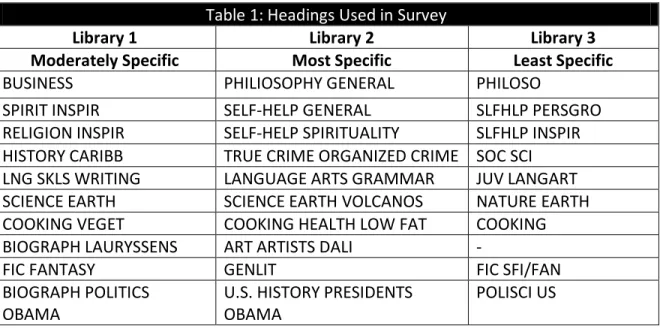
The New York Times Best Seller List and Library Journal were used to find titles that were available in at least two of the three libraries. The creation of this survey revealed that headings for the same book varied slightly from library to library. For the purposes of not pitting the libraries‘ taxonomies against the other, each library district will remain anonymous in the figures and tables.
Table 1: Headings Used in Survey
Library 1 Library 2 Library 3
Moderately Specific Most Specific Least Specific
BUSINESS PHILIOSOPHY GENERAL PHILOSO
SPIRIT INSPIR SELF-HELP GENERAL SLFHLP PERSGRO
RELIGION INSPIR SELF-HELP SPIRITUALITY SLFHLP INSPIR
HISTORY CARIBB TRUE CRIME ORGANIZED CRIME SOC SCI
LNG SKLS WRITING LANGUAGE ARTS GRAMMAR JUV LANGART
SCIENCE EARTH SCIENCE EARTH VOLCANOS NATURE EARTH
COOKING VEGET COOKING HEALTH LOW FAT COOKING
BIOGRAPH LAURYSSENS ART ARTISTS DALI -
FIC FANTASY GENLIT FIC SFI/FAN
BIOGRAPH POLITICS OBAMA
U.S. HISTORY PRESIDENTS OBAMA
POLISCI US
While these headings are similar topically, there are slight differences between them. The headings used by Library 1 (Moderate) demonstrate some attempt of
out full words. ―PERSGRO,‖ for example, presumably stands for PERSONAL GROWTH, a subheading of SELF HELP.
5.4 Overall Response to Survey
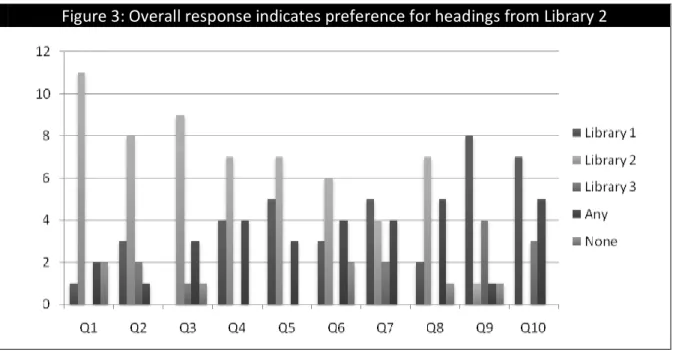
After distributing emails and recruiting via social networking websites, a total of fifteen participants participated in the survey. Eight of these participants were library users while the other seven participants were library affiliated (through employment or as a library school student). The following figure reveals that survey participants explicitly favored the headings from Library 2 (Most). While the headings from Library 2 (Most) are the most preferred, participants expressed some favor for the headings at Library 1 (Moderate) as well. Several participants selected the option that ―I would look for this book under any of these headings‖ several times, and it was only a handful of instances where participants decided they would not look the title under the headings provided.
5.5 User Response
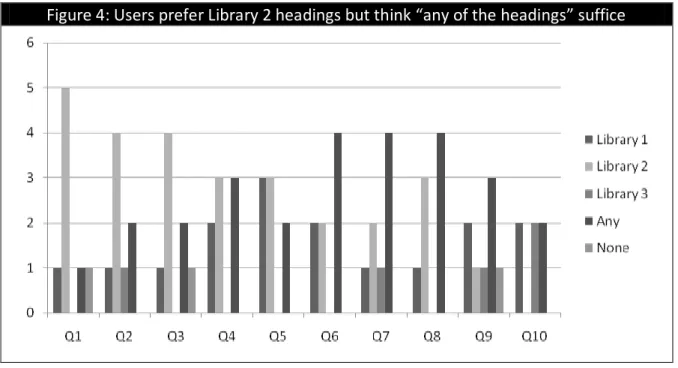
Narrowing down the data specifically to participants who identified themselves as library users reinforced the preference for headings used at Library 2 (Most). Users also demonstrated an indication that the differences between these headings were not of utmost important, due to the fact that they often selected the option, ―I would look for this book under any of these headings.‖
One user demonstrated that s/he did not think any of the headings provided fit the book whose sample matter they examined.
Table 2: Users’ rationale for headings deemed unsuitable
1. A new earth: awakening to your life’s
purpose
a.) RELIGION INSPIR
b.) SELF-HELP SPIRITUALITY
c.) SLFHLP INSPIR
d.) I would look for this book under any of these headings
e.) I would not look for this book under any of these headings
“The book seems more historical in nature”
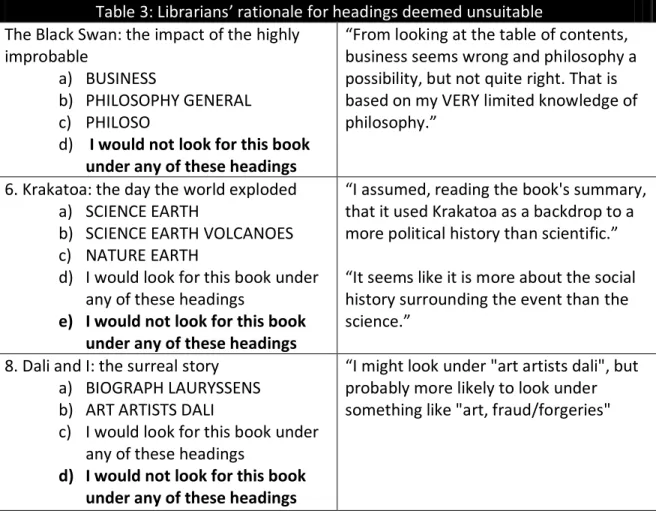
5.6 Librarian Response
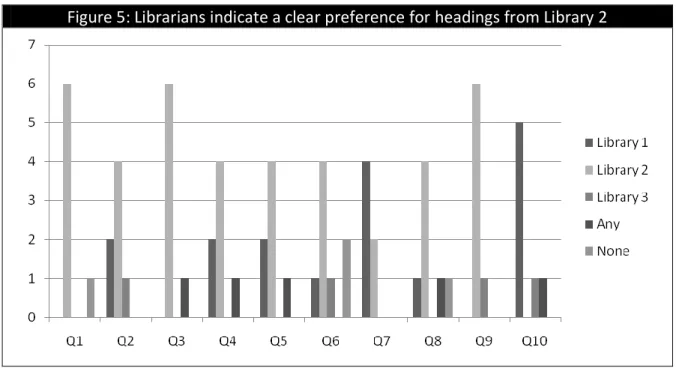
Those participants who identified themselves as library employees or library school students indicated that they greatly preferred the headings from Library 2 (Most) as well
Figure 5: Librarians indicate a clear preference for headings from Library 2
Table 3: Librarians’ rationale for headings deemed unsuitable
1. The Black Swan: the impact of the highly
improbable
a) BUSINESS
b) PHILOSOPHY GENERAL
c) PHILOSO
d) I would not look for this book under any of these headings
“From looking at the table of contents, business seems wrong and philosophy a possibility, but not quite right. That is based on my VERY limited knowledge of philosophy.”
6. Krakatoa: the day the world exploded
a) SCIENCE EARTH
b) SCIENCE EARTH VOLCANOES
c) NATURE EARTH
d) I would look for this book under
any of these headings
e) I would not look for this book under any of these headings
“I assumed, reading the book's summary, that it used Krakatoa as a backdrop to a more political history than scientific.”
“It seems like it is more about the social history surrounding the event than the science.”
8. Dali and I: the surreal story
a) BIOGRAPH LAURYSSENS
b) ART ARTISTS DALI
c) I would look for this book under
any of these headings
d) I would not look for this book under any of these headings
“I might look under "art artists dali", but probably more likely to look under something like "art, fraud/forgeries"
The library affiliated participants demonstrated an emphasis on the seeming disparity between the book whose sample contents they were asked to examine and the actual headings used in the anonymous libraries.
5.7 Overall opinions of BISAC-based headings
Ten out of the fifteen participants responded to the question that asked
Table 4: Participants’ opinions of BISAC-based headings
Positive “I'd be concerned that the subject categories are too broad, but I also think that might be perfect for a public library. It's a very interesting idea!” (Library affiliate)
“For the most part, however, the headings seemed appropriate for the book titles.” (User)
Neutral “I usually look in the catalog to find an area and then browse, so as long as books are logically grouped together, i can find what i want. (browse cookbooks, browse self help, browse sci fi, etc)” (User)
“Peculiar, but more general than one would think.” (User)
“I think that the bookstore style classification would only ever work in a public library whose patrons had little interest in major research. The biggest loss to effective research from adopting these headings would come at the expense of browsing. Maybe I am just not getting the presence of a more refined shelving scheme, but it seems like the headings are quite general and that within these broad categories books' proximity would be based more on author name than subject of the work. I am a little unsure how adopting this practice will benefit libraries, as they'd have to completely revise their catalogs and processing procedures, and relabel their books” (Library affiliate)
“I can see where there could be inconsistencies in some of these subject headings--many of them seem like "good enough" fits, but depending on the size of the library, that could leave the patron wandering around from section to section.” (Library affiliate)
Negative “Yikes.” (Library affiliate)
“For one thing, I found a lot of the abbreviations confusing and ambiguous. There's simply no reason to not spell out full words.” (Library affiliate)
“I found it difficult at times to pick which heading I would group this book under. I think overall it would be hard to classify these books by topics because it would be so varied based on a person's perception and opinion of that book. I think this method would not be a very black and white method of categorizing books” (User)
6. Discussion
6.1 Preference for Specific Headings
The results indicated that both users and librarians preferred the headings found in the online catalog of Library 2. As stated earlier, Library 2 had the most specific headings out of the three libraries. Despite the lack of classification, this finding demonstrates that both users and librarians prefer some level of specificity. This finding seems especially true given that the headings found at Library 3, whose headings were the least specific of the three libraries, were rarely selected by participants. Out of the three libraries, Library 2 (Most), with the one exception of the heading GENLIT, did not use abbreviations in their headings. The lack of abbreviations was a factor in deeming Library 2 to have the most specific headings and certainly a significant aspect to take into consideration as to why participants selected headings from Library 2 the most frequently out of the three libraries.
This disdain for abbreviations should be considered carefully as they can present some problems. One criticism of these word-centric arrangements is that they are not the friendliest for users whose native language is not English, which would negate the user-centric purpose of these kinds of rearrangement projects. Fister (2009) writes ―a system that is entirely based off of English words might inadvertently send the message that the public library is for English speakers only‖ (p. 24). Coupling this criticism with the fact that survey participants who are presumably native English speakers commented that the abbreviations were ambiguous and often confusing is problematic. One participant expressed that it ―took a few extra seconds‖ to figure out an odd abbreviation, especially when the abbreviation combined unrelated words. Although it would be an opportunity for a positive interaction between library personnel and users, how are these libraries to presume that all users would seek out help? Abbreviations may save space on the label or in the catalog field, but it seems that they are not quite the best way to reflect the
headings.
6.2 Differences between participant groups
Within each group of participants, the preference for the headings from Library 2 (Most) was still evident. Librarians almost unilaterally preferred those headings from Library 2 (Most). Justifiably, this finding makes sense as it is likely that librarians, who are trained in classification and subject analysis, would prefer specific headings to
general headings. With this background in subject analysis, librarians also indicated when they did not prefer any of the headings because they did not agree with the topical
Exploded (Appendix A, question 6) because it appeared to be related more to the social
aspects of the event. This issue of whether or not the heading is appropriate topically is valid, but there is only so much that can be said about the disagreement in where a book is placed. This is the nature of classification – not everything will fit just so. It was unsurprising that while users did indicate a preference for headings from Library 2 (Most), they generally opted for ―I would look for this book under any of these
headings.‖ If users think that any of these headings are suitable, then it would seem that they would not have a hard time navigating the stacks of a library that utilizes bookstore arrangement.
6.3 Neutral Response
When asked if any opinions had formed about these headings, the participants demonstrated a variety of mixed attitudes towards the headings. Some expressed mild negative opinions, such as ―Yikes‖ or ―Peculiar‖ (see table 4); however, there was no blatant proclamation that these headings were completely unacceptable replacements for call numbers. Most participants expressed the idea that the public library was the most suitable library setting for bookstore arrangement to occur. One participant thought that bookstore arrangement would be ―perfect‖ for the public library, and another participant remarked that the public library is suitable so long as the patrons did not have an interest in research.
6.4 Limitations
7. Conclusion and possibilities for future research
The goal of this study was to identify BISAC-based headings and any differences between them in order for a group of participants to evaluate. The identified headings used the survey demonstrated that there are indeed differences between headings for particular topics from library to library. While survey participants did indicate that preferred the most specific headings from Library 2, the fact remains that the majority of user participants indicated that any of the headings would suffice. This group of
participants was also fairly neutral in their opinions of BISAC-based headings as well. There are still areas within the issue of replacing DDC with bookstore
Appendix A: Survey Instrument
Introduction
Public libraries have traditionally used Dewey Decimal Classification (DDC) to classify and arrange collections since the inception of DDC in the 19th century. Over the past few years, some public libraries have openly declared their abandonment of DDC in favor of an arrangement that does not use call numbers and groups materials together topically. This arrangement is often referred to as bookstore arrangement as it is modeled after the arrangement of materials in bookstores. When someone searches for a book in the online catalog, the headings appears in place of a call number.
In the publishing industry, the headings seen on signs in bookstores originate from a standardized list (referred to as BISAC headings) created by the Book Industry Study Group. The libraries that have adopted bookstore arrangement either use headings obtained from this listing or have created headings based off of this list.
The purpose of this study is to evaluate BISAC-based headings currently used in public libraries that do not classify or arrange their collections by call numbers.
Instructions
There are 10 questions. With each question, you will be asked to look at the online samples of the books provided. Using matter such tables of contents or sample pages, you will be asked to determine which heading you think is most appropriate for the book. It is recommended that you right-click the link to the book and open it in a new tab or window. If you do not think any of the headings are adequate, you will be prompted to explain your reasoning. After you complete the 10 questions, you will be asked for your overall opinion of the BISAC-based headings. You may skip any question for any reason.
At the end of the survey, you will have the chance to enter into a drawing for one of two $100 Visa gift cards by including your email address. Entering into the drawing is optional.
This survey should take 15-20 minutes to complete.
Risks
There are no foreseeable risks to participating in this survey as participants provide their answers anonymously.
Consent
You are one of approximately 20 participants in this study. No identifying information, including place of work, will be collected as a part of survey data. Your decision to include your email address for the opportunity to win a $100 Visa gift card is entirely voluntary.
If you have any questions about this survey and your involvement in it, please email Shay Beezley at [email protected]
1. The Black Swan: the impact of the highly improbable Link: http://tinyurl.com/3cc7xy7
a.) BUSINESS
b.) PHILOSOPHY GENERAL
c.) PHILOSO
d.) I would look for this book under any of these headings e.) I would not look for this book under any of these headings
2. Title: The Secret: Link: http://tinyurl.com/5uk4hvv
a.) SPIRIT INSPIR b.) SELF-HELP General
c.) SLFHLP PERSGRO
d.) I would look for this book under any of these headings e.) I would not look for this book under any of these headings
3. A new earth: awakening to your life‘s purpose
f.) RELIGION INSPIR
g.) SELF-HELP SPIRITUALITY
h.) SLFHLP INSPIR
i.) I would look for this book under any of these headings j.) I would not look for this book under any of these headings
4. Havana Nocturne: How the Mob Owned Cuba and Then Lost It to the Revolution
a.) HISTORY CARIBB
b.) TRUE CRIME ORGANIZED CRIME
c.) SOC SCI
d.) I would look for this book under any of these headings e.) I would not look for this book under any of these headings
5. Eats, shoots, and leaves: the zero tolerance approach to punctuation
a.) LNG SKLS WRITING
b.) LANGUAGE ARTS GRAMMAR
c.) JUV LANGART
d.) I would look for this book under any of these headings e.) I would not look for this book under any of these headings
6. Krakatoa: the day the world exploded
a.) SCIENCE EARTH
c.) NATURE EARTH
d.) I would look for this book under any of these headings e.) I would not look for this book under any of these headings
7. Skinny bitch in the kitch
a.) COOKING VEGET
b.) COOKING HEALTH LOW FAT
c.) COOKING
d.) I would look for this book under any of these headings e.) I would not look for this book under any of these headings
8. Dali and I: the surreal story
a.) BIOGRAPH LAURYSSENS
b.) ART ARTISTS DALI
c.) I would look for this book under any of these headings d.) I would not look for this book under any of these headings
9. Good Omens: the nice and accurate prophecies of Agnes Nutter
a.) FIC FANTASY
b.) GENLIT c.) FIC SFI/FAN
d.) I would look for this book under any of these headings e.) I would not look for this book under any of these headings
10. Audacity of hope: thoughts on reclaiming the American dream
a.) BIOGRAPH POLITICS OBAMA
b.) U.S. HISTORY PRESIDENTS OBAMA
c.) POLISCI US
d.) I would look for this book under any of these headings e.) I would not look for this book under any of these headings
11. Please share any thoughts you may have had about these headings while taking this
survey
Demographics Are you a:
a.) Library Science student b.) Library employee c.) Library user
OPTIONAL:
Appendix B: Recruiting Email and Social Networking Announcements
B.1 Recruiting Email
Hello,
My name is Shay Beezley, and I am a current master‘s student at UNC-Chapel Hill. As a requirement for completing my degree, I am conducting a research study. For this study, I am in need of participants to evaluate BISAC-based headings used in public library collections that do not arrange their collections using traditional classification methods that employ call numbers. Participants will evaluate these headings via survey.
The survey consists of 10 questions. In each question, the participant is provided with a link to sample portions of a book and 2-3 headings currently used for that resource in a public library with nontraditional classification. The participant will be asked to compare the headings and determine which one that s/he thinks is most appropriate for the
resource, or otherwise explain why that heading may not be the best possible choice for the title in question.
The survey should take only 15-20 minutes. Participation in this survey will allow participants to voluntarily enter into a drawing for a $100 Visa gift card. 2 gift cards will be awarded.
If you would like to participate, please follow link to [survey] Thanks,
Shay Beezley
MSLS Student at UNC-Chapel Hill
B.2 Social Networking Announcement
References
Baker, S. and Shepherd, G. (1987). Fiction classification: a brief review of the research. Public Libraries, 26:1, 31-32.
Book Industry Study Group, Inc. (2011). BISAC Subject Headings List, Major Subjects. Retrieved June 2011 from http://www.bisg.org/what-we-do-0-136-bisac-subject-headings-list-major-subjects.php
Brisco, S. (2004). Dewey or Dalton? An investigation of the lure of the bookstore. Library Media Connection. 22:4, 36-37.
Caserotti, G. (2010). Dewey-lite. Public Libraries, 49:4, 17-19.
Casey, M, et al. (2009). It's fine to drop Dewey. Library Journal (1976), 134:12, 19. Cohen, S. (2011). Interview with Pam Sandlian Smith, Director, Rangeview Library
District.Tennessee Libraries, 61:1.
Courtright, H. R. (2010). The national impact of the Dewey-less library. Public Libraries, 49(4), 14-17.
Fialkoff, F. (2009). It‘s not about Dewey. Library Journal. 134:18, 8.
Fister, B. (2009). The Dewey dilemma. Library Journal (1976), 134:16, 22-25. Frankfort Public Library District (2008). Freeing Dewey. Retrieved from
http://deweyfree.com
Hopkins, S. (2007). Decimating Dewey: Introducing a bookshop arrangement for shelving the nonfiction collection. Australasian Public Libraries and Information Services, 20:1, 8.
Kenney, B. (2007). Desert storm. School Library Journal (New York, N.Y.), 53:8, 9. Lavallee, A. (2007). Discord over Dewey. Wall Street Journal. Retrieved from
Lynch, S. and Mulero, E. (2007). Dewey? At this library with a different outlook, they don‘t. New York Times. Retrieved from
http://www.nytimes.com/2007/07/14/us/14dewey.htm
Maker, R. (2009). Reader-centered classification of adult fiction in public libraries. Australasian Public Libraries and Information Services, 21: 4, 168 – 171. Maker, R. (2008). Finding what you‘re looking for: a reader-centered approach to the
classification of adult fiction in public libraries. Australian library journal. 57:2. 169-171.
Oder, N. (2007). Dropping Dewey in Maricopa. Library Journal (1976), 132:12, 14. Oder, N (2010a). In the country of Anythink. Library Journal (1976). 135:19, 18-23. Oder, N. (2010b) PLA Conference 2010: cracking the code, beyond Dewey. Library
Journal. Retrieved from
http://www.libraryjournal.com/article/CA6724514.html?industryid=49172 Rangeview Library District (2009). Rangeview library district is ―breaking up with
Dewey‖ [Press Release]. Retrieved from
http://www.businesswire.com/news/google/20090602005291/en
Rice, M. (2009). Transition & reflection: Frankfort public library districts‘ decision to go Dewey free. The Illinois Library Association Reporter, 27(3), 12-15.
Sapiie, J. (1995). Reader interest classification: The user friendly schemes. Cataloging & Classification Quarterly, 19:3/4, 143.
Stauffer, S. (2008). Dewey-or don‘t we- classify? Children & Libraries, 6:2, 49-51. Wang, A. (2009). County library embraces Dewey-less world. The Arizona Republic.
Retrieved from
http://www.azcentral.com/12news/news/articles/2009/09/09/20090909deweyless0 909-CP.html
Whaley, M. (2009) Adams County libraries shelving Dewey Decimal. Denver Post. Retrieved from http://www.denverpost.com/ci_12542434