Certified Medical Assistants (CMA) the Key to a More Efficient Healthcare System? An Investigation into the Roles and Functions of CMAs and State Scope-of-Practice Laws
by Soobin Seong
A master’s paper submitted to the faculty of The University of North Carolina at Chapel Hill
in partial fulfillment of the requirements for the degree of Master of Science in Public Health in the Department of Health Policy and Management,
Gillings School of Global Public Health
Chapel Hill May 8th, 2017
Approved by:
_______________________________ Bruce Fried, PhD [Signature]
Background
The delivery of care has changed dramatically in the past two decades to improve efficiency and quality of care. Healthcare professionals are now charged with a greater responsibility to look at not only the clinical aspects of care, but also social factors that affect health outside the examination room. The shift from disease-centered care to patient-centered care has prompted new roles in healthcare to emerge. One of the fastest growing healthcare professions is Medical Assistants (MA). Traditionally MAs took on administrative, rather than clinically focused roles in healthcare. However, the MA role is changing and has the potential to meet the demands of a rapidly evolving health care system.1
Figure 1 Career Tracks to Different Types of Medical Assistants
Medical Assistant Training
Nurses (RNs).3 Currently, only certain states require an MA to have certification or registration in order to practice. For example, in North Carolina, anyone with a high school diploma or Graduate Educational Development (GED) certification is eligible to become a MA and can get on-the-job training (Figure 1).4 In order for an individual to obtain certification, they must acquire two years of education through a program accredited by the Commission on Accreditation of Allied Health Education Programs (CAAHEP) and take the national certification test through the American Association of Medical Assistants (AAMA) to become a Certified Medical Assistant (CMA).5 They can also take a test by the American Medical Technologists (AMT) to become a Registered Medical Assistant (RMA). 6 There are also two other types of certification: National Certified Medical Assistant (NCMA) and a Certified Clinical Medical Assistant (CCMA). To become an NCMA, one must have a high school diploma or equivalent and graduate from a program approved by the National Center for Competency Testing (NCCT) or have practiced as an MA for at least two years in the last ten years. A CCMA must have graduated from high school and have completed an allied health training program within the past year or worked as an MA for one year within the last year.7 Broadly, MAs can fall under these five categories: non-certified MA, CMA (AAMA), RMA, NCMA, and CCMA. However, differing state-level “scope-of-practice”1 for MAs and differences in training requirements, results in heterogeneity in what they are prepared to do in practice and an unclear career ladder for this profession.
State Scope-of-Practice
Where they exist, there is great variation among states in MA “scope-of-practice” laws. Often times, states do not specifically define the boundaries of what a MA can do and may even
group all unlicensed assistive healthcare professionals into one category. North Carolina, for example, does not have any specifications of the scope-of-practice for MAs but has regulations on what a physician or nurse practitioner may delegate to unlicensed assistive personnel (UAP).8 Other states, such as Utah, have an official list of tasks they are restricted from performing such as diagnosing ailments, establish treatment plans, independently treat patients, and prescribe medications.9 However, other than these tasks, MAs can perform administrative tasks as well as administer injections and draw blood. New York has a highly restrictive list of what MAs can and cannot do. In the state statute, MAs in New York cannot triage, administer medications or injections or dyes, place or remove sutures, take or position patients for x-rays, apply casts, and cannot assist in surgical procedures.10 This restricts MAs to taking on more administrative roles rather than a mix of clinical and administrative functions.
Expanding Roles of Medical Assistants
Other studies have seen success utilizing MAs as health coaches in a team model. Chen et al. implemented a “teamlet model” in which they embedded chronic care teams consisting of a clinician and an MA within primary care practices. MAs were trained as health coaches who worked collaboratively with patients and clinicians to help patients manage their own conditions within the context of their daily lives. MAs working as health coaches expanded the physician visit to conduct pre-visit agenda setting, medication reconciliation and post-visit activities to engage patients in behavior-change action plans.13 A higher percentage of patients who received coaching, reached “at-goal levels” of diabetes or hypertension outcomes when compared with patients who did not receive coaching.14
Addressing the Quadruple Aim
Research Question and Aims
Although there are promising case studies that highlight future roles for CMAs, their potential impact on our health care system could be enhanced if there was a standardized model in which CMAs can be trained and deployed in practice. In order to do so, we must have a better understanding of the variation that exists and how we can address them. This research will focus on three specific aims:
1) Describe the variations in scopes-of-practice between states.
2) Understand the roles CMAs are performing in the current healthcare system and identify any workforce gaps.
3) Propose policy changes to curriculum and scope-of-practice regulations to better tool and utilize the CMA workforce.
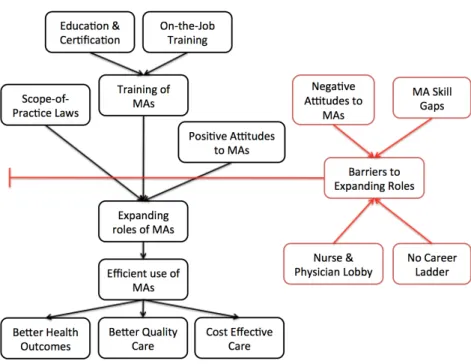
ConceptualModel
Figure 2 Conceptual Model
Methods
This study is a mixed methods study comprised of a literature review, survey, and a key informant interview with a subject matter expert. To understand variations in scope-of-practice between states and the factors that contribute to this variation, I performed a literature review on the expanding role of MAs. In this research, I include grey and peer reviewed literature since many case studies were published as grey literature.
State Scope-of-Practice Laws and Regulations
perform, regulations developed by the Medical and Nursing Boards were used as scope-of-practice regulations. In the case of North Carolina, the general statute states that all assistive personnel are delegated tasks under the supervision of the physician or licensed personnel.17 Therefore, we included regulations developed by the Board of Nursing as reference for scope-of-practice for CMAs in North Carolina.
Collection of Survey Data
A survey of CMAs (AAMA) within the four states was conducted and results were collected for four weeks. All potential participants were sent an email asking for their participation in the survey and two reminder emails within the four-week period. Individuals included in the survey population are CMAs who have certification membership within the AAMA and have reported their location to the AAMA within the four states included in this research. This survey asks questions to understand the current roles of CMAs in their respective states and the prospective role they have the ability to fill. The survey includes questions on types of tasks MAs are asked to do, where they are practicing, whether or not they have received formal training from their employer, their interests in attaining additional training to expand their role in their workplace, and job satisfaction. This survey was developed and used previously by Dr. Dana Neutze at the UNC Family Medicine Clinic. For the purposes of this research, edited the survey and added several survey questions based on previous peer-reviewed studies and expert input from the AAMA.
A total of 893 responses were received through Qualtrics. After cleaning initial data, we excluded unfinished survey responses, resulting in a total of 675 responses included in the analysis. Our response rate was 5.56 percent.
Interview of Legislative History
In order to understand the context of MA practice and barriers to expanding the scope-of-practice for CMAs, I conducted an audio-recorded key informant interview with an expert on scope-of-practice laws about legislative history and stakeholders’ perspectives in the four states included this study. Invitations for participation in interviews were extended to stakeholders in each of the four states, however, only one national representative volunteered to participate. Questions were asked on whether there have been recent legislative proposals for expanding scope-of-practice and if there were any legislative action regarding the bill(s), the main stakeholders involved, and questions about the political environment the state is in.
Data Analysis
Survey responses were collected into a database that was cleaned using Stata 14.0 to only include finished responses. Cross tabulation and chi-square tests of independence to understand if there are any relationships between the different variables that result in CMAs taking on certain roles in delivery of care. When developing the tables, we identified a CMA as “performing the task” when they have responded performing it either infrequently or daily. Tasks were classified into each expanded topic for training as follows:
Training Topic Accumulated from Number of Tasks Table 3
Description of Tasks from Table 3
Input information into EHR 5
Extract information from
EHR 3
Review patient lists to identify patients in need of preventive screening, collect information prior to patient visit,
review/update patients’ medications in the chart.
Screen patient for
depression 1 Screen for depression
Outreach to patients with
chronic diseases 3
Manage patients’ phone and email messages, outreach to patients in need of preventive and chronic disease services, routine outreach to high-risk patients between office visits.
Educating patients with chronic diseases on preventive care
6
Review patient goals for changing health behaviors/setting goals for next visit, provide patient education on medication use, provide patient education on diagnoses, provide nutrition counseling, develop action plans, review after visit summary.
Using motivational interviewing to assist patients win setting health goals
6 (same as above)
Assisting patients with chronic diseases in setting health goals (no
motivational interviewing)
6 (same as above)
Documenting on behalf of
the physician 1 Scribing during examination/visit
Administer immunizations 2
Follow standing orders for vaccine administration, perform
intradermal/subcutaneous/intramuscular injections.
Extract information from EHR to manage patient lists
1 Review patient lists to identify patients in need of preventive screening
Order or queue up tests
based on standing orders 1
Order or queue up tests based on standing orders
State Specific Scope-of-Practice Laws Connecticut
In Connecticut, Medical Assistants are grouped under UAPs and are delegated certain tasks by clinical providers including registered nurses. Originally, the statute did not permit MAs to perform any type of intradermal or intramuscular injections and immunizations. The legislation allowed the Connecticut Board of Nursing to develop regulations for delegable duties for nurses. In these regulations, it specifically states that MAs may not be delegated “health counseling, teaching, case finding, referral, medication administration by any route” as well as, any “nursing procedures that require an understanding of the nursing process.”18 However, on March 29th, 2017 the Connecticut General Assembly passed a new bill allowing only CMAs who have had proper training for injections through a CAAHEP or ABHES accredited program or has had additional training for injections specifically within one year to practice injections if delegated.19 This bill will be in full effect on October 1st 2017.
New York
medications through any route, administering injections or contrast dyes, placing and removing sutures, and first assisting in surgical procedures.21
North Carolina
As mentioned previously, North Carolina is one of the states with the most expansive scope-of-practice for MAs. Under Section 90-18(c)(13) of the North Carolina statute, physicians are not restricted from “delegating to a qualified person any acts, tasks, and functions that are otherwise permitted by law or established by custom.” This allows medical boards, practicing physicians and nurses to determine the scope-of-practice for MAs. In order to practice as an MA, you do not have to acquire any type of certification or register with the state health department. Washington
As one of the most progressive states for MA practice scope, Washington classifies MAs into four categories: Certified, Hemodialysis Technician, Phlebotomist, and MA-Registered. Any medical assistant, who has received certification through the AAMA, is classified under the MA-C. Of the four categories, MA-Cs practice the largest scope-of-practice with the newest addition of House Bill 2350 in the 2016 legislative session allowing administration of medications under physician or nurse supervision.22
Survey Results Demographics
Table 1. Characteristics of Certified Medical Assistant Survey Respondents Variables Observations Percent Standard
Deviation Minimum Maximum
Total N 675 100%
Gender 1 3
Male 26 3.85%
Female 648 96.00%
Non-binary/Third Gender 1 0.15%
Race/Ethnicity 1 5
White/Non-Hispanic 488 72.30% African-American 109 16.15%
Hispanic 37 5.48%
Asian/Pacific Islander 35 5.19%
Native American 6 0.89%
Age 1 6
18-28 120 17.78%
29-38 187 27.70%
39-48 183 27.11%
49-58 133 19.70%
59-65 43 6.37%
65+ 9 1.33%
State Distribution 1 5
Connecticut 40 5.93%
New York 63 9.33%
North Carolina 341 50.52%
Washington 212 31.41%
Other 19 2.81%
Education 1 3
Courses at a Private Vocational
School 214 31.70%
2-year Associate's Degree
Program (CAAHEP Accredited) 457 67.70% 4-year Postsecondary College
(ABHES/CAAHEP Accredited) 4 0.59% Work Experience : How long have you worked as
a CMA? 1 5
0-5 Years 302 44.74%
5-10 Years 157 23.26%
10-15 Years 84 12.44%
15-20 Years 48 7.11%
Worked as an MA before being certified: 1 2
Yes 219 32.44%
No 456 67.56%
Type of Practice 1 3
Single Provider Practice 45 6.67%
Small Group Practice (less than
10 providers) 239 35.41%
Hospital/Health System
Affiliated Practice 391 57.93%
Tenure 1 3
Less than one year 125 18.52%
1-3 years 225 33.33%
3+ years 325 48.15%
Involvement in Team Care 1 2
Yes 434 64.30%
No 241 35.70%
Table 2 Difference Between States for Worksite to Types of Tasks State
Practice Type Connecticut New York North
Carolina Washington
Total (n) 40 63 341 212
Single 18% 19% 5% 3%
Small Group 35% 27% 36% 36%
Hospital/ Health
Roles CMAs (AAMA) are Performing and Confidence Levels
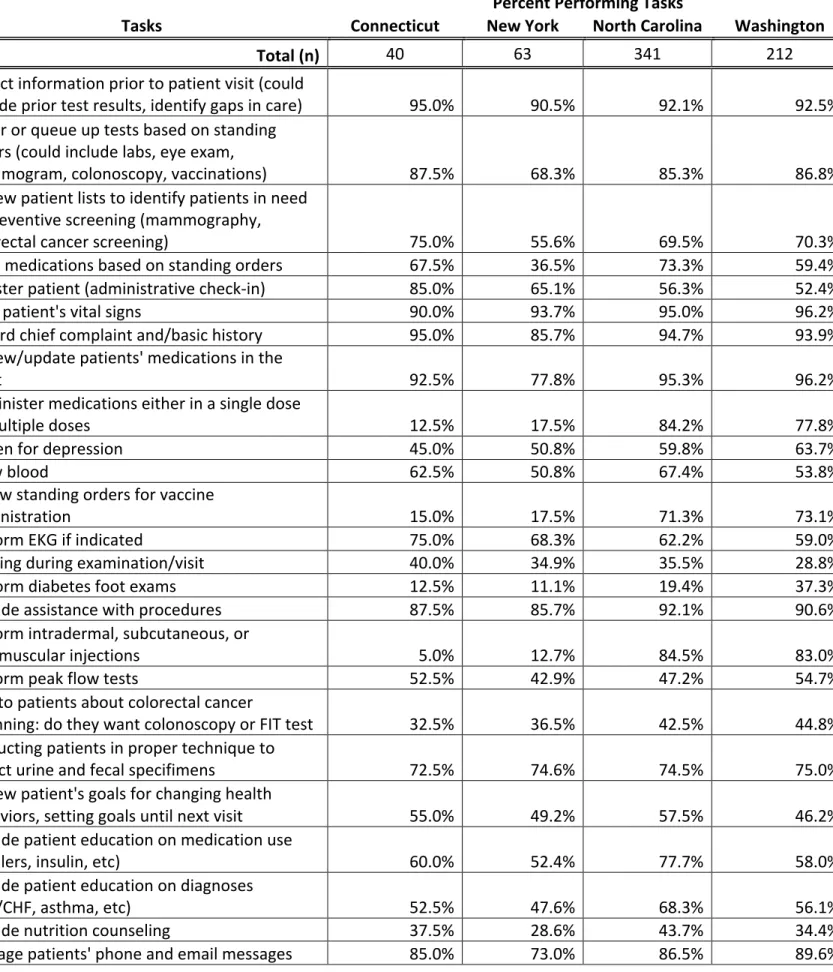
As expected, under their scope of practice, more CMAs (AAMA) in Connecticut and New York are performing administrative duties such as patient check-in than their counterparts in North Carolina and Washington (Table 3 in appendix). The duties that are similar across all states are panel management related tasks such as preventive tests and screening for patients as well as some basic clinical tasks such as taking a patient’s vitals, drawing blood, and collecting specimens for tests. There are several tasks that CMAs (AAMA) are not performing across all states. Only a small proportion, about a third or less are performing tasks such as scribing, talking to patients about colorectal cancer screening, nutrition counseling, and developing action plans.
For most tasks, the confidence levels of CMAs (AAMA) performing the task reflect the percent of CMAs (AAMA) currently performing the task. For example, over 90 percent of CMAs (AAMA) reported that they collect information prior to patient visits and CMAs (AAMA) have reported high confidence levels of doing so, with average confidence scores of 3.6 on a scale of 1 to 4. However when few were CMAs (AAMA) reported to performing a task, confidence levels are also low to reflect this, such as performing diabetes foot exams (see Table 3 and 4 in appendix).
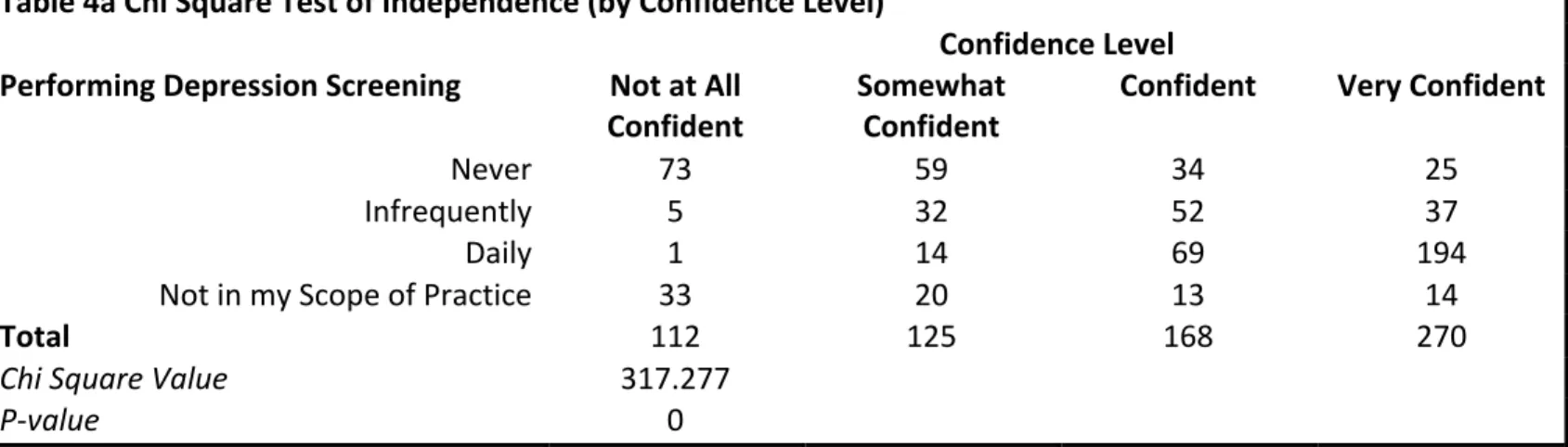
Table 4a Chi Square Test of Independence (by Confidence Level)
Confidence Level Performing Depression Screening Not at All
Confident Somewhat Confident Confident Very Confident
Never 73 59 34 25
Infrequently 5 32 52 37
Daily 1 14 69 194
Not in my Scope of Practice 33 20 13 14
Total 112 125 168 270
Chi Square Value 317.277
The vast majority of CMA (AAMA) tasks are helping to close the gap between the
licensed health professional and the patient. Tasks such as reviewing a patient’s goals for
changing health behaviors, providing patient education on medication use, helping patients feel
comfortable if they see a provider who is not their regular provider, and reviewing the after visit
summary with patients.
Workforce Gaps in Training for Expanded Roles
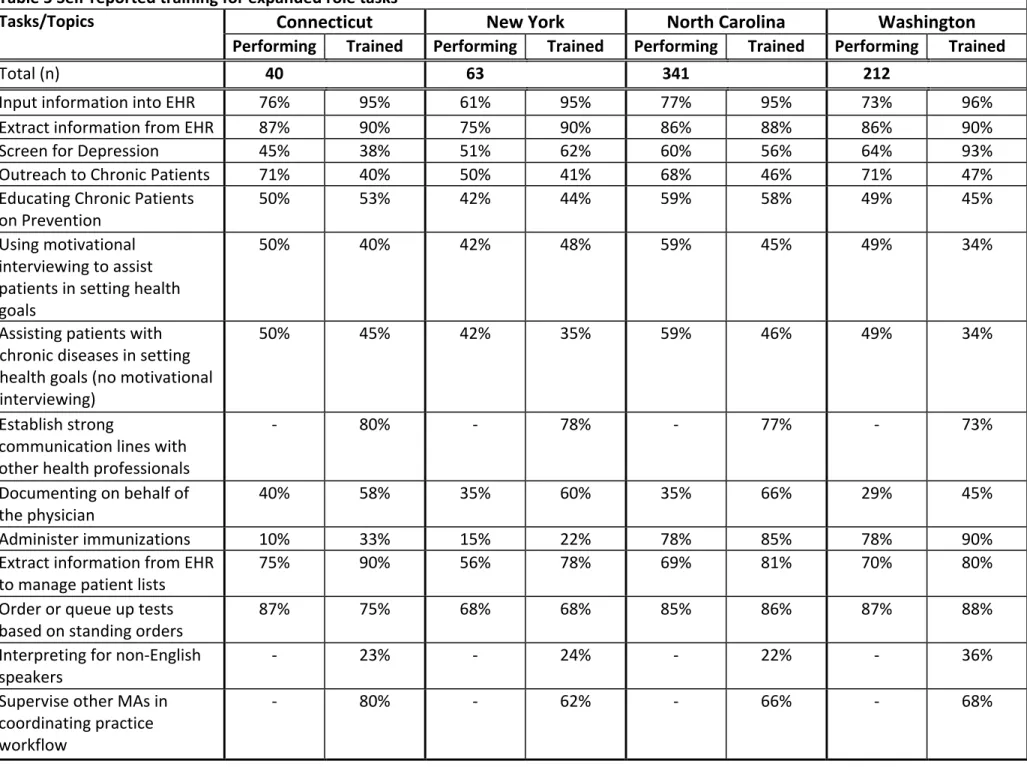
Table 5 shows whether CMAs (AAMA) were trained to perform the duties they are
delegated to do. I found that there are large differences between training and performing these
tasks. In all four states, over 90 percent of CMAs (AAMA) reported training to input information
into the Electronic Health Record (EHR), however, only about 70 percent of CMAs (AAMA)
reported performing duties that involve input of patient data into EHR. I also found that
respondents performed very low rates of extracting information from the EHR to manage patient
lists despite higher training rates in all four states.
I also found significant differences in performance rates and training rates for
immunizations and scribing. Despite 85 and 90 percent of CMAs (AAMA) trained in
administering immunizations in states of North Carolina and Washington, respectively, they
reported lower rates of performing these tasks. Interestingly, Connecticut and New York reported
very low rates of performing and training for administering immunizations compared to their
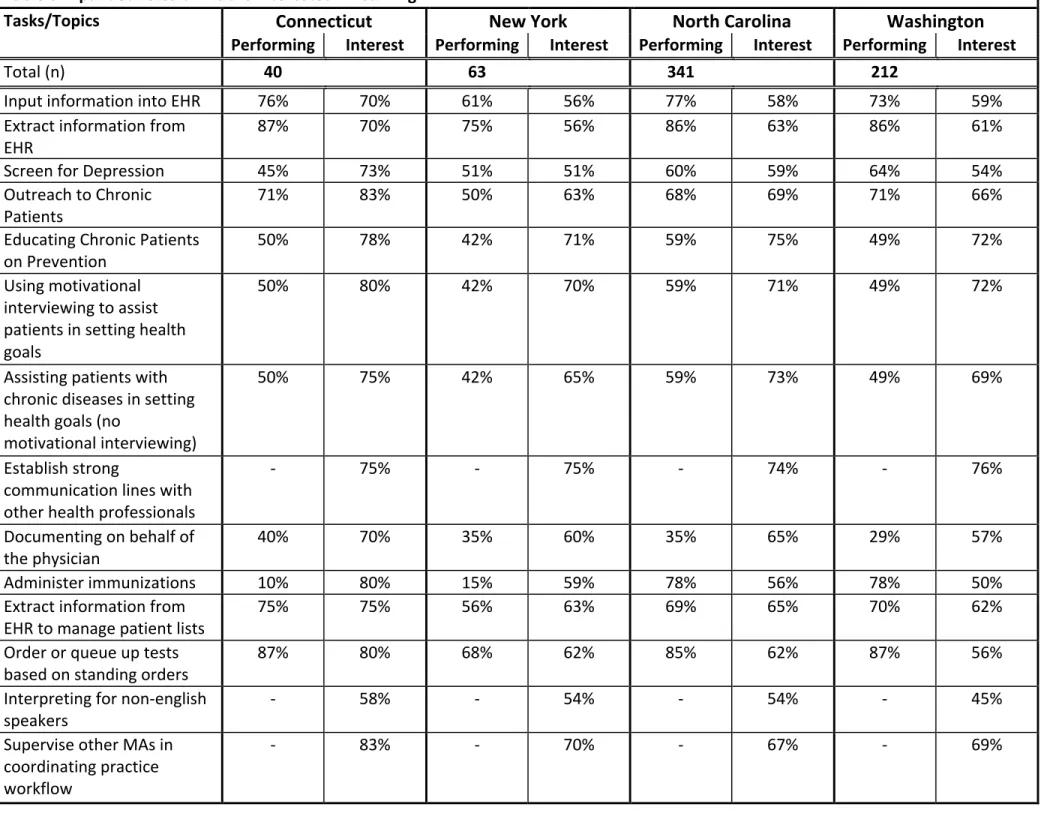
counterparts in North Carolina and Washington. In fact, when we look at the interest rates for
receiving training for immunizations in this population, we see 80 and 59 percent of the CMAs
in Connecticut and New York respectively are interested in receiving training for administering
immunizations (Table6). We will further discuss why there is a lack of training for administering
paper. In all four states, over half of respondents have said that they received training in scribing.
However, only about a third of respondents are scribing for their physician. High interest levels
persist among CMAs in all states to receive training for scribing ranging from 57 percent in
Washington to 70 percent in Connecticut (Table 6).
There were mixed results, depending on the state, on whether individuals performed
depression screening and whether they had training in this area. In Connecticut and North
Carolina, CMAs (AAMA) reported lower rates of training compared to performing rates. In
contrast, CMAs in New York and Washington show higher rates of training for depression
screening than performance rates in their states, especially Washington.
In all categories, I found a pattern of CMAs reporting higher rates of training than
performing certain tasks. However, the only task that CMAs reported lower percentages in being
trained compared to the percent of CMAs performing task is “outreach to chronic patients.”
According to our data, in Connecticut and Washington 71 percent of CMAs perform these roles,
however only 40 and 47 percent (respectively) of CMAs have been trained in this task. This is a
critical finding as our population is experiencing a rise in the elderly population with chronic
disease. In New York, half of the CMAs are providing outreach to patients with chronic disease
however only 41 percent received training; and while 68 percent of the CMAs in North Carolina
perform outreach, only 46 percent were trained (Table 5). Naturally, as more CMAs are asked to
perform outreach to chronic patients, respondents are also highly interested in receiving training.
While there is some overlap of individuals who have received training and would still like to
receive further training in outreach, the majority of those interested are those who have not
Table 5 Self-reported training for expanded role tasks
Tasks/Topics Connecticut New York North Carolina Washington
Performing Trained Performing Trained Performing Trained Performing Trained
Total (n) 40 63 341 212
Input information into EHR 76% 95% 61% 95% 77% 95% 73% 96%
Extract information from EHR 87% 90% 75% 90% 86% 88% 86% 90%
Screen for Depression 45% 38% 51% 62% 60% 56% 64% 93%
Outreach to Chronic Patients 71% 40% 50% 41% 68% 46% 71% 47%
Educating Chronic Patients
on Prevention 50% 53% 42% 44% 59% 58% 49% 45%
Using motivational interviewing to assist patients in setting health goals
50% 40% 42% 48% 59% 45% 49% 34%
Assisting patients with chronic diseases in setting health goals (no motivational interviewing)
50% 45% 42% 35% 59% 46% 49% 34%
Establish strong
communication lines with other health professionals
- 80% - 78% - 77% - 73%
Documenting on behalf of
the physician 40% 58% 35% 60% 35% 66% 29% 45%
Administer immunizations 10% 33% 15% 22% 78% 85% 78% 90%
Extract information from EHR
to manage patient lists 75% 90% 56% 78% 69% 81% 70% 80%
Order or queue up tests
based on standing orders 87% 75% 68% 68% 85% 86% 87% 88%
Interpreting for non-English
speakers - 23% - 24% - 22% - 36%
Supervise other MAs in coordinating practice workflow
Table 6 Expanded roles CMAs are interested in learning
Tasks/Topics Connecticut New York North Carolina Washington
Performing Interest Performing Interest Performing Interest Performing Interest
Total (n) 40 63 341 212
Input information into EHR 76% 70% 61% 56% 77% 58% 73% 59%
Extract information from
EHR 87% 70% 75% 56% 86% 63% 86% 61%
Screen for Depression 45% 73% 51% 51% 60% 59% 64% 54%
Outreach to Chronic
Patients 71% 83% 50% 63% 68% 69% 71% 66%
Educating Chronic Patients
on Prevention 50% 78% 42% 71% 59% 75% 49% 72%
Using motivational interviewing to assist patients in setting health goals
50% 80% 42% 70% 59% 71% 49% 72%
Assisting patients with chronic diseases in setting health goals (no
motivational interviewing)
50% 75% 42% 65% 59% 73% 49% 69%
Establish strong
communication lines with other health professionals
- 75% - 75% - 74% - 76%
Documenting on behalf of
the physician 40% 70% 35% 60% 35% 65% 29% 57%
Administer immunizations 10% 80% 15% 59% 78% 56% 78% 50%
Extract information from
EHR to manage patient lists 75% 75% 56% 63% 69% 65% 70% 62%
Order or queue up tests
based on standing orders 87% 80% 68% 62% 85% 62% 87% 56%
Interpreting for non-english
speakers - 58% - 54% - 54% - 45%
Supervise other MAs in coordinating practice workflow
CMAs as Part of a Team
Delivery of care is changing rapidly to team-based care. In this study, I examined the
types of practices in which CMAs are practicing, whether there is more team based care provided
in one type of practice than others, and whether satisfaction levels differ for CMAs if they are
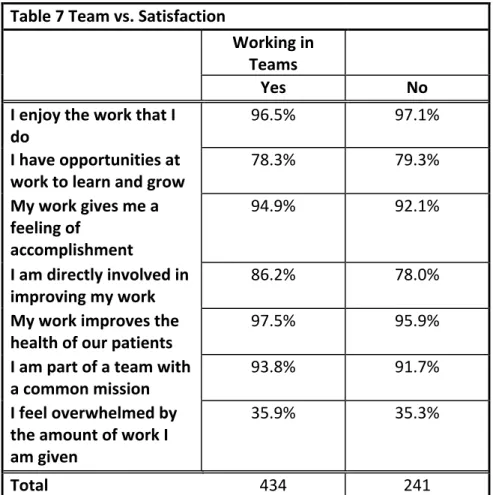
part of a team. We see very little variance in satisfaction rates for each of the measurements
collected (Table 7) except when respondents were asked whether they felt directly involved in
improving their work. I performed a chi square test of independence and found that there is a
difference in this satisfaction measurement depending on whether they were part of a team or not
(Table 11b).
I also looked at whether there is a relationship between the CMA being involved in a
team and the type of clinic they practice in. While there are higher rates of CMAs in teams for all
types of practices, there is a higher percentage of CMAs involved in teams for single practices
(Table 8). I ran a chi square test of independence on these variables and found that there is
Table 7 Team vs. Satisfaction
Working in Teams
Yes No
I enjoy the work that I
do 96.5% 97.1%
I have opportunities at
work to learn and grow 78.3% 79.3% My work gives me a
feeling of
accomplishment
94.9% 92.1%
I am directly involved in
improving my work 86.2% 78.0%
My work improves the
health of our patients 97.5% 95.9% I am part of a team with
a common mission 93.8% 91.7%
I feel overwhelmed by the amount of work I am given
35.9% 35.3%
Total 434 241
Table 8 Team vs. Type of Practice
Team Single Practice Small Group
Practice Hospital
Yes 87% 68% 60%
No 13% 32% 40%
Total 45 239 391
Table 8a Chi Square Test of Independence (by Type of Practice) Type of Practice
Team Single Provider Small Group Hospital/Healt h System
Yes 39 162 233
No 6 77 158
Total 45 239 391
Quadruple Aim: Job Satisfaction for CMAs
Thomas Bodenheimer and colleagues addressed the importance of achieving the
quadruple aim: to improve the health of the population, enhance the patient experience of care,
reduce per capita cost of care, and improve the work life of health care providers.26 I analyzed
the satisfaction rates for CMAs and determined the impact on satisfaction of whether they were a
part of a team, the type of practice in which they work, and state in which they practiced. The
data show differences in satisfaction rates, specifically on whether individuals felt they were
involved in improving their work, when they are part of a team and when they are part of a larger
clinical practice such as a small group practice or hospital/health system affiliated practice
(Table 10a and 10b).
Table 9 Satisfaction Between States
State
Connecticut New York North Carolina Washington
I enjoy the work that I do 98% 95% 97% 96%
I have opportunities at work
to learn and grow 83% 78% 78% 78%
My work gives me a feeling of
accomplishment 95% 94% 94% 93%
I am directly involved in
improving my work 85% 84% 84% 82%
My work improves the health
of our patients 98% 97% 97% 96%
I am part of a team with a
common mission 95% 89% 94% 91%
I feel overwhelmed by the
Table 10a Chi Square Test of Independence (by Type of Practice)
Type of Practice Single Practice Small Group
Practice Hospital/Health System Affiliated I am directly involved in improving my work
Strongly Disagree 5 3 19
Disagree 3 32 51
Agree 13 96 162
Strongly Agree 24 108 159
Total 45 239 391
Chi Square Value 15.776
P-value 0.015
Table 10b Chi Square Test of Independence (by Participation in Team Care)
Work in Teams
Yes No
I am directly involved in improving my work
Strongly Disagree 15 12
Disagree 45 41
Agree 171 100
Strongly Agree 203 88
Total 434 241
Chi Square Value 10.219
P-value 0.017
Interview Results
Connecticut
There are two bills currently introduced on the Connecticut floor of the House for debate
on expanding the MA scope-of-practice.2 , 27 These bills allow providers to delegate the
administration of medication through injection. Connecticut has experienced failures in
2The interview was held on February 17th, 2017. This was before House Bill 6025 passed on March 29th,
expanding the scope-of-practice for MAs previously. Several years ago, when this was brought
to debate, the Connecticut Board of Nursing and Nursing Specialties opposed the bill arguing
that this endangers the patient. They argued that since there is no mandate for MAs to attain
education and while programs are accredited, there is a variation in the training provided by
these programs. This lack of uniformity was used to argue against the expanded
scope-of-practice for MAs.
House Bill 6025, which was passed on March 29th 2017 and will be put into full effect on
October 1st, 2017, addresses the concerns raised in the previous debate. This bill has changed its
language to require that the MA is certified under the AAMA or the AMT and has graduated
from a postsecondary medical assisting program accredited by CAAHEP, ABHES, or
Accrediting Council for Independent Colleges and Schools (ACICS). It has also required MAs to
complete at least 24 hours of classroom training and at least 8 hours of training in a clinical
setting regarding the administration of vaccines.28
There were also two additional observed barriers to legislative change that were
mentioned in the interview. The first was that there is a lack of a legislative champion advocating
for an expanded scope of practice for Medical Assistants. The second barrier mentioned was an
unnamed legislator who was opposed to expanding the scope of practice for MAs sat on the chair
of the committee that oversees the bill. However, because this legislator is no longer in office,
there is a greater chance that this bill will pass in the current legislature.3
New York
New York also has a bill on the senate floor that requires MAs to gain certification or
training on the job that is of sufficient stringency of a nationally accredited education program.
3The interview was held on February 17th, 2017. This was before House Bill 6025 passed on March 29th,
This bill also requires MAs to register in order to practice by January 2018. Any MAs that have
practiced for five or more years before the effective date of the act are exempt from the
certification requirement this bill imposes.29 This bill does not expand the scope of practice for
MAs but instead requires certification that might impose a financial barrier for low-income or
minority groups. This bill is not supported by the AAMA and other key medical societies
because it imposes an extra barrier to enter the profession.
North Carolina
North Carolina has not seen any legislative action regarding expanding the
scope-of-practice. As mentioned previously, this state already has a large breadth in practice scope for
MAs. As a state with a large presence of other allied health professions, the state is also home to
many CAAHEP accredited programs. Less restrictive scope-of-practice laws allow for CAAHEP
accredited education programs and health systems to become a “de facto” for the MA practice
scope. Depending on the training CMAs receive, practices may allow them to perform more or
less clinical tasks. According to the interviewee, there is still room for improvement and future
steps should be taken to clearly establish the delegation rules for physicians and nurses.
Washington
Washington’s experience is very different from the other three states. For many years,
MAs in this state have had a wide scope-of-practice. However, as mentioned previously, in 2015
led by the state department of public health, the legislature re-categorized the MA profession into
five categories (MA-C, MA-R, MA-P, MA) to clarify the clinical duties allowable within each
category. While it was not an expanded scope of practice per se, it clarified some confusion that
Survey and Interview Discussion
Survey discussion
As mentioned previously, despite half of the CMA workforce performing depression
screening, we found that confidence levels were very low. In fact, 93 percent of CMAs in
Washington (table 5) reported that they received training in screening for depression yet their
average confidence level was only 2.86 (table 4). This may be contrasted with CMAs in North
Carolina, where only 56 percent (table 5) reported receiving training in depression screening but
had a similar confidence level of 2.95 (table 4). While this may be a characteristic difference in
CMAs between the two states, but since both states are considered high utilizers, we wonder why
this is the case. This points to the need for a review of the current curriculum that trains CMAs
for depression screening and identifying whether there needs to be supplemental training for this
particular task.
Training and practicing administration of immunizations and intradermal or subcutaneous
or intramuscular injections were interesting results in this study. While practicing administration
of immunizations or any type of injection is forbidden for CMAs and Connecticut and New
York, there were also very low levels of CMAs trained as well (Table 5). Even though CAAHEP
accreditation requires a somewhat standardized curriculum, due to legal restrictions in
scope-of-practice, CMAs are prohibited from learning these skills.
This study has also identified very low levels of training for CMAs in “interpreting for
non-English speakers.” The percentage of CMAs who provided interpretation for patients ranged
from 22 percent in North Carolina to 36 percent in Washington (Table 5). While I was unable to
collect data on whether CMAs were performing this task, we recognize the increased need for
with patients, we emphasize the importance of CMAs offered training in this topic as more than
half of the respondents have expressed interest in receiving training (Table 6).
Observed barriers to expanding CMA scope-of-practice
One of the main observed barriers in expanding the scope-of-practice for CMAs was that
in many states, the term “medical assistant” is not mentioned in the state statute. CMAs are not
in the spotlight in provision of care. The omission of “medical assistant” has its benefits and
consequences. Omission is beneficial when less strict regulations allow the practice, health
system or education program can become the “de facto” for scope-of-practice such as the
situation in North Carolina. However when strict regulations were put in the statute for similar
professions initially, it is hard to bring the practice scope back up for debate in the legislature.
The second observed barrier is that in the low-utilizer states, there is a lack of a
legislative champion advocating for expanding CMA scope-of-practice. At the same time, these
states often have strong advocates for the nursing and physician associations. In the case of
Washington, the State Department of Public Health became a legislative champion when it
realized that the previous law that grouped health care assistive personnel into one group, caused
confusion within the healthcare system. The department pushed for a clarification of medical
assistant scope-of-practice and re-classified medical assistants into the five categories mentioned
earlier.
Policy Implications
Changing the curriculum to meet the needs of the workforce
The first strategy to address the workforce gaps is to modify the CAAHEP curriculum to
reflect the evolving training needs of the workforce. The curriculum should strengthen training
option for CMAs to pursue training in interpreting for non-English speaking patients. The
education programs or the AAMA should allow CMAs in the current workforce options to
pursue continued training in specific topics of expanded roles such as screening for depression,
to ensure not only patient safety but also increase the confidence of CMAs performing new roles.
Standardizing the Curriculum: Academic Freedom
The second strategy is to understand that there is a need for standardizing training
provided to CMAs in training that is not hindered by their state scope-of-practice laws.
Recognizing the freedom of learning, it is imperative that while CMAs in such states as
Connecticut and New York may not be allowed to practice immunizations or injections, they still
should go through the same training as other CMAs required by the CAAHEP accredited
programs. Theoretically, if a CMA were to move from Connecticut to North Carolina and was
asked to give an injection to a patient, we would like this CMA to be trained properly to do so.
Standardizing the training of CMAs will not only increase patient safety but also result in better
utilization of the workforce.
Raising awareness
The third strategy to address workforce gaps is to simply raise awareness and
understanding of the skills and roles that CMAs are currently filling in healthcare delivery.
While there are several case studies of small primary care clinics and community health centers
using MAs for different expanded roles, many are unaware of the potential that CMAs have to
fill roles in patient care that may reduce physician or nurse’s time spent on the patient, allowing
for increased capacity to see more patients. One may expect that with expanding roles in care
percent of respondents were satisfied with their job with only about a third of respondents
reporting to feel overwhelmed.
Bring all stakeholders to the table
The final strategy to addressing workforce gaps and expanding the scope-of-practice for
CMAs is to bring all stakeholders to the table and the earlier the better. Allowing all stakeholders
to express their concerns for expanded scope-of-practice of CMAs will help to not only address
these concerns but also come to a better understanding of how different workforce groups can fit
better into the puzzle of healthcare delivery. Inviting these stakeholders to the table early allows
these entities to also gain ownership of the negotiated outcome and create a stronger coalition
among different advocacy groups.
Limitations
Since participation in the survey and interview was voluntary, there may be some
response bias. Another limitation is that these results may only address the CMA population and
may not be as applicable to the non-certified MA population. More research needs to be done to
address the workforce gaps for non-certified MAs. This survey did not collect any data of skills
on leadership, communication, and interpretation for other languages in the current workforce.
Acknowledgements
This research was done in cooperation with the American Association of Medical
Assistants. Expert clinical input was provided by Dr. Dana Neutze at UNC Family Medicine and
research guidance was provided by Dr. Bruce Fried from the UNC Department of Health Policy
and Management and Dr. Erin Fraher from the Health Workforce Research Group at the Cecil G.
1Chapman, S. Marks, A. Dower, C. “Positioning Medical Assistants for a Greater Role in the Era of
Health Reform.” Academic Medicine 2015; 90: 1347-1352.
2 Bureau of Labor Statistics. “Medical Assistants: Job Outlook” Available online at:
https://www.bls.gov/ooh/healthcare/medical-assistants.htm
3 Bureau of Labor Statistics. “State Specific Archive Data 2010, 2015.”
4 North Carolina Board of Nursing. “Office Practice Setting – UAP Delegation: Position Statement for
RN and LPN Practice.” Last Revised: 2013. Available Online: http://www.aama-ntl.org/docs/default-source/legal/uap-delegation-nc.pdf?sfvrsn=4
5 American Association of Medical Assistants (AAMA). “What is a CMA?” Available online at:
http://www.aama-ntl.org/medical-assisting/what-is-a-cma#.WCqGaXdh3-Y
6 American Medical Technologists. “Becoming a Medical Assistant (RMA)” Available online at:
http://www.americanmedtech.org/GetCertified/RMAEligibility.aspx
7 Balasa, D. “How the CMA (AAMA) stands apart: a comparison of four medical assisting certifications.”
CMA Today. Jul_Aug (2011).
8 North Carolina Board of Nursing. “Office Practice Setting – UAP Delegation: Position Statement for
RN and LPN Practice.” Last Revised: 2013. Available Online: http://www.aama-ntl.org/docs/default-source/legal/uap-delegation-nc.pdf?sfvrsn=4
9 Utah Administration Code. R156. Commerce, Occupational and Professional Licensing. Section 67
Utah Medical Practice Act Rule. Subsection 306 Exemptions from Licensure (4). Available Online: http://www.rules.utah.gov/publicat/code/r156/r156-67.htm
10 New York State Education Department. “Practice Alerts and Guidelines: Utilization of Medical
Assistants.” April 2010. Available online: http://www.op.nysed.gov/prof/nurse/nurse-medical-assistants.htm
11 Hitachi Foundation. “Four Reasons Medical Assistants are Key to Transforming Healthcare.”
November 19th, 2014. Available Online: http://www.hitachifoundation.org/news-a-views/thf-blog/565-four-reasons-medical-assistants-are-key-to-transforming-healthcare
12 Blash, L., Chapman, S., Dower, C. “UNITE HERE Health Center – Pioneering the Ambulatory
Intensive Caring Unit.” Center for Health Professions. Nov. 2011.
13 Chen, E.H. Thom, D.H., Hessler, D.M. et al. “Using the teamlet model to improve chronic care in an
academic primary care practice.” Journal of General Internal Medicine. 25(suppl 4): 610-4.
1414 Ibid.
15 Berwick, D.M. Nolan, T.W. Whittington, J. “The Triple Aim: Care, Health, and Cost.” Health Affairs.
Millwood (2008), 27(3): 759-769.
16 Bodenheimer, T. Sinsky, C. “From Triple to Quadruple Aim: Care of the Patient Requires Care of the
Provider.” Annals of Family Medicine. 2014. 12(6). 573-6.
17http://www.ncleg.net/EnactedLegislation/Statutes/HTML/BySection/Chapter_90/GS_90-18.html 18 Connecticut Board of Examiners for Nursing. “Memorandum of Decision. Declaratory ruling:
Delegation by licensed nurses to unlicensed assistive personnel.” April 5, 1995.
19 File No. 281 Substitute H.B. 6025. “An Act Allowing Medical Assistants to Administer Vaccines
Under Supervision.” Connecticut General Assembly. January Session, 2017. Available online: https://www.cga.ct.gov/2017/FC/2017HB-06025-R000281-FC.htm
20 New York State Department of Health. “New York State Education Section 6530 Definitions of
Professional Misconduct.” Revised September 2007. Available Online:
https://www.health.ny.gov/professionals/office-based_surgery/law/6530.htm Last Retrieved: April 24, 2017.
21 Ramos, W. “Utilization of unlicensed persons, such as medical assistants, in clinical settings and
22 Washington State 64th Legislature. 2016 Regular Session. House Bill 2350. February 16, 2016.
Available online: http://lawfilesext.leg.wa.gov/biennium/2015-16/Pdf/Bills/House%20Passed%20Legislature/2350.PL.pdf
23 Thom, D.H. et al. “Health Coaching by Medical Assistants Improves Patients’ Chronic Care
experience.” The American Journal of Managed Care. 21(10) 2015. 685-691.
24 Dillon, E. et al. “Using Unlicensed Health Coaches to Improve Care for Insured Patients with Diabetes
and Hypertension: Patient and Physician Perspectives on Recruitment and Uptake.” Population Health Management. 19(5) 2016. 332-340.
25 Elder, N.C. et al. “Patterns of relating between physicians and medical assistants in small family
medicine offices.” Annals of Family Medicine. 12(2) 2014. 150-157.
26 Bodenheimer, T Sinsky, C. “From triple to quadruple aim: care of the patient requires care of the
provider.” Annals of Family Medicine. 12(6): 573-6.
27 H.B. 6254 “An Act Concerning the Admininstration of Medicaitons by Medical Assistants at Federally
Qualified Health Centers.” Connecticut General Assembly. January Session 2017. Available online: https://www.cga.ct.gov/2017/TOB/h/2017HB-06254-R00-HB.htm
28 File No. 281 Substitute H.B. 6025. “An Act Allowing Medical Assistants to Administer Vaccines
Under Supervision.” Connecticut General Assembly. January Session, 2017. Available online: https://www.cga.ct.gov/2017/FC/2017HB-06025-R000281-FC.htm
29 S. 01047 “An Act to Amend the Education Law and Provides for the Registration and Regulation of the
Appendix
Table 3 Percent of CMAs in each state performing clinical and expanded role tasks
Percent Performing Tasks
Tasks Connecticut New York North Carolina Washington
Total (n) 40 63 341 212
Collect information prior to patient visit (could
include prior test results, identify gaps in care) 95.0% 90.5% 92.1% 92.5%
Order or queue up tests based on standing orders (could include labs, eye exam,
mammogram, colonoscopy, vaccinations) 87.5% 68.3% 85.3% 86.8%
Review patient lists to identify patients in need of preventive screening (mammography,
colorectal cancer screening) 75.0% 55.6% 69.5% 70.3%
Refill medications based on standing orders 67.5% 36.5% 73.3% 59.4%
Register patient (administrative check-in) 85.0% 65.1% 56.3% 52.4%
Take patient's vital signs 90.0% 93.7% 95.0% 96.2%
Record chief complaint and/basic history 95.0% 85.7% 94.7% 93.9%
Review/update patients' medications in the
chart 92.5% 77.8% 95.3% 96.2%
Administer medications either in a single dose
or multiple doses 12.5% 17.5% 84.2% 77.8%
Screen for depression 45.0% 50.8% 59.8% 63.7%
Draw blood 62.5% 50.8% 67.4% 53.8%
Follow standing orders for vaccine
administration 15.0% 17.5% 71.3% 73.1%
Perform EKG if indicated 75.0% 68.3% 62.2% 59.0%
Scribing during examination/visit 40.0% 34.9% 35.5% 28.8%
perform diabetes foot exams 12.5% 11.1% 19.4% 37.3%
Provide assistance with procedures 87.5% 85.7% 92.1% 90.6%
Perform intradermal, subcutaneous, or
intramuscular injections 5.0% 12.7% 84.5% 83.0%
Perform peak flow tests 52.5% 42.9% 47.2% 54.7%
Talk to patients about colorectal cancer
screnning: do they want colonoscopy or FIT test 32.5% 36.5% 42.5% 44.8%
Instructing patients in proper technique to
collect urine and fecal specifimens 72.5% 74.6% 74.5% 75.0%
Review patient's goals for changing health
behaviors, setting goals until next visit 55.0% 49.2% 57.5% 46.2%
Provide patient education on medication use
(inhalers, insulin, etc) 60.0% 52.4% 77.7% 58.0%
Provide patient education on diagnoses
(DM/CHF, asthma, etc) 52.5% 47.6% 68.3% 56.1%
Provide nutrition counseling 37.5% 28.6% 43.7% 34.4%
Develop action plans (asthma, CHF, etc) 32.5% 15.9% 36.1% 26.4% Help patients feel comfortable if they see a
provider who is not their regular provider 85.0% 85.7% 92.7% 92.9%
Review the after visit summary with patients 65.0% 55.6% 71.3% 73.6%
Report lab results to the patient 70.0% 49.2% 82.1% 86.8%
Outreach to patients in need of preventive and
chronic disease services 70.0% 39.7% 60.4% 61.3%
Routine outreach to high risk patients between
office visits 57.5% 36.5% 56.9% 63.2%
Participate on quality improvement teams or assist in the development of quality
improvement initiatives 70.0% 58.7% 71.3% 73.1%
Participate in team-based review of high risk patients (for high health care utilization, uncontrolled chronic disease, complex
Table 4 Confidence Level of Performing Tasks
Average Confidence Level (1-4)
Task Connecticut New York North Carolina Washington
Collect information prior to patient visit (could include
prior test results, identify gaps in care) 3.67 3.54 3.58 3.6
Order or queue up tests based on standing orders (could include labs, eye exam, mammogram, colonoscopy, vaccinations)
3.55 3.08 3.48 3.39
Review patient lists to identify patients in need of preventive screening (mammography, colorectal cancer screening)
3.23 2.89 3.27 3.19
Refill medications based on standing orders 3.52 2.78 3.44 3.18
Register patient (administrative check-in) 3.65 3.33 2.89 2.65
Take patient's vital signs 3.9 3.84 3.89 3.88
Record chief complaint and/basic history 3.87 3.78 3.87 3.86
Review/update patients' medications in the chart 3.85 3.52 3.86 3.76
Administer medications either in a single dose or multiple
doses 2.8 2.25 3.7 3.48
Screen for depression 2.67 2.68 2.95 2.86
Draw blood 3.07 2.97 3.16 2.91
Follow standing orders for vaccine administration 2.82 2.27 3.52 3.49
Perform EKG if indicated 3.57 3.41 3.3 3.14
Scribing during examination/visit 3.05 2.57 2.58 2.22
perform diabetes foot exams 1.87 1.7 1.97 2.42
Provide assistance with procedures 3.67 3.38 3.67 3.58
Perform intradermal, subcutaneous, or intramuscular
injections 2.6 2.17 3.74 3.68
Perform peak flow tests 2.97 2.49 2.73 2.86
Talk to patients about colorectal cancer screnning: do
they want colonoscopy or FIT test 2.65 2.46 2.63 2.55
Instructing patients in proper technique to collect urine
Review patient's goals for changing health behaviors,
setting goals until next visit 2.97 2.62 2.92 2.65
Provide patient education on medication use (inhalers,
insulin, etc) 3.25 2.9 3.25 2.86
Provide patient education on diagnoses (DM/CHF,
asthma, etc) 3 2.48 2.99 2.56
Provide nutrition counseling 2.5 2.11 2.48 2.1
Manage patients' phone and email messages 3.65 3.32 3.56 3.53
Develop action plans (asthma, CHF, etc) 2.55 1.9 2.31 2.07
Help patients feel comfortable if they see a provider who
is not their regular provider 3.72 3.6 3.68 3.62
Review the after visit summary with patients 3.5 3.1 3.53 3.45
Report lab results to the patient 3.38 2.78 3.54 3.44
Outreach to patients in need of preventive and chronic
disease services 3.17 2.49 2.99 2.95
Routine outreach to high risk patients between office
visits 3.08 2.52 2.91 2.93
Participate on quality improvement teams or assist in the
development of quality improvement initiatives 3.1 2.57 3 2.99
Participate in team-based review of high risk patients (for high health care utilization, uncontrolled chronic disease, complex psychiatric co-morbidities, etc)
MA Scope-of-Practice Survey (Thesis)
Please choose the gender you identify most with:
m Male
m Female
m Non-Binary/Third Gender
Please choose the race/ethnicity you identify most with:
m White/Non-Hispanic
m African-American
m Hispanic
m Asian/Pacific Islander
m Native American
What is your age?
m 18-28
m 29-38
m 39-48
m 49-58
m 59-65
m 65+
Which state do you currently practice in?
m Connecticut
m New York
m North Carolina
m Washington
m Other
Condition: Other Is Selected. Skip To: Please write the state in which you c....
Please write the state in which you currently practice in:
How long have you worked as a Certified Medical Assistant?
m 0-5 Years
m 5-10 Years
m 10-15 Years
m 15-20 years
m 20+ Years
Have you worked as an MA before being certified by the AAMA?
m Yes
Please select the type of education you received to become a Medical Assistant:
m Courses at a private vocational school
m 2-year Associate's Degree Program (CAAHEP Accredited)
m 4-year Postsecondary College (ABHES/CAAHEP Accredited)
What type of practice is your workplace?
m Single Provider Practice
m Small Group Practice (less than 10 providers)
m Hospital/Health System Affiliated Practice
How long have you been with your current organization?
m Less than one year
m 1-3 years
m 3+ years
Do you work with the same provider (MD/PA/NP/RN) every day? (i.e. Work in a team or dyad)
m Yes
m No
How often do you perform the following activities in your role as an MA?
Never Infrequently Daily Not in My
Scope-of-Practice Collect
information prior to patient visit (could include prior test results,
identify gaps in care)
m m m m
Order or queue up tests based
on standing orders (could include labs, eye
exam, mammogram,
colonoscopy, vaccinations)
m m m m
Review patient lists to identify patients in need
of preventive screening (mammography, colorectal cancer
screening)
m m m m
Refill medications
based on standing orders
m m m m
Find diabetes patients overdue for A1c and pend
A1c order
m m m m
Register patient (administrative
check-in)
m m m m
Take patient's
vital signs m m m m
Record chief complaint and/or
basic history
m m m m
Review/update patients' medications in
the chart Administer medications either in a single
dose or multiple doses
m m m m
Screen for
depression m m m m
Draw blood m m m m
Follow standing orders for
vaccine administration
m m m m
Perform EKG if
indicated m m m m
Scribing during
examination/Visit m m m m
Perform diabetes
foot exams m m m m
Provide assistance with
procedures
m m m m
Perform intradermal, subcutaneous, or intramuscular
injections
m m m m
Perform peak
flow tests m m m m
Talk to patients about colorectal cancer screening: do they want colonoscopy or FIT test
m m m m
Instructing patients in proper technique
to collect urine and fecal specimens
m m m m
Review patient's goals for changing health
behaviors,
setting goals until next visit Provide patient
education on medication use (inhalers, insulin,
etc.)
m m m m
Provide patient education on diagnoses (DM,
CHF, asthma, etc)
m m m m
Provide nutrition
counseling m m m m
Manage patients' phone and email
messages
m m m m
Develop action plans (asthma,
CHF, etc)
m m m m
Help patients feel comfortable
if they see a provider who is not their regular
provider
m m m m
Review the after visit summary
with patients
m m m m
Report lab results to the
patient
m m m m
Outreach to patients in need
of preventive and chronic disease services
m m m m
Routine outreach to high risk patients between
office visits
m m m m
Participate on quality improvement teams or assist
in the development of
quality improvement
initiatives Participate in
team-based review of high risk patients (for high health care
utilization, uncontrolled chronic disease,
complex psychiatric co-morbidities, etc)
Please rate your level of confidence in performing the following activities: Not at All
Confident
Somewhat Confident
Confident Very Confident
Collect information prior
to patient visit (could include prior test results,
identify gaps in care)
m m m m
Order or queue up tests based
on standing orders (could include labs, eye
exam, mammogram,
colonoscopy, vaccinations)
m m m m
Review patient lists to identify patients in need
of preventive screening (mammography, colorectal cancer
screening)
m m m m
Refill medications
based on standing orders
m m m m
Register patient (administrative
check-in)
m m m m
Take patient's
vital signs m m m m
Record chief complaint and/or
basic history
m m m m
Review/update patients' medications in
the chart
m m m m
Administer medications either in a single
dose or multiple
doses Screen for
depression m m m m
Draw blood m m m m
Follow standing orders for
vaccine administration
m m m m
Perform EKG if
indicated m m m m
Scribing during
examination/Visit m m m m
Perform diabetes
foot exams m m m m
Provide assistance with
procedures
m m m m
Perform intradermal, subcutaneous, or intramuscular
injections
m m m m
Perform peak
flow tests m m m m
Talk to patients about colorectal cancer screening: do they want colonoscopy or FIT test
m m m m
Instructing patients in proper technique
to collect urine and fecal specimens
m m m m
Review patient's goals for changing health
behaviors, setting goals until next visit
m m m m
Provide patient education on medication use
(inhalers, insulin, etc.) Provide patient education on diagnoses (DM, CHF, asthma, etc)
m m m m
Provide nutrition
counseling m m m m
Manage patients' phone and email
messages
m m m m
Develop action plans (asthma,
CHF, etc)
m m m m
Help patients feel comfortable
if they see a provider who is not their regular
provider
m m m m
Review the after visit summary
with patients
m m m m
Report lab results to the
patient
m m m m
Outreach to patients in need
of preventive and chronic disease services
m m m m
Routine outreach to high risk patients between
office visits
m m m m
Participate on quality improvement teams or assist
in the development of
quality improvement
initiatives
m m m m
Participate in
review of high risk patients (for high health care
utilization, uncontrolled chronic disease,
Have you ever received training from your employer and/or taken courses on any of the following topics?
Yes No
Input information into
Electronic Health Records m m
Extract information from
Electronic Health Records m m
Screen patient for
depression m m
Outreach to patients with
chronic diseases m m
Educating patients with chronic diseases on
preventive care
m m
Using motivational interviewing to assist patients in setting health
goals
m m
Assisting patients with chronic diseases in setting health goals (no motivational
interviewing)
m m
Establish strong communication lines with other health professionals
m m
Documenting on behalf of
the physician m m
Administer Immunizations m m
Extract information from Electronic Health Records to
manage patient lists
m m
Order or queue up tests
based on standing orders m m
Interpreting for non-english
speakers m m
Supervise other MAs in coordinating practice
workflow
Please rate your level of interest in receiving additional training from your employer (workshops, in-person/online training program) and/or take additional courses in the following topics:
Yes No
Input information into
Electronic Health Records m m
Extract information from
Electronic Health Records m m
Screen patient for
depression m m
Outreach to patients with
chronic diseases m m
Educating patients with chronic diseases on
preventive care
m m
Using motivational interviewing to assist patients in setting health
goals
m m
Assisting patients with chronic diseases in setting health goals (no motivational
interviewing)
m m
Establish strong communication lines with other health professionals
m m
Documenting on behalf of
the physician m m
Administer Immunizations m m
Extract information from Electronic Health Records to
manage patient lists
m m
Order or queue up tests
based on standing orders m m
Interpreting for non-english
speakers m m
Supervise other MAs in coordinating practice
workflow m
Please rate your level of agreement with the following statements Strongly
Disagree
Disagree Agree Strongly Agree
I enjoy the work
that I do m m m m
My job duties and responsibilities
are clearly defined
m m m m
I have opportunities at
work to learn and grow
m m m m
My work gives me a feeling of accomplishment
m m m m
I am satisfied with my opportunities for
promotion at work
m m m m
I am directly involved in improving my
work
m m m m
My work improves the
health of our patients
m m m m
I am part of a team with a common mission
m m m m
I feel overwhelmed by
the amount of work I am given