Report of Off-Road Vehicle-Related Injuries in North Carolina
By
Gary F. Burke
A Master’s Paper submitted to the faculty of the University of North Carolina at Chapel Hill
in partial fulfillment of the requirements for the degree of Master of Public Health in
the Public Health Leadership Program
Chapel Hill
2013
____________________________________
Advisor:
____________________________________ Date
____________________________________ Second Reader:
Off-Road Vehicle Injuries in North Carolina Page 2 Table of Contents
Abstract of Master’s Paper ... 3
Systematic Review ... 4
Introduction: ... 4
Methods: ... 5
Results: ... 8
Discussion: ... 10
Conclusion: ... 13
Tables/Figures: ... 14
Research Manuscript ... 28
Abstract: ... 28
Introduction: ... 28
Methods: ... 30
Discussion: ... 33
Tables/Figures: ... 38
References: ... 49
Off-Road Vehicle Injuries in North Carolina Page 3 Abstract of Master’s Paper
Off-road vehicle crashes account for over 3% of all motor vehicle crash related
emergency department (ED) visits in North Carolina and are an increasingly serious problem.
State legislators and ATV safety groups have recognized off-road vehicle safety as a significant
problem and have undertaken efforts to reduce off-road vehicle crashes. The research
component of this master’s paper is a study to identify off-road motor vehicle rider
demographics, patterns of injury, and type of injuries requiring ED visits in North Carolina.
Information was obtained from the North Carolina Disease Event Tracking and Epidemiologic
Collection Tool (NC DETECT) database, which collects data for over 99% of ED visits in North
Carolina. Patients in rural areas, male patients, and pediatric and young adult patients were
particularly vulnerable to off-road vehicle crash injuries. Injuries were often sustained to the
extremities and head, and the injury type was most often contusions, fractures, or
sprains/strains. The systematic review portion of this master’s paper was conducted with the
goal of determining the effectiveness of ATV state legislation in preventing injuries and deaths
related to ATV use. The review focused on ATVs because it was the off-road vehicle type most
often studied. Studies have found that ATV crash injuries and deaths can be prevented or
reduced in severity with appropriate injury prevention efforts; however, ATV state legislation
has resulted in modest to no change in ATV-related injuries. Future injury prevention efforts
should focus on education and compliance with ATV state legislation, particularly among
Off-Road Vehicle Injuries in North Carolina Page 4 Systematic Review
Effectiveness of State Legislation on ATV-related Injuries and Deaths Introduction:
In 1970, Honda introduced the world’s first all-terrain vehicle (ATV): a
seven-horsepower, three-wheeled vehicle called the US90.1 Since then, ATVs have quickly gained
popularity due to their ability to perform occupational work and provide fast-paced outdoor
recreation. Popularity, low cost, and versatility, coupled with aggressive manufacturer
marketing, have caused the number of ATVs in use to increase rapidly from 0.4 million in 1985
to 10.6 million in 2010.2
Along with increasing popularity of ATVs has come analysis of consequences from ATV
use. The studies reveal a substantial number of ATV-related injuries and deaths. The U.S.
Consumer Product Safety Commission (CPSC) began monitoring deaths related to ATV use in
1982.2 The estimated number of ATV deaths in the US from 1982-2007 is 9,346, with 822
deaths in 2007 (the most recent year with completed CPSC fatality data; 2008-2011 reporting is
ongoing).2 Even more concerning is the substantial portion of ATV-related deaths in children
and young adults. From 1982-2007, riders under the age of 16 accounted for over a quarter
(27%) of ATV deaths,2 while only representing 14% of all ATV riders.3 ATV-related injuries are
also a major concern. During the time frame of 2001-2011 there were an estimated 695,800
ATV-related injuries requiring treatment in emergency departments (EDs).2 Similar to
ATV-related deaths, ATV riders younger than 16 years of age accounted for roughly 29% of ATV
Off-Road Vehicle Injuries in North Carolina Page 5 The sizable number of injuries and deaths from ATV use has led to the analysis of risk
factors. Numerous studies have identified risk factors for persons likely to sustain ATV-related
injuries and death, including: age younger than 16 years; children operating an ATV with
greater than 90-cc engine; male gender; lack of helmet use; use of three-wheeled ATVs; and
operation on public roadways.3-6 The pattern of injuries from ATV-related incidents are
commonly traumatic brain injury and extremity injuries.6-8
Injury prevention programs have been discussed and implemented as a means of
controlling the risk factors and reducing crash rates among ATV operators. Injury prevention
efforts are usually categorized into three approaches: education; engineering and
environmental modification; and legislation.9 All three have been used to prevent off-road
vehicle-related injuries.10-17 Legislative interventions have been the most commonly used
approach; because ATVs are not under federal highway safety regulations, they are regulated
by each state. As a result, a patchwork of regulations exists across the United States. Forty-four
states have passed ATV safety laws of one form or another that vary on standards for required
education, safety equipment, operator licensing, passengers, and age restrictions (Table 1).
The object of this review was to examine the effectiveness of state legislation in
reducing injuries and deaths among ATV operators. To our knowledge, this will be the first
systematic review completed to assess the effectiveness of state regulations in reducing
ATV-related injuries and deaths.
Methods:
Off-Road Vehicle Injuries in North Carolina Page 6 The majority of research in this area involves studies with an ecological design, due to
feasibility and logistic issues. Ecological studies are those in which the intervention of interest
(i.e. ATV-related state legislation) is applied across an entire population. Studies examining the
effect of legislation are limited by the amount of information provided on how strongly the laws
are enforced at an individual level. Ecological studies are generally one of three forms: studies
comparing outcomes measured before and after legislation is implemented in a single
population; studies that compare two or more populations at the same time; and studies which
combined both over time and between population measures.18 Thus, studies were included in
this review if: 1) they compared outcomes pre- and post- implementation of ATV laws; 2)
comparisons were made between similar or adjacent states with and without ATV laws; or 3)
both. Only studies that were conducted in the United States and were already published in
English were considered. All studies included were original research.
Inclusion Criteria:
Inclusion and exclusion criteria were developed by using the PICOTTSS typology (Table
2). The PICOTTSS typology – Population, Intervention(s)/Exposure(s), Comparator(s), Outcomes,
Time of exposure, Time over which literature will be searched, Setting, and Study designs
allowed – is a tool designed to help focus inclusion and exclusion criteria for a systematic
review question.
Types of Populations:
Studies evaluating ATV-related legislation were included in the review and the target
population of interest was ATV operators.
Off-Road Vehicle Injuries in North Carolina Page 7 Studies were considered for inclusion if they were published in the past 10 years and
evaluated ATV-related state legislation. For the purpose of this review, the intervention was
any type of state legislation for ATVs. Furthermore, studies reporting effectiveness of injury
prevention strategies or recommendations that are not supported by state legislation were
excluded.
Types of Outcome Measures:
Studies were included if they reported at least one quantified outcome. The primary
outcomes of interest were ATV-related fatalities and ATV-related injuries with and without
legislation.
Search methods for identification of studies:
The selection of studies involved two steps. First, a PubMed search was completed on
5/22/2013 using MeSH, Medical Subject Headings, terms “off-road motor vehicles” and
“accident prevention”, and filtered for publications in the last 10 years (66 references). Hand
searches and cross-reference searches were also completed (2 references). A reviewer (GB)
excluded articles that were not published in English or focused on countries other than the
United States. Titles were initially reviewed with a specific focus on removing all articles not
related to ATV legislation. Second, the full text of selected articles was obtained. Studies
inclusion was based on full text review, using a standard form with pre-determined eligibility
criteria (Table 2). All searches and reviews were completed by one author (GB).
Off-Road Vehicle Injuries in North Carolina Page 8 Data was extracted by one author (GB). A standard form was used that described the
following: state(s) studied, target population, objective, data source, sample size, and study
results (outcomes).
Quality assessment:
It is difficult to assess the quality of ecological studies. Most tools for the assessment of
methodological quality are geared towards randomized and non-randomized studies. These
tools do not specifically address ecological studies. Since ecological studies are among the
weaker methodological study designs, quality was assessed based on threats to validity of
ecological studies as presented by Hingson et al.18 Control group, statistical methods, time
period studied, and confounders were assessed. A composite value of good, fair, and poor was
allocated to each study based on the assessments of threats to validity. No studies were
excluded based on quality.
Results:
Study Selection:
In total, the search yielded 68 titles (Table 3). Initial review of titles focused on removing
all articles not related to ATV legislation; this yielded 12 articles for full review. Full article
review generated 5 studies meeting all inclusion criteria (Figure 1). All five studies were
published in peer-reviewed medical journals.11-14,17
Study Characteristics:
All of the studies included in this review were published after 2002.11-14,17 A summary of
the study characteristics can be found in Table 4. Two of the studies used data from all 50
Off-Road Vehicle Injuries in North Carolina Page 9 Carolina.17 Three studies used non-equivalent control groups13,14,17 and two were pre-post
observational studies11,12. Three of the studies focused on pediatric populations
exclusively,12,13,17 while the other two included all operator ages.11,14 Study lengths varied from
6 months11 pre- and post-legislation to a 16 year time series.13 One study had <1 year length,11
one study had ≤5 year length,17 and three studies had >5 year length.12-14 Studies used different
sources of data: three studies utilized trauma registries,11,12,17 two studies CPSC databases,13,17
two studies Office of the Chief Medical Examiner/death certificates,11,12,17 and one study the
CDC WONDER database.14
Effects of Interventions:
All studies presented data for fatal crashes. The difference in fatal crashes with
legislation compared to without legislation had conflicting results. Two studies found ATV
legislation decreased deaths.11,13 The Upperman (2003) study found that states without
legislation had approximately a 2-fold increase in adjusted pediatric ATV mortality rates (0.08
per 100,000 persons vs. 0.17 per 100,000 persons).13 Beidler (2009) found a decrease in
patients younger than eight years of age requiring medical assessment or dying from
ATV-crashes (6 subjects vs. 0 subjects, p=0.0267), but found no difference in subjects age 8-15 years
during pre- and post-legislation time periods (14 subjects vs. 12 subjects).11 The remaining
three studies found no change in mortality with ATV legislation.12,14,17 Keenan (2004) found
that 3.6% of pediatric patients died in Pennsylvania, which had ATV laws, compared to 4.5% in
North Carolina, which had no ATV laws.17 No change in pediatric disposition
(death/rehabilitation) was observed by McBride (2011), finding 18.8% pre-law vs 20% post-law
Off-Road Vehicle Injuries in North Carolina Page 10 rates for states with and without helmet regulations (0.30 per 100,000 persons vs. 0.37 per
100,000 persons) and states with and without training/licensure requirements (0.31 per
100,000 persons vs. 0.35 per 100,000 persons).14
Two studies looked at injury severity scores (ISS) from ATV crashes.12,17 Keenan (2004)
observed that ISS scores in Pennsylvania (with ATV legislation) pediatric ATV crashes trended
toward higher scores when compared to North Carolina (no ATV legislation).17 McBride (2011)
found no difference in mean ISS scores pre- and post-legislation, 18.15 vs. 21.1, respectively
(p=0.2813).12
Quality of studies:
A summary of the quality measures assessed are presented in Table 5. All studies used
ecological designs and obtained data from routinely collected sources (e.g. Trauma registries,
CPSC database, Office of the Chief Medical Examiner). Three studies used different states as
control groups during the same time period,13,14,17 and two used the same state pre-legislation
as the control group.11,12 Three studies used multivariable methods to control for confounding;
the factors most often controlled for were age and gender.12,14,17 The Helmkamp (2012) study
was assigned an overall quality of good;14 Upperman (2003), Keenan (2004), and McBride
(2011) were assigned an overall quality of fair;12,13,17 and Beidler (2009) was assigned an overall
quality of poor.11
Discussion:
The results of this review provided insight regarding the effectiveness of ATV legislation.
Based on the available data, it appears that ATV legislation does not reduce injuries and deaths
Off-Road Vehicle Injuries in North Carolina Page 11 that ATV legislation is not effective at a population level. There are two inherent flaws to
legislative injury prevention approaches: compliance and enforcement. First, compliance is
dependent on the ATV operator to abide by legislation. If ATV operators are not abiding by
legislation, then no effect of legislation would be expected. Second, enforcement is dependent
on the state having sufficient resources to enforce legislation. If states do not have the
resources to enforce legislation, then ATV operators are less like to comply with legislation.
Both scenarios can result in legislation not achieving its desired effect. It is also possible,
however, that legislative approaches are not effective even when ATV operators are in
compliance with the law. A study of Florida ATV operators in compliance with legislation and
those violating legislation found no significant difference in injury patterns, outcome measures,
or mortality.10
Limitations:
It is important to consider three main sources of limitations in this review: the processes
involved in conducting the searches, the decisions made regarding inclusion and exclusion
criteria, and the quality of literature available at the time. The literature search was conducted
of only the PubMed database and did not include unpublished studies or published studies not
included in PubMed. This could have resulted in publication biases and influenced the validity
of this review’s results. Additionally, the literature search was only completed by one author
(GB). Specific inclusion criteria were adopted for the intervention and limited the review. By
choosing ATV legislation as the intervention of choice, we excluded a number of studies that
Off-Road Vehicle Injuries in North Carolina Page 12 One of the more important limitations was the quality of the studies available at the
time this review was completed. The included studies had relatively short time periods of
evaluation post-legislation: two studies that compared pre- and post-legislation evaluated
fewer than 36 months post-legislation.11,12 All studies were ecological, which means that there
is the potential for measurement errors in the intervention and control groups. Measures were
taken at different times or in different populations. It is impossible to tell if other factors
influenced the rates of injury and death among ATV operators during the post-legislation time
period or in different states. Therefore, the results of this systematic review have some
inherent biases because data are from observation studies alone.
Injury Prevention:
ATV injury prevention should take a multidimensional approach. It should include all
three approaches to injury prevention: education; engineering and environmental modification;
and legislation.9 Additionally, the approaches should work together to enhance injury
prevention efforts. For example, legislation that requires education can be strengthened
through requiring ATV titling and registration. At the time of registration, ATV operators could
be required to enroll and successfully complete an ATV safety training course. Many states
already have requirements for ATV safety education but the level of compliance is unclear.
Studies have suggested that only 4-14% of injured ATV operators have completed formal safety
education.4,19 It is important to increase compliance with ATV safety education because prior
studies have found it to have a significant effect on ATV safety behavior and knowledge.16,20
Off-Road Vehicle Injuries in North Carolina Page 13 Several gaps in the evidence were identified that could be potential targets for future
research. First, most of the existing literature has focused on a small population during pre- and
legislation time periods. Future studies, including larger populations of pre- and
post-legislation ATV-related operators, should provide a more accurate description of changes in
types of injury, injury patterns, and outcomes. Second, more studies should examine
compliance and enforcement and how they change the effectiveness of ATV legislation. If
compliance with legislation is low then measures should be taken to promote increased
compliance. Third, future studies need to focus on innovative forms of injury prevention.
ATV-related injuries and deaths remain a major public health concern, and new approaches to
prevent ATV incidence are needed. Finally, standard approaches to research methods and
reporting should be developed to allow for a more equitable comparison of the impact of
different ATV injury prevention strategies.
Conclusion:
The existing evidence indicates that ATV legislation, in its many forms, is ineffective in
reducing ATV-related injuries and death. It is unclear whether this is due to a lack of law
enforcement or other contributing factors, but it is clear that more needs to be done to
improve ATV injury prevention. Alternative forms of ATV injury prevention strategies have been
proposed, but more research on each strategy is required to determine which approach is best.
We hope this review will lend further knowledge to ATV legislation efforts and promote
Off-Road Vehicle Injuries in North Carolina Page 14 Tables/Figures:
Table 1. All-Terrain Vehicle (ATV) Safety Laws by State
State Minimum Age Safety Education Helmet and/or eye
protection
Passenger prohibition
Operator’s license
Alabama
Alaska √ √
Arizona √
Arkansas √
California √ √ √
Colorado
Connecticut √ √ √ √
Delaware
Florida √ √ √ √
Georgia Hawaii
Idaho √ √
Illinois
Indiana √ √
Iowa √ √ √ √
Kansas
Kentucky √ √ √
Louisiana
Maine √ √ √
Maryland √ √ √
Massachusetts √ √
Michigan √ √ √ √ √
Minnesota √ √ √ √
Mississippi √ √
Missouri √ √ √
Off-Road Vehicle Injuries in North Carolina Page 15
Nebraska √
Nevada
New Hampshire √ √ √ √ √
New Jersey √ √ √
New Mexico √ √ √ √
New York √ √ √ √
North Carolina √ √ √ √
North Dakota √ √ √ √ √
Ohio √ √ √ √
Oklahoma √ √ √
Oregon √ √ √
Pennsylvania √ √ √
Rhode Island √ √ √ √
South Carolina √ √
South Dakota
Tennessee √
Texas √ √ √ √
Utah √ √ √ √
Vermont √ √
Virginia √ √ √
Washington √ √
West Virginia √ √ √ √
Wisconsin √ √ √
Off-Road Vehicle Injuries in North Carolina Page 16 Table 2. PICOTTSS study eligibility criteria.
PICOTTSS Inclusion Exclusion
P: Population Off-road ATV vehicle operators
in the US
On-road ATV
All other motor vehicles
I: Intervention/Exposure Studies that look at off-road vehicle injuries/fatalities before and after state law/regulation changes
Recommendations
C: Comparator Prior to state law/regulation
implementation
Studies that compare different interventions
O: Outcomes Change in off-road vehicle injury
rates, mortality, other health outcomes
T: Time of exposure Any None
T: Time over which literature will be searched
Published in the past 10 years (2003 to present)
Anything prior to 2003
S: Setting United States All other countries
S: Study Design Probably not RCTs. Probably
ecological studies comparing rates before and after
intervention were introduced.
Off-Road Vehicle Injuries in North Carolina Page 17 Table 3: List of all studies identified from PubMed MeSH and hand search along with status of articles inclusion/exclusion.
Study Citation Status
Altizer LL. All-terrain vehicle safety: a long-standing issue! Orthop Nurs. 2008 Jul-Aug;27(4):243-5.
Excluded
Anfuso A, Weinberger PM, McKinnon BJ. Pediatric all-terrain vehicle related temporal bone fractures. Int J Pediatr Otorhinolaryngol. 2012 Feb;76(2):202-5.
Excluded
Barron PJ, McDonnell KP, Ward SM, Owende PM. A light-meter method for assessment of blind areas in operator field of view. J Agric Saf Health. 2005 Aug;11(3):373-7.
Excluded
Beidler SK, Kromhout-Schiro S, Douillet CD, Riesenman PJ, Rich PB. North Carolina all-terrain vehicle (ATV) safety legislation: an
assessment of the short-term impact on ATV-related morbidity and mortality. N C Med J. 2009 Nov-Dec;70(6):503-6.
Included
Bernard AC, Mullineaux DR, Auxier JT, Forman JL, Shapiro R, Pienkowski D. Pediatric anthropometrics are inconsistent with current guidelines for assessing rider fit on all-terrain vehicles. Accid Anal Prev. 2010
Jul;42(4):1220-5.
Excluded
Blanco-Ons Fernández P, Sánchez Santos L, Rodríguez Núñez A.
[Minimotorcycles: a new feature of an old problem]. An Pediatr (Barc). 2006 Feb;64(2):175-6. Spanish.
Excluded
Brann M, Mullins SH, Miller BK, Eoff S, Graham J, Aitken ME. Making the message meaningful: a qualitative assessment of media promoting all-terrain vehicle safety. Inj Prev. 2012 Aug;18(4):234-9.
Excluded
Burd R. American Pediatric Surgical Association Trauma Committee position statement on the use of all terrain vehicles by children and youth. J Pediatr Surg. 2009 Aug;44(8):1638-9.
Excluded
Burgus SK, Madsen MD, Sanderson WT, Rautiainen RH. Youths operating all-terrain vehicles—implications for safety education. J Agromedicine. 2009;14(2):97-104.
Off-Road Vehicle Injuries in North Carolina Page 18 Carr AM, Bailes JE, Helmkamp JC, Rosen CL, Miele VJ. Neurological injury
and death in all-terrain vehicle crashes in West Virginia: a 10-year retrospective review. Neurosurgery. 2004 Apr;54(4):861-6; discussion 866-7.
Excluded
Carruth AK, Skarke L, Gilmore K, Brown ER. Potential exposure to hazardous work activities: tractor usage among farmwomen. J Agromedicine. 2006;11(3-4):25-34.
Excluded
Catenacci MH. Changes in the epidemiology of all-terrain vehicle accidents. South Med J. 2009 May;102(5):449.
Excluded
Comer RS, Ayers PD, Liu J. Evaluation of engineering plastic for rollover protective structure (ROPS) mounting. J Agric Saf Health. 2007
Apr;13(2):137-45.
Excluded
Day L, Scott M, Williams R, Rechnitzer G, Walsh P, Boyle S. Development of the Safe Tractor Assessment Rating System. J Agric Saf Health. 2005 Aug;11(3):353-64.
Excluded
Denning G, Jennissen C, Harland K, Ellis D, Buresh C. All-terrain vehicles (ATVs) on the road: a serious traffic safety and public health concern. Traffic Inj Prev. 2013;14(1):78-85.
Excluded
Drakopoulos D, Mann DD. A mathematical equation for quantifying control functionality in agricultural tractors. J Agric Saf Health. 2008 Oct;14(4):377-89.
Excluded
Edmonson BC, Wilson MW, Fleming JC, Haik BG. Ophthalmic injuries in children involved in all-terrain vehicle crashes. Ophthal Plast Reconstr Surg. 2004 Mar;20(2):99-102.
Excluded
Garvey PM, Murphy DJ, Yoder AM, Hilton JW. National Safe Tractor and Machinery Operation Program: development and content evaluation. J Agric Saf Health. 2008 Jul;14(3):333-49.
Excluded
Hallman EM. ROPS retrofitting: measuring effectiveness of incentives and uncovering inherent barriers to success. J Agric Saf Health. 2005
Feb;11(1):75-84.
Excluded
Off-Road Vehicle Injuries in North Carolina Page 19 program. N C Med J. 2011 Nov-Dec;72(6):463.
Hassler DA, Mendell MF. Help easy riders stay safe on ATVs. Nursing. 2012 Aug;42(8):28-33; quiz 34.
Excluded
Heaney CA, Wilkins JR 3rd, Dellinger W, McGonigle H, Elliott M, Bean TL, Jepsen SD. Protecting young workers in agriculture: participation in tractor certification training. J Agric Saf Health. 2006 Aug;12(3):181-90.
Excluded
Helmkamp J. Double ATV-related fatalities in West Virginia, 2000-2007. W V Med J. 2007 Jul-Oct;103(4):30-1.
Excluded
Helmkamp J. A more effective prescription for ATV safety. W V Med J. 2006 Jul-Aug;102(4):5.
Excluded
Helmkamp JC, Aitken ME, Graham J, Campbell CR. State-specific ATV-related fatality rates: an update in the new millennium. Public Health Rep. 2012 Jul-Aug;127(4):364-74.
Included
Hoy RM. Farm tractor rollover protection: why simply getting rollover protective structures installed on all tractors is not sufficient. J Agric Saf Health. 2009 Jan;15(1):3-4.
Excluded
Ibendahl GA, Stephens WB, Myers ML. A stochastic analysis of tractor overturn costs on catfish farms. J Agric Saf Health. 2012 Oct;18(4):285-92.
Excluded
Jandhyala S. Paediatric motorbike accidents: the need for stricter regulation to reduce the frequency of injuries. ANZ J Surg. 2011 May;81(5):312-3.
Excluded
Keenan HT, Bratton SL. All-terrain vehicle legislation for children: a comparison of a state with and a state without a helmet law. Pediatrics. 2004 Apr;113(4):e330-4
Included
Kellum E, Creek A, Dawkins R, Bernard M, Sawyer JR. Age-related patterns of injury in children involved in all-terrain vehicle accidents. J Pediatr Orthop. 2008 Dec;28(8):854-8.
Excluded
Kelso SA, Stangherlin AM, Mann DD. Evaluation of mechanical tractor pedal extensions. J Agric Saf Health. 2008 Oct;14(4):441-59.
Off-Road Vehicle Injuries in North Carolina Page 20 Keskin SG, Keskin M, Soysal Y. Assessing farm tractor incidents and
awareness levels of operators for tractor safety issues in the Hatay province of Turkey. J Agric Saf Health. 2012 Apr;18(2):113-28.
Excluded
Lace JK, Goldstein B. Kids and motorbikes: the need for speed. Pediatrics. 2005 Apr;115(4):1085-6.
Excluded
Lord S, Tator CH, Wells S. Examining Ontario deaths due to all-terrain vehicles, and targets for prevention. Can J Neurol Sci. 2010
May;37(3):343-9.
Excluded
Mangado J, Arana I, Jarén C, Arnal P, Arazuri S, Ponce de León JL. Development and validation of a computer program to design and calculate ROPS. J Agric Saf Health. 2007 Jan;13(1):65-82.
Excluded
May JJ, Sorensen JA, Burdick PA, Earle-Richardson GB, Jenkins PL. Rollover protection on New York tractors and farmers' readiness for change. J Agric Saf Health. 2006 Aug;12(3):199-213.
Excluded
McBride AS, Cline DM, Neiberg RH, Westmoreland KD. Pediatric all-terrain vehicle injuries: does legislation make a dent? Pediatr Emerg Care. 2011 Feb;27(2):97-101. doi: 10.1097/PEC.0b013e31820942f8.
Included
McDonald P. Death and injury due to all-terrain vehicles--a disturbing trend. Can J Neurol Sci. 2010 May;37(3):301.
Excluded
Moore S, Sabella J. Young riders: all-terrain vehicle use in north Texas. J Trauma Nurs. 2007 Oct-Dec;14(4):203-5.
Excluded
Muñiz Fontán M, Martinón Torres N, Rodríguez Núñez A. [Are go-karts safe?]. An Pediatr (Barc). 2010 Jan;72(1):91-2.
Excluded
Myers JR. Prevalence of roll-over protective structure (ROPS)-equipped tractors on Hispanic-operated farms in the United States. J Agromedicine. 2010 Apr;15(2):137-47.
Excluded
Nichol CI, Sommer HJ 3rd, Murphy DJ. Simplified overturn stability monitoring of agricultural tractors. J Agric Saf Health. 2005 Feb;11(1):99-108.
Excluded
Nitz JC. Evidence from a cohort of able bodied adults to support the need for driver training for motorized scooters before community
Off-Road Vehicle Injuries in North Carolina Page 21 participation. Patient Educ Couns. 2008 Feb;70(2):276-80.
O'Connor T, Hanks H, Steinhardt D. All-terrain vehicle crashes and associated injuries in north Queensland: findings from the Rural and Remote Road Safety Study. Aust J Rural Health. 2009 Oct;17(5):251-6.
Excluded
Oliverio M. ATV safety legislation must become a reality. W V Med J. 2003 Nov-Dec;99(6):222.
Excluded
Owusu-Edusei K Jr. Net monetary benefit of cost-effective rollover protective structures (CROPS): an estimate of the potential benefits of the CROPS research project. J Agric Saf Health. 2008 Jul;14(3):351-63.
Excluded
Owusu-Edusei K Jr, Biddle EA. A stable dynamic cohort analysis of
installing cost-effective rollover protective structures (CROPS). J Agric Saf Health. 2007 Apr;13(2):177-87.
Excluded
Owusu-Edusei K Jr, Biddle EA. Installing a cost-effective rollover protective structure (CROPS): a cost-effectiveness analysis. J Agric Saf Health. 2007 Apr;13(2):165-76.
Excluded
Pelletier JS, McKee J, Ozegovic D, Widder S. Retrospective review of all-terrain vehicle accidents in Alberta. Can J Surg. 2012 Aug;55(4):249-53.
Excluded
Petrea RE, Madsen MD. Farm Equipment-Motor Vehicle Crash Prevention Conference (FEMVCPC). J Agromedicine. 2010 Apr;15(2):92-5.
Excluded
Rodríguez Núñez A, Igeño Cano JC, Dosil Gallardo S, Rivas Pumar P, Martinón Torres F. [Should children take part in motocross
competitions?]. An Pediatr (Barc). 2008 Sep;69(3):279-81. Spanish.
Excluded
Rodts MF. Helping parents make good decisions. Orthop Nurs. 2008 Sep-Oct;27(5):264-5.
Excluded
Scott A, Dansey R, Hamill J. Dangerous toys. ANZ J Surg. 2011
Mar;81(3):172-5. doi: 10.1111/j.1445-2197.2010.05484.x. Epub 2010 Sep 16.
Excluded
Shah SR, McKenna C, Miller M, Shultz B, Upperman JS, Gaines BA. Safety factors related to all-terrain vehicle injuries in children. J Trauma Acute Care Surg. 2012 Oct;73(4 Suppl 3):S273-6.
Off-Road Vehicle Injuries in North Carolina Page 22 Sorensen JA, May J, Ostby-Malling R, Lehmen T, Strand J, Stenlund H,
Weinehall L, Emmelin M. Encouraging the installation of rollover
protective structures in New York State: the design of a social marketing intervention. Scand J Public Health. 2008 Nov;36(8):859-69.
Excluded
Sorensen JA, May JJ, Paap K, Purschwitz MA, Emmelin M. Encouraging farmers to retrofit tractors: a qualitative analysis of risk perceptions among a group of high-risk farmers in New York. J Agric Saf Health. 2008 Jan;14(1):105-17.
Excluded
Sorensen JA, May JJ, Jenkins PL, Jones AM, Earle-Richardson GB. Risk perceptions, barriers, and motivators to tractor ROPS retrofitting in the New York state farm community. J Agric Saf Health. 2006 Aug;12(3):215-26.
Excluded
Spielholz P, Sjostrom T, Clark RE, Adams DA. A survey of tractors and rollover protective structures in Washington State. J Agric Saf Health. 2006 Nov;12(4):325-33.
Excluded
Su W, Hui T, Shaw K. All-terrain vehicle injury patterns: are current regulations effective? J Pediatr Surg. 2006 May;41(5):931-4.
Excluded
Sy ML, Corden TE. The perils of snowmobiling. WMJ. 2005 Feb;104(2):32-4.
Excluded
Trauma Committee of the Canadian Association of Pediatric Surgeons. Canadian Association of Pediatric Surgeons' position statement on the use of all-terrain vehicles by children and youth. J Pediatr Surg. 2008 May;43(5):938-9.
Excluded
Unni P, Morrow SE, L Shultz B. Analysis of pediatric all-terrain vehicle trauma data in Middle Tennessee: implications for injury prevention. J Trauma Acute Care Surg. 2012 Oct;73(4 Suppl 3):S277-80.
Excluded
Upperman JS, Shultz B, Gaines BA, Hackam D, Cassidy LD, Ford HR, Helmkemp J. All-terrain vehicle rules and regulations: impact on pediatric mortality. J Pediatr Surg. 2003 Sep;38(9):1284-6.
Included
Vane DW. Motorized vehicles for children: a new public health problem. Pediatrics. 2005 Apr;115(4):1087.
Off-Road Vehicle Injuries in North Carolina Page 23 Wang JT, Li JS, Chiu WT, Chen SH, Tsai SD, Yu WY, Liao CC, Choy CS.
Characteristics of bicycle-related head injuries among school-aged children in Taipei area. Surg Neurol. 2009 Dec;72 Suppl 2:S36-40; discussion S40.
Excluded
Williams RS, Graham J, Helmkamp JC, Dick R, Thompson T, Aitken ME. A trial of an all-terrain vehicle safety education video in a community-based hunter education program. J Rural Health. 2011 Summer;27(3):255-62.
Excluded
Winfield RD, Mozingo DW, Armstrong JH, Hollenbeck JI, Richards WT, Martin LC, Beierle EA, Lottenberg L. All-terrain vehicle safety in Florida: is legislation really the answer? Am Surg. 2010 Feb;76(2):149-53.
Excluded
Yuma PJ, Maxson RT, Brown D. All-terrain vehicles and children: history, injury burden, and prevention strategies. J Pediatr Health Care. 2006 Jan-Feb;20(1):67-70. Review.
Off-Road Vehicle Injuries in North Carolina Page 24 Table 4. Characteristics of Included Studies.
Study ID Location Population
Age
Objective Data Source Sample Size Results
Upperman 2003
United States Pediatric (≤ 16 years)
Assess where states with laws and regulations restricting pediatric ATV utilization have lower death rates than those without
CPSC database 1,342 ATV pediatric deaths
0.08 per 100,000 persons in states with ATV legislation vs. 0.17 per 100,000 persons in states without ATV legislation. Keenan 2004 Pennsylvania / North Carolina Pediatric (< 16 years)
Determine whether injury patterns treated by trauma centers are consistent with ATV regulations when comparing a state with and without ATV regulations and describe injury types that cause morbidity and
mortality among young ATV riders.
Pennsylvania Trauma Database, CPSC, death certificate data, and EMS data. North Carolina Trauma Registry and Office of the Chief Medical Examiner.
1080 children <16 years old
3.6% died in Pennsylvania vs. 4.5% died in North Carolina.
Beidler 2009
North Carolina
All ages Assess the effectiveness of NC ATV legislation in the first six months after the law went into effect.
North Carolina Trauma Registry and Office of the Chief Medical Examiner.
102 (51 in both pre- and pos-legislation) subjects.
Subjects less than eight years of age requiring medical assessment or dying secondary to ATV-crashes (6 pre vs 0 post p=0.0267)
McBride 2011 North Carolina Pediatric (≤ 16 years)
Determine if NC ATV legislation had an effect on the number of pediatric injuries within Wake Forest University Baptist Medical Center Trauma catchment area.
Wake Forest University Baptist Medical Center Trauma Registry and Office of the Chief Medical Examiner.
88 (48 pre-law and 40 post-law) children
No change in disposition (death/rehabilitation) 18.8% pre-law vs 20% post-law (p=0.8824)
Helmkamp 2012
United States All ages Evaluate the differences between ATV fatality rates by grouping states according to helmet requirements and
CDC WONDER online database
7,231 ATV-related deaths
Off-Road Vehicle Injuries in North Carolina Page 25 training and licensure
requirements. Training/Licensure:
Off-Road Vehicle Injuries in North Carolina Page 26 Table 5. Assessment of selected studies quality.
Study Jurisdiction Control Group Statistical methods Time period
studied
Confounders Overall
Quality Upperman
2003
United States States without legislation
Chi-squared. No multivariable modeling Time series from 1982-1998
None Fair
Keenan 2004 Pennsylvania / North Carolina State without legislation
Chi-squared. Logistic regression model Time series from January 1997-July 2000
Age, state, and gender
Fair
Beidler 2009
North Carolina Pre legislation period
Chi-squared and Fisher exact (two-tailed). No multivariable modeling
6 months pre and post-legislation (2005-2006)
None Poor
McBride 2011
North Carolina Pre legislation period
Chi-squared and Fish exact test. Multivariable models
35 months pre and 36 months post-legislation (2003-2008)
Mechanism of injury, sex, and race
Fair
Helmkamp 2012
United States States without legislation
Multivariable modeling (Poisson regression)
Time series 2000-2007
Stratified by age and gender
Off-Road Vehicle Injuries in North Carolina Page 27 Figure 1. Article inclusion and exclusion.
Number of articles identified through MeSH searching: 66
Number of article identified through hand searches: 2
Total number of articles identified: 68
Total number of articles screened (titles and abstracts): 68
Total number of full-text articles assessed for eligibility: 12
Total number of articles (titles and abstracts) excluded: 56
Total number of articles included: 5
Off-Road Vehicle Injuries in North Carolina Page 28 Research Manuscript
Abstract:
Objectives: This study was prepared to evaluate off-road vehicle-related injuries treated in emergency departments in North Carolina during 2010 and 2011.
Methods: A retrospective descriptive study was performed of emergency department visits
entered into the North Carolina Disease Event Tracking and Epidemiologic Collection Tool (NC
DETECT). All visits involving an off-road vehicle-related injury from January 2010 to December
2011 were reviewed and compared with all on-road and off-road motor vehicle-related injury
related ED visits during the same time period.
Results: 9,197 off-road vehicle-related injury related ED visits were identified (4,526 in 2010 and 4,671 in 2011). The majority of ATV-related injury related ED visits were made by males (70.2%)
and patients 15 years or younger (25.7%). Similarly, a majority of the off-road
motorcycle-related injury ED visits were by males (84%) and patients 15 years or younger (27.7%).
Contusions (32.2%), fractures (20%), and sprains/strains (16.2%) accounted for the majority of
off-road vehicle-related injuries. The extremities (50.7%) and head (19.4%) were the most
common body region injured.
Conclusions: A sizable number of off-road vehicle crash injuries occur annually in North Carolina despite ATV state legislation. Future injury prevention efforts should focus on vulnerable
populations and enhancement of current legislation.
Introduction:
Off-road vehicles are two-, three-, or four-wheeled vehicles that were initially intended
off-Off-Road Vehicle Injuries in North Carolina Page 29 road vehicles has gained them popularity as a form of motorized recreation. Off-road vehicles
include all-terrain vehicles (ATVs), motorcycles, golf-carts, dune buggies, snowmobiles, and
other vehicles, with ATVs being the most common type. The U.S. Consumer Product Safety
Commission (CPSC) estimates that there were 10.5 million four-wheeled ATVs in use in the
United States during 2009.21
Unfortunately, a sizeable number of injuries and deaths have been associated with the
use of ATVs. The estimated number of ATV deaths in the US from 2003-2007 is 3,861; the
annual number rose nearly 26% over those five years, from 653 deaths in 2003 to 822 deaths in
2007 (the most recent year with completed CPSC fatality data; 2008-2011 reporting is
ongoing).2 During the same five year time frame, there were an estimated 695,800 emergency
department (ED) visits requiring treatment for ATV-related injuries.2 ED visits for treatment of
ATV-related injuries have risen over 20%, from 125,500 in 2003 to 150,900 in 2007.2 Even more
concerning is the substantial portion of ATV-related morbidity and mortality in children and
young adults. From 2003-2007, riders under the age of 16 accounted for over a quarter of ATV
deaths and injuries,2 while only representing 14% of all ATV riders.3
Several studies have been published that define ATV-related injuries and death on a
national, regional, and state level.15,17,22-34 However, to our knowledge, no study has specifically
examined off-road vehicle-related injuries in North Carolina that resulted in an ED visit. In the
years 1982-2007, there were 331 ATV-related deaths reported to the CPSC from NC, the ninth
highest number of deaths in the nation. 2 Therefore, the purpose of this study was to identify
the off-road motor vehicle rider demographics, patterns of injury, and type of injuries requiring
Off-Road Vehicle Injuries in North Carolina Page 30 Methods:
Data Source:
Emergency department data for 2010-2011 were obtained from the North Carolina
Disease Event Tracking and Epidemiologic Collection Tool (NC DETECT) and analyzed in 2013.
NC DETECT is North Carolina’s near real-time public health surveillance system. ED visit data
are collected for over 99% of ED visits to 24/7 acute care hospital affiliated civilian EDs in North
Carolina.35 We retrospectively accessed the NC DETECT ED visit database to identify all ED visits
for off-road vehicle-related injuries presenting to North Carolina Emergency Departments
during 2010 and 2011. All unique patient identifiers were removed prior to analysis.
Case Definition:
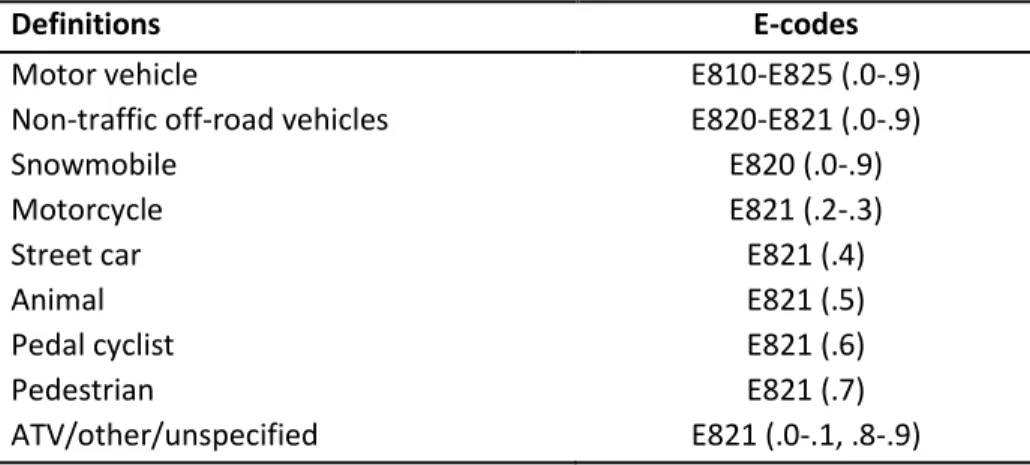
The NC DETECT database collects up to five Ninth Edition of the International
Classification of Disease – Clinical Modification (ICD-9-CM) external causes of injury codes
(E-codes) per visit. The database was queried for any ED visit with an E-code indicating motor
vehicle-related injury (E810-825). Then off-road vehicle-related injuries were defined as E-codes
in the range of E820-E821 (i.e. non-traffic accidents involving a motor-driven snow vehicle or
other off-road motor vehicles). Off-road vehicle-related injuries were further defined by the
type of off-road vehicle: E821 (.2-.3) off-road motorcycle and E821 (.0-.1,.8-.9)
ATV/other/unspecified (Table 1), referred to as “all-terrain vehicle (ATV)”. E821 (.0-.1,.8-.9) has
been used previously to identify ATV-related injuries.17,36,37 Visits with more than one code for
an off-road crash were assigned to a category based on the first-listed ICD-9-CM E-code.
Off-Road Vehicle Injuries in North Carolina Page 31 The following descriptive variables were analyzed: type of crash; age; sex; presenting
time of day grouped into 6 hour blocks, day of the week, and month of the year; ICD-9-CM
diagnosis codes; disposition; mode of transportation to ED; expected source of payment; chief
complaint; and county of residence. Type of crash, age, and sex had similar results for 2010 and
2011, and the decision was made to analyze the remaining variables for only 2011.
Results for each variable were reported as whole numbers and percentages. Counts of
less than 10 were not reported. Rates were calculated using estimated 2011 NC population
reported in the National Center for Health Statistics Bridged Population File38 and reported per
100,000 person-years for type of MVC, sex, age, and county of residence. Age was grouped by
five years from 0-4 and every ten years from 5-84. The age group 10-34 years was further
divided into one year increments. ICD-9 CM code data were used to create a Barell injury
diagnosis matrix.39 The Barell injury diagnosis matrix uses ICD-9-CM codes to classify injury by
body region and nature of injury. A map of North Carolina off-road vehicle-related injury rates
by county was generated using ArcGIS version 10. The same variables were compared to the
larger populations of all MVC-related injuries (ICD-9-CM E810-E825) during the identical 2010
and 2011 study period to identify any trends that may be unique to off-road vehicle-related
injuries.
Data analysis using descriptive statistics was performed utilizing SAS version 9.3. The
study was exempted by the UNC School of Medicine Institutional Review Board and approved
by the North Carolina Division of Public Health, with NC DETECT ED visit data provided through
a Data Use Agreement.
Off-Road Vehicle Injuries in North Carolina Page 32 Off-Road Vehicles:
A total of 4,671 off-road crash related ED visits were identified for 2011, representing
3.4% of all MVC related ED visits. ED visits for injury resulting from off-road crashes occurred at
a rate of 48.4 per 100,000 person-years (Table 2). Twelve of one hundred counties had a rate of
ED visits for injury from off-road crashes greater than 100 per 100,000 person-years (Ashe,
Avery, Bertie, Cleveland, Graham, Halifax, Lincoln, Northampton, Robeson, Rutherford,
Scotland, Stokes, and Swain) (Figure 1). Injuries resulting from off-road crashes and treated in
the ED included 28.2% upper extremity injuries, 22.5% lower extremity, 14.9% head/face/neck,
14.7% torso, and 7.5% vertebral column (Table 3). Nature of injury was 32.2% superficial
wounds/contusions, 20% fracture, 16.2% sprains and strains, 8.3% open wound, and 5.1%
internal organs (Table 3).
ATVs:
ATVs account for roughly 77% of off-road vehicle crash related ED visits and occurred at
a rate of 37.3 per 100,000 person-years (Table 4). Most patients (70%) seen in the ED for ATV
injuries were male (Table 5). Persons under the age of 15 accounted for 22.7% of ATV crash
related ED visits; 51.3% were age 15-34, and 25.8% were age 35 and over (Figure 2).
The greatest frequency of ATV-related ED visits was during the spring and summer
months of April through July. The bulk of ATV-related injuries presented to the ED on
weekends. The greatest proportion of ATV-related injuries presented to EDs between noon and
midnight (Figure 3).
A majority of ATV-related injury ED visits were walk-ins (70.1%) and 10.9% arrived to the
Off-Road Vehicle Injuries in North Carolina Page 33 32.4% private insurance, 32.3% self-pay, and 21.8% Medicaid. Approximately 88.4% of ED visits
for ATV-related injury resulted in the patient being discharged home and for only 4.8% was the
patient admitted to the hospital (Table 6).
Motorcycles:
Approximately 20% of off-road vehicle crash related ED visits were due to motorcycles,
occurring at a rate of 9.8 per 100,000 person-years (Table 4). Most patients (84%) seen in the
ED for off-road motorcycle-related injuries were male (Table 5). Children under the age of 10
accounted for 23% of off-road motorcycle-related injuries; 56.5% were age 15-34, and 18.2%
were over age 35 (Figure 2).
The greatest frequency of off-road motorcycle-related ED visits was during the spring
and early summer months of April through June. The majority of off-road motorcycle-related
injuries presented to the ED on weekends. The greatest proportion of off-road
motorcycle-related injuries presented to EDs between noon and midnight (Figure 3).
For approximately 74.7% of ED visits for off-road motorcycle-related injury, the patient
arrived to the ED as a walk-in and for 9.3% of visits the patient arrived via ground ambulance.
Thirty-seven percent of off-road motorcycle-related injury visits were expected to be paid by
private insurance, 32.8% by self-pay and 20.4% by Medicaid. A majority of off-road
motorcycle-related injury ED visits resulted in the patient being discharged home (90.4%), and only 4.2%
visits resulted in the patient being admitted to the hospital (Table 6).
Discussion:
Since their introduction in the early 1970s, off-road vehicles have gained popularity for
Off-Road Vehicle Injuries in North Carolina Page 34 injuries and deaths related to their use.36,40,41 This study is the first to use NC DETECT ED visit
data to describe ATV-related injuries over a full calendar year. Prior studies have looked at
off-road vehicle-related injuries in smaller populations by using trauma registries and hospital
discharge databases.10-12,17,23,24,42,43 In North Carolina, over 90% of the ED patients treated for
off-road vehicle crash related injuries were discharged home from the ED and would not have
been included in the NC trauma registry or hospital discharge database.
Children and males were identified as populations that are especially vulnerable to
off-road vehicle-related injuries. Children under that age of 16 accounted for roughly 26% of
ATV-related injuries, while only comprising 14% of ATV operators.3 This is similar to CPSC findings
where 25-30% of ATV-related injuries are in riders younger than 16 years old.2,3,21 Furthermore,
other studies have reported similar patterns of injury from off-road vehicle crashes.6-8 The
extremities and head are especially vulnerable to injury because off-road motorcycles and ATVs
leave the extremities and head exposed compared to other motor vehicles. Our findings also
suggest that off-road vehicle injuries are more common in rural settings, during warm months,
and on the weekend. This is likely due to the use of off-road vehicles in rural locations for
occupational and recreational purposes, thus leading to the increased injury rates in rural
counties.
A major concern from our findings is that a significant number of injuries are still
occurring in children and young adults. Injury prevention strategies consist of three approaches:
education; engineering/environmental modification; and legislation.9 All three approaches have
been used to prevent off-road vehicle-related injuries, but state legislation has been by far the
Off-Road Vehicle Injuries in North Carolina Page 35 In North Carolina, children as young as 8 years old are allowed to operate ATVs on
public lands. ATV engine size restrictions are present for children age 8-15 years. ATV operators
are not permitted by law to carry a passenger unless the ATV is specifically designed to allow
passengers. Operators must wear DOT approved helmet and goggles. ATVs are not to be driven
on public roads, except for crossing. Finally, ATV operators born after January 1, 1990 must
obtain a safety certificate by successfully completing an All-Terrain Safety Institute sponsored
or approved ATV safety course.44
Appropriate legislation should dramatically improve safety, because it provides a
standard for an entire population. Two studies looked specifically at the effectiveness of North
Carolina ATV legislation with regards to ATV-related injuries and deaths. Beidler et al. found
that children under the age of eight years were seriously injured or died less often due to
injuries sustained in ATV-related crashes; however, injuries and deaths among all ATV riders did
not change following enactment of ATV legislation.11 McBride et al. found no significant
changes in the children injured before and after ATV legislation.12 Numerous other studies have
also found that state ATV legislation has not caused significant changes in ATV-related injuries
and deaths.13,14,17 These studies suggest two flaws of legislative injury prevention approaches
that could limit its effectiveness, namely compliance and enforcement. Compliance is
dependent on the ATV operator to abide by legislation and enforcement is dependent on the
state having sufficient resources to enforce legislation.
Another concern regarding legislative approaches is that they are not effective even
when ATV operators are in compliance with the law. A study by Winfield et al. of Florida ATV
Off-Road Vehicle Injuries in North Carolina Page 36 in injury patterns, outcome measures, or mortality.10 Future injury prevention approaches need
to focus on education aimed at changing behavior and safety knowledge of ATV operators. Prior
studies have found ATV safety education to have a significant effect on ATV safety behavior and
knowledge,16,20 but only 4-14% of injured ATV operators have completed formal safety
education.4,19 Thus, we believe there needs to be more focus on education of ATV riders similar
to recommendations by Winfield et al.10 They recommended Florida add legislation requiring
ATV operators to register their ATV and successfully complete a safety training course.10
Our recommendation is legislation enhancement that requires all ATV operators to
complete registration of their ATV and retailers to enroll purchasers in a safety training course
at the time of purchase. The purpose of required ATV registration is to aid in completion of a
safety training course already required under North Carolina law. Individuals who purchase an
ATV from a non-retailer source would be required to enroll in a safety training course at the
time of ATV registration, while retailers would be required to enroll individuals in safety training
courses at the time of sale.
In summary, off-road vehicles are a major cause of injury in North Carolina. ATV crashes
continue to be a major source of injury in children and young adults. Current legislative
approaches of ATV injury prevention have focused on restricting ATV use for children. However,
ATV legislation has not been shown to significantly change ATV-related injuries and deaths. In
order to improve the impact of ATV legislation, we recommend requiring ATV registration and
enrollment in safety training course at the time of purchase. The goal would be to aid in
Off-Road Vehicle Injuries in North Carolina Page 37 knowledge about injury resulting from ATV crashes and promote discussion of ATV injury
prevention.
Limitations:
Most of the limitations of our study are because it was a retrospective review using
secondary data. The use of the NC DETECT data limited the number and types of variables that
could be analyzed. For example, NC DETECT data do not contain helmet usage information. This
information could have been useful to determine if helmet use or non-use influenced head and
neck injuries, which represented 19.4% of the injuries. The effectiveness of helmets has been
the focus of a number of studies and most have associated helmet use with a lower risk of head
injury.6,15,25 Also, the NC DETECT data contain no information on alcohol use or ATV size. The
information would have allowed us to determine if operating an ATV under the influence or
ATV size influence injury type. Additionally, North Carolina legislation clearly states that all ATV
operators are to wear DOT approved helmets, ATVs are not to be operated under the influence,
and that children age 8-15 years old can only operate ATVs of a specific size.44 Access to these
variables would have allowed us to measure compliance with current legislation but none of
these variables are captured in routinely collected injury data sources in NC.
Furthermore, the information included in the NC DETECT data presented certain
limitations. NC DETECT data include ICD-9-CM coded E-codes, and these were used to define
cases. The ICD-9-CM E821 code is not specific to ATVs, and may have identified cases of “other”
off-road vehicle crashes (i.e. golf carts, go-carts, and dune buggies). Case identification should
Off-Road Vehicle Injuries in North Carolina Page 38 Tables/Figures:
Table 1. External cause of injury code (E-code) definitions for off-road
crashes
Definitions E-codes
Motor vehicle E810-E825 (.0-.9)
Non-traffic off-road vehicles E820-E821 (.0-.9)
Snowmobile E820 (.0-.9)
Motorcycle E821 (.2-.3)
Street car E821 (.4)
Animal E821 (.5)
Pedal cyclist E821 (.6)
Pedestrian E821 (.7)
Off-Road Vehicle Injuries in North Carolina Page 39 Table 2. Off-road and all on/off-road motor vehicle (All MVC) crashes in North Carolina during 2010
and 2011a
2010 2011 Total
Number Rate Number Rate Number Rate
Off-road crashes 4,526 47.5 4,671 48.4 9,197 47.9
All MVC 138,540 1,452.9 139,028 1,439.7 277,568 1,446.3
aDenominator is based on the estimated 2010-2011 NC population reported in the NCHS Bridged Population File; rates are reported per
Off-Road Vehicle Injuries in North Carolina Page 40 Table 3. The Barell injury diagnosis matrix based on ICD-9-CM codes for classification by body region and nature of injury for
off-road crashes in North Carolina during 2011a,b
Nature of injury
Body region of injury Total
Head and neck Spine and back Torso Extremities Unclassifiable by site
Traumatic brain injury
Other head, face, and neck
Spinal cord Vertebral column
Torso Upper Lower Other and unspecified
System-wide and late effects
# % # % # % # % # % # % # % # % # % # %
Fracture 21 0.5% 40 0.9% <10 -- 60 1.4% 100 2.3% 423 9.9% 206 4.8% <10 -- -- -- 854 20.0%
Dislocation 0 0.0% <10 -- 0 0.0% 74 1.7% 17 0.4% 93 2.2%
Sprains and strains 0 0.0% 261 6.1% 56 1.3% 173 4.0% 180 4.2% 24 0.6% 694 16.2%
Internal organs 170 4.0% <10 -- 46 1.1% 0 0.0% 217 5.1%
Open wound 174 4.1% 12 0.3% 70 1.6% 96 2.2% <10 -- 357 8.3%
Amputations <10 -- <10 -- <10 --
Blood vessels 0 0.0% <10 -- 0 0.0% <10 -- 0 0.0% <10 --
Superficial wounds/contusions
186 4.3% 339 7.9% 317 7.4% 337 7.9% 201 4.7% 1380 32.2%
Crush 0 0.0% <10 -- <10 -- <10 -- 11 0.3%
Burns 0 0.0% <10 -- <10 -- 11 0.3% <10 -- 19 0.4%
Nerves 0 0.0% <10 -- 0 0.0% <10 --
Other and unspecified
236 5.5% 73 1.7% 140 3.3% 107 2.5% 86 2.0% 642 15.0%
Total 191 4.5% 636 14.9% <10 -- 323 7.5% 630 14.7% 1207 28.2% 961 22.5% 322 7.5% <10 -- 4280 100.0%
Missing: 391 ED visits (8%) were missing an ICD-9-CM code in the range of 800-999
a
Off-Road Vehicle Injuries in North Carolina Page 41 Table 4. Off-road crashes by type in North Carolina during 2010 and 2011
2010 2011 Total
Number Percent Rate Number Percent Rate Number Percent Rate
ATV/other/unspecified 3,571 78.9% 37.4 3,601 77.1% 37.3 7,172 78.0% 37.4
Motorcycle 828 18.3% 8.7 949 20.3% 9.8 1,777 19.3% 9.3
Pedestrian 77 1.7% 0.8 72 1.5% 0.7 149 1.6% 0.8
Snowmobile 22 0.5% 0.2 28 0.6% 0.3 50 0.5% 0.3
Pedal cyclist 17 0.4% 0.2 14 0.3% 0.1 31 0.3% 0.2
Street car 11 0.2% 0.1 <10 -- -- 17 0.2% 0.1
Animal 0 0.0% 0 <10 -- -- <10 -- --
Off-Road Vehicle Injuries in North Carolina Page 42 Table 5. Frequency and Rate of off-road motorcycle and off-road ATV/other/unspecified crashes by sex compared to
all on-road and off-road motor vehicle crashes in North Carolina during 2011
Off-Road Motorcycle ATV/other/unspecified All MVC
Number Percent Rate Number Percent Rate Number Percent Rate Sex
Female 152 16.0% 3.1 1,074 29.8% 21.7 72,426 52.1% 1,462.4
Male 797 84.0% 16.9 2,527 70.2% 53.7 66,589 47.9% 1,415.7
Missing 0 0.0% -- 0 0.0% -- 13 <0.1% --
Off-Road Vehicle Injuries in North Carolina Page 43 Table 6. Frequency of off-road motorcycle and off-road ATV/other/unspecified crashes by mode of transportation to the
ED, payment type, and ED disposition compared to all on-road and off-road motor vehicle crashes in North Carolina during 2011
Off-Road Motorcycle ATV/other/unspecified All MVC
Number Percent Number Percent Number Percent
Mode of Transportation
Walk-ina 709 74.7% 2,525 70.1% 72,042 51.8%
Ground ambulance 88 9.3% 393 10.9% 40,452 29.1%
Air ambulanceb <10 -- 31 0.9% 752 0.5%
Ambulance, unspecified <10 -- 48 4,626
Other mode of transportation 25 2.6% 154 4.3% 4,064 2.9%
Missing 117 12.3% 448 12.4% 17,092 12.3%
Payment Type
Private insurance 355 37.4% 1,166 32.4% 51,358 36.9%
Self-pay 311 32.8% 1,164 32.3% 47,732 34.3%
Medicaid 194 20.4% 786 21.8% 17,564 12.6%
Medicare 21 2.2% 138 3.8% 6,302 4.5%
Other government payment 20 2.1% 85 2.4% 2,291 1.6%
Workers' compensation <10 -- 29 0.8% 2,637 1.9%
Other form of payment 26 2.7% 171 4.7% 7,723 5.6%
Missing 18 1.9% 62 1.7% 3,421 2.5%
Disposition
Discharged 858 90.4% 3,183 88.4% 125,988 90.6%
Admittedc 44 4.6% 174 4.8% 5,632 4.1%
Transferred 24 2.5% 128 3.6% 2,326 1.7%
Left against /without medical advice <10 -- 43 1.2% 1,436 1.0%
Died 0 0.0% <10 -- 220 0.2%
Other dispositiond <10 -- 20 0.6% 399 0.3%
Off-Road Vehicle Injuries in North Carolina Page 44
Total 949 100.0% 3,601 100.0% 139,028 100.0%
a
Includes walk-ins following transport via private vehicle, public transportation, law enforcement, and not otherwise specified b
Includes fixed wing and helicopter ambulance C
Includes patients admitted to the hospital, intensive care unit (ICU), or psychiatry d
Off-Road Vehicle Injuries in North Carolina Page 46 Figure 2. Frequency of off-road motorcycle and off-road ATV/other/unspecified crashes by age compared to all on-road and off-road motor vehicle crashes in North Carolina, 2011
0.0% 5.0% 10.0% 15.0% 20.0% 25.0% 30.0% 35.0% 40.0%
0-4 5-14 15-24 25-34 35-44 45-54 55-64 65-74 75-84 85+
Motorcycle ATV/other/unspecified All MVC
0.00% 1.00% 2.00% 3.00% 4.00% 5.00%
10 11 12 13 14 15 16 17 18 19 20 21 22 23 24 25 26 27 28 29 30 31 32 33 34
Off-Road Vehicle Injuries in North Carolina Page 47 Figure 3. Frequency of off-road motorcycle and off-road ATV/other/unspecified crashes by month, day of week, and hour of day compared to all on-road and off-road motor vehicle crashes in North Carolina, 2011
0.0% 2.0% 4.0% 6.0% 8.0% 10.0% 12.0% 14.0%
Motorcycle ATV/other/unspecified All MVC
0.0% 5.0% 10.0% 15.0% 20.0% 25.0% 30.0%
Sunday Monday Tuesday Wednesday Thursday Friday Saturday
Off-Road Vehicle Injuries in North Carolina Page 48
0.0% 5.0% 10.0% 15.0% 20.0% 25.0% 30.0% 35.0% 40.0% 45.0%
12-5:59 AM 6-11:59 AM 12-5:59 PM 6-11:59 PM