Attachment A
One vs. two paramedics: Does ambulance crew configuration affect scene time or performance of certain clinical skills?
By
Eric Hawkins
A Master's Paper submitted to the faculty of the University of North Carolina at Chapel Hill
In partial fulfillment of the requirements for the degree of Master of Public Health in
the Public Health Leadership Program.
Chapel Hill
Abstract
Background: Emergency Medical Services (EMS) organizations have a wide range of options in the design and composition of their individual
systems. Many have opted to provide a paramedic on every emergency
call in a single-tiered response plan, but little evidence exists to
demonstrate that ambulances staffed with two paramedics provide a
different level of care than those with a single paramedic and another
prehospital provider. The Wake County EMS System is unique in that one
half of all ambulances have dual paramedic crews while the other half has
single paramedic crews, all under the same organization and training.
Objective: The purpose of this study is to compare scene times and performance of specific clinical skills for two-paramedic and one
paramedic crews for a variety of high acuity emergency response
scenarios. Methods: We conducted a retrospective cohort study by
examining electronic medical records from the Wake County EMS system
from 6/1/2003 to 6/1/2006. We selected patients treated for traumatic
injuries, cardiac arrest, cardiac emergencies, and respiratory distress that
required emergent transport using lights and sirens. For these clinical
scenarios, we defined our cohort as patients that received response from
ambulances with a Two Paramedic Crew (TPC) versus those with a Single
Paramedic Crew (SPC). For each group, we abstracted information on
patient demographics, scene times, placement of IVs, and performance of
with T-Tests for all means and categorical data using Chi Square of
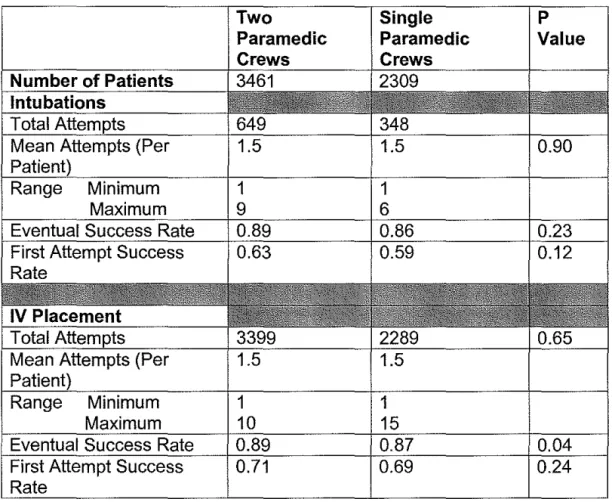
Fisher's Exact test. Results: A total of 5,770 patients met inclusion
criteria for all clinical scenarios. For scene time for all patients, no
significant difference between TPC vs. SPC groups was noted (17.8 vs.
17.6 minutes, p
=
0.35). When stratified by clinical scenario, TPC groupshad a non-significant shorter scene time for trauma and cardiac arrest
patients and SPC groups had a shorter scene time for respiratory distress.
No difference was seen between groups for cardiac emergencies. For all
intubations, TPC groups had a slightly higher rate of success for both
eventual success (0.89 vs. 0.86, p=0.23) and first attempt success (0.63
vs. 0.59, p=0.12) when compared to SPC groups. For IV placement, TPC
groups had a small but significant higher rate of eventual success (0.89
vs. 0.87, p=0.04), but not for success on IV placement on the first attempt
(0.71 vs. 0.69, p = 0.24). When stratified by clinical scenario, TPC and
SPC groups did not differ significantly on performance of either intubation
of IV placement for any group. Conclusions: We noted that TPC
ambulances had similar scene times and slightly improved rates of
intubation and IV placement success when compared to SPC staffed
ambulances. These differences were small and should be placed in
context with the clinical scenario. For our four groups of high-acuity
patients there was little difference noted if care was provided by either a
Introduction
Emergency medical services (EMS) systems across the United
States have a wide variety of organizational designs and strategies to
provide prehospital care 1· 2. In broad terms, systems may chose to deploy ambulances with all basic life support (BLS) personnel, all advanced life
support (ALS) personnel, or a hybrid system of units staffed with providers
with various levels oftraining3. Most EMS organizations evolved without the benefit of evidence-based guidelines or research on optimal
ambulance crew configurations and many current system designs reflect
early political or economic decisions instead of evidence on optimal
patient care or efficiency of deployed resources.
While there has been much investigation and debate on providing
BLS vs. ALS staffed ambulances3· 4, little work has been published comparing these options to ambulances staffed with configurations of
personnel with different training. A prospective cohort study of "Advanced
Paramedic Skilled Units" in Melbourne, Australia found that ambulances
with two paramedics had longer scene times, attempted more ALS
procedures on-scene, and had a non-statistically significant higher rate of
failures for these procedures when compared with teams with one
paramedic and a BLS provider5. However, the specific types of procedures were not defined and no information on the medical
indications for each procedure or the eventual outcome for any patients
higher failure rates by two paramedic teams were due to the higher
number of attempted procedures, but did not address the issue further.
Recently, the New York City Fire Department has considered
changing their policies to move from a system of two paramedic-staffed
ambulances to one with hybrid units of a paramedic and an emergency
medical technician (EMT)6. They report this new policy is necessary because a current nationwide paramedic shortage has prevented hiring
sufficient numbers of ALS-trained paramedics and that such a system
could improve their disaster response capability and average emergency
response time for the system. In considering this change in policy, they
note that "There is no published data that shows improved clinical
effectiveness by ALS ambulances that are staffed with two paramedics."6 It is also noteworthy that there are no published data that show the clinical
effectiveness of ALS ambulances staffed with one paramedic and one
BLS provider.
To further investigate the issue of optimal ambulance crew staffing
configuration, we conducted a retrospective cohort analysis of specific
emergency response calls from the Wake County EMS System. This
system is unique for the present study because half of all ambulances are
staffed with two paramedics and half with a paramedic and a BLS
provider. Our purpose was to compare specific clinical parameters of
between ambulances with two ALS trained paramedics versus those with
a single paramedic and a BLS provider.
Methods
Study Design. We conducted a retrospective cohort analysis using three years of archived prehospital patient care reports from the Wake County
EMS quality improvement database. Because this study examined a
database of existing electronic medical records collected for quality
assurance purposes, the University North Carolina School of Medicine
Institutional Review Board approved all study components and waived
requirements for informed consent.
Study Setting and Population. The Wake County EMS System is the sole provider of emergency prehospital services in Wake County, North
Carolina, serving an estimated population of 719,520 and covering a
geographic area of 832 square miles. Annually, the system responds to
an average of 65,000 emergency calls and transports an average of
45,000 patients to local hospitals.
The system operates a multi-component, single-tiered ambulance
response system to provide patient care for all emergency response calls,
with a total of 250 ALS providers operating from 33 ambulances.
Fire-department based first-responders (FR) provide BLS care for all
because of their wide geographic disbursement throughout the county.
Ambulance crews respond with either two ALS-trained paramedics or a
paramedic and a BLS provider. This second provider may include an
EMT-Intermediate or an EMT-Basic. Thus, all calls are evaluated by an
ALS capable ambulance and crews do not differ in their equipment or
ability to perform any advanced ALS procedure or treatment protocol if
deemed necessary. There is no protocol or procedure to send a specific
type of ambulance crew to any type of call based on patient criteria or
acuity from the EMS dispatch center and the choice of the responding unit
is based on ambulance availability and geographic proximity to the
location of the emergency call. Within the system, individual paramedics
may predominantly work in a two paramedic crew, a single paramedic
crew, or both but tend to work in either one configuration or another the
majority of the time.
Study Protocol. All data for the study originated from the Wake County EMS Quality Assurance Database, which contains over 300,000 archived
records of patient care encounters for emergency response calls. These
medical records are completed by paramedics after each call and are
recorded concurrently in the database. For patients with cardiac arrest,
these records are linked to hospital reports, with admission, treatment,
electronic records. System administrators review this database for a wide
variety of quality assurance indicators on a regular basis.
From the database, we studied 4 specific populations based on
patient clinical condition from April 2003 to April 2006. These included
patients with traumatic injury, cardiac arrest, other cardiac emergencies,
and respiratory distress based on information provided paramedics from
the emergency call. To select higher acuity patients who might require
more ALS procedures, we only included those transports that were
considered emergent and used lights/sirens for transport to the hospital
based on the clinical judgment of the ambulance crew.
For each clinical scenario, we identified the configuration of the
responding ALS ambulance crew and created two groups for analysis.
We identify these "Two Paramedic Crew" (TPC) or "Single Paramedic
Crew" (SPC) cohorts based on the documentation in each patient record.
From there, we extracted information on patient demographics, scene
times for each call, and performance of the clinical procedures of
placement of intravenous {IV) lines and endotracheal intubation for each
category of call. Wake EMS does not use rapid sequence intubation and
has no protocols for sedation-facilitated intubation. For each clinical
procedure, we recorded the number of attempts per patient and the
outcome of each attempt. For cardiac arrests we also recorded hospital
admission and discharge rates of all patients. We excluded those patient
patients under the age of 15, and any crew configuration that did not
include a paramedic.
Measurement. For each of the four categories of emergency calls, we focused on the elements of scene time and the completion of specific
procedures. We defined "scene time" as the interval between the arrival
of the ambulance unit and the departure of that unit from the scene. All
times rely on the record of emergency dispatch system and their official
central clock and computerized time-keeping software.
For performance of clinical procedures, we define each as follows.
For IV line placement, we defined an "attempt" as any self-reported and
documented effort to place an IV line placement and "success" as
self-reported completion of the procedure. For endotracheal intubation {ETI),
we similarly defined an "attempt" as any self-reported attempt to intubate
the patient and "success" as documented completion of placement of the
endotracheal tube. From these definitions, we define an "eventual
success rate" as dichotomous eventual success divided by the total
number of attempts required. For a "first attempt success rate," we
defined a dichotomous success for procedural completion on the first
attempt divided by the number of total first attempts for both procedures.
We also calculated a "mean attempt per patient" to measure how many
mutually exclusive and it is possible that a patient could receive an ETI
attempt, an IV attempt, or both.
Data Analysis. We abstracted all information into Microsoft Access 2003 (Microsoft Corp., Redmond, WA) and analyzed all data using SPSS
version 14.0 (SPSS Inc., Chicago, ILL). For all data, we calculated means
for continuous variables and calculated percent frequencies for categorical
variables of procedural success rates. To compare groups of continuous
variables, we performed independent t-tests on all means. For
comparisons of categorical data, we used Chi-Square testing and Fisher's
exact test when appropriate. Because we have little background
information on our research question and because this retrospective
design was intended to generate hypotheses and information for future
study, we had no initial power calculations for our analysis and analyzed
all data that met our inclusion criteria.
Results:
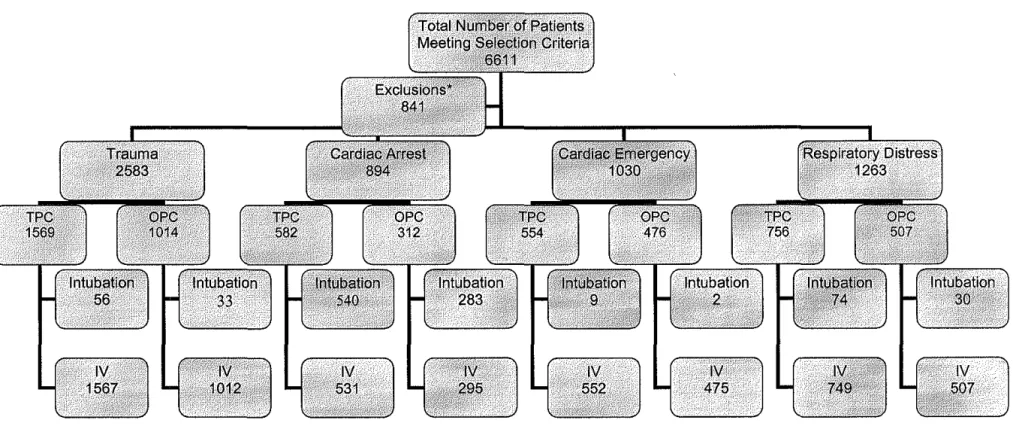
During the 3 year study period we identified 6611 patients who met
criteria for our 4 clinical scenarios. Of these, 841 patients did not meet
inclusion criteria and were thus removed from all data analysis because
they were under the age of 15 or had no record of the ambulance crew
configuration, resulting in a final study population of 5770. Table 1
our two paramedic crew (TPC) and single paramedic crew (SPC) and
provides basic demographic information on each group.
For the entire study population, were found no significant
differences in scene time when we compare calls from TPC versus SPC
groups ( 17.8 vs. 17.6 minutes, p = 0.35). When we stratified our study by
clinical scenario, the TPC groups had slightly shorter scene times when
compared to SPC groups for trauma and cardiac arrest patients, but these
differences were not statistically significant. For the SPC group, only the
respiratory distress group had a lower scene time (Mean difference= 1.6
minutes, 95% Cl 0.9 to 2.3 minutes, p<0.001 ). Results for scene times
are summarized in Table 2.
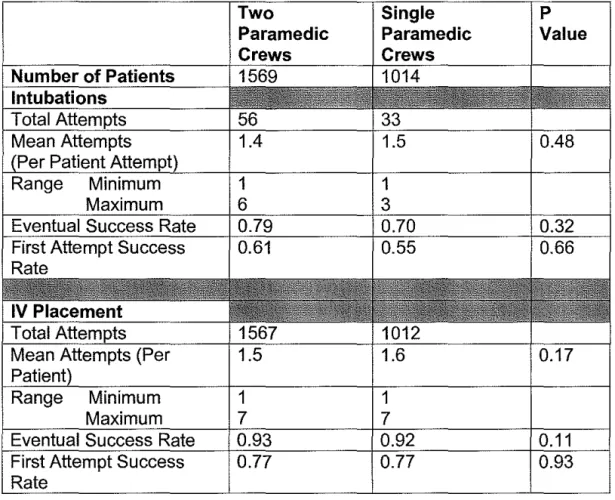
For our trauma group, 2,583 patients met inclusion criteria and all
were included for analysis. Two paramedic crews attempted 56
intubations versus 33 attempted in the single paramedic crew group, but
there was no statistically significant difference in number of procedures
performed per patient (Mean 1.4 vs. 1.5, p = 0.48). Overall, the TPC
group had a greater eventual success rate for completion of the intubation
procedure (79% vs. 70 %), but this difference was not statistically
significant (p = 0.32). Similarly, the TPC group had a higher rate of
success on their first attempt at intubation when compared to the SPC
group (61% vs. 55%), but this difference failed to reach statistical
compared to SPC teams (mean 1.5 vs. 1.6, p=0.17). Rates of IV
placement were similar for both eventual success (93% vs. 92%, p = 0.11)
and for success on the first attempt (77% vs. 77%, p = 0.93) in both
groups.
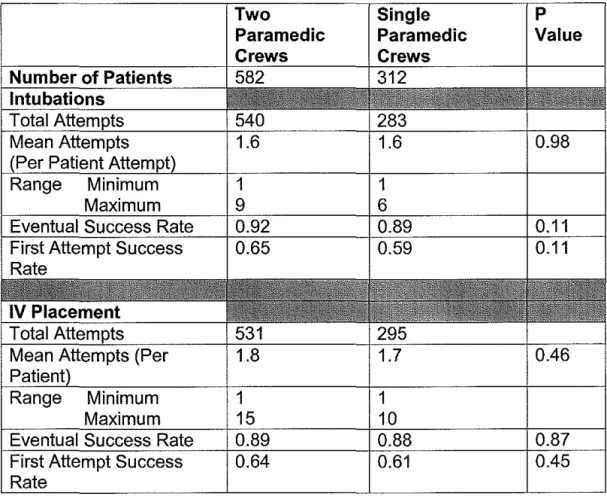
For cardiac arrest, 894 patients met inclusion criteria. Comparing
TPC and SPC teams, each attempted 582 and 312 intubations
respectively and the groups did not differ in their number of attempts per
patient (1.6 vs. 1.6, p = 0.98). Two paramedic crews also had a higher
non-significant rate of eventual intubation success (0.92 vs. 0.89, p = 0.11)
and on first-attempt success (0.65 vs. 0.59, p = 0.11 ). For placement of
IVs, two paramedic teams attempted 531 procedures and one paramedic
teams attempted 295, with no significant difference in the number of
attempts per patient (1.8 vs. 1.7, p = 0.46). For IV placement, the two
types of crews had similar rates of eventual procedural success (0.89 vs.
0.88, p = 0.87) as well as success on the first attempt (0.64 vs. 0.61, p =
0.45).
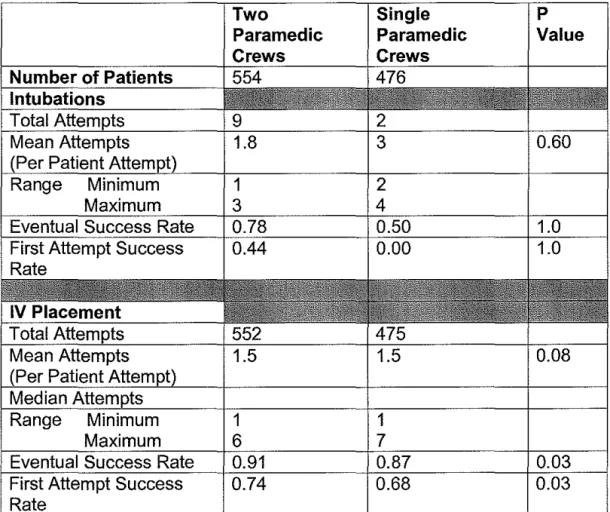
For cardiac emergencies, 1030 patients met criteria for inclusion for
analysis. TPC teams attempted more intubations than SPC Teams (9 vs.
2), but attempted less intubations per patient (1.8 vs. 3, p = 0.60). For
intubations, TPC Teams also had a higher success rate (0.78 vs. 0.50, p =
1.0) and had a higher rate of success on their first attempt when
compared to SPC teams(0.44 vs. 0.00, p = 1.0), but neither of these
attempted 552 procedures compared to 475 attempts in SPC group, but
the average number of attempts per patient was identical. TPC teams did
show a statistically significant higher rate of eventual IV placement (0.91
vs. 0.87, p
=
0.03) and a higher rate of success on their first attempt (0.74vs. 0.68, p
=
0.03).For respiratory distress, 1263 patients met inclusion criteria. For
intubations, TPC teams attempted more procedures than SPC teams (74
vs. 30), but no difference in attempts per patient was seen (1.3 vs. 1.4, p
=
0.52). SPC teams had more success in eventual intubation (0.83 vs. 0.74,
p = 0.32) and in successful completion of intubation on the first attempt
(0.67 vs. 0.64, p
=
0.76), but neither of these differences in success ratesreached statistical significance. For IV Placements, the TPC group
attempted more procedures than SPC group (749 vs. 507), but the mean
number of attempts (1.5 vs. 1.5, p
=
0.52), eventual success rate (0.79 vs.0.79, p
=
0.88), and success rate on the first IV attempt (0.59 vs. 0.58, p=
0.99) was virtually identical for each type of team.
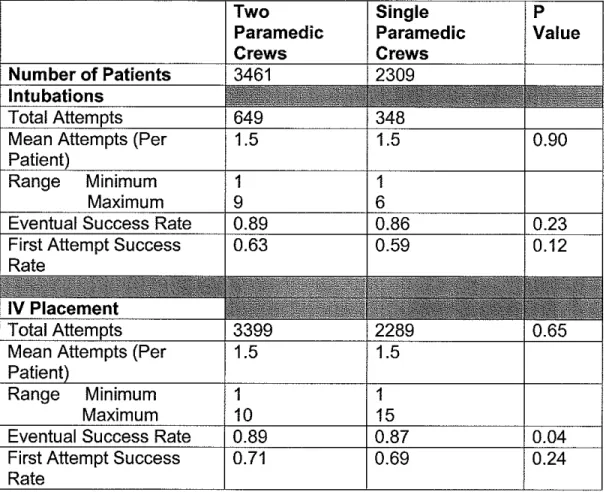
For all patient groups, we pooled all procedural data for similar
analysis and results are summarized in Table 3. For intubation, we noted
no differences in the number of attempts between groups but did see a
non-significant higher rate of success in the TPC group for both eventual
success (0.89 vs. 0.86, p
=
0.23) and first-attempt success (0.63 vs. 0.59,statistically significant higher rate of success when compared to the SPC
group (0.89 vs. 0.87, p
=
0.04). The rate of first attempt IV success wasslightly higher in TPC groups (0.71 vs. 0.69, p
=
0.24), but this result wasnot statistically significant.
Discussion
Our data demonstrate that ambulances staffed with two paramedics
do not have considerably different scene times but may have slightly
higher rates of success on performance of intubation and IV placement
when compared to single paramedic crews.
Our findings are in contrast to work by Kelly and Currell, who
reported that "AII-APS Crews" had statistically significant longer scene
times of 1.38 minutes when compared to "Mixed Crews" for all types of
critical patients5. We saw no such difference in our study population when all patient records were combined and found that our similar group of two
paramedic crews had virtually identical scene times when compared to
single paramedic crews. However, we did note that two paramedic crews
had slightly lower scene times for trauma and cardiac arrest patients when
compared to single paramedic crews (0.6 and 0.4 minutes respectively),
but that these differences were not statistically significant. We also noted
an increase in scene times for two paramedic crews for respiratory
distress patients, but it is unclear why these results differ from our other
decrease in success for any advanced procedure in the two paramedic
crew group and noted a general trend of greater procedural success for
the TPC group across all subgroups except for respiratory distress.
In examination of our data of differences in scene times between
our ambulance crew configurations, it is important to note that
interpretation of our results should take the clinical situation of each
scenario into consideration. For example, our 0.6 minute difference in
scene time in our trauma groups may or may not be clinically significant
for this population given the importance time to hospital treatment in
critically injured patients. In contrast, our findings for cardiac arrest are
unlikely to be clinically important given that differences in scene time in
cardiac arrest patients has not been established as an independent risk
factor for survival or adverse outcomes7. For any EMS system, the clinical
significance of scene time should be evaluated on an individual basis and
application of our results should be considered in context of local
situations and system goals. However, our results do show that the
magnitude of scene time differences between our different paramedic
crew configurations are relatively small and do not support concerns that
two paramedic crews might have prolonged scene times by attempting
more procedures on scene.
Our data documenting success rates of intubation are consistent
scenario are consistent with other studies showing that intubation is easier
in cardiac arrest patients than in non-arrest or trauma patients who not
receive rapid sequence intubation (RSI) or paralytic agents to facilitate the procedure 11, 13, 14.
When comparing two paramedic crews to single paramedic crews,
it is unclear why the two groups differ in their success rates for
performance of ETI and it is debatable if these relatively small differences
are clinically significant. Previous work has shown that procedural
competence in performance of ETI is higher in paramedics who perform
the procedure more often 15 and it could be argued that the higher number of cases requiring ETI in all TPC clinical scenarios could increase success
through a practice effect for this group of paramedics. However, the
actual number of procedures performed per-paramedic in the TPC group
is impossible to determine from our database and it is likely that certain
providers perform the procedure more often relative to others in this
group. This is reasonable given that previous studies have demonstrated
that the numbers of ETI attempts are not uniform in a given paramedic
population and that many paramedics may go years without attempting
intubation at all16• 17. Our findings also show that TPC and SPC groups do not differ in their number of intubation attempts per patient and this is
consistent with published reports documenting that as many as 30% of all
prehospital intubations require multiple attempts per patient before
that one paramedic crews could improve procedural competence by
focusing the procedure the hands of fewer providers, thus creating a
potential practice effect that could increase success rates through greater
attempts per provider. However, this is a difficult conclusion given the
relatively small differences seen between the TPC and SPC groups and
the lack of patient information that would allow our analysis to control our
procedural outcomes for patients with greater illness or injury severity.
Our results for completion of IV placement are also consistent with
previous studies documenting prehospital provider success for this
procedure18.20. Despite a statistically significant difference in the overall success rate of the procedure between our TPC and OPC groups (0.89
vs. 0.87, p
=
0.04), it is unlikely that this difference is clinically significant.This result is expected given that the numbers of IV procedures performed
is far in excess to ETI attempts, which would erode any difference in
procedural competence from a practice effect between the TPC and OPC
groups.
Limitations:
Several limitations of our study deserve mention and consideration.
First, we obtained all data retrospectively from a quality assurance
patients and it was thus impossible to control for these differences. In
selection of our four clinical groups, we chose patients who were
transported via ambulance using lights and sirens. For each call, the
decision on the type of transport was determined by each paramedic team
individually in all cases. It is possible that teams with two paramedics
could differ in their level of comfort of treating critical patients when
compared with one paramedic teams and that this difference could affect
the decision to use lights and sirens in transport. Therefore, it is possible
that our cohorts contain records of patients that differ in unmeasured ways
that affect our outcomes. In interpretation of this study and limitations in
our design, it is also important to note that this effort is primarily designed
to generate hypotheses about ambulance crew configuration and the
potential effect of paramedic staffing on patient care.
Similarly, our database contains no information on individual
paramedic or BLS providers. In our analysis, we have no way to compare
groups based on years of experience, number of procedures performed,
or any other measure on the provider level that could establish or predict
their clinical ability. In addition, all information recorded on patient care
procedures represents paramedic self-report data that may be incomplete
or subject to certain biases that under-report failure of clinical procedures.
In our formation of groups, we also treated all BLS providers equally when
compared to paramedics and given the differences in skills of EMT-B,
crews differ in unmeasured ways. Furthermore, it is possible that the
study of ambulance crews could be confounded by unequal distribution of
skills and responsibilities within the TPC group, especially if one partner
performs many more procedures or if there is unequal sharing of patient
care responsibilities. This type of situation could bias our results or
confound any comparison with the SPC groups in which the paramedic
must perform all advanced skills.
When applying these results to other EMS systems, it should be
noted that this study originated from a single prehospital system in a
single county and that our results may represent a cohort of paramedics
that are unique in their overall level of training, procedural competence,
and experience. Our organization is also a mixed urban/suburban system
and results here may not apply to more rural or urban locations. Similar
prospective studies should be performed in other EMS systems in other
types of geographic settings or on a national level to provide further
investigation of the complex issue of paramedic staffing on patient care.
Conclusions:
In our study, we found that ambulance teams with two paramedics
had similar scene times and slightly improved rates of endotracheal
intubation and placement of IV catheters when compared with single
paramedic teams. When stratified by four clinical scenarios, two
difference in scene times between cardiac emergency patients in either
group. We also found rates of eventual success and first-attempt success
of performance of endotracheal intubation and placement of IV catheters
had a higher trend in two paramedic crews, but that these results varied in
magnitude and statistical significance.
References:
1. National Highway Traffic Safety Administration. The National EMS Scope of Practice Model.
http://www.soundrock.com/sop/pdf/SoP Final Draft. pdf. Accessed April 30,2005.
2. Braun 0, McCallion R, Fazackerley J. Characteristics of midsized urban EMS systems. Ann Emerg Med. May 1990;19(5):536-546.
3. Persse DE, Key CB, Bradley RN, Miller CC, Dhingra A. Cardiac arrest survival as a function of ambulance deployment strategy in a large urban emergency medical services system. Resuscitation. Oct 2003;59(1 ):97-104.
4. Stout J, Pepe PE, Mosesso VN, Jr. All-advanced life support vs tiered-response ambulance systems. Prehosp Emerg Care. Jan-Mar 2000;4(1):1-6.
5. Kelly AM, Currell A Do ambulance crews with one advanced paramedic skills officer have longer scene times than crews with two? Emerg Med J. Mar 2002;19(2):152-154.
6. FDNY Wants to Change Paramedic Rules. Scene 911 Magazine; 2005:4. 7. Part 7.2: Management of Cardiac Arrest. Circulation. December 13,2005
2005;112(24_suppl):N-58-66.
8. Stewart RD, Paris PM, Winter PM, Pelton GH, Cannon GM. Field endotracheal intubation by paramedical personnel. Success rates and complications. Chest. Mar 1984;85(3):341-345.
9. Pointer JE. Clinical characteristics of paramedics' performance of endotracheal intubation. J Emerg Med. Nov-Dec 1988;6(6):505-509. 10. Doran N, Tortella BJ, Drivet WJ, Lavery RF. Factors influencing
successful intubation in the prehospital setting. Prehospital Disaster Med. Oct-Dec 1995;10(4):259-264.
12. Wang HE, Sweeney TA, O'Connor RE, Rubinstein H. Failed prehospital intubations: an analysis of emergency department courses and outcomes. Prehosp Emerg Care. Apr-Jun 2001;5(2):134-141.
13. Wang HE, Yealy DM. How many attempts are required to accomplish out-of-hospital endotracheal intubation? Acad Emerg Med. Apr 2006; 13( 4):372-377.
14. Garza AG, Algren A, Gratton MC, Ma OJ. Populations at Risk for Intubation Nonattempt and Failure in the Prehospital Setting. Prehospital Emergency Care. 2005;9:163-166.
15. Garza AG, Gratton MC, Coontz D, Noble E, Ma OJ. Effect of paramedic experience on orotracheal intubation success rates. J Emerg Med. Oct 2003;25(3):251-256.
16. Wang HE, Kupas DF, Hostler D, Cooney R, YealyDM, Lave JR. Procedural experience with out-of-hospital endotracheal intubation. Crit Care Med. Aug 2005;33(8):1718-1721.
17. Burton JH, Baumann MR, Maoz T, Bradshaw JR, Lebrun JE.
Endotracheal intubation in a rural EMS state: procedure utilization and impact of skills maintenance guidelines. Prehosp Emerg Care. Jul-Sep 2003;7(3):352-356.
18. Slovis CM, Herr EW, LondorfD, Little TD, Alexander BR, Gutlunann RJ. Success rates for initiation of intravenous therapy en route by prehospital care providers. Am J Emerg Med. Jul1990;8(4):305-307.
19. Spaite DW, Valenzuela TD, Criss EA, Meislin HW, Hinsberg P. A prospective in-field comparison of intravenous line placement by urban and nonurban emergency medical services personnel. Ann Emerg Med. Aug 1994;24(2):209-214.
Trauma Paramedic Crews 1569 36.1 582 63.5 554 63.3 Single Paramedic Crews 1014 37.4 312 63.9 476 63.8 68.1
Table 2: Relationship of Paramedic Crew Configuration and Scene Times in Patients Who Received at Least One Procedure, Stratified by Clinical Scenario.
Two Single Mean
Paramedic Paramedic Difference P-value
Crew Crew (Minutes)
Scene Time Scene Time (Minutes) (Minutes)
Trauma 14.6 15.2 0.6 0.06
Cardiac 24.9 25.3 0.4 0.53
Arrest
Cardiac 18.0 18.0 0.0 0.99
Emergency
Respiratory 18.8 17.3 1.5 <0.001 Distress
**NOTE: This only provides information on calls in which a clinical procedure was performed (i.e. intubation, IV, or both).
95%
Table 3: Comparison of intubation and IV placement in all patients who received a procedure by ambulance crew configuration. (* Note: These groups are not mutually exclusive, i.e. a patient could have
received an IV, an intubation, or both).
Rate
Two
Paramedic Crews
Single Paramedic Crews
1
INTRODUCTION
Modern EMS developed during the late 1960 from efforts designed
to respond to cardiac arrest and trauma patients in the field1"3 and
generally developed without the benefit of research or evidence to provide
guidance for optimal system design3· 4. Instead, local political or economic concerns drove most early system design decisions and rarely included
references to specific patient care outcomes2. Given the importance of EMS to the overall healthcare system, more information is needed on
patient treatment protocols, system design, and other key issues that
affect the ability of prehospital providers to provide optimal care to their
patients.
Definition of Terms
In the United States today, there is considerable diversity of
reported EMS system design 1• 2 and most studies provide few standardized definitions to describe the composition of emergency
response units in individual organizations5. This creates difficulties in assessment of the published scientific literature on the topic and requires
an initial visitation of general terms necessary for a meaningful discussion.
In the past, prehospital care has been divided along two broad
categories. The first division is known as Basic Life Support (BLS) and
generally includes provision of patient care activities like initial assessment
or basic patient care. Within BLS, skills like first aid and cardiopulmonary
providers and the lay public6. Further skills like oxygen administration and the use of electronic defibrillators for cardiac arrest are also included
under BLS care. The second division, Advanced Life Support (ALS),
generally includes more advanced procedures beyond the BLS level6, but use of this term has been criticized as vague and less useful in modern
systems that often blur the lines between provider level and responsibilit/.
In general, the term ALS includes higher-level paramedic skills and
abilities like endotracheal intubation and administration of intravenous
medications, while the term BLS includes skills below the paramedic level.
Within EMS systems, varying levels of specific providers are
recognized and defined by their scope of practice. The United States
National Highway Traffic Safety Administration (NHTSA) officially
recognizes four levels of prehospital providers and defines the criteria for
their practice and training requirements 1. These include medical first responder (FP), emergency medical technician-basic (EMT-B), emergency
medical technician-intermediate (EMT-1) or advanced EMT, and
emergency medical technician-paramedic (EMT-P). An additional
provider is often also recognized called an emergency medical
technician-defibrillator (EMT-D), which denotes additional training of the EMT-B to
use automatic external defibrillators (AEDs). In addition to these national
standards, individual states generally have requirements for practice and
For additional clarity, we define the following terms to further
describe EMS system design. A "one-tier system" is a system that
employs paramedic-staffed ALS units to respond to all prehospital calls.
In this design, a paramedic is paired with another prehospital provider,
ranging from an EMT-8 to another paramedic. In contrast, a "tiered
system" uses multiple types of response teams with various levels of
certification to provide more specialized care. For example, many
organizations use a first tier staffed with EMT-8 providers from local fire
departments to provide the initial evaluation and care of all patients and
then provide a second tier team composed of paramedics for further
evaluation, treatment, and transport only if needed. Some have used
sophisticated triage mechanisms to send first-tier teams of 8LS providers
to evaluate low acuity calls in an effort to spare ALS crews from
responding, which in theory allows higher level crews to focus on more
critical incidents8.
Finally, the actual compositions of individual crews may differ within
a system. For our discussion, a "Two Paramedic Crew" (TPC) is defined
as a two person ambulance staffed by two certified paramedics with
higher level training and access to ALS treatments and procedures. The
exact level of care and individual protocols for these paramedic providers
will vary by local system policy. In contrast, a "Single Paramedic Crew"
lower certification and training. This second provider could include an
EMT-B, EMT-D, or an EMT-1.
EMS System Design
In the prehospital care literature, very little evidence-based
guidelines have been published on optimal EMS system design and
composition. The majority of the available literature deals with the specific
issue of using aii-ALS capable providers versus a system that uses a
tiered response that mixes types of emergency response teams based on
specific criteria for each type of call.
Stout, Pepe, and Mosesso provide an excellent background and
discussion of the merits of different system designs9. Specifically, they compare aii-ALS trained paramedic ambulance systems with systems that
use specific ambulances staffed by paramedics and others staffed by
EMT-Basics focusing on BLS care. In aii-ALS systems, they argue that
offering a paramedic with advanced training on every call may provide
better patient care by providing more experience and more ability to
perform advanced procedures if needed. They also cite that efficiency in
these systems could be higher because they typically employ specialized
dispatch programs that link scheduling and deployment with specific acuity
and temporal demand for services from the community. On the other
citing that less than 15 percent of all prehospital responses require any
ALS inteNention 10• They further hypothesize that a tiered system could provide faster response times for critical patient by sending crews with
lower certification to lower acuity calls, thus sparing crews with higher
training for calls likely to need more advanced ALS treatment and
procedures. This focus of ALS-trained crews on higher level acuity calls
could also create increased opportunities for individual paramedics to
utilize ALS procedures like endotracheal intubation or administration of
medications, skills which may improve when practiced on a more frequent
basis. Finally, they argue that fewer paramedics in a system could lead to
greater efficiency through lower costs of employment and continuing
medical education because ALS skills require more intensive and more
expensive training programs.
Among systems that provide ALS-trained paramedics on each
response, very little evidence exits on the question of whether to use two
paramedics or a single paramedic and another BLS provider for emergent
calls. The only published examination of this issue is a cohort study of
"Advanced Paramedic Skilled Units" (APS) in Melbourne Australia that
compared scene times and success rates of certain procedures between
crews with two advanced paramedic providers (defined as AII-APS crews)
versus those with a single advanced provider and a lower level provider
(defined as "Mixed Crews"). In a prospective, non-randomized study of
crews was 15.54 minutes compared with 16.92 minutes for aii-APS
units 11. They also reported that the AII-APS crews performed more patient procedures on-scene, but found that these crews had a non-statistically
significant lower success rates for these procedures when compared to
Mixed Crews. The study is limited by the failure to define the specific
types of procedures performed, the lack of information on the clinical
scenario for each patient, and the lack of documentation of any patient
outcomes or rates of hospital admission or discharge. It is also unclear if
the differences in scene times represent any meaningful clinical
differences between groups. Despite these limitations, these results
provide a point at which to begin further examination of the issue.
Another early examination EMS crew configuration and the
performance of prehospital interventions sought to examine the
differences in teams of three ALS-trained paramedics versus those with
two identical providers in Greenville, North Carolina 12. This
observational, before-and-after investigation found that the two-person
EMS crews had statistically significant longer scene times when compared
with three-person crews, but that the overall number of procedures
performed on-scene did not differ between the two groups 12. While this represents an important early study in the relationship between EMS
system design and patient care, it is limited by the fact that no actual
external validity of the results are also limited because very few modern
EMS agencies across the country use ambulance teams with three
paramedics and because most systems use First Responders that provide
adequate BLS assistance and manpower for most calls.
The New York City Fire Department has recently considered
changing their policies to move from a system of two paramedic-staffed
ambulances to one with hybrid units of a paramedic and an EMT13. They report this new policy is necessary because a current nationwide
paramedic shortage has prevented hiring sufficient numbers of
ALS-trained paramedics and that such a system could improve their disaster
response capability and average emergency response time for the
system. However, in considering this change in policy, they note that
"There is no published data that shows improved clinical effectiveness by
ALS ambulances that are staffed with two paramedics.13"
Many of the same issues in the debate between an aii-ALS TPC
versus a tiered BLS/ALS system are applicable to a system that employs
SPC crews to provide prehospital care. Like aii-ALS systems, hybrid
crews have the advantage of providing an ALS provider to each call.
However, having only one ALS provider could also provide the advantage
of greater efficiencies in employment and training because the numbers of
required ALS skilled providers would be lower, which could potentially
lower the costs to the system overall. Similarly, having a mixed crew
paramedics to more critical situations and procedures per year, which
could improve their proficiency through greater practice and exposure. On
the other hand, aii-ALS crews could be more beneficial in that all providers
would have the same level of access to all system protocols and could
thus function interchangeably in any patient care situation. A system with
aii-ALS crews may also be more efficient from a scheduling and training
point of view because all paramedics in the system could be considered
interchangeable, allowing all policies and training procedures to be
standardized for all providers.
Controversies in Prehospital and EMS research
Research in EMS has been widely criticized and debated.
Prehospital investigations are notoriously difficult to conduct and many
commonly performed prehospital treatments and procedures lack rigorous
study and evaluation for effectiveness 14. Others have cited a lack of appropriate research models to translate existing treatments to the
prehospital environment, the inability to randomize and withhold
treatments that could be considered the current standard of care, and the
lack of sufficient numbers of EMS systems that collect high-quality data
and generate subsequent research as further weakness in the prehospital
limits the ability of researchers to study many new or existing treatments 14•
Even when these methods are implemented, most prehospital studies are
unable to have sufficient blinding and often lack rigorous design to
minimize bias and increase confidence in the stated results 14. These
concerns and criticisms make interpretation of the prehospital literature
difficult and further complicate the assessment of EMS system designs.
Effectiveness of Advanced Life Support in the Prehospital Setting Within the published literature, controversy exists over the actual
effectiveness of Advanced Life Support (ALS) over Basic Life Support
(BLS) care in the prehospital care setting. Currently, the only intervention
with the most proven benefit to mortality is early access to electrical
defibrillation for cardiac arrest from ventricular fibrillation (VF)15-19•
In the largest prehospital study ever conducted, researchers from
the Canadian province of Ontario sought to examine the question of the
marginal benefit of adding the ALS skills and treatment protocols to a
system with defibrillation-only capacity for pre hospital cardiac arrest
patients. Called the Ontario Prehospital Advanced Life Support Study
(OPALS), this well-conducted before-after design trial added the skills of
endotracheal intubation and administration of standard intravenous
advanced cardiac life support medications through standardized education
and training of paramedics in over 17 cities in the Canadian province of
and 4247 patients in the ALS phase then compared their rates of hospital
admission and survival to discharge after treatment for cardiac arrest. The
ALS treatment group found slight improvement to survival to hospital
admission, but surprisingly the investigators noted no increase in the
primary outcome of survival to hospital discharge. By contrast, witnessed
arrest, bystander CPR, or access to rapid defibrillation improved survival
to hospital admission and hospital discharge for all patients. This large,
well-designed study raises concerns about the efficacy of advanced life
support for cardiac arrest, especially in comparison with basic life support
interventions that require less time or resources. However these results
only examine ALS care for cardiac arrest patients, which represent an
important but small fraction of all patients seen by paramedics on a daily
basis. Further research on ALS care from paramedics is currently under
study for trauma and respiratory distress patients, but this work is ongoing
and results have yet to be published as of the current date21.
With regard to response and treatment of conditions other than
cardiac arrest in the prehospital setting, considerable further controversy
exists and less clear evidence has been published for evaluation. For
example, the issue of ALS in trauma patients is an enormous source of
disagreement that has resulted in a large body of literature both for and
against. In short, the debate centers on the appropriate role of advanced
injuries versus more expedient transport to the hospital for more definitive
treatment22.
The first view in the debate, generally called the "scoop and run"
approach, advocates minimal performance of any interventions on-scene
and instead emphasizes the rapid transportation of trauma patients to a
hospital for more comprehensive evaluation and treatmenf. Advocates
here argue that patients with severe injuries need surgical interventions
and treatment beyond the scope of any prehospital provider and that any
small gain from on-scene treatment will be outweighed by time lost to
these critical interventions.
On the other side of the issue, proponents argue that trauma
patients can receive potentially saving interventions for many
life-threatening conditions on scene and that these treatments should not be
delayed7. This view does not advocate spending long amounts of time on the scene with these patients, but does advocate for the performance of
specific key skills like endotracheal intubation (ETI) and placement of
intravenous (IV) lines either on-scene or en route to the hospital if deemed
necessary.
Summary of ALS
vs.
BLS IssuesThe study of ALS and BLS care in the prehospital setting is difficult
and continuing controversies exist on optimal treatment protocols and
established benefits, while others have shown insignificant improvements
or may actually prove harmful. It may be argued that many marginal ALS
skills and protocols are excessively expensive to implement and keep
up-to-date, especially when compared to more proven BLS interventions.
Whenever possible, EMS systems should seriously re-examine current
protocols and procedures to ensure that their level of care coincides with
published literature and local medical opinion. Similarly, an aii-ALS
system using TPC ambulances may examine this evidence and determine
if having less ALS providers in SPC ambulance configurations is more
efficient
Prehospital Scope of Practice: Discussion of Specific ALS Paramedic Skills and Procedures
Endotracheal Intubation
Endotracheal intubation (ETI) is a cornerstone of most modern
EMS treatment protocols and has provided the gold-standard for
management of the prehospital airway in a wide variety of life-threatening
clinical scenarios for over 20 years23• 24• This invasive procedure allows
prehospital providers to ensure a patent airway and enables provision of
artificial respirations and oxygenation to a patient who is unable to
adequately breathe without assistance, which may prove to be life-saving
proper oxygenation to a critically ill or injured patient26. ETI also provides a route for administration of certain medications, allows opportunities for
tracheal suction and removal of foreign body obstructions, and may allow
greater protection of the airway from gastric aspiration and subsequent
pulmonary infections24• 27•
Previous research has shown mixed results for performance of ETI
in the field by paramedics. For the past three decades, studies have
reported a wide range of success rates for procedural completion of ETI
by paramedics ranging from 50% to 98%24· 28-36• These success rates are difficult to interpret because most of the published literature is based on
retrospective studies of a wide range of patients, with substantial potential
for reporting bias or selective outcome evaluation based on attempting ETI
in easier cases24. In general, studies show higher rates of successful intubation for cardiac arrest patients, but lower rates in traumatically
injured populations because awake or un-relaxed patients are generally
harder to intubate when compared to the un-responsive state of cardiac
arrest. Similarly, studies reporting techniques of medication-facilitated
intubation or rapid sequence intubation (RSI) using sedative and paralytic
medications generally report similar success rates to cardiac arrest
patients because patients are unresponsive and paralyzed after
vary dramatically in level of medical oversight, training, and capability to
perform advanced procedures in general.
Even if eventually completed, ETI may require multiple attempts
before successful outcome. In an examination of data collected from a
large prospective, observational study of prehospital endotracheal
intubations, Wang and Yealy demonstrated that multiple attempts to
successfully complete the procedure are required in 30 percent of all
patients and that some required as many as six attempts to achieve
eventual success39. Within the study, participating prehospital providers included paramedics, out-of-hospital nurses, and physicians, with 94
percent of all ETI attempts from paramedics. The authors reported no
differences in success rates by type of provider, but noted higher
cumulative rates among patients with cardiac arrest and in those patients
in which rapid sequence intubation was used to facilitate the procedure.
For all subgroups, the number of cumulative success rates for ETI
seemed to plateau after 3 attempts, leading to the suggestion by the
authors that EMS systems should consider protocols to limit providers to
no more than three intubation attempts per patient. Within their results,
the investigators provided no links between successful ETI placement and
scene times or patient outcomes and identified this as an important
limitation to the interpretation of their results.
shown to improve patient outcomes in rigorously designed trials when
compared to other methods of airway management. To date only one
such randomized control trial exists, which compared endotracheal
intubation to bag-valve mask (BVM) for pediatric trauma patients under
the age of 1240. Investigators assigned pediatric patients to treatment group based on the day of the week, with odd days receiving BVM (n
=
41 0) and even days receiving ETI (n
=
420). When compared, the authorsreported no differences in survival or improvements in neurological
outcome for either ETI or BVM, suggesting that less-invasive airway
management techniques are as effective as ETI for pediatric patients. No
such study has been conducted in adults to date and the issue is not likely
to be investigated given the widespread acceptance of ETI as the
gold-standard for definitive airway management in severely ill or injured adults
in the prehospital setting.
For adults, no similar prospective clinical trial comparing ETI versus
another method of ventilation in the prehospital setting has been has been
conducted to date. The best current evidence comes from a retrospective
examination of trauma patients from New Orleans reported that patients
receiving ETI without RSI protocols had a higher mortality rate when
compared to patients receiving only BVM (88.9% vs. 30.9%, p<0.001 )41. However, patients who received ETI had higher injury severity scores
(ISS) and a more severe mechanism of injury when compared to patients
was no survival advantage noted between groups. Between groups,
patients receiving ETI had a slightly longer scene time when compared to
BVM patients (22.0 vs. 20.1 min), but this did not affect controlled mortality
differences between groups and appears to be clinically irrelevant. At
best, these results show that ETI is as effective as BVM in adults and at
worst shows that we should reconsider ETI as the standard of care for
airway management in trauma patients.
Other work has shown that ETI may be harmful under certain
circumstances. In the San Diego Rapid Sequence Intubation Trial,
researchers sought to determine if ETI using a system-wide RSI protocol
improved outcomes in patients with severe traumatic head injuries42• They compared the experimental group to matched historical controls who
received no intubation and found a dramatically higher mortality in those
receiving RSI-facilitated ETI for all groups (33% vs. 24.2% mortality,
p<0.05). When stratifying for injury severity, this relationship persisted
and the treatment groups demonstrated even higher rates of mortality for
more severely injured patients. In their discussion, the authors debate the
cause of their results and speculate that the increase in mortality from the
treatment group could have occurred from intrathoracic hyperinflation from
excessive ventilation, transient hypoxemia, bradycardia, or increased
ETI Complications
Potential complications of ETI have also been well documented.
These include aspiration and subsequent pulmonary infection, misplaced
endotracheal tubes, intubation of the right main stem bronchus, broken
teeth, and cardiac arrhythmias27• 29• 40• 43• 44• Multiple attempts are often
necessary for eventual procedure completion27• 39 and repeated attempts
have been linked to periods of oxygen deprivation or physical injury of the
airway45. Others have cited further potential problems with prehospital ETI, noting that success rates for completing the procedure are
inconsistent or low46 and that performance of the procedure on the scene may prolong the time to eventual evaluation and more definitive treatment
at a hospital setting47• 48•
Of the potential adverse specific events associated with ETI,
misplaced tubes represent the most serious and potentially catastrophic
result. A non-tracheal ETI can result in ineffectual respiration or
inadvertent gastric distension with air that should instead be directed to
the lungs49. In a critically ill or injured patient who truly needs placement of an endotracheal tube for ventilation and oxygenation, failure to
complete this procedure virtually ensures a fatal outcome and may render
all other treatments and efforts useless.
More recently a prospective examination of 108 consecutive
prehospital intubations in Orlando, Katz and Falk reported an alarmingly
because identify a higher rate of this complication in a prospective format,
suggesting that this error may be more prevalent than originally thought.
The authors also noted that misplaced ET tubes are suspect to
under-reporting from potential detection biases in current surveillance methods
and that this should be addressed when considering ETI in the field.
However, the design of the study failed to provide a method to survey
paramedics and determine their frequency of use of confirmation
techniques or circumstances surrounding the misplaced tubes, so it is
difficult to determine how these results occurred. In their discussion, the
authors report many potential reasons for these results and speculate that
the problem was not with the actual procedure, but with the local system
and the inconsistencies in training and medical oversight. For example,
they note that the prehospital system under study was not organized in a
uniform system under the supervision of an emergency medicine-trained
medical director and that this led to a lack of uniformity in standards and
training contributed to the results. They also note that out out-of-hospital
end-tidal carbon dioxide (ETC02) detectors were inconsistently used by all paramedic providers and advised use of such devices by other EMS
systems as a potential method to provide a more reliable verification of
tube placement.
The conclusion that ETCOz detection devices are necessary and
of ETC02 detection methods, researchers reported a similar rate of ET tube misplacement of 12%50• A subsequent follow-up study in the same system studied by Katz and Faulk noted that the rate of misplaced
endotracheal tubes fell from 25 percent to 9 percent after the
implementation of a new protocol using (ETC02 ) detection devices 51. More recent work has reported similar rates of misplaced tubes using
more rigorous protocols to verify ETI placement, noting a total rate of 5.8
percent non-tracheal prehospital intubations52. Of those non-tracheal tubes, none occurred in patients treated by paramedics using these new
devices51. Of those complications, no verification device was used in 75 percent of cases, providing more evidence for the importance of these
methods to detect proper ET tube placement. While it is clear that these
devices can lower the rate of non-tracheal endotracheal tube location, it is
probable that these devices can never be 100% effective and there is no
consensus that any acceptable rate of this complication can or should be
considered reasonable53.
A Potential Unintended ETI Side Effect: Thoracic Hyperinflation Recent research has demonstrated that ETI may have an
unintended serious effect on hemodynamic status of certain patients and
may cause adverse outcomes through a mechanism of thoracic
hyperinflation. Once an ET tube is successfully placed, providers
manual rates of inflation. For patients with low blood pressure or low
cardiac output (hemorrhagic shock, cardiac arrest, etc), excessive rates of
BVM ventilation could increase intra-thoracic pressure by providing
inadequate expiratory intervals and trapping air in the lungs. Here
increased pressure can decrease blood return to the heart, leading to low
blood pressure and low cardiac output. In a critically ill or injured patient,
this can lead to poor outcomes and potential death.
Originally, several investigators described this phenomenon in a
variety of settings. Aufderheide and Lurie first noted that prehospital
providers often provided excessive rates of ventilation after intubation of
cardiac arrest patients, despite adequate training on proper ALS protocols
and procedures54• In the same study, they applied these findings to porcine models of cardiac arrest and demonstrated that excessive
ventilation after ETI decreased survival and coronary perfusion pressure
dramatically54. In similar porcine models of moderate hemorrhage, Pepe showed that survival decreases with escalating artificial respiratory rates
after intubation and that lower ventilatory rates provided sufficient
oxygenation and greater hemodynamic stability55• 56.
Based on these results, changes have been made in current CPR
and resuscitation recommendations. The new American Heart
Association (AHA) Guidelines, released in November of 2005, have called
for decreased ventilatory rates in all cardiac arrest patients to 8 to 10
usage of impedance threshold devices (lTD) to increase venous return to
the heart and to decrease excessive intrathoracic pressure associated
with the procedure58. One such device, called the ResQPOD®, has been shown to increase survival to hospital admission by 50 percent when
compared to historical controls receiving standard ETI alone59. While these devices have yet to show improvements in long-term survival when
used in the prehospital setting, they have the potential to improve
outcomes given their theoretical and experimentally demonstrated results
on hemodynamic performance and may provide a method to address
potential confounders that reduce survival in patients who receive ETI.
Challenges of ETI in the Field
Performance of ETI is a complex procedure requiring cognitive and
motor skills that must quickly and effective adjust to the individual patient
characteristics and requirements for successful implementation. It must
be performed rapidly, often under intense pressure from a critical patient.
The actual procedure may also be hindered by many patient factors,
including variable levels of consciousness, protective airway reflexes,
anatomical variations, and the presence of secretions, vomit, blood, or
other substances that can block visualization of the airwaf7· 35· 60• Current
standards emphasize that once ETI is performed, steps must be taken to
bilateral air entry into the lungs, use of end-tidal C02 detectors, or
placement of esophageal detector devices to avoid the complication of
non-tracheal placement26• 57. After confirmation of placement, providers
must secure the tube and perform continual assessment to verify proper
tube position, especially after any movement of the patient
In addition to the difficulties in perform performing ETI, the accuracy
of completing and replicating the procedure is further complicated by
additional factors that may reduce procedural competence. The
pre-hospital setting, which by its very nature is often unstable and potentially
dangerous, may make ETI difficult and even impossible in certain
situations60. Paramedics also generally lack access to more advanced equipment or procedures like RSI, which makes the procedure more
difficult when compared with intubations performed in the hospital
setting61. Other factors like paramedic experience and frequency of intubation attempts may also influence ETI proficiency and performance 52, with evidence that the skill can become extinguishable over time without
sufficient practice 57• 63.
Paramedic Training and Skill Maintenance of ETI Skills
Once the decision to include ETI within the scope of practice for
paramedic providers is made for an EMS system, the key issue becomes
maintain these skills through adequate practice and continuing medical
education are available as well. Without measures to ensure proper skill
training and competence, ETI will never be an effective treatment for the
prehospital setting.
The National Highway Traffic Safety Administration (NHTSA)
establishes all criteria for initial education of prehospital providers and
these standards have been organized into a national curriculum outlining
minimal requirements for each levels of training. With regard to ETI,
NHTSA requires that all paramedic curriculums ensure at least five
successful intubations on live patients as a requirement for graduation64•
This represents a minimum level of training and individual paramedic
educational programs or local systems may require more initial training as
a condition of certification and practice. For perspective, anesthesiologists
and emergency medicine physicians must perform a minimum of 35
successful ETI's to fulfill respective requirements for certification in their
residency training65.
Traditionally, multiple educational and training approaches have
been implemented to teach ETI. Most learn through a combination of
lectures, procedural practice on mannequins, and actual intubation of live
patients in controlled settings of an operating room (OR) environment.
Stewart studied the issue of intubation education techniques and reported
that paramedics could be trained with a variety of combinations of
with no differences in success rates for intubation for any one method30• However, the external validity of these results should be viewed with some
skepticism because all outcome measures recorded field intubation of
cardiac arrest patients, a group that has been proven to be easier to
intubate than groups like trauma patients or children. It is also important
to note that investigators saw no difference in success rates only after
adjusting for operator experience, with unadjusted procedural success
rates of 76 percent in manikin-only trained groups and 92 percent in
OR-trained groups. Given that paramedic students generally have minimal
operator experience, it may be more appropriate to apply these
un-adjusted rates to these groups and recommend OR training given the
superior results from this method.
In a more recent effort randomized trial, Hall et. al compared
paramedic ETI training with traditional OR methods on live patients to a
manikin-based human simulator method66. They reported no statistically different rates of successful intubation ability between these groups when
compared on their primary outcome of successful intubation of live OR
patients (87.8% vs. 84.8%, p=0.42). However, it is important to note that
no blinding of group evaluation could be conducted and that their primary
outcome is only a surrogate marker paramedic ability to perform ETI in the
uncontrolled prehospital environment67.