Family Planning Policies in the Republic of Tajikistan From Soviet Times to Today
By
Ellison Bookless Henry
A paper presented to the faculty of The University of North Carolina at Chapel Hill in partial fulfillment of the requirements
For the degree of Master of Public Health in the Department of Maternal and Child Health.
Chapel Hill, N.C.
April 13, 2018
2 Table of Contents
Acknowledgements
Section 1: Introduction
Section 2: Tajikistan: From a Soviet Republic to Independence (1927-1991) - Historical context
- Soviet-era population policies and family planning
- Independent Tajikistan (1991) and the civil war (1992-1997)
Section 3: The Current Political and Economic Situation in Tajikistan and the Role of Women - The current political and economic context
- The current health workforce
- Marriage, fertility and women in Tajik culture
Section 4: Reproductive Health and Family Planning Policies, Programs and Practices: 2002 – Today - Family planning structure
- Financing family planning programs - Family planning personnel
- Women’s status in Tajikistan and the role of family planning - The situation in Khatlon Oblast
Section 5: Conclusions and the Way Forward
3 Acknowledgements
I would first like to thank my thesis advisor Dr. John Tomaro of the Gillings School of Global Public Health at UNC-Chapel Hill. John’s door was always open to my questions about research or writing. He
consistently allowed this paper to be my own work but kept me focused on the bigger picture. I am indebted to him for his valuable comments and pearls of wisdom.
I would also like to thank the experts who were involved in validating this work: Dr. Gulnora Razykova and Dr. Tahmina Jaborova. In addition, the contributions from USAID’s Feed the Future Tajikistan Health and Nutrition Activity were unparalleled. Without their passionate participation, input and hospitality this project could not have been successfully completed.
I am grateful for Dr. Herbert Peterson of the Gillings School of Global Public Health as the second reader of this document. His advice and guidance allowed me to turn my passion into my work.
4 SECTION 1
Introduction
In the case of the Soviet Socialist Republic of Tajikistan, a member of the Soviet Union from
1927-1989, an aggressive pro-natalist policy, and supporters of this policy, were in place during the
country’s long history of membership within the Soviet bloc. In theSoviet Empire, which wanted
member countries like Tajikistan to expand the size of their populations to meet economic targets
defined in five-year plans, it was possible to support a high fertility rate with financial and other
resources provided by Moscow. Soviet leadership did not look to Tajikistan to support large families
using internally generated financial means.
Support for large families ceased after 1991 when Tajikistan became a sovereign republic and no
longer had the means to subsidize births, child-rearing and the costs associated with large families. The
shock of the political and economic transition from being a member republic of the Soviet Union to an
independent republic relying on its own resources and support from international donor agencies
prompted Tajik families, especially the women of reproductive age in those families, to adopt family
planning as a means to achieve desired family size. In the new economy without subsidies supporting
large families and dependent on household-generated resources to establish and maintain a level of
well-being, couples who once had ten or more children during the Soviet period now have four or fewer.
As reported in the Tajikistan Demographic and Health Survey (DHS) of 2012 1, Tajik women now prefer
an average of 3.6 children; the highest fertility preference recorded is four children for the women living
in the Khatlon Oblast. (1)
Tajikistan’s dramatic transition from a high to a low fertility society has taken place over a little
more than two decades. Given the rapidity with which Tajikistan’s economic and political transition has
1 Statistical Agency under the President of the Republic of Tajikistan (SA), Ministry of Health [Tajikistan], and ICF
5 taken place – from a centrally planned command and control structure to a free market economy – it
could be assumed that some former beliefs and attitudes with respect to fertility have remained in
place. At the same time, however, it is expected that couples are responding to the financial realities of
life in modern day Tajikistan – the poorest of the Soviet republics and the poorest among the newly
independent Central Asian republics – by having fewer children.
This paper is based on a review of material relevant to Tajikistan during and following the Soviet
period. In addition, the paper reviews the quantitative research reported in the UNICEF-financed
Multiple Indicator Clusters Surveys in 2000 2 and 2005,3 and the 2012 DHS. In addition, the paper
analyzes the new national family planning policy (2017), and concludes by suggesting that further
research is required to: (a) understand the beliefs and practices related to family planning in the Khatlon
Oblast, the poorest region in Tajikistan; and (b) define strategies to address the issue of unmet need of
family planning services.
2United Nations International Children’s Emergency Fund. 2002. Tajikistan Multiple Indicator Cluster Survey, 2000,
Final Report. Dushanbe, Tajikistan.
3 State Committee on Statistics of the Republic of Tajikistan, and United Nations International Children’s
6 SECTION 2
Historical Context
The Republic of Tajikistan is landlocked, bordered by Afghanistan, China, the Kyrgyz Republic
and Uzbekistan. More than half of the national territory is mountainous and less than seven percent of
land is arable. For Tajiks living in rural and often mountainous villages, conditions are very harsh,
especially during the long, cold winters.
According to population figures, published in July 2017, there are just under 8.5 million citizens.
(2) A near-total majority of people are Sunni Muslims, and Islam is deeply rooted in the history and
traditions of the Tajik people, who have a culture shaped in part by Persian language and the traditions
of Zoroastrianism, e.g. Norooz – the celebration of the Iranian New Year that takes place during the
Spring Equinox. (3)
When first establishing the five Central Asian republics, the leadership of the USSR defined
arbitrary political borders. In 1924, for example, Tajikistan was part of the Soviet Republic of Uzbekistan.
Five years later the Soviet Socialist Republic of Tajikistan was established and national borders were
defined. Joseph Stalin authorized the establishment of Tajikistan as a ‘self-standing Union republic’ but
without the cities of Samarkand and Bokhara that held populations that were predominantly Tajik. In
the course of establishing the republics and aligning their future with the central regime, mosques were
forcibly shuttered. The regime fostered not nationalism per se, but the establishment of Soviet nations
with Communist institutions and ways of thinking. (3) (4)
Throughout the 1930s-40s Tajik culture was “Sovietized” to meet the political expectations of
Moscow. (3) During the long period of Soviet rule, unlike in the tsarist period, citizens of Tajikistan were
ruled by a forceful central political authority that was ideologically foreign. The Tajik lifestyle changed
7 politics never resulted in the complete eradication of traditional Tajik culture or the other unique
cultures of Central Asia. (3)
Between 1959-1970 the annual rate of population growth in the Soviet Union was 1.3 percent.
In the decade following (1971-1979), the population of the USSR grew at an annual rate of 0.9 percent.
However, vital statistics at the republic level, i.e. in the Central Asian Republics and elsewhere, revealed
a disparity in growth rates between Muslim and Slavic groups. “While birth rates in the Muslim republics
began to decline, they were still 1.5 to 2.4 times higher than those in the Slavic republics.”(5) As in the
other Central Asian republics, Tajikistan experienced a population growth rate of more than three
percent during the three decades from 1960 to 1990. Two major factors account for this growth. First,
infant mortality, while remaining relatively high, declined significantly, i.e. from 80.8 deaths per 1,000
live births in 1975 to 48.9 deaths per 1,000 live births in 1988. Overall economic development and
improvements in health services and sanitary conditions contributed to this decline. Second, the Soviet
policy of rewarding families for having large numbers of children was effective in Tajikistan and
throughout Central Asia, but not in Russia and the Slavic republics. (6)
As a result of the overall decline in the rate of population growth throughout the Soviet Union
and the divergence in the rate of decline between the Slavic and Muslim republics, a thoughtful debate
took place at the last Party Congress in 1976. To address the issue of overall rate of population decline
and the differences in rates of decline between Slavic and Muslim regions, one group of demographers
argued that the existing population policies should continue to apply across the Soviet Union; another
group proposed the formulation and application of different policies for the Slavic and Muslim regions.
By the close of the Party Congress, no changes in policy were approved. (5)
As noted above, improved health services contributed to lower mortality rates in Tajikistan and
8 principles 4 that called for Moscow to direct the fifteen ministries of health in the various republics
according to stringent rules and guidelines. Typically, the core functions of the health system were
administered across the republics via three hierarchical tiers: national, oblast and district/city. This
health system achieved significant coverage but often duplicated services and responsibilities. Primary
care was fragmented within the Soviet healthcare system because there was little health promotion and
clinical training outside health facilities, a weak referral system and the physical infrastructure and
financial remuneration favored secondary, i.e. curative, care and urban hospital facilities. There was also
a tradition of “vertical disease management programs” that segregated care. In this structure
reproductive health services were provided in separate facilities and only available to women. (7)
Soviet-Era Population Policies and Family Planning
The link between population growth and economic development became a world-wide debate
in the middle of last century. Stated in general terms, one school of thought considered unchecked
population growth as a constraint to economic and other forms of development, i.e. social. Another
school argued that the effects of population growth could be addressed through human ingenuity and
modern technology. (8)
While the Soviet Union’s population policy changed several times between the 1920s and 1990s,
the government’s general position remained pro-natalist – in favor of and often incentivizing high
fertility rates. From the Soviet point of view, giving birth was not only a patriotic duty, but an honor for
women. (9) In 1944, in the midst of the ‘Great Patriotic War’ (1941-1945), Stalin introduced the “Mother
Heroine” scheme which awarded mothers with five or more children the title of Order of Maternal
Glory. Mothers also received financial incentives to have more children and cash for each live birth.
4Nikolai Semashko was the People’s Commissioner of Public Health for the Soviet Union and one of the organizers
9 The Maternity Medal was given to women with at least five and up to nine children. The Order
of Maternal Glory had three classes: Third Class went to women with ten births; Second Class was
awarded to women with twenty births; and First Class went to mothers of thirty children. 5 Financial
incentives were awarded in the form of pensions, food and other goods, along with a discount on public
utility charges. Although in place across the Soviet Union until its collapse, and continued in Tajikistan
until 1996, these practices were very effective in contributing to population growth in Central Asia. (10)
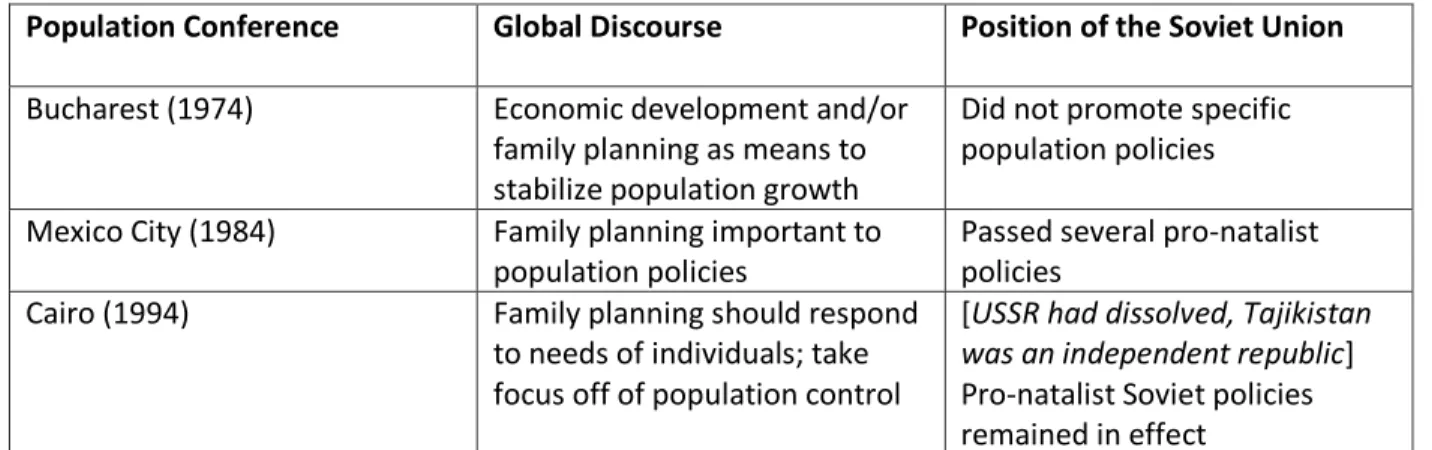
The first noteworthy UN-sanctioned conference on population, the World Population
Conference, took place in Bucharest in 1974. In the midst of heated debates, the Soviet Union and a
large number of low- and middle-income countries argued that socioeconomic development was critical
to ‘population stabilization’. Implementing family planning programs and motivating couples to have
smaller families alone were not sufficient. During this meeting, the USSR blamed development problems
on the free-market economic policies and practices of the United States and the western democracies.
The USSR supported overall development goals but did not promote specific policies on population. (11)
Ten years later (1984), participants at the Mexico City conference promoted family planning as a
critical component of population policy. (12) It was during this time that the USSR passed its final
population policies; these remained in effect until its dissolution in 1991. The Soviet policies of the
1980s awarded mothers maternity leave of nearly four months 6, irrespective of the length of their
employment. Mothers were provided financial grants that varied according to the family’s monthly
income. The Soviets also distributed child allowances, based on the number of children in the
household, provided additional income for single-mothers, promulgated labor legislation designed to
improve working conditions for women, and kept in place the law that allowed abortion “on-demand”
within the first three months of gestation. (5)
5 First Class mothers were eligible either by giving birth or adopting children.
10 The International Conference on Population and Development (ICPD), which took place in Cairo
in 1994, influenced the views of thousands of politicians and policy makers with respect to the
objectives, content and implementation of population programs. The ICPD promoted the concept of
moving away from the Soviet-style top-down policy approach and adopted policies and practices
designed to respond to the needs of individual couples and individuals. (11)
In 1994, the ICPD declared “…advancing gender equality and equity and the empowerment of
women and the elimination of all kinds of violence against women, and ensuring women’s ability to
control their own fertility are cornerstones of population and development related programs”. (13) The
UNDP’s Human Development Report periodically ranks 186 countries on a Gender Inequality Index. This
index is defined as “…a composite measure reflecting inequality in achievements between women and
men in three dimensions: reproductive health, empowerment, and the labor market”. Tajikistan ranked
57th out of 186 countries in 2013 and 65th in 2016. (14) (15)
Population Conference Global Discourse Position of the Soviet Union
Bucharest (1974) Economic development and/or
family planning as means to stabilize population growth
Did not promote specific population policies
Mexico City (1984) Family planning important to population policies
Passed several pro-natalist policies
Cairo (1994) Family planning should respond
to needs of individuals; take focus off of population control
[USSR had dissolved, Tajikistan was an independent republic] Pro-natalist Soviet policies remained in effect
Table 1: Summary of major global conferences on population
Independent Tajikistan and the Civil War
Immediately following independence in September 1991, Tajikistan underwent a protracted civil
war from 1992-1997. 7 In simplest terms the war split Tajikistan in half – Khatlon and Sughd Oblasts were
7 The genesis of the war was the election of a new government after the fall of the Soviet Union. Tajikistan had
11 supported by Russia and represented “traditional” politics, while RRS and GBAO Oblasts represented
“new” liberal democratic principles. That Khatlon/Sughd alliance prevailed and the current leader
(President Emomali Rahmon) has been at the head of government since a peace agreement was signed.
The costs of the war in terms of finances, people killed and injured, and communities displaced were
high. Between 65,000 and 150,000 people were killed, 1.2 million people were displaced, an additional
500,000 to one million refugees fled the country, and the economy collapsed. (16) In the midst of the
civil war (1992-1997), newly independent Tajikistan was not in a position to continue to maintain a high
level of social services, including health care services, across the nation. Consequently, the quality and
quantity of maternal and child health services declined in the first decade after independence. (17) The
maternal mortality ratio in 1990 was 107 deaths per 100,000 live births; that number increased to 129
by 1995. (19) During the crisis many trained health professionals left the country, pharmaceuticals were
in short supply, health facilities were ill-equipped, abandoned or destroyed, and management and
monitoring systems were only sporadically applied. (17)
Following the signing of the peace agreement, the country was without the large workforce of
highly educated and skilled professionals who migrated out of the country. (17) In addition to
addressing the effects of a steady outmigration of educated professionals, in this instance Tajiks, the
country had to overcome challenges of increasing food supply and improving power, creating
employment opportunities, and re-establishing the educational system. Tajikistan continues to face a
“double-burden” of development as it works through post-Soviet transition and post-conflict
peacebuilding and reconstruction. (18)
12 SECTION 3
The Current Political and Economic Context
Economic conditions in Tajikistan are characterized by low wages, high rates of unemployment,
dependence on remittances from Tajik migrants working principally in Russia, and loans and grants from
multilateral financial institutions and national development assistance organizations. In addition, the
productivity and efficiency of the economy is undermined by high levels of corruption, reportedly
present in every aspect of Tajik culture. (19) For example, it is understood that students pay bribes for
better grades and, according to Transparency International, citizens of Tajikistan consider government
bureaucrats the most corrupt; police, customs, and tax-collectors are at the top of the list of most
corrupt professionals, followed by university and hospital administrators.(20)
Tajikistan is anticipating USD $45 million in foreign grants to support the 2018 budget. An
additional amount of USD $22.5 million is expected from a combination of aid and grants to “cover the
budget deficit”. The last piece is set to come from USD $365 million from unspecified international
financial organizations via “investment projects”. In total, one-fifth of all incoming funds are to be
sourced from foreign entities. (21) It is unclear how these projections will be realized in light of a recent
World Bank report that noted Tajikistan only received USD $20 million total in 2016 and that “the World
Bank, Asian Development Bank and European Union halted payments of budget support funds to
Tajikistan after targets on political reforms were missed and irregularities in the financial sector were
not properly addressed.” (22)
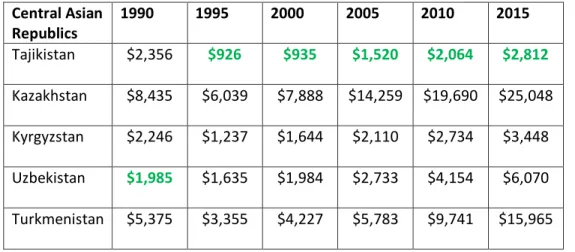
Tajikistan has one of the lowest per capita gross domestic products (GPDs) of all former Soviet
states. Table 1 uses World Bank data to show the trend in per capita GDPs for each Central Asian republic since the collapse of the Soviet Union, highlighting the lowest GDP in each given year. Though
13 are limited, under-employment is common and more than one million Tajiks are actively searching for
work abroad, mainly in the large cities of Russia.
Central Asian Republics
1990 1995 2000 2005 2010 2015
Tajikistan $2,356 $926 $935 $1,520 $2,064 $2,812
Kazakhstan $8,435 $6,039 $7,888 $14,259 $19,690 $25,048
Kyrgyzstan $2,246 $1,237 $1,644 $2,110 $2,734 $3,448
Uzbekistan $1,985 $1,635 $1,984 $2,733 $4,154 $6,070
Turkmenistan $5,375 $3,355 $4,227 $5,783 $9,741 $15,965
Table 2: Gross domestic product per capita (current USD value), Central Asia
The economy relies heavily on remittances from citizens working abroad. In 2014 remittances
amounted to nearly 50% of the nation’s GDP; in 2015 remittances were only about 30% of GDP due to
the slow-down in the Russian economy related to the effects of sanctions imposed by the EU and the
US. In general, Tajikistan has a poor economic outlook because little has been done to create jobs and to
foster an enabling environment favoring the creation of private industries and business. In addition, the
economy has been adversely affected by slowdowns in the Chinese economy, low pricing of
commodities, and, currency fluctuations. (2) The government’s inability to apply appropriate fiscal
policies to address the economic crisis places most Tajiks in very difficult financial straits.
The Current Health Workforce
Without the subsidies provided by the Soviet Union, Tajikistan has been unable to provide
adequate resources to invest in health infrastructure and services for decades. The distribution of
functioning health facilities, funding for health services, and provision of care is uneven. The overall ratio
of health worker to population in Tajikistan has declined since independence. While the MoHSPP
14 population across the country, most physicians (and nurses) are concentrated in the capital, Dushanbe.
Currently, the combined ratio of physicians and nurses to population is one of the lowest in the WHO
European Region, as shown below in Figure 1. 8
Figure 1
The most significant provider losses have been among nurses and midwives. Table 1 shows that the number of nurses per 100,000 population declined from 809 in 1990 to 447 in 2006. The midwife
ratio per 100,000 population declined from 129 to 57 over the same period.
Notably, there has been only a small decline in the number of physicians in the country. It is
unclear whether this measure of physicians is accurate and includes those providing medical care or if it includes all who have a medical degree but do not provide health services. It is also noteworthy that
many highly-skilled Russian doctors, both practitioners and professors, left Tajikistan after 1991, leaving
the country with the lowest ratio of doctors to population in the former Soviet Union. (23)
8Tajikistan’s combined physician and nurse to population ratio in 2006 was 4.47:1,000. The physician to
population ratio was 2.01:1,000, the nurse to population ratio was 2.46:1,000.
0 2 4 6 8 10 12 14
Uzbekistan Kazakhstan Kyrgyzstan Turkmenistan Tajikistan CIS WHO European Region
Number of physicians and nurses per 1,000 population in Central
Asia, 2007
15 Type of provider 1990 2002 2003 2004 2005 2006 2007 %
Decline
Physicians 255 203 193 194 192 201 186 17%
Nurses 890 470 435 428 418 447 411 55%
Midwives 129 60 58 54 54 57 52 60%
Table 3: Medical providers per 100,000 population, Tajikistan, 1990-2007
During the Soviet period the health system was designed to provide uniform service quality
across the member republics of the USSR. However, in reality there were large variations in the number
of health workers and the range and quality of services provided. For example, in 1987 Georgia had
more than two times the number of physicians per 1,000 population as Tajikistan. 9 Today, there are
fewer health professionals per capita in Tajikistan than any other country in Central Asia. Table 1, above, shows the total percent decline of each level of provider in Tajikistan from 1990-2007. Outmigration of
educated and skilled medical providers has been a significant contributing factor.
Figure 2, below,shows the distribution of health workers by provider level and region of the country. Inequalities are evident across geographic areas and in the level of medical training. Physicians
are concentrated in Dushanbe, where the medical market offers more lucrative employment
opportunities.
The density of all other provider levels per 1,000 population are lowest in the Khatlon oblast and health worker shortages are most severe in rural areas. This is the result of low salaries, outdated
medical equipment, poor human resource training, re-training and management, and the deteriorating
health infrastructure. (23)
9Georgia’s physician to population ratio in 1987, 5.7:1,000; Tajikistan’s physician to population ratio in 1987,
16 The necessity of importing all pharmaceuticals has created an acute shortage of some critical
items. The shortage of facilities, materials, and personnel is especially serious in rural areas.
Figure 2
Marriage and Fertility and Women in Tajik Culture
Marriage is a central event in Tajik culture, especially in rural areas, as it is often the couple’s
first exposure to sexual activity and the possibility of pregnancy. According to the latest DHS (2012), 67%
of all women in Tajikistan between 15 and 49 years old are currently married. (24) Marriage rates 10
around the world are calculated to measure the popularity and social value placed on this tradition by a
given culture. Tajikistan has the highest marriage rate in Central Asia – 13.5 marriages per 1,000 adults.
In comparison, Kyrgyzstan, the second poorest republic in Central Asia, has the second highest regional
rate, 9.7 marriages per 1,000 adults. 11
10 Defined as the number of marriages per 1,000 adults, per year.
11 Egypt has the highest marriage rate among the majority-Muslim nations of Northern Africa and the Middle East,
11.0.
0 1 2 3 4 5 6 7 8
Physicians Midwives Nurses
Count of health workers per 1,000 population by region, 2004
17 Marriages are frequently arranged by parents, and Tajik culture expects the couple to have a
child within one year of union. (24) Approximately eight percent of teenage girls aged 15-19 in Khatlon
have begun childbearing. The 2012 DHS reports the wanted fertility rate (WFR) and total fertility rate
(TFR) by oblast for Tajikistan (Table 2). 12 The table indicates that women in every oblast report having more children than they want; however, the difference between those two figures is greatest in Khatlon,
i.e., .6 births per woman. This level of unmet need suggests that women in Khatlon are not able to
achieve their fertility objectives and less likely to achieve their desired fertility than women in any other
oblast in Tajikistan. (1)
Many programs that supported women’s reproductive and productive roles in society were
reduced or discontinued after independence. These included the pro-natalist programs that encouraged
higher fertility by providing birth incentives. With the elimination of subsidies, Tajik couples have
responded to their economic challenges by having fewer children. However, without access to qualified
providers and quality health and family planning services, Tajik couples may be finding it difficult to
achieve their ideal fertility. (25)
12 Wanted fertility rate is calculated the same way as the total fertility rate, excluding unwanted births. Total
fertility rate is defined by the DHS as the total number of births a woman would have by the end of her
childbearing years if she were to pass through those years bearing children at the currently observed age-specific fertility rate.
Region Wanted Fertility Rate Total Fertility Rate
Dushanbe 3.0 3.4
RRS 3.4 3.9
GBAO 3.0 3.3
Sughd 2.9 3.3
Khatlon 3.6 4.2
18 There are rather significant generational differences among women in Tajik society. For
example, today’s women navigate a space that is somewhere between progressive (i.e. Soviet) and
traditional (i.e. Tajik). 13 Soviet policy and propaganda promoted gender equality and the participation of
women in the public sphere. The traditional patriarchal influences in Tajik culture promote the role of
women as mothers and homemakers, i.e. as a central figure in the private sphere.
Tajikistan is officially a secular state. However, since independence there has been a resurgence
of some traditional Islamic (Tajik) values that define a woman’s main role in the private sphere (i.e. in
the home). The government has been publicly promoting the traditional interpretation of the role of
women in Tajik society. The affect this may have on women’s roles in Tajik society has not been
thoroughly studied. (25) (26)
While Tajikistan has adopted a national program 14 and ratified several international
conventions on gender equality, e.g. Convention on the Elimination of All Forms of Discrimination
Against Women (CEDAW) in 1993, women are disadvantaged in modern-day Tajikistan. UN Women has
aligned women’s empowerment and gender equality programming with Tajikistan’s national
development priorities (2016-2020) to identify economic empowerment and violence against women as
key areas of focus. The 2012 DHS found that 20% of ever-married women have/had husbands that
displayed three or more controlling behaviors 15. In addition, the DHS conducted an in-depth analysis of ever-married women having experienced physical, sexual or emotional violence at the hands of a
husband. The percent of women surviving these forms of abuse was second-highest in Khatlon, as seen
in Table 4. (24) (27)
13 It should be mentioned that certain aspects of Soviet life may have, in reality, reinforced traditional gender roles, particularly in regards to women’s reproductive lives (i.e. Mother awards and birth incentives).
14 The Main Directions of State Policy to Ensure Equal Rights and Opportunities for Men and Women in the
Republic of Tajikistan for 2001-2010
15Specific behaviors identified as “controlling” by the 2012 DHS: (1) jealousy or anger if wife talks to other men, (2)
19
Region Emotional
Violence
Physical Violence Sexual Violence Physical or Sexual or Emotional Violence
GBAO 7.1 14.6 2.8 18.2
Sughd 23.6 23.0 8.3 34.6
RRS 4.0 11.5 1.2 12.6
Khatlon 5.4 23.0 3.5 25.2
Table 5: Percentage of ever-married women who have experienced violence by a husband/partner, Tajikistan, 2012
A disturbing consequence of gender-based violence and abandonment seen across Tajikistan,
but particularly prevalent in Khatlon, has been an increase in suicides and murder-suicides among
women. In Khatlon, in 2010, an Interior Ministry official reported 108 suicides by women, with at least
half of those known to be the result of domestic violence and violence against women. It is difficult to
get exact numbers of suicides and murder-suicides and their root causes, it is reasonable to assume
reported figures are an underestimate. Single-mothers and those who experience violence are at
increased risk for self-harm largely because of the social taboos associated with talking about and
seeking help for both. (27) (28) (29)
There is a stark difference between the laws that appear to promote gender equality and the measures in effect to implement them. Women are not viewed in the same fashion as men, but
predominantly homemakers and mothers. This view is reinforced annually on March 8, International
Women’s Day. On this holiday, President Rahmon usually remarks on women’s roles in the private
sphere and recognizes Tajik women as mothers, first and foremost. President Rahmon characterizes
Tajik women as caretakers, housewives, and those responsible for preserving national customs and
traditions. In a recent March 8thspeech he said, “This day awakens the sense of kindness and love in our
souls, because this day is devoted to our women and mothers – tutors of the future generation and
20 As previously discussed, outmigration is common and remittances are an important source of
income for many, if not most, Tajik families. Outmigration by married and unmarried men has a direct
impact on Tajik women, making them responsible for maintaining the family while financially vulnerable
if husbands decide not to return home and/or fail to send money routinely to the families. In 2009 the
International Organization for Migration reported over 300,000 households in Tajikistan had been
abandoned by the male head of household, 70% of those homes had children. (27) Often the migrant’s
wives, who become de-facto heads of households, face barriers to employment and do not have control
over family resources. It is common for husbands to retain the role of household decision-maker and
21 SECTION 4
Family Planning Structure
Post-independence, the Tajik government became responsible for developing and implementing
national health policies. Though the government is the largest provider of health services because the
private sector is small, expensive and operating only in the larger urban areas like Dushanbe and
Khujand, Tajik citizens provide the largest percentage of health expenditures, primarily for curative care.
Over half of the total expenditures on curative health services in 2014 were from out-of-pocket
payments by Tajiks. It is estimated that by the year 2040 around 40% of all funds spent on health will
come from out-of-pocket payments. (7) While the government promotes family medicine and
preventative programs, government (oblast-level, i.e. hukumat) financing give primary attention to hospital services and continues to be dominated by input-based budgeting that is based on the number
of hospital beds and/or personnel rather than on health objectives, quality of care and outcomes. (23)
(31)
In the first decade of the twenty-first century, Tajikistan piloted health sector reform initiatives
that tried to address health financing, primary care provision and provider reimbursement; however,
these reforms and others did not produce major changes in the functioning of the health care system
and the delivery of health services. (7)
The MoHSPP prioritizes family planning under the umbrella of reproductive health and is in
charge of providing family planning guidance to local implementers (i.e. oblast-level facilities) across
Tajikistan. The ministry’s main objectives, specific to family planning, include:
1) “Ensuring low-risk pregnancy and safe motherhood; and
2) Reducing complications caused by closely-spaced pregnancies and pathological
22 The ministry is responsible for training providers, providing “extensive” family planning education to all
Tajiks, and supplying contraceptives throughout the nation. Family planning services are provided at
regional, district and city reproductive health centers at the PHC level and supervised/monitored by the
National Center on Reproductive Health. (24) These departments work in conjunction with local city
authorities to define and deliver health services throughout the facilities in each oblast. (23)
In the Strategic Plan for Reproductive Health (2005-2014) the MoHSPP formulated an initiative
to improve the reproductive health of Tajiks, specifically women, by:
1) Increasing access to family planning services and contraceptives;
2) Increasing access to antenatal and safe delivery services; and
3) Decreasing mortality and morbidity during pregnancy and improving perinatal outcomes.
While the objective of the plan was to integrate reproductive health services into primary care services,
the program has yet to be successfully defined and implemented. Consequently, measures to increase
public awareness of the importance of reproductive health and to train adequate human resources to
meet reproductive health needs, have not been fully implemented. (23)
The most recent reproductive health and family planning implementation policy that was passed
in 2017 recommends key interventions to: (a) create an enabling environment favorable to reproductive
health and family planning; (b) adapt the health system to address reproductive health challenges; and,
(c) provide programs that meet the needs of adolescents and youth.
Financing Family Planning Programs
As noted, funds for health have historically been allotted to support hospital services, a practice
in effect throughout the Soviet period. Primary and preventative care have only recently become a
government focus. (23) In 2014, a total of USD $1.7 billion was spent on curative health care services in
23 The United Nations Population Fund (UNFPA) has been the largest donor for reproductive health
and family planning services in Tajikistan. In total, 40% of all integrated sexual and reproductive health
programs across Tajikistan in 2016 were financed by UNFPA; other NGOs were responsible for 54% of
the financing. The Tajik government financed less than 5% of integrated reproductive health programs.
(25) However, of the 77% of Tajikistan’s program expenditures – totaling USD $985,674 – on integrated
sexual and reproductive health services provided by UNFPA (Figure 3) most of the funds were allocated for HIV/AIDS programs. (33)
IN 2016, only about USD $130,000 of the total integrated sexual and reproductive health service
funding was set aside to finance family planning initiatives across Tajikistan. UNFPA funded 67% of the
family planning-specific programs in Tajikistan in 2016, NGOs were responsible for 14% of family
planning funding; the government financed 19% of family planning initiatives.
Figure 3
The 2017-2020 national policy on family planning, the MoHSPP estimates the total amount
needed for family planning and proposes how those funds will be allocated. However, the plan does not
designate the source(s) of funds nor indicate how the projected program costs were calculated. Figure 4 shows the distribution of funds by action area; in total these efforts are estimated to cost about $1.9
24 Around $1.6 million USD will be spent on program interventions, the remaining funds are
allocated to purchase the contraceptives required to meet the target contraceptive prevalence rate
increase of 1.5% per year for each of the plan years (2017-2020). The source for these contraceptive
methods and a plan for distribution and use were not identified by the MoHSPP. Within the $1.6 million
USD for programs, about $110,000 USD is slated for specific provider education efforts. $964,000 USD is
allotted to “increase access to family planning services and methods”. This increase will be achieved
through additional provider training and a bit of service monitoring in selected facilities. (34) There is no
mention of efforts to train additional providers, retain those graduating from medical education programs or to extend family planning services more equitably across Tajikistan.
Figure 4 26.30%
57.10% 4.10%
0.30% 15.80%
Distribution of funds by priority action area, Costed
Implementation Plan for Family Planning, 2017-2020
Delay early childbearing and promote health birth spacing
Increase acceess to quality family planning services
Integrate family planning services into PHCs
Enhance community support for delaying marriage
25 Family Planning Personnel
In Tajikistan mid-level 16 medical professionals typically practice in rural areas, carry out
preventive and diagnostic tasks, and preform some administrative duties. Nurses train for four years but
hold low status within the medical community and extremely modest salaries when compared with
physicians. Assumptions could be made about which level of medical provider is responsible for
providing family planning services and reproductive health counseling, but specific responsibilities
remain unclear and are not laid out in the national Implementation Plan for Family Planning Services
(2017-2020).
Career paths for physicians follow the former Soviet system with advancement and salary linked
with years of experience. (7) In this system, there is no incentive to provide high quality care to patients.
In fact, quality of care is a major shortcoming; in addition to low levels of morale among providers, lack
of investment in facilities, technology, pharmaceutical supply, adequate training, and basic protocols
have contributed to a health system that provides general services with minimal quality. (23)
Table 3 shows the percent of women who received information about family planning from either a traveling health worker or a facility-based provider. Women in Khatlon are less likely to be
visited in the home or to speak with a facility provider about family planning than women in almost all
the other regions. It is unclear how women in Khatlon receive reproductive health information if they
lack access to a home health visitor or a health provider. This suggests that many women rely on TV
broadcasts and some brochures in circulation. The DHS (2012) found 39.2% of women of reproductive
age (15-49 years) in Khatlon had seen a family planning message via television within a few months of
the survey. Additionally, 57.9% of women had not received any messaging from radio, TV or print media
(i.e. newspaper, magazine). (24) Many women may be subject to myths about family planning and
reproductive health and are unaware of useful family planning information.
26
Region Home visit health
worker
Health facility provider
Dushanbe 18.6 10.9
GBAO 46.6 32.8
Sughd 19.2 22.5
RRS 17.9 15.5
Khatlon 16.1 16.0
Table 6: Percentage of women who talked with medical professional about family planning by region, Tajikistan, 2012
Women in Tajikistan and the Role of Family Planning
The empowerment of women has broad implications for improving health outcomes, and access
to and use of family planning services contributes to empowerment and improved health status. The
ability to control fertility by accessing contraceptive methods is associated with a woman’s status in the
home and her sense of self-worth. A woman who feels she cannot control other areas of her life may
feel less able to control her fertility. (24)
The 2012 DHS examined the degree of women’s empowerment 17 among married women in
Tajikistan and its relationship with family planning decisions. The survey found that contraceptive use
was “…positively associated with women’s participation in household decision-making 18…”. The use of
any method of contraception and any modern method both steadily increased with the number of household decisions women participated in. The DHS also identified an association between
decision-making power and unmet need for family planning. Tajik women who reported not participating in
17DHS, “Women’s empowerment has been defined to encompass women having a sense of self-worth, access to
opportunities and resources, choices and the ability to exercise them, control over their own lives, and influence
over the direction of social change.”
27 household decisions had the highest unmet need, 25%, while those who participated in all three
measured decisions had lower unmet need, 21%. (24)
According to the 2012 DHS report, 72% of currently married women in Tajikistan are not using
any method of contraception, modern or traditional. Nineteen percent of women use the IUD and a
marginal percentage use pills, male condoms, injectables or traditional methods of family planning. In
total, 44% of women want to stop having children while 19% want another child in two or more years. (1) This suggests that 63% of married women in Tajikistan should have access to long acting
contraceptive methods (i.e. implant or sterilization) to achieve fertility goals. The inability of a woman to
space or limit births as she chooses is referred to as ‘unmet need for family planning’.
In Khatlon 21.8% of women report having an unmet need, the majority (12.2%) express a desire
to prevent future births. (1) In the Costed Implementation Plan for Family Planning (2017-2020), the
MoHSPP identified unmet need as a specific area of concern. The government proposed a target of 1.5%
annual increase in the contraceptive prevalence rate (CPR) as a pathway to reducing unmet need. (34)
However, the plan does not provide the details of how CPR will be increased; it does indicate that “to reach this goal a number of key interventions were developed making use of the … expertise of national
experts and technical assistance partners”. (34)
The Situation in Khatlon Oblast
Historically, Khatlon Oblast has been more vulnerable to economic shocks than other oblasts of
Tajikistan because this area has had little investment in non-agricultural activities and is heavily
dependent on the profitability of cotton cultivation and marketing. The region is overwhelmingly
dependent on agriculture, primarily cotton, even though most farms, which were once “collectivized
28 While there has been steady but slow progress in reducing poverty in Tajikistan, regional
disparities persist.19Table 4 shows statistics reported by the ADB on regional poverty rates. Khatlon’s poverty rate is higher than the national rate. (36) (28) The most recent DHS reports regional economic
disparities in terms of the Gini Coefficient, also seen in Table 4. 20 Khatlon had the highest regional Gini Coefficient, meaning that Khatlon has the greatest income inequality compared with the other three oblasts, Sughd, the RRS and GBAO. (24) Adding to the financial struggle for Khatlon families is the
tradition of having larger families than those in the other oblasts. Regional total fertility rates, seen in
Table 4, show Khatlon has the most number of births per woman than any other area in Tajikistan. (24)
Region Poverty Rate,
2013
Gini Coefficient, 2012
Total Fertility Rate, 2012
Tajikistan (national) 35.6% .30 3.8
RRS 45.56% .28 3.9
GBAO 51.53% .28 3.3
Sughd 23.93% .29 3.3
Khatlon 39.24% .30 4.2
Table 7: Selected statistics by region, Tajikistan
In the Costed Implementation Plan for Family Planning Services (2017-2020) the MoHSPP
identifies Khatlon as an area requiring focused attention and activities with respect to family planning
and reproductive health. This focus mirrors the findings in the 2012 DHS and a situational analysis
conducted by international consultants who identify Khatlon as the region with highest unmet need,
highest fertility rates and some of the poorest overall maternal health outcomes. The government’s plan
calls for community-based programs in Khatlon to work with those at risk of early marriage and early
19 The Asian Development Bank (ADB) calculates poverty rate by looking at the relationship between the
population density per square kilometer and economic density.
20 Gini Coefficient is an economic tool used to describe inequalities in trends across populations. It is a statistical
29 childbirth. According to the federal government, the aim of these programs should be to keep girls in
school longer and to delay marriages. In 2011 the legal age for marriage was raised from 17 to 18 years
30 SECTION 5
Conclusions and the Way Forward
In 2014, with support from USAID, EngenderHealth’s RESPOND project used DHS data points to
work with the MoHSPP and other national stakeholders to project fertility and contraceptive prevalence
trends in Tajikistan until 2020. RESPOND published a report specifying the inputs (i.e. finances,
contraceptive methods) necessary to achieve two outcomes of interest: (1) maintain current CPR among
married women of reproductive age through 2020; and (2) reduce the current unmet need by 2020 by
providing a more balanced method mix. An estimate of USD $1.3 million was given to meet the first
outcome, and an additional USD $450,000 to achieve the second outcome. The source of funds and
other recommended inputs were not identified.
The RESPOND activity and most recent national implementation strategy are encouraging steps
towards providing the reproductive healthcare services that Tajik couples and women seek to achieve
fertility goals. The 2017-2020 Costed Implementation for Family Planning policy suggests reproductive
health is a core component of the political agenda of the Tajik government. However, it is noteworthy
that the government has not identified specific sources of funding for family planning programming or
laid out steps to achieve the goals of increased contraceptive prevalence and decreased maternal
mortality. Research is needed to provide an understanding of the family planning beliefs and practices of
key populations in the Khatlon Oblast, an important location to access both because the MICS and DHS
surveys have reported Khatlon’s unmet need for family planning and fertility rates as the highest in
Tajikistan, coupled with early marriages and low contraceptive method uptake.
Reproductive health and family planning are connected with all aspects of population health and
should be pillars of future health policies and reforms. This paper has collected relevant information on
the situation of family planning in Tajikistan, with a focus on the Khatlon Oblast. Data has been provided
31 to family planning services is insufficient [for women and couples to achieve their desired fertility].
Additional research is required to develop an in-depth understanding of reproductive health in the
32 SECTION 6
Bibliography
1. FR279.pdf [Internet]. [cited 2017 Dec 18]. Available from: https://dhsprogram.com/pubs/pdf/FR279/FR279.pdf
2. The World Factbook — Central Intelligence Agency [Internet]. [cited 2017 Dec 17]. Available from: https://www.cia.gov/library/publications/the-world-factbook/geos/ti.html
3. Hays J. TAJIKISTAN UNDER THE SOVIET UNION | Facts and Details [Internet]. [cited 2017 Dec 18]. Available from: http://factsanddetails.com/central-asia/Tajikistan/sub8_6a/entry-4850.html
4. Kotkin S. Stalin: Waiting for Hitler, 1928-1941. Vol. II. New York: Penguin Press; 2017.
5. Weber C, Goodman A. The Demographic Policy Debate in the USSR. Population and Development Review. 1981;7(2):279–95.
6. Lewis RA. Geographic Perspectives on Soviet Central Asia. London;
7. Trends in Health Systems in the Former Soviet Countries. United Kingdom: World Health Organization; 2014.
8. Simon JL. The Ultimate Resource. Princeton University Press; 1981. 734 p.
9. Castaneda A. PRONATALISM IN THE SOVIET UNION AND RUSSIA [Internet]. Feminism in the Slavic World. 2016 [cited 2018 Jan 6]. Available from:
https://feminism.slavic.lsa.umich.edu/2016/12/19/pronatalism-in-the-soviet-union-and-russia/
10. Order of Maternal Glory - Soviet award for the women bearing and raising a large family [Internet]. The Vintage News. 2016 [cited 2018 Jan 9]. Available from:
http://www.thevintagenews.com/2016/09/23/order-maternal-glory-soviet-award-women-bearing-raising-large-family/
11. Singh JS. Creating a New Consensus on Population: The Politics of Reproductive Health, Reproductive Rights, and Women’s Empowerment. Routledge; 2013. 234 p.
12. Burdman M. The U.N. Population Conference: Dare Call It Genocide! EIR Special Report. 1984 Sep 4;11(34).
13. A/CONF.171/13: Report of the ICPD (94/10/18) (385k) [Internet]. [cited 2018 Feb 3]. Available from: http://www.un.org/popin/icpd/conference/offeng/poa.html
14. hdr2013_en_complete.pdf [Internet]. [cited 2018 Feb 3]. Available from: http://hdr.undp.org/sites/default/files/reports/14/hdr2013_en_complete.pdf
33 16. Hays J. TAJIKISTAN CIVIL WAR | Facts and Details [Internet]. [cited 2018 Jan 6]. Available from:
http://factsanddetails.com/central-asia/Tajikistan/sub8_6a/entry-4858.html#chapter-14
17. Tajikistan’s Civil War: A Nightmare The Government Won’t Let Its People Forget [Internet].
RadioFreeEurope/RadioLiberty. [cited 2018 Jan 6]. Available from: https://www.rferl.org/a/qishloq-ovozi-tajikistan-civil-war/28575338.html
18. The Tajik civil war: Causes and dynamics [Internet]. Conciliation Resources. 2011 [cited 2018 Jan 6]. Available from: http://www.c-r.org/accord-article/tajik-civil-war-causes-and-dynamics
19. Country Profile: Tajikistan. Library of Congress - Federal Research Division;
20. Research - Corruption Q&As - Overview of Corruption and Anti-Corruption in Tajikistan [Internet]. [cited 2018 Jan 18]. Available from:
https://www.transparency.org/whatwedo/answer/overview_of_corruption_in_tajikistan
21. Tajikistan: How a Broke Government Keeps its Books Balanced. EurasiaNet [Internet]. 2017 Dec 11; Available from: http://www.eurasianet.org/node/86441
22. ECA2017-TJK-RUS-003.pdf [Internet]. [cited 2018 Jan 4]. Available from:
http://pubdocs.worldbank.org/en/615841500543125516/ECA2017-TJK-RUS-003.pdf
23. E94243.pdf [Internet]. [cited 2018 Apr 1]. Available from:
http://www.euro.who.int/__data/assets/pdf_file/0009/119691/E94243.pdf
24. FR279.pdf [Internet]. [cited 2018 Jan 9]. Available from: https://dhsprogram.com/pubs/pdf/FR279/FR279.pdf
25. women-tajikistan.pdf [Internet]. [cited 2018 Feb 1]. Available from:
https://www.adb.org/sites/default/files/institutional-document/32601/women-tajikistan.pdf
26. women.pdf [Internet]. [cited 2018 Feb 1]. Available from: http://atlas.usv.ro/www/codru_net/CC19/2/women.pdf
27. Tajikistan [Internet]. UN Women | Europe and Central Asia. [cited 2018 Apr 13]. Available from: http://eca.unwomen.org//where-we-are/tajikistan
28. Female Suicides In Tajikistan Linked To Domestic Violence [Internet]. RadioFreeEurope/RadioLiberty. [cited 2018 Apr 13]. Available from:
https://www.rferl.org/a/Female_Suicides_In_Tajikistan_Linked_To_Domestic_Violence/2122013.ht ml
29. Tajikistan: New Concerns Over Female Suicides [Internet]. Institute for War and Peace Reporting. [cited 2018 Apr 13]. Available from: https://iwpr.net/global-voices/tajikistan-new-concerns-over-female-suicides
34 31. Falkingham J. Poverty, out-of-pocket payments and access to health care: evidence from Tajikistan.
Social Science & Medicine. 2004 Jan;58(2):247–58.
32. Tajikistan [Internet]. [cited 2018 Feb 4]. Available from: http://www.healthdata.org/tajikistan
33. UNFPA Tajikistan | UNFPA - United Nations Population Fund [Internet]. [cited 2017 Oct 10]. Available from: https://www.unfpa.org/data/transparency-portal/unfpa-tajikistan
34. Costed Implementation Plan for Family Planning for the period 2017-2020. Dushanbe: Ministry of Health and Social Protection of Population of the Republic of Tajikistan; 2017.
35. Tajikistan: Reinvigorating Growth in the Khatlon Oblast. The World Bank; Report No.: 80022–TJ.
36. Bank AD. Country Partnership Strategy: Tajikistan, 2016-2020 [Internet]. [cited 2018 Jan 20]. Available from: https://www.adb.org/sites/default/files/linked-documents/cps-taj-2016-2020-pa.pdf
37. Family Code, 1998 -- RUSSIAN.pdf.
38. Teenage Marriage Persists in Tajikistan [Internet]. Institute for War and Peace Reporting. [cited 2018 Apr 13]. Available from: https://iwpr.net/global-voices/teenage-marriage-persists-tajikistan