The U.S. Department of Health and Human Services (DHHS) has identified law enforcement naloxone programs (LENP) as an essential strategy to expand naloxone access1. Recruiting law enforcement to play a central role in naloxone expansion is a significant paradigm shift in our nation’s approach to drug use. In law enforcement naloxone programs, officers are in a position to help, rather than punish, drug users at risk of overdose. The abrupt shift in expectations for law enforcement creates a need to evaluate whether a paradigm shift in federal policy has also translated to a shift in attitudes and behaviors of law enforcement towards naloxone use.
The goals of this paper are twofold. First, I aim to identify variables that influence the decision of law enforcement to support or resist the adoption of law enforcement naloxone programs. Guided by a diffusion of innovations theoretical framework2, I will explore the differences in the rate and process of adoption of LENP in a sample of 5 states. I hypothesize that the adoption rate of law enforcement naloxone programs will be positively associated with a high degree of perceived compatibility, a high degree of perceived relative advantage, and a low degree of perceived complexity for program implementation by law enforcement officers.
Second, I will conduct a systematic review of the literature that evaluates the attitudes and behaviors of law enforcement officials towards naloxone programs. With these two objectives, my goal is to provide evidence that supports future policy-making decisions about law
2
Table of Contents
Abstract ... 1
Acknowledgements ... 3
List of Tables and Figures... 4
Introduction ... 5
Methods ... 9
Findings and Discussion ... 11
Observability Effects in the Early Stages of Adoption ... 12
Compatibility with Law Enforcement Culture ... 14
Compatibility with State Culture ... 17
Relative Advantage and the Stigmatization of Drug Use ... 19
Complexity of Naloxone Storage and Administration ... 21
Challenges to LENP Adoption ... 23
How States Have Approached LENP Expansion ... 26
Conclusion ... 32
References ... 34
3 Acknowledgements
To Dr. TR – Thank you for your encouragement, guidance, and expertise in helping me
accomplish my goals. I have learned so much and am extremely grateful for your mentorship and time.
4 List of Tables and Figures
Table 1. Opioid-Related Overdose Rates (per 100,000) ... 43
Table 2. Law Enforcement Naloxone Programs (LENP) and Law Enforcement Agencies (LEA), by State ... 44
Table 3. Timeline of Important Events for Law Enforcement Naloxone Programs (LENP) Adoption in New York State ... 45
Table 4. States that Have Negotiated Contracts with Amphastar for Naloxone Purchasing Discounts, as of June 2016 ... 46
Figure 1. Rogers' Analytical Framework to Identify the Variables that Determine the Rate of Adoption of Innovations………47
Figure 2. Training Materials Used to Teach Ohio Law Enforcement Officers How to Prepare and Administer Naloxone Through Off-Label Intranasal Delivery……...48
Figure 3. State Map of Pennsylvania’s Law Enforcement Naloxone Programs (LENP), as of June 2015, and Counties Eligible to Receive Funding Through the Capital BlueCross Naloxone Grant………....49
Figure 4. A Modified Theoretical Framework to Understand the Variables that Influence the Rate of Adoption for Law Enforcement Naloxone Programs (LENP)……...50
Table A- 1. Literature Search Strategies ... 62
Table A- 2. Eligibility Criteria for Systematic Review ... 63
Table A- 3. Characteristics of Quantitative Studies………..…63
Table A- 4. Critical Appraisal of Quantitative Studies……….64
Table A- 5. Characteristics and Limitations of Qualitative Studies………..65
Figure A- 1. Yale MeSH Analysis Grid Used to Develop Search Strategy………..66
5 Introduction
Since President Nixon declared drug abuse to be “America's public enemy number one,”3 our nation has come quite a long way in our understanding of the physiologic nature of
addiction. Historically, law enforcement officials have addressed substance abuse by enforcing punitive drug laws and policies that criminalized drug use and addiction. However, sharply climbing overdose rates over the last twenty years confirm that we have lost the “War on Drugs” that began in the early 1970’s.
In the United States, drug overdoses have reached what many have called epidemic proportions, surpassing both motor vehicle accidents and firearms as the leading cause of unintentional death in 20084. Over 60% of these drug overdoses have been opioid-related5. Since 1999, the rate of opioid-related deaths has nearly quadrupled in number5. In 2014, opioid-related overdose deaths, which includes both prescription opioids and illicit opioids such as heroin, reached an all-time high, accounting for 29,467 deaths that year alone5.
Realizing that we can no longer arrest our way out of what many consider an epidemic, the Obama administration has transitioned to a national drug policy that treats addiction as an issue of public health, rather than criminal justice. The U.S. Department of Human Health and Services (DHHS) has endorsed a three-pronged approach to addressing opioid-related overdoses: reduce irresponsible prescribing practices, increase access to medication-assisted treatment (MAT), and expand access to naloxone6.
To expand naloxone access, the U.S. DHHS has identified law enforcement naloxone programs (LENP) as an effective “best practice naloxone delivery model and strategy.”6 Law
6 to equip their officers to carry naloxone and administer if needed. Law enforcement is uniquely posed to be first on the scene of an overdose and thus, save lives with naloxone. Former Attorney General Eric Holder went so far as to recommend that every law enforcement agency in the country be equipped to carry and administer naloxone 7, and current Attorney General Loretta Lynch has continued to preside over the implementation of that goal, using strategies such as the DOJ”s Bureau of Justice Assistance to create a Naloxone Toolkit for law enforcement agencies8.
Increasing expansion of naloxone is a fundamental shift in the federal government’s approach to drug use. Naloxone expansion is a type of harm reduction, which is defined as “a set of practical strategies and ideas aimed at reducing negative consequences associated with drug
use.”9
But, at the very core of harm reduction is its symbolic representation as “a movement for
social justice built on a belief in, and respect for, the rights of people who use drugs.”9
Law enforcement naloxone programs (LENP), in particular, represent a significant cultural paradigm shift in the roles, responsibilities, and expectations of law enforcement officials. This sentiment is well reflected by the statements of U.S. Capitol Police Chief, Kim Dine, at the 2014 Police Executive Research Foundation (PERF) Summit, who states, “This is historic. We are hearing police officials from across the country saying, ‘Heroin is a medical
problem.’ That is not the way we have viewed this for the last 40 years.”10
As of April 2016, law enforcement naloxone programs (LENP) had expanded to 971 departments across 36 states11. While increasing numbers of law enforcement agencies are training their officers to administer naloxone, the significant majority of the nation’s 18,000 police departments still have not equipped officials with naloxone.
What is Naloxone?
7 decade, naloxone has been available in the United States for quite some time. The FDA approved naloxone in 197112. But, for much of its lifetime, the drug has been available only as an
injectable formulation. Before April 2014, intranasal naloxone administration was given “off-label”. Before the naloxone can be administered, off-label naloxone use requires responders to first connect a mucosal atomizer device (MAD) to a prefilled naloxone syringe (See figure 1). Then, responders may insert the MAD into each of the victim’s nostrils and deliver aerosolized droplets of naloxone into the nasal cavity. Currently, the newer formulations of NARCAN® Nasal Spray and EVZIO® now allow law enforcement to give naloxone through FDA-approved means that are straightforward and uncomplicated.
Naloxone reverses the respiratory depression associated with opioid overdose by displacing opioid molecules from their receptors in the central nervous system. In victims who are physiologically dependent on opioids- as overdose victims frequently are- the abrupt absence of bound opioid receptors results in a state of opioid withdrawal. Opioid withdrawal most
commonly results in symptoms such as fever, chills, nausea, vomiting, or psychological distress13.
Naloxone is a prescription medication that can quickly reverse the effects of opioid overdose if it is administered within 1 to 3 hours after the start of overdose symptoms. Naloxone takes effect within minutes of its administration, and is able to revive opioid overdose victims to full consciousness from a near-death state13. The overdose antidote poses little to no risk for adverse side effects, no risk for overdose, and has no potential for addiction13.
Theoretical Perspective
8 adopted by individuals and organizations2. E.M. Rogers, an early and very prominent proponent of diffusion of innovation theory, defines an innovation as any “idea, practice, or object that is perceived as new by an individual or other unit of adoption2” (pg. 2). Even though naloxone has been commonplace in the pre-hospital setting for decades, its use has been previously restricted to medical first responders, such as paramedics, and/or laypersons, such as friends and family members of drug users. Thus, the innovative nature of law enforcement naloxone programs stems from the clear departure of naloxone use from previous law enforcement practices.
The diffusion of an innovation refers to the “process by which (1) an innovation (2) is communicated through certain channels (3) over time (4) among the members of a social system” (Rogers, pg. 11)2. These four elements of diffusion – an innovation, communication channels, time, and the social system- have the largest influence on the rate at which innovation adoption occurs.
Rogers’ theory has been applied in diffusion research across a wide spectrum of research disciplines that encompass social sciences, public health, and criminal justice research. Given its multidisciplinary breadth, the diffusion of innovations theory is well suited to study law
enforcement adoption of LENP programs- an innovative strategy that unifies the public health and criminal justice sectors. Furthermore, there is a well-established body of policing research that has used the diffusion of innovations theory to understand a large number of policing innovations, such as community policing, computerized crime mapping14, robbery prevention programs 15, and electronic communication delivery systems16.
9 Methods
Sample Selection
After selecting an appropriate theoretical framework, I then selected a sample of states for in-depth analysis that met two inclusion criteria: high rates of opioid overdose and LENP authorization enacted prior to July 2015. Given that the majority of LENP authorization laws have been enacted within the last 3 years, I deemed 1 year to be sufficient in length to explore the rate of LENP adoption within the state. Among those states that met inclusion criteria, I ultimately chose a sample of five states to conduct a case study comparative analysis of LENP adoption within each state. The five states were Massachusetts, New York, Florida, Ohio, and Pennsylvania.
My aim was to select a sample of states that varied in the time frames for diffusions, their experiences and strategies with LENP adoption, and the subsequent degree of success among law enforcement adoption and buy-in of naloxone programs. To accomplish my objectives of
characterizing LENP adoption process and rates, my ideal protocol would have been designed with a larger sample size. Given the time restrictions and scope of this master’s paper, I was limited to a smaller sample size than ideally designed. The study is also limited in scope
geographically to states that were sampled from the regions of New England, Mid-Atlantic, and Florida. This study thus largely fails to sample from the West Coast, Midwest, and the South, and thus may limit the generalizability of results to states in those regions.
Estimation of the Number of Law Enforcement Agencies
10 sources of national data on the number of law enforcement agencies: the Uniform Crime
Reporting (UCR), Annual Survey of Public Employment and Payroll (ASPEP), and the Census of State and Local Law Enforcement Agencies (CSLLEA)17. All three sources use different inclusion criteria for law enforcement agencies17. To estimate the number of law enforcement agencies in each state, I used the Census of State and Local Law Enforcement Agencies (CSLLEA).
Compared to the UCR and the ASPEP, the CSLLEA uses the most inclusive criteria to define a law enforcement agency. The CSLLEA includes the following agencies: campus police, transit police, primary state police, sheriffs’ offices, local police departments, tribal police, and special jurisdiction agencies (which includes campus police)17. In the CSLLEA, federal agencies and agencies that do not employ sworn officers are excluded from the total count of law
enforcement agencies17.
Despite using the most comprehensive source of data on law enforcement agencies, the most recent data publicized on the number of law enforcement naloxone programs in New York18 surpassed the total number of law enforcement agencies in New York reported by the CSLLEA19. I attempted to contact the state contact for author of the publication reporting the number of LENP programs to determine the inclusion criteria used in counting the number of law enforcement agencies. The author had not responded by the date at which this paper was submitted (July 2016).
Data Extraction
11 forces, and state task forces at which law enforcement leaders were present. During the
extraction process, data was extracted from information and quotes that demonstrated or suggested the perceptions, opinions, attitudes, and behaviors of law enforcement that related to opioid overdoses, naloxone and/or law enforcement drug policies. Given the hierarchal structure of law enforcement, any relevant quotes and/or actions by leaders of law enforcement agencies (police chiefs or sheriffs) were included during the data extraction process.
To search for relevant newspaper publications on LexisNexis, I used a search strategy with keywords that included “naloxone”, “narcan”, “law enforcement”, “sheriff,” and “police”. The search strategy is outlined in detail in Table A-1. For each state, the search was performed and a geographical state filter was applied. Duplicates with “high similarity” were filtered out of the search results.
Findings and Discussion
The nation’s opioid overdose epidemic is also evident in the five states I analyze here. See Table 1 for comparison of the age-adjusted opioid overdose death rates in each state in 2013 and 2014. Among the sample of five states, Ohio has seen the highest rates of opioid overdose. In 2014, Ohio was ranked fifth in the country with an opioid overdose rate of 24.6 per 100,000 people5. New York experienced the lowest rates of opioid overdose with a rate of 11.0 per 100,000 people5. Between 2013 and 2014, the overdose epidemic significantly worsened in three out of the five states. Massachusetts, Ohio, and Pennsylvania all experienced statistically
significant increases in opioid overdose deaths5.
12 Rogers argues that half to more than four fifths of program adoption is attributable to five variables: relative advantage, compatibility, complexity, trialability, and observability2.
Figure 1 depicts Rogers’ theoretical framework of how an innovation’s adoption rate is influenced by these variables, with the understanding that their degree of influence also varies by innovation, social systems, and external change agents2. A straightforward application of
Rogers’ diffusion theory predicts that LENP adoption will occur at a faster rate if police chiefs and sheriffs perceive LENP programs as (a) relatively advantageous, (b) compatible with their beliefs, values, and past experiences, (c) simple to understand and implement, and (d) easily observable. To that point, I will use Rogers’ diffusion theory framework to explore the variation in LENP adoption rate across my five selected states, New York, Pennsylvania, Massachusetts, Ohio, and Florida.
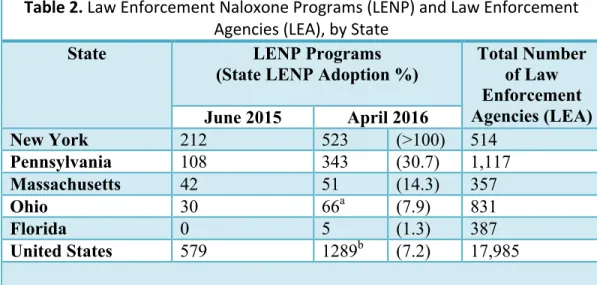
As of April 2016, New York had over a 100% adoption rate, with a count of 523 LENP programs19,20. A discussion of possible explanations for this discrepancy in data can be found in the Methods section. Pennsylvania has the second highest adoption rate of 30.7%.19,20. For the remaining states, in descending order, the LENP adoption rates are as follows: Massachusetts (13.7%), Ohio (6.0%), and Florida (1.3%)19, 20. See Table 2 for a side-by-side comparison of the LENP program adoption rates between states.
Observability Effects in the Early Stages of Adoption
13 majority” of innovative states to adopt naloxone programs for law enforcement, neither state developed a pilot program before expanding LENP authorization statewide.
For the early adopters - NY, and OH- the observability of Quincy’s naloxone program helped to drive the adoption of early LENP pilot programs for both states. Massachusetts’ LENP pilot program, Quincy Police Department, was the first LENP in the nation in 2010. After Quincy’s officers began saving lives, states such as New York and Ohio sought to replicate LENP pilot programs in their own states.
Massachusetts. In November 2007, the Massachusetts Department of Public Health piloted the state's Overdose Education and Naloxone (OEND) program to distribute free naloxone to bystanders at 8 pilot sites located in high-overdose communities. Between December 2007 and June 2010, the OEND program trained over 6,700 potential bystanders and resulted in at least 670 documented naloxone reversals across the 8 pilot locations. The OEND pilot program set the
stage for Massachusetts to expand naloxone access to its police and fire departments. In 2010,
the MDPH expanded its OEND pilot program to include the Revere Fire Department and the Quincy Police Department, the first law enforcement naloxone program in the country23. New York. Two years after the Quincy Police Department adopted the first LENP, New York piloted a 20-month (April 2012 - December 2013) naloxone expansion program for EMTs. The New York pilot program trained 2,035 basic EMTs, resulting in 223 naloxone rescues with a 10% treatment diversion rate. Following the lead of Massachusetts, New York developed a second naloxone pilot program in May 2012, this time for Suffolk County law enforcement
14 immediately by the entire department. Still in the early phases, within 5 months of the pilot program, the cohort of trained police officers had 32 naloxone rescues under their belt24. The rapid pace and visible nature of outcomes in just the first five months of the pilot led the police department to quickly expand the naloxone program to all of the officers24.
Ohio. In October 2013, the first law enforcement programs in Ohio were adopted in Lorain County, located just west of Cleveland, in Ohio’s major northern urban rustbelt region. The Lorain County Drug Task Force – which included local law enforcement leaders- first lobbied state legislators to introduce and pass Senate Bill 57, which authorized a 1-year pilot program in Lorain County22. The pilot program - named Project DAWN (Deaths Avoided With Naloxone) of Lorain County- successfully trained law enforcement in 10 out of Lorain County’s 18 police departments, and several fire departments as well22. Due to a deadly batch of heroin, in the first month of the pilot program, first responders had 16 successful naloxone rescues22. Project DAWN of Lorain County was the product of a collaborative effort by a county drug task force, 3 county hospital systems, 2 county health departments, and the Alcohol and Drug Addiction Services Board of Lorain County25.
Yet, still a number of Lorain County police chiefs reportedly remained reluctant, wanting to “wait and see” the experiences and outcomes of the pilot program26. Detective Greg Mehling of the Lorain County Drug Task Force explains that positive media coverage of naloxone rescues caught the attention of local mayors- who then convinced these reluctant police chiefs to stop “waiting it out” and adopt similar programs in their towns26. Thus, media-driven observability drove a more rapid spread of LENP programs throughout Lorain County.
Compatibility with Law Enforcement Culture
15 Among potential adopters, Rogers argues that the perceived compatibility of an innovation is strongly influenced by the indigenous knowledge systems of their social systems. Another social scientist, Warren (1991) describes indigenous knowledge as, “knowledge that is unique to a given culture or society,” emphasizing that it frequently serves as “the basis for local-level decision-making,” even when it conflicts, “with the international knowledge system generated by universities, research institutions and private firms”27.
For many law enforcement agencies, their indigenous knowledge systems about drug use has undergone a dramatic transformation from what was thought to be true during the “War on Drugs” era of years past. Thus, LENP compatibility will depend upon whether or not the existing values and knowledge systems of potential adopters has moved away from their
indigenous knowledge systems from a past era - one that criminalized drug use and thought of addiction as a moral failing.
Law enforcement leaders who have become early adopters and champions for naloxone programs perceive LENPs to be very compatible with their law enforcement duty “to protect and to serve”. The founder of the first LENP in the country, Lieutenant Detective Patrick Glynn, illustrates this point: "We're in the business of saving lives. The individuals we treat through this program have a disease, and it is our place to treat them"28.
Another commonality seen among LENP adopters is their recognition that the existing values of today’s law enforcement must move away from their past experiences with the
16 by the Police Chief Cel Rivera of the Lorain Police Department, one of the ten departments to participate in Ohio’s LENP pilot program. He comments that,
Our role is to enforce laws. Now, we are saying, more than likely, we’re not even going to charge you. We just want to come and help you. And that’s a shift in philosophy for most departments.30
This change in philosophy goes deeper than just a change of protocol. LENP adopters and LENP resisters demonstrate a fundamental difference in how they empathize with people who are affected by addiction. One theme among LENP supporters is a shared empathy for the family and loved ones of drug users. For instance, in Pennsylvania, Richmond Police Chief, Michael Burgan has said "These aren't just addicts. They're someone's brother. They're
someone's son or daughter”. As Suffolk County (NY) Sheriff Vincent DeMarco advocates for addiction treatment, he talks about how the mistakes are made by drug users, yet, the
repercussions of drug use are felt by their loved ones. He says, “I know all too well how families are affected by drug use. Unfortunately, many individuals who use and abuse drugs risk
life-threatening overdose situations, I want to encourage people to seek help before it’s too late”31 .
But, law enforcement acceptance of this paradigm shift has not been universal. Many officers continue to have drug-related stigmas that arise from a fundamental incompatibility with how they have defined their core identities as law enforcement officers. During the early
17 positive effects of naloxone use on victims, family members, and with improving the relationship of law enforcement with the community30,32.
Compatibility with State Culture
In addition to the indigenous culture of law enforcement, the compatibility of naloxone programs can also be influenced by the state culture within which law enforcement operates. For New York and Florida, unique state cultures and experiences have played a role in shaping current drug policies in each state.
New York: A Culture of Public Health. New York ranks first among the five states with close to a 100% adoption rate of naloxone programs by law enforcement agencies20. Compared to the rest of the nation, New York is one of only a select few states to achieve universal or near-universal adoption11. As of April 2016, close to 30% of states (n=14) are still devoid of any LENP expansion whatsoever11.
The rapid rate at which New York law enforcement commenced LENP adoption reflects proactive statewide coordination, and on a deeper level, a state culture that prides itself on its status as a innovator. In 1969, Walker’s well-known study on state-level policy diffusion, New York ranked first with the highest composite innovation score of all 50 states33. Of note,
Massachusetts – which would later become home to the nation’s first LENP program – earned the second highest composite innovation score33.
18 with a score of 9/10, surpassing the majority of states by a wide margin. Out of the remaining 4 states, Massachusetts scored a 5/10, Pennsylvania scored a 4/10, Ohio scored a 3/10, and Florida scored a 2/1034. Nationwide, Florida shared last place in a four-way tie with Iowa, Missouri, and Montana34.
New York’s culture of innovation has extended to multiple strategies to expand naloxone access. In addition to the state’s near-universal LENP adoption, New York also leads the country in the number of community-based naloxone programs for friends and families of drug users. Home to 274 community-based naloxone programs, New York outpaces the second ranked state, New Mexico, by a factor of five35. The distribution of community-based naloxone programs in the other states ranges from a high of 43 programs in Massachusetts to 1 program in Florida36. Florida: The Former Pill Mill Capital of the United States. Among the five states in this study, Florida’s authorization of law enforcement was the most recent, with the passage of the
Emergency Treatment and Recovery Act in June 2015. To understand the context of Florida’s relatively late efforts to authorize LENP programs, we first must consider Florida’s past experiences with law enforcement strategies and opioid overdoses.
Up until 2011, Florida reigned as the nationwide capital of “pill mills” – illegitimate “pain management” clinics run to make large amounts of money by prescribing opioids that are not medically necessary to patients. Within one year of Florida’s efforts, the state slashed its Oxycodone-related overdose rate by 97% by taking action on two fronts: implementing a prescription drug monitoring program (PDMP) and widespread policing efforts to prosecute owners of illegitimate pain management clinics37.
19 away from arrests and toward prevention and treatment. The actions of law enforcement in
Manatee County, Florida, for example, suggest a reluctance to change their approach to drug use: Manatee County may illustrate the slow uptake of LENP programs in Florida38.
In 2014 and 2015, Manatee County, Florida had the highest per capita rate of heroin and fentanyl- related deaths among all of Florida’s counties 39. Yet, despite earning the title of Florida’s “heroin capital,” Manatee County is devoid of a single law enforcement naloxone program20. Manatee County Sheriff Brad Steube has given a number of reasons, including faster EMS and firefighter response times for 911 overdose dispatch calls, naloxone storage
requirements, and logistics of deputy training 39. While any number of these variables may in fact be legitimate reasons not to adopt a LENP, part of his decision seems to stem from a belief that “cracking down” on drug use is in of itself an effective strategy to reduce overdose rates in Manatee County. In April 2016, he said, "over a month ago we arrested 15 people for trafficking, sale and possession of heroin. The overdoses and deaths have significantly decreased since those arrests"38
Relative Advantage and the Stigmatization of Drug Use
Relative advantage is “the degree to which an innovation is perceived as being better than the idea it supersedes” (Rogers, p. 212)2. According to Rogers, the relative advantage of an innovation is most commonly perceived along one or more of the following sub-dimensions: “economic profitability, low initial cost, a decrease in discomfort, social prestige, a saving of time and effort, and immediacy of reward”(p. 233)2. In this research, the findings suggest that for law enforcement officers to perceive naloxone as relatively advantageous, officers must first perceive naloxone as compatible – before considerations of economic profitability, social prestige, and so forth, begin to influence the adoption decision of naloxone programs.
20 policies that they supersede. If officer values remain grounded in the “old” drug policies of law enforcement, the perception of incompatibility will eclipse any perceived relative advantage of “economic profitability, low initial cost, a decrease in discomfort, social prestige, a saving of time and effort, and immediacy of reward”. In my exploratory research analysis, I have found that officers’ perceptions of naloxone’s relative advantage are inherently tied to how compatible naloxone is with their values, beliefs, and identity as law enforcement officers.
Leaders of law enforcement agencies that have opted not to adopt naloxone programs have identified several barriers to adoption, which include concerns related to costs, storage, medical complications after naloxone administration, and reliance on medical responders. These challenges to implementation are legitimate for many departments that lack support in the state and the community. However, for others, these reasons may veil an underlying stigmatization or, at best, a lack of understanding of addiction. Across the country, law enforcement officials have voiced concern that expanded access to naloxone enables addiction by giving individuals a “safety net” that will protect them from potential overdose. Among the 5 sample states, this safety net concern has been voiced outright to media sources by police chiefs and sheriffs in both Ohio 40 and Florida 41.
21 say that naloxone gets traded for heroin” 42.
Yet, not all law enforcement officials have been impossible to sway. My search for media coverage of Ohio’s naloxone programs uncovered documentation of a change of opinion towards naloxone on the part of at least one county sheriff. During the early phases of Ohio’s LENP adoption in 2013, Montgomery County Sheriff Phil Plummer, said, "I don't think giving people Narcan so they can do heroin again is the answer. We are putting a Band-Aid on the problem" 43. By February 2016, Sheriff Plummer had changed his mind, stating that, “We definitely support [naloxone access without a prescription] for everybody with any involvement with a heroin addiction. Narcan is definitely saving lives in this community.” 44 While we are limited to speculation of the variables that led to Sheriff Plummer’s change in position, his statements suggest that there has been a change in how relatively advantageous he perceives naloxone to be. Complexity of Naloxone Storage and Administration
Complexity is “the degree to which an innovation is perceived as relatively difficult to understand and use” (Rogers, pg. 257)2. Several police chiefs have explained their decision not to adopt naloxone programs because of the complicated storage and administration requirements of naloxone. One area where this has been particularly prevalent is rural Western Pennsylvania, where LENP prevalence is much lower than the rest of the state. Despite the area’s high local rates of overdose, law enforcement leaders have blamed the complicated requirements of using and storing naloxone for their decision to not pursue LENP adoption45–47.
22 argued the following leads North Berks PD:
Is that going to justify me having to take naloxone in and out of the police car every shift, every day, flip it back and forth between the cars for something that maybe I can
envision? Where does it stop for police? We’re carrying everything under the sun, now we’re going to be medical people. At what point does it stop?48
To some degree, his statement is rooted in stigma, suggesting that the value of a drug user’s life has not justified the minimal additional burden that would be required of him and his officers to transfer naloxone kits during shift changes. In Columbus, Ohio, Sargent Rich Weiner has also blamed naloxone storage for his department’s decision to not adopt a LENP program. He explains, “We have close to 900 patrol officers. Where are we going to store [the naloxone]? … It’s easier for the medics to carry it.”49
To ease any uncertainty that surrounds such logistical questions, the BJA’s Law Enforcement Naloxone Toolkit includes several LEA naloxone protocols for reference50. In Massachusetts, the Norwood Police Department’s Protocol instructs officers to store naloxone kits with AED (automated external defibrillator) equipment at the beginning and end of each shift. By integrating naloxone storage into existing AED protocols, Norwood Police
Department’s policy effectively neutralizes potential or actual resistance from officers that may contest an additional duty that is required of them – particularly one that they perceive to be incompatible with their responsibilities.
23 and none were life threatening in nature. Adverse effects experienced by overdose victims
include irritability and/or anger (24%), feelings of "dope sickness" (26%), vomiting (11%), combativeness (5%), and other (7%) which was an umbrella category for confusion,
disorientation, headache, chills and body aches, crying, diarrhea, and/or emotions of happiness or feeling miserable51.
In New York, law enforcement collected data on nearly 1,000 naloxone rescues, reporting that 6 out of 10 overdose victims experienced no adverse effects. The remaining overdose victims who were saved by naloxone experienced "dope sick" effects (23%),
respiratory distress (7%), and "other" (15%). As in Massachusetts, the majority of New York’s law enforcement naloxone rescues were not associated with adverse effects. But, the degree of severity of adverse side effects remains unclear with New York’s data. In the data brief
published by the New York State Department of Health, no further explanation or clarification was provided for the categories of respiratory distress and other52.
In my literature search of media reports and official documents, I was unable to find further discussion of adverse side effects that were serious and/or life threatening. This suggests that there has been minimal concern in New York for risk of serious adverse effects with
naloxone use. This conclusion would also be consistent with previous evaluations of pre-hospital naloxone administration. However, further inquiry into New York’s data collection methods would be necessary before making any conclusions about the absence of serious side effects in naloxone rescues by New York’s law enforcement.
Challenges to LENP Adoption
24 given to allegations of pharmaceutical price gauging of this life-saving drug in the midst of rising overdose rates53,54–56. As of February 2016, the wholesale price of the auto-injectable
formulation of naloxone, known as EVZIO®, had reached $4,500 57. Despite its high wholesale price, the pharmaceutical company that produces EVZIO®, Kaleo, has made a concerted effort to ensure that naloxone is affordable for law enforcement agencies and other first responder groups.
Since October 2014, the "Kaleo Cares Product Donation Program," has donated EVZIO® kits free of charge to over 120 first responder organizations. In November 2014, “The Kaleo Cares Product Donation Program,” provided 2,000 kits (4,000 doses) for police and fire
departments in 23 high-risk overdose communities throughout Massachusetts23. More recently, Kaleo’s donations have also been essential in the development of Florida’s first two LENP programs- Sarasota County Sheriff’s Office and Delray Beach Police Department58.
However, the finite nature of Kaleo’s donation program leaves police departments uncertain about how to fund naloxone kits that will eventually be needed to replenish those that were donated. For the many police departments with limited financial resources, current
strategies such as pharmaceutical donations or one time grants, will not be able to sustain law enforcement naloxone programs over the long term. This uncertainty has contributed to the reluctance of several police departments to invest the time and resources in starting a naloxone program.
Today, the most affordable layperson-friendly naloxone formulation for law enforcement is the NARCAN ® Nasal Spray. Adapt Pharmaceuticals Inc., the sole manufacturer of
25 organizations, to purchase NARCAN® Nasal Spray59. For minimum orders of 48 naloxone kits or more, qualified purchasers are currently able to purchase a kit of NARCAN® Nasal Spray at a 40% discount for $75 ($37.50 per dose)59. Unfortunately, the requirement for a minimum
naloxone order is likely to be cost-prohibitive for small police departments who may not be able to use 48 kits within a time frame that meets the 2-year shelf life requirements for naloxone59.
Even with the “affordable” public interest price, the going rate of $75 per naloxone kit is likely to remain cost-prohibitive for smaller police departments with fewer resources to spend on policing innovations such as naloxone. Among Pennsylvania police departments that have not adopted naloxone programs, 51% reported cost concerns as a prohibitive factor.60
Strong Police Unions. Out of the five sample states, only Massachusetts seemed to face
collective bargaining conflicts from police unions. In Massachusetts’ towns such as Somerville61, Taunton62, and Newton63, and communities, police unions have argued that naloxone training and administration represents an additional duty for law enforcement officers, and thus requires a contract renegotiation. Collective bargaining conflicts in these towns have prevented the
adoption of LENP programs by local departments- in spite of support of local mayors and/or police chiefs.
26 police departments64.
How States Have Approached LENP Expansion
Amphastar Naloxone Purchasing Agreements. In New York, Ohio, and Massachusetts, state attorneys general have played a key role to ensure that the cost of naloxone is not the reason for law enforcement failure to adopt naloxone programs. After Amphastar Pharmaceuticals, Inc. nearly doubled the cost of naloxone in late 2014, New York’s Attorney General Schneiderman successfully negotiated a $6 discount rebate per syringe for law enforcement agencies and other eligible organizations with Amphastar65. Soon after, Ohio’s Attorney General, Mark DeWine, followed Schneiderman’s lead to petition Amphastar Pharmaceuticals, Inc. for reduced naloxone costs through the New York model of discount rebates66.
As of June 2016, attorneys general in 8 states have negotiated Amphastar contracts, all of which are structured as discount rebates with the exception of Massachusetts 65–72 (Table 4). Rather than naloxone discount rebates, Massachusetts Attorney General Healey negotiated a lump sum donation of $325,000 (or an estimated purchase of 10,000 naloxone doses) from Amphastar to the Commonwealth's Municipal Naloxone Bulk Purchase Trust Fund69. Whereas New York’s and Ohio’s discount rebates rely on a retrospective reimbursement system,
Massachusetts’s purchasing agreement requires a much lesser degree of statewide coordination in the allocation of naloxone grants. In addition to negotiating contracts with Amphastar, Massachusetts and New York have both pioneered innovative strategies to reduce the cost of naloxone purchasing for law enforcement agencies (LEA).
27 individual police departments, naloxone is now purchased by the Massachusetts Department of Public Health (MDPH), which will serve as a central resource from which municipal police and fire departments can purchase naloxone kits at reduced price. Through a centralized naloxone purchasing system, the MDPH negotiates a rate for naloxone kits with the Massachusetts wholesale provider73. After a negotiated rate is determined by the MDPH, the Bulk Purchase Trust Funds allows for an additional discount in cost for each naloxone kit that is purchased from the MDPH. As of November 2015, the final cost to law enforcement for naloxone was $20i per
syringe and $4.32 per atomizer73. Prior to statewide coordination of naloxone purchasing,
Massachusetts law enforcement naloxone programs reported paying anywhere from $22 per dose in Norfolk County up to $67 per dose in Needham and Wrentham Counties74.
New York’s Community Overdose Prevention (COP) Program. To reduce naloxone prices even further for law enforcement, Attorney General Schneiderman pioneered the creation of New York’s Community Overdose Prevention (COP) program18. The first program of its kind in the country, the COP program commits $5 million dollars of criminal and civil asset seizure monies towards reimbursing New York law enforcement agencies for naloxone purchases 18.
Since the program was enacted in April 2014, COP program funds have significantly expanded the number of law enforcement officers who are now trained to carry and administer naloxone. It wasn’t until the development of the COP program spurred the largest police
department in the country - the New York City Police Department (NYPD)- to equip its force of 20,000 police officers with 19,760 naloxone kits ($1,185,600)18.
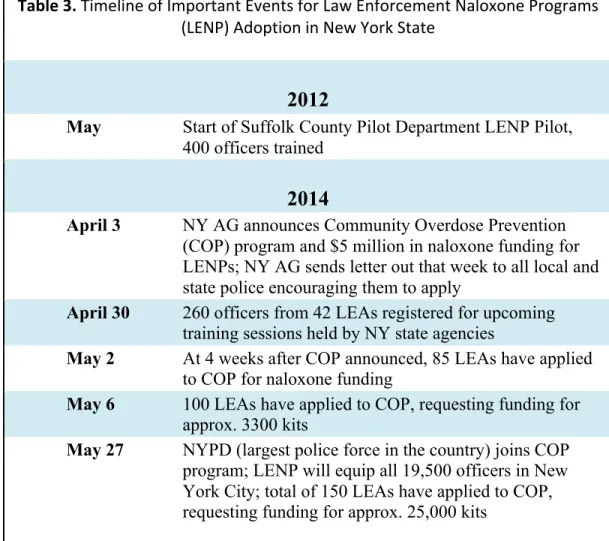
Schneiderman’s COP program was instrumental in speeding up the rate of LENP program adoption across New York. Within five weeks of his announcing the COP program,
i The cost of $20 comes from a discount of $13.27 that is subtracted from the statewide negotiated rate for naloxone . At
28 over 100 law enforcement agencies had applied for funds to purchase naloxone. By the 2-month mark, the number of applications had risen to 150 departments. Table 4 presents a timeline to show the rapid rate at which the number of LENP programs expanded across the state of New York.
As of January 2015, the NY's COP Program has given law enforcement agencies across New York State approximately $1.8 million worth of naloxone kits, funding the purchase of 2,593 kits ($140,435) in Long Island, 1,642 kits ($94,688) in the mid-Hudson region, 1,180 kits ($94,688) in Western New York and 595 kits ($44,825) in central New York area. 18
By developing regional training programs, New York state agencies have also
streamlined the state’s naloxone training of law enforcement officers. The training program is a product of regional and state-level collaboration among the New York State AIDS Institute, the Division of Criminal Justice Services, the Office of Alcoholism and Substance Abuse Services, Albany Medical Center, and the Harm Reduction Coalition52. Between April 2014 and December 2015, naloxone training and free naloxone kits were provided to 7,873 law enforcement officers in New York. New York’s provision of in-person training to several departments at once
facilitates peer-to-peer interactions among officers from different departments, which likely contributes to increased buy-in and support for LENP programs among local law enforcement. No Statewide Push to Expand Naloxone in the Sunshine State. In contrast to the efforts of State Attorneys General in Massachusetts, Ohio, and New York, Florida’s Attorney General Pam Bondi has remained notably silent on the issue of naloxone. Although Florida has seen a
precipitous rise in heroin overdose rates in recent years, Attorney General Bondi’s outspoken
support for cracking down on pill mills and drug dealers has not applied to harm reduction
strategies, such as naloxone expansion. During my research into Florida’s LENP programs38
29 was not able to find any statements or opinions about naloxone by Attorney General Pam Bondi.
One likely reason for the slow rate of LENP adoption in Florida may be the absence of any statewide coordination thus far to expand naloxone access. Without any statewide apparatus to negotiate lower naloxone costs or coordinate LENP implementation, the burden of
responsibility is left for individual police departments in Florida to determine the means to purchase naloxone, acquire funding, and train officers.
The Buckeye State: An Example of Criminal Justice and Public Health Partnerships. In Ohio, local partnerships between law enforcement and public health stakeholders have been important to the implementation of LENP programs. Dating back to the Lorain County Pilot Program, local health departments (LHDs) have played a key role in the planning and implementation phases of local LENP programs. As LENP programs subsequently expanded outside of Lorain County, Ohio has continued to encourage mobilization and coordination for LENP adoption at the county level.
Like New York and Massachusetts, Ohio also allocated state funds to cover the costs associated with adopting and sustaining LENP programs. In the 2016-2017 FY budget, Ohio appropriated $500,000 for purchasing naloxone for first responders75. Rather than distribute monies directly to law enforcement agencies, Ohio designated local health departments to be the county-level receiving entities for naloxone funds75. By establishing a central role for local health departments to distribute naloxone funds to responders, Ohio emphasizes county-level coordination of LENP programs rather than the more centralized statewide apparatus that is seen in New York and Massachusetts.
30 state’s large rural population and historically weak public health infrastructure. All 48 of
Pennsylvania’s rural counties lack a local health department76, and Pennsylvania has the lowest ratio of public health workers to residents in the nation with only 37 public health workers per 100,000 people, compared to a national average of 138 workers76.
Instead, efforts by two key groups of stakeholder have driven the increased rate of LENP adoption: health insurance companies and district attorneys. In Pennsylvania, private-public partnerships with several health insurance companiesii has been essential to equipping law
enforcement with naloxone77. Capital Blue Cross provided a $50,000 grant in 2014, and a
$100,000 grant in 2015, to pay for naloxone purchasing by law enforcement in its 21-county
service area 78
. The state’s District Attorney’s Association oversees the allocation of the Capital
Blue Cross grants to the 21 district attorney’s within this region across central Pennsylvania and
the Lehigh Valley. In Figure 3, the 21-county region is outlined in green on a state map that
shows the status of Pennsylvania’s LENP programs as of June 201560
.
The combination of private-public partnerships and the proactive efforts of county district attorneys have together resulted in LENP expansion through much of Pennsylvania. District attorneys such as Jack Whelan of Delaware County have taken on the role of LENP champions, coordinating the funding of naloxone kits and collaborating with police chiefs in their counties. In Delaware County, DA Whelan, has appeared to champion LENP programs with the same initiative and passion as that of Attorney General Schneiderman on a statewide level in New York.
In 2012, Whelan enacted the Delaware County Heroin Task Force, the driving force that lobbied for the introduction and passage of Act 139, which authorized naloxone use by law and
31 provided limited criminal immunity for overdose victims and bystanders through a Good
Samaritan clause79. Even before Act 139 had been passed into law, Whelan was working to gain support for LENP programs from county leaders of law enforcement agencies. As soon as Act 139 took effect in November 2014, all 42 police departments in DA Whelan’s Delaware County were trained and equipped with naloxone80.
In April 2015, York County became the second county in Pennsylvania to achieve 100%
countywide adoption of law enforcement naloxone programs (n=23). Three months later,
Lancaster County became the third county in Pennsylvania to achieve this feat. Akin to Delaware
County, the additional countywide LENP adoption rates reflect significant efforts by York
County DA Tom Kearney and Lancaster County DA Craig Stedman.
As of June 2015, 108 municipal police departments in Pennsylvania reported the
presence of LENP programsiii. Almost one year later, by April 2016, the number of LENP
programs had more than tripled in Pennsylvania (n=343)11
. This significant increase in LENP
program adoption seems to be largely a reflection of the efforts by county district attorneys in
Pennsylvania.
However, in several Western Pennsylvanian communities, district attorneys have
struggled to convince police chiefs to adopt LENP programs81. For instance, despite providing free naloxone kits to police departments through state grants, LENP adoption has been quite scant in Berks County. The resistance to LENP programs has been pervasive throughout Western Pennsylvania (see Figure 3) 60,81, suggesting a need for greater regional coordination, rather than leaving expansion up to the efforts of individual district attorneys in each county in Western Pennsylvania.
iii This number (n=108) may contain some degree of under-estimation of Pennsylvania’s total LENP count due to non-response
32 Conclusion
Naloxone expansion through law enforcement remains crucial to our multi-pronged approach to prevent, reverse, and treat individuals addicted to opioids. Several barriers remain in our efforts to equip law enforcement officials with naloxone. Persisting stigmatization of drug overdose and a misunderstanding of addiction among law enforcement still shape the perceived attributes of naloxone programs, including its relative advantage to law enforcement,
compatibility with law enforcement identities and roles, and its complexity involved with side effects, storage, and administration.
Moving forward, the application of Rogers’ diffusion of innovation theory can help shape future policy-making that aims to expand LENP adoption practices in the United States. This series of case studies showed that for law enforcement officers to buy-in to the idea of naloxone programs, naloxone must be perceived as compatible with their values and with their constructs of the roles, duties, and values of their law enforcement identity. Because of the central role that indigenous knowledge systems, and thus the perceived compatibility of LENP programs, has had among law enforcement, I propose a modified theoretical framework to understand the decision of law enforcement leaders to support or reject LENP program adoption (Figure 4). The indigenous knowledge (IK) systems about drug use has influenced not only how law enforcement perceive LENP compatibility, but serves as the lens which law enforcement perceive the complexity and relative advantage of adopting LENP programs.
34 References
1. U.S. Department of Health and Human Services. HHS Opioid Initiative: One Year Later. http://www.hhs.gov/sites/default/files/Factsheet-opioids-061516.pdf. Published June 2016. Accessed July 1, 2016.
2. Rogers E. Diffusion of Innovations 5th Ed. 5th ed. New York, NY: New York, NY: Free Press; 2003.
https://books-google-com.libproxy.lib.unc.edu/books/about/Diffusion_of_Innovations_4th_Edition.html?id= v1ii4QsB7jIC. Accessed June 6, 2016.
3. Richard Nixon. Remarks About an Intensified Program for Drug Abuse Prevention and Control. http://www.presidency.ucsb.edu/ws/index.php?pid=3047#axzz1PCJydjl5. Published June 17, 1971. Accessed June 25, 2016.
4. Warner M, Chen LH, Makuc D, Anderson R, Minino A. Drug Poisoning Deaths in the United States, 1980-2008. Centers for Disease Control [CDC].
http://www.cdc.gov/nchs/data/databriefs/db81.pdf. Published December 2011. Accessed June 26, 2016.
5. Centers for Disease Control and Prevention (CDC). Increases in Drug and Opioid Overdose Deaths — United States, 2000–2014.
http://www.cdc.gov/mmwr/preview/mmwrhtml/mm6450a3.htm?s_cid=mm6450a3 _w. Published January 1, 2016. Accessed June 23, 2016.
6. Opioid Abuse in the U.S. and HHS Actions to Address Opioid-Drug Related Overdoses and Deaths. ASPE. https://aspe.hhs.gov/basic-report/opioid-abuse-us-and-hhs-actions-address-opioid-drug-related-overdoses-and-deaths. Published June 13, 2015. Accessed May 17, 2016.
7. Eric Holder. Attorney General Eric Holder’s Remarks at the 2014 Police Executive Research Forum. https://www.justice.gov/opa/speech/attorney-general-eric-holder-delivers-remarks-2014-police-executive-research-forum. Published April 16, 2014. Accessed May 26, 2016.
8. Department of Justice. Attorney General Loretta E. Lynch Delivers Keynote Address at the Opioid Misuse and Addiction Summit. The United States Department of Justice: Justice News. https://www.justice.gov/opa/speech/attorney-general-loretta-e-lynch-delivers-keynote-address-opioid-misuse-and-addiction. Published October 2, 2015. Accessed July 4, 2016.
9. Harm Reduction Coalition. Principles of Harm Reduction.
35 10. Police Executive Research Forum (PERF). A Heroin Epidemic and Changing Attitudes
Toward Marijuana: Police Chiefs and Federal Leaders Focus on the Heroin Epidemic. http://www.policeforum.org/assets/docs/Critical_Issues_Series_2/a%20heroin%20e pidemic%20and%20changing%20attitudes%20toward%20marijuana.pdf. Published August 2014. Accessed June 25, 2016.
11. North Carolina Harm Reduction Coalition. US Law Enforcement Who Carry Naloxone. http://www.nchrc.org/law-enforcement/us-law-enforcement-who-carry-naloxone/. Published April 26, 2016. Accessed May 26, 2016.
12. FDA Center for Drug Evaluation and Research: Division of Anesthesia, Analgesia, and Addiction Products. Division Director’s Review and Summary Basis for Approval. April 2014.
http://www.accessdata.fda.gov/drugsatfda_docs/nda/2014/205787Orig1s000SumR. pdf.
13. U.S. Food and Drug Administration. Evzio (naloxone hydrochloride injection) Auto-injector for intramuscular or subcutaneous use: Full Prescribing Information.
http://www.accessdata.fda.gov/drugsatfda_docs/label/2014/205787Orig1s000lbl.pd f. Published April 2014. Accessed June 13, 2016.
14. Weisburd D, Lum C. The Diffusion of Computerized Crime Mapping in Policing: Linking Research and Practice. Police Practice and Research. 2005;6(5):419-434.
doi:10.1080/15614260500433004.
15. Cabell A, Casteel C, Chronister T, Nocera M, Vladutiu CJ, Peek-Asa C. Factors influencing law enforcement decisions to adopt an evidence-based robbery prevention program. Health Education Research. 2013;28(6):1105-1115. doi:10.1093/her/cyt093.
16. Korteland E, Bekkers V. The diffusion of electronic service delivery innovations in Dutch E-policing: the case of digital warning systems. Public Management Review. 2008;10(1):71-88.
http://www.tandfonline.com/doi/abs/10.1080/14719030701763195. Accessed June 22, 2016.
17. Banks D, Hendrix J, Hickman M, Kyckelhahn T. National Sources of Law Enforcement Data. April 2016. http://www.bjs.gov/content/pub/pdf/nsleed.pdf. Accessed June 21, 2016.
18. New York State Office of the Attorney General. Community Overdose Prevention Program Information Page. http://cop.ag.ny.gov/COPReport/. Published January 2015. Accessed June 7, 2016.
19. Reaves BA. Census of State and Local Law Enforcement Agencies, 2008. U.S. Department of Justice, Office of Justice Programs, Bureau of Justice Statistics; 2011.
36 20. US Law Enforcement Who Carry Naloxone » North Carolina Harm Reduction Coalition.
http://www.nchrc.org/law-enforcement/us-law-enforcement-who-carry-naloxone/. Accessed May 24, 2016.
21. Encarnacao J. White House recognizes Quincy police for drug program. The Patriot Ledger (Quincy, MA). April 2013.
http://www.patriotledger.com/article/20130430/News/304309758. Accessed July 2, 2016.
22. Project DAWN of Lorain County. SB 57 Project DAWN Lorain County Pilot Year-End Report. http://www.lorainadas.org/wp-content/uploads/SB-57-Project-DAWN-Lorain-Pilot-Year-End-Report-distributed.pdf. Published 2014. Accessed June 20, 2016.
23. Department of Public Health Bureau of Substance Abuse Services. Overdose Education and Naloxone Distribution (OEND) Pilot Expansion.
http://www.mass.gov/eohhs/docs/dph/substance-abuse/opioid/fy-15-oend-pilot-expansion-report.pdf. Published 2015. Accessed June 1, 2016.
24. Beletsky L. Engaging Law Enforcement in Opioid Overdose Response: Frequently Asked Questions. http://papers.ssrn.com/abstract=2530695. Published November 25, 2014. Accessed May 19, 2016.
25. Georgas E. SB 57 Project DAWN: Lorain County Pilot Narcan Presentation.
http://webcache.googleusercontent.com/search?q=cache:oiV-Q5qX8QMJ:ohiohospitals.org/OHA/media/Images/Membership%2520Services/Docu
ments/OHA%2520Events/Behavioral%2520Health%2520Seminar%2520-
%2520Oct%25202015/Elaine-Georgas-Presentation.pptx+&cd=1&hl=en&ct=clnk&gl=us. Accessed June 15, 2016.
26. Gregg Mehling. Naloxone Protocol: Lorain County Pilot Program, Lorain County Sheriff’s Office & Lorain County Drug Task Force. April 2014.
https://www.youtube.com/watch?v=5v9p1W_pdIs.
27. Warren DM. Using Indigenous Knowledge in Agricultural Development. 1991. 28. Gary Hayes Award Recognizes Lt. Patrick Glynn For Helping to Save Lives of Heroin
Users. Subject to Debate: A Newsletter of the Police Executive Research Forum. 2014;28(3):6.
http://www.policeforum.org/assets/docs/Subject_to_Debate/Debate2014/debate_20 14_mayjun.pdf. Accessed June 5, 2016.
37 30. Bonzar E. Lorain police chief attends Narcan symposium in D.C. The Morning Journal.
http://www.morningjournal.com/article/MJ/20140814/NEWS/140819786. Published August 14, 2014. Accessed July 5, 2016.
31. Suffolk County Sheriff’s Office. Sheriff DeMarco and Legislator Kara Hahn Team Up With Hope House. Suffolk County Sheriff’s Office: Long Island, New York.
http://www.suffolkcountyny.gov/sheriff/PressReleases/IntheNews/tabid/1446/ctl/ details/itemid/1361/mid/1989/sheriff-demarco-and-legislator-kara-hahn-team-up-with-hope-house.aspx. Published June 10, 2013. Accessed June 27, 2016.
32. Office of National Drug Control Policy. 2013 Advocate for Action: Lieutenant Detective Patrick Glynn. Youtube video. https://www.youtube.com/watch?v=L_deE4IaAog. Published October 9, 2014. Accessed July 2, 2016.
33. Walker JL. The Diffusion of Innovations among the American States. American Political Science Review. 1969;63(03):880-899. doi:10.2307/1954434.
34. Levi J, Segal L, Martin A. The Facts Hurt: A STATE-BY-STATE INJURY PREVENTION POLICY REPORT 2015. Trust for America’s Health; Robert Wood Johnson Foundation; 2015. http://healthyamericans.org/assets/files/TFAH-2015-InjuryRpt-final6.18.pdf. Accessed July 1, 2016.
35. Centers for Disease Control and Prevention (CDC). Opioid Overdose Prevention Programs Providing Naloxone to Laypersons — United States, 2014. Morbidity and Mortality Weekly Report (MMWR).
http://www.cdc.gov/mmwr/preview/mmwrhtml/mm6423a2.htm?s_cid=mm6423a2 _w. Published June 19, 2014. Accessed June 23, 2016.
36. Centers for Disease Control and Prevention (CDC). Community-based opioid overdose prevention programs providing naloxone - United States, 2010. MMWR Morb Mortal Wkly Rep. 2012;61(6):101-105. http://www.cdc.gov/mmwr/pdf/wk/mm6106.pdf. Accessed July 1, 2016.
37. Johnson H, Paulozzi L, Porucznik C, Mack K. Decline in Drug Overdose Deaths After State Policy Changes — Florida, 2010–2012. Centers for Disease Control and Prevention (CDC); 2014. http://www.cdc.gov/mmwr/preview/mmwrhtml/mm6326a3.htm. Accessed June 26, 2016.
38. Masferrer MR, Dymond R. Medical examiner says heroin deaths in Manatee dropping in 2016. Bradenton Herald.
http://www.bradenton.com/news/local/heroin-epidemic/article73720597.html. Published April 26, 2016. Accessed May 26, 2016. 39. Irby K. Sarasota Sheriff’s Office receives donation of $320,000 worth of heroin overdose
recovery medication. Bradenton Herald.
38 40. LaSalle R. Marion police chief: Naloxone gives addicts a “safety net” feeling. NBC4i.com.
April 2016. http://nbc4i.com/2016/04/21/marion-police-chief-naloxone-gives-addicts-a-safety-net-feeling/. Accessed June 13, 2016.
41. Orange County Heroin Task Force. Orange County Heroin Task Force - Draft Meeting Minutes: October 14. 2015, 1 pm-3pm.
http://www.orangecountyfl.net/portals/0/resource%20library/all%20meeting%20 minutes/Heroin%20Task%20Force/2015%20October%2014%20Minutes.pdf. Published October 14, 2015. Accessed June 13, 2016.
42. Winstanley EL, Clark A, Feinberg J, Wilder CM. Barriers to implementation of opioid overdose prevention programs in Ohio. Subst Abus. 2016;37(1):42-46.
doi:10.1080/08897077.2015.1132294.
43. Bennish S. Antidote may soon be in more hands; Fast-acting drug can save lives of addicts who overdose. Dayton Daily News (Ohio).
http://www.daytondailynews.com/news/news/lifesaving-overdose-antidote-could-soon-be-in-more/nbPsZ/. Published October 23, 2013. Accessed July 1, 2016.
44. Pitman M. Kroger to offer life-saving Narcan. Dayton Daily News (Ohio).
http://www.daytondailynews.com/news/news/kroger-announces-pharmacies-to-dispense-naloxone-w/nqPGK/. Published February 13, 2016. Accessed June 20, 2016. 45. W.Pa. police slow to carry overdose antidote. Pittsburgh Tribune Review. December
2015.
46. Faye M. Police forces aren’t rushing to carry Narcan. Tribune-Review (Greensburg, PA). http://www.lexisnexis.com.libproxy.lib.unc.edu/lnacui2api/api/version1/getDocCui?
lni=5GWC-MJM1-DYCW-C17T&csi=8411&hl=t&hv=t&hnsd=f&hns=t&hgn=t&oc=00240&perma=true. Published September 8, 2015. Accessed June 3, 2016.
47. Schaefer MA. Many Pennsylvania police units still not using overdose antidote. The Philadelphia Inquirer.
http://articles.philly.com/2015-08-23/news/65743395_1_narcan-drug-overdoses-departments. Published August 23, 2015. Accessed July 1, 2016.
48. Cherkis J, Wing N. Overdose Reversal Drug Naloxone Is Saving Lives, But Not All Police Departments Are On Board. The Huffington Post.
http://www.huffingtonpost.com/entry/naloxone-police_us_56216b5fe4b02f6a900c6d80. Published October 17, 2015. Accessed May 12, 2016.
49. Mitchell K. Ohio police slow to carry overdose drug on patrol | The Columbus Dispatch. The Columbus Dispatch.
39 50. Bureau of Justice Assistance [BJA]. Acquiring Naloxone. Law Enforcement Naloxone
Toolkit. https://www.bjatraining.org/tools/naloxone/Acquiring-Naloxone. Published 2016. Accessed May 27, 2016.
51. Walley A. Evaluating the Impact of Overdose Prevention Education and Naloxone Rescue Kits in Massachusetts. July 2015.
http://www.fda.gov/downloads/Drugs/NewsEvents/UCM454823.pdf. Accessed June 15, 2016.
52. New York State Department of Health. The New York State Opioid Overdose and Intranasal Naloxone Program for Law Enforcement: Data Brief #1. January 2016. https://www.health.ny.gov/diseases/aids/general/opioid_overdose_prevention/docs /fact_sheet_law_enforcement.pdf. Accessed June 15, 2016.
53. Committee on Oversight & Government Reform. Cummings, Sanders Urge Mayors and County Officials to Combat Overcharging for Critical Drug Used by First Responders.; 2015.
http://democrats.oversight.house.gov/news/press-releases/cummings-sanders-urge-mayors-and-county-officials-to-combat-overcharging-for. Accessed June 13, 2016.
54. Silverman E. Lawmaker criticizes Amphastar for naloxone pricing. Wall Street Journal. https://www.pharmacist.com/lawmaker-criticizes-amphastar-naloxone-pricing. Published July 9, 2015. Accessed May 24, 2016.
55. Washington: Blumenthal Calls on Amphastar to Reverse Obscene and Immoral Narcan Price Hike, Urges FTC to Investigate Prescription Drug Profiteering and Price Gouging. US Official News. October 13, 2015.
56. Gray N. Senators request pricing info from opioid-overdose drugmakers. BioPharma Dive. http://www.biopharmadive.com/news/senators-request-pricing-info-from-opioid-overdose-drugmakers/420542/. Published June 8, 2016. Accessed June 13, 2016.
57. Bebinger M. Price Of User-Friendly Form Of Overdose Reversal Drug Spikes. Wbur’s CommonHealth Reform and Reality. http://commonhealth.wbur.org/2016/02/price-spikes-overdose-reversal-drug. Published February 12, 2016. Accessed May 26, 2016. 58. Schultz R. Delray gets Narcan, Chabad goes before city council again & other notes |
Boca Raton Magazine. Boca Raton Magazine. March 2016.
http://bocamag.com/blog/2016/03/03/delray-gets-narcan-chabad-goes-before-city-council-again-and-other-notes/. Accessed June 21, 2016.
40 60. The Center for Rural Pennsylvania: A Legislative Agency of the Pennsylvania General
Assembly. Pennsylvania Municipal Police Departments and Naloxone. July 2015. http://www.senatorgeneyaw.com/files/2014/07/Police-Naloxone-Survey-2015.pdf. Accessed June 1, 2016.
61. Ortega O. Required to carry Narcan, Somerville police union argues for new contract - The Boston Globe. Boston Globe.
https://www.bostonglobe.com/metro/2014/09/21/required-carry-narcan-
somerville-police-union-argues-for-new-contract/ATzxFwi8VYDy3NV1I7nWfI/story.html. Published September 22, 2014. Accessed May 19, 2016.
62. Winokoor C. Taunton Fire Department to receive $26K as state’s anti-overdose program expands. Wicked Local Plymouth.
http://plymouth.wickedlocal.com/article/20141126/NEWS/141126904. Published November 26, 2014. Accessed June 21, 2016.
63. Dame J. Newton fire, police still without Narcan. Newton TAB.
http://newton.wickedlocal.com/article/20151104/NEWS/151108262/?Start=1. Published November 4, 2015. Accessed June 21, 2016.
64. Michel L. First responders clash over antidote; Anti-heroin drug a point of contention. The Buffalo News (New York). https://www.highbeam.com/doc/1P2-35841438.html. Published March 25, 2014. Accessed June 20, 2016.
65. New York State Office of the Attorney General. New York: A.G. Schneiderman
Announces Agreement To Cut And Cap The Price Of Heroin Overdose Antidote For All Agencies In New York State. Attorney General Eric T. Schneiderman.
http://www.ag.ny.gov/press-release/ag-schneiderman-announces-agreement-cut-and-cap-price-heroin-overdose-antidote-all. Published February 5, 2015. Accessed July 1, 2016.
66. Ohio Attorney General’s Office. Naloxone Rebate Instructions. Columbus, Ohio; 2015. http://www.ohioattorneygeneral.gov/naloxonerebate. Accessed July 1, 2016. 67. Office of the Attorney General State of Connecticut. Attorney General: State Reaches
Agreement with Amphastar Providing Rebates for State and Municipal Naloxone Purchases, Will Receive Donation of 500 Doses of Life-saving Drug from Kaléo. http://www.ct.gov/ag/cwp/view.asp?Q=578812&A=2341. Published April 5, 2016. Accessed June 26, 2016.
68. Office of the Attorney General of Delaware. Naloxone Rebate.
http://attorneygeneral.delaware.gov/fraud/cpu/naloxonerebate.shtml. Published 2015. Accessed June 20, 2016.
69. Office of the Attorney General of Massachusetts. AG Healey Announces $325K
41 Statewide Access Life-Saving Drug.
http://www.mass.gov/ago/news-and-updates/press-releases/2015/2015-08-31-amphastar-agreement.html. Published August 31, 2015. Accessed May 26, 2016.
70. Office of the Vermont Attorney General. Attorney General Announces Agreement To Reduce And Cap State’s Cost For Overdose Antidote.
http://ago.vermont.gov/focus/news/attorney-general-announces-agreement-to-reduce-and-cap-states-cost-for-overdose-antidote.php. Published December 18, 2015. Accessed July 1, 2016.
71. Wisconsin Department of Justice. AG Schimel reaches rebate agreement with manufacturer of lifesaving opiate antidote. https://www.doj.state.wi.us/news- releases/ag-schimel-reaches-rebate-agreement-manufacturer-lifesaving-opiate-antidote. Published March 23, 2016. Accessed July 1, 2016.
72. State of New Jersey Office of the Governor. Governor Christie Announces Agreement To Secure Discounts On Life-Saving Overdose Antidote For New Jersey First Responders. Legal Monitor Worldwide.
https://dspace.njstatelib.org/xmlui/bitstream/handle/10929/35191/Office%20of% 20the%20Governor%20_%20Newsroom.pdf?sequence=1&isAllowed=y. Published June 5, 2015. Accessed July 1, 2016.
73. Massachusetts Department of Public Health (MDPH). Frequently Asked Questions about the Bulk Purchase Trust Fund. November 2015.
http://www.mass.gov/eohhs/docs/dph/substance-abuse/bulk-purchasing-q-and-a-doc.pdf. Accessed June 6, 2016.
74. Norfolk District Attorney’s Office. Press Release: DA Morrissey joins AG Healey, police and fire chiefs announcing fund and funding for overdose reversal drug: Local police and fire dpeartments will get steady price, state support. August 2015.
http://www.mass.gov/norfolkda/Press_Releases/08-31-15%20Municipalities%20get%20better%20access%20to%20overdose%20reversal %20drug.pdf. Accessed June 6, 2016.
75. The Ohio Department of Mental Health and Addiction Services (OhioMHAS). Naloxone. (GCOAT) Opiate Action Team. http://mha.ohio.gov/Default.aspx?tabid=817. Accessed July 5, 2016.
76. Cardelle A. Public Health Infrastructure for Rural Pennsylvania. July 2005.
http://www.rural.palegislature.us/public_health_infrastructure_rpa.pdf. Accessed July 1, 2016.
77. Gov. Wolf backs plan to equip Pennsylvania State Police vehicles with naloxone. The Evening Sun (Hanover, Pennsylvania). April 2015:NEWS.