
PROFET® Data Sheet BTS 443 P
Smart Highside Power Switch
Reversave
• Reverse battery protection by self turn on of power MOSFET
Features
• Short circuit protection • Current limitation • Overload protection • Thermal shutdown
• Overvoltage protection (including load dump) • Loss of ground protection
• Loss of Vbb protection (with external diode for charged inductive loads)
• Very low standby current
• Fast demagnetisation of inductive loads • Electrostatic discharge (ESD) protection
• Optimized static electromagnetic compatibility (EMC)
Diagnostic Function
• Proportional load current sense (with defined fault signal during thermal shutdown)
Application
• Power switch with current sense diagnostic feedback for 12V and 24 V DC grounded loads • All types of resistive, capacitive and inductive loads (no PWM with inductive loads)
• Replaces electromechanical relays, fuses and discrete circuits
General Description
N channel vertical power FET with charge pump, current controlled input and diagnostic feedback with load current sense, integrated in Smart SIPMOS chip on chip technology. Providing embedded protective functions.
IN
Charge pump Level shifter
Rectifier
Limit for unclamped
ind. loads Gate protection Current
limit
2
Overvoltage protection
+ Vbb
PROFET
OUT
3 & Tab
1, 5
Load GND
Load
Output Voltage detection
RIS IS 4
IIS
IL
VIS IIN
Logic GND
Voltage sensor Voltage
source
Current Sense Logic
ESD
Temperature sensor
R bb
VIN
Product Summary
Operating voltage
V
bb(on)5.0
...
36
V
On-state resistance
R
ON16
m
Ω
Load current (ISO)
I
L(ISO)25
A
Current limitation
I
L(SCr)65
A
Package
Pin Symbol
Function
1 OUT
O
Output to the load. The pin 1 and 5 must be shorted with each other especially in high current applications!*)2 IN I
Input, activates the power switch in case of short to groundTab/(3) Vbb +
Positive power supply voltage, the tab is shorted to this pin.4 IS S
Diagnostic feedback providing a sense current proportional to the load current; high current on failure (see Truth Table on page 6)5 OUT
O
Output to the load. The pin 1 and 5 must be shorted with each other especially in high current applications!*)*) Not shorting all outputs will considerably increase the on-state resistance, reduce the peak current capability and decrease the current sense accuracy
Maximum Ratings at T
j= 25 °C unless otherwise specified
Parameter Symbol
Values
Unit
Supply voltage (overvoltage protection see page 4)
V
bb36
V
Supply voltage for full short circuit protection
(see also diagram on page 9) T
j=-40...150 °C:
V
bb24
1)
V
Load dump protection V
LoadDump= U
A+ V
s, U
A= 13.5 V
R
I= 2
Ω
, R
L= 2.7
Ω
, t
d= 200 ms, IN= low or high
V
Load dump2)60
V
Load current (Short-circuit current, see page 4)
I
Lself-limited
A
Operating temperature range
Storage temperature range
T
jT
stg-40 ...+150
-55 ...+150
°C
Power dissipation (DC) TC
≤
25°C
P
tot42
W
Inductive load switch-off energy dissipation,
single pulse U=12V, I=10A, L=3mH
T
j=150 °C:
E
AS0.15
J
Electrostatic discharge capability (ESD)
(Human Body Model)
acc.
ESD assn. std. S5.1-1993; R=1.5kΩ; C=100pFV
ESD4.0
kV
Current through input pin (DC)
Current through current sense pin (DC)
see internal circuit diagrams page 7I
INI
IS+15, -100
+15, -100
mA
1) Short circuit is tested with 100mΩ and 20µH
2) V
Data Sheet BTS 443 P
Thermal Characteristics
Parameter and Conditions Symbol
Values
Unit
min typ
max
Thermal resistance
chip - case
:R
thJC3)-- --
1.5
K/W
junction - ambient (free air):
R
thJA--
80
--SMD version, device on PCB
4):
--
45
3) Thermal resistance R
thCH case to heatsink (about 0.5 ... 0.9 K/W with silicone paste) not included! 4) Device on 50mm*50mm*1.5mm epoxy PCB FR4 with 6cm2 (one layer, 70µ
m thick) copper area for Vbb connection. PCB is vertical without blown air.
Electrical Characteristics
Parameter and Conditions Symbol
Values
Unit
at Tj= -40°C...150°C, Vbb = 12 V unless otherwise specified
min typ
max
Load Switching Capabilities and Characteristics
On-state resistance (pin 3 to pin 1,5)
V
IN= 0, I
L= 5 A
T
j=25 °C:
T
j=150 °C:
R
ON--
13
25
16
31
m
Ω
Output voltage drop limitation at small load
currents (Tab to pin 1,5)
T
j=-40...150 °C:
V
ON(NL)--
50
--
mV
Nominal load current (Tab to pin 1,5)
ISO Proposal: T
C=85°C, V
ON≤0.5V, T
j≤150°C
SMD
4): T
A
=85°C, V
ON≤0.5V, T
j≤150°C
I
L(ISO)I
L(nom)21
6.2
25
7.6
--A
Turn-on time
IIN
to 90% V
OUT:
Turn-off time
IIN
to 10% V
OUT:
R
L= 2,5
Ω
,T
j=-40...150 °C
t
ont
off150
70
--
--
410
410
µ
s
Slew rate on
10 to 30% V
OUT,R
L= 2.5
Ω,
T
j=-40...150 °C
dV /dt
on0.1 -- 1
V/
µ
s
Slew rate off
70 to 40% V
OUT, R
L= 2.5
Ω,
T
j=-40...150 °C
Parameter and Conditions Symbol
Values
Unit
at Tj= -40°C...150°C, Vbb = 12 V unless otherwise specified
min typ
max
Operating Parameters
Operating voltage (V
IN=0V)
V
bb(on)5.0
--
36
V
Undervoltage shutdown
5)V
bIN(u)1.5 3.0 4.5
V
Undervoltage restart of charge pump (V
IN=0V)
V
bb(ucp)3.0 4.5 6.0
V
Overvoltage protection
6)I
bb=15 mA
V
Z,IN61
68
--
V
Standby current
T
j=-40...+25°C
:I
IN=0
T
j=150°C:
I
bb(off)--
--
2
4
5
8
µ
A
Protection Functions
7)Short circuit current limit (Tab to pin 1,5)
V
ON=8V, time until limitation max. 300µs
T
j=-40°C:
T
j=25°C:
T
j=+150°C:
I
L(SC)35
35
35
75
65
65
110
110
125
A
Repetitive short circuit current limit,
Tj = TjtI
L(SCr)--
65
--
A
Output clamp (inductive load switch off)
at V
OUT= V
bb- V
ON(CL)(e.g. overvoltage)
I
L= 40 mA
8)V
ON(CL)38
42 48
V
Thermal overload trip temperature
T
jt150 -- --
°C
Thermal hysteresis
∆
T
jt-- 10 --
K
Reverse Battery
Reverse battery voltage
-V
bb--
--
20
V
On-state resistance (pin 1,5 to pin 3)
V
bb= - 8V, V
IN= 0, I
L= -5 A, R
IS= 1 k
Ω
, T
j=25 °C:
V
bb= -12V, V
IN= 0, I
L= -5 A, R
IS= 1 k
Ω
, T
j=25 °C:
T
j=150 °C:
R
ON(rev)--
--
--
16
25
22
19
32
m
Ω
Integrated resistor in V
bbline
R
bb--
200
--
Ω
5) VbIN=Vbb-VIN see diagram on page 11. 6) see also VON(CL) in circuit diagram on page 7.
7) Integrated protection functions are designed to prevent IC destruction under fault condition described in the
data sheet. Fault conditions are considered as “outside” normal operating range. Protection functions are not for continuous repetitive operation.
Data Sheet BTS 443 P
Diagnostic Characteristics
Current sense ratio, static on-condition
k
ILIS=
I
L:
I
ISV
ON<1.5
V, V
IS<V
OUT-
5
V, V
bIN>4.5
V
9)k
ILIS--
8200
--IL = 20A, Tj = -40°C:
Tj = +25°C:
Tj = +150°C:
IL = 5A, Tj = -40°C:
Tj = +25°C:
Tj = +150°C:
IL = 2.5A, Tj = -40°C:
Tj = +25°C:
Tj = +150°C:
IL = 1A, Tj = -40°C:
Tj = +25°C:
Tj = +150°C:
7400
7500
7500
6800
7200
7200
6800
6800
6800
6800
6800
6800
8300
8300
8200
8300
8300
8200
8500
8500
8100
8600
8600
8600
9100
9100
8800
9700
9300
9000
10000
9800
9200
10500
10500
10500
I
IN= 0
(e.g. during de-energising of inductive loads):
-- n.a.
--Sense current under fault conditions;
V
DS>1.5V, typ.
T
j= -40...+150°C
:I
IS,fault2.5
4 --
mA
Fault-Sense signal delay after negative input slope t
delay(fault)0.8
ms
Current sense leakage current
I
IN=
0:
V
IN=
0, I
L=
0:
I
IS(LL)I
IS(LH)--
--
--
4
0.5
12
µ
A
Current sense settling time to I
IS static±
10% after
positive input slope, I
L= 0
20 A
10)T
j= -40...+150°C
:t
son(IS)--
--
400
µ
s
Overvoltage protection
I
bb=
15
mA
T
j=
-40...+150°C:
V
bIS(Z)61
68
--
V
9) If V
ON is higher, the sense current is no longer proportional to the load current due to sense current
saturation.
10) not subject to production test, specified by design
Input
Required current capability of input switch
T
j=-40..+150°C:
I
IN(on)-- 0.7 1.2
mA
Truth Table
Input Current
level
Output level
Current Sense
IIS
Normal operation
L H
L H
0 nominal
Overload L
H
L H
0 IISfault
Short circuit to GND L
H
L L
0 IISfault
Overtemperature L
H
L L
0 IISfault
Short circuit to Vbb L
H
H H
0 <nominal11
Open load L
H
Z H
0 0
L = "Low" Level Z = high impedance, potential depends on external circuit H = "High" Level
11) Low ohmic short to
V
bb may reduce the output current
I
L and therefore also the sense currentI
IS.Terms
PROFET
V
IN
IS
OUT bb
V
IN IIS
IIN
V bb
I bb
I L
VOUT
VON
2
4 3
1,5
RIS
VIS
VbIN
RIN
DS
VbIS
Two or more devices can easily be connected in parallel to increase load current capability.
Data Sheet BTS 443 P
Input circuit (ESD protection)
IN
ZD
IN
I
V bb
Rbb V
Z,IN
V bIN
V IN
ESD-Zener diode: 68 V typ., max 15 mA;
Current sense output
Normal operation
IS
IS
R
ZD
IS
V Vbb
Z,IS
V Rbb
IIS IIS,fault
VZ,IS=68V(typ.), RIS =1kΩ nominal (or 1kΩ /n, if n devices are connected in parallel). IS = IL/kilis can be
only driven by the internal circuit as long as
Vout - VIS > 5V. If you want to measure load currents
up to IL(M), RIS should be less than
ilis M L
bb
K
I
V
V
/
5
) (
−
. Note: For large values of RIS the voltage VIS can reach
almost Vbb. See also overvoltage protection. If you don't use the current sense output in your application, you can leave it open.
Inductive and overvoltage output clamp
+ Vbb
OUT
PROFET
VZ1
VON
VON is clamped to VON(Cl) =42V typ.
Overvoltage protection of logic part
+ Vbb
VOUT
IN
bb
R
Signal GND
Logic
PROFET
V
Z,IS
R IS
IN
R
IS
V
Z,IN
R V V Z,VIS
Rbb =200Ωtyp.,VZ,IN = VZ,IS = 68Vtyp.,RIS=1kΩ
nominal. Note that when overvoltage exceeds 73Vtyp. a voltage above 5V can occur between IS and GND, if
Reversave
(Reverse battery protection)
Logic IS IN
IS
R RV
OUT
L R
Power Signal
Vbb
-Power Transistor IN
R
bb R
D
RV≥1kΩ, R IS =1kΩ nominal. Add RIN for reverse
battery protection in applications with Vbb above 16V; recommended value: 1
RIN +
1 RIS +
1
RV =
V
V
A
bb
|
12
|
,
05
.
0
−
To minimise power dissipation at reverse battery operation, the summarised current into the IN and IS pin should be about 50mA. The current can be provided by using a small signal diode D in parallel to the input switch, by using a MOSFET input switch or by proper adjusting the current through RIS and RV.
Since the current through Rbb generates additional
heat in the device, this has to be taken into account in the overall thermal considerations.
V
bbdisconnect with energised inductive
load
Provide a current path with load current capability by using a diode, a Z-diode, or a varistor. (VZL <73 V or
VZb <30 V if RIN=0). For higher clamp voltages
currents at IN and IS have to be limited to 250 mA. Version a:
PROFET V
IN OUT
IS bb V
bb
VZL
Version b:
PROFET V
IN OUT
IS bb V
bb
VZb
Note that there is no reverse battery protection when using a diode without additional Z-diode VZL, VZb.
Version c:
Sometimes a necessary voltage clamp is given by non inductive loads RL connected to the same switch and
eliminates the need of clamping circuit:
PROFET V
IN OUT
IS bb V
bb R
Data Sheet BTS 443 P
Inductive load switch-off energy
dissipation
PROFET
V
IN OUT
IS bb E
E
E EAS
bb
L
R ELoad
L
RL
{
Z L RIS
IIN
Vbb i (t)L
Energy stored in load inductance: EL = 1/2
·
L·
I2LWhile demagnetising load inductance, the energy dissipated in PROFET is
EAS= Ebb + EL - ER= VON(CL)
·
iL(t) dt,with an approximate solution for RL > 0Ω: EAS= IL
·
L2·RL
(
Vbb +|VOUT(CL)|)ln
(1+IL
·
RL|VOUT(CL)| )
The device is not suitable for permanent PWM with inductive loads if active clamping occurs every cycle.
Maximum allowable load inductance for
a single switch off
L = f (IL ); Tj,start =150°C, Vbb =12V, RL =0Ω L[mH]
0.01 0.1
1 10 100
0 25 50 75 100
Timing diagrams
Figure 1a: Switching a resistive load,
change of load current in on-condition:
I
INt
V
OUTI
LI
IStson(IS)
tslc(IS) t
Load 1 Load 2
soff(IS) t t
t on
off
slc(IS) 90%
dV/dton
dV/dtoff
10%
The sense signal is not valid during a settling time after turn-on/off and after change of load current.
Figure 1b: typical behaviour of sense output:
IL(lim) = 20A IS
IL IIS,fault >= 2.5mA
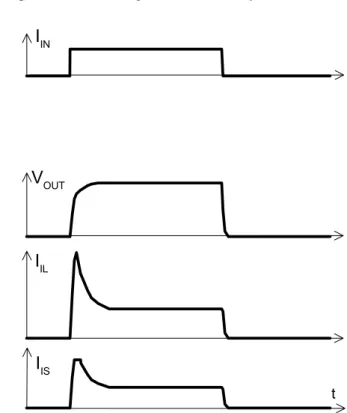
Figure 2a: Switching motors and lamps:
I
INt
V
OUTI
ILI
ISSense current above IIS,fault can occur at very high inrush currents.
Figure 2b: Switching an inductive load:
I
INt
V
OUTI
LData Sheet BTS 443 P
Figure 3a: Short circuit:
t I
IIS IN
L
L(SCr) I IL(SCp)
IISfault
Figure 4a: Overtemperature
Reset if Tj<Tjt
I
INt
I
ISV
OUTT
jAuto Restart
IIS,fault
Figure 5a: Undervoltage restart of charge pump,
overvoltage clamp
0 2 4 6 8 10 12
0 2 4 6 8 10 12
V
OUTVbIN(ucp)
V
IN= 0
I
IN= 0
V ON(CL)
VON(CL) VbIN(u)
VbIN(u) dynamic, short
Undervoltage not below
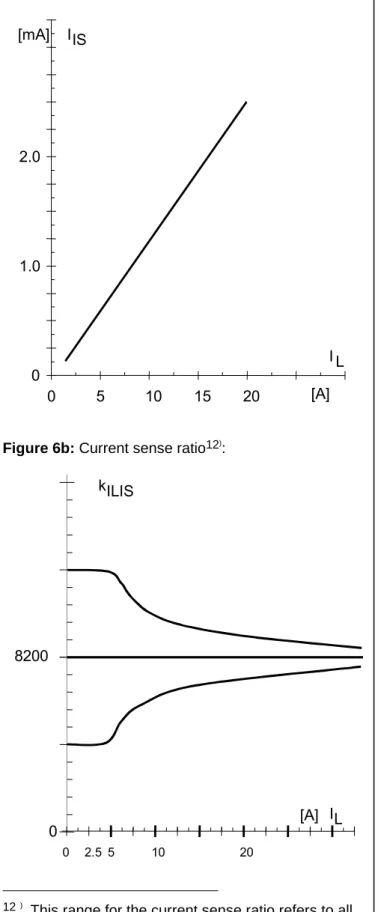
Figure 6a: Current sense versus load current:
0 1.0 2.0
0 5 10 15 20
I L [A]
[mA] IIS
Figure 6b: Current sense ratio12):
0 8200
0 2.5 10 20
IL [A] kILIS
5
12)
This range for the current sense ratio refers to all devices. The accuracy of the kILIS can be raised by
means of calibration the value of kILIS for every
single device.
Figure 7a: Output voltage drop versus load current:
0.0 0.05 0.1
0 1 2 3 4 5 6 7 8
I L [A]
[V] VON
ON(NL) V
ON R
Data Sheet BTS 443 P
Package and Ordering Code
All dimensions in mmD-Pak-5 Pin: TO-252-5-1
Sales Code BTS443P
Ordering code Q67060-S7404-A 2
Published by
Infineon Technologies AG, St.-Martin-Strasse 53, D-81669 München
© Infineon Technologies AG 2001 All Rights Reserved.
Attention please!
The information herein is given to describe certain components and shall not be considered as a guarantee of characteristics.
Terms of delivery and rights to technical change reserved.
We hereby disclaim any and all warranties, including but not limited to warranties of non-infringement, regarding circuits, descriptions and charts stated herein.
Infineon Technologies is an approved CECC manufacturer.
Information
For further information on technology, delivery terms and conditions and prices please contact your nearest Infineon Technologies Office in Germany or our Infineon Technologies Representatives worldwide (see address list).
Warnings
Due to technical requirements components may contain dangerous substances. For information on the types in question please contact your nearest Infineon Technologies Office.
Infineon Technologies Components may only be used in life-support devices or systems with the express written approval of Infineon Technologies, if a failure of such components can reasonably be expected to cause the failure of that life-support device or system, or to affect the safety or effectiveness of that device or system. Life life-support devices or systems are intended to be implanted in the human body, or to support and/or maintain and sustain and/or protect human life. If they fail, it is reasonable to assume that the health of the user or other persons may be endangered.
GPT09161 5.4±0.1
-0.10
6.5+0.15
A
±0.5
9.9 6.22
-0.2
1
±0.1
±0.15
0.8
0.15 max
±0.1
per side 5x0.6
1.14 4.56
+0.08 -0.04 0.9 2.3-0.10+0.05 B
0.51 min
±0.1 1
+0.08 -0.04 0.5 0...0.15
B A 0.25M
0.1
All metal surfaces tin plated, except area of cut.

![Crystal structure of μ peroxido κ4O1,O2:O1′,O2′ bis[(nitrato κO)(2,2′:6′,2′′ terpyridine κ3N,N′,N′′)dioxidouranium(VI)]](data:image/gif;base64,R0lGODlhAQABAIAAAP///wAAACH5BAEAAAAALAAAAAABAAEAAAICRAEAOw==)