Hach Method 10360
Luminescence Measurement of Dissolved Oxygen in Water and Wastewater and
for Use in the Determination of BOD5 and cBOD5
Revision 1.2
October 2011
1.
Scope and Application
1.1 This method is for the measurement of dissolved oxygen (DO) in surface and ground water, municipal and industrial wastewater, and for use in Biochemical Oxygen Demand5 (BOD5) and
carbonaceous Biochemical Oxygen Demand5 (cBOD5) determination.
1.2 The method may be used as a replacement for the modified Winkler and membrane electrode procedures for the measurement of DO in wastewater treatment processes such as aeration and biological nutrient basins, effluent outfalls, receiving water, and water for BOD5 and cBOD5
determination.
1.3 The method is for use in the United States Environmental Protection Agency’s (EPA’s) survey and monitoring programs for the measurement of DO and for the determination of BOD5 and cBOD5
under the Clean Water Act.
1.4 This method is capable of measuring DO in the range of 0.20 to 20 mg/L.
1.5 This method is restricted to luminescence probe technologies where calibration is performed by single-point water-saturated air (100% saturation).
2.
Summary of Method
2.1 This luminescence-based sensor procedure measures the light emission characteristics from a luminescence-based reaction that takes place at the sensor-water interface. A light emitting diode (LED) provides incident light required to excite the luminophore substrate. In the presence of dissolved oxygen the reaction is suppressed. The resulting dynamic lifetime of the excited luminophore is evaluated and equated to DO concentration.
3.
Interferences
3.1 There are no known agents that interfere with luminescence DO detection and quantification with this method.
4.
Safety
4.1 This method does not address all safety issues associated with its use. The laboratory is responsible for maintaining a safe work environment and a current awareness file of OSHA regulations regarding the safe handling of any chemicals specified in this method. A reference file of material safety data sheets (MSDSs) should be available to all personnel involved in these analyses. Additional information on laboratory safety can be found in References 17.5-17.6.
5.
Equipment for the Measurement of Dissolved Oxygen
5.1 BOD bottle 300-mL with stoppers and plastic caps (Hach # 62016 and 241906, or equivalent). 5.2 Magnetic Stirring plate (optional)
5.3 Magnetic stirring device (optional)
5.4 Pipette, serological, 1-mL (Hach Catalog Number 919002, or equivalent) 5.5 Pipette, serological, 5-mL (Hach Catalog Number 53237, or equivalent) 5.6 Pipette, serological, 10-mL (Hach Catalog Number (53238, or equivalent) 5.7 Pipette Filler (Hach Catalog Number 1218900, or equivalent)
5.8 Meter and LBOD Probe (Hach Catalog Number 8508500) for DO measurement in BOD bottles, or equivalent as defined in Section 1.5 of this method)
5.9 Meter and LDO Probe (Hach Catalog Number 8505200 or 8506300) for DO measurement in open containers and water bodies, or equivalent as defined in Section 1.5 of this method)
5.10 Dispenser Cap, for Nitrification Inhibitor (Hach Catalog Number 4590) 5.11 Temperature controlled environment for BOD bottle incubation, 20 ± 1o C.
6.
REAGENTS
6.1 Phosphate Buffer Solution - 0.17 g AR grade Ammonium Chloride, 8.5 g Potassium Phosphate Monobasic, 17.7 g Sodium Phosphate Dibasic, 21.7 g Potassium Phosphate Dibasic diluted to 1000 mL with deionized water, APHA, pH 7.2, (Hach Catalog Number 43149, or equivalent) 6.2 Calcium Chloride Solution - 27.5 g AR grade Calcium Chloride diluted to 1000 mL with deionized
water, APHA, for BOD (Hach Catalog Number 42849, or equivalent)
6.3 Ferric Chloride Solution - 0.25 g Ferric Chloride diluted to 1000 mL with deionized water, APHA, for BOD (Hach Catalog Number 42953, or equivalent)
6.4 Glucose-glutamic Acid - Standard Solution, Voluette™ Ampoule, 300-mg/L, 150 mg glucose and 150 mg glutamic Acid to 1000 mL in deionized water, 10 mL (Hach Catalog Number 1486510, or equivalent) or, ezGGA Ampoules, 450 mg/L, 225 mg/L Glucose and 225 mg/L Glutamic Acid, (Hach Catalog Number 25144-20, or equivalent)
6.5 Magnesium Sulfate Solution - 22.5 g Magnesium Sulfate diluted to 1000 mL with deionized water, APHA, (Hach Catalog Number 43094, or equivalent)
6.6 Nitrification Inhibitor - (Hach Catalog Number 253334)
6.7 Potassium Iodide Solution (100 g AR grade Potassium Iodide diluted to 1000 mL with deionized water) (Hach Catalog Number 1228949, or equivalent)
6.8 Sodium Thiosulfate Solution – 0.025 N (Hach Catalog Number 35253, or equivalent) 6.9 Sodium Hydroxide Solution - 1 N (Hach Catalog Number 104532, or equivalent) 6.10 Sodium Hydroxide Pellets - ACS (Hach Catalog Number 18734, or equivalent)
6.11 Starch Indicator - 5.5 g AR grade Starch, and 1.25 g AR grade Salicylic Acid diluted to 1000 mL with deionized water (Hach Catalog Number 34932, or equivalent)
6.12 Sulfuric Acid Solution - 0.020 N (Hach Catalog Number 104532, or equivalent) 6.13 Sulfuric Acid Solution - 1.000 N (Hach Catalog Number 127053, or equivalent)
Note: The Phosphate Buffer Solution should be refrigerated to decrease the rate of biological growth.
7.
Standards for Calibration
7.1 Initial LDO/LBOD Probe Calibration
7.1.1 Add approximately 1 inch (2.54 cm of reagent water to a clean BOD bottle and stopper. 7.1.2 Shake vigorously for ~ 10 seconds.
7.1.3 Allow for the BOD bottle and its contents to equilibrate to room temperature. Room temperature should be approximately 20 ± 3o C.
7.1.4 The stopper may now be removed from the BOD bottle and the LBOD probe inserted for calibration purposes.
7.1.5 The luminescence technology for measuring dissolved oxygen is a superior technique from that of Winkler titration and membrane potentiometric measurement and has no interferences associated with the oxygen detection process. Therefore, for calibration and measurement purposes, do not adjust the calibration luminescence measurement to that of Winker or membrane measurement readings.
Note: Section 7.1 is a suggested procedure for the preparation of water-saturated air. Other procedures for the preparation of water-saturated air may used that are equally effective.
7.2 Calibration Verification, Initial Precision and Recovery, and On-going Precision and Recovery 7.2.1 Add approximately 1500 mL of organic-free water or BOD dilution water to a 2-L beaker or
PET bottle.
7.2.2 Allow the water to equilibrate to room temperature. Room temperature should be approximately 20 ± 3o C.
7.2.3 With a steady gentle stream of filtered air ( 10 – 40 mL per minute), aerate the water for a minimum of 30 minutes. Alternatively, vigorously shake the reagent water or BOD dilution water for several minutes.
7.2.4 At the completion of aeration, let water re-equilibrate to room temperature (20 3o C) for 30 minutes and note the barometric pressure of the laboratory during preparation. The
barometric temperature reading is used in the calculation and determination of the theoretical DO concentration for the preparation of air-saturated water.
7.2.5 Transfer the aerated water to a BOD bottle until overflowing and stopper.
7.2.6 Calculate the theoretical dissolved oxygen concentration using a dissolved oxygen table such as Hitchman referenced in Section 17.2 of this method.
Note:Section 7.2 is a suggested procedure for the preparation of air-saturated water. Other procedures for the preparation of air-saturated water may used that are equally effective.
8.
Sample Collection Preservation and Storage
8.1 See Title 40 of the Code of Federal Regulations Part 136.3, Table II (Section 17.3) for information regarding required sample collection containers, preservation techniques and holding times for collection of water for measurement of DO and for the determination of BOD5 and cBOD5.
9.
Quality Control
9.1 It is recommended that each laboratory that uses this method be required to operate a formal quality assurance program (Reference 17.1). The minimum requirements of this program consist of an initial demonstration of laboratory capability and ongoing analyses of laboratory prepared water standards as a test of continued performance to assess accuracy and precision. Laboratory performance is compared to established performance criteria to determine if the results of analyses meet the performance characteristics of the method.
9.1.1 The analyst shall make an initial demonstration of the ability to generate acceptable accuracy and precision with this method. This ability is established as described in Section 9.2.
9.1.2 The laboratory shall, on an ongoing basis, demonstrate through calibration verification and analysis of the ongoing precision and recovery sample that the analysis system is in control. These procedures are described in Sections 9.3 and 9.4, respectively.
9.1.3 Accompanying QC for the determination of DO is required per analytical batch. An analytical batch is a set of samples processed during a contiguous 8-hour period, not to exceed 20 samples. Each analytical batch should be accompanied by a calibration verification and ongoing precision and recovery sample, resulting in a minimum of three analyses (1 CV, 1 sample, and 1 OPR). Perform additional CV and OPR for each batch that exceeds 20 samples.
9.2 Initial Demonstration of Laboratory Capability
9.2.1 Initial precision and recovery (IPR) - To establish the ability to generate acceptable precision and accuracy for the measurement of DO in water, the analyst shall perform the following operations:
9.2.1.1 Prepare and measure four samples of the IPR standard (Section 7.2) according to the procedure beginning in Section 11.
9.2.1.2 Using the results of the set of four analyses, compute the average percent recovery (X) and the standard deviation of the percent recovery (s) for DO. Use the following equation for calculation of the standard deviation of the percent recovery:
1
2 2
n n
x x
s
where:
n = Number of samples
x = Concentration in each sample
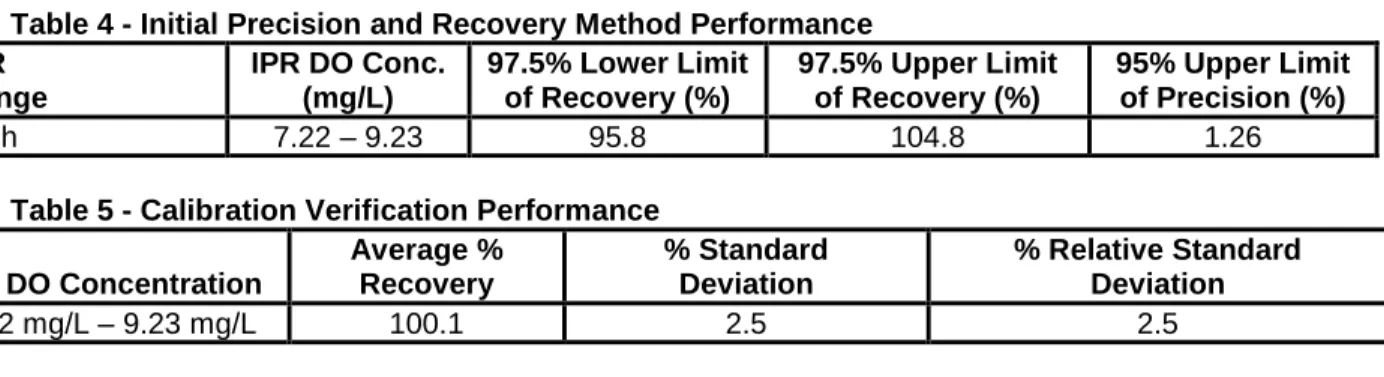
9.2.1.3 Compare s and X with the corresponding limits for initial precision and recovery in Table 4. If s and X meet the acceptance criteria, system performance is acceptable and analysis of samples may begin. If, however, s exceeds the precision limit or X falls outside the range for recovery, system performance is unacceptable. In this event correct the problem, and repeat the test.
9.3 Calibration Verification
9.3.1 Upon air calibration, prepare a calibration verification standard (Section 7.2) with each analytical batch of 20 samples or less in an 8 hour period. Analyze according to the procedure beginning in Section 11 and compare the recovery results to those in Table 4. 9.4 Ongoing Calibration and Precision and Recovery
9.4.1 To demonstrate that the analysis system is in control, and acceptable precision and accuracy is being maintained with each analytical batch, the analyst shall perform the following operations
9.4.2 Prepare a precision and recovery standard (Section 7.2) with each analytical batch according to the procedure beginning in Section 11.
9.4.3 Initially, and at the end of each analytical batch of samples, analyze a precision and recovery standard and compare the concentration recovery with the limits for ongoing precision and recovery in Tables 4 and 5. If the recovery is in the range specified, measurement process is in control and analysis of samples may proceed. If, however, the recovery is not in the specified range, the analytical process is not in control. In this event, correct the problem, recalibrate and verify the calibration and reanalyze analytical batch, repeating the ongoing precision and recovery test.
9.4.4 The laboratory should add results that pass the specification in Tables 4 and 5 to IPR and previous OPR data and update QC charts to form a graphic representation of continued laboratory performance. The laboratory should also develop a statement of laboratory data quality for each analyte by calculating the average percent recovery (R) and the standard deviation of the percent recovery (sr). Express the accuracy as a recovery interval from R 2sr to R + 2sr. For example, if R = 95% and sr = 5%, the accuracy is 85% to 105%.
9.5 Depending upon specific program requirements, field replicates may be required to assess the precision and accuracy of the sampling and sample transporting techniques.
9.6 Glucose-Glutamic Acid Seed Strength Check
9.6.1 Many factors can influence the BOD analysis (toxicity from sample matrix, contaminated dilution water, poor quality seed, etc. In order to insure sufficient seeding in the BOD test, a glucose-glutamic acid check is performed in parallel with each day’s BOD5 and cBOD5 test
samples. Well prepared dilution water and an active seed will produce a BOD5 of 198 ± 30
mg/L BOD (Reference 17.7).
9.6.1.1 Prepare in triplicate a 300-mL BOD bottle with 3.0 mL of the 300 mg/L Standard Solution of GGA (Section 6.4) or 1 ampoule (2.0 mL) of ezGGA (Section 6.4) with each day of samples prepared for BOD determination.
9.6.1.2 When using ezGGA ampoules, place the ezGGA ampoule in the ampoule breaker (provided with ezGGA ampoules) and rinse the assembly with reagent water. Hold the ampoule and breaker over the rim of the BOD bottle, break and allow the ampoule to fall into the BOD bottle. Leave the ampoule in the BOD bottle during the incubation period and reading of DO.
GGA Standard Solution
3.0 mL x 0.300 mg/mL GGA x 1000 mL/L = 3.0 mg/L GGA per bottle 300 mL final volume
ezGGA Ampoule
1 ampoule (2.0 mL) x 0.450 mg/mL GGA x 1000 mL/L = 3.0 mg/L GGA per bottle 300 mL final volume
9.6.1.2 Add seed at three different volumes (typically 4 mL, 6 mL, and 8 mL,) to the GGA bottles. Other volumes may be required, depending on the strength of the seed being used.
9.6.1.3 Bring to volume with dilution water and analyze as described in Sections 12.9 and 12.10.
Note: GGA BOD5 recovery results outside of 198 ± 30 mg/L should be investigated as to causation. If
toxicity of dilution water has been ruled out as a probable cause for low recovery, it is likely that the seed is of low activity or poor quality. Either increase the seed amount or use a seed of higher quality. High GGA recoveries are generally due to incorrect amount of GGA Standard Solution.
10. Calibration and Standardization
10.1 Because of the possible diversity of future LDO instrument hardware and, no detailed operating conditions are provided. The analyst is advised to follow the recommended operating conditions provided by the manufacturer. It is the responsibility of the analyst to verify that the instrument configuration and operating conditions satisfy the analytical requirements of this method and to maintain quality control data verifying instrument performance and analytical results.
10.2 Water-saturated air (Section 7.1) is used for instrument calibration.
10.3 Calibration verification (Section 7.2) is performed with air-saturated water prior to any DO sample measurements to the method specifications in Section 14.
11. Procedure for Measuring DO in Grab Samples, Outfalls, and Open Water
Bodies
11.1 Instrument Setup
11.1.1 Follow the instrument manufacturer’s instructions for instrument setup (Hach Document DOC022.53.80021 for Hach LDO IntelliCal™ Rugged and Standard Probes, Hach Document Number DOC022.53.80116for LBOD probes, and Hach Catalog Number 5790018 for Hach LDO process probes.
Note: Manufacturer’s instructions are only for instrument set and use. These instructions do not preclude the calibration and performance requirements of this method.
11.2 Measurement of DO
11.2.1 For samples in an open vessel, container, or water body, place the LDO probe into the water sample to be measured and stir gentle with probe or add a stir bar. Do not put the probe on the bottom or sides of the container. Stir the sample at a moderate rate or put the probe in flowing conditions. Read sample. The display will show "Stabilizing" and a progress bar as the probe stabilizes in the sample. The display will show the lock icon when the reading stabilizes.
11.3.1 For BOD5 and CBOD5 prepared samples, insert the LBOD probe into the BOD bottle for
DO determination. Insure that there are no air bubbles that may have collected around the probe or sensor. Turn on the stir paddle and read sample. The display will show
"Stabilizing" and a progress bar as the probe stabilizes in the sample. The display will show the lock icon when the reading stabilizes.
12. Procedure for the Preparation and Determination of BOD5 and cBOD5
Samples
12.1 The BOD test is a 5-day test. Follow all steps carefully to make sure that the test does not have to be repeated.
12.2 The dilution water for this test must be fully air-saturated immediately before use and determined to not have an oxygen demand or any toxins. When incubated for 5 days at 20 ± 1° C, the dissolved oxygen concentration in the dilution water must not change by more than 0.2 mg/L. Air-saturation is a function of water temperature and laboratory barometric pressure. Use an oxygen saturation table such as in Section 17.2 of this method to insure full air-saturation of dilution water.
12.3 Distilled Water Preparation
12.3.1 The distilled water must be prepared very carefully to make sure that no source of oxygen demand or toxins are added. The water that is used to prepare the dilution water must be of very high quality. The water must not have any organic compounds or any toxic compounds such as chlorine, copper, and mercury at a concentration level that would interfere would the BOD seed and inhibit microbiological growth of organisms.
12.3.2 For best results, use an alkaline permanganate distillation for preparing dilution water. Resin in ionization cartridges will occasionally release organic materials that have an oxygen demand.
12.4.3 Store the distilled water in clean jugs at a temperature of 20 ± 3o C. Fill the containers to about ¾ full and shake the jugs to saturate the water with air. Alternatively, saturate the water with air as described in Section 7.2.1. A small aquarium pump or air compressor can be used to saturate the water with air. Insure that the air is filtered and that the air filter does not grow bacteria.
12.4 Dilution Water Preparation
12.4.1 Using the distilled water prepared above in Section 12.4, select a BOD nutrient buffer pillow from the BOD nutrient buffer pillows in Table 1.
12.4.2 Add the contents of the BOD Nutrient Buffer Pillow to the distilled water in a jug with ample headspace. Cap the jug and shake vigorously for one minute to dissolve the nutrients and to saturate the water with air.
12.4.3 Alternatively, prepare the dilution water by adding 1 mL each of the following solutions per liter of distilled water prepared in Section 12.4:
Phosphate Buffer Solution - 0.1.7 g AR grade Ammonium Chloride, 8.5 g Potassium Phosphate Mono Basic, 17.7 g Sodium Phosphate Dibasic, 21.7 g Potassium Phosphate Dibasic to 1000 mL with deionized water, APHA, pH 7.2, (Hach Catalog Number 43149, or equivalent)
Calcium Chloride Solution - 27.5 g AR grade Calcium Chloride to 1000 mL with deionized water, APHA, for BOD (Hach Catalog Number 42849, or equivalent)
Ferric Chloride Solution - 0.25 g Ferric Chloride to 1000 mL deionized water, APHA, for BOD (Hach Catalog Number (42953, or equivalent)
12.5.4 Cap the jug and shake vigorously for one minute to dissolve the nutrients and to saturate the water with air.
Note: Dilution water should be prepared immediately before use unless it can be demonstrated that the dilution water blank has no DO depletion greater than 0.2 mg/L.
12.5 Seed Preparation
12.6.1 Use raw sewage or other reliable sources for the bacterial seed that will yield 198 ± 30 mg/L BOD with the GGA check sample in Section 9.6. Potential seed sources include wastewater influent, primary effluent, soil, and domestic sewage.
12.6.2 Allow raw sewage to stand undisturbed at 20 ± 3o C for 24 to 36 hours before use. 12.6.3 When seeding samples with raw sewage, always pipette from the upper portion of the
sewage.
12.7 Sample Size Selection Guide
12.7.1 Make an estimate of the sample volumes that are necessary for the test. At least 2.0 mg/L of DO should be consumed during the test and at least 1.0 mg/L of un-depleted DO should remain in the bottle.
12.7.2 Samples such as raw sewage will have a high BOD. Small sample volumes must be used because large samples will deplete all of the oxygen in the sample. Samples with a low BOD must use larger sample volumes to insure that adequate oxygen is depleted to give accurate results.
12.7.3 Refer to the Minimum Sample Volume in Table 2 to select the minimum sample volume. For example, if a sewage sample is estimated to contain 300 mg/L BOD, the minimum sample volume is 2 mL. For sewage effluent with an estimated BOD of 40 mg/L, the minimum sample volume is 15 mL.
12.7.4 Refer to the Maximum Sample Volume in Table 3 to select the maximum sample volume. At 1000 in elevation, with an estimated BOD5 of 300 mg/L, the largest sample volume is 8
mL. For a BOD of 40 mg/L, the maximum volume of sample is 60 mL. 12.8 Sample Matrix Pretreatment
12.8.1 Determine the pH of each sample at a sample temperature of 20 ± 3o C. prior to BOD sample preparation. For samples that of have pH of less than 6 or greater than 8, adjust the pH accordingly with a solution of sulfuric acid (H2SO4) or sodium hydroxide (NaOH).
Strength of pH adjustment solution should be at a concentration that does not dilute the sample by greater than 0.5 percent.
12.8.2 For sample matrices that contain residual chlorine, de-chlorinate with a solution of Sodium Thiosulfate (Na2S2O3).
12.8.2.1 Measure 100 mL of sample into a 250 mL Erlenmeyer flask. Using a 10-mL serological pipette and pipette filler, add 10 mL of 0.020 N Sulfuric Acid Standard Solution and 10 mL of Potassium Iodide Solution, 100-g/L, to the flask.
12.8.2.2 Add three full droppers of Starch Indicator Solution and swirl to mix.
12.8.2.3 Fill a 25-mL burette with 0.025 N Sodium Thiosulfate Standard Solution and titrate the sample from dark blue to colorless.
12.8.2.4 Calculate the amount of 0.025 N Sodium Thiosulfate Solution to add to the sample:
mL 0.025 N Sodium Thiosulfate required = mL titrant used x volume of remaining sample divided by 100
12.8.2.5 Add the required amount of 0.025 N Sodium Sulfate Standard Solution to the sample. Mix thoroughly and wait 10 to 20 minutes before performing the BOD test.
Note: Samples should be brought to a temperature of 20 ± 3o C. prior to making dilutions. 12.9 Sample Preparation
12.9.1 Select the sample volume as described in Section 12.7.Select a minimum of three different volumes for each sample.
12.9.1.1 If the minimum sample volume is 3 mL or more, determine the DO
concentration in the undiluted sample; this determination can be omitted when analyzing sewage and settled effluents known to have dissolved oxygen content near 0 mg/L.
12.9.2 Stir the sample gently with a pipette. Use the pipette to add the determined sample volumes to the BOD bottles.
12.9.3 Add the appropriate seed to the individual BOD bottles as described in Section 12.6. 12.9.3.1 Separately, with each batch of BOD samples, prepare a seed sample with
dilution water. Measure the BOD of the seed for subtraction from the sample BOD.
12.9.3.2 A seed that has a BOD5 of 200 mg/L (a typical range for domestic sewage) will
typically deplete at least 0.6 mg/L DO when added at a rate of 3 mL/L of dilution water.
12.9.4 If the test is for cBOD5, add two potions of Nitrification Inhibitor (approximately 0.16 g) to
each bottle. The oxidation of nitrogen-based compounds will be prevented. 12.9.5 Fill each bottle to just below the lip with dilution water.
12.9.5.1 Allow the dilution water to flow down the sides of the bottle to prevent air bubbles from becoming entrapped in the bottle.
12.9.6 Fill an additional BOD bottle with only dilution water. This will be the dilution water blank. 12.9.7 Stopper the bottles carefully to prevent air bubbles from becoming entrapped.
12.9.7.1 Tightly twist the stopper and invert the bottles several times to mix. Note: The sample preparation procedures in Section 12.9 are designed for a BOD sample analysis volume of 300 mL. A 60-mL sample preparation volume may also be used.
12.10 Sample Analysis
12.10.1 Measure the initial dissolved oxygen concentration in each bottle with the LBOD probe within 30 minutes of sample preparation.
12.10.2 After the initial DO measurement, stopper the bottles carefully to prevent air bubbles from becoming entrapped.
12.10.2.1 Add dilution water to the lip of each BOD bottle to make a water seal. 12.10.3 Place a plastic cap over the lip of each bottle and incubate at 20 ± 1o C for five days. 12.10.4 After 5 days, measure the remaining dissolved oxygen concentration in each bottle with
the LBOD probe.
12.10.4.1 At least 1.0 mg/L DO should have remained in each bottle.
12.10.4.2 Discard results of samples where the DO is depleted below 1.0 mg/L.
13. BOD and cBOD Calculations
13.1 When Dilution Water Not Seed (generally influent and primary treated influent to treatment) BOD5 or cBOD5, mg/L = D1 – D2
P
where:
BOD5 or cBOD5 = BOD value from the 5-day test
D1 = DO of diluted sample immediately after preparation, in mg/L
D2 = DO of diluted sample after 5 day incubation at 20 ±1 o
C, in mg/L P = Decimal volumetric fraction of sample used
13.2 When Dilution Water Requires Seed BOD5 or cBOD5, mg/L = (D1 – D2) – (B1 – B2)f
P
as defined above plus:
B1 = DO of seed control before incubation, in mg/L
B2 = DO of seed control after incubation, in mg/L
f = ratio of seed in diluted sample to seed in seed control (% seed in diluted sample/%seed in seed control) or, if seed material is added directly to sample or to seed-control bottles: f = (volume of seed in diluted sample/volume of seed in seed control)
13.3 Averaged Results
13.3.1 Averaged results from different dilutions are acceptable if more than one sample dilution meets all of the following criteria:
13.3.1.1 The remaining un-depleted DO is at least 1 mg/L.
13.3.1.2 The final DO value is at least 2 mg/L lower than the initial prepared sample DO 13.3.1.3 There is no evidence of toxicity at higher sample concentrations
14. Method Performance for Dissolved Oxygen in Reference Water and GGA
BOD5 Recovery
Acceptance Criterion Section Limit
Initial DO Accuracy in Reagent Water 9.2.1 95% to 105%
Initial Precision in Reagent Water 9.2.1 2.1%
On-going DO Accuracy 9.4.1 95% to 105%
15. Pollution Prevention
15.1 There are no standards or reagents used in this method when properly disposed of, pose any threat to the environment.
16. Waste Management
16.1 It is the laboratory’s responsibility to comply with all federal, state, and local regulations governing waste management, particularly the hazardous waste identification rules and land disposal restrictions, and to protect air, water, and land by minimizing and control all releases from fume hoods and bench operations. Compliance with all sewage discharge permits and regulations is also required.
16.2 For further information on waste management, consult “The Waste Management manual for Laboratory Personnel”, and Less is Better: Laboratory Chemical Management for Waste
Reduction”, both available from the American Society’s Department of Government relations and Science Policy, 1155 16th Street N.W., Washington, D.C. 20036.
17. References
17.1 Handbook of Analytical Quality Control in Water and Wastewater Laboratories,” USEPA, EMSL-CI, Cincinnati, OH 45268, EPA-600-4-79-019, March 1979.
17.2 Hitchmen, M.L. (1978) Chemical analysis. Vol. 49. Measurement of Dissolved Oxygen. Wiley and sons, New York.
17.3 Title 40, Code of Federal Regulations (40 CFR), Part 136.
17.4 Protocol for EPA Approval of New Methods for Organic and Inorganic Analytes in Wastewater and Drinking Water (EPA-821-B-98-003, March 1999).
17.5 “OSHA Safety and Health Standards, General Industry,” (29 CFR 1910), Occupational Safety and Health Administration, OSHA 2206 (Revised, January 1976)
17.6 “Safety in Academic Chemistry Laboratories,” American Chemical Society, Committee on Chemical Safety, 3rd Edition, 1979.
17.7 “Standard Methods for the Examination of Water and Wastewater”, 20th Edition; American Public health Association: 1015 Fifteenth Street, NW, Washington, D.C. 2005, 1998; Method 5210B.
18. Tables
18.1 Nutrient Buffer Preparation Options Table 1 - BOD Nutrient Buffer Pillows
Volume of Dilution Water to Prepare Hach BOD Nutrient Pillow Catalog Number
300 mL) add pillow to each BOD Bottle 1416066
3 liters 1486166
4 liters 2436466
6 liters 1486266
19 liters 1486398
Note: Hach BOD Nutrient Pillows are formulated with the same reagents adjusted for volume preparation as in Sections 6.1 through 6.3.
18.2 Sample Volume Selection Guides
Table 2 - Minimum Sample Volume Selection Guide
Sample Type Estimated BOD mg/L Minimum Sample Volume (mL)
Strong Waste 600 1
Raw and Settled Sewage
300 2
200 3
150 4
100 6
75 8
60 10
Oxidized Effluents
50 12
40 15
30 20
20 30
10 60
Polluted River Water
6 100
4 200
2 300
Table 3 – Maximum Sample Volume Selection Guide BOD at Sea Level
(mg/L)
BOD at 1000 ft Elevation (mg/L)
BOD at 5000 feet Elevation (mg/L)
Maximum Sample Volume (mL)
615 595 508 4
492 476 406 5
410 397 339 6
304 294 251 8
246 238 203 10
205 198 169 12
164 158 135 15
123 119 101 20
82 79 68 30
41 40 34 60
25 24 21 100
12 12 10 200
8 8 7 300
Note: Samples with higher concentrations of BOD should be pre-diluted. 18.3 Performance Criteria
Table 4 - Initial Precision and Recovery Method Performance IPR
Range
IPR DO Conc. (mg/L)
97.5% Lower Limit of Recovery (%)
97.5% Upper Limit of Recovery (%)
95% Upper Limit of Precision (%)
High 7.22 – 9.23 95.8 104.8 1.26
Table 5 - Calibration Verification Performance CV DO Concentration
Average % Recovery
% Standard Deviation
% Relative Standard Deviation
7.22 mg/L – 9.23 mg/L 100.1 2.5 2.5
19. Glossary of Definitions and Purposes
The definitions and purposes are specified to this method but have been conformed to common usage as much as possible.
19.1 Units of Weight and Measure and their Abbreviations 19.1.1 Symbols
o
C degrees Celsius 19.1.2 Alphabetical characters
mg/L milligram per liter
19.2 Definitions, acronyms, and abbreviations
19.2.1 LDO® - Luminescence dissolved oxygen
19.2.2 LBOD® - Luminescence biochemical oxygen demand 19.2.3 BOD - Biochemical oxygen demand
19.2.4 BOD5 - Biochemical oxygen demand, 5-day test
19.2.5 cBOD5 - Carboneous biochemical oxygen demand, 5-day test
19.2.6 DO: Dissolved oxygen 19.2.75 CV: Calibration verification 19.2.8 IPR: Initial precision and recovery 19.2.9 OPR: On-going precision and recovery