Section 9
Human resource management
The VEC has approximately 270 Senior Election Officials (SEO) on standby, who have been recruited and trained for engagement as Election Managers during State and Council elections. From this pool of SEOs, individuals were selected for appointment to management roles for Legislative Assembly and Legislative Council electorates.
Election Managers and
Region Coordinators
Appointment and training of Election Managers
A total of 56 Election Managers were appointed to conduct elections for 88 members of the Legislative Assembly. Each Election Manager was responsible for one or two Districts; most Election Managers in metropolitan areas were responsible for two Districts, while most Election Managers in rural areas with larger geographic boundaries were allocated one district. All Election Managers completed extensive training for the State election, comprising home study in conjunction with a series of seminars at the VEC (one two-day seminar, one three-day seminar and a one three-day briefing in late October).
Assistant Election Managers from the VEC’s pool of SEOs were appointed to assist each Election Manager. One or two Assistant Election Managers were appointed for each office. The Assistant Election Managers also completed the VEC’s training program, but did not attend the final briefing in October. The Election Manager’s role is to establish offices and appoint staff to facilitate the smooth running of the election for their electorates. They issue early votes, process independent candidates’ nominations, organise the draw for the order of the candidates’ names on the ballot papers, appoint and train voting centre staff, and make arrangements for establishing voting centres for Election Day. On Election Day, the Election Manager is responsible for the conduct of the election and the counting of votes for those electorates for which they have responsibility. Immediately following Election Day, Election Managers checked, sorted and despatched completed ballot material to other electorates, finalised payroll tasks for election officials and conducted counts for postal, early and other declaration votes. For the first time, all ballot papers were rechecked, even if a preference distribution was not required. A total of 44 preference distributions were conducted for district electorates by the relevant Election Managers. No recounts were required.
Appointment and training of Region Coordinators
A new role of Region Coordinator, with responsibility for rechecking all region ballot papers for their appointed region, was created for the 2010 election. The Region Coordinator was responsible for receiving region ballot papers from Election Managers, supervising the checking and reconciliation of those ballot papers and despatching those marked ‘below-the-line’ to the central computer counting venue. An Assistant Region Coordinator was appointed to assist each Region Coordinator.
Support for Election Managers
and Region Coordinators
Election Support Officers
Eleven Election Support Officers (ESOs) provided support to the VEC’s Election Managers and Region Coordinators throughout the election. Located at the VEC’s Melbourne office, the ESOs were the central point of contact between the Election Managers / Region Coordinators, the Electoral Commissioner and other VEC staff. They assisted Election Managers and Region Coordinators with procedural and other complex issues.
Helpdesk
Seven Helpdesk operators provided support to Election Managers and Region Coordinators. Principally, they assisted the Election Managers and Region Coordinators with the operation of the VEC’s Election Management System and other technical issues.
Election officials
Recruitment
Election Managers and Region Coordinators were responsible for recruiting administrative staff to work in their offices, and Election Managers were also required to recruit staff for voting centres on Election Day.
In addition, Election Managers were able to appoint Election Liaison Officers (ELO) who visited voting centres on Election Day. The ELO’s role was to alert the Election Manager to instances where voting centres may have needed extra resources and deliver them where appropriate, and to ensure procedures were applied consistently.
To assist them in this task, the VEC developed job specifications to assess potential candidates and to ensure that Equal Employment Opportunity (EEO) principles were considered in the selection of all staff. A recruitment company was also engaged to assist with the recruitment of suitable staff who were employed on a casual basis. The company was provided with job specifications to ensure that staff recruited met the VEC’s requirements. Election Managers in areas with large numbers of people from culturally diverse backgrounds appointed multi-lingual staff where possible.
Human resource
management
Figure 43: Staff with skills in languages other than English, Victorian State elections, 1999–2010
Figure 44: Staff identifying as belonging to special groups, Victorian State elections, 2006–2010
NC: Not collected
Apart from agency staff, all appointments were drawn from people who had completed the VEC’s online Expression of Interest. Persons who had worked on previous elections were invited to register their interest in working on the election, and provided with a login that would enable their previous work history with the VEC to be linked to their registration.
The Expression of Interest Register was also advertised to the wider public, through the VEC’s website, universities, colleges and schools, and through multicultural organisations. The VEC created new part-day roles for this election to address the higher demand often experienced in voting centres during the morning and to assist with counting activities after 6.00pm on election night. A total of 2,320 of the 16,993 officials on Election Day were appointed to part-day roles. A list of Election Managers is included as Appendix 15.
Training of election officials
For the first time, election officials were required to complete relevant online training. There were three streams of online training, depending on the specific appointment: one for Voting Centre Managers (VCMs), Assistant Voting Centre Managers (AVCMs) and ELOs, one for Declaration Issuing Officers, and one for other election officials. Some election officials appointed to part-day roles were not required to complete online training.
In addition, Election Managers conducted a three-hour training session for their VCMs, AVCMs and ELOs. The VEC developed a standard training package, which included a PowerPoint presentation and practical activities, and arranged the hire of projectors to assist Election Managers with their training. This ensured that training sessions were conducted in a professional and consistent manner across the State. All election officials were provided with a manual, which covered voting centre procedures in detail, and a 30 minute DVD which provided an overview of procedures, with an emphasis on good customer service.
Figure 45: Election officials and take up of online training, Victorian State elections, 2006-2010
0 1000
500 1500 2000 2500 3000
1999 2002 2006 2010
883
1,126 1,669 2,931
0 200
100 400
300
2006
NC 6 177 361
2010 People identifying as having a disability People identifying as Aboriginal or Torres Strait islander
0 10,000
5,000 20,000
15,000
Election officials
13,732
NA
Completed online training 2010
2006
16,993
14,811
Human resource management
Voting Centre Managers and ELOs evaluated the work performance of all election officials, in order to determine their suitability for future employment. These details provided the VEC with a strong database repository for future elections.
Measures to ensure impartiality
In 2009, the VEC was granted an exemption from provisions of the Equal Opportunity Act 1984 to be able to employ only those personnel who were not engaged in political activities. This enabled the VEC to advertise and appoint suitable, politically-impartial staff. The exemption applies to the appointment of all VEC staff, including Election Managers and election officials.
Election officials and election casuals are appointed to a variety of roles at the time of an election. The VEC’s Disclosure of Political Activities brochures and forms were sent out for completion to all prospective Election officials and election casuals prior to appointment for the 2010 State Election. This information was also available on the VEC website. A total of 21,217 Disclosure of Political Activities forms were completed and returned. Of all the Disclosure of Political Activities forms received, 236 prospective appointees were initially disqualified. Requests for review were subsequently received from 48 disqualified applicants of which 15 decisions were overturned and offers of appointment subsequently made. A final total of 221 prospective appointees were disqualified from being appointed as an election official or election casual. No legal proceedings alleging bias by Election Managers or election officials in the conduct of their duties for
parliamentary elections have been lodged in the last 16 years. The VEC has not been involved in any breach of the Equal
Opportunity Act in relation to any employment matter in the last
20 years. Nor has any of its Election Managers or election officials.
Online recruitment
The VEC provided an online application for prospective employees to register for appointment as either election officials or as casual workers. The VEC received more than 30,000 expressions of interest and the application allowed the VEC to efficiently manage this central pool of prospective appointees and reduced the considerable administrative effort required to appoint staff.
Online training
An online training application was developed to train over 13,000 election officials appointed at voting centres on Election day. The software was provided by a third party company and was considerably enhanced by the VEC to suit the training requirements. Election officials undertook the training in a four week period.
0 100
50 150 200 250
236 15 33 221
Payroll
The payroll system used for election officials appointed to conduct the 2010 State election was administered by the VEC’s Finance and Budget Branch and ensured that the 16,993 election casuals and election officials appointed to conduct the State election were paid within two weeks of the election. Election casuals were paid fortnightly. The system also provided for the production of group certificates and special reports for the VEC.
The VEC maintained records in the Election Management System to ensure that obligations relating to employment records were met, and to assist with any enquiries received from election officials.
Occupational health and safety
All Election Managers completed a training session in Occupational Health and Safety (OH&S) covering items such as Victorian OH&S legislative requirements, hazard identification, risk assessment and control strategies in the workplace.
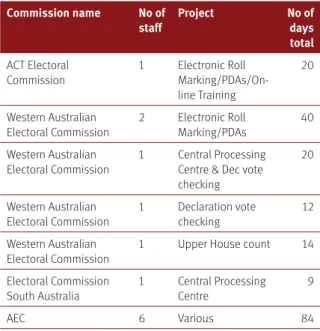
Interstate secondments
During elections, electoral commissions provide staff to other jurisdictions to provide expert assistance and to gain election experience. The VEC would like to thank the Electoral Commissions for releasing their staff for the 2010 Victorian State election. Their experience and hard work was invaluable to the conduct of the election.
See Figure 47 for details of staff seconded to the VEC for the 2010 State election.
Commission name No of staff
Project No of days total
ACT Electoral Commission
1 Electronic Roll Marking/PDAs/On-line Training
20
Western Australian Electoral Commission
2 Electronic Roll Marking/PDAs
40
Western Australian Electoral Commission
1 Central Processing Centre & Dec vote checking
20
Western Australian Electoral Commission
1 Declaration vote checking
12
Western Australian Electoral Commission
1 Upper House count 14
Electoral Commission South Australia
1 Central Processing Centre
9
AEC 6 Various 84
Figure 47: Staff seconded to VEC, 2010 State election
Staff feedback
Feedback received from Election Managers often provides a useful perspective on the VEC’s delivery of election services and leads to improvements. As part of the evaluation of the State election, the VEC conducted debriefing sessions with Election Managers and Region Coordinators. In addition, Election Managers and Region Coordinators provided comprehensive written feedback which included comments and recommendations for future consideration.
Election officials were also surveyed as part of the VEC’s independent evaluation conducted after the election. Results of the evaluation are summarised in Section 14.
Human resource management