and utilities
Executive summary
Energy and utility companies face challenges from aging infrastructures, disruptive technologies, environmental concerns and new regulations. The companies must implement a de- carbonization strategy, including renewable energy, and build a more intelligent, secure and reliable grid. They must meet their customers’ growing demands for a better experience and comply with changing and strict regulations. Utilities must meet these challenges amidst a surge in structured and unstructured data, new technologies such as electric vehicles and energy storage, and their customers’ reliance on social media.
The transformation of the industry means energy and utility companies must invest in new technologies and optimize their existing processes, standardization and collaboration. Cloud technology has proven to be an effective tool in this transforma-tion by improving collaboratransforma-tion, providing innovative and better client experiences, increasing IT efficiency, and improving the implementation speed of new processes and technologies.
Energy and utility industry trends
The energy and utility industry’s move to smart grid technolo-gies is driving a more integrated and complex approach to the generation, transmission, distribution and consumption of energy. Responding to these changes means companies must transform their business, both in operations technology and information technology.
Energy and utility companies must address myriad concerns, such as renewable and traditional generation, energy demand, grid security, environmental sustainability and economic com-petitiveness. They must make these changes while being held accountable for maintaining a 100 percent reliable grid, manag-ing costs, and increasmanag-ing workforce and asset efficiency and revenue.
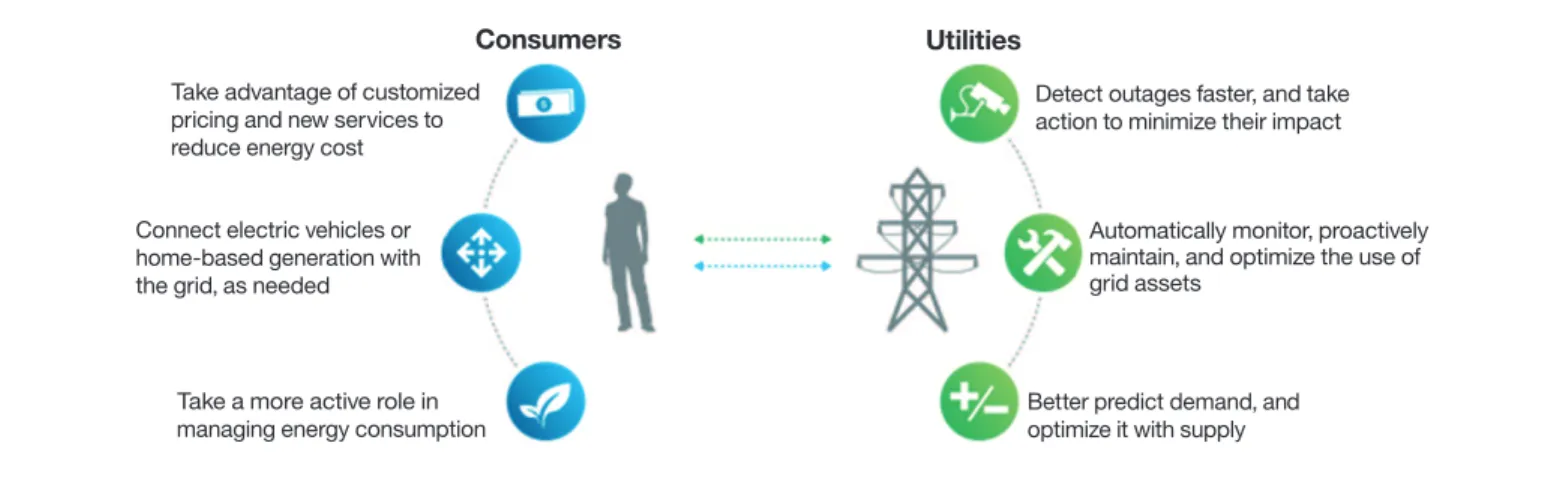
Consumers
Take advantage of customized pricing and new services to reduce energy cost Connect electric vehicles or home-based generation with the grid, as needed
Detect outages faster, and take action to minimize their impact
Automatically monitor, proactively maintain, and optimize the use of grid assets
Better predict demand, and optimize it with supply Take a more active role in
managing energy consumption
Utilities
The increasing level of consumer engagement and expectations has changed the nature of customer interactions with utilities. Customers have been transferred into the center of the organiza-tions’ business strategy. Figure 1 shows how market forces are transforming the landscape of utilities and redefining the rela-tionship between utilities and consumers. The IT departments at these companies are responsible for ensuring the companies are successful in meeting these challenges. The main issues IT departments contend with include:
●● The massive surge in structured and unstructured big data; its
management, storage and security drive the need for sophisti-cated analytics.
●● The maintenance of aging electric infrastructures requires
sophisticated asset analytics and optimization to enable peak performance.
Strategy: Expect significant increase in substantial change resulting from cloud:
13%
10%
16%
14%
41%
29%
Today 2015 43%
57% Customers: Expect to reinvent their customer value propositions with cloud:
Business Value: Expect to create / transform value chain through cloud:
Transformation: Shift focus to driving substantial impact on customer relationships:
Figure 2. Technology plays a key role in the future of utility and energy companies.2
●● The implementation of new business models, best practices
and process standardizations requires IT support.
●● An aging workforce results in the need to transfer knowledge
to a more technically savvy new set of workers.
Utility companies are under pressure to reduce or control costs, while investing and modernizing their energy network infrastructure. Meeting these challenges influences many of the choices companies make, especially ones related to the IT department.
Cloud computing helps organizations increase operational efficiency and simplify processes, while achieving higher revenue growth and decreasing operational expenditures. The 2011 IBM CIO study concluded that technology is the number one external factor that affects energy and utility com-panies. By 2015, 41 percent of the companies expect significant changes will result from cloud computing.1
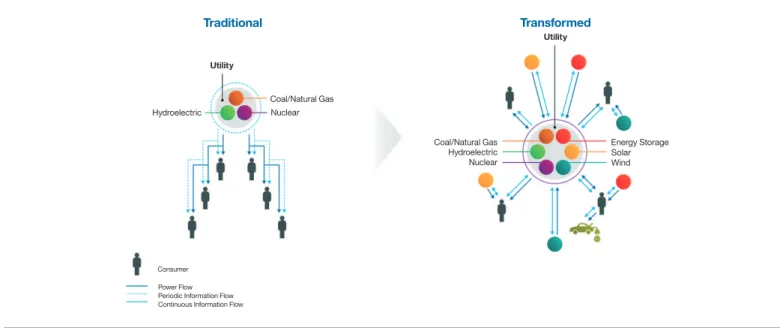
Traditional Transformed
Utility
Hydroelectric
Hydroelectric Coal/Natural Gas
Coal/Natural Gas Energy Storage Solar Wind Nuclear
Nuclear
Consumer Power Flow Periodic Information Flow Continuous Information Flow
Utility
Figure 3. The traditional energy value chain is evolving into a more distributed structure. It will continue to evolve into a networked structure. Cloud computing provides a highly automated, dynamic and
cost-effective alternative for the acquisition and delivery of IT services. It plays a critical role for energy and utility organiza-tions that are striving to improve operational efficiency and decrease expenses. Because cloud computing offers massive scal-ability and collaboration capabilities, it is used to deploy new services with greater speed without extra capital investment.
Challenges and opportunities for energy
and utility companies
The scale of the challenges faced by energy and utility compa-nies around the world is significant. As described in the US Department of Energy’s report, “The Smart Grid: An Introduction,” the electrical system in the United States is more than 99 percent reliable, but it still experiences power interrup-tions that cost consumers and businesses USD150 billion a year.3
The situation is more severe in many growth markets. Despite a dip in consumption due to the recent economic turmoil and government-imposed restrictions such as the European Union’s “20-20- 20” plan, global growth in energy consumption is expected to increase by more than 40 percent over the next 25 years.4
In some regions of the world, the increase in demand will exceed 100 percent over the same time period. Regardless of the rate of growth in energy demand in a particular market, complexity is certain to increase. This complexity is driven by societal shifts that call for more sustainable and less polluting technologies, such as distributed and renewable energy generation, energy storage and electric vehicles.
Key imperatives for the industry
To succeed, leaders in energy and utilities organizations are focusing on three key imperatives in their organizations: trans-forming the utility network, improving generation performance and revitalizing customer operations.
Transform the utility network
To develop the energy systems that address industry challenges, utilities must transform electric, gas and water infrastructures to dynamic, automated and reliable networks. The result will be the ability to manage demand, reduce losses, and decrease or perhaps even eliminate the need to build more capacity. The functional areas involved in this aspect of the transformation include consumers, energy providers, regulators and the utility’s own operations. These operations include areas such as smart metering, grid operations, work and asset management, secure communications and the integration of renewable resources.
Improve generation performance
To improve and optimize generation asset performance and return on investment (ROI), instrumentation and sophisticated analytics are used to meet operational efficiency requirements. Analytics, simulation and asset status are used to run the most efficient assets. Using predictive analytics, the company can maintain assets before a costly shut down or forced downtime. Companies that improve generation performance are better able to meet demand, control production costs, reduce emissions and increase profit in their current operations.
Revitalize customer operations
To transform the existing relationship between the utility and its customers, companies must implement a foundation of technical capabilities and skills for managing customer relation-ships in this age of social media. With a foundational platform,
energy and utility organizations can engage with customers across various channels, providing better customer service and offering more products and services. Analytical tools can also help utilities better understand customers and their individual needs.
Cloud computing: A smart choice for
energy and utility companies
Cloud computing technologies are well-suited for companies that are looking for proactive ways to meet current energy and utility industry challenges. Companies can use cloud technolo-gies to rein in spiraling costs, standardize and optimize opera-tions, enable secure storage of massive amounts of data, and tap into a security-rich supercomputing environment for advanced analytics. Cloud solutions can provide pay-as- you-use pricing and as-needed hardware or software provisioning so companies can access technology when they need it and only pay for what they use. Using cloud solutions, utilities can take advantage of best practices or business intelligence from other companies that are addressing similar challenges in and out of their own industry as they pursue implementation of best practices. Energy companies are counting on cloud computing to play a key role in bringing down the cost of IT while facilitating access to technology. A 2013 market assessment study by NelsonHall showed that 90 percent of the respondents thought cloud had an important role to play in reducing IT costs. In addition, 80 percent thought cloud technology was highly important for improving their access to technology. Among energy company executives, 30 percent perceived cloud to be highly important in improving business agility.5
Cloud computing is shaping the way organizations approach their business IT requirements. This change is especially true in non-regulated or mixed business environments. It also is prevalent in businesses that are confronting the reality of dealing with the deluge of data being captured with smart metering and grid optimization projects.
Understanding the benefits of cloud
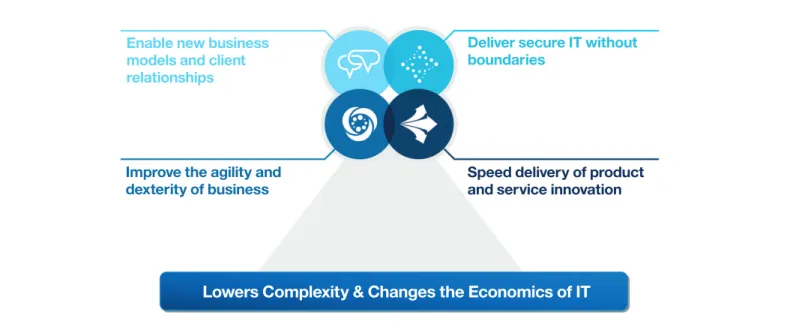
When an organization implements cloud solutions, they have the opportunity to decrease costs and reinvent certain aspects of their IT operations by embracing standard business processes and best practices. An effective cloud environment must be scalable enough to support an organization’s needs today and into the future. The cloud environment must be open and standards-based to reduce interoperability and network issues, including increased security threats.Leveraging the transformational power of Cloud computing, with a common platform built on open standards
Enable new business models and client relationships
Deliver secure IT without boundaries
Improve the agility and
dexterity of business Speed delivery of productand service innovation
Lowers Complexity & Changes the Economics of IT
Figure 4. Taking advantage of the transformational power of cloud computing with a common platform built on open standards.Effective cloud computing solutions take high-cost workloads and move them to low-cost environments that can be dynami -cally configured and provisioned on demand. Virtualization, standardization and other fundamental features of cloud com-puting have the potential to lower the cost of IT, simplify service management and accelerate service delivery. Because of industry regulations, cloud implementations in the energy and utility industry must be able to store operations information, data and correspondence securely. They must adhere to regulatory requirements that apply to the areas of industry and the specific location of the company, such as country- or state-specific regulations.
Deciding where to use cloud
For energy and utility executives to make an informed decision regarding cloud technology, the risks and benefits must be clear. The adoption of cloud solutions should be based on a practical analysis of the benefits and the risk of cloud technology, in par-ticular with regard to security.
Energy and utility companies can benefit from cloud in a number of key areas.
●● IT infrastructure: An agile and secure infrastructure provides
security-rich enterprise class virtual servers, business backup and recovery, and development and test environments to support UNIX, Linux and Microsoft Windows for improved enterprise flexibility.
●● Data storage: Green data centers around the world can
enable archive, backup, and smart searches of structured and unstructured data. They offer secure scalable storage with a pay-as-you-go model.
●● Advanced analytics: Business intelligence and advanced
analytics can turn old and new information into insights that can be acted on in areas such as procurement, asset operations and maintenance, renewable generation and electric vehicles.
●● Marketing and social business: On-demand scalability makes
it easier to capture, integrate and analyze unstructured social media content to personalize marketing programs across various channels.
Cloud computing for the energy and
utility industry
Cloud computing offers a powerful combination of virtualiza-tion, standardizavirtualiza-tion, automation and efficiency to help reduce costs and release operational funds for new investments. Software as a service (SaaS) and infrastructure as a service (IaaS) are the most relevant delivery models for the industry. Energy and utility companies should include cloud technology in their IT strategy and evaluate the benefits of these solutions for their business.
IBM IaaS solutions include:
●● An agile cloud infrastructure that is designed to provide rapid
access to security-rich, scalable, enterprise-class virtual servers and operating systems middleware.
●● A growing number of IBM state-of- the-art green cloud data
centers around the world.
●● A development and test solution for developing innovative
applications and services to drive growth with support for UNIX, Linux and Windows for enterprise flexibility.
●● Cloud storage capabilities that can address security and
scalability with a pay-as- you-go model.
●● Cloud-based services that help you respond to IT disruptions
by recovering data quickly and affordably through the cloud resilience features.
IBM SaaS solutions include:
●● Digital marketing optimization, which can be used to provide
a highly personalized and compelling customer experience across all marketing channels.
●● Social business for integrating collaboration solutions into the
business. These products can help improve teamwork, deepen customer relationships and speed idea generation.
●● Smarter analytics, which allows utilities to rapidly deploy
business intelligence and predictive analytics solutions with SaaS and accelerate the ability to turn information into insights and action.
●● IBM® Intelligent Water solutions, which give water utilities
the ability to derive insights from data to manage pressure, detect leaks, reduce water consumption, mitigate sewer overflow and better manage the water infrastructure, assets and operations.
●● The intelligent electric vehicle enablement offering from
IBM, which is a cost-effective, scalable and secure multi-party solution with flexible business services to deploy and manage an electric vehicle recharging infrastructure.
●● The IBM Emptoris® Spend Analysis solution, which enables
utilities to consolidate, cleanse and classify data from across dispersed and disparate systems.
Cloud solutions from IBM
Cloud computing services and solutions from IBM give utility companies a cost-effective way to respond to business and IT challenges. With thousands of successful cloud client engagements and millions of daily cloud transactions processed, IBM has demonstrated its vast experience in helping clients across multiple industries realize the value of cloud.
IBM is uniquely qualified to provide the essential components for successful cloud computing solutions with:
●● Solid infrastructure products to help optimize workloads,
regardless of how much capacity is needed.
●● Integrated service management to enable the immediate
allocation and provisioning of IT resources and support where and when needed.
●● Advanced security analysis to identify and analyze threats and
improve risk and regulatory compliance management.
●● Secure backup and recovery services to protect critical data,
reduce operational risk and meet regulatory requirements.
●● Various applications and business processes to help
organiza-tions accelerate process innovation, deliver business analytics and enable collaboration.
●● Consulting services for IT transformation, optimization and
resiliency to ensure maximum use of the cloud computing environment.
The energy and utilities industry can gain substantial benefits by adopting cloud computing as part of its IT transformation. Cloud solutions can help reduce operating costs, simplify and standardize business processes, enable IT agility and facilitate collaboration. IBM offers a number of cloud solutions for energy and utility companies.
IBM infrastructure as a service
IBM offers a range of enterprise-class IaaS offerings with a global reach that are based on open standards. IBM SmartCloud® Enterprise is a self-service, public cloud IaaS that is suited to workloads require agile development and that are created on the cloud. IBM SmartCloud Enterprise+ is a fully managed, isolated IaaS that is optimized for the demanding requirements of enterprise system-of- record workloads like SAP. IaaS offerings from IBM enable companies to gain access to enterprise-grade development and test environments and tools as a service, which can help accelerate development, testing, and batch or web analytics processing.IBM Smart Business Storage Cloud
IBM Smart Business Storage Cloud helps reduce costs and improve performance with a scalable storage-virtualization solu -tion. As data volumes grow and the ability to handle various file formats becomes more complex, supporting efficient, cost- effective and secure access to data can be increasingly difficult and costly. Smart Business Storage Cloud can help utilities successfully deploy a high-performance, scalable storage- virtualization solution to facilitate growth and innovation at lower operational costs.
IBM SmartCloud Managed Backup
IBM SmartCloud Managed Backup is a cloud-based service that enables security-rich, managed protection of critical data. The service provides onsite or offsite data backup to help a utility
reduce operational risk and total cost of ownership. The solution can help utilities meet and manage strict industry regulatory requirements.
IBM cloud security solutions
IBM protects cloud environments with cloud security strategies and a comprehensive portfolio of solutions that span the entire cloud lifecycle and all security domains. The solutions use advanced security analysis to identify and analyze threats and ensure reduced downtime and improved productivity. With an emphasis on visibility, control and automation, IBM cloud secu-rity solutions help meet regulatory compliance efficiently and defend against the latest threats. With IBM, you can have a robust, security-rich cloud and a security program that spans the entire cloud lifecycle and all security domains. IBM can help energy and utility organizations better understand threats and vulnerabilities in terms of business impact, and respond to secu-rity events with secusecu-rity controls that optimize business results.
IBM Smart Business Desktop
IBM Smart Business Desktop can accelerate the virtualization of the organization’s desktop environment with a range of cloud computing solutions. Smart Business Desktop can help control costs and enable security-rich access to corporate applications and data.
IBM software as a service
The portfolio of IBM SaaS offerings is continually expanding. IBM has solutions to help organizations focus on business and not IT deployment. The solution portfolio includes more than 100 applications that are supported by SmartCloud SaaS operation centers around the world. The centers provide the enterprise-grade security, availability and elasticity you expect from IBM.
IBM Social Media Analytics Software as a Service
IBM Social Media Analytics Software as a Service helps utilities understand and act upon social media. The solution analyzes bil-lions of social media comments and provides customized results in configurable charts. Organizations can better understand the impact of their products, services, campaigns and employees in the social realm without the administrative expense of onsite software.
IBM Smarter Analytics
With IBM Smarter Analytics™, organizations can rapidly deploy business intelligence and predictive analytics solutions with SaaS to accelerate the ability to turn information into insights and actions. The Smarter Analytics solutions include:
●● IBM SPSS® Decision Management software, which helps
utilities automate and optimize decisions. It combines SPSS foundational predictive technologies, including SPSS Modeler and SPSS Collaboration and Deployment Services.
●● IBM Cognos® Disclosure Management software, which is
a secure, collaborative and scalable reporting and process automation solution. It can help utilities merge enterprise data with focused narrative analysis in a controlled auditable environment. The solution also enables integrated tagging and regulatory filings.
IBM Intelligent Water
The IBM Intelligent Water solution software derives insights from data to help water utilities manage pressure, detect leaks, reduce water consumption, mitigate sewer overflow and better manage their water infrastructure, assets and operations.
The solution manages the structured and unstructured data, correlation and analytics to transform the data into useful infor-mation. The data can be collected from meters, asset sensors, control systems and other sources.
IBM Emptoris solutions
The Emptoris Spend Analysis solution consolidates, cleanses and classifies data from across dispersed and disparate systems. The solution can provide enterprise-wide visibility into spending, enriched spending data and improved data accuracy. This solu-tion helps utilities identify saving opportunities and decrease spending.
The Emptoris Sourcing solution gives utilities the ability to optimize value and price from their existing supply base by fac-toring cost, risk and performance into their sourcing decisions. The solution automates various sourcing events from reverse auctions to complex multi-stage negotiations and provides both broad and granular visibility into corporate sourcing data.
Why IBM?
IBM manages 430 data centers worldwide at IBM and customer locations in all major geographic regions. Client IT solutions can be deployed and managed at a location that meets their requirements and yields the greatest economic benefit for their business needs, whether at an IBM facility or the client’s own data center. IBM worldwide centers for cloud and managed computing resources include thousands of skilled consultants and architects, cloud centers of competency, executive briefing centers, centers for proofs of concept and benchmarking.
IBM has 11 cloud laboratories to innovate and build new fea-tures, and seven cloud data centers to implement and manage solutions. IBM Cloud Labs are currently in Dublin, Sao Paulo, Johannesburg, Beijing, Hong Kong, Seoul, Tokyo, Singapore, Bangalore and Hanoi; and in the US in Silicon Valley, California. IBM Cloud Delivery Centers are in Ehningen, Germany, Wroclaw, Poland; Singapore; Tokyo; Toronto, Canada; and in the US in Boulder, Colorado and Raleigh, North Carolina. The cloud data centers currently support clients in 53 countries. IBM addresses the needs of clients through this extensive network of recognized technology and cloud experts and fully equipped research and development facilities—the largest in the IT industry. IBM clients are increas-ingly shifting IT requirements to the cost-effective managed services and cloud computing models.
For more information
To learn more about cloud computing for energy and utilities, please contact your IBM representative or IBM Business Partner, or visit: ibm.com/smartcloud
Additionally, IBM Global Financing can help you acquire the IT solutions that your business needs in the most cost-effective and strategic way possible. We’ll partner with credit-qualified clients to customize an IT financing solution to suit your business goals, enable effective cash management, and improve your total cost of ownership. IBM Global Financing is your smartest choice to fund critical IT investments and propel your business forward. For more information, visit: ibm.com/financing
About the author
Mozhi Habibi is a member of the Global Energy and Utilities Strategy and Solutions team, which is responsible for leading IBM energy and utility solutions strategy worldwide. Mozhi focuses on IBM strategy that relates to challenges in the industry, which range from power generation, smart grid, distributed energy resources and emissions. Her focus is on business analytics and cloud computing. Working with the IBM corporate strategy team, Mozhi provides industry insight on IBM solutions, market entry and exit, acquisition evaluation and business plan development. She can be contacted at [email protected]
Linux is a registered trademark of Linus Torvalds in the United States, other countries, or both.
Microsoft, Windows, Windows NT, and the Windows logo are trademarks of Microsoft Corporation in the United States, other countries, or both. UNIX is a registered trademark of The Open Group in the United States and other countries.
This document is current as of the initial date of publication and may be changed by IBM at any time. Not all offerings are available in every country in which IBM operates.
THE INFORMATION IN THIS DOCUMENT IS PROVIDED “AS IS” WITHOUT ANY WARRANTY, EXPRESS OR IMPLIED, INCLUDING WITHOUT ANY WARRANTIES OF MERCHANTABILITY, FITNESS FOR A PARTICULAR PURPOSE AND ANY WARRANTY OR CONDITION OF NON-INFRINGEMENT. IBM products are warranted according to the terms and conditions of the agreements under which they are provided.
1Institute for Business Value/The Economist study 2011.
22011 IBM Institute for Business Value/Economist Intelligence Unit
Cloud-Enabled Business Model Survey.
3Galvin Electricity Initiative; US Department of Energy, “The Smart Grid:
An Introduction.”
4International Energy Outlook 2011 by the US Energy Information
Administration (EIA).
5NelsonHall – Role of Cloud in Organization Development in the Energy
Sector in 2013, January 2013 URL: http://research.nelson-hall.com/ sourcing-expertise/it-outsourcing/?avpage-views=article&id=77116&fv=1
Please Recycle