fo
R
the
tR
ansition
fR
om
a
nal
ogue
to
d
igit
al
te
RR
est
R
ial
television
B
R
oadcasting
in
sR
i
lanka
Repo
R
t
f
e
B
R
u
a
R
y
2
0
1
1
International Telecommunication Union Telecommunication Development Bureau Place des Nations CH-1211 Geneva 20 Switzerland www.itu.int
Roadmap for the transition from
analogue to digital teRRestRial
television BRoadcasting in
s R i l a n k a
Roadmap for the Transition from
Analogue to Digital Terrestrial
Television Broadcasting in Sri Lanka
Report
February 2012
The roadmap for the transition from analogue to digital terrestrial television broadcasting in Sri Lanka has been prepared in the framework of the ITU digital broadcasting project in collaboration with the Korea Communications Commission (KCC), Republic of Korea. The project’s objective is to assist countries in setting out a roadmap and to shift smoothly from analogue to digital terrestrial television broadcasting, and to introduce mobile television (MTV).
This report was prepared by ITU expert Mr Peter Chu with the support from the National Roadmap Team (NRT) of Sri Lanka and the ITU Regional Office for Asia and the Pacific.
ITU 2012
All rights reserved. No part of this publication may be reproduced, by any means whatsoever, without the prior written permission of ITU.
Page
Foreword ... vii
Executive Summary ... viii
1. Introduction ... 1
2. Current Broadcasting Situation in Sri Lanka ... 2
2.1 Market structure ... 2
2.2 Regulatory framework ... 12
2.3 Digital switch-over objective ... 13
3. National Roadmap ... 16
3.1 Roadmap concept ... 16
3.2 Roadmap construction ... 16
3.3 Functional building blocks relevant to the Sri Lanka situation ... 18
3.4 Description of the Sri Lanka roadmap ... 20
4. Consideration of the top-10 most critical key topics ... 39
4.1 Construction of a frequency plan ... 40
4.2 Issue on system licence for first DBNO ... 41
4.3 Common infrastructure at eight DTTB sites ... 44
4.4 Require available budget for Capex ... 50
4.5 Regulation of access and tariffs of DBNO services ... 53
4.6 Funding the conversion, e.g. subsidies for set-top-boxes ... 55
4.7 Communication to end-consumers and industry ... 56
4.8 Ensure DBNO can meet DTTB services from eight DTTB principal stations ... 57
4.9 DTTB reception issue ... 60
4.10 Digital dividend ... 62
5. Recommendations ... 63
Glossary of Abbreviations ... 65
Annex 1: Functional building blocks related to phase 1 of the roadmap for the regulator... 65
Annex 2: Functional building block related to phase 2 of the roadmap for regulator ... 73
Annex 3:Functional building block related to phase 3 of the roadmap for regulator ... 78
Annex 4: Functional building block related to phase 1 of the roadmap for operator (DBNO) ... 87
Annex 5: Functional building block related to phase 2 of the roadmap for operator (DBNO) ... 91
Annex 6: Functional building block related to phase 3 of the roadmap for operator (DBNO) ... 94
Page
Figure 1: Sri Lanka TV market structure ... 5
Figure 2: ITN combined coverage map formed by Band III and Band IV/V transmitter stations ... 11
Figure 3: Functional framework ... 17
Figure 4: Roadmap construction ... 17
Figure 5: Roadmap structure ... 18
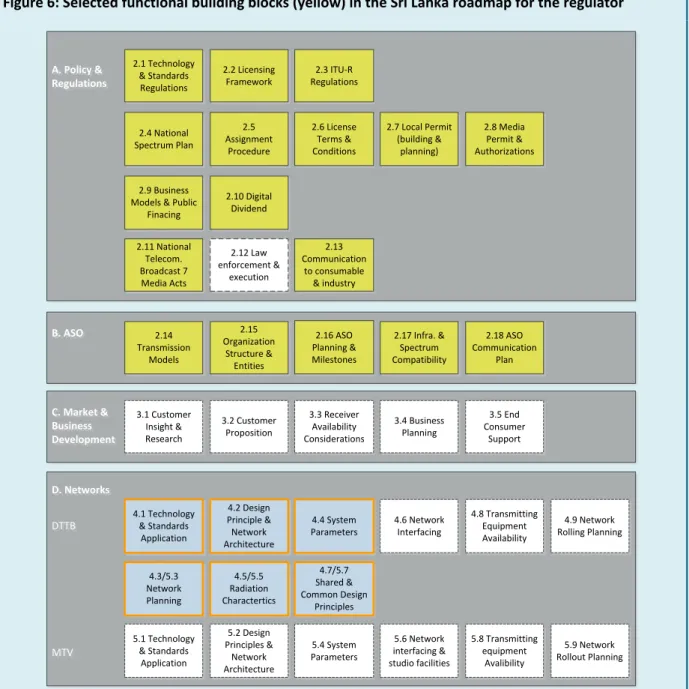
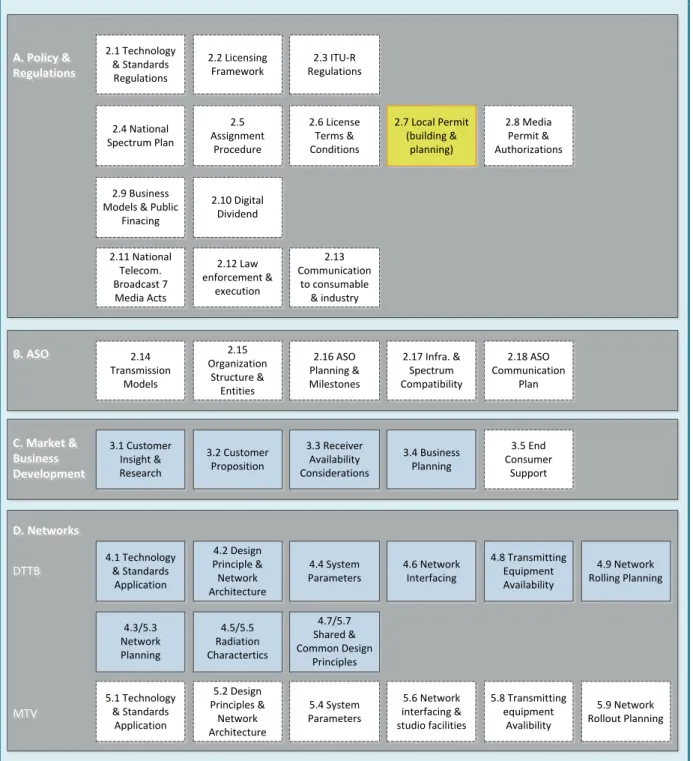
Figure 6: Selected functional building blocks (yellow) in the Sri Lanka roadmap for the regulator ... 19
Figure 7: Selected functional building blocks (blue) in the Sri Lanka roadmap for operators (DBNO) . 20 Figure 8: Symbols used in roadmap figures ... 21
Figure 9: Top level Sri Lanka roadmap under Model B ... 21
Figure 10: Functional blocks in each phase for the regulator ... 22
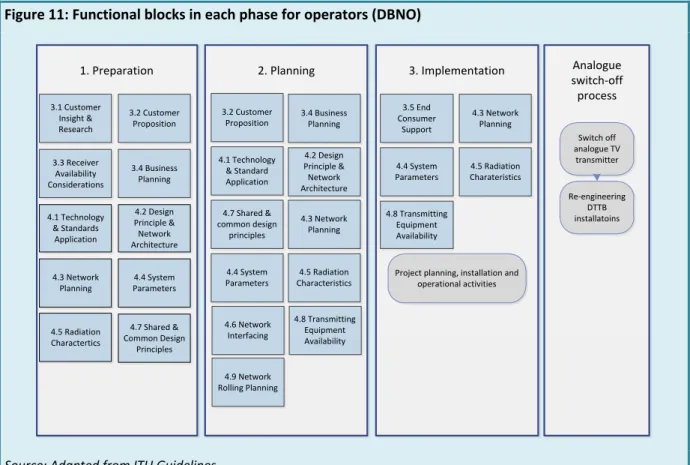
Figure 11: Functional blocks in each phase for operators (DBNO) ... 23
Figure 12: DTTB policy development phase 1 of the roadmap for the regulator ... 25
Figure 13: ASO planning phase 2 of the roadmap for the regulator ... 27
Figure 14: Licensing policy and regulation phase 3 of the roadmap for the regulator ... 29
Figure 15: Licensing administration phase 4 of the roadmap for the operator ... 31
Figure 16: Phase 1 Preparation of the roadmap for the operator (DBNO) ... 32
Figure 17: Flowchart for developing the service proposition and initial network plan ... 34
Figure 18: Phase 2 planning of the roadmap for the operator (DBNO) ... 35
Figure 19: Phase 3 implementation of the roadmap for operators (DBNO) ... 36
Figure 20: Flowchart for reviewing service planning and transmission equipment availability ... 37
Figure 21: Phase 4 analogue switch-off of the roadmap for operators (DBNO) ... 39
Figure 22: Top-ten most critical key topics and choices ... 39
Figure 23: Current TV broadcasters and proposed new DBNO players in the digital value chain ... 41
Figure 24: Video bit rate requirements ... 42
Figure 25: Location map of proposed eight DTTB sites in Sri Lanka ... 45
Figure 26: Photo of the 50m tower at SLRC broadcasting station at Piduruthalagala ... 47
Figure 27: Drawing of the Band III TX antenna and 50m tower ... 47
Figure 28: Equipment hall in SLRC broadcasting station at Piduruthalagala ... 47
Figure 29: Band III combiner in SLRC broadcasting station at Piduruthalagala ... 47
Figure 30: Impact of choices regarding shared and common design principles on other functional blocks ... 49
Figure 31: Summary of approaches used by other countries ... 55
Figure 32: Key milestone and implementation for ASO in Sri Lanka ... 58
Figure 33: TV broadcaster transmitter stations in the Colombo District ... 61
Figure 34: Measured distance between proposed DTTB sites and test point locates at Colombo DTTB site ... 97
Figure 35: SFN coverage probability under Scenario 3a (self interference occurs in Colombo area) ... 98
Figure 36: SFN coverage interference limited under Scenario 3a (self interference occurs in Colombo area) ... 99
Figure 37: Impulse response at check point in Colombo District with probability value 0.572 ... 100
Figure 38: SFN coverage probability under Scenario 3b ... 101
Figure 39: coverage interference limited under Scenario 3b (self interference occurs in power/field strength limited area) ... 102
Figure 40: Impulse response at check point in Colombo District with probability value 1 ... 103
Figure 41: Kokavil DTTB Site FS coverage ... 104
Figure 42: Colombo DTTB Site FS coverage ... 104
Figure 43: Yatiyantota DTTB Site FS coverage... 104
Figure 44: Piduruthalagala DTTB Site FS coverage ... 104
Figure 45: Karagahatenna DTTB Site FS coverage ... 105
Figure 46: Numunukula DTTB Site FS coverage ... 105
Figure 47: Gongala DTTB Site FS coverage ... 105
Foreword
The process of transition from analogue to digital terrestrial television broadcasting offers advantages in terms of spectrum efficiency, higher video and audio quality and new business opportunities. It also offers the opportunity to allocate part of the broadcasting band to International Mobile Telecommunication (IMT) services and other applications.
In all ITU regions this has started. In a number of countries (e.g. the USA and many countries in the European Union) analogue switch-off has been completed. Most developing countries are also considering digital switch-over or have started the process. To support developing Member States to overcome the challenges and transit smoothly from analogue to digital broadcasting ITU developed a programme to help countries to reap the full benefits of spectrum efficiency, and covers terrestrial TV, mobile TV and sound broadcasting.
In May 2010, the ITU published a comprehensive set of guidelines for the transition from analogue to digital terrestrial television broadcasting under this programme. These guidelines were developed for the Africa region but most of this version can be used worldwide. A version which contains the specific information for the Asia-Pacific region and the conversion of the analogue archives to digital will be published soon. In a further effort to help countries to switch over to digital broadcasting, ITU has been helping countries to draft a roadmap, and Sri Lanka is one of the countries receiving further assistance. From August to October 2011, the roadmap for transition from analogue to digital terrestrial television in Sri Lanka was jointly developed by a team of ITU experts and the National Roadmap Team (NRT) of the Sri Lanka Government.
I would like to commend Mr Peter Chu the ITU expert who has developed the roadmap through his excellent expertise and experience, as well as to give special thanks to the Sri Lanka National Roadmap Team.
Also, I very much appreciate the active support of the Telecommunications Regulatory Commission of Sri Lanka (TRCSL) and the Ministry of Mass Media and Information (MMMI), Sri Lanka, with the support of the Korea Communications Commission (KCC) and ITU Regional Office for Asia and the Pacific in facilitating the work of the ITU experts.
I am confident that this report will help the Sri Lanka Government in reaching their digital switch-over objectives.
Brahima Sanou Director Telecommunication Development Bureau International Telecommunication Union
Executive Summary
The roadmap for transition from analogue to digital terrestrial television broadcasting in Sri Lanka was prepared by ITU expert Mr Peter Chu with the support from the National Roadmap Team (NRT) from August to October 2011.
The main observations and conclusion of the roadmap are summarized below.
Scope of the roadmap
The roadmap for transition from analogue to digital terrestrial television broadcasting in Sri Lanka covers the short term digital switch-over (DSO) and long term DSO objectives and the activities managed by the NRT. However, this report does not include:
• The introduction of Mobile TV, because frequency channel in UHF band is exhausted by current
TV broadcasting services. Nevertheless, mobile TV remains a long term DSO objective.
• The introduction of digital radio. In this case, digital radio remains a long term DSO objective and
will be reviewed once the analogue switch-off (ASO) has been completed.
The Sri Lanka television market is characterized by a great number of national and commercial TV services and a wide choice of TV platforms (analogue and digital cable, satellite TV, IPTV). The TV market in Sri Lanka is mainly a free-to-air terrestrial TV market with a total of 23 TV licence holders. Sixteen broadcasters are currently in operation.
The aim of the roadmap is reflected in the DSO objectives. In the deliberation process of the first NRT meeting, the NRT considered the DSO short term and long term objectives as summarized in Table 1(see also section 2.3.1).
Table 1: Summary of DSO objectives
No Objective
Short term (1 year after analogue
switch-off)
Long term (5-10 years after analogue
switch-off)
1 Smooth transition from analogue to digital by means of using strategy driven and regional service approach.
DTTB service before mid-2012 is planned to be available in Western Province and Northern Province.
All analogue services converted to digital with same island-wide coverage areas for all current analogue TV programmes.
NRT will follow the direction from Ministry of Mass Media and Information (MMMI);
Telecommunications Regulatory Commission of Sri Lanka (TRCSL) will conduct the planning for digital dividend.
2 Issue system licence to the Digital Broadcast Network Operator (DBNO)1
Second DBNO licence will be issued if frequency spectrum is available after ASO.
Assignment of frequencies for free-to-air DBNOs take
NIL
1
Subsequent to a cabinet decision on introducing digital television transmission in Sri Lanka, a subcommittee was appointed by the secretary to the Ministry of Mass Media and Information to propose a suitable policy framework for the digitalization of terrestrial television broadcasting in Sri Lanka, through deliberations. A report named, A Policy Framework for the Digitalization of Terrestrial Television Broadcasting in Sri Lanka, drafted by the subcommittee on 20 August 2011. The report recommends a new category of network operator to provide the service of delivering the content of the broadcasters to the viewers. The new category is termed Digital Broadcast Network Operators (DBNO).
No Objective
Short term (1 year after analogue
switch-off)
Long term (5-10 years after analogue
switch-off)
precedence over subscription based DBNOs.
3 The DBNO should set up the free-to-air DVB-T2 digital terrestrial television transmission network.
NIL NIL
4 The broadcasters should make use of the services of a DBNO for the delivery of their television programmes to the viewer. All existing broadcasters should beinstructed to make all channels available as a mandatory requirement in the digital platform constructed by the respective DBNOs from the very beginning.
NIL NIL
5 Solution to issues arising out of practical difficulties in
implementing the policy. The regulator shall take
responsibilities on the concerned solutions.
NIL NIL
6 Tax policy From 2012 to 2015, tax
concessions will be provided to promote current broadcasters.
From 2012 to 2018, tax concessions will be provided for the CPE.
7 Frequency planning before ASO in supporting framework of transition from analogue to DTTB
The outcome of frequency planning will be used for the second DBNO system licence and other possible digital
broadcasting services.
Can accommodate more DBNO licences.
8 Better picture quality HDTV quality up to the market if more island-wide multiplexes are available after ASO
3D TV up to the market
9 More digital broadcasting services
NIL MTV and/or digital radio
10 Digital dividend Draft to be discussed Restacking UHF spectrum
Source: Production based on discussion with NRT of Sri Lanka
The duration of the transition process from analogue to digital terrestrial television broadcasting has been determined by the NRT. The following milestones are based on the timelines originally stated in the
subcommittee draft report2 submitted to the Ministry of Mass Media and Information (MMMI):
• end-2011 to mid-2012: Deployment of DTTB pilot transmission services in Northern Province and
Western Province;
• mid-2014: Deployment of DTTB services from eight DTTB principal stations;
• end-2015: Analogue shut off in Western Province;
2
• end-2017: Complete analogue switch-off.
It is estimated that it will take around five to six years for consumers to convert.
The scope of activities outlined in the roadmap depends on the licensing model that will be adopted. In the digital value chain, the proposed digital broadcast network operator (DBNO) needs to be established with a licence encompassing the role of multiplex operator, content distributor and service provider. The multiplex operator combines the programme stream from all current free-to-air terrestrial TV broadcasters into transport streams to be distributed to the DTTB transmitters. The tasks of the multiplex operator together with the task of the transmitter network operator and service providers (licensing model B). In the latter case the roadmap includes more activities.
The input and output documents of the phases of the roadmap related to licensing model B (common multiplex and network operator) are summarized in Table 2. Before a licence can be issued to the first DBNO, the NRT and regulator have to conduct initial network planning as shown in phase 3 (Licensing policy regulation). The detailed network planning will be the responsibility of the DBNO once the system licence has been issued.
Table 2: Input and output documents of the phases of the roadmap for licensing model B
Roadmap phase for NRT and
regulator Input document Output document
Phase 1: DTTB policy development for NRT and regulator
• International agreements • Existing national telecom
broadcast and media laws • Existing policy document and
objectives
• Digital terrestrial television broadcasting policy •Initial frequency plan
Phase 2: ASO for NRT and regulator • Digital terrestrial television broadcasting policy
• Analogue switch-off plan Phase 3: Licensing policy and
regulation for NRT and regulator
• Analogue switch-off plan • Digital terrestrial television
broadcasting policy
• National coordinated frequency plan
• Internationally coordinated frequency plan
• Licence terms and conditions • Licence procedure and planning Phase 4: Licensing administration
for NRT and regulator
• Licensing procedure and planning
• Notification to regulator from contents distributor
• Station N TRCSL approved • Station N record in MFIR
Roadmap phase for operator
(DBNO) Input document Output document
Phase 1: Preparation for the operator (DBNO)
Licence procedure Licence application
Service proposition, business plan and network plan
Phase 2: Planning for the operator (DBNO)
• Licence procedure
• Service proposition, business plan and network plan
• DTTB Network implementation plan
Roadmap phase for operator
(DBNO) Input document Output document
Phase 3: Implementation for the operator (DBNO)
• DTTB network implementation plan
• End-consumer support and communication plan • Coverage presentation • Notification to regulator • Order to put DTTB site in
operation Phase 4: ASO for operator (DBNO) • Analogue switch-off plan
• DTTB network implementation plan
• Notification to the regulator • Order to put revised DTTB site
in operation
Source: Production based on discussion with NRT of Sri Lanka
The decisions taken, partly taken and not yet taken on the key topics and choices regarding phases 1 to 4 of the roadmap by the NRT, the regulator and the operator (DBNO) and the activities required to prepare the decisions are indicated in annexes 1 to 6.
Recommendations
1. The NRT is recommended to carry out the following steps for a smooth transition to digital
terrestrial television broadcasting and the analogue services switch off:
a. Seek the roadmap report approval by the Ministry of Mass Media and Information and
Telecommunications Regulatory Commission of Sri Lanka (TRCSL).
b. After approval, acquire a mandate to plan and manage the ASO process in accordance with the
phases of the roadmaps for NRT and the regulator and work out the output documents in phases 1, 2 and 3 in order to prepare and issue a system licence to the first DBNO by mid-2012.
c. Form a project management office and NRT under the proposed broadcasting authority and start
drafting an initial detailed ASO planning and determine the progress reporting procedures and structures.
2. Apart from these next steps for the NRT to take, additional recommendations are given below to
meet the situation of Sri Lanka:
a. The frequency channels in categories of reserved, proposed, expired and cancelled should be
reviewed with high priority. It is recommended to limit the scale of frequency channel assignment furthermore for current and new broadcasters in order to release frequency channels in island wide to the DBNOs (see Table 13). The TRCSL is recommended to complete an initial DTTB frequency plan in supporting the output document of the DTTB policy in the phase 1 of the roadmap for NRT and the regulator.
b. As the milestone to issue a system licence for the first DBNO is scheduled in mid-2012, initial
network DTTB network planning is the key issue to prepare the output document, national coordinated frequency plan and licence and terms and conditions in phase 3 of the roadmap for NRT and regulator.
c. The initial feasibility study for the site infrastructure sharing with current TV broadcasters at the
proposed eight DTTB sites and the design of Single Frequency Network (SFN) transmission network and coverage planning based on DVB-T2 as proposed by the NRT are key issues. The NRT and project management office under the broadcasting authority are recommended to start the feasibility studies earlier before the awarded DBNO to undertake detailed DVB-T2 transmission network design.
1.
Introduction
ITU has published guidelines for the transition from analogue to digital broadcasting (hereinafter referred
to as ITU Guidelines)3. The ITU Guidelines provide assistance to ITU Member States to migrate smoothly
from analogue to digital broadcasting. In a further effort to help countries to switch over to digital broadcasting ITU has selected beneficiary countries to help draft a national roadmap for the digital switch-over (DSO) process. Sri Lanka is one of the five beneficiary countries in Asia and the Pacific receiving further assistance.
The roadmap for transition from analogue to digital terrestrial television broadcasting in Sri Lanka has been jointly developed by ITU expert Peter Chu and the Sri Lanka National Roadmap Team (NRT). The NRT is chaired by Mr Helasiri Ranatunga, Deputy Director, Spectrum Management, Telecommunications Regulatory Commission of Sri Lanka (TRCSL). The NRT consists of representatives from the following organisations:
• Telecommunications Regulatory Commission of Sri Lanka;
• Ministry of Defence;
• University of Moratuwa;
• Sri Lanka Rupavahini (TV) Corporation (National Television Network);
• Independent Television Network Ltd. (National Television Network);
• EAP Networks (Pvt) Ltd. (commercial broadcaster);
• MTV Channel (Pvt) Ltd. (commercial broadcaster);
• Dialog Television (Pvt) Ltd. (commercial broadcaster).
The Sri Lanka TV market, with an estimated 3.5 million TV households, is mainly a terrestrial TV free-to-air (FTA) market with a very high number of analogue terrestrial TV programme services (23). There is a wide choice of TV delivery platforms; in addition to analogue terrestrial TV, there is also digital TV satellite, analogue and digital cable TV, IPTV.
The Sir Lanka Gross Domestic Product (GDP) per capita was an estimated USD 2 2404 in 2010, and
continues to grow rapidly. This relatively low GDP figure and the very competitive TV market mark is one of the great challenges for the DSO process. Digital switch-over can only succeed if the costs for the government, the broadcasters and the viewers are kept low. On the other hand, transition to digital television will offer great advantages. The viewer will have more services and better picture quality, the broadcasters can offer new services and network costs can be reduced. The government can achieve more efficient use of the frequency spectrum and may allocate part of the broadcasting band to other communication services.
The ITU assistance to Sri Lanka consisted of four key activities:
1. preparation and first country visit to collect information;
2. drafting of the roadmap report;
3. missions to present and discuss the draft roadmap report; and
4. drafting of the final roadmap report.
The ITU experts who prepared the guidelines for the transition to digital broadcasting visited Sri Lanka from 15 to 26 August 2011 and from 26 September to 4 October 2011. During the first visit the experts together with the NRT prepared:
• an analysis of the TV market and regulatory situation;
3
The ITU Guidelines for transition from analogue to digital broadcasting can be found at www.itu.int/publ/D-HDB-GUIDELINES.01-2010/en.
4
• an overview of short term and long term digital switch-over objectives; and
• an inventory of decisions (partly) taken regarding key objectives and choices with respect to the
functional building blocks of the ITU Guidelines.
Section 2 of this report addresses the current situation and digital switch-over (DSO) objectives. Section 3 shows the draft national roadmap for achieving the DSO objectives. Section 4 considers the top-ten key topics and choices.
Annexes 1 to 6 show in detail the decisions taken, partly taken and not yet taken on the key topic and choices regarding the DSO process in Sri Lanka. Activities required to prepare the decisions that are still pending are also indicated. Annex 7 provides examples of digital terrestrial television broadcasting (DTTB) single frequency network (SFN) coverage based on the proposed eight DTTB sites.
2.
Current Broadcasting Situation in Sri Lanka
2.1
Market structure
In 2001, the population in Sri Lanka had reached 18.8 million5 and it is estimated to reach 20.68 million in
20116. There are 4 054 385 households in 3 969 211 occupied housing units in 18 districts. The average
household size is 4.2 persons. Households with television in 2002 had reached 31.64 per cent7. The total
number of households with a television was estimated at about 1.28 million in 2002 increasing to about
3.5 million8 in 2011.
The first television network in Sri Lanka was launched on 14 April 1979. The ITN channel, owned by the Independent Television Network Ltd. (ITN) became the first terrestrial television channel in Sri Lanka. On 5 June 1979 ITN was the subject of a government takeover and was later brought under the Sri Lanka Rupavahini Act 6 of 1982 along with the newly created Sri Lanka Rupavahini Corporation (SLRC).
Significant changes occurred in 1992 as the government permitted the establishment of private television networks. Subsequently, the Maharaja Television Network was launched in collaboration with Singapore Telecommunications Limited (SingTel).
Since then many new television networks have come into existence within Sri Lanka. There are also a number of satellite networks and pay per view television networks in Sri Lanka. The national
telecommunications provider Sri Lanka Telecom also launched an IPTV service in 20089.
Table 3 lists the registered broadcasting licences10. Two new broadcasters, Carlton Sports Network (Pvt.)
Ltd. and Ritz Asia (Pvt.) Ltd obtained a licence in the first quarter of 2011. In March 2011, there was a total of 23 TV broadcasters issued with a TV licence since 1992.
5
Final result CPH 2001, Brief Analysis of Population and Housing Characteristics, Department of Census and Statistics, Sri Lanka.
6
Central Bank of Sri Lanka www.cbsl.gov.lk/ 7
NationalMaster.com www.nationmaster.com/country/ce-sri-lanka/med-media 8
The total TV households is just above 3.5 million and total viewers are around 14 million i.e. one TV has four viewers average) in accordance to the research organization, LMRB www.lmrbint.com
9
Television in Sri Lanka, source: Wikipedia,
http://en.wikipedia.org/wiki/Television_in_Sri_Lanka#Pay_Television_Networks_.28Sri_Lankan_Owned.29 10
Registered institutions for radio and TV licenses record in Ministry of Mass Media and Information, www.media.gov.lk/licenses.html
Table 3: Registered TV licences
No. Broadcaster Name Programme Name % Pop
Coverage
Million viewers per week (note
1)
RUPAVAHINI (Ch 1) 95 1.92 m
CHANNEL EYE/NETHRA (Ch 2) 95 1.56 m
NTV 95 0.014 m
ITN 93 2.54 m
Vasantham 93 0.056 m
Prime TV NA NA
SWARNAVAHINI (SWAR) 87 2.30 m
ETV 10 0.056 m
SIRASA TV 85 2.25 m
Shakthi TV 85 1.36 m
CHANNEL 1 MTV 85 0.028 m
5 Telshan Network (Pvt) Ltd. TNL 70 0.36 m
6 IWS Holding (Pvt) Ltd. Art TV 12 0.042 m
7 Asia Broadcasting Corporation (Pvt.) Ltd. NA NA NA
8 Television and Radio Network TV Lanka 50 0.014 m
9 Power House Ltd. DERANA TV 75 1.16 m
10 MGMR Network Pvt Ltd. MaxTV 10 0.028 m
11 Dumee Intenational (Pvt) Ltd. NA NA NA
SIYATHA 70 0.24 m
Vetri TV 70 0.056 m
13 People`s Media Network (Pvt) Ltd. Buddlist TV 10 0.014 m
14 Rangiri Sri Lanka Media Network (Pvt) Ltd. NA NA NA
15 Lak View Broadcasting (Pvt.) Ltd. NA NA NA
16 Sat Net (Pvt.) Ltd. NA NA NA
17 Yellow Win Media (Pvt) ltd. NA NA NA
18 Future Sat Com Holdings (Pvt) Ltd. NA NA NA
19 VIS Broadcasting Network (Pvt) Ltd. CCTV 12 note 3
20 Sri Globaal Television Company ( Pvt) Ltd. NA NA NA
21 Ask Media (Pvt,) Ltd NA NA NA
22 Carlton Sports Network (Pvt,) Ltd PRIME/CSN 75 0.028 m
23 Ritz Asia (Pvt) ltd. NA NA NA
Note:
1 Million viewers per week is based on audience share in one week from 31 July 2011 to 6 August 2011 2 NA: means the broadcaster is not operational
3 No audience share data Sri Lanka Rupavahini Corporation 1
Independent Television Network. (Pvt.) Ltd. 2
Voice of Asia Netwok (Pvt) Ltd. 12
3 EAP Network (Pvt) Ltd.
MTV Channel (Pvt) Ltd (Maharaja Group) 4
Source: Production based on information provided by NRT of Sri Lanka
In addition to free-to-air terrestrial TV licences, there are also Radio, Cable TV, IPTV and Mobile TV11
licences. (See Table 4).
11
Mobitel currently operates a 3.5G network with HSDPA/HSUPA support and downlink speeds of up to 3.6 Mbit/s and uplink speed up to 1.00Mbit/s. According to speedtest.net Mobitel is the operator to issue the fastest internet connections in Sri Lanka via HSPA, while they have also fully tested out 42Mbit/s downlink HSPA MIMO technology in Colombo. It is also serving customers with over 1500 GSM and 400 3.5G base stations island wide. Source: http://en.wikipedia.org/wiki/Mobitel_(Sri_Lanka)
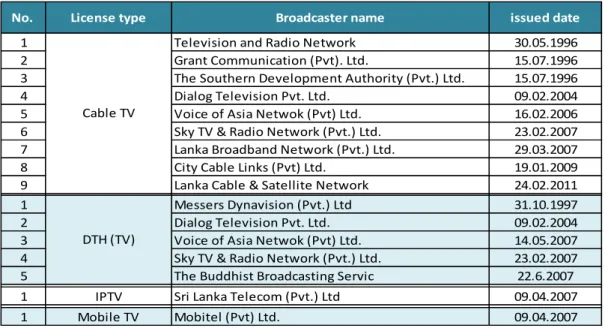
Table 4: Registered Cable TV, DTH (TV), IPTV and Mobile TV licences
No. License type Broadcaster name issued date
1 Television and Radio Network 30.05.1996
2 Grant Communication (Pvt). Ltd. 15.07.1996
3 The Southern Development Authority (Pvt.) Ltd. 15.07.1996
4 Dialog Television Pvt. Ltd. 09.02.2004
5 Voice of Asia Netwok (Pvt) Ltd. 16.02.2006
6 Sky TV & Radio Network (Pvt.) Ltd. 23.02.2007
7 Lanka Broadband Network (Pvt.) Ltd. 29.03.2007
8 City Cable Links (Pvt) Ltd. 19.01.2009
9 Lanka Cable & Satellite Network 24.02.2011
1 Messers Dynavision (Pvt.) Ltd 31.10.1997
2 Dialog Television Pvt. Ltd. 09.02.2004
3 Voice of Asia Netwok (Pvt) Ltd. 14.05.2007
4 Sky TV & Radio Network (Pvt.) Ltd. 23.02.2007
5 The Buddhist Broadcasting Servic 22.6.2007
1 IPTV Sri Lanka Telecom (Pvt.) Ltd 09.04.2007
1 Mobile TV Mobitel (Pvt) Ltd. 09.04.2007
DTH (TV) Cable TV
Source: Production based on information provided by NRT of Sri Lanka
The Sri Lanka television market structure is shown in Figure 1.
The TV market in Sri Lanka is mainly a free-to-air terrestrial TV market with 23 TV licence holders and 16 broadcasters currently in operation. The audience share rating survey is currently undertaken by a
research organization, LMRB12. Table 3 provides a sample of audience measurement (viewers per week)
for key broadcasters.
In the draft subcommittee report on a policy framework for the digitalization of terrestrial television broadcasting in Sri Lanka, it is recommended to the Ministry of Mass Media and Information in 2010, to stop issuing new media licences for analogue television broadcasting. The expansion or new assignments for current analogue transmission infrastructure in the Western Province should be terminated with immediate effect.
In addition to terrestrial analogue TV broadcasting services, the current commercial broadcasting services market include nine Cable TV licensees, five DTH TV licences and one IPTV licence and Mobile TV licence. The current operating Cable TV Distribution Network operator is Lanka Broadband Network (Pvt.) Ltd.
(LBN)13 and City Cable Links (Pvt) Ltd. LBN provides connection fees and monthly subscriptions rates in
four packages. For example, the basic package monthly rental is LKR 699 with an additional telecommunication levy of 20 per cent. It provides 36 channels and VHS quality pictures, mono sound system on selected channels. While the digital premium package, the monthly rental is LKR 1599 with an additional telecommunication levy of 20 per cent. It provides more than 100 channels, DVD quality pictures, and stereo sound. The number of cable TV subscribers is estimated to be 50 000.
The current licence to operate direct-to-home satellite broadcasting service is held by Dialog TV (Pvt)
Ltd.14 and Future Satcom Holding (Pvt.) Ltd. Dialog TV provides four standard packages. The pearl package
12
The most accepted Market Research Company for media audience measurement is Lanka Market Research Bureau Limited (LMRB), www.lmrbint.com/ in Sri Lanka. The survey of TV progammes from all broadcasters uses the people meter method for audience measurement.
13
LBN, www.lbn.lk/ provided as many as 15 foreign language channels including Maldivian, French, Chinese, German, Russian. The list of channels include different programme contents, such as Movies, Sports, Entertainment, Life Style, Educational, Children, Music and Fashion, News, Religious, Tamil, Hindi, Local TV Channels, Other. LBN also reaches people in the Mattakuliya, Negombo, Raddolugama and Nivasiepura areas.
14
provides 41 channels with monthly package rental LKR 699 and the gold package provides 73 channels with a monthly package rental of LKR 1 949. All packages provide local TV channels. The connection fee is LKR 9 990. Direct-to-home Satellite broadcasting services delivered services to about 183 000 subscriber by mid-2011.
Figure 1: Sri Lanka TV market structure
Sri Lanka Rupavahini Corporation (VHF/UHF) Sri Lanka Rupavahini Corporation (VHF/UHF)
St at e o w n ed T V N et w o rk s C o m m er ci al T V N et w o rk s
Independant Television Network Ltd (VHF/UHF) Independant Television Network Ltd (VHF/UHF)
E A P NETWORKS (PVT) LTD. E A P NETWORKS (PVT) LTD.
Maharaja Organization (Pvt) Ltd. Maharaja Organization (Pvt) Ltd.
T
T
S
Telshan Network (Pvt) Ltd. (VHF/UHF) Telshan Network (Pvt) Ltd. (VHF/UHF)
IWS Holding (Pvt) Ltd. IWS Holding (Pvt) Ltd.
Asia Broadcasting Corporation (Pvt.) Ltd. Asia Broadcasting Corporation (Pvt.) Ltd.
Television and Radio Networks Television and Radio Networks
Power House Ltd. Power House Ltd.
MGMR Network Pvt Ltd. MGMR Network Pvt Ltd.
E.W. BALASURIYA & COMPANY (PVT) LTD E.W. BALASURIYA & COMPANY (PVT) LTD
Voice of Asia Netwok (Pvt) Ltd. Voice of Asia Netwok (Pvt) Ltd.
People`s Media Network (Pvt) Ltd. People`s Media Network (Pvt) Ltd.
Sri Globaal Television Company ( Pvt) Ltd. Sri Globaal Television Company ( Pvt) Ltd.
IWS Holding (Pvt) Ltd. IWS Holding (Pvt) Ltd.
DIaglog Television (Ptv.) Ltd. DIaglog Television (Ptv.) Ltd. – DTT Services (Ch44,50,54)
DIaglog Television (Ptv.) Ltd. – 73 channels comm. broadcasters and other contents
% pop coverage, million viewers per wk
(95% pop, 1.92 m/wK)
(93% pop, 2.54 m/wK)
(87% pop, 2.3 m/wK) (85% pop, 2.25 m/wK)
= Public + Commercial Entity = Commercial Entity
(75% pop, 1.16 m/wK)
VIS Broadcasting Network (Pvt) Ltd. VIS Broadcasting Network (Pvt) Ltd.
CARLTAN SPOT NETWORK CARLTAN SPOT NETWORK
*) Ruras Lanka (Private) Limited *) Ruras Lanka (Private) Limited
*) Rangiri Sri Lanka Media Network (Pvt) Ltd. *) Rangiri Sri Lanka Media Network (Pvt) Ltd.
C
comm. broadcasters and other contents City Cable Links (Pvt) Ltd.comm. broadcasters and other contents Lanka Broadband Network (Pvt.) Ltd.
comm. broadcasters and other contents Future Satcom Holding (Pvt.) Ltd.
Sri Lanka Telecom (Pvt.) Ltd. Sri Lanka Telecom
IPTV
Sri Lanka Rupavahini Corporation (SLRC) **) SLRC – DTT Services in North & Western provinces (Ch41 & 43)
DTT
= License for DTT Transmission *) Broadcaster is pending for UHF channel assignment from TRC as update in September 2011
**) DTT is not in operation
SUMATHI HOLDINGS SUMATHI HOLDINGS
(70% pop 0.36 m/wK) (12% pop 0.042 m/wK)
(50% pop 0.014 m/wK)
(10% pop 0.028 m/wK)
(70% pop 0.24 m/wK) (10% pop 0.014 m/wK)
(12% pop 0.042 m/wK)
(75% pop 0.028 m/wK)
Source: Production based on information provided by NRT of Sri Lanka
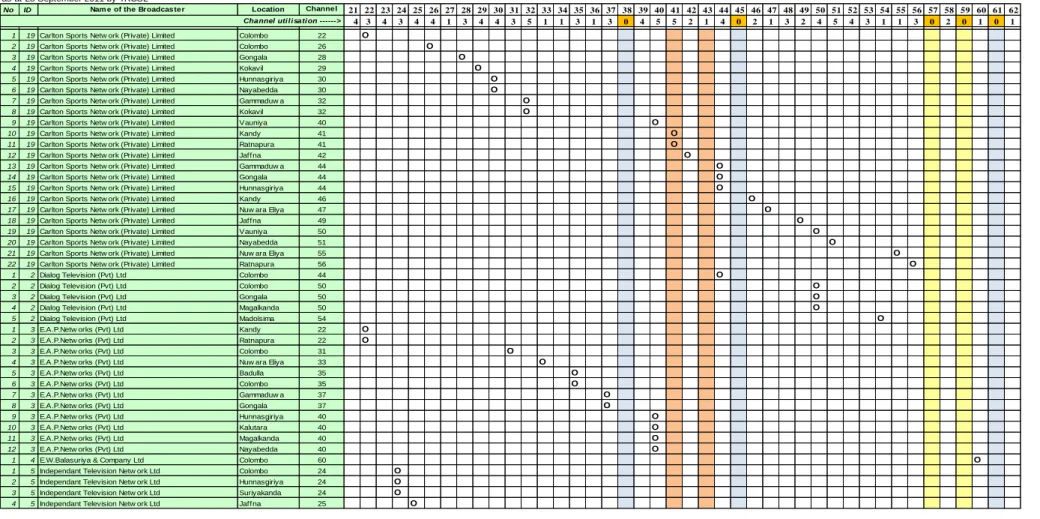
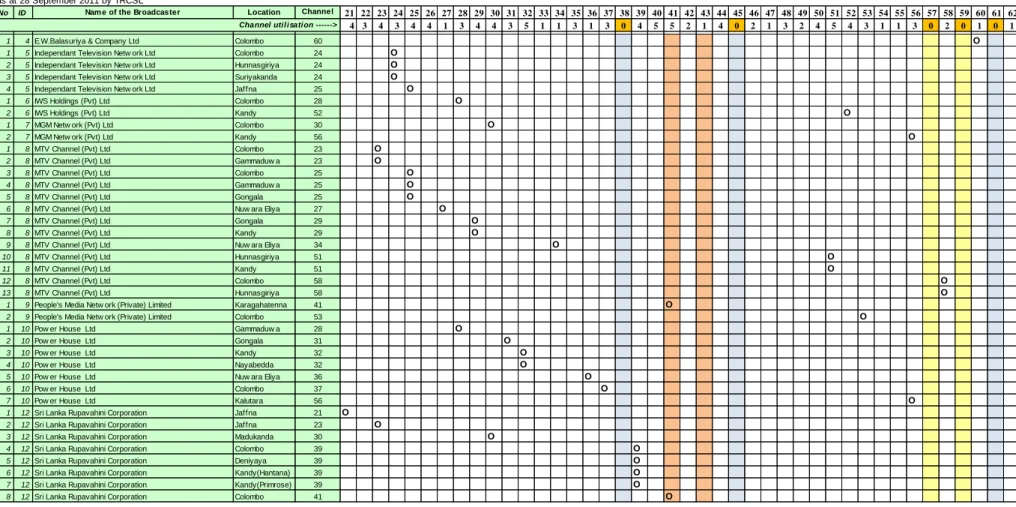
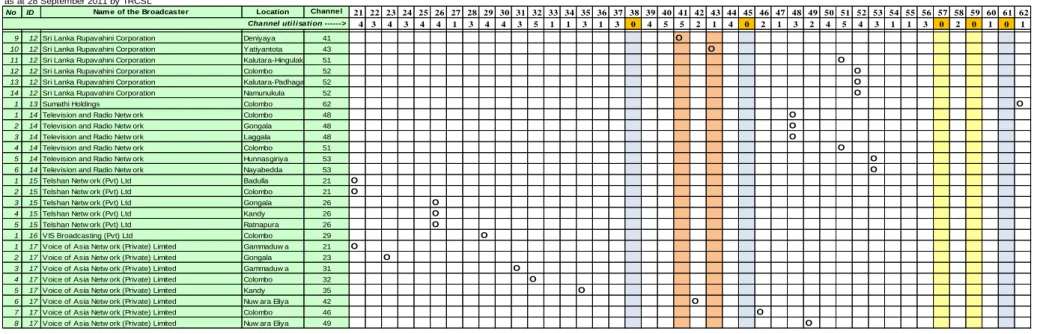
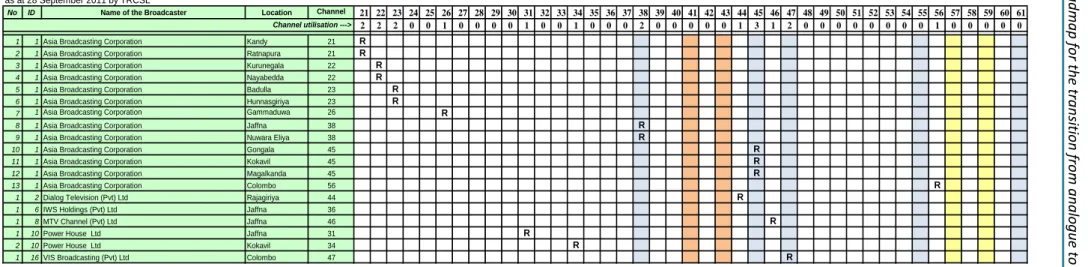
In accordance with TRCSL records as of September 2011, the frequency channel assignment for the FTA TV broadcasters in operation is shown in Table 5, 6 and 7. Channels 41 and 43 will be island wide frequency channels, planned for the digital broadcasting service. Five UHF channels: 38, 45, 57, 59 and 61 are possible clean channels under the frequency channel assignment.
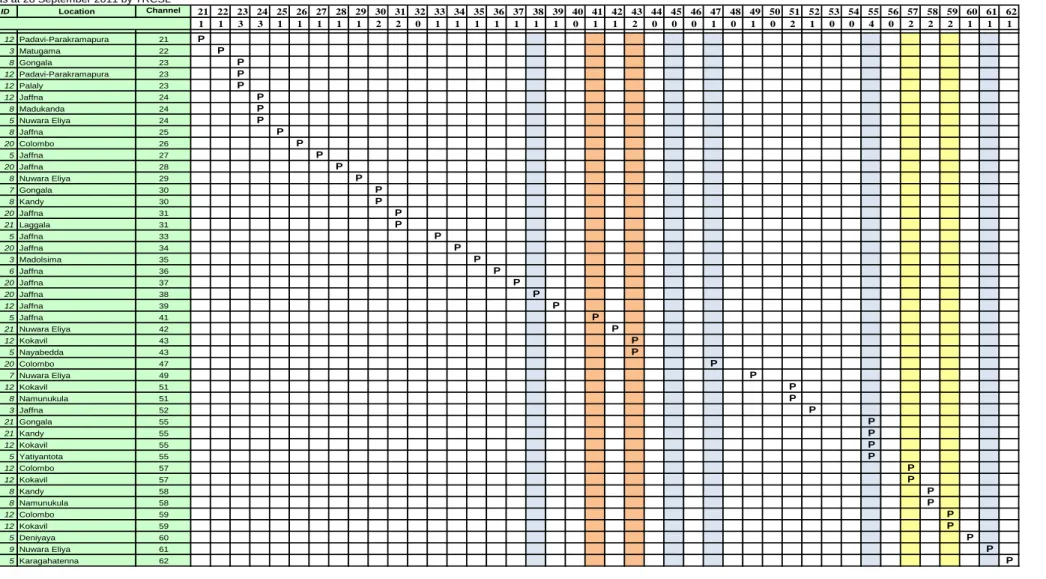
In addition to the operational UHF channels, some UHF channels are reserved and proposed for current broadcasters as shown in Table 8 and Table 9.
6
6
6
Roadmap for the transition from
an alogue to digital te rrest rial t elevis ion b roadca sti ng
in Sri L
an
ka
Table 5: Overview of TV frequency usage in UHF Band IV and V (1 of 3)
UHF Television Channel Assignment in operational as at 28 September 2011 by TRCSL
No ID Nam e of the Broadcaster Location Channel
Num ber
21 22 23 24 25 26 27 28 29 30 31 32 33 34 35 36 37 38 39 40 41 42 43 44 45 46 47 48 49 50 51 52 53 54 55 56 57 58 59 60 61 62 4 3 4 3 4 4 1 3 4 4 3 5 1 1 3 1 3 0 4 5 5 2 1 4 0 2 1 3 2 4 5 4 3 1 1 3 0 2 0 1 0 1
1 19 Carlton Sports Netw ork (Private) Limited Colombo 22 O
2 19 Carlton Sports Netw ork (Private) Limited Colombo 26 O 3 19 Carlton Sports Netw ork (Private) Limited Gongala 28 O 4 19 Carlton Sports Netw ork (Private) Limited Kokavil 29 O 5 19 Carlton Sports Netw ork (Private) Limited Hunnasgiriya 30 O 6 19 Carlton Sports Netw ork (Private) Limited Nayabedda 30 O 7 19 Carlton Sports Netw ork (Private) Limited Gammaduw a 32 O 8 19 Carlton Sports Netw ork (Private) Limited Kokavil 32 O
9 19 Carlton Sports Netw ork (Private) Limited Vauniya 40 O
10 19 Carlton Sports Netw ork (Private) Limited Kandy 41 O
11 19 Carlton Sports Netw ork (Private) Limited Ratnapura 41 O
12 19 Carlton Sports Netw ork (Private) Limited Jaf f na 42 O
13 19 Carlton Sports Netw ork (Private) Limited Gammaduw a 44 O
14 19 Carlton Sports Netw ork (Private) Limited Gongala 44 O
15 19 Carlton Sports Netw ork (Private) Limited Hunnasgiriya 44 O
16 19 Carlton Sports Netw ork (Private) Limited Kandy 46 O
17 19 Carlton Sports Netw ork (Private) Limited Nuw ara Eliya 47 O
18 19 Carlton Sports Netw ork (Private) Limited Jaf f na 49 O
19 19 Carlton Sports Netw ork (Private) Limited Vauniya 50 O
20 19 Carlton Sports Netw ork (Private) Limited Nayabedda 51 O
21 19 Carlton Sports Netw ork (Private) Limited Nuw ara Eliya 55 O
22 19 Carlton Sports Netw ork (Private) Limited Ratnapura 56 O
1 2 Dialog Television (Pvt) Ltd Colombo 44 O
2 2 Dialog Television (Pvt) Ltd Colombo 50 O
3 2 Dialog Television (Pvt) Ltd Gongala 50 O
4 2 Dialog Television (Pvt) Ltd Magalkanda 50 O
5 2 Dialog Television (Pvt) Ltd Madolsima 54 O
1 3 E.A.P.Netw orks (Pvt) Ltd Kandy 22 O 2 3 E.A.P.Netw orks (Pvt) Ltd Ratnapura 22 O
3 3 E.A.P.Netw orks (Pvt) Ltd Colombo 31 O
4 3 E.A.P.Netw orks (Pvt) Ltd Nuw ara Eliya 33 O
5 3 E.A.P.Netw orks (Pvt) Ltd Badulla 35 O
6 3 E.A.P.Netw orks (Pvt) Ltd Colombo 35 O
7 3 E.A.P.Netw orks (Pvt) Ltd Gammaduw a 37 O
8 3 E.A.P.Netw orks (Pvt) Ltd Gongala 37 O
9 3 E.A.P.Netw orks (Pvt) Ltd Hunnasgiriya 40 O
10 3 E.A.P.Netw orks (Pvt) Ltd Kalutara 40 O
11 3 E.A.P.Netw orks (Pvt) Ltd Magalkanda 40 O
12 3 E.A.P.Netw orks (Pvt) Ltd Nayabedda 40 O
1 4 E.W.Balasuriya & Company Ltd Colombo 60 O
1 5 Independant Television Netw ork Ltd Colombo 24 O 2 5 Independant Television Netw ork Ltd Hunnasgiriya 24 O 3 5 Independant Television Netw ork Ltd Suriyakanda 24 O 4 5 Independant Television Netw ork Ltd Jaf f na 25 O
Roadmap for the
transition
from
an
alogue
to digital
te
rrest
rial t
elevis
ion b
roadca
sti
ng
in Sri L
an
ka
7
Table 6: Overview of TV frequency usage in UHF Band IV and V (2 of 3)
UHF Television Channel Assignment in operational as at 28 September 2011 by TRCSL
No ID Nam e of the Broadcaster Location Channel
Num ber
21 22 23 24 25 26 27 28 29 30 31 32 33 34 35 36 37 38 39 40 41 42 43 44 45 46 47 48 49 50 51 52 53 54 55 56 57 58 59 60 61 62
4 3 4 3 4 4 1 3 4 4 3 5 1 1 3 1 3 0 4 5 5 2 1 4 0 2 1 3 2 4 5 4 3 1 1 3 0 2 0 1 0 1
1 4E.W.Balasuriya & Company Ltd Colombo 60 O
1 5Independant Television Netw ork Ltd Colombo 24 O 2 5Independant Television Netw ork Ltd Hunnasgiriya 24 O 3 5Independant Television Netw ork Ltd Suriyakanda 24 O 4 5Independant Television Netw ork Ltd Jaffna 25 O
1 6IWS Holdings (Pvt) Ltd Colombo 28 O
2 6IWS Holdings (Pvt) Ltd Kandy 52 O
1 7MGM Netw ork (Pvt) Ltd Colombo 30 O
2 7MGM Netw ork (Pvt) Ltd Kandy 56 O
1 8MTV Channel (Pvt) Ltd Colombo 23 O
2 8MTV Channel (Pvt) Ltd Gammaduw a 23 O
3 8MTV Channel (Pvt) Ltd Colombo 25 O
4 8MTV Channel (Pvt) Ltd Gammaduw a 25 O
5 8MTV Channel (Pvt) Ltd Gongala 25 O
6 8MTV Channel (Pvt) Ltd Nuw ara Eliya 27 O
7 8MTV Channel (Pvt) Ltd Gongala 29 O
8 8MTV Channel (Pvt) Ltd Kandy 29 O
9 8MTV Channel (Pvt) Ltd Nuw ara Eliya 34 O
10 8MTV Channel (Pvt) Ltd Hunnasgiriya 51 O
11 8MTV Channel (Pvt) Ltd Kandy 51 O
12 8MTV Channel (Pvt) Ltd Colombo 58 O
13 8MTV Channel (Pvt) Ltd Hunnasgiriya 58 O
1 9People's Media Netw ork (Private) Limited Karagahatenna 41 O
2 9People's Media Netw ork (Private) Limited Colombo 53 O
1 10Pow er House Ltd Gammaduw a 28 O
2 10Pow er House Ltd Gongala 31 O
3 10Pow er House Ltd Kandy 32 O
4 10Pow er House Ltd Nayabedda 32 O
5 10Pow er House Ltd Nuw ara Eliya 36 O
6 10Pow er House Ltd Colombo 37 O
7 10Pow er House Ltd Kalutara 56 O
1 12Sri Lanka Rupavahini Corporation Jaffna 21 O 2 12Sri Lanka Rupavahini Corporation Jaffna 23 O
3 12Sri Lanka Rupavahini Corporation Madukanda 30 O
4 12Sri Lanka Rupavahini Corporation Colombo 39 O
5 12Sri Lanka Rupavahini Corporation Deniyaya 39 O
6 12Sri Lanka Rupavahini Corporation Kandy(Hantana) 39 O
7 12Sri Lanka Rupavahini Corporation Kandy(Primrose) 39 O
8 12Sri Lanka Rupavahini Corporation Colombo 41 O
8
8
8
Roadmap for the transition from
an
alogue
to digital
te
rrest
rial t
elevis
ion b
roadca
sti
ng
in Sri L
an
ka
Table 7: Overview of TV frequency usage in UHF Band IV and V (3 of 3)
UHF Television Channel Assignment in operational as at 28 September 2011 by TRCSL
No ID Nam e of the Broadcaster Location Channel
Num ber 21 22 23 24 25 26 27 28 29 30 31 32 33 34 35 36 37 38 39 40 41 42 43 44 45 46 47 48 49 50 51 52 53 54 55 56 57 58 59 60 61 624 3 4 3 4 4 1 3 4 4 3 5 1 1 3 1 3 0 4 5 5 2 1 4 0 2 1 3 2 4 5 4 3 1 1 3 0 2 0 1 0 1
9 12Sri Lanka Rupavahini Corporation Deniyaya 41 O
10 12Sri Lanka Rupavahini Corporation Yatiyantota 43 O
11 12Sri Lanka Rupavahini Corporation Kalutara-Hingulakanda 51 O
12 12Sri Lanka Rupavahini Corporation Colombo 52 O
13 12Sri Lanka Rupavahini Corporation Kalutara-Padhagala 52 O
14 12Sri Lanka Rupavahini Corporation Namunukula 52 O
1 13Sumathi Holdings Colombo 62 O
1 14Television and Radio Netw ork Colombo 48 O
2 14Television and Radio Netw ork Gongala 48 O
3 14Television and Radio Netw ork Laggala 48 O
4 14Television and Radio Netw ork Colombo 51 O
5 14Television and Radio Netw ork Hunnasgiriya 53 O
6 14Television and Radio Netw ork Nayabedda 53 O
1 15Telshan Netw ork (Pvt) Ltd Badulla 21 O 2 15Telshan Netw ork (Pvt) Ltd Colombo 21 O
3 15Telshan Netw ork (Pvt) Ltd Gongala 26 O
4 15Telshan Netw ork (Pvt) Ltd Kandy 26 O
5 15Telshan Netw ork (Pvt) Ltd Ratnapura 26 O
1 16VIS Broadcasting (Pvt) Ltd Colombo 29 O
1 17Voice of Asia Netw ork (Private) Limited Gammaduw a 21 O 2 17Voice of Asia Netw ork (Private) Limited Gongala 23 O
3 17Voice of Asia Netw ork (Private) Limited Gammaduw a 31 O 4 17Voice of Asia Netw ork (Private) Limited Colombo 32 O
5 17Voice of Asia Netw ork (Private) Limited Kandy 35 O
6 17Voice of Asia Netw ork (Private) Limited Nuw ara Eliya 42 O
7 17Voice of Asia Netw ork (Private) Limited Colombo 46 O
8 17Voice of Asia Netw ork (Private) Limited Nuw ara Eliya 49 O
Roadmap for the
transition
from
an
alogue
to digital
te
rrest
rial t
elevis
ion b
roadca
sti
ng
in Sri L
an
ka
9
Table 8: Overview of TV frequency usage in UHF Band IV and V (reserved)
UHF Television Channel Assignment under reservation as at 28 September 2011 by TRCSL
No ID Name of the Broadcaster Location Channel
Number
21 22 23 24 25 26 27 28 29 30 31 32 33 34 35 36 37 38 39 40 41 42 43 44 45 46 47 48 49 50 51 52 53 54 55 56 57 58 59 60 61
2 2 2 0 0 1 0 0 0 0 1 0 0 1 0 0 0 2 0 0 0 0 0 1 3 1 2 0 0 0 0 0 0 0 0 1 0 0 0 0 0
1 1Asia Broadcasting Corporation Kandy 21 R 2 1Asia Broadcasting Corporation Ratnapura 21 R 3 1Asia Broadcasting Corporation Kurunegala 22 R 4 1Asia Broadcasting Corporation Nayabedda 22 R 5 1Asia Broadcasting Corporation Badulla 23 R 6 1Asia Broadcasting Corporation Hunnasgiriya 23 R
7 1Asia Broadcasting Corporation Gammaduwa 26 R
8 1Asia Broadcasting Corporation Jaffna 38 R
9 1Asia Broadcasting Corporation Nuwara Eliya 38 R
10 1Asia Broadcasting Corporation Gongala 45 R
11 1Asia Broadcasting Corporation Kokavil 45 R
12 1Asia Broadcasting Corporation Magalkanda 45 R
13 1Asia Broadcasting Corporation Colombo 56 R
1 2Dialog Television (Pvt) Ltd Rajagiriya 44 R
1 6IWS Holdings (Pvt) Ltd Jaffna 36
1 8MTV Channel (Pvt) Ltd Jaffna 46 R
1 10Power House Ltd Jaffna 31 R
2 10Power House Ltd Kokavil 34 R
1 16VIS Broadcasting (Pvt) Ltd Colombo 47 R
10
1
0
1
0
Roadmap for the transition from
an alogue to digital te rrest rial t elevis ion b roadca sti ng
in Sri L
an
ka
Table 9: Overview of TV frequency usage in UHF Band IV and V (proposed)
UHF Television Channel Assignment under proposal as at 28 September 2011 by TRCSL
ID Location Channel
Number
21 22 23 24 25 26 27 28 29 30 31 32 33 34 35 36 37 38 39 40 41 42 43 44 45 46 47 48 49 50 51 52 53 54 55 56 57 58 59 60 61 62
1 1 3 3 1 1 1 1 1 2 2 0 1 1 1 1 1 1 1 0 1 1 2 0 0 0 1 0 1 0 2 1 0 0 4 0 2 2 2 1 1 1
12Padavi-Parakramapura 21 P
3Matugama 22 P
8Gongala 23 P
12Padavi-Parakramapura 23 P
12Palaly 23 P
12Jaffna 24 P
8Madukanda 24 P
5Nuwara Eliya 24 P
8Jaffna 25 P
20Colombo 26 P
5Jaffna 27 P
20Jaffna 28 P
8Nuwara Eliya 29 P
7Gongala 30 P
8Kandy 30 P
20Jaffna 31 P
21Laggala 31 P
5Jaffna 33 P
20Jaffna 34 P
3Madolsima 35 P
6Jaffna 36 P
20Jaffna 37 P
20Jaffna 38 P
12Jaffna 39 P
5Jaffna 41 P
21Nuwara Eliya 42 P
12Kokavil 43 P
5Nayabedda 43 P
20Colombo 47 P
7Nuwara Eliya 49 P
12Kokavil 51 P
8Namunukula 51 P
3Jaffna 52 P
21Gongala 55 P
21Kandy 55 P
12Kokavil 55 P
5Yatiyantota 55 P
12Colombo 57 P
12Kokavil 57 P
8Kandy 58 P
8Namunukula 58 P
12Colombo 59 P
12Kokavil 59 P
5Deniyaya 60 P
9Nuwara Eliya 61 P
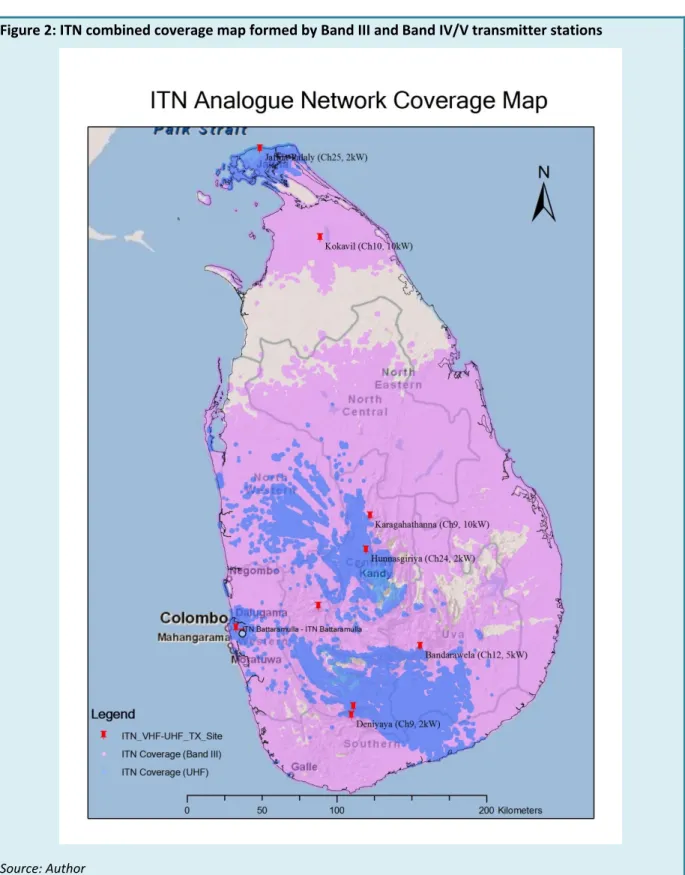
The broadcasters, Sri Lanka Rupavahini Corporation (SLRC) and Independent Television Network Ltd. (ITN) provide more than 95 per cent of the population coverage. Both broadcasters are assigned with frequency channels in Band III and Band IV/V. Telshan Network (Pvt) Ltd. was assigned with frequency channels in Band I/III and Band IV. Other broadcasters are assigned with frequency channels in Band IV/V only.
Taking ITN as an example, Figure 2 illustrates location of the ITN transmitter site location and combined coverage map formed by six Band III stations and four UHF transmitter stations.
2.2
Regulatory framework
The regulatory framework with regard to television broadcasting is shown in Table 10.
Table 10: Regulatory framework
Relevant legislation Arrange/Covers Regulatory body Assigned rights
National Media Policy Policy applies to the media and broadcasting
MMMI Media/Content/Broadcast
right
Sri Lanka
Telecommunications Act No. 25 of 1991 amended by Act No. 27 of 1996
Legislation applies to the establishment and operation of radio frequency transmitters and broadcasting.
TRCSL Spectrum right
Sri Lanka Rupavahini Corporation Act 6 of 1982
Sri Lanka Broadcasting Corporation Act
Laws and regulations are currently to regulate broadcasting content
MMMI Contents/Broadcast right;
Sri Lanka Rupavahini Corporation Act no. 6 of 1982 to be amended to incorporate Digital TV broadcasting services. Issue of licences for
DBNOs under the Telecommunication Act
Specify transmission and technical parameters with regard to technical quality Access and tariff of DBNO services
A regulatory authority for broadcasting to resolve issues arising in implementing
TRCSL and MMMI
Source: Production based on information provided by NRT of Sri Lanka
The main regulatory bodies are the Ministry of Mass Media and Information (MMMI) and the Telecommunications Regulatory Commission (TRCSL). With regard to the transition to digital television the following observations can be made:
1. Subsequent to a Cabinet decision on introducing digital television transmission in Sri Lanka, a
subcommittee was appointed by the Secretary to the Ministry of Mass Media and Information to propose a suitable policy framework for the digitization of terrestrial television broadcasting in Sri Lanka. After the detailed study and deliberations the subcommittee submitted a report on drafting the policy framework to the Secretary to the Ministry of Mass Media and Information in August 2010. The report provides policy directives.
2. One of the policy directives introduces a new category of network operator to provide the service
of delivering the content of the broadcasters to the viewers. The new category is termed Digital Broadcast Network Operators (DBNO).
3. The DBNO needs to set up the free-to-air (FTA) digital terrestrial television transmission network
to accommodate all of current analogue TV licensees with the minimum number of DBNOs implying that the programme channels per DBNO would be the maximum possible. The subcommittee recommends using DVB-T2 because it can provide the highest data rate capacity.
4. The Ministry of Mass Media and Information (MMMI) and the Telecommunications Regulatory
Commission of Sri Lanka (TRCSL) need to form the DBNO and regulation of access and tariff of DBNO services. TRCSL needs to issue licences for DBNOs under the Telecommunication Act and take care to specify transmission and technical parameters with regard to technical quality.
5. In the TRCSL UHF spectrum utilisation record of September 2011, a great number of analogue TV channels are operational and many UHF channels are reserved and proposed for the current TV broadcasters and any new TV licence holder. The great number of reserved and proposed channels will make the frequency planning difficult for DTTB and render the digital switch-over process more complex.
2.3
Digital switch-over objective
2.3.1 DTTB short and long term objectives
After discussion with NRT members, the digital switch-over (DSO) objectives for digital terrestrial television broadcasting are set out in Table 11.
Table 11: DTTB DSO objectives
No Objective Short term
(1 year after analogue switch-off)
Long term (5-10 years after analogue
switch-off)
1 Smooth transition from analogue to digital by means of using strategy driven and regional service approach.
Target timeline of ASO End 2011
Provide DTTB transmission service in Northern Province;
Mid-2012
Provide DTTB transmission service in Western Province;
Mid-2014
DTTB service from all locations End-2015
Analogue shut off in Western Province End-2017
Complete analogue shut off
All analogue services converted to digital with same island wide coverage areas for all current analogue TV programme.
NRT will follow the direction from Ministry of Mass Media and Information; TRCSL will conduct the planning for digital dividend.
2 Issue system licence for content distribution by the network operator Summary of the DBNO
Introduce Digital Broadcast Network Operator (DBNO) to provide service in delivering current broadcasters’ content to the viewers.
Assign two frequencies in UHF Ch41 and Ch43 to form two multiplexes to carry 28 programmes initially for the first DBNO. Additional frequencies should be assigned to the DBNO for island wide coverage.
No additional DBNO licence should be issued before completion of island wide coverage for reason of no sufficient frequency before analogue switch-off.
Second DBNO licence will be issued in condition of frequency spectrum available after ASO. Assignment of frequencies for FTA DBNOs take precedence over
subscription based DBNOs. NIL
3 The DBNO should set up the free-to-air DVB-T2 digital terrestrial television transmission network.
No Objective Short term (1 year after analogue
switch-off)
Long term (5-10 years after analogue
switch-off)
4 Issuance of TV licences to the
broadcasters based on condition relating to the content, the broadcasters should make use of the services of a DBNO for the delivery of their television
programme to the viewer. All existing broadcasters should be instructed that all channels should be made available as a mandatory requirement in the digital platform constructed by the respective DBNOs from the very inception.
NIL NIL
5 Solution to issues arising out of practical difficulties in implementing the policy. The regulator/Authority shall take responsibilities on,
DBNOs maintain specified availability levels in disaster recovery facilities. The analogue services for satellite and cable television transmission to fall in line with the digitalization plan must be addressed.
It is recommended to stop issuing of new media licence for analogue television broadcasting.
The expansion for current analogue transmission infrastructure should be terminated with immediate effect.
NIL NIL
6 Tax policy
To provide import tax concessions for broadcast quality digital production, transmission and customer premises equipment (CPE) for a specific period of time.
CPE, such as digital TV receiver and set top boxes needs some subsidizing.
From 2012 to 2015, the tax concessions will be revised to promote current broadcasters.
From 2012 to 2018, the tax concessions will be revised for the CPE.
7 Frequency planning before ASO
Before ASO, conduct full scale frequency planning in order to sort out possible island wide frequency channel in supporting framework of transition from analogue to DTTB.
The outcome of frequency planning will be used for the 2nd DBNO system licence and other possible digital broadcasting services.
Can accommodate more DBNO licences.
8 Better picture quality HDTV quality up to the
market in condition of more island wide multiplex available after ASO
3D TV up to the market
9 More digital broadcasting services NIL MTV and/or Digital Radio up
to the market
10 Digital dividend Draft to be discussed Restacking UHF Spectrum
With reference to the DTTB DSO objective, some observations are given below.
1. DSO objective 1: The target timeline aims to provide DVB-T2 pilot transmission service in
Northern and Western Provinces by end 2011 and mid-2012 respectively. In terms of project progress and technical consideration:
a. It is assumed that the pilot DVB-T2 transmission equipment setup in Kokavil site should be
completed on time and is most likely available for the DVB-T2 deployment before end 2011 in the Northern Province. Before forming the DBNO, the State TV broadcast network operator, SLRC was assigned to undertake the engineering work at Kokavil that is one of the proposed eight DTTB principal sites.
b. On the other hand, the Western Province DVB-T2 coverage is mainly provided by a new
developed transmitter site located in urban area of Colombo District in accordance to NRT’s proposal. The DVB-T2 transmission facilities and infrastructure, e.g. station building, antenna tower and site development are still in progress. There are at least three key issues are recommended to take into account:
i. Is the transmitter site located in Colombo District compatible with the SFN transmitted
from other principal DTTB stations located in Yatiyantota and Piduruthalagala sites? The SFN coverage prediction using radio planning software indicates that the SFN overlapping area in Colombo District with the SFN coverage from Yatiyantota and Piduruthalagala sites will cause self-interference because part of the SFN overlapping area in Colombo exceeds the guard interval, see Annex 7 for details.
ii. Is the site development in Colombo DTT site ready for DVB-T2 equipment facilities
setup and meet the deployment on time, i.e. end of the second quarter of 2012?
iii. Will the Colombo sites be designed as a multiplex centre operated by the first DBNO?
2. DSO objective 2: The system licence for the first DBNO is scheduled to be issued by mid-2012. The
critical factors are:
a Does the direction from Ministry of Mass Media and Information agree to the proposal to
use system licences for DBNO by end 2011 or earlier?
b Can the progress of the output document from the licensing policy and regulation phase 2 of
the roadmap be completed in a timely manner?
3. DSO objective 3: The DBNO should set up the FTA DVB-T2 digital terrestrial television
transmission network after the system licence is issued (by mid-2012) and has to deploy DTTB services by mid-2014 from all eight proposed DTTB sites including the pilot DVB-T2 sites at Kokavil and Colombo. However, these two pilot sites will be put into service earlier, by end 2011 and mid-2012 respectively, before forming the first DBNO. Therefore the NRT and TRCSL have to undertake the engineering design work in advance and ensure the SFN coverage to be compatible with the remaining six principal DTTB sites’ coverage.
4. DSO objective 4: Existing broadcasters should be instructed that all analogue programme
contents should be made available as a mandatory requirement in the digital platform through the respective DBNOs from the beginning. Before actually deciding the licensing regime (to include licensing framework, conditions and procedures in phase 3 of the roadmap), the NRT can organize a market consultation to check the validity and market support for its plans. It is noted that forming the first NRT does not include stakeholders from all current broadcasters.
5. DSO objective 7: Frequency planning before ASO is a critical issue. The reasons given in Figure 12
DTTB policy development phase 1 of the roadmap for the regulator (2: Determining the current available spectrum for DTTB (functional building blocks 2.3 and 2.4)) indicate that the frequency planning will provide clear and updated records of current frequency channel use in UHF Band IV and V spectrum that will enable the NRT to develop a DTTB policy document.