A STUDY ON THE INTEGRATION OF QFD-PMMM IN CLOUD COMPUTING SYSTEM QUALITY
Chih-Had Chen1, Shing-Han Li2, Mark Hwang2 and Jang-Ruey Tzeng2
1Department of Computer Science and Engineering 2Department of Information Management
Tatung University
No. 40, Sec. 3, Zhongshan N. Rd., Taipei City 104, Taiwan
[email protected]; {shli; petertzeng}@ttu.edu.tw; [email protected] Received June 2010; accepted September 2010
Abstract. Although cloud computing is at the leading edge of the information
tech-nology industry, it lacks a set of quality measurement models in the evaluation of cloud computing system. The study starts out from the perspective of cloud computing informa-tion system and attempts to eliminate the uncertainty between cloud computing system and project management by integrating PMMM related improvement factors with QFD, so as to integrate quality into cloud-based project management. Through a model analysis and test results of cases, this study discovers the impact of 5 demand guideline factors and 5 project management processes for quality improvement in cloud-based project man-agement system.
Keywords: Quality function deployment, Project management maturity model, Cloud project management system
1. Introduction. Cloud-based project management system consists of integrated mod-ules with different functions that achieve maximum efficiency in available resources and accelerates collaborative cooperation among staff through cloud computing. Cleland [1] suggests that the adoption of cloud-based project management system effectively imple-ment rapid sharing in the planning, organization, guidance, incentives and knowledge control of projects in addition to reducing the building and maintenance costs of corpo-rate information system and effective collaboration, which concurrently provides a repos-itory for preserving massive project knowledge. Therefore, corporations use cloud-based project management system for the improvement of system quality from the perspective of project management, thereby, facilitating the corporate project teams with the completion of project tasks meeting the budget and quality on a timely basis. The research purposes are described below: (1) Construct a quality improvement model for cloud-based project management system. (2) Understand the relationship between the demand guidelines of cloud-based project management system and PMMM project improvement process. (3) The implementation strategic steps of quality in cloud-based project management system are rendered to facilitate the effective allocation of prioritized resources for cloud-based project management system.
2. Literature Review. Cellopoint [2] believes that cloud computation is offered to the Internet users through a service form of virtualization, whereby the users are not required to know the implementation process but to simply wait for the return of pending results. F. Xhafa and J. Carretero [3] believe a computational grid is a large scale, heterogeneous collection of autonomous systems, geographically distributed and interconnected by het-erogeneous networks. N. Moghim [4] believe QoS becomes one of the main concerns in the Internet. F.-T. Lin and T.-S. Shih [5] believe Cloud computing is (1) satisfy-ing business requirements on demand, (2) lowersatisfy-ing the cost and energy-savsatisfy-ing and (3)
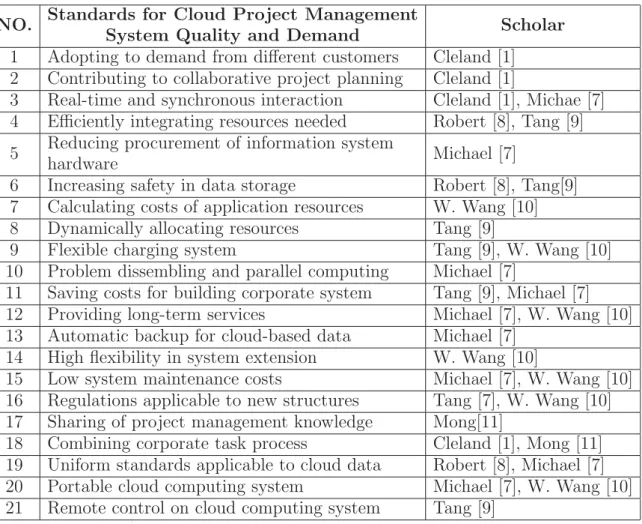
improving the efficiency of resource management. C.-Y. Chen and M.-H. Cheng [6] be-lieve a lot of communication protocols adopted in industrial automation systems easily increase both complexity and difficulty of different system integrations. Therefore, the adoption of cloud-based technology on the management of project routines facilitates the collaboration of project management which concurrently enhances efficiency in project management system. The various quality demand guidelines are compiled in Table 1.
Table 1. Cloud system quality demand standards from various scholars
NO. Standards for Cloud Project Management Scholar System Quality and Demand
1 Adopting to demand from different customers Cleland [1] 2 Contributing to collaborative project planning Cleland [1]
3 Real-time and synchronous interaction Cleland [1], Michae [7] 4 Efficiently integrating resources needed Robert [8], Tang [9] 5 Reducing procurement of information system Michael [7]
hardware
6 Increasing safety in data storage Robert [8], Tang[9] 7 Calculating costs of application resources W. Wang [10] 8 Dynamically allocating resources Tang [9]
9 Flexible charging system Tang [9], W. Wang [10] 10 Problem dissembling and parallel computing Michael [7]
11 Saving costs for building corporate system Tang [9], Michael [7] 12 Providing long-term services Michael [7], W. Wang [10] 13 Automatic backup for cloud-based data Michael [7]
14 High flexibility in system extension W. Wang [10]
15 Low system maintenance costs Michael [7], W. Wang [10] 16 Regulations applicable to new structures Tang [7], W. Wang [10] 17 Sharing of project management knowledge Mong[11]
18 Combining corporate task process Cleland [1], Mong [11] 19 Uniform standards applicable to cloud data Robert [8], Michael [7] 20 Portable cloud computing system Michael [7], W. Wang [10] 21 Remote control on cloud computing system Tang [9]
This study adopts K-PMMM model as the improvement function factor for quality in cloud-based project management system. The major reasons taken into account consist of the following: 1. K-PMMM model takes into consideration of corporate development, cul-ture and environment. 2. The concept of overlapping levels can simultaneously improve multiple standard guidelines. Miyoung [12] recommended concurrently taking into con-sideration the collaborative relationship between qualitative and quantitative attributes of customers with organizational functions with regards to constructing QFD on the base model. Among which the base structure for the house of quality, as shown in mainly divided into six sections including: customer demands, engineering analysis, relation-ship matrix, correlation analysis, competitor analysis and design quality, and technology assessment and key technology management as shown in Figure 1.
This study integrates PMMM-based QFD model with exploration on introducing qual-ity planning of project improvement process as new technology or new management model for the introduction of quality.
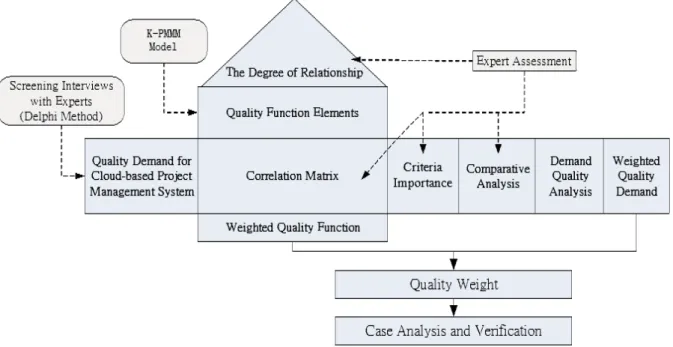
3. Research Method and Architecture. The K-PMMM based project management improvement process is used as quality function elements of QFD and described through literature review on QFD analysis and reasons stated in 2.3. The Delphi Theory and
Figure 1. Fundamental structure for house of quality
K-PMMM model are used in QFD to establish a measuring model for improving quality in cloud-based project management system of QFD-PMMM as shown in Figure 2.
Figure 2. Quality improvement model for cloud project management
sys-tem of QFD-PMMM
There are two indicators for reaching consistent consensus: (1) Each interview process contains at least two thirds (inclusive) of demand guidelines for experts of interview accepting that quality. (2) At least two thirds (inclusive) of the interview experts score the same points in each interview. The cloud-based project management system quality model integrating QFD-PMMM is established as shown in Figure 3.
4. Case Study. The cloud computation quality demand guidelines of cases undergo three rounds expert interviews about the demand guideline items of cloud computation
Figure 3. Quality model for cloud project management system of QFD-PMMM
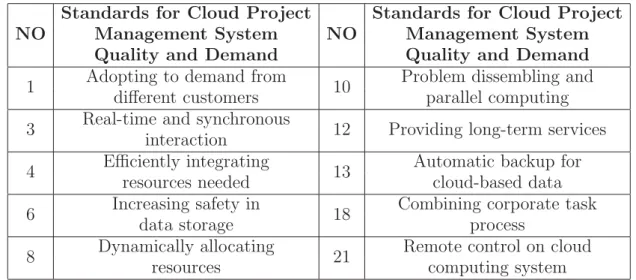
quality. The demand guidelines of cloud-based project management system quality for the final cases are compiled, as shown in Table 2.
Table 2. The demand for cloud-based project management system quality
NO
Standards for Cloud Project NO
Standards for Cloud Project
Management System Management System
Quality and Demand Quality and Demand
1 Adopting to demand from 10 Problem dissembling and different customers parallel computing 3 Real-time and synchronous 12 Providing long-term services
interaction
4 Efficiently integrating 13 Automatic backup for resources needed cloud-based data 6 Increasing safety in 18 Combining corporate task
data storage process
8 Dynamically allocating 21 Remote control on cloud
resources computing system
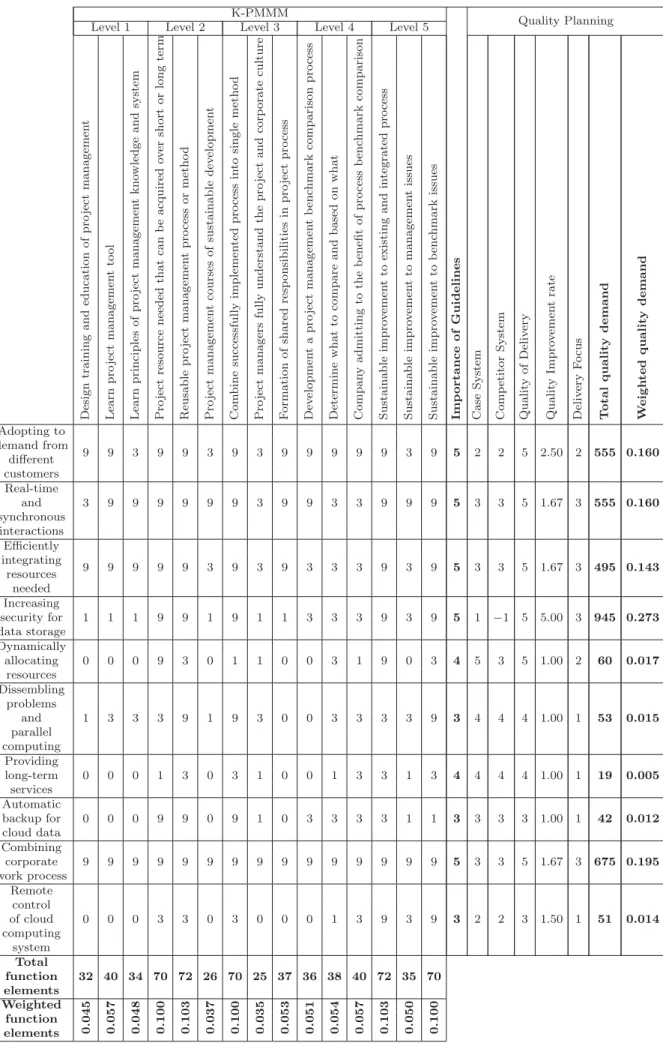
To define the demand guidelines and weighted PMMM process of the cloud-based project management system, the weighted demand quality and weighted quality func-tion elements are computed as shown in Figure 4.
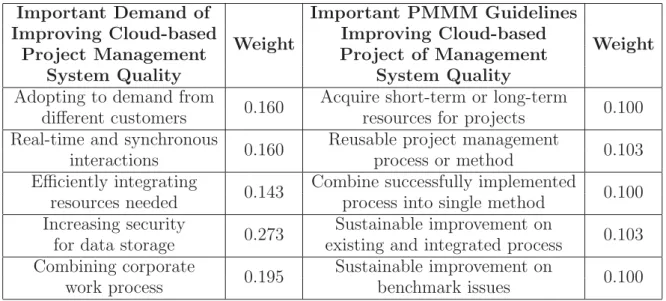
The study weights the weighted quality function elements of the 5 demand guidelines and the project management process with higher weights, with the results shown in Table 3.
The case lists “system availability” and “system response efficiency” as the most impor-tant quality measurement indicators. The case underwent system reengineering in 2009 and again in 2010 using cloud computation through interview, the computation system availability and system response efficiency are compared as shown in Tables 4 and 5.
The various system quality indicators and the cloud project management system quality have improved upon data compilation, and the automatic and manual system recovery time has been reduced by 238.6 hours. The average monthly system test response time exceeding 10 seconds shows significant reduction. The overall system response efficiency has substantially improved and the overall system availability has significantly increased. 5. Conclusion and Recommendation. The case cloud project management system in-tegrates demand guidelines of cloud-based operating system with QFD and QFD-PMMM
K-PMMM
Quality Planning
Level 1 Level 2 Level 3 Level 4 Level 5
Design training and education o f p ro ject managemen t Learn p ro ject managemen t to ol Learn p rinciples of pro ject managemen t kno w ledge and system Pro ject resource needed that can b e a cquired o v e r short o r long term Reusable p ro ject managemen t pro cess o r m etho d Pro ject managemen t courses o f sustainable d ev elopmen t Com b ine successfully implemen ted pro cess in to single m etho d Pro ject managers fully understand the p ro ject and corp orate c ulture F o rmation o f shared resp onsibilities in p ro ject pro cess Dev e lopmen t a pro ject managemen t b e nc hmark c omparison p ro cess Determine what to compare and based on what Compan y admitting to the b enefit o f p ro cess b enc h mark comparison Sustainable impro v e men t to existing and in tegrated pro cess Sustainable impro v e men t to managemen t issues Sustainable impro v e men t to b e nc hmark issues Imp o rtance of Guidelines Case System Comp etitor S ystem Qualit y o f D eliv ery Qualit y Impro v e men t rate Deliv ery F o c us T o tal q ualit y d emand W e igh t ed qualit y d emand Adopting to
9 9 3 9 9 3 9 3 9 9 9 9 9 3 9 5 2 2 5 2.50 2 555 0.160
demand from different customers Real-time
3 9 9 9 9 9 9 3 9 9 3 3 9 9 9 5 3 3 5 1.67 3 555 0.160
and synchronous
interactions Efficiently
9 9 9 9 9 3 9 3 9 3 3 3 9 3 9 5 3 3 5 1.67 3 495 0.143
integrating resources
needed Increasing
1 1 1 9 9 1 9 1 1 3 3 3 9 3 9 5 1 −1 5 5.00 3 945 0.273
security for data storage Dynamically
0 0 0 9 3 0 1 1 0 0 3 1 9 0 3 4 5 3 5 1.00 2 60 0.017
allocating resources Dissembling
1 3 3 3 9 1 9 3 0 0 3 3 3 3 9 3 4 4 4 1.00 1 53 0.015
problems and parallel computing
Providing
0 0 0 1 3 0 3 1 0 0 1 3 3 1 3 4 4 4 4 1.00 1 19 0.005
long-term services Automatic
0 0 0 9 9 0 9 1 0 3 3 3 3 1 1 3 3 3 3 1.00 1 42 0.012
backup for cloud data Combining
9 9 9 9 9 9 9 9 9 9 9 9 9 9 9 5 3 3 5 1.67 3 675 0.195
corporate work process
Remote
0 0 0 3 3 0 3 0 0 0 1 3 9 3 9 3 2 2 3 1.50 1 51 0.014
control of cloud computing
system
Total
32 40 34 70 72 26 70 25 37 36 38 40 72 35 70 function
elements Weighted
0.045 0.057 0.048 0.100 0.103 0.037 0.100 0.035 0.053 0.051 0.054 0.057 0.103 0.050 0.100
function elements
Figure 4. Cases cloud-based project management system quality model
Table 3. Weights for improving cloud-based project management system quality
Important Demand of
Weight
Important PMMM Guidelines
Weight
Improving Cloud-based Improving Cloud-based
Project Management Project of Management
System Quality System Quality
Adopting to demand from
0.160 Acquire short-term or long-term 0.100 different customers resources for projects
Real-time and synchronous
0.160 Reusable project management 0.103 interactions process or method
Efficiently integrating
0.143 Combine successfully implemented 0.100 resources needed process into single method
Increasing security
0.273 Sustainable improvement on 0.103 for data storage existing and integrated process
Combining corporate
0.195 Sustainable improvement on 0.100
work process benchmark issues
Table 4. Case system availability comparison (chart in 2009 and 2010)
Year 2009 2010
Month Jan Feb Mar Apr May Jun Jul Aug Sep Oct Nov Dec Jan Feb Mar
Operating
44640 40320 44640 43200 44640 43200 44640 44640 43200 44640 43200 44640 44640 40320 44640 Minutes/
Month (F) Repairing
15264 15218 15345 12335 13578 15332 14538 15660 14335 12564 13633 14623 30 20 3
Minutes/ Month (R) System
A-0.6581 0.6226 0.6563 0.7145 0.6958 0.6451 0.6743 0.6492 0.6682 0.7185 0.6844 0.6724 0.9993 0.9995 0.9999 vailability
of the M-onth (A) Average
0.6716 0.9996
System Availabi-lity/Year
Table 5. Case system response efficiency comparison (chart in 2009 and 2010)
Year 2009 2010
Month Jan Feb Mar Apr May Jun Jul Aug Sep Oct Nov Dec Jan Feb Mar
Number
3734 3836 4438 4353 4347 4242 3838 3341 3444 3498 3454 3522 0 0 0
of system testing
more than 10 seconds(S)
/Month Total
8928 8064 8928 8640 8928 8640 8928 8928 8640 8928 8640 8928 8928 8064 8928
number of test(T)/
Month Efficiency
0.5818 0.5243 0.5029 0.4962 0.5131 0.5090 0.5701 0.6258 0.6014 0.6082 0.6002 0.6055 1.0000 1.0000 1.0000 of the
system response
(E) Average
0.5615 1.0000
Efficiency of the system response/
quality model, in order to facilitate the quality improvement guidelines of case cloud project management system in the deployment of PMMM process. The analysis of qual-ity model is obtained as an important implementation reference for improving qualqual-ity in cloud-based project management system. The study probes into QFD from the perspec-tive of cloud-based project management system to produce the deployment table. The cloud-based project management system are clearly integrated with the orientation and focus of project management, clearly and quantitatively highlighting the key tasks and weights of cloud-based project management system through simple approach for model construction in a short time. This study provides values and contribution to the aver-age small and medium enterprise systems in terms of reference in applications related to cloud-based project management system.
Acknowledgements. Financial support of this research by the National Science Council, Taiwan (NSC 99-2622-H-036-001-CC3) and Tatung University (B99-N05-067).
REFERENCES
[1] D. I. Cleland,Project Management: Strategic Design and Implementation, Asia Project Management Consultant Inc., 2005.
[2] Cloud Concepts and Applications: Next-Generation Email Security, http://www.cellopoint.com/tw/ solution/cellocloud, Cellopoint, 2010.
[3] F. Xhafa and J. Carretero, Genetic algorithm based schedulers for GRID computing systems, In-ternational Journal of Innovative Computing, Information and Control, vol.3, no.5, pp.1053-1071, 2007.
[4] N. Moghim, S. M. Safavi and M. R. Hashemi, Performance evaluation of a new end-point admission control algorithm in NGN with improved network utilization, International Journal of Innovative Computing, Information and Control, vol.6, no.7, pp.3067-3080, 2010.
[5] F.-T. Lin and T.-S. Shih, Cloud computing: The emerging computing technology, ICIC Express Letters, Part B: Applications, vol.1, no.1, pp.33-38, 2010.
[6] C.-Y. Chen and M.-H. Cheng, Open architecture design of embedded controller for industrial com-munication gateway,ICIC Express Letters, Part B: Applications, vol.1, no.1, pp.51-56, 2010. [7] M. Michael,Cloud Computing: Web-Based Applications That Change the Way You Work and
Col-laborate Online, Gotop Information Inc., 2009.
[8] Robert,Oracle and Intel Join Hands for Accelerating Development in Enterprise-Class Cloud Com-puting, http://www.oracle.com/global/hk/corporate/chi/press 080925-03.html, Oracle, 2008. [9] R. Z. Tang,Five Major Problems Still Exist in Cloud Computing Deployment, http://www.bnext.
com.tw/LocalityView 8730, 2009.
[10] W. Wang,Introduction and Development Trend in Cloud Computing, http://opm.twnic.net.tw/cloud /doc/1.pdf, 2010.
[11] W. Mong,PMIS for Cloud Service, http://www.mt.com.tw/091016-cloudepaper.htm, 2009.
[12] J. Miyoung, Quality function deployment: An extended framework for service quality and customer satisfaction in the hospitality industry,Hospitality Management, vol.17, no.2, pp.375-390, 1998.