
Hubble: Linked Data Hub for Clinical Decision
Support
Rinke Hoekstra1,3, Sara Magliacane1 Laurens Rietveld1, Gerben de Vries2, Adianto Wibisono2, and Stefan Schlobach1
1 Department of Computer Science, VU University Amsterdam, The Netherlands
{rinke.hoekstra,s.magliacane,laurens.rietveld,k.s.schlobach}@vu.nl
2 Department of Computer Science, University of Amsterdam, The Netherlands
{g.k.d.devries,a.wibisono}@uva.nl
3 Leibniz Center for Law, University of Amsterdam, The Netherlands
Abstract. The AERS datasets is one of the few remaining, large pub-licly available medical data sets that until now have not been published as Linked Data. It is uniquely positioned amidst other medical datasets. This paper describes the Hubble prototype system for clinical decision support that demonstrates the speed, ease and flexibility of producing and using a Linked Data version of the AERS dataset for clinical practice and research.
Keywords: linked data, adverse event, clinical decision support, health care
Introduction
This paper describes a prototype system for clinical decision support, Hubble, that demonstrates the ease with which (medical) legacy data can be turned into RDF, linked to other data sets, and used to support both clinical research and clinical practice. At the heart of the system lies a Linked Data version of the Adverse Event Reporting System (AERS) dataset of the Federal Drug Ad-ministration (FDA). To some extent, this exercise can be categorised under the heading ‘yet another exposing of data as Linked Data’. However, the system convincingly demonstrates three importantsales pitches of Linked Data: inter-operability, interlinking, and tool availability. In particular, the system shows the huge difference inusability between the original ‘dead’ dataset and the ‘live’ Linked Data version, it shows how quickly this can be achieved using standard tools, and itvalidates the standard three-tier architecture that separates data, application logic and presentation. We validate the quality of the dataset by comparing it to results of a real use-scenario on the AERS dataset.
Clinical Decision Support Clinical decision support (CDS) can be defined as “the use of the computer to bringrelevant knowledge to bear on the health care and well being of a patient”[2]. Clinical guidelines play a central role in CDS systems; they contain the consolidated knowledge on patient treatment. How-ever, guidelines are slow movers, decided upon in periodic conferences where
new evidence is weighed for updating a guideline document. The evidence itself, however, accumulates at a tremendous pace: there are numerous clinical trials and well over 10 thousand publications on breast cancer every year. Therefore, a CDS should bring together patient information, relevant guidelines and impor-tant new findings in clinical research. In this context, the key challenge is: how to ensure that the information presented by the CDS is relevant and trustworthy? The Data The fields of health care and life science (HCLS) have tradition-ally seen a lot of attention from the Semantic Web community, and vice versa: semantic web languages, and their predecessors have proven to be a convenient paradigm for representing biomedical knowledge. Vocabularies in the HCLS field are highly standardised; computer analysis, and computer-based information ex-change are ubiquitous throughout the field (viz. the Humanities). As a result, many (bio)medical databases and terminologies are now published as linked data, taking up about a fourth of the Linked Data cloud. Examples are medical vocabularies such as SnomedCT, MeSH, MedDRA, and the NCI Thesaurus (all part of the Unified Medical Language System (UMLS)),4 and datasets such as LinkedCT (clinical trials), Sider, Drugbank and RxNorm (drug information), Uniprot (protein sequences), to name but a few.
The AERS datasets is one of the few remaining, large publicly available medical data sets that until now have not been published as Linked Data. An adverse event (AE) is an adverse change in health or side effect while the patient is receiving treatment. A serious adverse event (SAE) is life-threatening and, amongst others, may result in death, requires hospitalisation or prolongation of existing hospitalisation and will result in persistent or significant disability or incapacity. Known chemotherapy-related SAEs in breast cancer (US only) were linked to 22% of hospitalisations. Clearly, from a clinical perspective, serious adverse events are very important: this is where CDS can make a huge difference.
System Description
The architecture of Hubble follows a three tiered architecture: a) a 4Store triple store,5containing the AERS dataset (AERS-LD), CTCAE,6a selection of DBPe-dia, Sider, and Drugbank.7; b) a set of SPARQL 1.1 queries and some server-side code; and c) a Java Smart GWT framework client interface.8This section briefly discusses the way weconvert andlinkdata,annotatedocuments andpresent the result to a user.
Data Conversion & Linking The AERS data files are published on a quarterly basis, as zip files containing dollar separated tables. These zip files are roughly
4
Seehttp://www.nlm.nih.gov/research/umls/.
5 Seehttp://4store.org. 6
CTCAE, subset of MedDRA, lists AEs for cancer therapy:http://bit.ly/zOVPUt.
7 See http://dbpedia.org, http://www4.wiwiss.fu-berlin.de/sider/ and http:
//www4.wiwiss.fu-berlin.de/drugbank/, respectively
8
20MB in size, and available from the FDA website from two separate static web-pages.9 Converting this data is a five step process: 1) scrape the FDA website, download and unzip the data dump; 2) check integrity of the files, applying fixes if necessary;10 3) import the data into a MySQL database; 4) dump the data to RDF following a D2RQ mapping;11 and 5) import the data into 4Store.12 This conversion was implemented as a pipeline called through a Python prove-nance wrapper. This wrapper generates proveprove-nance information expressed in the PROV-O vocabulary.13 Due to hardware limitations we had to restrict the dataset to the years 2011 and 2012 (first two quarters), resulting in a total size of 80M triples.
The AERS dataset is uniquely positioned amidst other HCLS datasets, pro-viding opportunities for linking to drug, location, patient and diagnosis related information. Furthermore, reports in AERS are filled in by hand. Linking out to other datasets could help in identity reconciliation (e.g. drug names, marketing names, and chemical substances) as well as detecting misspellings (e.g. in man-ufacturer names). We specified mappings between the UMLS, Sider, LinkedCT, Drugbank, DBPedia and CTCAE datasets using the SILK link specification lan-guage [4], resulting in over 60K links basedonly on exact string matches.14 Annotations Step two is the automatic annotation of scientific publications and clinical guidelines (available as PDF files) using the vocabularies in the repos-itory. This process has three steps: stripping of PDF documents to plain text, indexing the plain text documents andgeneratingannotations. We use the PDF-Box library15 for conversion to plain text. Each document is then divided into separate paragraphs, dubbed ‘chunks’. For each chunk we store the coordinates of its bounding box in the PDF. The chunks are then indexed for terms (includ-ing synonyms) from the CTCAE ontology, us(includ-ing Lucene.16
The Annotation Ontology (AO) is a vocabulary for annotating scientific pub-lications and documents on the Web. AO has a lightweight provenance model, which allows storing information about the authors, curation and different ver-sions for each annotation. We use the AO format [1] to represent an annotation for every term found, using aprefix-postfix selector to identify its position inside a chunk. The advantage of using this method is that annotations will persist across different manifestations of the same document (pdf, html, xml, etc.). We store an image selector that uses the chunk bounding box: this image selector is then used to highlight part of the PDF document.
9
Seehttp://1.usa.gov/uyoAI.
10For instance, some rows contain line breaks in the wrong places, do not properly
escape the separator character or span fewer columns than expected.
11Seehttps://github.com/cygri/d2rq 12
Unfortunately, exposing through D2R Server turned out to be too slow.
13PROV-O-Matic, see http://github.com/Data2Semantics/, currently in alpha
stages of development. PROV-O: Seehttp://www.w3.org/TR/prov-o/.
14Using less exact matching on drug names can have unwanted consequences. 15
Seehttp://pdfbox.apache.org/.
16
(a) (b)
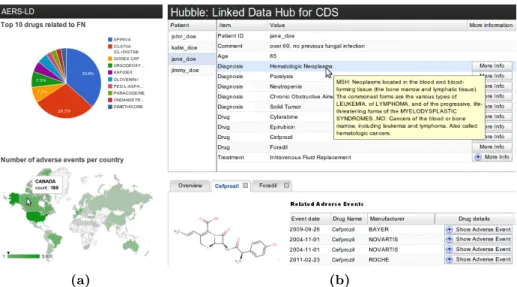
Fig. 1:Examples of possible visualisations (a) and Hubble interface (b)
User Interface The Hubble interface is our prototype CDS system.17 It lists patients, shows information about a selected patient, and presents more de-tailed information about specific parts of the patient information to the bottom (Fig. 1b). This is done in several steps, each consisting of a single SPARQL query. First, we retrieve a list of available patient records. Second, when the user selects a record we retrieve actual patient data: detailed patient information (diagnoses, drugs, age, etc.), enriched with information from the Linked Life Data (LLD) endpoint (e.g. a drug description tooltip).18At the same time, we retrieve anno-tations that match the patient description, and depict small snippets of clinical guidelines and relevant literature. We can drill-down from this detailed informa-tion to: more informainforma-tion about adiagnosis (taken from LLD), similarcases in AERS-LD,drug information such as its chemical structure (from LLD and Dru-gank) and common AEs related to the drug, provenance information about an annotation, and the underlying text. We have intentionally limited the amount and diversity of information presented through the interface, pending feedback from expert users.
The AERS-LD repository is publicly accessible through its SPARQL end-point, and can be browsed through a customised Pubby browser interface.19 Arguably a more actionable presentation than dollar-separated files. The end-point turned out to be very well suited for various visualisations of the underlying data (Fig. 1a).20
17Seehttp://aers.data2semantics.org/prototypeInterface. 18
Seehttp://linkedlifedata.com.
19Seehttp://aers.data2semantics.orgfor more information. Pubby:http://www4.
wiwiss.fu-berlin.de/pubby/.
20
Fig. 2: Number of co-occurrences of Adverse Events and 5-FU (Y-axis). The X-axis represents the ranking of AEs based on the one in [3].
Evaluation and Discussion
The Hubble CDS prototype was built in a very short period (literally over Christ-mas), and is already showing real potential for clinical research. We validated the dataset by comparing results from AERS-LD with a study into the co-occurrence of AEs with two drugs (5-FU and Capecitabine) [3]. This study was preceded by a labor intensive effort to clean the dataset: consolidation of multiple names for drugs and removal of duplicate submissions and non-drug entries. We compared AE-drug co-occurrence on the same selection of AEs in [3] with and without taking advantage of the 60K links (see above) in AERS-LD. We did not apply any other data cleaning or harmonisation and used only a limited dataset. The result, depicted in Fig. 2, although far from perfect, shows that the Linked Data cloud provides a huge bootstrap for improving the quality of results.
Future work includes publishing the full AERS-LD dataset (all 7 years), in-creasing both the breadth and depth of annotations through supervised annota-tion of guidelines, combined with large scale annotaannota-tion of scientific publicaannota-tions, improving selection and ranking of query results in the Hubble interface based on annotations, citation indexes, and provenance related information.
References
1. Ciccarese, P., et al.: An open annotation ontology for science on web 3.0. Journal of biomedical semantics (2011)
2. Greenes, R.A.: Clinical Decision Support: The Road Ahead. AP/Elsevier Science and Technology (January 2007)
3. Kadoyama, K., et al.: Adverse event profiles of 5-Fluorouracil and Capecitabine: Data mining of the public version of the FDA adverse event reporting system, AERS, and reproducibility of clinical observations. Ing. J. Med. Sci. 9, 33–39 (2012) 4. Volz, J., Bizer, C., Gaedke, M., Kobilarov, G.: Silk – a link discovery framework for the web of data. In: 2nd Workshop about Linked Data on the Web (LDOW2009)
![Fig. 2: Number of co-occurrences of Adverse Events and 5-FU (Y-axis). The X- X-axis represents the ranking of AEs based on the one in [3].](https://thumb-us.123doks.com/thumbv2/123dok_us/8652017.2336862/5.918.254.669.178.316/fig-number-occurrences-adverse-events-represents-ranking-based.webp)
