There is no need for time-consuming interface programming, since GBOS solves the definition of the business objects of relevance to the com-munication via simple parameterisation. This is performed with the aid of a graphically sup-ported definition tool, the Business Object Designer (BOD). With this tool, GBOS provides a high-performance and easily configurable work-ing environment for definition, administration and clearly laid-out documentation of communi-cation objects managed in the GBOS repository. SAP® certification of the reference scenario with GBOS
CeGIT and CSC have developed a reference scen-ario for the support of the house connection pro-cess for the GIS Business Object Service (GBOS) for EAI-based integration of GIS and SAP®. This scenario has been certified by SAP as XI content for integration with SAP XI 3.0 and covers the following system components:
1. The integration platform SAP-XI with mapping of the integration process (XI content)
2. GBOS – for interfacing all types of GI systems to SAP-XI and provision of the communication objects necessary for the process
3. SAP R/3 – in which the mapping of the corre-sponding PM system structure takes place fully automatically as the basis for maintenance and order/task handling via the integration process in SAP XI
The solution
GBOS, together with the specialist CeGIT know-how, ensures that integration projects are implemented more simply in companies and can also be started more easily, thus creating cost-effective and efficient company processes. CeGIT provides extensive support for the intro-duction and use of GBOS:
• An option of presenting already implemented and tested integration scenarios in live pres-entations, and templates for evaluation of the performance using the existing process rules and standards
• Mapping of the desired process via represen-tation on a reference system (Proof of Concept) • Implementation of pilot GBOS applications
for estimation of the effort involved prior to the implementation
• Support during the inclusion and definition of processes
• Inclusion of already implemented interfaces and defined objects
• Support during the process modelling (customizing, settings)
• Provision of training for the company’s staff • Continuous further development of GBOS and
introduction of further service modules
Note: SAP® and R/3 are registered trademarks of SAP AG.
Other trademarks referred to (e.g. kVASy and WebSphere) are registered trademarks of the respective manufacturers.
GBOS
SAG GmbH CeGIT Stockholmer Allee 30b 44269 Dortmund Germany T +49 231 725488-0 F +49 231 725488-13 E [email protected] I www.sag.eu/cegit SAG_6S-GBOS_10/2012_EN
GIS Business Object Service
Applications2 GBOS
GBOS – the universal tool for integration
of GIS into business processes
The heterogeneous nature of today’s application landscapes makes integration of operational information systems an essential task of IT departments. If integrated use of geographical data in your network management processes is as important as the avoidance of inconsistencies and duplicate data entry and maintenance, you can achieve this simply and stepwise with GBOS.
Your partner
for energy
infrastructure
The SAG Group is the leading partner for the energy related infrastructure of public utilities and industrial companies. SAG provides manufacturer-independent services and systems for the generation, transmission and distribution of electricity, gas, water and telecommunication networks. Approx. 8,500 employees generated revenue of around € 1.2 Billion. SAG is present nationwide in Germany with over 120 locations and with subsidiaries in France, Poland, Hungary, Czechia and Slovakia.
3
GBOS – the universal tool for integration
of GIS into business processes
The GIS Business Object Service (GBOS) is a sys-tem and manufacturer-independent integration tool that supports process-oriented integration solutions in a distributed system landscape. Based on Service-Oriented Architecture (SOA) standards, it is an easily configurable functional package for the transmission, assignment and forwarding of object-related data and methods. With this functional package, GBOS provides previously unavailable functions that are necess-ary for efficient integration of geo-information systems for cross-system automation and opti-misation of spatially oriented business processes in conjunction with ERP systems such as SAP®. Information from other applications such as fleet management, workforce management, network calculation or network management systems can be integrated into the business processes in the same way.
This opens up a capability for cross-system use of data to support and control company-specific business processes.
Possible application areas for implementing integrated business processes
Thanks to its open and scalar architecture, GBOS can easily be implemented as an integration tool in a company’s existing system architecture. The solution is particularly suitable for:
• Supply and disposal companies who use geographical data and information in their day-to-day work (e.g. in the management of their transport and distribution networks)
• Companies who use ERP systems such as SAP R/3 or kVASy for their business management processes (e.g. for customer management, cal-culation, planning and maintenance)
• Companies who already use GIS-ERP interfaces with limited functionality for specific processes and who now wish to enhance the
support available for their business processes GBOS offers significant advantages for companies The use of GBOS for the integration of business processes provides many advantages for companies:
• Neutrality and investment protection thanks to support of the existing ERP/SAP and GI systems • Integration of existing and other relevant IT
applications and data
• A faster ROI thanks to simple graphical parameterisation rather than system-specific programming
• Use of standard protocols
• Scalable use for all supply companies (e.g. public utility companies, integrated network operators)
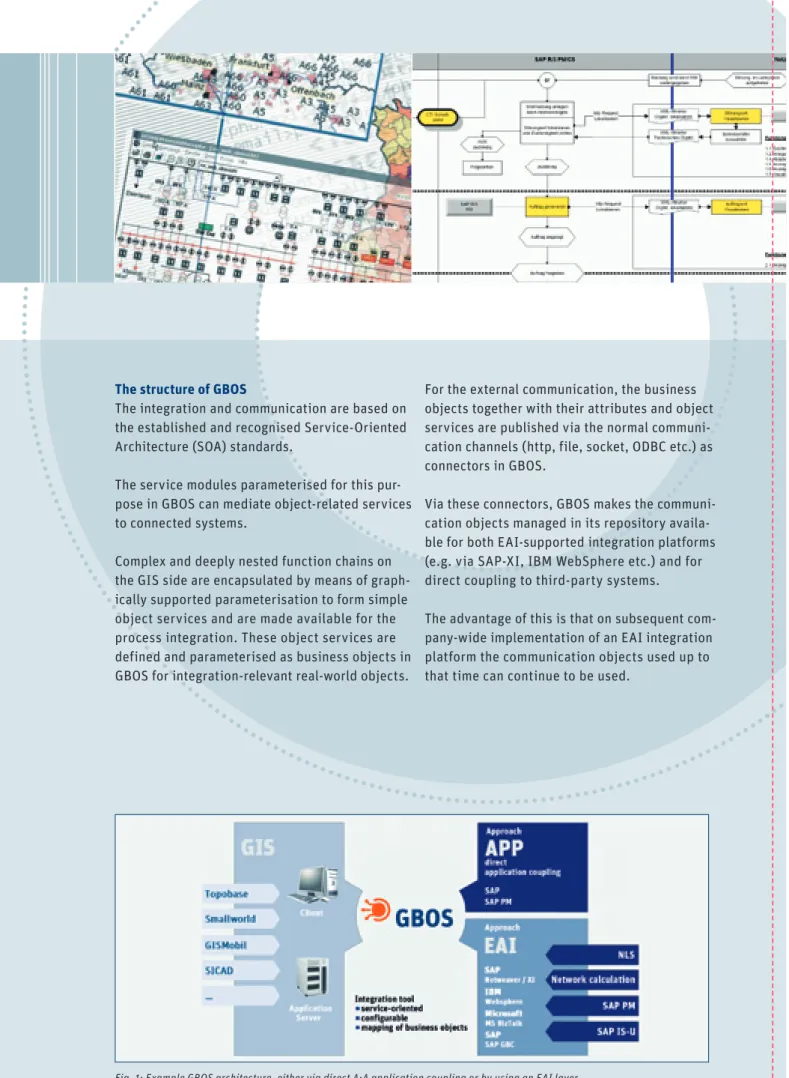
• Flexibility thanks to direct application coupling or interfacing to an EAI platform (see Fig. 1) • Integration in “small steps”
• Comprehensive support of the SAP NetWeaver platform by means of SAP-certified reference processes using SAP-XI
The structure of GBOS
The integration and communication are based on the established and recognised Service-Oriented Architecture (SOA) standards.
The service modules parameterised for this pur-pose in GBOS can mediate object-related services to connected systems.
Complex and deeply nested function chains on the GIS side are encapsulated by means of graph-ically supported parameterisation to form simple object services and are made available for the process integration. These object services are defined and parameterised as business objects in GBOS for integration-relevant real-world objects.
For the external communication, the business objects together with their attributes and object services are published via the normal communi-cation channels (http, file, socket, ODBC etc.) as connectors in GBOS.
Via these connectors, GBOS makes the communi-cation objects managed in its repository availa-ble for both EAI-supported integration platforms (e.g. via SAP-XI, IBM WebSphere etc.) and for direct coupling to third-party systems.
The advantage of this is that on subsequent com-pany-wide implementation of an EAI integration platform the communication objects used up to that time can continue to be used.
Fig. 1: Example GBOS architecture, either via direct A:A application coupling or by using an EAI layer
GBOS