Cover Page
The handle
http://hdl.handle.net/1887/50156
h
olds various files of this Leiden University
dissertation.
Author:
Dimov, D.W.
Title:
Crowdsourced online dispute resolution
Dispute Resolution
PROEFSCHRIFT
ter verkrijging van
de graad van Doctor aan de Universiteit Leiden,
op gezag van Rector Magnificus prof. mr. C.J.J.M. Stolker, volgens besluit van het College voor Promoties
te verdedigen op dinsdag 27 juni 2017 klokke 16.15 uur
door
Daniel Velizarov Dimov
geboren te Tutrakan, Bulgarije
Prof. dr. A. R. Lodder (Vrije Universiteit Amsterdam)
Promotiecommissie: Prof. dr. N. J. H. Huls
Prof. dr. O. Rabinovich (University of Haifa, Israel) Prof. dr. H. B. Verheij (Rijksuniversiteit Groningen) Prof. dr. J. Zeleznikow (Victoria University, Melbourne, Australia)
Mr. dr. ir. B. H. M. Custers
eLAW - Leiden University Center for Law and Digital Technologies
SIKS Dissertation series no. 2017-17. The research reported in this thesis has been caried out under the auspicies of SIKS, the Dutch Research School for Information and Knowledge Systems.
Lay-out: AlphaZet prepress, Waddinxveen Printwerk: Ipskamp Printing
ISBN 978-94-028-0578-9
© D.V. Dimov 2017
In the dawn of the Internet era, I succeeded to buy an expensive computer. I started providing it to other people in return for a small fee. Later, at the age of 16, I bought 7 new computers and made an Internet cafe in the garage of my parents. During my work at the Internet cafe, I became familiar with the Internet. In these times, I learned about programming, web design, hacking, Linux, and other computer activities. Then, I registered myself as a law student in the former Technical University of Ruse (now University of Ruse). In Bulgaria, the Internet and law are two distant things. I really want-ed to connect them, but in the University of Ruse there were neither experts in IT law, nor experts in a related discipline. I did not achieve the union of my interests and went to the Netherlands where I studied European law at the Radboud University Nijmegen.
In the Netherlands, I was pleased to learn about the Center for Law in the Internet Society at the Leiden University. After a meeting with prof. dr. Jaap van den Herik, I found the interesting topic of “Crowdsourced Online Dispute Resolution (CODR)”. I was particularly attracted to this topic by the fact that it requires research not only in field of Internet law, but also in the field of philosophy. For instance, during the research, I felt myself close to Plato’s idea for collective organisms and to Jung’s idea for collective con-sciousness.
I firmly believe in the future of CODR. I also believe that justice should be free, fast, and available to everyone. Please do not understand me wrong-ly; I know that expertise cannot be provided always for free. However, even if CODR can resolve fairly only some kinds of disputes (1) for lower cost than the costs, which need to be paid for traditional dispute resolution, and (2) faster than the traditional dispute resolution, it would be a great success.
Daniel Dimov
Preface V
Acknowledgements VII
List of Figures XII
List of Tables XIII
List of Cases XIV
List of Definitions XV
List of current CODR providers XVI
List of Abbreviations XVII
1 Introduction 1
1.1 Three disadvantages of traditional dispute resolution
mechanisms 4
1.2 eBay’s Community Review Forum 5
1.3 Problem statement 7
1.4 Three research questions 8
1.5 Research goal and research methodology 9
1.6 Structure of the thesis 11
2 Literature review 13
2.1 Literature review on crowdsourcing 13
2.1.1 Crowdsourcing in general 13
2.1.2 Crowdsourcing in the field of law 29
2.2 Literature review on Online Dispute Resolution (ODR) 30
2.2.1 Definitions of ODR 30
2.2.2 Typologies 35
2.2.3 Benefits of ODR 39
2.2.4 Drawbacks of ODR 40
2.3 Literature review on CODR 41
2.4 Chapter summary 43
3 Analysing existing CODR procedures 45
3.1 Online opinion polls 45
3.2 Online mock jury systems 53
3.3 Arbitration tribunals rendering self-enforceable decisions 63
4 A framework for CODR 71
4.1 The four building blocks of the Malone framework 71
4.2 The Crowd 74
4.2.1 Type of entity 75
4.2.2 Diversity 76
4.2.3 Governance of the crowd 76
4.2.4 Temporality of the crowd 78
4.3 Incentives 78
4.4 Two broad categories of disputes to be resolved through CODR 82
4.4.1 Online Disputes 82
4.4.2 Offline Disputes 90
4.5 The CODR procedures 91
4.5.1 Parties 91
4.5.2 Stages of CODR 94
4.5.3 Characteristics of CODR procedures 99
4.6 Chapter summary 105
5 Our interpretation of procedural fairness 107
5.1 Objective procedural fairness 108
5.1.1 Expertise 109
5.1.2 Independence 109
5.1.3 Impartiality 111
5.1.4 Transparency 111
5.1.5 Fair hearing 113
5.1.6 Counterpoise 114
5.1.7 Ensuring a reasonable length of procedure 115
5.1.8 Providing reasons 115
5.1.9 Voluntary participation 116
5.2 Subjective procedural fairness 117
5.2.1 Process control 118
5.2.2 Decision control 119
5.2.3 Consistency 120
5.2.4 Accuracy 121
5.2.5 Correctability 122
5.2.6 Ethicality 122
5.3 Our interpretation of procedural fairness 123
5.4 Chapter summary 125
6 Procedural fairness of CODR procedures 127
6.1 Selection of three CODR procedures 127
6.1.1 Selection of a CODR procedure representing online
opinion polls 128
6.1.2 Selection of a CODR procedure representing online
mock jury systems 130
6.1.3 Selection of CODR procedures representing arbitration
6.2 Analysis of compliance with our interpretation 132 6.2.1 The compliance of iCourthouse with our interpretation 132
6.2.2 The compliance of Jurytest with our interpretation 137
6.2.3 The compliance of the ECRF with our interpretation 140
6.2.4 Section summary 146
6.3 Chapter summary 147
7 A model of a fair CODR procedure 149
7.1 The composition of the model 149
7.1.1 Expertise 149
7.1.2 Independence 150
7.1.3 Impartiality 151
7.1.4 Transparency 152
7.1.5 Fair hearing 153
7.1.6 Counterpoise 155
7.1.7 Ensuring a reasonable length of procedure 156
7.1.8 Providing reasons 156
7.1.9 Voluntary participation 157
7.1.10 Process control 157
7.1.11 Decision control 158
7.1.12 Consistency 158
7.1.13 Accuracy 162
7.1.14 Correctability 163
7.1.15 Ethicality 164
7.2 Chapter summary 164
8 Conclusions and future research 167
8.1 Answers to the research questions 167
8.2 Answer to the problem statement 168
8.3 Contributions 169
8.4 Future research 170
References 175
Summary 191
Samenvatting 193
Summary in Bulgarian 195
Publications 197
Curriculum Vitae 199
Figure 1. A screenshot of a task published on Amazon’s Mechanical Turk 16
Figure 2. A task published on InnoCentive 18
Figure 3. Case Number 2005-11320 published on iCourthouse.com 47
Figure 4. A screenshot of SideTaker 49
Figure 5. A screenshot of a comment of an Internet visitor in relation
to case 47048 posted on PeopleClaim 50
Figure 6. A screenshot of eJury 54
Figure 7. A notice of open call published by eJury 56
Figure 8. A notice of open call published by Jurytest 58
Figure 9. An excerpt of a verdict published by OnlineVerdict.com 59
Figure 10. A screenshot of TrialJuries 61
Figure 11. A screenshot of the eBay’s Community Court (an early
version of the ECRF) 66
Figure 12. A screenshot of Marktplaats Gebruikersjury 68
Figure 13. A screenshot of the crowdsourcing application ESP 80
Figure 14. A screenshot of feedback posted by customers of a company
selling books on Amazon.co.uk 84
Figure 15. A list of freelancers in Elance.com, including the rating
received by those freelancers 84
Figure 16. A virtual arbitration room of the arbitration center created
by the Portuguese government in Second life 89
Figure 17. Parties in CODR procedures 92
Figure 18. A complaint form used by PeopleClaim 95
Figure 19. A notice sent by iCourthouse to the defendant 133
Figure 20. A screenshot of casetext.com 154
Figure 21. A screenshot of the case search interface of iCourthouse 159 Figure 22. A screenshot of the case search interface of the Arbitration
center for Internet disputes of the Czech Arbitration Court 160 Figure 23. A screenshot of an interface window of the platform
Table 1. Four interrelations between three taxonomies 19 Table 2. The characteristics of the three types of past and present
CODR procedures 104
Table 3. Assessment of CODR procedures that function as online opinion polls in accordance with two criteria, namely, availability of documents explaining the examined procedures and the use of adjudication for resolving
disputes 128
Table 4. Assessment of CODR procedures that function as online mock jury systems in accordance with one criterion, namely,
the use of adjudication for resolving disputes 129
Table 5. Assessment of CODR procedures that function as arbitration tribunals rendering self-enforceable decisions in accordance with two criteria, namely, availability of documents explaining the examined procedures and the use of adjudication for
resolving disputes 131
Table 6. Findings of the assessment of iCourthouse, JuryTest, and the ECRF with our interpretation of procedural fairness
I. European court of Human Rights Bulut v. Austria (1996) 24 EHRR 84 Foucher v. France (1997) 25 EHRR 234 H v. Belgium (1987) 10 EHRR 339 Hentrich v. France (1994) 18 EHRR 440 Klimentyev v. Russia (2009) 49 EHRR 14
Le Compte, Van Leuven And De Meyere v. Belgium (1981), 4 EHRR 1 Suominen v. Finland (2003), ECHR 330
II. United Kingdom
R v. Bow Street Stipendiary Magistrate ex parte Cherry [1990] 91 Cr App R 283
III. United States
Cheney v. U.S. Dist. Court for Dist. Of Columbia, 542 U.S. 367 (2004)
IV. iCourthouse
Case No. 2006-11582 Case No. 2006-11578 Case No. 2007-11593 Case No. 2007-11596 Case No. 2008-11618 Case No. 2012-11652
CODR CODR is a term that encompasses some forms of ADR and court proceedings using the Internet and crowdsourcing as parts of the dispute resolution process.
Collective decision “A collective decision occurs when members of a
collectivity make individual decisions that they would not make if the other members of the lectivity were not making related decisions. A col-lective decision thus entails coordination of inten-tions” (Tideman, 2006, p.5).
Crowdsourcing Crowdsourcing is “the act of a company or institution
taking a function once performed by employees and outsourcing it to an undefined (and generally large) network of people in the form of an open call.”
Due process Due process refers to fundamental procedural legal
safeguards of which every citizen has an absolute right when a court or a state intends to take a deci-sion which can affect any right of that citizen.
Objective procedural fairness
Objective procedural fairness is a compliance of a procedure with a standard whereby the procedure is assessed by an individual or an organisation as just or unjust.
ODR ODR is a broad term that encompasses forms of
ADR and court proceedings, which use ICT as a part of the dispute resolution process.
Subjective procedural fairness
Subjective procedural fairness is an individual’s subjective perception of the fairness of a procedure.
The crowd The crowd participating in CODR is a group of
1. eJury, http://www.ejury.com
2. iCourthouse, http://www.icourthouse.com
3. Jurytest, http://www.jurytest.net
4. League of Legends Tribunal, http://na.leagueoflegends.com/tribunal 5. Marktplaats GebruikersJury,
https://gebruikersjury-marktplaats.mo-dria.com
6. OnlineVerdict, http://www.onlineverdict.com
7. PeopleClaim, http://www.peopleclaim.com
8. Sidetaker, http://www.sidetaker.com
9. Taobao User Dispute Resolution Center, http://pan.taobao.com 10. TrialJuries, http://www.trialjuries.com
11. VirtualJury, http://www.virtualjury.com
ADR Alternative Dispute Resolution
AJDR Alberta’s Judicial Dispute Resolution
AMT Amazon’s Mechanical Turk
BATNA Best Alternative to Negotiated Agreement
CAPP A Facebook group called “Quickly, Canadians against
Proroguing Parliament”
CODR Crowdsourced Online Dispute Resolution
DSR Detailed Seller Rating
EC European Communitiy
ECHR The European Convention on Human Rights
ECRF eBay’s Community Review Forum
ECtHR The European Court of Human Rights
ESP Extra Sensory Perception
FAQ Frequently Asked Questions
ICANN Internet Corporation for Assigned Names and Numbers
ICT Information and communications technology (ICT)
ODR Online Dispute Resolution
PS Problem statement
RQ Research question
UDRP Uniform Domain-Name Dispute-Resolution Policy
USD United States dollar
In the past two decades, two new concepts appeared in the scientific domain in relation to decision making and information systems. These concepts are crowdsourcing and online dispute resolution (ODR). The latter concept is directly related to the discipline of law. The former concept is intriguing and may be applied to the framework of legal decisions. In this thesis, we inves-tigate to what extent crowdsourcing is a fruitful concept to be incorporated in the set of legal decision procedures.
The concept of crowdsourcing was coined by Howe (2006). Basically, crowdsourcing is an act of outsourcing a job, previously done by workers, to a large group of people in the form of an open call.1 Nowadays, crowdsourc-ing is used by commercial and public organisations. A widely known exam-ple of an organisation using crowdsourcing is Wikipedia Foundation Inc. It is an American non-profit charitable organisation maintaining an online encyclopedia called Wikipedia. Wikipedia allows any Internet user to edit the Wikipedia articles.2 The users of Wikipedia are not paid for their contri-butions. Nevertheless, by 3rd of January 2017, the English version of
Wiki-pedia contained 5,322,750 articles.3 Several studies indicate that the quality of the articles in Wikipedia is similar to the quality of paid encyclopedias (Clauson, Polen, Kamel Boulos, Dzenowagis, 2008; Leithner, Maurer-Ertl, Glehr, Friesenbichler, Leithner, Windhager, 2010; Wood and Struthers, 2010; Staub and Hodel, 2015).
ODR refers to Alternative Dispute Resolution (ADR) and court pro-ceedings which use the Internet as a part of the dispute resolution process (cf. Kaufmann-Kohler and Schultz, 2004, p. 7). The term ODR was coined in the period 1995-1998 (cf. Morek, 2006).4 Today, ODR is used by many
1 There are several defi nitions of crowdsourcing. The most important ones can be found in Section 2.1.
2 The Wikipedia editing policy can be read at http://en.wikipedia.org/wiki/Help:Editing (last visited Jan. 3, 2017).
3 See https://en.wikipedia.org/wiki/Wikipedia:Size_of_Wikipedia (last visited Jan. 3, 2017).
commercial and public organisations.5 A widely known example of an ODR procedure is ICANN’s Uniform Domain-Name Dispute-Resolution Policy (UDRP).6 UDRP is an online administrative procedure that allows disputants to resolve disputes concerning domain names. The decisions rendered through UDRP are enforced by the Registrar. The Registrar is an entity through which the respondent has registered a domain name that is the subject of a complaint.7
In 1999, Perception Corporation, an American company, started an ODR platform that uses crowdsourcing. The platform is called iCourthouse.8 In iCourthouse, anyone can start a dispute resolution process or become a juror. iCourthouse allows the plaintiffs to post any kind of dispute. iCourt-house jurors select the cases they would like to decide from a list of cases. Every juror is entitled to post his9 “verdict” and thus help the parties to reach an agreement.10 The decisions rendered by iCourthouse are neither legally binding nor self-enforceable.
The dispute resolution procedure offered by iCourthouse uses both the Internet and crowdsourcing. It is also known as Crowdsourced Online Dis-pute Resolution (CODR). The term CODR was used for the first time in a meeting in 2009 hosted by the Berkman Center for Internet & Society’s Law Lab.11
CODR encompasses some forms of Alternative Dispute Resolution (ADR) using the Internet and crowdsourcing as parts of the dispute reso-lution process.12 In the context of this definition, ADR refers to a method for resolving disputes, which is different from the normal trial process (cf. Thomson and Sherr 2012, p. 29). ADR mechanisms can be divided into two groups: (i) adjudicative mechanisms and (ii) non-adjudicative mech-anisms (Kaufmann-Kohler and Schultz, 2004, p. 56). In comparison with adjudicative mechanisms, non-adjudicative mechanisms may not achieve a result because the disputants using them may fail to agree on a settlement
5 To demonstrate the popularity of ODR, it is suffi cient to note that the European Commis-sion has created an ODR platform which is a single point of entry for consumers and traders seeking out-of-court disputes covered by the EU Regulation No 524/2013 on con-sumer ODR. Pursuant to Article 14 of the same Regulation, all information society service providers based in the European Union should provide their customers with a link to the ODR platform. For more information on the history of the EU Regulation No 524/2013 on consumer ODR, see Lodder (2016).
6 ICANN stands for the Internet Corporation for Assigned Names and Numbers. 7 See ICANN’s Rules for the Uniform Domain-Name Dispute-Resolution Policy available
at http://www.icann.org/en/help/dndr/udrp/rules (last visited Jan. 3, 2017). 8 See www.icourthouse.com (last visited Jan. 3, 2017).
9 For the sake of brevity, we use “he” and “his” whenever “he or she” and “his or her” are meant.
10 For more information on iCourthouse’s Rule of procedure, see http://www.i-court-house.com/main.taf?area1_id=front&area2_id=rulesofproc (last visited Jan. 3, 2017). 11 The report on the meeting can be found at http://lawlab.org/cODR_Workshop_
Report_7-8-09.pdf (last visited Jan. 3, 2017).
(Kaufmann-Kohler and Schultz, 2004, p. 56). Some CODR procedures use adjudicative mechanisms, whereas other CODR procedures rely on non-adjudicative mechanisms.13
Because CODR allows a quick dispute resolution at (almost) no cost for the disputants and is capable of resolving a large number of disputes, it has the potential to become an important dispute resolution mechanism for online disputes, such as disputes concerning feedback, online transactions, and relations in virtual worlds (cf. Rule and Nagarajan, 2010). The reason for this potential is that resolving online disputes through non-CODR pro-cedures can be difficult (see Rule and Nagarajan, 2010).14 In practice, the difficulties are caused by (1) the high price and (2) slow speed of traditional dispute resolution mechanisms as well as (3) their incapability to resolve a large number of online disputes (cf. Rule and Nagarajan, 2010, p. 5). Here, we explicitly remark that the traditional dispute resolution mechanisms are incapable to resolve a large number of online disputes because the number of such disputes may amount to millions per year (See Section 1.1).
Our research focuses on the development of fair and just means involv-ing crowdsourcinvolv-ing to help resolvinvolv-ing a small and a large number of (online) disputes (cf. Van den Herik and Van Eijk, 2013).
The content of the first chapter is as follows. The three disadvantages of the traditional dispute resolution mentioned above are elaborated upon in Section 1.1. Section 1.2 describes eBay’s solution to the disadvantages of the traditional dispute resolution mechanisms. The solution consists of an ODR procedure using crowdsourcing which is called eBay’s Community Review Forum (the ECRF). In Section 1.3, our problem statement is formulated. Sec-tion 1.4 contains three research quesSec-tions. SecSec-tion 1.5 describes our research goal and research methodology. Section 1.6 describes the structure of the thesis.
13 For example, Taobao User Dispute Resolution Center (http://pan.taobao.com, last visit-ed Jan. 3, 2017) and Markplaats Gebruikersjury (https://gebruikersjury-marktplaats. modria.com, last visited Jan. 3, 2017) resolve disputes through adjudicatory mechanisms, i.e., the members of the crowd make decisions which are compulsorily enforced on the parties. In contrast, People Claim (http://www.peopleclaim.com, last visited Jan. 3, 2017) uses a non-adjudicative mechanism for resolving disputes, i.e., the members of the crowd in PeopleClaim do not render a decision, but merely provide recommendations to the disputants on how to resolve their disputes. For an overview of Taobao User Dispute Resolution Center, Markplaats Gebruikersjury, and PeopleClaim, see Chapter 3. 14 Hereinafter, we refer to litigation, ADR, and ODR as traditional dispute resolution
1.1 Three disadvantages of traditional dispute resolution mechanisms
The three disadvantages of traditional dispute resolution mechanisms men-tioned above, viz. (1) a high price, (2) a slow speed, and (3) the incapability to resolve a large number of online disputes are explained and substantiated by examples. 15
With regard to the high price of traditional dispute resolution mecha-nisms, Rule and Nagarajan (2010, p. 4) note that, because the average value of online disputes is usually less than USD 100, and quite often less than USD 20, delivering an appropriate dispute resolution process at a price that is acceptable to the disputants and the platform administrators is extreme-ly difficult to achieve.16 Tang (2015, p. 333) supports Rule and Nagarajan’s observations by stating that the average online consumer contract value is USD 60, whereas an exemplary UK provider of ODR services charges between GBP 25 and GBP 850 for a resolution of consumer disputes. Accord-ing to Tang (2015, p. 333) even the lowest charge of GBP 25 will be dispro-portionately expensive compared with the average value of the consumer disputes. Therefore, a cheap CODR procedure is recommended.
Pertaining to the slow speed of traditional dispute resolution mecha-nisms, it should be noted that such mechanisms are usually designed to be deliberate and thorough, so as to enable a quality outcome for each case (Rule and Nagarajan, 2010, p. 5). However, in the online environment
15 We consider the three disadvantages to be the major disadvantages of traditional dispute resolution mechanisms. However, traditional dispute resolution mechanisms may have other disadvantages. For example, providers of traditional dispute resolution mecha-nisms usually do not provide the disputants with the opportunity to choose third neutral parties speaking less-common languages. This may have a negative impact on the quali-ty of the dispute resolution services as an interpreter may not be able to correctly trans-late the statements of the disputants and the supporting evidence. To illustrate, as of 31st
of December 2016, 52 arbitrators registered at the UDRP section of the Czech Arbitration Court offer arbitration services in English, whereas no arbitrator registered at the Czech Arbitration court offers arbitration services in Bulgarian. See http://udrp.adr.eu/adr/ panelists/ (last visited Jan. 3, 2017).
16 There are exceptions from this general trend. For example, some non-governmental organisations provide free and timely dispute resolution. Below, we discuss two such examples, namely, the Better Business Bureau (BBB) and the Centre for Volunteering. BBB, a nonprofi t organization established in 1912, facilitates the resolution of disputes between businesses and their customers. Complaints submitted to the BBB are usually resolved within 30 business days. See https://www.bbb.org/consumer-complaints/fi le-a-complaint/get-started (last visited Jan. 3, 2017).
The Centre for Volunteering provides early mediation to volunteers contributing to the activities of the Centre. See “Voluntas program offers free dispute solutions for Austra-lia’s volunteers”, an article published by the Australian Catholic University on 9th of
people often would like to have a quick dispute resolution. As Rule and Nagarajan noted, people expect online services, including online dispute resolution services, to be available 24 hours a day, seven days a week (cf. Rule and Nagarajan, 2010, p. 5). Furthermore, disputed online content (e.g., copyrighted materials and negative reviews) can be propagated through the Internet within a matter of hours, thus making regular ODR procedures ineffective (cf. Pearson, Roux-Dufort, Clair, 2007, pp. 88-89). Hence, the chal-lenge for CODR procedures is to resolve disputes faster than the current ODR procedures.
In relation to the incapability of the traditional dispute resolution to resolve a large number of online disputes, it should be pointed out that, when the number of disputes runs into millions, human-powered dispute resolution cannot handle the scale of disputes. If the disputes have pre-dominantly small monetary value, their resolution will be even more dif-ficult because of the limited budgets which disputants usually are willing to spend for the resolution of such disputes (cf. Benyekhlef and Gelinas, 2005, p. 14). To illustrate the high number of online disputes, it is sufficient to note that eBay has to resolve about 60 million online disputes concerning transactions of goods every year (see Rule and Nagarajan, 2010, p. 5). If all 15,000 employees working at eBay were to resolve 10 disputes a day, and if every employee spent every workday just resolving disputes, the employees could satisfactory complete two-thirds of the volume in one year. Here, too, the challenge is whether CODR is a solution to the large number of online disputes.
The three disadvantages of the traditional dispute resolution with regard to the resolution of online disputes urged eBay to create the ECRF, to which we turn in the next section (See also Rule and Nagarajan, 2010, p. 5).
1.2 eBay’s Community Review Forum
While the first web platforms providing CODR were launched in the end of the 1990s, CODR became better known with the launch of the eBay’s Com-munity Review Forum (ECRF) in 2008. The ECRF was started by eBay Inc. as a reaction to the increased number of online disputes.
A brief introduction to eBay reads as follows. eBay Inc. is a private com-pany based in San Jose, California, USA. It manages eBay.com, an online auction and shopping website in which people and companies buy and sell a wide variety of goods and services. As of the second quarter of 2011, eBay had 100 million active users globally. In 2015, eBay’s revenue amounted to USD 8.59 billion.17
Until 2012, the ECRF allowed sellers to appeal non-positive feedback on matters, which they believed to be unfair. The claims were sent to 21 randomly selected members of eBay’s Community for a proper judgement. The 21 members acted as a jury. Their selection will be discussed later. The decisions of the jury were enforced by the eBay Customer Service Repre-sentative, who, if appropriate, removed the feedback. The CODR procedure offered by the ECRF was capable of resolving a large number of disputes, free of charge, and in a short time. The ECRF was capable to handle so many disputes because there were more than sufficient applications of potential jury members to support the case volume (see Rule and Nagarajan, 2010, p. 6). In relation to the timing of ECRF’s procedure, it should be noted that the maximum time of the procedure was 22 days.
However, on January 31, 2012, the ECRF was stopped. According to eBay, the reason for closing the ECRF was the reduced impact of negative feedback on a seller’s performance evaluation. Also, according to eBay, the impact was reduced because eBay began evaluating seller performance on the basis of Detailed Seller Ratings (DSRs). The DSRs rate specific aspects of the transaction between a seller and a buyer.18 According to eBay, DSRs will allow the buyers “to be honest and open about their buying experience so sellers can get a more complete picture of their performance.”19
It should be noted that, following the example of the ECRF, Marktplaats. nl and Taobao.com launched their own CODR procedures in 2010 and 2012, respectively.20 The procedure operated by Marktplaats.nl is called Gebrui-kersJury, whereas the procedure operated by Taobao.com is called Taobao User Dispute Resolution Center (Ericson and Wang, 2014).21 While Gebrui-kersJury resolves feedback disputes only, Taobao User Dispute Resolution Center resolves all kinds of e-commerce disputes arising out of the use of Taobao.com (Ericson and Wang, 2014). 22
Taking into account the success of Taobao User Dispute Resolution Center which (1) resolved 238,000 online-shopping disputes in 2013 and (2) attracted more than 575,000 crowd jurors within the period December 2012 – July 2014, it can be argued that CODR has a potential to become a widely used mechanism for resolving online disputes (Erickson and Wang, 2014).23
18 A section of eBay’s Help Page containing information on Detailed Seller Ratings can be accessed at http://pages.ebay.com/help/feedback/detailed-seller-ratings.html (last vis-ited Jan. 3, 2017).
19 See the section eBay’s Help Page containing information on Detailed Seller Ratings. 20 A Google search indicates that the webpage of Marktplaats Gebruikersjury (https://
gebruikersjury-marktplaats.modria.com, last visited Jan. 3, 2017) appeared in Google Search Engine on 25th of July 2010. For information on the year of creation of Taobao User Dispute Resolution Center, see Ericson and Wang (2014).
21 See the terms and conditions of GebruikersJury available at https://gebruikersjury-marktplaats.modria.com/mp/jsp/TermsAndConditions.jsp (last visited Jan. 3, 2017). 22 See the terms and conditions of GebruikersJury available at
https://gebruikersjury-marktplaats.modria.com/mp/jsp/TermsAndConditions.jsp (last visited Jan. 3, 2017). 23 Taobao is a Chinese online shopping website. See
CODR, being a type of ODR, may be the technology envisaged by Susskind (2013, p. 102) in the following paragraph:
“I predict that ODR will prove to be a disruptive technology that fundamen-tally challenges the work of traditional litigators (and of judges). In the long run, I expect it to become the dominant way to resolve all but the most complex and high-value disputes.”
I believe that the potential of CODR can be realised if we manage to arrive at a fair dispute resolution via CODR, which is acknowledged by the whole online community (and even by the offline community, i.e., the people who do not use Internet for their communication, contacts, and living).
1.3 Problem statement
There are two types of procedural fairness, namely, objective procedural fairness and subjective procedural fairness. Objective procedural fairness relates to the compliance of a procedure with a standard whereby the pro-cedure is assessed by an individual or an organisation as just or unjust, whereas subjective procedural fairness refers to an individual’s subjective perception of fairness of a procedure (cf. Mansbridge, 1990, p. 327).
Procedural fairness is one of the most essential concepts of dispute res-olution. The concepts of procedural fairness in dispute resolution, includ-ing ODR, have been discussed by a number of scholars (Lind and Tyler, 1988; Röhl and Machura, 1997, pp. 3-4; Kaufmann-Kohler and Schultz, 2004, pp. 118-120; Coteanu, 2005, pp. 157-160; Schiavetta, 2008; Hörnle, 2009; Cor-tés, 2010, pp. 79-82). In our study, we build on these publications.
Although procedural fairness in ODR procedures has been already extensively discussed, there is a lack of literature on procedural fairness in CODR. Hence, it is not clear whether CODR procedures comply with the requirements of procedural fairness. It is also not clear what procedural safeguards should be implemented in CODR procedures in order to prevent instances of procedural unfairness. Since the procedural fairness affects (a) the attractiveness of dispute resolution procedures and (b) the acceptance of decisions of dispute resolution procedures, the unclarity whether or to what extent CODR procedures comply with the requirements of procedural fair-ness may hamper the future development of CODR (cf. Grey, 1977, p. 182; Adler, Hensler, and Nelson 1983; McEwen and Maiman, 1984; Lind and Tyler, 1988, p. 93; Kaplow and Shawell 2009, p. 264).
disputants to ask for costly punishments, such as cutting off future rela-tionships, unless real misbehaviour has occurred, and the unwillingness of disputants to allow actual wrongdoers to avoid punishment (Kaplow and Shawell 2009, p. 264).
Three studies indicate that subjective procedural fairness is linked to the acceptance of the decisions.24 First, McEwen and Maiman (1984) examined the compliance with adjudicated and mediated settlements of disputes in small claims courts. They found that disputants are more likely to comply with settlements that they perceive to be fair. Second, Adler, Hensler, and Nelson (1983) conducted a study in the context of nonbinding arbitration administered by the courts. They found that the satisfaction of the dispu-tants was linked to the perceived fairness of the procedure used to resolve the dispute. We will assess the extent to which CODR procedures meet the requirements of procedural fairness. This leads us to the following Problem Statement (PS).
PS: To what extent is it possible for CODR procedures to resolve disputes in a way that complies with the requirements of procedural fairness?
For answering the problem statement, we will investigate whether CODR procedures can be designed in such a way as to ensure fair dispute resolu-tion. If this is possible, CODR procedures will have the potential to become attractive, trusted, and widely accepted dispute resolution procedures.
1.4 Three research questions
To guide our research and to answer the problem statement, we formulate three research questions (RQs). For a proper assessment of a new CODR procedure, we will compare its working with the working of other dispute resolution mechanisms. This leads us to the first research question, which reads as follows.
RQ1: In what way does CODR differ from other dispute resolution schemes? The answer to this research question will allow us to acquire a clear under-standing of the essence of CODR. The underunder-standing is a necessary part of answering the problem statement. In particular, there is a need for establish-ing whether or not the only difference between CODR and other dispute resolution mechanisms, including ODR, lies in replacing judges, arbitrators, or mediators by a group of people, which is called “crowd”. If this is not so, then there are other differences that need to be investigated. As a
quence, they have to be analysed in the context of RQ1. Moreover, it is then necessary to obtain an understanding of crowdsourcing and its relation to dispute resolution processes in general.
Our PS requires us to acquire understanding about two concepts, name-ly, (1) CODR and (2) procedural fairness in the context of dispute resolution. While RQ1 will provide us with understanding about CODR, we will need to formulate a second research question in order to get understanding about procedural fairness. Our question will be focused on procedural fairness in the field of adjudicative dispute resolution because all, but one CODR pro-cedures, resolve disputes through adjudication.25 Consequently, the second research question reads as follows.
RQ2: What is procedural fairness in the context of adjudicative dispute resolution? The answer to RQ2 will be provided by using standards of fairness and supplementing them in accordance with the findings of empirical studies examining individuals’ perceptions of procedural fairness. Thus, our inter-pretation of procedural fairness will reflect not only standards of fairness, but also disputants’ perceptions of procedural fairness. It should be pointed out that definitions of fairness created for the purposes of this research are necessary for answering the problem statement.
RQ3: Are the past and present CODR procedures fair?
In order to answer RQ3, we will examine whether representative past and present CODR procedures comply with the requirements of procedural fair-ness. More specifically, we will focus our research on three procedures, viz. iCourthouse, JuryTest, and the ECRF.26 These three procedures were chosen because they represent different stages of the history of CODR as well as different approaches.27 We prefer to examine three, and not more, CODR procedures due to readability, space limitations, and focus of the thesis.
1.5 Research goal and research methodology
The research goal of this study is to propose a model of a CODR procedure that would guarantee a fair dispute resolution. The model can be used for the creation of new procedurally fair CODR procedures and may become a basis for an academic debate on fairness of CODR procedures. To reach the research goal, we will be guided by the PS and the three research ques-tions. For answering the PS and the three questions accurately, we follow the methodology described below.
25 For more information on the dispute resolution mechanisms used by past and present CODR procedures, see Section 6.1.
26 iCourthouse and the ECRF have already been briefl y described above. For more informa-tion on JuryTest, please visit Secinforma-tion 3.2.B.
For RQ1 (In what way does CODR differ from other dispute resolution schemes?), we will conduct a thorough literature review on CODR and oth-er dispute resolution schemes. Moreovoth-er, we will examine the past and pres-ent CODR procedures and idpres-entify the precise characteristics of CODR. For a proper comparison, we will analyse the differences and analogies between CODR and other dispute resolution schemes.
It should be pointed out that the literature review of ADR, ODR, and CODR includes (1) a review of academic literature, (2) documents con-cerning ADR and ODR published by national public authorities and inter-national organisations, and (3) documents published by ADR, ODR, and CODR providers. The documents published by national authorities and international organisations include mainly non-binding legal instruments, such as Communications, Recommendations, and Reports. The documents published by CODR providers include Rules of Procedures and Frequently Asked Questions (FAQs).
For RQ2 (What is procedural fairness in the context of adjudicative dispute resolution?), we will initially examine the EU Directive on ADR.28 The Directive is a normative standard of procedural fairness of ADR pro-cedures. We have chosen to base our interpretation of objective procedural fairness on the EU Directive on ADR for two reasons. First, the Directive establishes a standard of fairness applying to ADR procedures. This makes it an appropriate standard for examining CODR procedures, all of which are ADR procedures.29 Second, we aim to make our model of a fair CODR procedure compliant with a widely used standard of procedural fairness. This will increase the practical applicability of the model. The Directive is a widely used standard of procedural fairness of ADR procedures. It applies in the entire European Union, which has a population of about 500 million people.30 Next, we will examine empirical studies related to subjective pro-cedural fairness and formulate an interpretation of subjective propro-cedural fairness. Afterwards, we will supplement our interpretation of objective pro-cedural fairness with our interpretation of subjective propro-cedural fairness. Thus, we will formulate our interpretation of procedural fairness.
For answering the PS (To what extent is it possible for CODR procedures to resolve disputes in a way that is consistent with the requirements of pro-cedural fairness), we analyse whether and to what extent the current CODR procedures comply with our interpretation of procedural fairness.
In this regard, it should be noted that we analyse three CODR proce-dures, namely iCourthouse, JuryTest, and the ECRF. They were chosen
28 Directive 2013/11/EU of the European Parliament and of the Council of 21 May 2013 on alternative dispute resolution for consumer disputes and amending Regulation (EC) No 2006/2004 and Directive 2009/22/EC.
29 An overview of past and present CODR procedures is provided in Chapter 3.
because they represent different types of CODR procedures. iCourthouse falls into the group of online opinion polls. JuryTest is an online mock jury system. ECRF is a typical example of an arbitration tribunal rendering self-enforceable decisions (see Chapter 3). The three differences between the three CODR procedures are as follows. Online opinion polls only extract and aggregate information (cf. Jurca and Faltings, 2008, p. 119). Online mock jury systems allow lawyers who have actual cases to gain insight into how prospective jurors view those cases. The decisions of the arbitration tribu-nals rendering self-enforceable decisions are enforced by private organisa-tions.
1.6 Structure of the thesis
In Chapter 1, we provide an introduction to CODR. Then, we formulate our problem statement, three research questions, a research goal, and our research methodology. At the end, the structure of the thesis is described.
In Chapter 2, we examine literature on crowdsourcing, ODR, and CODR. The literature review provides us with a degree of understanding that is necessary for answering the research questions.
In Chapter 3, we examine the past and present CODR procedures. This will be done by examining various CODR procedures.
In Chapter 4, we provide a framework describing the building blocks of CODR and analyse the differences between CODR and other dispute resolu-tion schemes. Thus, we answer RQ1 (In what way does CODR differ from other dispute resolution schemes?).
In Chapter 5, we intend to answer RQ2 (What is procedural fairness in the context of adjudicative dispute resolution?) by providing: (1) a suit-able interpretation of objective procedural fairness based on the Directive on ADR; and (2) a suitable interpretation of subjective procedural fairness on the basis of empirical studies measuring perceptions of procedural fair-ness. At the end of the chapter, we establish our interpretation of fairness by supplementing our interpretation of objective procedural fairness with our interpretation of subjective procedural fairness.
Chapter 6 provides an answer to RQ3 (Are the past and present CODR procedures fair?) by investigating whether three of the current CODR plat-forms comply with our interpretation of procedural fairness. We identify the obstacles that prevent them from being called fair CODR procedures.
In Chapter 7, we design and construct a model of a CODR procedure that complies with our interpretation of procedural fairness. Thus, we answer the PS (To what extent is it possible for CODR procedures to resolve dis-putes in a way that complies with the requirements of procedural fairness) and accomplish our research goal (proposing a model of a CODR procedure that would guarantee a fair dispute resolution).
This chapter reviews the literature on crowdsourcing, online dispute resolu-tion (ODR), and crowdsourced online dispute resoluresolu-tion (CODR). Crowd-sourcing refers to a business model. In Section 2.1, we review the existing literature on crowdsourcing in general and crowdsourcing in the field of law. The concept of ODR refers to a mechanism used for dispute resolution. In Section 2.2, we review the literature of online dispute resolution. Section 2.3 contains a literature review on crowdsourced online dispute resolution CODR. In Section 2.4, we provide concluding remarks.
2.1 Literature review on crowdsourcing
For the purpose of this research, the articles and books on crowdsourcing are divided into two categories, namely, works discussing crowdsourcing in general (Subsection 2.1.1) and works discussing the use of crowdsourcing in the field of law (Subsection 2.1.2). In both subsections, academic literature related to these two categories is examined.
2.1.1 Crowdsourcing in general
From the works on crowdsourcing in general, we select six relevant topics for a closer inspection. They are: (A) relevant definitions, (B) typologies of crowdsourcing, (C) the relation of crowdsourcing to advanced concepts, (D) crowdsourcing as a business model, (E) the benefits of crowdsourcing, and (F) the drawbacks of crowdsourcing. These topics were identified on the basis of our literature review of crowdsourcing.
A: Relevant definitions
The use of crowdsourcing is an essential characteristic of CODR. That is why a clear understanding of CODR requires a discussion of crowdsourcing in general. For the purpose of this research, we will use the definition of crowd-sourcing provided by Howe (2006) (See definition 2.1).
Definition 2.1 (Crowdsourcing): Crowdsourcing is “the act of a company or
In order to clarify the definition, we need to understand the term “open call.” As far as we know, this term has not been defined or clarified in the literature on crowdsourcing in general. In our view, two requirements must be met to classify a call as “open.” The first requirement as dedicated to CODR is that everyone from the online community where the call is pub-lished should be entitled to participate in CODR, provided that the candi-date meets certain conditions.1 One such a condition can be that only users of a website who have been registered for a certain time can participate in CODR (this is the case at the ECRF). A second condition can be that only the first n members of the crowd (e.g., n=30) can participate in CODR (cf. Van den Herik and Dimov, 2011a, p. 245).2 We note that theoretically an open call may not require the members of the crowd to meet any conditions.3 The second requirement for classification of a call as “open” is that it should be published or made available in such a way that every member of the online community where the open call is published should be able to find informa-tion about it (see Van den Herik and Dimov, 2011a, pp. 245-246).
The reason for using Howe’s (2006) definition for the purposes of this research is twofold. First, this definition is widely accepted and used in other definitions of crowdsourcing (see, e.g., the definitions below by Geerts, 2009, p. 2; Nachira, Dini, and Nicolai, 2009, p. 11).4 Second, the definition provides a clear and precise description of crowdsourcing. As can be seen, other definitions of crowdsourcing examined below lack clarity or do not describe all features of crowdsourcing.
We divide the set of other definitions of crowdsourcing into two groups, namely, (A1) definitions based on the definition by Howe and (A2) other definitions of crowdsourcing. Below, we show the definitions of both groups.
1 The members of the crowd can participate in CODR as jurors, arbitrators, mediators, and facilitators of negotiations.
2 The First File First Serve principle is often used in the fi eld of law. For instance, the principle is used in Article 12 of the Industrial Design Law No.31 of 2000 of Indonesia which states: “The party who fi rst fi les an application shall be deemed as the holder of the Right of Indus-trial Design, unless proven otherwise.” The IndusIndus-trial Design Law No.31 of 2000 of Indone-sia is available at https://www.jpo.go.jp/shiryou_e/s_sonota_e/fi ps_e/pdf/indoneIndone-sia_ e/e_ishou.pdf (last visited Jan. 3, 2017).
3 However, crowdsourcing platforms usually have legal documents, which should be accepted by crowdsourcing workers before participating in an open call. For example, users of Wikipedia must accept Wikipedia’s Terms of Use. See https://wikimediafoun-dation.org/wiki/Terms_of_Use#Our_Terms_of_Use (last visited Jan. 3, 2017). Users of the crowdsourcing platform “Innocentive” (a platform allowing its users to resolve research and innovation problems) must accept the Terms of Use of Innocentive. See https://www.innocentive.com/ar/contract/view (last visited Jan. 3, 2017). The users of Amazon Mechanical Turk must accept Amazon Mechanical Turk Participation Agree-ment. See https://www.mturk.com/mturk/conditionsofuse (last visited Jan. 3, 2017). 4 The defi nitions of crowdsourcing by Geerts (2009, p. 2), Nachira, Dini, and Nicolai (2009,
A1: Definitions based on the definition by Howe
Below, we present two different definitions of crowdsourcing which are based on the definition by Howe (2006). They emphasise accomplishing a task and using a new business model, respectively.
• Geerts (2009, p. 2): crowdsourcing is “the online outsourcing of a task to (a group of) private individuals in the form of an open call.” The concept of open call is discussed in Subsection 2.1.1.A.
• Nachira, Dini, and Nicolai (2007, p. 11): crowdsourcing is a “new busi-ness model in which a company or institution takes a job traditionally performed by a designated agent (usually an employee) and outsources it to an undefined, generally large group of people in the form of an open call over the Internet.”
These two definitions and the definition by Howe (2006) have three similari-ties, namely, they all define crowdsourcing as (1) outsourcing of activisimilari-ties, (2) to a number of people, (3) and in the form of an open call. The similarities clearly indicate that the definitions by Geerts (2009, p. 2) and Nachira, Dini, and Nicolai (2007, p. 11) are based on the definition by Howe (2006).
A2: Other definitions of crowdsourcing
Below, we present three definitions of crowdsourcing which are not based on the definition by Howe (2006) and do not share any similar elements with it. For example, in comparison with the definition by Howe (2006), the three definitions do not define crowdsourcing as an act of outsourcing, which takes place in the form of an open call. The first of these three definitions is as follows.
• Souza, Ramos, and Esteves (2011): crowdsourcing is “a set of methods and technologies of reaching external contributions from a large number of individuals through Internet tools.”
This definition does not reflect one of the important features of crowdsourc-ing, namely, that crowdsourcing is a business model that allows the pro-viders of crowdsourcing applications to utilise the labor of the members of the crowd for the completion of certain tasks that are previously done by employees. A clear indication that the term crowdsourcing should be under-stood as a business model, and not as a mere set of methods and technolo-gies of reaching contributions, can be found in the article by Howe in which he coined the term crowdsourcing (Howe, 2006(b)). In that article, Howe states it is as follows:
The second of the three definitions follows below.
• Gerber, Hui, Kuo (2012, p. 2): crowdsourcing is “a way to harness the creative solutions of a distributed network of individuals.”
The definition states that crowdsourcing is a way to harness creative solu-tions. However, the solutions provided by the members of the crowd may not be creative at all. For example, Amazon’s Mechanical Turk, a crowd-sourcing application where requesters post tasks and workers choose which tasks to do for payment, allows the requesters to post tasks that include simple data entry operations.5 Figure 1 is a screenshot of a task published on Amazon’s Mechanical Turk that requires the completion of straightforward data entry operations.6
The third of the three definitions reads as follows.
• Kolb (2013, p. 124): crowdsourcing is “taking a large job, which might be too difficult or time consuming for one person, dividing it into smaller actions, and then getting many people to be involved by doing a portion of that larger job.”
The use of the following five adjectives deprives the aforementioned defini-tion from clarity: “large”, “too difficult”, “smaller”, “many”, and “larger”.
Figure 1. A screenshot of a task published on Amazon’s Mechanical Turk B: Typologies of crowdsourcing
In our literature review, we found many typologies of crowdsourcing. These typologies are relevant and allow us to understand the great variety and complexity of CODR procedures. Below, we will mention the typologies of crowdsourcing based on (B1) the complexity of the tasks, (B2) the nature of the tasks, and (B3) the platforms of crowdsourcing.
B1: Complexity of the task
Schenk and Guittard (2011) distinguish between crowdsourcing of simple tasks and crowdsourcing of complex tasks. These two types of crowdsourc-ing are examined below.
5 See Amazon’s Mechanical Turk. Available on https://www.mturk.com (last visited Jan. 3, 2017).
B1a: Crowdsourcing of simple tasks
The crowdsourcing of simple tasks is suitable for the completion of such tasks on a large scale requiring substantial resources. Examples are tasks requiring the identification of a large number of photos. Two examples of crowdsourcing applications which use crowdsourcing of simple tasks are (1) NASA’s Clickworkers and (2) Galaxy Zoo.7 We briefly describe both of them below.
Operating between November 2000 and September 2001, NASA’s Click-workers, a project run by the US National Aeronautics and Space Adminis-tration (NASA), relied on Internet volunteers to identify craters on photos of Mars to support the NASA research. The volunteers did not need any previ-ous expertise. The project attracted more than 80,000 people who marked nearly 2 million craters for measurement and classified the relative age of another 300,000 craters. The quality of the work by the crowdsourced work-ers was the same as the quality achieved by expert crater ratwork-ers (cf. Szpir, 2002).
Galaxy Zoo is an interactive project that allows the users to classify mil-lions of galaxies found in the Sloan Digital Sky Survey. It was an astronomi-cal survey using a dedicated 2.5-m wide-angle optiastronomi-cal telescope at Apache Point Observatory in New Mexico, United States. The survey resulted in multi-color images covering more than a quarter of the sky and created 3-dimensional maps containing more than 930,000 galaxies and more than 120,000 quasars.8
In the future, crowdsourcing of small tasks may be successfully applied in the field of CODR. For example, crowdsourcing of small tasks can be used for electronic discovery of information related to disputes. Electronic dis-covery refers to the disdis-covery of electronically stored information, including e-mail, web pages, word processing files, computer databases, and other information stored on a computer device (cf. Jaishankar and Ronel, 2013, p. 86).
The use of crowdsourcing in the field of electronic discovery is a rela-tively new method of electronic discovery, but it is not unprecedented. On 18th of June 2009, the lower house of the Parliament of the United Kingdom published 700,000 receipts indicating the expenses of the members of the parliament. The UK’s newspaper The Guardian published the receipts in a special crowdsourcing system allowing any Internet user to comment on individual expenses and highlight ones of interest (cf. Rogers, 2009). Within 90 minutes of its launch, 1700 users had audited the MPs’ expenses using The Guardian’s new crowdsourcing tool (see Townend, 2009). 170,000 docu-ments were reviewed by the members of the crowd in the first 80 hours
7 See the offi cial website of NASA’s Clickworkers at http://nasaclickworkers.com (last vis-ited Jan. 3, 2017) and the ofi cial website of Galaxy Zoo available at http://www.galaxy-zoo.org (last visited Jan. 3, 2017).
(Vehkoo, 2013, p. 6). Although no major misconduct was found, the experi-ment allowed The Guardian to build its reader community (Vehkoo, 2013, p. 6).
B1b: Crowdsourcing of complex tasks
Crowdsourcing can be used for the completion of simple tasks as well as for complicated tasks that require a high level of expertise (cf. Schenk and Guit-tard; 2011). InnoCentive is a typical example of a crowdsourcing application utilising crowdsourcing of complex tasks.9 InnoCentive connects organ-isations with innovators. When an organisation chooses a solution to the problem, the winning innovator receives a premium. The premium is usu-ally higher than USD 10,000 (see Schenk and Guittard 2011). The tasks are within various scientific domains, including, but not limited to, chemistry, computer science, engineering, mathematics, and physical science. Figure 2 displays a task published on InnoCentive.
The example of InnoCentive shows that crowdsourcing has the poten-tial to be used in the field of dispute resolution not only for simple tasks that do not require previous expertise, but also for tasks that require a high level of expertise, such as providing legal and scientific advice to disputants. For instance, crowdsourcing of tasks that require a high level of expertise may be used to ensure the impartiality of the third neutral party in proceed-ings related to professional malpractice or unauthorized practice of law. If the third neutral parties in such proceedings are professionals, they may be biased towards their colleagues. A CODR procedure in which the crowd is composed of an equal number or professionals and clients may decrease the risk of such a bias.
Figure 2. A task published on InnoCentive
B2: The nature of the tasks
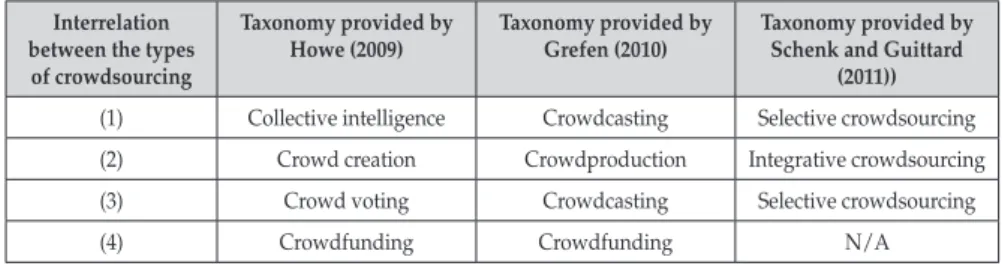
Below, we compare three characterisations that are based on the nature of the tasks. We combine them in Table 1 and distinguish four interrelations.
Depending on the nature of the tasks that can be accomplished through crowdsourcing, Howe (2009) distinguishes four types of crowdsourcing, namely, collective intelligence, crowd creation, crowd voting, and crowdfunding. The first type is used for problem solving, the second for content creation, the third for rating content, and the fourth for gathering funds.
Grefen (2010) distinguishes three types of crowdsourcing, namely, (1) crowdcasting, (2) crowdproduction, and (3) crowdfunding. Crowdcasting is a business model in which the crowd is used to generate ideas by answering specific questions. Here, crowdstorming is a variation of crowdcasting; it allows the crowd to generate new ideas without very clear questions as a basis. Crowdproduction is a business model in which the crowd is used to produce a product, which can be of a digital nature. Crowdfunding is aimed at having a crowd fund a venture.
Schenk and Guittard (2011) distinguish two types of crowdsourcing, namely: (1) integrative crowdsourcing and (2) selective crowdsourcing. The integrative crowdsourcing is used for accomplishing large tasks by inte-grating complementary contributions from the crowd. A typical example of integrative crowdsourcing is Wikipedia. By integrating millions of small contributions, including text and photos, Wikipedia offers an encyclopedia containing a wide array of detailed articles. The selective crowdsourcing is used for accomplishing tasks by harnessing the problem solving skills of the members of the crowd. As Schenk and Guittard (2011) noted, selective crowdsourcing implies a winner-takes-all mechanism where only the finder of the “winning” solution receives an award. A typical example of selective crowdsourcing is InnoCentive.
Interrelation between the types of crowdsourcing
Taxonomy provided by Howe (2009)
Taxonomy provided by Grefen (2010)
Taxonomy provided by Schenk and Guittard
(2011))
(1) Collective intelligence Crowdcasting Selective crowdsourcing
(2) Crowd creation Crowdproduction Integrative crowdsourcing
(3) Crowd voting Crowdcasting Selective crowdsourcing
(4) Crowdfunding Crowdfunding N/A
Table 1. Four interrelations between three taxonomies
Below, we discuss the four interrelationships between the three taxonomies on the basis of their concepts.
(1) Collective intelligence, crowdcasting, and selective crowdsourcing are interrelated because all of them refer to crowdsourcing processes in which the tasks assigned to the crowd may include problem solving. (2) Crowd creation, crowdproduction, and integrative crowdsourcing are
in-terrelated because all of them refer to crowdsourcing processes in which the tasks assigned to the crowd may include production of content. (3) Crowd voting, crowdcasting, and selective crowdsourcing are
(4) The concepts of crowdfunding used by Howe (2010) and Greven (2010) are the same because both of them refer to crowdsourcing in which the crowd submits funds to a crowdsourcing provider.
In summary, Table 1 indicates that the different typologies of crowdsourcing have common elements, which can be used for understanding crowdsourc-ing. Finally, we remind that the taxonomy provided by Howe (2009) again serves as an umbrella for the other taxonomies.
B3: The platforms of crowdsourcing
The platform of crowdsourcing can be considered as the basis from where the venue originates. Stanoevska-Slabeva (2011) distinguishes the following five crowdsourcing platforms: (1) intermediary platforms, (2) user-initiated crowdsourcing platforms, (3) company initiated platforms, (4) idea market places and platforms, and (5) public crowdsourcing-initiative platforms. Below, we describe them briefly.
The intermediary platforms are created by intermediaries, which pro-vide a venue where crowdsourcing workers and seekers of crowdsourcing services can meet and work together. InnoCentive is an example of an inter-mediary platform.
In user-initiated crowdsourcing platforms, the term “user-initiated crowdsourcing” refers to a crowdsourcing process where the crowdsourcing is initiated by an individual user. Thus, a blog of an individual user allow-ing the visitors to rate the articles published by that user is an example of a crowdsourcing platform using user-initiated crowdsourcing.
Company initiated platforms are created by companies which outsource certain tasks to crowdsourced workers. Company initiated platforms may, for instance, allow a company to collect and examine the opinions of the consumers in relation to the products or services offered by that company. The global online job marketplaces using crowdsourcing, which allow com-panies to find and work with freelancers, are typical examples of company-initiated platforms.10
The term “idea market places” refers to crowdsourcing platforms col-lecting ideas from the users and selling those ideas to the public. A typical example of an idea marketplace is Threadless.11 Threadless allows anyone to submit images for t-shirts, bags, and other products. The images are put to a public vote. The top-scoring images are printed on products and sold worldwide through the website of Threadless and their retail store in Chi-cago, USA. Since its establishment in 2000 up to 2010, Threadless sold more than four million T-shirts (cf. Nickel and Kalmikoff, 2010).
Public crowdsourcing-initiative platforms contain initiatives initiated by public authorities. For example, in 2010, the Irish government launched a crowdsourcing platform which aimed to collect ideas from the population regarding the question how to achieve higher economic growth. The top two ideas were awarded with EUR 100,00 (cf. Foremski, 2010).
The typology of crowdsourcing platforms indicates that a great variety of crowdsourcing platforms have been developed up to the present time. In Chapter 3, we will focus on the different crowdsourcing platforms.
C: The relation of crowdsourcing to the advanced concepts
The concept of crowdsourcing may overlap or sometimes even be used interchangeably with other concepts, such as (C1) collaborative systems, (C2) user-generated content, (C3) collective intelligence, and (C4) Web 2.0. Below, we will explain the four concepts. We give their meaning and show the relation to the term crowdsourcing.
C1: Collaborative systems
In the field of the information technology, collaborative systems are soft-ware applications that are used by individuals to help them coordinate their work with others, whether designed for that purpose or not (cf. Khosrow-pour, 2002, p. 86). The term “collaborative system” is a broad concept that includes crowdsourcing applications allowing the members of the crowd to coordinate their work. Wikipedia is an example of a crowdsourcing applica-tion allowing the members of the crowd to coordinate their work in order to build an encyclopedia of use to a larger community.
C2: User-generated content
Casoto, Dattolo, Omero, Pudota, and Tasso (2010, p. 16) define the user-generated content as “any kind of published content, result of a non-pro-fessional activity with creative effort.” In most cases, the content published on the Internet by the users of crowdsourcing applications is user-generated content. The reason is that such content is often a result of non-professional activities with creative efforts. Examples of user-generated content created by the users of crowdsourcing applications include the articles of Wikipedia and the content published by the users of online social networks.
C3: Collective intelligence
Below, we provide a definition (C3a) of collective intelligence by Sulis (1997) as well as an explanation of collective intelligence by Lévy (C3b).
C3a: Sulis (1997) defines collective intelligence as “consisting of a large number of quasi-independent, stochastic agents, interacting locally both among themselves as well as with an active environment, in the absence of hierarchical organisation, and yet which is capable of adaptive behaviour.”
intel-ligent, the people should be aware that they act as a collective organism and intentionally act as members of such an organism (cf. Lykourentzou, Vergados, Kapetanious, and Loumos, 2011, p. 219). Collective intelligent behaviour is, for example, the behaviour of the contributors in Wikipedia who create encyclopedic articles by collaborating and building on the con-tributions of each other.
C3b: Lévy (1999, p. 13) explains, that “the collective intelligence is con-tinuously enhanced, coordinated in real time, and resulting in the effective mobilization of skills.” In this regard, Lévy points out that intelligence that is “frequently ridiculed, ignored, unused, and humiliated is obviously not enhanced (Lévy, 1999, p. 13).” As an example of ignored intelligence, Lévy refers to the social exclusion through unemployment. By not being able to involve all of its members in the economic life, the society does not act in a collectively intelligent way. According to Lévy, the result is a “terrifying waste of experience, skill, and human wealth.”
A good example is Wikipedia. The collective intelligence of the editors of Wikipedia is continuously enhanced because the editors have the oppor-tunity to contribute to various topics and by various ways. We mention the editor’s contributions (1) by writing articles, (2) by merely proofreading the articles of the other wikipedians, and (3) by checking whether the articles comply with the strict requirements of Wikipedia concerning the sources of information used in the articles.
C4: Web 2.0
Web 2.0 can be defined as “all Internet services and tools which are based on a database which Internet users can modify, whether in terms of con-tent (adding, deleting or editing information or relating information with existing information), its presentation, or both” (Ribes, 2007). The most-ly used Web 2.0 applications include online social networks, blogs, and wikis. Online social networks are services that encourage their members to exchange their ideas, interest, music, and videos (cf. Varmaat, Sebok, Freund, Frydenberg, Campbell, 2016, p. 23). A blog is a web page that contains a series of chronological entries by its author (cf. Laudo and Traver, 2012, p. 159). A Wiki is a web application that allows users to add and edit content on a webpage.
Web 2.0 provides the technological foundations upon which the crowd-sourcing applications operate, enabling the members of the crowd to com-plete tasks that were previously assigned to employees (cf. Vukovic and Bar-tolini, 2010, p. 425). For instance, Wikipedia (a crowdsourcing application) is based on a Wiki (a Web 2.0 application).
D: Crowdsourcing as a business model
of applications based on the traditional business model. Below, we provide two different examples.
A first example is the competition between Wikipedia and Microsoft Encarta. Microsoft Encarta was a digital multimedia encyclopedia published by Microsoft Corporation from 1993 to 2009. However, Wikipedia became a very strong competitor of Microsoft Encarta and forced Microsoft to shut down Encarta (Cohen, 2009). Thus, Wikipedia challenged the validity of tra-ditional business models based on individual and explicit relationships (cf. RAND Europe, 2010, p. 11; Lee Eden, 2015, p. 179).12
A second example is the open-source operating system Linux. Linux is the result of the programming efforts of thousands of people around the world contributing to a free code base. The contributors submit their con-tributions to persons, also known as maintainers, who are responsible for the development of the particular area of Linux (cf. Timberg, 2015). While many maintainers are employed by various Linux vendors, others still work in their free time without remuneration (cf. Mauerer, 2010). The maintain-ers collect the contributions and send them to Linus Torvalds, the top-level maintainer. Linus Torvalds uses the contributions to create a new version of Linux (see Sally, 2009, p. 252; Timberg, 2015). The business value to organisa-tions that have adopted Linux is huge. For example, by adopting the Linux platform, IBM alone has estimated savings in the hundreds of millions of dollars (cf. Ekins, Williams, Pikas, 2011, p. 89).
The business model introduced by crowdsourcing can be either decen-tralised or cendecen-tralised. In the decendecen-tralised business model, the relationship between the organisation that crowdsources tasks and the crowdsourcing workers is not hierarchical. The organisation crowdsourcing tasks does not exercise direct control on the crowdsourcing workers.
Wikipedia is an example of a decentralised crowdsourcing application. The control on the articles published on Wikipedia is exercised only by other users of Wikipedia. There are some users of Wikipedia who even volunteer as Wikipedia cops (cf. Brafman and Beckstrom, 2007, p. 76). Some authors (Brafman and Beckstrom, 2007, p. 76; Godet, 2015, p. 189) compare an organ-isation having a decentralised business model to a starfish. A starfish does not have a head, but it can still live and grow.
In the centralised business model, the relationship between the organ-isation crowdsourcing tasks and the crowdsourcing workers is hierarchical. A typical example is InnoCentive where the organisation crowdsourcing the tasks chooses one of the solutions proposed by the innovators. Thus, the organisation crowdsourcing the tasks has complete control over which crowdsourcing worker will receive a financial remuneration. Brafman and Beckstrom (2007) and Godet (2015, p. 189) compare an organsation with a