R E S E A R C H A R T I C L E
Open Access
Coping and wellbeing in bereavement: two
core outcomes for evaluating bereavement
support in palliative care
Emily Harrop
1*, Hannah Scott
2, Stephanie Sivell
1, Kathy Seddon
1, Jim Fitzgibbon
1, Fiona Morgan
1, Sara Pickett
3,
Anthony Byrne
1, Annmarie Nelson
1and Mirella Longo
1Abstract
Background:Bereavement support is a core part of palliative care. However, the evidence base is limited by a lack
of consistency in the outcomes used to evaluate services and models of support, which makes it difficult to compare approaches. Core Outcome Sets (COS) represent the minimum that should be measured in research into specific conditions or services. The aim of this study was to use a stakeholders’perspective to develop a COS for evaluating bereavement support for adults in adult palliative care settings.
Methods:A list of outcomes relevant to bereavement support was created following a systematic review of the
quantitative and qualitative literature. At an expert workshop 21 stakeholders discussed their views on the most important outcomes and compared these to and critiqued the lists constructed from the review. These lists and
discussions informed a two round international DELPHI survey (n= 240) designed to reach consensus on which
outcomes/outcome dimensions should be included in the COS. To prioritise and validate the items emerging from the survey, participants at a subsequent consensus day ranked the relative importance of these items (n= 23). A final feedback exercise with these consensus day participants was conducted to confirm the selection of outcomes and dimensions.
Results:‘Ability to cope with grief’and‘Quality of life and mental wellbeing’were selected as two core outcomes.
Twenty-one different dimensions to explore when assessing these outcomes were also identified. The coping related dimensions have been categorised as: Negative and overwhelming grief; Communication and
connectedness; Understanding, accepting and finding meaning in grief; Finding balance between grief and life going forwards; Accessing appropriate support. Those relating to quality of life and wellbeing have been
categorised as; Participation in work and/or regular activities; Relationships and social functioning; Positive mental wellbeing and Negative mental and emotional state.
(Continued on next page)
© The Author(s). 2020Open Access This article is licensed under a Creative Commons Attribution 4.0 International License, which permits use, sharing, adaptation, distribution and reproduction in any medium or format, as long as you give appropriate credit to the original author(s) and the source, provide a link to the Creative Commons licence, and indicate if changes were made. The images or other third party material in this article are included in the article's Creative Commons licence, unless indicated otherwise in a credit line to the material. If material is not included in the article's Creative Commons licence and your intended use is not permitted by statutory regulation or exceeds the permitted use, you will need to obtain permission directly from the copyright holder. To view a copy of this licence, visithttp://creativecommons.org/licenses/by/4.0/. The Creative Commons Public Domain Dedication waiver (http://creativecommons.org/publicdomain/zero/1.0/) applies to the data made available in this article, unless otherwise stated in a credit line to the data.
* Correspondence:[email protected]
1Marie Curie Research Centre, Division of Population Medicine, Cardiff
University, 8th Floor Neuadd Meirionydd, Heath Park Way, Cardiff CF14 4YS, UK
(Continued from previous page)
Conclusion:This COS outlines a more consistent way forward for bereavement researchers and practitioners, whilst
also orientating towards public health and resilience-based approaches to bereavement care. Further work is planned to identify and develop measures which are specific to this core outcome set, and which will facilitate the future comparability of bereavement services and interventions.
Keywords:Bereavement, Palliative care, Core outcome set, Delphi survey
Background
Although grief is a natural process, in which many people adjust with support from their social networks, others re-quire more formal forms of professional support [1, 2]. Bereavement is associated with elevated risks to mental health, morbidity and mortality [2–5], and services that provide bereavement support can be important for man-aging these risks [2]. The socio-economic costs of bereave-ment can also be considerable, affecting all sectors of society [6–8]. Bereavement support is an important part of palliative and end of life care, with different levels of provision recommended to meet the varying needs of bereaved individuals [1, 2, 9–11]. The public health ap-proach to bereavement care [12,13] and the UK National Institute for Health and Clinical Excellence (NICE) [10] both propose three tiers of bereavement support, to be made available according to level of need:
Component 1 where information is universally
offered regarding the experience of bereavement and people are sign-posted towards further support if needed. Informal support is also provided by existing social networks.
Component 2 which makes provision for people
with moderate needs to access formal opportunities to reflect upon their grief and may involve individual or mutually supportive group sessions.
Component 3 which encompasses specialist
interventions such as mental health services, psychological support and specialist counselling for those identified as having complex needs and at high risk of Prolonged Grief Disorder (PGD).
However, the research evidence available for these dif-ferent types of support is limited. Inconclusive results and lack of positive effects are commonly reported in system-atic reviews and meta-analyses of bereavement interven-tion studies [4, 14–16], with some indicating that grief interventions may only be effective for those with more severe and complicated grief symptoms [4, 16]. As also noted, however, such findings run counter to the profes-sional experience of many clinicians in the field [15] and are challenged by the positive impacts that have been consistently reported in qualitative and mixed methods evaluations of bereavement interventions [14].
Several of these systematic reviews have identified problems with inconsistent outcome measurement [4, 14, 17–19]. A systematic review of the end of life and bereavement experiences of family caregivers identi-fied 89 unique instruments, almost half of which were study specific with no psychometric testing reported [19]. A meta-analysis of the prevention and treatment of com-plicated grief noted the limitations caused by variation in outcome measures [4]; conclusions also mirrored in sys-tematic reviews of the evidence for bereavement support generally [18], and in cancer and palliative care specifically [14,17]. Some commentators have also suggested that be-reavement intervention studies may fail to find an effect because they are measuring the wrong outcomes, often relying on narrowly defined and simplistic criteria such as psychiatric symptom checklists or global measures of functioning, which are not specific to bereavement [15]. These problems with outcome measurement undermine the potential for study results to be combined and com-pared, and the kind of robust conclusions on effectiveness that are needed to inform clinical practice and service de-livery [14, 17, 18, 20]. Recent national and international programmes of work have focused on developing sets of service standards through consensus building activities with expert stakeholders [10,21] (https://www.eapcnet.eu/ eapc-groups/task-forces/bereavement). By reaching agree-ment on what constitutes a good service, and commit-ment amongst service providers to adhere to such standards, improved outcomes for service users should be expected to follow. However, without also identifying what these outcomes should be, the impact of these services on their service users will remain difficult to determine.
reporting bias and ensuring that all trials contribute out-come data to meta-analysis [22]. By engaging with a range of stakeholders in the process it is also more likely relevant outcomes will be captured [22]. To address the limitations and gaps highlighted in the above literature, the current study aimed to develop a COS specific to bereavement research and clinical practice in palliative care. The scope of the COS was defined to include be-reavement interventions or services for adults who have lost other adults to terminal illness.
Methods
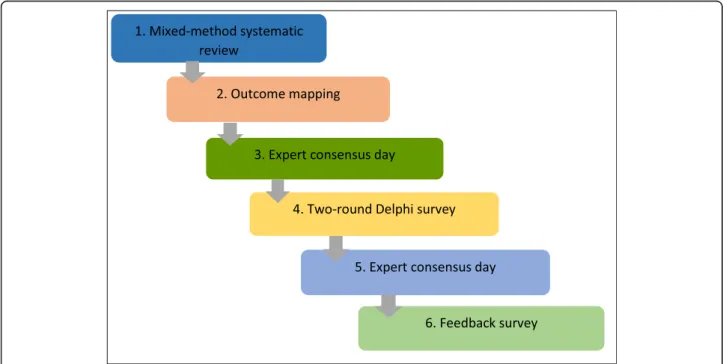
There are a variety of methods that can be used to develop a COS, with literature or systematic reviews and Delphi techniques having become popular of late [20,23]. This COS was developed using information on outcomes and measures collected from a systematic review, two expert consensus meetings and a modified two-round Delphi survey, to gain agreement amongst stakeholders on which outcomes and dimensions are‘core’(Fig.1).
Systematic review and outcome mapping exercise
A mixed methods systematic review of bereavement sup-port interventions for adults bereaved through terminal illness was conducted to identify relevant outcomes and outcome measures. Specialist databases Medline, Embase, PsycINFO and CINAHL were searched using index terms and key words. A set of bereavement/grief terms were identified and combined with a set of palliative care/ad-vanced illness/caregiver terms. Studies were included if they reported results from evaluations of bereavement
support interventions or services for adults bereaved through terminal illness, delivered in ‘western’ countries and published in English from 1996 onwards. Relevant pa-pers were identified by two independent reviewers, follow-ing a process of title, abstract and full paper screenfollow-ing. The protocol for this review, including full search strategy is published on Prospero (www.crd.york.ac.uk/prospero, CRD42016043530). Using the same databases an add-itional search was carried out to identify systematic re-views of adult bereavement interventions and tools used in bereavement research and practice. This supplementary search allowed us to capture outcomes and measures that may not have been used in solely palliative care related interventions.
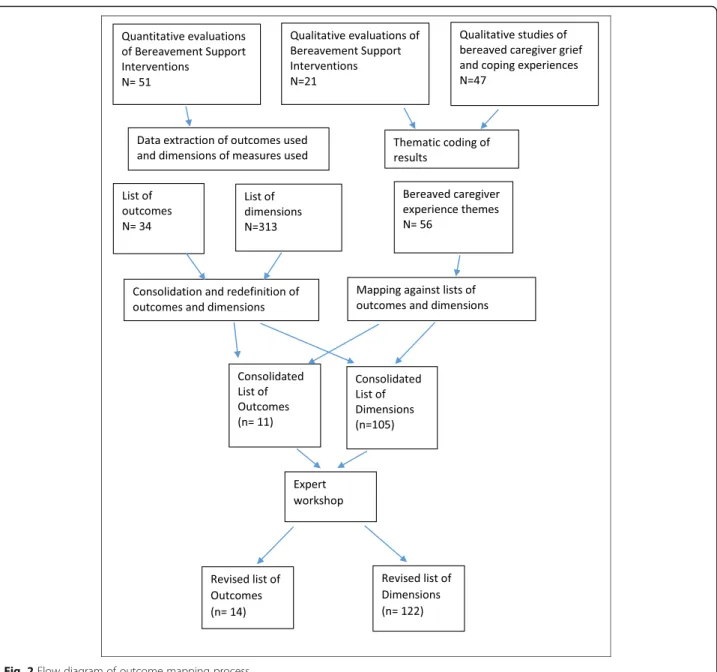
Once relevant studies were identified a cross tabulated Excel spreadsheet was constructed listing all outcomes used in quantitative evaluations of bereavement support, published from 1996 onwards. Two researchers (EH and SS) independently interrogated the long list of outcomes with the goal of clustering and identifying single defini-tions for similarly described outcomes and organising the outcomes into broader domains. Uncertainties or disagreements were resolved by discussion with the wider team. Information on the psychometric properties (outcome dimensions) of all measures used in these studies was collated and similarly described dimensions were grouped together and given single definitions following the same process. Additional measures were also included following the recommendations of other researchers or identification in supplementary searches (see additional file one: list of all measures used).
Interventional impacts identified and described in the synthesis of qualitative evaluation studies, and all aspects of caregiver grief and coping experiences reported in qualitative observational studies were extracted, organised under thematic headings and described as potential out-come dimensions. These were mapped across to the lists of outcomes and dimensions created from the quantitative measures, highlighting those which‘matched’and adding new dimensions where needed. At the end of this process there were 11 outcomes, and 105 different outcome di-mensions associated with these outcomes.
Expert workshop
To ensure that we captured all potentially relevant out-comes and outcome dimensions, a stakeholder workshop was held with 21 UK based delegates, representing a variety of professional and non-professional backgrounds. Dele-gates were identified through local and national bereave-ment provider networks and organisations, PPI networks, professional contacts and further recommendations (See Table 1 for participant details). The day was organised around breakout sessions, with two professional groups and one group of people with caregiving and bereavement experiences. In the first group session participants were asked to identify and categorise potential outcomes and outcome dimensions that they felt were important to cap-ture when assessing how well a bereavement support ser-vice is working. In the second session each group was given a copy of the outcome lists from the systematic re-view and asked to discuss and critique these with reference to their suggestions from the first sessions. Following re-view of the points raised in the two sessions, the outcome lists used on the day were adapted, with various new items added to the lists (Fig.2).
Delphi survey
A modified two round Delphi survey was conducted to capture the views of stakeholders on the most important outcomes and outcome dimensions to include in the COS. A Delphi process is a systematic, interactive method using a panel of experts answering questions in two or more rounds to reach agreement on what to in-clude in a target end product [24,25]. The outcome lists developed from the literature and consensus day discus-sions were used to create the items included in the Del-phi survey, following processes of further mapping, consolidation and piloting with a mix of stakeholder par-ticipants (n = 23). A paper and an online version of the questionnaire were produced. There were two rounds to the Delphi. In the first-round participants rated the ex-tent to which they agreed or disagreed that each out-come/outcome dimension should be included in the core outcome set (i.e. what to measure). Participants
rated the items on 5-point Likert type scales ranging from‘not important’to‘very important’.
The first round of the survey remained open for 34 weeks and the second round for 4 weeks. A link to the online ver-sion of the questionnaire was sent to the corresponding au-thors of the studies identified in the systematic review and to participants who attended the first consensus day. These participants were also asked to circulate amongst their networks and colleagues and social media were used to promote the survey further. To increase service user partici-pation in the survey we also invited all the UK Marie Curie Hospices to recruit current bereavement service users into the study. The bereavement research lead at each hospice identified suitable staff members and eligible service users, introduced the study and provided them with an informa-tion pack containing the participant informainforma-tion sheet and a paper copy of the questionnaire.
Online responses were downloaded into SPSS and paper questionnaires were manually inputted. Respondents were grouped into four key stakeholder groups: service users, service providers, members of the public and researchers. Members of the public included adults bereaved with no experience of using bereavement support services. Sum-mary statistics (frequencies; descriptives) were run to deter-mine consensus (defined as greater than 70% agreement) at each stakeholder’s group level. Services users’ preferences were considered top priority. As a result, an item reached consensus in the first-round if at least 70% of the overall sample and 70% of service users considered it to be‘not im-portant’/‘slightly important’or‘important’/‘very important’.
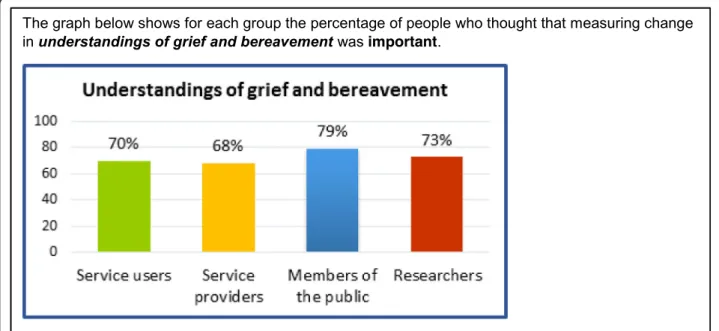
In round two, participants from round one were asked to re-evaluate those items which did not reach consen-sus. Each question included a graph to show the per-centage of agreement reached across each stakeholder group, a reminder of the answer the respondent pro-vided in round one and a question asking to indicate their preferences again (Fig.3).
Final consensus day
A final consensus day was held in April 2018 to help pri-oritise and validate the selection of items emerging from the survey. Delegates were presented with a series of lists of outcomes and outcome dimensions. In order to reduce burden on the respondent, each question included up to seven items and participants were allowed up to three votes depending on the scores that the items had reached in the survey. Using electronic voting technology partici-pants voted on what they felt were the most important items. After voting for each question, the participants were presented with the survey results and the two sets of results were discussed.
items that were shortlisted and identify any items not on the shortlists that they felt should be included. Unfortu-nately, due to time constraints it was not possible to sat-isfactorily complete this exercise. It was thus agreed that these sets of results would be circulated to provide par-ticipants with the opportunity to consider and provide feedback on the emergent selection of outcomes and dimensions.
Mapping exercise and feedback survey
The results from the Delphi rounds and voting exercises demonstrated good consistency between the highest scoring outcomes, with a clear indication for the first core outcome. To inform and further validate the selec-tion of other potential core outcomes, a mapping
exercise was conducted which re-connected the highest scoring outcome dimensions from the Delphi survey with their associated outcomes. The results of this exer-cise demonstrated that almost all of these outcome di-mensions mapped back to the top three outcomes from the Delphi survey. However, it also showed significant duplication between the dimensions associated with the second and third outcomes, suggesting a need to choose between these two outcomes.
A feedback survey detailing results from the Delphi survey and consensus day voting was sent to all consen-sus day delegates, highlighting convergent and divergent items. Based on these results respondents were asked to describe their preferences for the uncertain second out-come and to identify any excluded outout-come dimensions
that they felt should be included in the COS. The di-mensions proposed for exclusion were those that scored below 80% in the Delphi survey in both the overall sam-ple and the service user only samsam-ple. It was decided that an excluded dimension could be added to the final version of the COS if a clear majority (80% or more) of respondents in the final feedback survey selected it. If there was no majority the item would remain ex-cluded, and in cases where the majority was marginal (or under 80%) the item would be considered ‘ unre-solved’ and worthy of further consideration in future work.
Patient and public involvement (PPI)
Two PPI representatives (Public Contributors, PCs) were actively involved in all stages of this work. One was a co-applicant on the grant and the other joined us at the start of the project. Their expertise was embedded in all project planning, outputs and future research design. The PCs helped refine the research question and the study protocol
and ensured that research design and methods used were appropriate for the study participants, in particular be-reaved carers. Their participation also ensured that study documentation (e.g. the participant information sheet, consensus day materials, Delphi and feedback surveys) and project outputs were accessible to all participant groups. The PCs were actively involved in the outcome-mapping process, study management group meetings and both facilitated group discussions on the first consensus day. Reflective log sheets filled both by researchers and PCs were used to monitor and to reflect on how well the steps in the study protocol were achieved and the impact of PPI input into the research.
Results
Participant characteristics
Study recruitment lasted from the 3rd of March 2017 to the 13th of April 2018. The sample of the different groups of stakeholders that participated across the dif-ferent stages of this work are detailed in Table1.
Outcome extraction and mapping
Results from the outcome mapping exercise are detailed in Table2, with frequencies given for the descriptor out-come assigned by the research team, and individual fre-quencies for each outcome as verbatim reported in the quantitative studies used in this exercise. The 105 out-come dimensions defined at this stage are provided in
additional file two.
First expert workshop
Two main themes emerged from the group discussions. Participants considered what bereavement services should focus on when supporting service users, and what this might mean in terms of measurable outcomes.
Managing and coping with grief
Within all three groups there was talk around the need for bereavement services to enable service users to man-age and cope with their grief, rather than try to treat it, and related to this a preference for coping rather than grief to be used as an outcome. Key points included:
Bereavement support services should aim to support
the coping strategies, resilience and“capacity to
bear”of service users (bereaved and professional
groups).
Bereavement services should help people to
understand the normality of grieving and coping processes and avoid pathologising grief (bereaved and professional groups).
Service users should be helped to understand the
difference between depression and grief, whilst also provided with psychological support to help them process their feelings, reduce feelings of anxiety and panic and improve sleep quality (professional group).
Bereavement services should help their service users
make sense of their experience and loss, enabling them to channel and deal with any feelings of anger that may accompany the loss (e.g. from poor care
experiences) (bereaved group), and to“identify
maladaptive thoughts and behaviours”(bereaved and
professional groups).
Bereaved people should be supported to remember
their loved ones without feeling overwhelmed, and to feel able to enjoy their memories and their sorrow (bereaved and professional groups).
Social adjustment, relationships and wellbeing
Other types of identified impacts related to personal and social adjustment and relationships with others, with preferences expressed for support related outcomes.
“Improved wellbeing”was identified in one of the profes-sional groups, and a number of different ideas relating to individual, family and social wellbeing were discussed in all three groups. Key points included;
Services should help bereaved people feel“able to
face the future”(bereaved group). This was
Table 2List of outcomes used in previous studies
Descriptor Outcomes(Reported verbatim outcomes) Overall Frequency
Anxiety and Depression
Anxiety (13), Depression (19), Anxiety and Depression (2), Mental Stress (1), Distress (9), Symptom Distress (3), Mental Health (2)
49
Grief
Grief (22), Complicated Grief (2), Blame (1), Despair (1), Knowledge of death and bereavement (1)
27
Post Traumatic Stress
Avoidance/intrusion (6), Post-traumatic Stress (3) 9
Quality of Life and Wellbeing
Quality of Life (3), Spiritual Wellbeing (1), Hopelessness (2), Hope (1), Balance (1)
8
Coping
Coping and adaptation (1), coping (2), religious coping (2)
5
Self Esteem 5
Mood/Affect 4
Social Functioning and Adjustment
Social adjustment (1) Social functioning (2) Marital strain (1) Interpersonal problems(2)
6
Physical Health
Health (1), Physical Health (1), Physical functioning (1) 3
Locus of Control 2
Interpersonal and Social Support
Social support (1), Interpersonal relations (1)
2
Table 1Participants recruited at each stage of the study
Groups First Consensus Day Delphi One Delphi Two Second Consensus Day Feedback Survey
Bereaved People 7 69 30 8 7
Service Providers 11 119 49 8 3
Academic/Researchers 3 33 18 3 1
Members of the Public 19 11 4
described as“incremental moves from hopelessness
to optimism”in one of the professional groups.
The re-emergence of sense of self-identity (short
and longer term) is important, as is one’s ability to
function in life roles and responsibilities, including returning to work and being able to deal with social and financial insecurities (professional groups).
Bereavement services should help bereaved people
manage their often troubled relationships with other family members and close friends (bereaved and professional groups).
Opportunities for peer support are important.
Bereaved participants emphasised the value of talking and being listened to by those with shared experiences, empathy and understanding.
Professionals also discussed the need for services to
“help with connectedness”and address problems of
social isolation (bereaved and professional groups).
Following the discussions that took place on the day, the lists that were originally created from the systematic review were amended to incorporate these discussion points and comments made about the lists. The outcome lists are provided in additional file two, with additions and amendments from the day highlighted.
Two-round Delphi survey
The outcomes and outcome dimensions identified in stage 1 and 2 of the project were grouped into 17 out-comes and 51 dimensions (additional file two: Lists of outcomes and outcome dimensions). In order to ease the burden on respondents, the dimensions were grouped under the overarching themes of emotional is-sues, wellbeing, health and support.
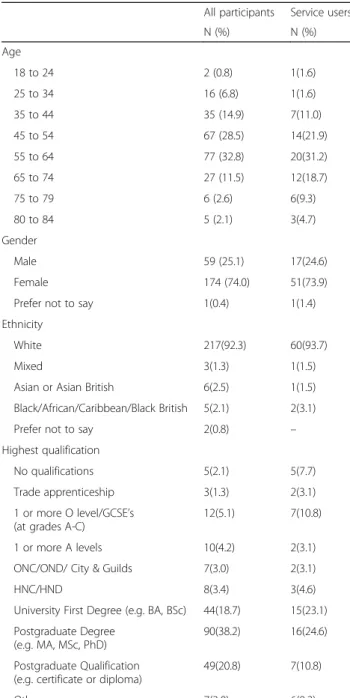
A cohort of 240 people took part in the Delphi round 1. Table3lists the key characteristics of the respondents.
There was very little missing data, all respondents an-swered the questions relating to the outcomes and out-comes measures. Four respondents chose not to report age, education and ethnicity, and a further two respon-dents also did not answer the ethnicity question.
The results for the outcomes for the first round of the Delphi is shown in Fig.4. Against each outcome there is a group of five bars representing the percentage of each stakeholder group who agreed or completely agreed over the importance of the specific outcome being included in the core outcome set and a bar representing the entire cohort score. Two outcomes did not reach the 70% agreement threshold: self-esteem and identity and belief systems. In addition, 17 of the 51 outcome dimensions did not reach the agreement threshold. Hence, these 2 outcomes and 17 outcome dimensions formed the 19 questions included in the Delphi round 2 questionnaire. There was no agreement that any of
the outcomes should be considered not important or slightly important (Fig. 4).
Following Delphi round 2, the overall scores for the two outcomes were as follows: ‘self-esteem’ (62%) and
‘identity and belief system’(62%). It is interesting to note that for most of the outcomes a similar level of agree-ment was reached across the stakeholder groups in both Delphi rounds.
Table 4 lists the 51 outcome dimensions. For each of them it is indicated if it reached 70% or 80% agreement in the Delphi survey.
Table 3Socio-demographic characteristics of participants for Delphi round 1
All participants Service users
N (%) N (%)
Age
18 to 24 2 (0.8) 1(1.6)
25 to 34 16 (6.8) 1(1.6)
35 to 44 35 (14.9) 7(11.0)
45 to 54 67 (28.5) 14(21.9)
55 to 64 77 (32.8) 20(31.2)
65 to 74 27 (11.5) 12(18.7)
75 to 79 6 (2.6) 6(9.3)
80 to 84 5 (2.1) 3(4.7)
Gender
Male 59 (25.1) 17(24.6)
Female 174 (74.0) 51(73.9)
Prefer not to say 1(0.4) 1(1.4)
Ethnicity
White 217(92.3) 60(93.7)
Mixed 3(1.3) 1(1.5)
Asian or Asian British 6(2.5) 1(1.5)
Black/African/Caribbean/Black British 5(2.1) 2(3.1)
Prefer not to say 2(0.8) –
Highest qualification
No qualifications 5(2.1) 5(7.7)
Trade apprenticeship 3(1.3) 2(3.1)
1 or more O level/GCSE’s (at grades A-C)
12(5.1) 7(10.8)
1 or more A levels 10(4.2) 2(3.1)
ONC/OND/ City & Guilds 7(3.0) 2(3.1)
HNC/HND 8(3.4) 3(4.6)
University First Degree (e.g. BA, BSc) 44(18.7) 15(23.1)
Postgraduate Degree (e.g. MA, MSc, PhD)
90(38.2) 16(24.6)
Postgraduate Qualification (e.g. certificate or diploma)
49(20.8) 7(10.8)
Second consensus day results
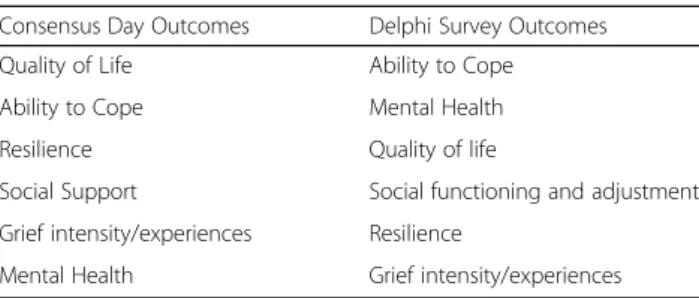
The second consensus day revolved around a succession of electronic voting sessions. This approach enabled each respondent to independently express their priorities, and as a group, discuss agreement and disagreement with the survey results. Overall, there was substantial agreement between the voting exercise and the Delphi survey. The top six outcomes shortlisted from the voting exercises are listed in Table 5below and compared with the top six outcomes from the Delphi survey, demonstrating a good level of consistency. The outcome dimensions that were shortlisted from the voting exercises are re-corded in Table4.
Mapping exercise: outcomes versus dimensions
The mapping exercise that was conducted re-connected the outcome dimensions which exceeded 80% agreement in the Delphi survey with their associated outcomes and was used to help inform and validate the selection of outcomes. This analysis demonstrated that almost all the selected outcome dimensions mapped back to the top three outcomes from the Delphi survey (see additional file three: results of mapping exercise). Whilst there was a clear indication for the first core outcome, ‘Ability to cope’, this exercise also demonstrated significant overlap between the second and third outcomes,‘Mental health’ and ‘Quality of life’, which converged around the high
number of wellbeing related dimensions that were se-lected. These results thus indicated a need to choose be-tween these two outcomes, and for a wellbeing-oriented definition of ‘Mental health’. Given the grief specific nature of the coping items that were selected, a deci-sion was taken to re-describe ‘ability to cope’ as ‘ abil-ity to cope with grief’. This also allowed for several of the grief items that were selected to be accommo-dated within this outcome.
Feedback exercise results
The primary purpose of the feedback survey was to es-tablish the preferences of consensus day delegates for the uncertain second core outcome. It also enabled dele-gates to identify any outcome dimensions proposed for exclusion that they felt should be included in the COS. Eleven delegates responded to the survey, although one only noted their agreement with the study results and did not respond to specific questions. Quality of life was favoured by 6 respondents (4 bereaved people; 1 service provider; 1 researcher), Mental health and wellbeing by 3 respondents (2 bereaved people; 1 service provider) and one respondent described a preference for a com-bined ‘Quality of life and wellbeing’ outcome. In re-sponse to these mixed preferences, the reasoning offered in free text comments, and the apparent convergence around wellbeing related dimensions a decision was
made to describe the second outcome as‘Quality of life and mental wellbeing’.
No new outcome dimensions were included following the feedback survey results, although five were consid-ered ‘unresolved’ according to our stated criteria (50 to 79% in favour of inclusion). These five items were: Sense of identity and role; Problems with memory, concentra-tion, making decisions, speech; Accessing financial/ma-terial support if needed; Tiredness and Fatigue; General health problems (eg infections, blood pressure). These items may warrant further consideration in future work in this area.
Core outcomes and dimensions
The selected outcomes and dimensions are presented below. For ease of interpretation the outcome dimensions have been categorised under 9 thematic headings (Table6).
Discussion
Through an extensive process of outcome identification, mapping and stakeholder consultations this piece of work has identified two core outcomes and associated outcome dimensions that can be used to inform the
design and evaluation of adult bereavement support in palliative care. The stakeholder-based selection of two outcomes, ‘Ability to cope with grief’and‘Quality of life and mental wellbeing’ offers a consistent way forward for researchers and practitioners working in the field. It also represents a different conceptual approach for evaluating bereavement interventions than the medica-lised and pathological approaches dominant in the pub-lished literature, aligning more closely with public health and resilience-based approaches to bereavement care [12, 13]. The implications of these results for future evaluation, research and service design are discussed.
The need for a set of core outcomes that can be used in evaluations of adult bereavement support interventions was confirmed in the outcome mapping exercise con-ducted at the start of this study. The identification of 34 differently described outcomes and many more measure-ment instrumeasure-ments supports previous observations of problematic and inconsistent outcome measurement in bereavement research [4,14,15,17–19]. The stakeholder-based identification of two core outcomes,‘Ability to cope with grief’ and ‘Quality of life and mental wellbeing’ is a first important step towards facilitating a more consistent and useful approach to outcome measure-ment in this field of research and evaluation. In doing so it also complements sets of consensus-based ser-vice standards that have been recently developed [11,21], or are in current development (https://www.eapcnet.eu/ eapc-groups/task-forces/bereavement).
This selection of outcomes appears to favour an alter-native conceptual approach for evaluating bereavement care to the more pathological approaches which have dominated in the published research literature. They instead align more closely with public health and
Table 5Highest scoring outcomes from Consensus Day and Delphi Survey
Consensus Day Outcomes Delphi Survey Outcomes
Quality of Life Ability to Cope
Ability to Cope Mental Health
Resilience Quality of life
Social Support Social functioning and adjustment
Grief intensity/experiences Resilience
Mental Health Grief intensity/experiences
Table 6Core Outcomes with Dimensions
Ability to Cope with Grief Quality of Life and Mental Wellbeing
Negative and overwhelming grief
•Feelings of loneliness and emptiness
•Feelings of blame, guilt, anger, bitterness, regret •Overwhelming thoughts and/or nightmares about loss •Preoccupation with thoughts of the deceased
Participation in work and/or other regular activities
•Ability to perform daily tasks •Ability to participate in work •Ability to participate in social activities
Communication and connectedness
•Ability to express feelings openly and honestly
•Feeling understood by and connected with other bereaved people
Relationships and social functioning
•Ability to function as part of a family •Relationships with friends and family
Understanding, accepting and finding meaning in grief
•Acceptance of grief experiences as normal •Understanding, acceptance, finding meaning in loss •Positive reminiscence and remembering of the deceased
Positive mental wellbeing
•Sense of meaning and purpose in life •Optimism and hopefulness
Finding balance between grief and life going forwards
•Ability to find balance and channel grief
•Ability to take control/ look ahead and start to move forward with life
Negative mental & emotional state
•Anxiety (feelings of tension, nervousness, panic and distress) •Depression (a sense of hopelessness, pessimism, periods of crying) •Suicidal thoughts
Accessing appropriate support
resilience-based approaches which emphasise the im-portance of social networks and an appropriate mix of community based and specialist support [12, 13]. The need for a shift towards coping, support and wellbeing outcomes was explicitly articulated by participants at our stakeholder workshops. The apparent divergence be-tween the outcomes most commonly used by re-searchers in the published literature (Grief, Depression, Anxiety) and the outcomes which were most popular in our consensus days and Delphi sur-veys (Coping, Wellbeing, Quality of Life, Mental Health, Social Support) also further confirms this. Al-though aspects of grief experience, depression and anxiety are represented in the two outcomes, the overall orientation of the outcomes is more positive, addressing both individual and social dimensions of coping, resilience and wellbeing during bereavement. As a COS there is an assumption that improvements in these areas would occur for bereaved indi-viduals accessing an‘effective’program of bereavement sup-port. Whilst improvements in some dimensions may more likely represent direct impacts of the support (e.g. in‘ Com-munication and connectedness’), improvements in others may be more likely to occur as indirect impacts, indicative of generalised improvements to wellbeing (e.g.‘Participation in work and/or regular activities’).
There are several factors that may explain this apparent departure from the more disease focused outcomes used in previous studies. One reason may be the relatively high number of Randomised Control Trials (RCTs) of grief therapy interventions that were included in the mapping exercises and a possible preference amongst these re-searchers for pathological outcomes. The majority of par-ticipants in our consensus days and Delphi survey were service providers and service users, with researcher partic-ipants also representing a diversity of methodological backgrounds. The scope of our COS was not restricted to grief therapy, and instead intended to cover the wide-ranging types of support provided in palliative care settings, to meet the varying needs of service users. The consensus exercises therefore represented the perspectives of a much wider range of stakeholders, than those who design and test grief therapy interventions, further reinfor-cing the importance of wide-ranging stakeholder partici-pation when developing COS.
Following this, it is also worth noting that in the Delphi results, voting exercises and expert discussions, many of the preferences and priorities to emerge were for outcomes and outcome dimensions that either origi-nated from the qualitative literature and/or group dis-cussions, or were only marginally represented in the quantitative measures used in previous evaluations. This would suggest that there may not just be a problem with consistency but also the appropriateness of some of the outcomes commonly used in research studies. This
re-ignites the question of whether the inconclusiveness and lack of positive results reported in many bereavement trials and reviews (e.g. 4, 14–16), might in part be ex-plained by the choice of outcomes and measures, rather than poor efficacy of the intervention or service [15]. Whilst a recent mixed-methods review of bereavement support in palliative care found limited evidence of posi-tive effects in the RCT studies, there were a number of positive impacts consistently identified in the qualitative and mixed methods evaluations that were included in the review. Several of these are now represented in the outcome set reported here e.g. ‘facilitating loss and grief resolution’, ‘restoration and moving on’, ‘acquisition of coping strategies’and‘social support’[14]. This again re-iterates the importance of using existing qualitative work, combined with stakeholder discussions, for identi-fying and defining potential outcomes that may other-wise get missed out of evaluation study protocols.
Limitations, strengths and implications for further research
One difficulty with this piece of work concerned the po-tential variation in how survey items are interpreted and understood by participants. Steps taken to mitigate the effects of participant subjectivity included open discus-sions in consensus days, extensive piloting of the survey, and active PPI involvement throughout. The high degree of consistency between the results of both consensus days and the Delphi Survey, and between the outcomes and dimensions that were prioritised, also helps to valid-ate these results. The relatively high numbers of be-reaved and service user participants are another strength of this work, helping to ensure that our outcome sets represent the views and experiences of those who matter most when designing and evaluating services. However, there was inevitably some self-selection bias and lower socio-economic status and minority ethnic groups were under-represented in our sample.
content analysis, quality appraisal and stakeholder consult-ation for all potentially relevant measures is needed follow-ing the COMET and COSMIN guidance [31,32]. This will enable robust recommendations for any existing outcome measures considered suitable for this COS and the identifi-cation of any additional validation or development work still required. Given the acknowledged difficulties of con-ducting trials in complex interventions generally [33], and in palliative care and bereavement specifically [34,35], con-sideration is also being given to how tools could be devel-oped to be useful for other types of evaluation designs, to serve the needs of clinical practice and research [36].
Conclusion
This project has identified two core outcomes and asso-ciated dimensions which can inform the design and evaluation of adult bereavement support in palliative care. The stakeholder based selection of two outcomes,
‘Ability to cope with grief’and‘Quality of life and mental wellbeing’begins to pave a more consistent way forward for researchers and practitioners working in the field, as well as a departure from the more medicalised ap-proaches and pathological outcomes typically seen in the published quantitative literature. Further work is being planned to identify and develop measures which are spe-cific to this core outcome set, and which will facilitate the future comparability of services or interventions, from both clinical and research perspectives.
Supplementary information
Supplementary informationaccompanies this paper athttps://doi.org/10. 1186/s12904-020-0532-4.
Additional file 1.List of all measures used to construct Delphi survey lists.
Additional file 2.Integrated lists of outcomes and outcome dimensions developed from systematic review and consensus day discussions.
Additional file 3.Results of outcomes/dimensions mapping exercise.
Abbreviations
COS:Core Outcome Set; EoL: End of Life; NICE: National Institute for Clinical
Excellence; PC: Public Contributors; PPI: Patient and Public Involvement; RCT: Randomised Control Trial
Acknowledgements
Our sincere gratitude goes to all of our research participants and the many organisations which assisted with this research, including Cruse Bereavement Care, Hospice UK, Marie Curie and the National Bereavement Alliance. We also thank Kristen Thomas, Luke Cowey, Ankita Rai and Maria Giovanna Palmieri for their work on the project.
The results reported in this manuscript have been presented at the following conferences with respective citations:
Marie Curie Annual Palliative Care Research Conference, London, October 2018 (poster presentation)
Longo M, Scott H, Seddon K, Fitzgibbon J, Morgan F, Pickett S, Byrne A, Sivell S, Harrop E. Consensus and consistency: development of a core outcome set
for evaluating bereavement support in palliative care.BMJ Supportive &
Palliative Care2018;8:371.
Hospice UK Conference, Telford, November 2018 (oral presentation)
Harrop E, Scott H, Seddon K, Fitzgibbon J, Morgan F, Pickett S, Byrne A, Sivell S, Longo M. Coping with grief: identifying core outcomes for evaluating
bereavement support in palliative care.BMJ Supportive & Palliative Care.2018;
8(Suppl 2):A5.
European Association of Palliative Care Conference, Berlin 2019 (poster presentation)
Harrop E, Scott H, Seddon K, Fitzgibbon J, Morgan F., Pickett S, Byrne A, Sivell
S, Nelson A, Longo M.‘Ability to Cope with Grief’and‘Quality of Life and
Mental Wellbeing’: Two Core Outcomes for Evaluating Bereavement Support
in Palliative Care.Palliative Medicine. 2019; 33, 1: 280.
Authors’contributions
EH and ML drafted the paper and oversaw the project in its different phases (EH pre-Delphi; ML Delphi Survey and Second Consensus Day). EH, HS and SS analysed the data from the systematic review and consensus days and ML analysed the data from the Delphi Survey and second consensus day. FM conducted the searches and helped screen results. HS, SS, JFG, KS, AN, AB, SP, FM contributed to project management, workshop facilitation, survey design and data analysis. All authors contributed to the drafting of the paper and read and approved the final manuscript.
Funding
This study was funded by a Marie Curie Research Grant (grant reference MCCC-RP-16-A20999). The project was also supported by Marie Curie core grant funding to the Marie Curie Research Centre, Cardiff University (grant reference: MCCC-FCO-11-C). EH, AN, AB, SS, ML posts are supported by Marie Curie core grant funding (grant reference: MCCC-FCO-11-C). The funder was not involved in the study design, implementation, analysis or interpretation of results, and have not contributed to this manuscript.
Availability of data and materials
The datasets generated and analysed during the current study are available in a
separate report in the Cardiff University repository,http://orca.cf.ac.uk/128233/
Ethics approval and consent to participate
Cardiff University School of Medicine REC and East of England–Essex
Research Ethics Committee approved the project (Ref 17/EE/0513). Written informed consent was taken from participants at the start of both consensus days, following provision and explanation of study information sheets. Consent to the Delphi Survey was indicated by each participant at the start of the questionnaire. At the end of the questionnaire there was a brief description about the second round of the survey. Participants were asked to indicate if they wished to receive the questionnaire and to give the details needed (i.e. postal or email address).
Consent for publication
Not applicable.
Competing interests
The authors declare that they have no competing interests.
Author details
1
Marie Curie Research Centre, Division of Population Medicine, Cardiff University, 8th Floor Neuadd Meirionydd, Heath Park Way, Cardiff CF14 4YS, UK.2School of Dentistry, Cardiff University, University Hospital Wales, Heath Park, Cardiff CF14 4XY, UK.3Swansea Centre for Health Economics, Swansea University, Singleton Park, Swansea SA2 8PP, UK.
Received: 27 September 2019 Accepted: 21 February 2020
References
1. Aoun SM, Breen LJ, Howting DA, Rumbold B, McNamara B, Hegney D. Who
needs bereavement support? A population based survey of bereavement risk and support need. PLoS One. 2015;10(3):e0121101.
2. National Bereavement Alliance. A Guide to Commissioning Services in
England. 2017.https://nationalbereavementalliance.org.uk/wp-content/
uploads/2017/07/A-Guide-to-Commissioning-Bereavement-Services-in-England-WEB.pdf.
3. Guldin MB, Vedsted P, Zachariae R, Olesen F, Jensen AB. Complicated grief
palliative care: a longitudinal cohort study. Support Care Cancer. 2012;20(8):
1679–85.
4. Wittouck C, Van Autreve S, De Jaegere E, Portzky G, van Heeringen K. The
prevention and treatment of complicated grief: a meta-analysis. Clin Psychol
Rev. 2011;31(1):69–78.
5. Stroebe M, Schut H, Stroebe W. Health outcomes of bereavement. The
Lancet. 2007;370(9603):1960-73.
6. Birrell J, Corden A, Macduff C, Newsom C, Petrie D, Schut H, Skar S, Stephen
A, Tseng F-M, Wang S, Wilson S. Socio-economic costs of bereavement in Scotland: main study report. Aberdeen: Robert Gordon University; 2013.
https://openair.rgu.ac.uk/handle/10059/1561.
7. Van den Berg, Gerard J. and Lundborg, Petter and Vikström, Johan, the
economics of grief. IZA discussion paper no. 7010. Available at SSRN:
https://ssrn.com/abstract=2183543. Accessed 25 Feb 2020.
8. Genevro J, Miller T. The emotional and economic costs of bereavement in
health care settings. Psychologica Belgica. 2010;50(1–2):69-88.
9. Hudson P, Remedios C, Zordan R, Thomas K, Clifton D, Crewdson M, Hall C,
Trauer T, Bolleter A, Clarke DM, Bauld C. Guidelines for the psychosocial and bereavement support of family caregivers of palliative care patients. J Palliat
Med. 2012;15(6):696–702.
10. National Institute for Clinical Excellence (NICE). Guidance on cancer services:
Improving supportive and palliative care for adults with cancer. The manual. London: National Institute for Clinical Excellence; 2004.
11. Hudson P, Hall C, Boughey A, Roulston A. Bereavement support standards
and bereavement care pathway for quality palliative care. Palliat Support
Care. 2018;16(4):375–87.https://doi.org/10.1017/S1478951517000451.
12. Aoun SM, Breen LJ, O'Connor M, Rumbold B, Nordstrom C. A public health
approach to bereavement support services in palliative care. Aust N Z J
Public Health. 2012;36:14–6 pmid:22313700.
13. Rumbold B, Aoun S. An assets-based approach to bereavement care.
Bereavement Care. 2015;34(3):99–102.
14. Morgan F, Scott H, Longo M, et al. Interventions and support for people
bereaved through advanced progressive illness: a mixed-methods
systematic review. BMJ Support Palliat Care. 2018;8:380–1.
15. Jordan JR, Neimeyer RA. Does grief counselling work? Death Stud. 2003;
27(9):765–86.
16. Schut H, Stroebe MS, van den Bout J, Terheggen. The efficacy of
bereavement interventions: determining who benefits. In: Stroebe MS, Hansson RO, Stroebe W, Schut H, editors. Handbook of bereavement research. Washington, DC: American Psychological Association; 2001. p. 7057738.
17. Gauthier LR, Gagliese L. Bereavement interventions, end-of-life Cancer care,
and spousal well-being: a systematic review. Clin Psychol Sci Pract. 2012;
19(1):72–92.
18. Forte AL, Hill M, Pazder R, Feudtner C. Bereavement care interventions: a
systematic review. BMC Palliat Care. 2004;3(1):3.
19. Williams AL, McCorkle R. Cancer family caregivers during the palliative,
hospice, and bereavement phases: a review of the descriptive psychosocial
literature. Palliat Support care. 2011 Sep;9(3):315–25.
20. Gorst SL, Gargon E, Clarke M, Blazeby JM, Altman DG, Williamson PR.
Choosing important health outcomes for comparative effectiveness research: an updated review and user survey. PLoS One. 2016;11(1): e0146444.
21. Bereavement Services Association and CRUSE (2013) Bereavement Care
Service Standards.https://www.cruse.org.uk/sites/default/files/default_
images/pdf/Documents-and-fact-sheets/Bereavement_Care_Service_ Standards.pdf.
22. Webbe J, Sinha I, Gale C. Core outcome sets. Arch Dis Child Educ Pract Ed.
2018;103(3):163–6.
23. Williamson PR, Altman DG, Bagley H, Barnes KL, Blazeby JM, Brookes ST,
Clarke M, Gargon E, Gorst S, Harman N, Kirkham JJ. The COMET handbook: version 1.0. Trials. 2017;18(3):280.
24. de Meyrick J. The Delphi method and health research. Health Educ. 2002;
103:7–16.
25. deVilliers MR, deVilliers PJ, Kent AP. The Delphi technique in health sciences
education research. Med Teach. 2005;27:639–43.
26. Caserta MS, Lund DA. Toward the development of an inventory of daily
widowed life (IDWL): guided by the dual process model of coping with
bereavement. Death Stud. 2007 Jun 11;31(6):505–35.
27. Sim J, Machin L, Bartlam B. Identifying vulnerability in grief: psychometric
properties of the adult attitude to grief scale. Qual Life Res. 2014;23(4):1211–20.
28. Gillies JM, Neimeyer RA, Milman E. The grief and meaning reconstruction
inventory (GMRI): initial validation of a new measure. Death Stud. 2015;39(2):
61–74.
29. Mezzich JE, Cohen NL, Ruiperez MA, Banzato CE, Zapata-Vega MI. The
multicultural quality of life index: presentation and validation. J Eval Clin
Pract. 2011;17(2):357–64.
30. Tennant R, Hiller L, Fishwick R, Platt S, Joseph S, Weich S, Parkinson J, Secker
J, Stewart-Brown S. The Warwick-Edinburgh mental well-being scale (WEMWBS): development and UK validation. Health Qual Life Outcomes. 2007;5(1):63.
31. Mokkink LB, De Vet HC, Prinsen CA, Patrick DL, Alonso J, Bouter LM, Terwee
CB. COSMIN risk of Bias checklist for systematic reviews of patient-reported
outcome measures. Qual Life Res. 2018;27(5):1171–9.
32. Prinsen CA, Vohra S, Rose MR, Boers M, Tugwell P, Clarke M, Williamson PR,
Terwee CB. How to select outcome measurement instruments for outcomes
included in a“Core outcome set”–a practical guideline. Trials. 2016;17(1):449.
33. Craig P, Dieppe P, Macintyre S, Michie S, Nazareth I, Petticrew M.
Developing and evaluating complex interventions: the new Medical Research Council guidance. BMJ. 2008;337:a1655.
34. Chen EK, Riffin C, Reid MC, Adelman R, Warmington M, Mehta SS, Pillemer K.
Why is high-quality research on palliative care so hard to do? Barriers to improved research from a survey of palliative care researchers. J Palliat Med.
2014;17(7):782–7.
35. Higginson IJ, Evans CJ, Grande G, Preston N, Morgan M, McCrone P, Lewis P,
Fayers P, Harding R, Hotopf M, Murray SA. Evaluating complex interventions in end of life care: the MORECare statement on good practice generated by a synthesis of transparent expert consultations and systematic reviews. BMC Med. 2013;11(1):111.
36. Evans C, Preston N, Gysels M, Daveson B, Bausewein C, Higginson I. The
Selection and Use of Outcome Measures in Palliative and End-of-Life Care Research: The MORECare International Consensus Workshop. J Pain Symptom Manag. 2013;46:6.
Publisher’s Note