Open Access
Research
Female smokers beyond the perimenopausal period are at
increased risk of chronic obstructive pulmonary disease: a
systematic review and meta-analysis
Wen Qi Gan
1,2, SF Paul Man
1,2, Dirkje S Postma
3, Patricia Camp
1and
Don D Sin*
1,2Address: 1James Hogg iCAPTURE Center for Cardiovascular and Respiratory Research, University of British Columbia, Vancouver, B.C., Canada, 2Department of Medicine (Pulmonary Division), University of British Columbia, Vancouver, B.C., Canada and 3Department of Pulmonology, University Hospital, University of Groningen, Groningen, The Netherlands
Email: Wen Qi Gan - [email protected]; SF Paul Man - [email protected]; Dirkje S Postma - [email protected]; Patricia Camp - [email protected]; Don D Sin* - [email protected]
* Corresponding author
Abstract
Background: Recent reports indicate that over the next decade rates of chronic obstructive pulmonary disease (COPD) in women will exceed those in men in the western world, though in most jurisdictions, women continue to smoke less compared with men. Whether female adult smokers are biologically more susceptible to COPD is unknown. This study reviewed the available evidence to determine whether female adult smokers have a faster decline in forced expiratory volume in one second (FEV1) compared with male adult smokers and whether age modifies the relationship between cigarette smoke and lung function decline.
Methods: A systematic review and a meta-analysis was performed of population-based cohort studies that had a follow-up period of at least 3 years, measured FEV1 on at least two different time points, and presented FEV1 data stratified by gender and smoking status in adults.
Results: Of the 646 potentially relevant articles, 11 studies met these criteria and were included in the analyses (N = 55 709 participants). There was heterogeneity in gender-related results across the studies. However, on average current smokers had a faster annual decline rate in FEV1% predicted compared with never and former smokers. Female current smokers had with increasing age a significantly faster annual decline in FEV1% predicted than male current smokers (linear
regression analysis, R2 = 0.56; p = 0.008). Age did not materially affect the rate of decline in FEV 1%
predicted in male and female former and never smokers (p = 0.775 and p = 0.326, respectively).
Conclusion: As female smokers age, they appear to experience an accelerated decline in FEV1% predicted compared with male smokers. Future research powered specifically on gender-related changes in lung function is needed to confirm these early findings.
Background
Chronic obstructive pulmonary disease (COPD) is a
major cause of death in North America and Europe and the only major disease for which the morbidity and mor-Published: 29 March 2006
Respiratory Research2006, 7:52 doi:10.1186/1465-9921-7-52
Received: 20 January 2006 Accepted: 29 March 2006
This article is available from: http://respiratory-research.com/content/7/1/52 © 2006Gan et al; licensee BioMed Central Ltd.
tality are still increasing in these continents [1,2]. Although COPD is currently the 4th-leading cause of mor-tality and the 12th-leading cause of disability, by the year 2020 it will be the 3rd-leading cause of death and the 5th-leading cause of disability worldwide [3,4]. Strikingly, this projected increase in COPD-related morbidity and mor-tality will be driven largely by the female population, a trend that started 20 years ago [5]. Some have ascribed this trend to increased smoking rates in women over the past two decades [6]. However, there are likely to be other factors involved. While female smoking rates have indeed increased relative to male rates since the 1970's, female smoking rates continue to be lower than those for men [5,7]. For example, in the US in 2003, 19% of adult women smoked versus 24% of adult men [8]. Moreover, even when women smoke, they consume on average fewer cigarettes per day and have lower serum cotinine levels compared with men, indicating that cigarette smoke
exposure per se cannot account for the rising COPD
bur-den in women [9]. These data raise the possibility that female smokers may be biologically more susceptible to COPD compared to male smokers. We conducted a sys-tematic review and a meta-analysis to determine whether female smokers do or do not have increased susceptibility to COPD compared with male smokers. Additionally, since age is a major determinant of changes in lung func-tion [10], we sought to determine whether age modified the relationship between smoking and lung function decline in both men and women.
Methods
Search for relevant studies
Using PUBMED (1966–January 2006) and EMBASE (1980–January 2006) electronic databases, we conducted a comprehensive literature search to identify studies related to the decline of lung function published before January 2006. We used lung function sensitive terms (forced expiratory volume, vital capacity) combined with design sensitive terms (cohort studies, longitudinal stud-ies, follow-up studstud-ies, prospective studies), and smoking sensitive terms (smoke, cigarette, smoking) in our searches. The electronic searches were supplemented by scanning of the reference lists from retrieved articles to identify additional studies that may have been missed during the electronic search. We also contacted the pri-mary authors of retrieved studies for additional data and/ or clarification of data, where necessary.
Study selection and data abstraction
The primary objective of this study was to compare the annual decline of lung function, measured as percent
pre-dicted forced expiratory volume in one second (FEV1 %
pred), which is an important phenotype of COPD [11], between men and women stratified according to smoking status. To mitigate methodological biases, we limited our search to studies that: (1) were population-based; (2) employed a longitudinal cohort design; (3) had a
follow-up of at least 3 years; (4) measured FEV1 on at least two
different time points; and (5) presented FEV1 data
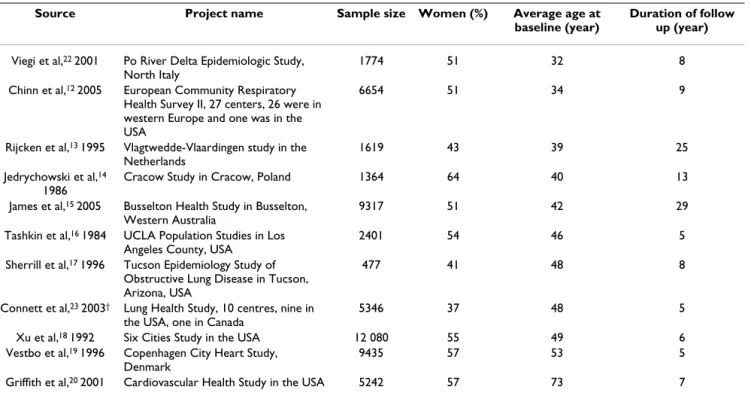
strati-Table 1: Characteristics of studies included in meta-analyses*
Source Project name Sample size Women (%) Average age at
baseline (year)
Duration of follow up (year)
Viegi et al,22 2001 Po River Delta Epidemiologic Study, North Italy
1774 51 32 8
Chinn et al,12 2005 European Community Respiratory Health Survey II, 27 centers, 26 were in western Europe and one was in the USA
6654 51 34 9
Rijcken et al,13 1995 Vlagtwedde-Vlaardingen study in the Netherlands
1619 43 39 25
Jedrychowski et al,14 1986
Cracow Study in Cracow, Poland 1364 64 40 13
James et al,15 2005 Busselton Health Study in Busselton, Western Australia
9317 51 42 29
Tashkin et al,16 1984 UCLA Population Studies in Los Angeles County, USA
2401 54 46 5
Sherrill et al,17 1996 Tucson Epidemiology Study of Obstructive Lung Disease in Tucson, Arizona, USA
477 41 48 8
Connett et al,23 2003† Lung Health Study, 10 centres, nine in the USA, one in Canada
5346 37 48 5
Xu et al,18 1992 Six Cities Study in the USA 12 080 55 49 6
Vestbo et al,19 1996 Copenhagen City Heart Study, Denmark
9435 57 53 5
Griffith et al,20 2001 Cardiovascular Health Study in the USA 5242 57 73 7
fied by gender and smoking status. We excluded cross-sec-tional studies, or studies that evaluated occupacross-sec-tional exposures on lung function. We also excluded studies whose primary focus was on secondhand smoke expo-sures. From each retrieved article, two independent inves-tigators abstracted the following information: project name, sample size, average age at baseline, proportional-ity of women, duration of follow up, and annual decline
rate of FEV1 % pred stratified by gender and smoking
sta-tus (Table 1, Table 2). Any questions or discrepancies regarding these data were resolved through iteration and consensus.
Statistical analysis
We used the annual change in the rate of FEV1% pred
reported in the studies to conduct the primary analyses.
Annual changes in FEV1% pred were calculated by
sub-tracting the final FEV1% pred from the baseline value and
dividing the difference by the number of years of
follow-up. For studies that only provided absolute FEV1 values
[12-20], we calculated FEV1% pred by applying a
pub-lished prediction equation to the absolute values [21]. The reported baseline mean age and height were used in these calculations. For studies that did not report data on the subjects' height [12,14,17-19], we imputed 174 cm for men and 161 cm for women because the populations of these studies had similar race and age profiles as those reported in James's study (Table 2) [15]. We compared the
annual changes in FEV1% pred between women and men
across smoking status by using male values as the referent. A positive value denoted a larger decline in women, while a negative value denoted a larger decline in men. We hypothesized that age might be an important modifier for the relationship between smoking and gender-related
decline in lung function since the incidence of obstructive airways disease in women increases sharply in the post-menopausal period [5]. We used both unweighted and weighted linear regression techniques to assess
gender-related differences in the annual decline of FEV1% pred. In
the weighted analysis, we used the sample size of men and women in each smoking category as the weights. All tests were two-tailed in nature and were performed using statis-tical software SAS (version 9.1, SAS Institute, Carey, N.C).
Results
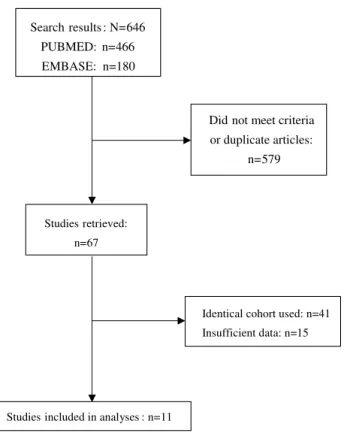
A summary of the search strategy is shown in Figure 1. The original search yielded 466 and 180 citations in PUBMED and EMBASE, respectively. The abstracts of these articles were selected and reviewed. Of these, 67 articles were retrieved for a detailed review. After excluding studies that used identical cohorts (n = 41) and studies that had insuf-ficient data (n = 15), we were left with 11 original studies that met the inclusion criteria. The baseline characteristics of these studies are summarized in Table 1. Collectively, there were 55 709 participants in these studies, 52% were women, and the baseline average age of the cohorts varied from 32 to 73 years. The duration of follow-up ranged from 5 to 29 years.
Table 2 summarizes the annual decline in FEV1% pred in
both men and women according to smoking status. In general, older cohorts experienced a faster decline in
FEV1% pred/yr compared with younger cohorts and
cur-rent smokers had a faster decline in FEV1% pred/yr
com-pared with never smokers. Former smokers had similar
decline rates in FEV1% pred/yr as never smokers. There
were four studies that provided data on lung function changes stratified by the mean daily consumption of ciga-Table 2: Annual decline rate in FEV1% pred/yr in men and women according to smoking status
Source Average age at baseline (year)
Never smokers Former smokers Current smokers
Women Men Difference* Women Men Difference* Women Men Difference*
Viegi et al,22 2001 32 NA NA NA -0.12 -0.21 0.09 0.12 0.13 -0.01
C hinn et al,12 2005 34 0.78 0.76 0.02 0.91 0.76 0.15 0.88 0.84 0.04
Rijcken et al,13 1995 39 0.83 0.96 -0.13 0.89 0.87 0.02 0.97 1.11 -0.14
Jedrychow ski et al,14 1986
40 1.35 1.13 0.22 NA NA NA 1.41 1.46 -0.05
James et al,15 2005 42 0.87 0.91 -0.04 0.99 1.01 -0.02 1.05 1.22 -0.17
Tashkin et al,16 1984
46 1.51 1.70 -0.19 1.36 1.65 -0.29 1.97 2.15 -0.18
Sherrill et al,17 1996 48 0.50 0.44 0.06 0.49 0.85 -0.36 0.66 0.49 0.17
Connett et al,23 2003
48 NA NA NA 0.37 0.07 0.30 1.20 1.05 0.15
Xu et al,18 1992 49 1.08 0.98 0.10 1.11 0.89 0.22 1.42 1.37 0.05
Each cell represents annual change in FEV1% pred/yr, unless otherwise indicated.
rettes [15,18,19,22]. There was a dose-dependent
acceler-ation in the decline of FEV1% pred/yr (Table 3).
In current smokers, with increasing age, women had a
sig-nificantly faster decline in FEV1% pred/yr compared with
men (R2 = 0.56; p = 0.008), while in former and never
smokers, age did not significantly modify the rate of
decline in FEV1% pred/yr between men and women (p =
0.775 and p = 0.326, respectively) (Figure 2). There were no material differences in the results between the weighted and unweighted analyses. The three average
age-difference in FEV1% pred/yr regression lines diverged at
~45 to 50 years of age. As a sensitivity assessment, we repeated the analysis after excluding the study by Griffith and colleagues [20], which appeared to an outlier in Fig-ure 3. In the sensitivity analysis, female compared with
male smokers still had a faster decline in FEV1% pred/yr
(R2 = 0.40; p = 0.050), while in former smokers and never
smokers, there were no gender differences (in former
smokers, R2 = 0.14; p = 0.323; in never smokers, R2 = 0.28
and p = 0.179).
Discussion
The present systematic review indicates that female com-pared with male smokers experienced a faster decline in lung function beyond age 45 to 50 years. This trend was evident even in female smokers who smoked only a mod-est amount of cigarettes (<15 g/day). In non- or ex-smok-ers, there were no significant gender-related changes in
FEV1% pred over time. However, there was considerable
heterogeneity in the results across the studies (see table 2 and figure 3) and as such these data should be interpreted cautiously. Additional prospective longitudinal studies powered specifically on gender-related changes in lung function in the post-menopausal age group are needed to confirm these observations.
The findings from the present study are consistent with other studies, which were not included in this review [21-29]. Prescott and colleagues reported similar findings from two independent population samples: Copenhagen City Heart Study (CCHS) and Glostrup Population Stud-ies (GPS) [24]. In both samples, when adjusted for pack-years of smoking, female smokers had a faster decline in lung function compared with male smokers. In the CCHS,
the estimated excess loss of FEV1 was 7.4 ml per pack-year
in female current smokers and 6.3 ml per pack-year in male current smokers. In the GPS, the estimated excess
loss of FEV1 was 10.5 ml per pack-year in the female
cur-rent smokers and 8.4 ml per pack-year in the male curcur-rent smokers. Importantly, in both samples, even after
adjust-Table 3: Annual decline rate in FEV1% pred/yr for female and male current smokers stratified by the daily amount of cigarette
consumption
Source Average age at baseline (year)
Never smokers < 15 g/day 15 g/day
Women Men Difference* Women Men Difference* Women Men Difference*
Viegi et al,22 2001 32 NA NA NA 0.08 0.12 -0.04 0.22 0.15 0.07
James et al,15 2005 42 0.87 0.91 -0.04 0.97 1.12 -0.15 1.13 1.26 -0.13
Xu et al,18 1992 49 1.08 0.98 0.10 1.16 0.97 0.19 1.51 1.44 0.07
Vestbo et al,1 1996 53 1.00 0.83 0.17 1.23 0.98 0.25 1.32 1.22 0.10
Total -- 0.99 0.91 0.08 1.10 0.95 0.15 1.35 1.23 0.12
Each cell represents annual change in FEV1% pred, unless otherwise indicated.
Symbols: *: A positive number denotes a larger decline in FEV1% pred in women; a negative number denotes a larger decline in FEV1% pred in men. Flow diagram of study selection
Figure 1
Flow diagram of study selection.
Search results : N=646 PUBMED: n=466 EMBASE: n=180
Did not meet criteria or duplicate articles:
n=579
Studies retrieved: n=67
Identical cohort used: n=41 Insufficient data: n=15
ments of daily tobacco consumption and years of smok-ing, female smokers had a higher risk of hospitalization for COPD compared with male smokers (relative risk, RR, 1.5, 95% confidence interval, CI, 1.2–2.1 in the CCHS and RR, 3.6, 95% CI, 1.4–9.0 in the GPS) [24].
Further-more, women with impaired lung function (FEV1 < 40%
pred) had a higher risk of death from all causes (RR, 5.0 for women, 2.7 for men) and of deaths from obstructive lung diseases (RR, 57 for women, 34 for men,) compared with men [25]. Xu and colleagues studied 1 618 male and 1 669 female adults aged 40–69 yrs in the Beijing Respira-tory Health Study [28]. Although female never smokers had better lung function than did male never smokers, female current smokers had significantly lower lung func-tion compared with male smokers [28]. In a genetics study of early onset COPD, Silverman and colleagues found that
female first-degree current or ex-smoking relatives of the probands were almost two times more likely to
demon-strate mild airflow limitation (FEV1 <80% predicted) and
over three times more likely to have severe airflow
limita-tion (FEV1 <40% predicted) than did male relatives [29].
Although the present study did not evaluate effects of smoking cessation on lung function in men and women, data from the Lung Health Study indicates that female quitters may experience larger gains in lung function than do male sustained quitters. In that study, female sustained quitters experienced a 2.5 fold larger improvement in
FEV1% pred than did male sustained quitters after one
year of smoking cessation [30]. These data, in conjunction with results of the present systematic review, suggest that female smokers have increased susceptibility for COPD,
Unweighted analysis of the relationship between age and gender-related differences in the annual decline in FEV1% pred according to smoking status
Figure 2
Unweighted analysis of the relationship between age and gender-related differences in the annual decline in FEV1% pred according to smoking status Abbreviation: FEV1: forced expiratory volume in one second.
D
iff
e
rence in FEV
1
% pr
e
d
/y
ea
r
Fa
st
e
r in
me
n
F
a
st
er
in
w
o
men
-0.4
-0.3
-0.2
-0.1
0.0
0.1
0.2
0.3
0.4
0.5
30
35
40
45
50
55
60
65
70
75
R2
=0.56,
P
=0.008
R2
=0.14,
P
=0.326
R2
=0.01,
P
=0.775
Average age at baseline (year)
Current
Never
Current
Never
Former
Former
D
iff
e
rence in FEV
1
% pr
e
d
/y
ea
r
Fa
st
e
r in
me
n
F
a
st
er
in
w
o
men
-0.4
-0.3
-0.2
-0.1
0.0
0.1
0.2
0.3
0.4
0.5
30
35
40
45
50
55
60
65
70
75
R2
=0.56,
P
=0.008
R2
=0.14,
P
=0.326
R2
=0.01,
P
=0.775
Average age at baseline (year)
Current
Never
Current
Never
Former
especially after age 45 to 50 years. With smoking cessa-tion, however, female quitters may experience a larger recovery of their lung function than do male quitters.
Although our study was not designed to evaluate the effects of smoking in adolescent youths, previous studies indicate that smoking may also have a greater (negative) impact on lung growth in female than male youngsters. Gold et al [31] found that among adolescents, smoking five or more cigarettes a day, as compared with never smokers, was associated with a 1.09% per year reduction
in the growth rate of FEV1 in girls, while for boys, smoking
reduced FEV1 growth by only 0.20%/yr. Patel et al [27]
found that exposure to cigarette smoke during childhood was an independent risk factor for the development of obstructive airways disease in women but not in men.
Thus, the relationship between gender, age and FEV1
changes may be U-shaped.
The mechanisms responsible for the increased susceptibil-ity of women to cigarette smoke are largely unknown. There is now a general consensus that inflammation is at the heart of the pathobiology of COPD and that the inflammatory process involves both the lung (airways and parenchyma) and the systemic circulation [32-34]. The intensity of the inflammatory process in the airways and in the systemic circulation is associated with severity of
FEV1 impairment [33,34]. Whether women are more
likely to demonstrate airway inflammation compared with men is unknown. Interestingly, women in the gen-eral population are known to have higher circulating C-reactive protein levels, a marker of systemic
inflamma-Weighted analysis of the relationship between age and gender-related differences in the annual decline in FEV1% pred for cur-rent smokers
Figure 3
Weighted analysis of the relationship between age and gender-related differences in the annual decline in FEV1% pred for current smokers The regression line is weighted by the numbers of current smokers. The diameter of each circle is proportional to the number of current smokers in each study. Abbreviation: FEV1: forced expiratory volume in one second.
-0.4
-0.3
-0.2
-0.1
0.0
0.1
0.2
0.3
0.4
0.5
30
35
40
45
50
55
60
65
70
75
Diff
ere
n
ce
in
F
E
V
1%
pre
d
/y
e
ar
Fast
e
r in m
e
n
Faste
r
in
wo
me
n
Average age at baseline (year) Chinn12
Rijcken13
Jedrychowski14
James15
Tashkin16
Sherrill17
Connett23
Xu18
Vestbo19
Griffith20
Viegi22
R2
=0.53,
P
=0.011
-0.4
-0.3
-0.2
-0.1
0.0
0.1
0.2
0.3
0.4
0.5
30
35
40
45
50
55
60
65
70
75
Diff
ere
n
ce
in
F
E
V
1%
pre
d
/y
e
ar
Fast
e
r in m
e
n
Faste
r
in
wo
me
n
Average age at baseline (year) Chinn12
Rijcken13
Jedrychowski14
James15
Tashkin16
Sherrill17
Connett23
Xu18
Vestbo19
Griffith20
Viegi22
tion, but only after ~50 years of age [35]. Since active smoking amplifies systemic inflammation, independent of other factors [36], smoking-inflammation pathway may be an important contributor to the increased risk observed in women in the peri and post-menopausal peri-ods. Further research is needed to confirm this hypothesis.
Another potential mechanism may relate to bronchial hyperresponsiveness. In the Lung Health Study, there was a higher prevalence of bronchial hyperresponsiveness among women than among men (85% in women versus 59% of the men) [37]. In another population-based study, Leynaert and coworkers demonstrated increased prevalence of bronchial hyperresponsiveness in women, even after adjustments for respiratory symptoms, atopy, or lung function parameters [38]. Paoletti et al [39] also found increased risk of bronchial hyperresponsiveness among women compared with men independent of base-line lung function. In women, they observed that current smokers had significantly more reactive airways than did non- or ex-smokers. However, in men, smoking status made no material impact on bronchial responsiveness [39]. These data may be clinically relevant since bronchial hyperresponsiveness has been associated with increased risk of both COPD progression [40] and COPD mortality [41].
Additionally, cigarette smoke may modify hormonal sta-tus in women, which may affect lung function. Women who are active smokers become relatively estrogen defi-cient compared with non-smokers because cigarette smoke induces cytochrome P450 isoenzymes CYP1A1 and CYP1A2, which alter estrogen metabolism leading to increased production of inactive catechols [42]. Hormone replacement therapy in the post-menopausal period is associated with improved lung function, reducing the risk of airflow obstruction by ~25% [43]. Hormone replace-ment therapy also reduces bronchial hyperresponsiveness in post-menopausal women [44].
An alternative hypothesis for higher susceptibility of females to smoking may be differences in lung develop-ment between females and males. Interestingly, relative to male rates, female rates of obstructive airway diseases increase sharply during adolescence [45]. Before pubes-cence, girls have smaller lung volumes than do boys but generate higher flows [46]. During teenage years, airways and lung volumes demonstrate isotropic growth in boys. In girls, however, airway growth becomes disproportion-ately smaller relative to lung volume growth, indicating dysanapsis [47]. Thus, for any given lung volume and size, women have smaller airways compared with men, which may make the airways more susceptible to the adverse effects of cigarette smoke.
There were several limitations to the study. Firstly, we used only a crude marker of smoking (i.e. self-report of smoking). Since male smokers generally smoke more cig-arettes than do female smokers and have a longer smok-ing history, we may have underestimated the true effects of cigarette smoking in the female population [9]. Sec-ondly, as with most systematic reviews, publication bias is a source of concern. Figure 3 indicates that there were no material differences in results between large and small studies, suggesting that publication bias did not signifi-cantly affect the results.
Conclusion
We found that beyond age 45 to 50 years, female smokers
appear to experience an accelerated decline in FEV1%
pred/yr compared with male smokers. Additional pro-spective longitudinal studies powered specifically on gen-der-related changes in lung function in the post-menopausal age group are needed to confirm these obser-vations. In view of the growing incidence of smoking and the COPD in the female population, there is an urgent need to promote smoking abstinence and cessation in the female population.
Abbreviations
CCHS: Copenhagen City Heart Study
COPD: chronic obstructive pulmonary disease
FEV1: forced expiratory volume in one second
GPS: Glostrup Population Studies
Pred: predicted
RR: relative risk
Yr: year
Competing interests
This project is supported by ICEBERGS (Interdisciplinary Capacity Enhancement: Bridging Excellence in Respira-tory Disease and Gender Studies), which is funded by the Canadian Institutes of Health Research (IGH / ICRH), the Canadian Lung Association, and the Heart and Stroke Foundation of Canada.
Authors' contributions
All authors have made substantial intellectual contribu-tion to the interpretacontribu-tion of the results and drafting of the manuscript.
Acknowledgements
References
1. Murray CJ, Lopez AD: Alternative projections of mortality and disability by cause 1990–2020: Global Burden of Disease Study. Lancet 1997, 349:1498-1504.
2. Brown CA, Crombie IK, Tunstall-Pedoe H: Failure of cigarette smoking to explain international differences in mortality from chronic obstructive pulmonary disease. J Epidemiol
Com-munity Health 1994, 48:134-139.
3. Michaud CM, Murray CJ, Bloom BR: Burden of disease – implica-tions for future research. JAMA 2001, 285:535-539.
4. Sullivan SD, Ramsey SD, Lee TA: The economic burden of COPD. Chest 2000, 117:5S-9S.
5. Mannino DM, Homa DM, Akinbami LJ, Ford ES, Redd SC: Chronic obstructive pulmonary disease surveillance – United States, 1971–2000. MMWR Surveill Summ 2002, 51:1-16.
6. Zorrilla-Torras B, Garcia-Marin N, Galan-Labaca I, Gandarillas-Grande A: Smoking attributable mortality in the community of Madrid: 1992–1998. Eur J Public Health 2005, 15:43-50. 7. U.S. Department of Health and Human Services: Reducing tobacco
use: a report of the Surgeon General. Atlanta, Georgia: U.S. Department of Health and Human Services, CDC; 2000.
8. Centers for Disease control: Cigarette Smoking Among Adults – United States. 2003 [http://www.cdc.gov/mmwr/preview/ mmwrhtml/mm5420a3.htm#tab].
9. Gillum RF: Frequency of attendance at religious services and cigarette smoking in American women and men: the Third National Health and Nutrition Examination Survey. Prev Med 2005, 41:607-613.
10. Fletcher C, Peto R: The natural history of chronic airflow obstruction. Br Med J 1977, 1:1645-1648.
11. Pauwels RA, Rabe KF: Burden and clinical features of chronic obstructive pulmonary disease (COPD). Lancet 2004, 364:613-620.
12. Chinn S, Jarvis D, Melotti R, Luczynska C, Ackermann-Liebrich U, Anto JM, Cerveri I, de Marco R, Gislason T, Heinrich J, Janson C, Kun-zli N, Leynaert B, Neukirch F, Schouten J, Sunyer J, Svanes C, Ver-meire P, Wjst M, Burney P: Smoking cessation, lung function, and weight gain: a follow-up study. Lancet 2005, 365:1629-1635. 13. Rijcken B, Schouten JP, Xu X, Rosner B, Weiss ST: Airway hyper-responsiveness to histamine associated with accelerated decline in FEV1. Am J Respir Crit Care Med 1995, 151:1377-1382. 14. Jedrychowski W, Krzyzanowski M, Wysocki M: Changes in lung
function determined longitudinally compared with decline assessed cross-sectionally. The Cracow Study. Eur J Epidemiol 1986, 2:134-138.
15. James AL, Palmer LJ, Kicic E, Maxwell PS, Lagan SE, Ryan GF, Musk AW: Decline in lung function in the Busselton Health Study: the effects of asthma and cigarette smoking. Am J Respir Crit
Care Med 2005, 171:109-114.
16. Tashkin DP, Clark VA, Coulson AH, Simmons M, Bourque LB, Reems C, Detels R, Sayre JW, Rokaw SN: The UCLA population studies of chronic obstructive respiratory disease. VIII. Effects of smoking cessation on lung function: a prospective study of a free-living population. Am Rev Respir Dis 1984, 130:707-715. 17. Sherrill DL, Enright P, Cline M, Burrows B, Lebowitz MD: Rates of
decline in lung function among subjects who restart ciga-rette smoking. Chest 1996, 109:1001-1005.
18. Xu X, Dockery DW, Ware JH, Speizer FE, Ferris BG Jr: Effects of cigarette smoking on rate of loss of pulmonary function in adults: a longitudinal assessment. Am Rev Respir Dis 1992, 146:1345-1348.
19. Vestbo J, Prescott E, Lange P: Association of chronic mucus hypersecretion with FEV1 decline and chronic obstructive pulmonary disease morbidity. Copenhagen City Heart Study Group. Am J Respir Crit Care Med 1996, 153:1530-1535.
20. Griffith KA, Sherrill DL, Siegel EM, Manolio TA, Bonekat HW, Enright PL: Predictors of loss of lung function in the elderly: the Car-diovascular Health Study. Am J Respir Crit Care Med 2001, 163:61-68.
21. Hankinson JL, Odencrantz JR, Fedan KB: Spirometric reference values from a sample of the general U.S. population. Am J
Respir Crit Care Med 1999, 159:179-187.
22. Viegi G, Sherrill DL, Carrozzi L, Di Pede F, Baldacci S, Pistelli F, Enright P: An 8-year follow-up of carbon monoxide diffusing capacity in a general population sample of northern italy.
Chest 2001, 120:74-80.
23. Connett JE, Murray RP, Buist AS, Wise RA, Bailey WC, Lindgren PG, Owens GR, Lung Health Study Research Group: Changes in smok-ing status affect women more than men: results of the Lung Health Study. Am J Epidemiol 2003, 157:973-979.
24. Prescott E, Bjerg AM, Andersen PK, Lange P, Vestbo J: Gender dif-ference in smoking effects on lung function and risk of hospi-talization for COPD: results from a Danish longitudinal population study. Eur Respir J 1997, 10:822-827.
25. Lange P, Nyboe J, Appleyard M, Jensen G, Schnohr P: Relation of ventilatory impairment and of chronic mucus hypersecre-tion to mortality from obstructive lung disease and from all causes. Thorax 1990, 45:579-585.
26. Downs SH, Brandli O, Zellweger JP, Schindler C, Kunzli N, Gerbase MW, Burdet L, Bettschart R, Zemp E, Frey M, Keller R, Tschopp JM, Leuenberger P, Ackermann-Liebrich U, SAPALDIA team: Acceler-ated decline in lung function in smoking women with airway obstruction: SAPALDIA 2 cohort study. Respir Res 2005, 6:45. 27. Patel BD, Luben RN, Welch AA, Bingham SA, Khaw KT, Day NE, Lomas DA, Wareham NJ: Childhood smoking is an independent risk factor for obstructive airways disease in women. Thorax 2004, 59:682-686.
28. Xu X, Li B, Wang L: Gender difference in smoking effects on adult pulmonary function. Eur Respir J 1994, 7:477-483. 29. Silverman EK, Chapman HA, Drazen JM, Weiss ST, Rosner B,
Camp-bell EJ, O'DONNELL WJ, Reilly JJ, Ginns L, Mentzer S, Wain J, Speizer FE: Genetic epidemiology of severe, early-onset chronic obstructive pulmonary disease. Risk to relatives for airflow obstruction and chronic bronchitis. Am J Respir Crit Care Med 1998, 157:1770-1778.
30. Scanlon PD, Connett JE, Waller LA, Altose MD, Bailey WC, Buist AS: Smoking cessation and lung function in mild-to-moderate chronic obstructive pulmonary disease. Am J Respir Crit Care
Med 2000, 161:381-390.
31. Gold DR, Wang X, Wypij D, Speizer FE, Ware JH, Dockery DW: Effects of cigarette smoking on lung function in adolescent boys and girls. N Engl J Med 1996, 335:931-937.
32. Barnes PJ, Shapiro SD, Pauwels RA: Chronic obstructive pulmo-nary disease: molecular and cellular mechanisms. Eur Respir J 2003, 22:672-688.
33. Hogg JC, Chu F, Utokaparch S, Woods R, Elliott WM, Buzatu L, Cher-niack RM, Rogers RM, Sciurba FC, Coxson HO, Pare PD: The nature of small-airway obstruction in chronic obstructive pulmonary disease. N Engl J Med 2004, 350:2645-2653. 34. Sin DD, Man SF: Why are patients with chronic obstructive
pulmonary disease at increased risk of cardiovascular dis-eases? The potential role of systemic inflammation in chronic obstructive pulmonary disease. Circulation 2003, 107:1514-1519.
35. Hutchinson WL, Koenig W, Frohlich M, Sund M, Lowe GD, Pepys MB: Immunoradiometric assay of circulating C-reactive protein: age-related values in the adult general population. Clin Chem 2000, 46:934-938.
36. Gan WQ, Man SF, Sin DD: The interactions between cigarette smoking and reduced lung function on systemic inflamma-tion. Chest 2005, 127:558-564.
37. Tashkin DP, Altose MD, Bleecker ER, Connett JE, Kanner RE, Lee WW, Wise R: The lung health study: airway responsiveness to inhaled methacholine in smokers with mild to moderate air-flow limitation. The Lung Health Study Research Group. Am
Rev Respir Dis 1992, 145:301-310.
38. Leynaert B, Bousquet J, Henry C, Liard R, Neukirch F: Is bronchial hyperresponsiveness more frequent in women than in men? A population-based study. Am J Respir Crit Care Med 1997, 156:1413-1420.
39. Paoletti P, Carrozzi L, Viegi G, Modena P, Ballerin L, Di Pede F, Grado L, Baldacci S, Pedreschi M, Vellutini M: Distribution of bronchial responsiveness in a general population: effect of sex, age, smoking, and level of pulmonary function. Am J Respir Crit Care
Med 1995, 151:1770-1777.
40. Tashkin DP, Altose MD, Connett JE, Kanner RE, Lee WW, Wise RA: Methacholine reactivity predicts changes in lung function over time in smokers with early chronic obstructive pulmo-nary disease. The Lung Health Study Research Group. Am J
Respir Crit Care Med 1996, 153:1802-1811.
Publish with BioMed Central and every scientist can read your work free of charge "BioMed Central will be the most significant development for disseminating the results of biomedical researc h in our lifetime."
Sir Paul Nurse, Cancer Research UK
Your research papers will be:
available free of charge to the entire biomedical community
peer reviewed and published immediately upon acceptance
cited in PubMed and archived on PubMed Central
yours — you keep the copyright
Submit your manuscript here:
http://www.biomedcentral.com/info/publishing_adv.asp
BioMedcentral obstructive pulmonary disease: a cohort study. Lancet 2000,
356:1313-1317.
42. Baron JA, La Vecchia C, Levi F: The antiestrogenic effect of ciga-rette smoking in women. Am J Obstet Gynecol 1990, 162:502-514. 43. Carlson CL, Cushman M, Enright PL, Cauley JA, Newman AB, Cardi-ovascular Health Study Research Group: Hormone replacement therapy is associated with higher FEV1 in elderly women. Am
J Respir Crit Care Med 2001, 163:423-428.
44. Mueller JE, Frye C, Brasche S, Heinrich J: Association of hormone replacement therapy with bronchial hyper-responsiveness.
Respir Med 2003, 97:990-992.
45. Skobeloff EM, Spivey WH, St Clair SS, Schoffstall JM: The influence of age and sex on asthma admissions. JAMA 1992, 268:3437-3440.
46. Hibbert ME, Couriel JM, Landau LI: Changes in lung, airway, and chest wall function in boys and girls between 8 and 12 yr. J
Appl Physiol 1984, 57:304-308.
47. Merkus PJ, Borsboom GJ, Van Pelt W, Schrader PC, Van Houwelingen HC, Kerrebijn KF, Quanjer PH: Growth of airways and air spaces in teenagers is related to sex but not to symptoms. J Appl