Original Research Article
Knowledge, attitude and practices regarding breastfeeding and infant
milk substitutes among mothers of upper middle-class society in a baby
friendly hospital initiative accredited hospital of New Delhi, India
Maansi Gangwal, Bindu T. Nair*, Varun Kumar Singh
INTRODUCTION
Breast feeding forms an important practice of mankind. WHO recommends exclusive breastfeeding till 6 months and should be continued till 2 years of age.1,2 The benefits of breastfeeding are innumerable and it is vital for overall growth and development of a child.3,4 The benefits of breastfeeding are not only limited to the baby, but also in many ways positively affect mothers.5
Despite establishment of all these facts, exclusive breastfeeding has remained low in prevalence.6 Despite
strong implementation of IMS Act use of bottle feeding and Infant Milk Substitutes (IMS) has been quite high.7 It has been seen that introduction to formula feeds in initial days of breastfeeding leads to lower rates of exclusive breastfeeding compared to the ones who have not been introduced.8
Literature has ample articles on this issue, but still much is needed to have a better understanding of factors causing cessation of breastfeeding. Also, no such study has been done in India among mothers reporting at a Baby Friendly Hospital Initiative (BFHI) accredited ABSTRACT
Background: Exclusive breastfeeding is considered a major public health intervention to promote both child and maternal health. Introduction and awareness of infant milk substitutes among mothers appear as a threat to this important practice.
Methods: The study is an observational cross-sectional study using a questionnaire containing socio-demographic variables. The study was conducted among 300 mothers who reported to immunization clinic and paediatrics OPD of a BFHI accredited hospital in Delhi. Data collected in the study has been analysed using SPSS version 21.0 and MS-Excel. Student ‘t’ test for quantitative variables and ‘chi square test’ for categorical variable have been used for statistical significance. p-value <0.05 was considered to be significant.
Results: In this study 78.7% mothers intended to breastfeed. 71.3% knew that breastfeeding should be continued up to 2 years and 96.3% knew exclusive breastfeed should be given till 6months. Major source of knowledge were doctors and elders of society. However, 49.6% mothers started breastmilk substitutes before 6 months of age. Major causes that appeared as barriers against exclusive breastfeeding were insufficient quantity of milk (23.4%), child refusal (61%) and maternal health problems (15.6%).
Conclusions: Despite good knowledge about breastfeeding among upper middle-class mothers, practice of exclusive breastfeeding remains suboptimal. There is a need for more reinforcement upon importance of breastfeeding, its benefits for both mother and baby so as to foster the practice.
Keywords: Baby friendly hospital initiative,Breast feeding, Infant milk substitutes, Knowledge, Practice Department of Paediatrics, Army College of Medical Sciences, New Delhi, India
Received: 30 October 2019 Revised: 12 November 2019 Accepted: 28 November 2019
*Correspondence: Dr. Bindu T. Nair,
E-mail: [email protected]
Copyright: © the author(s), publisher and licensee Medip Academy. This is an open-access article distributed under the terms of the Creative Commons Attribution Non-Commercial License, which permits unrestricted non-commercial use, distribution, and reproduction in any medium, provided the original work is properly cited.
hospital.9 A similar study has been done in Bangalore on urban population, assessing Knowledge, Attitude and Practice (KAP) but it doesn't clearly specify the prevalence of breastfeeding and formula feeds’ exposure among different socioeconomic classes of urban population.10
This study aims to give a better insight of not only breastfeeding practices but also of attitude and practices regarding formula feeding among 'upper middle class' population. It aims to understand the impact of education and occupation of mothers on feeding practices, attitude and knowledge in a better way. It also aims to evaluate 'BFHI practices' and its effect on breastfeeding after discharge from hospital.
Aim and objectives of the study were assessment of knowledge, attitude and practices of breastfeeding and infant milk substitutes among mothers of ‘upper middle-class society’ in New Delhi with respect to various socio-demographic and cultural variables and to assess the impact of Baby Friendly Hospital Initiative on feeding practices after discharge from hospital.
METHODS
The study was conducted in a time frame of two months from 30 June 2017 to 30 August 2017 in a BFHI accredited hospital. 300 mothers reporting at Immunization Clinic and Pediatrics Outpatient Department with their babies of age 6 weeks to 24 months were included in the study.
The Study setting and design of this study was conducted among mothers who delivered at Base Hospital, Delhi Cantt which is a BFHI accredited hospital. All mothers included in the study belong to upper middle class as per modified Kuppuswamy socio-economic scale.11 They were interviewed on reporting with their babies at Immunization Clinic or Pediatrics Outpatient Department. The study is an observational study of cross-sectional design using a questionnaire containing socio-demographic variables and 4 sections.
The Study Population was conducted on mothers reporting at Immunization Clinic and Pediatrics Outpatient Department with their babies of age 6 weeks to 24 months.
The Sample size was calculated by convenience random sampling, i.e., 300 mothers. The study subjects were included in the study by systematic random sampling. Every 5th mother visiting the study site after applying the inclusion criterion was selected for the study.
Inclusion criteria
• Mothers with babies in the age group of 6 weeks to 24 months and born in Base Hospital, Delhi Cantt.
• Mothers who consent to take part in the study.
• Mothers belonging to upper middle-class society.
Exclusion criteria
• Mothers with long-standing diseases restricting breast feeding.
• Mothers who are/were on long term medications (Anti-cancer drugs, thyroxine, sedatives) for six months postpartum.
• Infants with congenital anomalies restricting breastfeeding.
• Mothers who have taken part in such a study earlier.
• Mothers not carrying their babies along them.
Data Collection Procedure of mothers falling in the selection criteria were included in the study after an informed written consent. The KAP was assessed on the basis of a questionnaire which contains 4 sections other than socio-demographic variables.
Section-A Knowledge Questionnaire
Section-B Iowa Infant Feeding Attitude Scale Section-C Postpartum bonding questionnaire Section-D Practices Questionnaire
The 'knowledge' and 'postpartum bonding' questionnaire has been used in a study conducted by Vijayalakshmi P et al, in Bangalore.10,12 It has been included in the study after addition of some questions related to IMS feeding. Informed consent has been taken by the authors of the study for modifying the existing questionnaire.
Attitude has been assessed by an internationally standardized scale, Iowa Infant Feeding Attitude Scale (IIFAS). Only a few studies in India have been done using this standard attitude scale. It is a reliable scale for evaluation in cross-cultural settings and has been validated in Indian settings. (Cronbach's alpha scores ranging from .85-.86).
The 'Practice' Questionnaire is a self-prepared questionnaire. It assesses the current feeding practices of breast milk and infant milk substitutes. The questionnaires were pretested on 40 postnatal mothers in Pediatrics OPD setting during the month of December 2016, to check the credibility of questions added in the knowledge and practice questionnaire.
Statistical analysis
have been used for statistical significance. p-value <0.05 is considered for decision making.
Quality controls of mothers were interviewed relating to knowledge, attitude and practices of breastfeeding and formula feedings as per the questionnaire, under supervision of the guide. A small sample of mothers was interviewed by the guide independently, to note the trends.
It was assured that all their doubts pertaining to feeding practices are cleared either by researcher or with the help of guide.
Ethical considerations
All participants have been included in the study only after taking consent. No mother has participated in the study unwillingly. There was no harm to the morals and self-dignity of the patient. Ethical clearance form from IEC has been attached.
RESULTS
The study included 300 mothers belonging to an age group of 27.00±4.038 years (Mean±S.D.). The demographic and sociocultural details of the sample population are shown in table 1. Other significant findings were
• Breastfeeding intention of mothers: 78.7% mothers said that they intended to breastfeed. The causes of breastfeeding unwillingness among these 21.3% mothers was health problems (15.6%), insufficient quantity of milk (23.45%) and refusal by infant in 61.00%.
• Incidence of illnesses in infants in first 6 months of life: Only 19.3% infants were disease free. As much as 80.7% children suffered from illnesses during first 6months of life. Various diseases encountered were respiratory tract infections (32%), diarrhea (23.8%), jaundice (11.2%), miscellaneous like urinary tract and skin infections etc. (13.7%). Table 2 shows in details the knowledge of mothers towards breastfeeding and formula feeding.
• Source of knowledge about breastfeeding: 78.57% mothers claimed doctors as their source of knowledge. Besides doctors, 28.58% also credited elders, 14.28% credited relatives and friends, and 7.14% credited mass media too. 14.28% of mothers said they have gained knowledge about breastfeeding from elders only and 7.15% claimed that they gained knowledge only through relatives and friends.
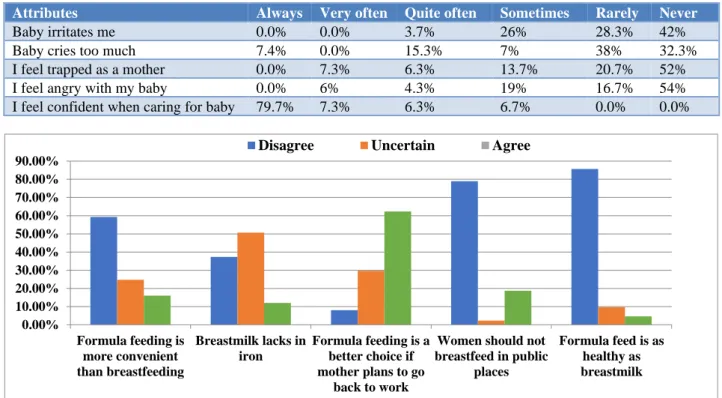
Figure 1 shows the attitude of mothers towards breastfeeding and formula feeding as per Iowa Infant Feeding Attitude Scale (IIFAS). While 16% believed formula feeding is more convenient, 59.3% mothers were of opinion that breastfeeding is more convenient and 24.7% were indecisive. Only 12% agreed that breast milk
lacks in iron. More than half of the mothers believed formula feeding is a better choice if mothers plan to go back to work. Nearly three fourth of mothers agreed that they can breastfeed in public places. Many women (85.7%) didn’t consider formula milk as healthy as breast milk.
Table 1: Demographic and socio-cultural details of participants.
Total number of participants (n) 300
Age of Mother (years) 27.00±4.038 Socio-demographic data N %
Age of child
6 weeks- 6 months 86 28.7% 6 months- 12 months 193 64.3% >12 months-24 months 21 7.0% Gender of
child
Female 146 48.7%
Male 154 51.3%
Birth order
1 196 65.3%
2 85 28.3%
>2 19 6.3%
Type of delivery
Vaginal delivery 235 78.3% Caesarean section 65 21.7%
Education of mother
High school 41 13.7% Graduation 232 77.3% Post-graduation 27 9.0% Occupation
of mother
Housewife 266 88.7%
Working 34 11.3%
Religion
Hindu 246 82%
Sikh 37 12.3%
Christian 11 3.7%
Muslim 6 2.0%
Table 3 shows postpartum bonding between mothers and babies as assessed using a postpartum questionnaire. 79.7% mothers agreed that they ‘always’ feel confident while taking care of baby. 54% mothers ‘never’ feel angry with their babies, 16.7% said rarely.
Only 10.3% said they feel angry with their babies ‘often’ or ‘very often’. Only 3.7% mothers said that their baby irritates them.
Table 2: Knowledge of mothers towards breastfeeding and formula feeding.
Variables % of mothers who agreed
Colostrum is important for maintain immunity 93.7% Breastfeeding should be continued up to 2 years 71.3% Exclusive breastmilk should be given till 6 months of life 96.3% Mother should maintain eye to eye contact and talk to baby while breastfeeding 52% Wash each breast with warm water before breastfeeding 53.7% Breastfeeding helps in mother and child bonding 93% Breastfeeding can prevent diseases affecting breast 50.7% Mothers should ‘not’ feed the child when baby suffers from diarrhea 53.7% Breastmilk is easily digested as compared to formula milk and animal milk 98.3% Formula feeding and bottle feeding predispose baby to infections 72.3%
Table 3: Postpartum bonding.
Attributes Always Very often Quite often Sometimes Rarely Never
Baby irritates me 0.0% 0.0% 3.7% 26% 28.3% 42%
Baby cries too much 7.4% 0.0% 15.3% 7% 38% 32.3%
I feel trapped as a mother 0.0% 7.3% 6.3% 13.7% 20.7% 52%
I feel angry with my baby 0.0% 6% 4.3% 19% 16.7% 54%
I feel confident when caring for baby 79.7% 7.3% 6.3% 6.7% 0.0% 0.0%
Figure 1: Attitude towards breast feeding and formula feeding.
Figure 2: Time of initiation of breastmilk substitutes.
DISCUSSION
This cross-sectional study has been done among 300 mothers with babies born in a BFHI accredited hospital and currently in the age group of 6 weeks to 24 months. The study has included participants belonging to upper middle-class society. This inclusion criterion has made the comprehension of trends among the more privileged and educated part of the society in a better way. Many studies have been done on KAP of breastfeeding but there is no clear specification of effect of socioeconomic status on the results.
With modernization in the country, there is an increased level of education and varied nature of occupation can
0.00% 10.00% 20.00% 30.00% 40.00% 50.00% 60.00% 70.00% 80.00% 90.00%
Formula feeding is more convenient than breastfeeding
Breastmilk lacks in iron
Formula feeding is a better choice if mother plans to go
back to work
Women should not breastfeed in public
places
Formula feed is as healthy as breastmilk
Disagree Uncertain Agree
Do not Give Breast
Milk Substitutes
, 41.70%
Started from the Beginning,
12.30%
Started between 2-6 months,
37.30%
Started after 6 months,
8.70% Give
Breastmilk Substitutes
also be seen among women. Hence, it is inevitable that it will affect knowledge, attitude and practices of breastfeeding. Studies have shown higher rates of exclusive breastfeeding among poorer sections of the society.13 Keeping this in mind and to make the objective of the study more achievable, the study has been done on the richer part of the population. Since, upper class of the society is difficult to seek for in a government hospital, the study has included upper middle class as the representative of richer part of population.
The mean age of mothers is found to be higher (27.00±4.038 years) than in other studies. Out of 300, 281(93.6%) babies were of birth order 2 or less. While in the study done in Bangalore from where a part of the questionnaire has been referred to, the mean age of participants is 23.07±3.50.10,14 This portrays the fact that women in the educated and privileged part of population chose to become mothers at a later age. This factor can be considered as an important influence in the practices and attitude of the mothers. A study has shown higher rates of awareness of breastfeeding practices among older groups.15 72.7% women either rarely or never felt being trapped as a mother, which is a good indication of postpartum bonding between mother and baby.
80.3% mothers have the highest degree as graduation or more. This is in contrast to the similar studies conducted by Vijayalakshmi et al, and Chinnasam B et al, where nearly half of the population were illiterate or only primarily educated.10,14 Despite this large difference between educational status of mothers, there appears not much difference between the knowledge quotients. 93.7% women knew the importance of colostrum in maintaining the immunity of baby. While a relatively lesser percentage, 71.3% agreed that breastfeeding should be continued till 2 years of age, a larger number of 289 mothers (96.3%) knew that exclusive breastmilk should be given during first 6 months of age. While this finding is consistent with that of the study done in Bangalore.10 Some studies in contrast show good knowledge among mothers about breastfeeding till 2 years too.16,17
Although 96.3% mothers knew that exclusive breastmilk should be given during first 6 months of age, 49.6% started breastmilk substitutes before 6 months of age. The rest were practicing/ have practiced Exclusive Breastfeeding (EBF). The prevalence of EBF is almost equal to that in Iran.18 Although 62.3% mothers were in unison with the statement that formula feeds are a better choice if mothers plan to go back to work, only 32.3% of working mothers (11 out of 34) reasoned their occupation as the cause of introduction of formula feeds or not breastfeeding exclusively. The finding is in unison with studies done in India.1,14,18 But the studies done in Malaysia and Saudi Arabia, suggest mother’s occupation as the main cause.19,20
Lack of confidence and unhealthy relationship between mother and baby can hinder milk ejection. But correct
attitude and positive emotions helps the milk ejection reflex. So, author included variables related to attitude and postpartum bonding also in the study. Attitude has been assessed by an internationally standardized scale, Iowa Infant Feeding Attitude Scale (IIFAS). Only a few studies in India have been done using this standard attitude scale. It is a reliable scale for evaluation in cross-cultural settings and has been validated in Indian settings.
'Postpartum bonding' questionnaire has been used in a study conducted by Vijayalakshmi P et al, in Bangalore.10 It has been included in the study after addition of some questions related to IMS feeding. Informed consent has been taken by the authors of the study for modifying the existing questionnaire. On evaluation of results it was seen, though many women agreed that they can breastfeed in public places and that formula feed is not as healthy as breastmilk, only a few were aware that breastmilk lack in iron. Also, more than half of the mothers said that breastfeeding is way more convenient than formula feeding.
On the contrary, almost two thirds of mothers opined that formula feeding is a better choice if mother plan to go back to work. Very few (12%) knew that breastmilk lacks in iron. Figure 1 depicts the attitude among mothers regarding breastfeeding and infant milk substitutes. Although 96.3% mothers knew that exclusive breastmilk should be given during first 6 months of age, 49.6% started breastmilk substitutes before 6months of age. This gap between knowledge and practice needs to be addressed.
BFHI practices by WHO constitute having a written breastfeeding policy that is routinely communicated to all health care staff and effective communication of breastfeeding practices to mothers. 78.57% mothers prefer doctors as their counsellors and consider doctors as their source of knowledge. The findings of the study bring out good indicators of BFHI practices and impact on mothers. On the other hand, it also emphasizes the need for strengthening and assessment of BFHI practices in the hospital as many mothers were still unaware of the finer details of breastfeeding. Facts like washing of breast, proper ways of breastfeeding, continuing breastfeeding even if baby is suffering from diarrhoea, its importance for mothers were all not well known among participants. Despite a higher level of education in majority of mothers, such facts were less known and understood by them. The study throws light on the areas of lack of knowledge. If this gap is filled, there would be better incidence of breastfeeding.
questionnaires and the ones which have been used in a similar study. Also, they were pretested before initiation of the study to assure upon the credibility of the questions added. The literature is full of articles related to breastfeeding knowledge, attitude and practices, but not many focus on infant milk substitutes.
Although the present study has been able to achieve its objectives, it has limitations being of cross-sectional design. To assess BFHI practices in a better way, a prospective cohort design would be more apt. Such studies may be done in future by interviewing mothers at delivery and then after 6 months. Also, deeper cultural and anthropological studies need to be done to evaluate correlation between major factors (which cause cessation of breastfeeding) and exclusive breastfeeding.
Also, doing a similar study among different socioeconomic classes can be of interest, as it would lead to better and more reliable comparison. It will help in understanding good and bad practices and deficient areas of knowledge of each class. The present study has included upper middle-class society as the representative of richer part of population because ‘upper class’ is difficult to seek for in government institutions. Future studies can include mothers visiting private hospitals.
Despite these limitations, present study has been able to assess KAP related to breastfeeding and IMS. It has been able to comprehend deficient areas of knowledge among mothers of upper middle class of society. Practices like IMS feeding, early introduction of IMS, and the reasons behind them among the richer part of population are understood in a better way. Mothers who had initiated IMS early to their babies were counselled and importance of breastfeeding was reinforced.
CONCLUSION
There is optimal knowledge among mothers of educated part of society but there exists a gap between knowledge and practice which needs to be addressed. Doctors and hospital staff need to do more reinforcement of breastfeeding among mothers after delivery so as to improve exclusive breastfeeding prevalence among this part of society.
ACKNOWLEDGEMENTS
Authors are highly grateful to the Department of Bio Statistics in helping us with the statistical analysis of the study.
Funding: No funding sources Conflict of interest: None declared
Ethical approval: The study was approved by the Institutional Ethics Committee
REFERENCES
1. Aidam BA, Perez-Escamilla R, Lartey A. Lactation counseling increases exclusive breast-feeding rates in Ghana. The J Nutr. 2005;135(7):1691-5.
2. Ogunlesi TA, Dedeke IO, Okeniyi JA, Oyedeji GA. The impact of the baby freindly hospital initiative on breastfeeding prectices in Ilesa. Nigerian J Paediatr. 2005;32(3):46-51.
3. Mihrshahi S, Tait H, Haider R, Ara G, Kabir I, Dibley MJ. Characteristics and experiences of peer counsellors in urban Dhaka: a structured interview study. Intern Breastfeeding J. 2019;14(1):48. 4. Mathias JG, Zhang H, Soto-Ramirez N, Karmaus
W. The association of infant feeding patterns with food allergy symptoms and food allergy in early childhood. Intern Breastfeeding J. 2019;14(1):43. 5. Hale R. Infant nutrition and the benefits of
breastfeeding. British J Midwifery. 2007;15(6):368-71. 6. Anatolitou F. Human milk benefits and breastfeeding. J Pediatr Neonatal Individualized Med (JPNIM). 2012;1(1):11-8.
7. Cai X, Wardlaw T, Brown DW. Global trends in exclusive breastfeeding. Int Breastfeed J. 2012;28:12 .
8. Pries AM, Huffman SL, Adhikary I, Upreti SR, Dhungel S, Champeny M, et al. Promotion and prelacteal feeding of breastmilk substitutes among mothers in Kathmandu Valley, Nepal. Maternal Child Nutrit. 2016;12:8-21.
9. Waite WM, Christakis D. The Impact of Mailed Samples of Infant Formula on Breastfeeding Rates. Breastfeeding Med. 2016;11(1):21-5.
10. Vijayalakshmi P, Susheela T, Mythili D. Knowledge, attitudes, and breast-feeding practices of postnatal mothers: A cross sectional survey. Intern J Health Sci. 2015;9(4):364.
11. Shaikh Z, Pathak R. Revised Kuppuswamy and BG Prasad socio-economic scales for 2016. Intern J Commun Med Pub Health. 2017;4(4):997-9. 12. Mora AD, Russell DW, Dungy CI, Losch M,
Dusdieker L. The Iowa Infant Feeding Attitude Scale: Analysis of Reliability and Validity 1. J Appl Social Psychol. 1999;29(11):2362-80.
13. Rasania SK, Singh SK, Pathi S, Bhalla S, Sachdev TR. Breast-feeding practices in a maternal and child health Centre in Delhi. Health Popul Perspect Issues. 2003;26(110):15.
14. Chinnasami B, Sundar S, Kumar J, Sadasivam K, Pasupathy S. Knowledge, attitude and practices of mothers regarding breastfeeding in a South Indian Hospital. Biomed Pharmacol J. 2016;9(1):195-9. 15. Harnagle R, Chawla PS. A study of knowledge,
attitude and practices (KAP) of lactating mothers on breast feeding, weaning immunization and dietary practices at Jabalpur cantonment, India. Int J Curr Microbiol App Sci. 2013;2(11):393-403.
breast-feeding-a questionnaire survey in an urban population of western Nepal. Pub Health Nutrit. 2007;10(2):192-7.
17. Vafaee A, Khabazkhoob M, Moradi A, Najafpoor AA. Prevalence of exclusive breastfeeding during the first six months of life and its determinant factors on the referring children to the health centers in Mashhad, Northeast of Iran-2007. J Appl Sci. 2010;10(4):343-8.
18. Oommen A, Vatsa M, Paul VK, Aggarwal R. Breastfeeding practices of urban and rural mothers. Ind Pediatr. 2009;46(10).
19. Tan KL. Knowledge, attitude and practice on breastfeeding in Klang, Malaysia. Int Med J. 2009;8(1):17-21.
20. Ayed AA. Knowledge, attitude and practice regarding exclusive breastfeeding among mothers attending primary health care centers in Abha city. Int J Med Sci Pub Health. 2014;3(11):1355-63.
21. Forster DA, McLachlan HL, Lumley J. Factors associated with breastfeeding at six months postpartum in a group of Australian women. International Breastfeeding J. 2006;1(1):18.
22. Dungy CI, McInnes RJ, Tappin DM, Wallis AB, Oprescu F. Infant feeding attitudes and knowledge among socioeconomically disadvantaged women in Glasgow. Maternal Child Health J. 2008;12(3):313-22. 23. Khassawneh M, Khader Y, Amarin Z, Alkafajei A. Knowledge, attitude and practice of breastfeeding in the north of Jordan: a cross-sectional study. Intern Breastfeeding J. 2006;1(1):17.
Cite this article as: Gangwal M, Nair BT, Singh VK. Knowledge, attitude and practices regarding