R E S E A R C H
Open Access
COPD association and repeatability of blood
biomarkers in the ECLIPSE cohort
Jennifer A Dickens
1†, Bruce E Miller
2†, Lisa D Edwards
3, Edwin K Silverman
4, David A Lomas
1*†and
Ruth Tal-Singer
2†, for the Evaluation of COPD Longitudinally to Identify Surrogate Endpoints (ECLIPSE)
study investigators
Abstract
Background:There is a need for biomarkers to better characterise individuals with COPD and to aid with the development of therapeutic interventions. A panel of putative blood biomarkers was assessed in a subgroup of the Evaluation of COPD Longitudinally to Identify Surrogate Endpoints (ECLIPSE) cohort.
Methods:Thirty-four blood biomarkers were assessed in 201 subjects with COPD, 37 ex-smoker controls with normal lung function and 37 healthy non-smokers selected from the ECLIPSE cohort. Biomarker repeatability was assessed using baseline and 3-month samples. Intergroup comparisons were made using analysis of variance, repeatability was assessed through Bland-Altman plots, and correlations between biomarkers and clinical characteristics were assessed using Spearman correlation coefficients.
Results:Fifteen biomarkers were significantly different in individuals with COPD when compared to former
or non-smoker controls. Some biomarkers, including tumor necrosis factor-a and interferon-g, were
measurable in only a minority of subjects whilst others such as C-reactive protein showed wide variability over the 3-month replication period. Fibrinogen was the most repeatable biomarker and exhibited a weak correlation with 6-minute walk distance, exacerbation rate, BODE index and MRC dyspnoea score in COPD subjects. 33% (66/201) of the COPD subjects reported at least 1 exacerbation over the 3 month study with 18% (36/201) reporting the exacerbation within 30 days of the 3-month visit. CRP, fibrinogen interleukin-6 and surfactant protein-D were significantly elevated in those COPD subjects with exacerbations within 30 days of the 3-month visit compared with those individuals that did not exacerbate or whose exacerbations had resolved.
Conclusions:Only a few of the biomarkers assessed may be useful in diagnosis or management of COPD where the diagnosis is based on airflow obstruction (GOLD). Further analysis of more promising biomarkers may reveal utility in subsets of patients. Fibrinogen in particular has emerged as a potentially useful biomarker from this cohort and requires further investigation.
Trial Registration:SCO104960, clinicaltrials.gov identifier NCT00292552
Keywords:Biomarkers, Chronic Obstructive Pulmonary Disease (COPD), Evaluation of COPD Longitudinally to Iden-tify Surrogate Endpoints (ECLIPSE), Inflammation
* Correspondence: [email protected]
†Contributed equally
1
Department of Medicine, University of Cambridge, Cambridge Institute for Medical Research, Cambridge, UK
Full list of author information is available at the end of the article
Background
Chronic obstructive pulmonary disease (COPD) is a major cause of global morbidity and mortality and is predicted to become the third leading cause of death by 2020 [1]. It is a multicomponent condition involving both local and systemic pathological processes that include airway obstruction, emphysema, mucus hyperse-cretion, loss of lean body mass and an increased risk of cardiovascular disease [2]. The most widely used marker of disease severity and progression is the forced expira-tory volume in one second (FEV1). However FEV1
corre-lates poorly with both symptoms and other measures of disease progression [3]. Moreover it does not differenti-ate between the causes of airflow obstruction (i.e. small airways disease or emphysema) or identify the extra-pul-monary manifestations of COPD. There is clearly a need for biomarkers that can aid with the diagnosis, risk stra-tification and the assessment of therapeutic interven-tions. The search for biomarkers has centred around proteins and other molecules in exhaled breath conden-sate, sputum, urine, bronchoalveolar lavage and blood that have been implicated in the pathogenesis of COPD [4]. Profiling of blood biomarkers has identified a num-ber of biomarkers that may distinguish individuals with COPD from control subjects [5]. However, additional research is needed to determine the value of biomarkers in characterizing COPD patients, following disease pro-gression, and/or the ability to serve as intermediate or surrogate endpoints in clinical studies.
We have used the ECLIPSE (Evaluation of COPD Longitudinally to Identify Surrogate Endpoints) cohort to evaluate a number of previously reported biomarkers, and to identify new biomarkers for COPD [6]. This cohort has already been used to evaluate serum CC-16, surfactant protein D (SP-D) and CCL-18/PARC. SP-D and CCL-18/PARC were elevated and CC-16 was decreased in individuals with COPD when compared to control subjects [7-9]. We report here the assessment of a panel of 34 biomarkers in a subgroup of individuals from the ECLIPSE cohort. The biomarkers were selected based on previous work suggesting their potential asso-ciation with the pathogenesis of COPD [5,10].
Methods
A sub-group of individuals was selected from the ECLIPSE study (SCO104960, Clinicaltrials.gov identifier NCT00292552) as the “biomarker cohort” in order to evaluate 34 potential blood biomarkers in COPD [7,8]. The aims and operational aspects of ECLIPSE have been described elsewhere [6]. Briefly ECLIPSE is a 3-year multicentre, longitudinal, prospective study to identify novel endpoints in COPD. Individuals aged 40-75 years were recruited to the study if they had a smoking
history of ≥ 10 pack-years, a post bronchodilator ratio between forced expiratory volume in 1 second (FEV1)
and forced vital capacity (FVC)≤0.7 and Global Initia-tive on ObstrucInitia-tive Lung Disease (GOLD) stage II (FEV150-80% predicted), III (FEV130-50% predicted) or
IV (FEV1 < 30% predicted) COPD. Smoking (≥10
pack-years) and non-smoking (< 1 pack-year) control subjects were enrolled if they were aged 40-75 years and had normal lung function (post bronchodilator FEV1> 85%
predicted and FEV1/FVC ratio > 0.7). The “biomarker
cohort” consisted of 275 subjects (201 COPD subjects with GOLD stage II-IV disease, 37 ex-smoker controls and 37 non-smoker controls) matched to the full ECLIPSE cohort. Only former smokers were included to avoid the influence of acute cigarette smoke exposure that might increase variability in our relatively small sample size.
The methods used to evaluate lung function and the extent of emphysema have been described previously [8]. The number of exacerbations was assessed by tele-phone contact on a monthly basis enquiring about details of contact with doctors or hospital and the need to take medications for exacerbations (oral steroids and/ or antibiotics) [11]. Exercise capacity was measured at enrolment with a standard supervised six-minute walk test. Assessments of depression, fatigue and level of dys-pnoea were assessed with the CES-D (centre of epide-miological studies depression scale) [12], FACIT (functional assessment of chronic illness therapy) [13] and modified MRC (Medical Research Council) [14] dyspnoea scores, respectively.
Measurement of blood biomarkers
Repeatability over two visits was assessed by measur-ing biomarker levels at baseline and at 3 months. The analysis included all subjects that had appropriate sam-ples at the respective timepoints. In addition, 5 serum biomarkers were assessed at a single timepoint at the 6 months study visit: adiponectin, b-defensin-2, CXCL7 (chemokine (C-X-C motif) ligand 7), leptin and MMP-8 (matrix metalloproteinase 8). Additional details of the assay methods as well as assay performance information are available in additional file 1.
Statistical Analysis
Variability of analytes was assessed through Bland-Alt-man plots and frequency histograms. Due to non-nor-mality of biomarker results as identified by Shapiro-Wilk and Kolmogorov-Smirnov tests, all values in the biomarker cohort were log-transformed prior to analysis. All comparisons between groups were then conducted by analysis of variance (ANOVA) based on the log-transformed values with adjustment made for differences in age and sex seen between the three groups. Spearman correlation coefficients (based on ranks) were calculated
for correlations between biomarkers and clinical para-meters. Analyte results that were below the limit of quantification (LLOQ) were imputed as 1/2 times the LLOQ. All analyses were performed with SAS® Version 9.1 (SAS Institute, Cary, NC). Differences were consid-ered significant if p≤0.05. No adjustments were made for multiple comparisons.
Ethics
The ECLIPSE study was conducted in accordance with the Declaration of Helsinki and ICH Good Clinical Prac-tice Guidelines. The study protocol was approved by the local ethics committees for all 46 participating sites in 12 countries. All participants gave written informed consent.
Results
Assessment of biomarkers in COPD and control subjects The characteristics of the cohort selected for the bio-marker analysis are shown in Table 1. The cohort con-sisted of 201 individuals (all former smokers) with GOLD stage II-IV COPD, 37 smoker controls and 37 non-smoker controls. There were fewer males in the
Table 1 Baseline characteristics of the biomarker cohort
Characteristic COPD Subjects Smoker Controls Non-smoker Controls
Number 201 37 37
Age (yrs) 64.5 (6.0) 60.7 (7.6) 60.0 (8.8)
Male (%) 73% 68% 38%
Smoking, pack-years 45.7 (26.9) 29.3 (16.5) 0.0 (0.2)
FEV1% predicted 43.8 (17.2) 109.6 (12.3) 115.9 (11.9)
% Low attenuation area on CT (< -950HU) 22.7 (13.7) 4.6 (4.5) 5.3 (5.5)
Radiologist Score < 5% emphysema 20% 95% 97%
5-25% emphysema 18% 5% 0
25-50% emphysema 15% 0 3%
> 50% emphysema 48% 0 0
% reversibility FEV1 9.6 (11.2) 3.7 (5.1) 2.2 (4.9)
BMI 26.9 (5.5) 29.2 (4.9) 27.1 (6.1)
Fat free mass index 17.1 (2.6) 18.2 (2.5) 16.8 (2.6)
Number of exacerbations in year prior to enrollment in ECLIPSE 0 46% 100% 97%
1 26% 0 3%
2 18% 0 0
3 or more 10% 0 0
6 min walk (m) 384 (124)
BODE Index 3.4 (2.2)
mMRC score 1.9 (1.1) 0.2 (0.5) 0.1 (0.4)
CES-D score 11.5 (9.0) 7.1 (8.8) 5.3 (5.1)
FACIT score 34.8 (10.6) 44.4 (8.4) 47.4 (4.3)
SGRQ-C Total score 52.9 (18.9) 8.4 (11.9) 2.5 (2.3)
BMI = Body Mass Index; BODE = BMI (B), airflow obstruction (O) as measured by the post-bronchodilator FEV1(percentage of predicted value), dyspnoea (D)
assessed by the modified Medical Research Council (mMRC) score, and exercise tolerance (E) measured by 6-minute walking distance; FEV1= Forced Expiratory
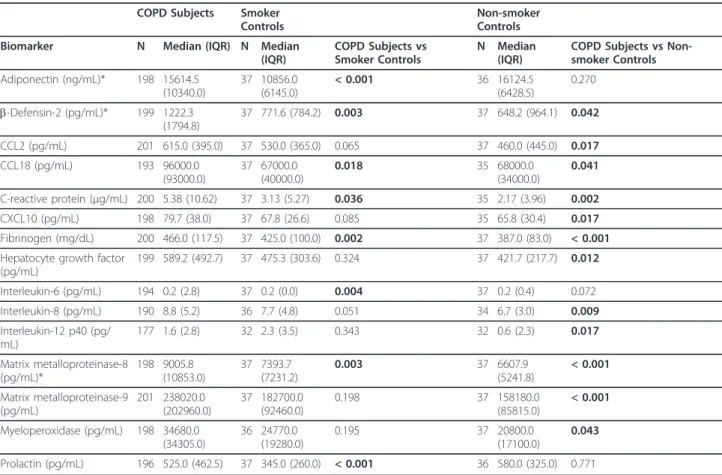
non-smoker control group and individuals in both con-trol groups were on average younger than COPD sub-jects; multivariate analysis was used to adjust for age and sex prior to comparison of data between groups. Comparisons were made between potential biomarkers in COPD subjects and both smoker and non-smoker controls with normal lung function. At baseline, 15 ana-lytes were significantly different between COPD subjects and either smoker or non-smoker controls: adiponectin,
b-defensin-2, CRP (C-reactive protein), CCL18 (Chemo-kine (C-C motif) ligand 18), fibrinogen, hepatocyte growth factor, CXCL10, IL-12p40, IL-6, IL-8, MMP-8, MMP-9, CCL2, myeloperoxidase and prolactin (Table 2). Significant differences between individuals with COPD and both control groups were seen withb -defen-sin-2, CRP, CCL18, fibrinogen and MMP-8.
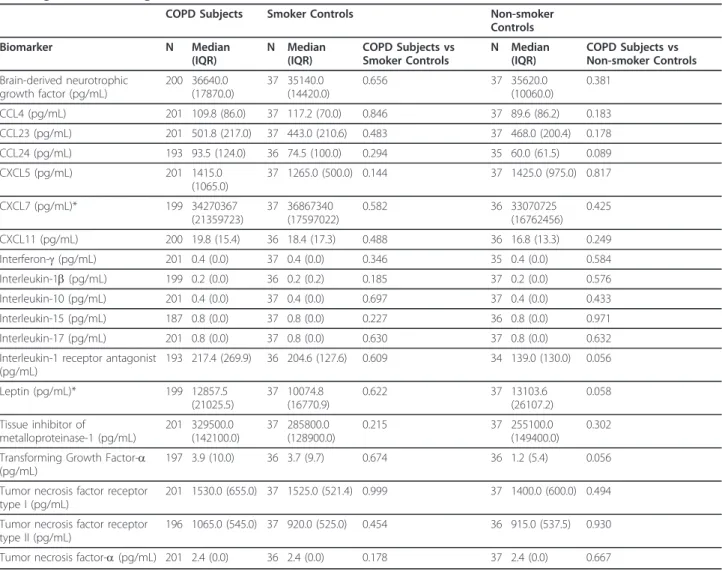
There were no significant differences between cases and controls for the other markers and therefore these were not analysed further (Table 3). Importantly, the concentra-tions of a number of analytes were above the lower limit of quantification in only a small percentage of subjects: TNF-a (10% COPD subjects, 10% combined controls),
interferon-g(6% COPD subjects, 6% combined controls), 10 (14% COPD subjects, 12% combined controls), IL-15 (17% COPD subjects, IL-15% combined controls), IL-17 (< 1% COPD subjects, 0% combined controls) and IL-1b (21% COPD subjects, 22% combined controls).
Assessment of biomarkers at 3 months and the effect of exacerbations
Over the 3 month period of this study, 33% (66/201) of the COPD subjects reported at least one exacerbation as defined by the requirement for antibiotics or oral corti-costeroids or admission to hospital. Of these, 18% (36/ 201) of the COPD subjects had exacerbations within 30 days of the 3-month study visit. In addition, 4 COPD subjects were still taking an oral steroid within 2 weeks of the 3-month visit and 1 subject was taking azithromy-cin. CRP, fibrinogen, IL-6 and SP-D were significantly higher in these subjects (Table 4 and Additional File 2).
Assessment of repeatability over 3 months
Twelve of the 15 biomarkers of interest were assessed for repeatability between the baseline and 3-month
Table 2 Baseline values for biomarkers with a significant difference between COPD subjects and either smoking or non-smoking controls.
COPD Subjects Smoker Controls
Non-smoker Controls
Biomarker N Median (IQR) N Median (IQR)
COPD Subjects vs Smoker Controls
N Median (IQR)
COPD Subjects vs Non-smoker Controls
Adiponectin (ng/mL)* 198 15614.5 (10340.0)
37 10856.0 (6145.0)
< 0.001 36 16124.5 (6428.5)
0.270
b-Defensin-2 (pg/mL)* 199 1222.3 (1794.8)
37 771.6 (784.2) 0.003 37 648.2 (964.1) 0.042
CCL2 (pg/mL) 201 615.0 (395.0) 37 530.0 (365.0) 0.065 37 460.0 (445.0) 0.017
CCL18 (pg/mL) 193 96000.0
(93000.0)
37 67000.0 (40000.0)
0.018 35 68000.0
(34000.0)
0.041
C-reactive protein (μg/mL) 200 5.38 (10.62) 37 3.13 (5.27) 0.036 35 2.17 (3.96) 0.002
CXCL10 (pg/mL) 198 79.7 (38.0) 37 67.8 (26.6) 0.085 35 65.8 (30.4) 0.017
Fibrinogen (mg/dL) 200 466.0 (117.5) 37 425.0 (100.0) 0.002 37 387.0 (83.0) < 0.001
Hepatocyte growth factor (pg/mL)
199 589.2 (492.7) 37 475.3 (303.6) 0.324 37 421.7 (217.7) 0.012
Interleukin-6 (pg/mL) 194 0.2 (2.8) 37 0.2 (0.0) 0.004 37 0.2 (0.4) 0.072
Interleukin-8 (pg/mL) 190 8.8 (5.2) 36 7.7 (4.8) 0.051 34 6.7 (3.0) 0.009
Interleukin-12 p40 (pg/ mL)
177 1.6 (2.8) 32 2.3 (3.5) 0.343 32 0.6 (2.3) 0.017
Matrix metalloproteinase-8 (pg/mL)*
198 9005.8 (10853.0)
37 7393.7 (7231.2)
0.003 37 6607.9
(5241.8)
< 0.001
Matrix metalloproteinase-9 (pg/mL)
201 238020.0 (202960.0)
37 182700.0 (92460.0)
0.198 37 158180.0
(85815.0)
< 0.001
Myeloperoxidase (pg/mL) 198 34680.0 (34305.0)
36 24770.0 (19280.0)
0.195 37 20800.0
(17100.0)
0.043
Prolactin (pg/mL) 196 525.0 (462.5) 37 345.0 (260.0) < 0.001 36 580.0 (325.0) 0.771
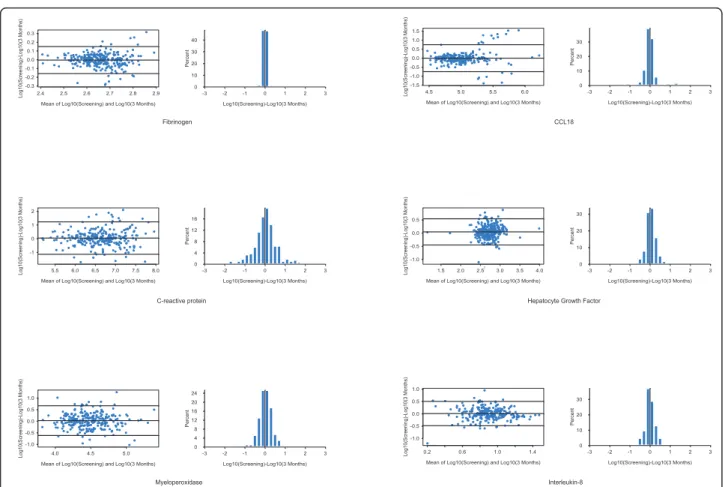
study visits. Results from subjects with either exacerba-tions within 4 weeks or who had been taking oral ster-oids within 2 weeks of the 3-month study visit were excluded from this analysis. Figure 1 shows Bland Alt-man plots and graphs of the distribution of percentage variability for several of the biomarkers with the largest
differences between COPD and controls (see Additional File 3 for the remaining biomarkers). Repeatability was assessed by calculating the proportion of values at three months that were within 25% of the baseline value (Table 5). Twenty-five percent was chosen as this reflects the typical total error associated with the types
Table 3 Baseline values for biomarkers in which there was no significant difference between COPD subjects and either smoking or non-smoking controls.
COPD Subjects Smoker Controls Non-smoker
Controls
Biomarker N Median
(IQR)
N Median (IQR)
COPD Subjects vs Smoker Controls
N Median (IQR)
COPD Subjects vs Non-smoker Controls
Brain-derived neurotrophic growth factor (pg/mL)
200 36640.0 (17870.0)
37 35140.0 (14420.0)
0.656 37 35620.0
(10060.0)
0.381
CCL4 (pg/mL) 201 109.8 (86.0) 37 117.2 (70.0) 0.846 37 89.6 (86.2) 0.183
CCL23 (pg/mL) 201 501.8 (217.0) 37 443.0 (210.6) 0.483 37 468.0 (200.4) 0.178
CCL24 (pg/mL) 193 93.5 (124.0) 36 74.5 (100.0) 0.294 35 60.0 (61.5) 0.089
CXCL5 (pg/mL) 201 1415.0
(1065.0)
37 1265.0 (500.0) 0.144 37 1425.0 (975.0) 0.817
CXCL7 (pg/mL)* 199 34270367
(21359723)
37 36867340 (17597022)
0.582 36 33070725
(16762456) 0.425
CXCL11 (pg/mL) 200 19.8 (15.4) 36 18.4 (17.3) 0.488 36 16.8 (13.3) 0.249
Interferon-g(pg/mL) 201 0.4 (0.0) 37 0.4 (0.0) 0.346 35 0.4 (0.0) 0.584
Interleukin-1b(pg/mL) 199 0.2 (0.0) 36 0.2 (0.2) 0.185 37 0.2 (0.0) 0.576
Interleukin-10 (pg/mL) 201 0.4 (0.0) 37 0.4 (0.0) 0.697 37 0.4 (0.0) 0.433
Interleukin-15 (pg/mL) 187 0.8 (0.0) 37 0.8 (0.0) 0.227 36 0.8 (0.0) 0.971
Interleukin-17 (pg/mL) 201 0.8 (0.0) 37 0.8 (0.0) 0.630 37 0.8 (0.0) 0.632
Interleukin-1 receptor antagonist (pg/mL)
193 217.4 (269.9) 36 204.6 (127.6) 0.609 34 139.0 (130.0) 0.056
Leptin (pg/mL)* 199 12857.5
(21025.5)
37 10074.8 (16770.9)
0.622 37 13103.6
(26107.2)
0.058
Tissue inhibitor of
metalloproteinase-1 (pg/mL)
201 329500.0 (142100.0)
37 285800.0 (128900.0)
0.215 37 255100.0
(149400.0)
0.302
Transforming Growth Factor-a (pg/mL)
197 3.9 (10.0) 36 3.7 (9.7) 0.674 36 1.2 (5.4) 0.056
Tumor necrosis factor receptor type I (pg/mL)
201 1530.0 (655.0) 37 1525.0 (521.4) 0.999 37 1400.0 (600.0) 0.494
Tumor necrosis factor receptor type II (pg/mL)
196 1065.0 (545.0) 37 920.0 (525.0) 0.454 36 915.0 (537.5) 0.930
Tumor necrosis factor-a(pg/mL) 201 2.4 (0.0) 36 2.4 (0.0) 0.178 37 2.4 (0.0) 0.667
Values expressed as median (IQR), p values based on log transformed results adjusted for age and sex. Biomarkers marked with * were measured at a single timepoint.
Table 4 The effect of exacerbations on biomarkers.
Biomarker Exacerbation within 30 days No or Resolved Exacerbations p-value
N Median (IQR) N Median (IQR)
Fibrinogen (mg/dL) 33 534.0 (156.0) 157 464.0 (115.0) < 0.001
Interleukin-6 (pg/mL) 30 2.8 (6.0) 151 0.6 (2.6) < 0.001
Surfactant Protein D (ng/mL) 32 132.7 (135.9) 148 101.0 (70.7) 0.011
C-reactive protein (μg/mL) 33 6.96 (6.52) 153 3.98 (6.76) 0.048
Mean of Log10(Screening) and Log10(3 Months)
Log10
(Scre
enin
g)-Log10(3 M
onths)
2.4 2.5 2.6 2.7 2.8 2.9 -0.3
-0.2 -0.1 0.0 0.1 0.2 0.3
-3 -2 -1 0 1 2 3
Log10(Screening)-Log10(3 Months)
Percent
0 10 20 30 40
Mean of Log10(Screening) and Log10(3 Months)
Log10
(Scre
eni
ng)-Log10(3 M
onths)
5.5 6.0 6.5 7.0 7.5 8.0 -1
0 1 2
-3 -2 -1 0 1 2 3
Log10(Screening)-Log10(3 Months)
Percent
0 4 8 12 16
Mean of Log10(Screening) and Log10(3 Months)
Log10
(Scre
enin
g)-Log10(3 M
onths)
4.0 4.5 5.0
-1.0 -0.5 0.0 0.5 1.0
-3 -2 -1 0 1 2 3
Log10(Screening)-Log10(3 Months)
Percent
0 4 8 12 16 20 24
Fibrinogen
C-reactive protein
Myeloperoxidase
Mean of Log10(Screening) and Log10(3 Months)
Log10
(Scre
eni
ng)-Log10(3 M
onths)
4.5 5.0 5.5 6.0
-1.5 -1.0 -0.5 0.0 0.5 1.0 1.5
-3 -2 -1 0 1 2 3
Log10(Screening)-Log10(3 Months)
Percent
0 10 20 30
!
Mean of Log10(Screening) and Log10(3 Months)
Log10
(Scre
enin
g)-Log10(3 M
onths)
1.5 2.0 2.5 3.0 3.5 4.0 -1.0
-0.5 0.0 0.5
-3 -2 -1 0 1 2 3
Log10(Screening)-Log10(3 Months)
Percent
0 10 20 30
!
Mean of Log10(Screening) and Log10(3 Months)
Log10
(Scre
eni
ng)-Log10(3 M
onths)
0.2 0.6 1.0 1.4
-1.0 -0.5 0.0 0.5 1.0
-3 -2 -1 0 1 2 3
Log10(Screening)-Log10(3 Months)
Percent
0 10 20 30
CCL18
Hepatocyte Growth Factor
Interleukin-8
Figure 1Bland Altman plots and frequency histograms of differences between baseline and 3-month results illustrating variability of
selected biomarkers. All values have been log transformed prior to analysis.
Table 5 Variability of selected biomarkers in stable subjects.
Biomarker COPD Subjects* Smoker Controls Non-smoker Controls All Subjects
CC-16 132/146 (90%) 29/35 (83%) 31/34 (91%) 192/215 (89%)
C-reactive protein 32/153 (21%) 7/36 (19%) 12/35 (34%) 51/224 (23%)
CCL24 51/144 (35%) 8/32 (25%) 16/35 (46%) 75/211 (36%)
Fibrinogen 139/156 (89%) 31/36 (86%) 35/36 (97%) 205/228 (90%)
Hepatocyte growth factor 57/152 (38%) 17/36 (47%) 19/36 (53%) 93/224 (42%)
Interleukin-6 55/147 (37%) 22/34 (65%) 24/36 (67%) 101/217 (47%)
Interleukin-8 67/141 (48%) 12/35 (34%) 13/33 (39%) 92/209 (44%)
Interleukin 12p40 64/124 (52%) 14/27 (52%) 20/30 (67%) 98/181 (54%)
CXCL10 86/152 (57%) 19/35 (54%) 23/34 (68%) 128/221 (58%)
CCL2 72/154 (47%) 22/36 (61%) 13/36 (36%) 107/226 (47%)
Matrix metalloproteinase-9 53/154 (34%) 8/36 (22%) 18/36 (50%) 79/226 (35%)
CCL23 93/154 (60%) 20/36 (56%) 23/36 (64%) 136/226 (60%)
Myeloperoxidase 52/154 (34%) 7/35 (20%) 15/36 (42%) 74/225 (33%)
CCL-18 53/135 (39%) 15/26 (58%) 15/35 (43%) 83/196 (42%)
Prolactin 47/148 (32%) 7/36 (19%) 9/35 (26%) 63/219 (29%)
Surfactant Protein D 107/145 (74%) 26/35 (74%) 30/34 (88%) 163/214 (76%)
of ‘research-grade’ immunoassays used for this study [15]. Fibrinogen was the least variable biomarker with 3-month values that were within 25% of the baseline value for 89% of the COPD subjects. CRP was the most vari-able biomarker with only 21% of COPD subjects having a 3-month value that was within 25% of the baseline value. For most of the other analytes, the 3-month values were within 25% of the baseline values for 40-50% of the subjects. The same analysis was retrospec-tively applied to the data from the biomarker cohort for CC-16 and SP-D [7,8]. Ninety percent of CC-16 values at months were within 25% of baseline and 74% of 3-month SP-D values were within 25% of baseline for the COPD subjects.
Correlation of biomarkers with the severity of COPD and the presence of emphysema
For the baseline assessments, six biomarkers showed weak correlation with COPD disease severity as defined by GOLD stage: b-defensin-2 (r = 0.2, p = 0.005), IL-8 (r = 0.15, p = 0.043), MMP-8 (r = 0.19, p = 0.007), MMP-9 (r = 0.16, p = 0.024), adiponectin (r = 0.18, p = 0.009) and hepatocyte growth factor (r = -0.21, p = 0.003). MMP-8 (r = 0.15, p = 0.043), MMP-9 (r = 0.18, p = 0.011) and adiponectin (r = 0.26, p =< 0.001) also correlated weakly with the percentage of emphysema as defined by low attenuation area on chest CT scans; MMP-9 correlated with the radiologists’ score of emphysema (r = 0.18, p = 0.010).
Fibrinogen as a promising biomarker for COPD
The most stable biomarker over 3 months in the ECLIPSE biomarker cohort was fibrinogen. It was signif-icantly elevated in COPD patients relative to both ex-smoking and non-ex-smoking controls although it was not associated with the severity of COPD as assessed by GOLD score or the severity of emphysema. There was a weak association with the number of reported exacerba-tions (0, 1, 2, 3+) in the year prior to the study, with a Spearman correlation coefficient (r) of 0.21 (p = 0.003) and fibrinogen was elevated in those subjects with unre-solved exacerbations at 3 months compared with sub-jects that did not exacerbate or whose exacerbations had resolved. Decreased exercise tolerance as measured by 6-minute walk distance was also associated with higher levels of plasma fibrinogen (r = -0.23, p = 0.001) and there were associations with BODE index (r = 0.20, p = 0.007) and MRC dyspnoea score (r = 0.17, p = 0.021).
Discussion
A subgroup of the ECLIPSE cohort was used to assess thirty-four putative blood biomarkers for their associa-tions with important characteristics of COPD. The ana-lytes that were chosen have previously been associated
with either local or systemic features of COPD [5,10]. In subjects with stable COPD, fifteen analytes had signifi-cantly different concentrations in the COPD cohort as compared with smoker and non-smoker controls. Twelve of these were assessed for repeatability; this revealed wide variation over 3 months for many of the analytes, particularly CRP. Similar variability in a num-ber of the biomarkers assessed in the ECLIPSE cohort has been shown by Man and colleagues in a cohort of 41 COPD subjects over a two week period [16] though less variable results were reported when measured at a yearly interval [17].
exacerbations in the first year of ECLIPSE [8] and with the findings of others [37,38].
Many of the analytes studied that were different between cases and controls may play important roles as chemoattractants for monocytes/macrophages (8, IL-12p40, CCL2), lymphocytes (CCL18, CXCL10) and neu-trophils (IL-8) in driving inflammation in individuals with COPD. Unfortunately, many of the analytes we assessed showed poor repeatability when measured at a 3-month interval and thus they may have limited utility as markers of disease progression or measures of the effects of drug intervention. It is however possible that they may be useful to help define subgroups of COPD subjects based on common underlying disease mechan-isms [39]. Studies with larger numbers of subjects will be required to determine if this is the case.
Aberrant tissue destruction and repair is known to be central to the development of emphysema [10]. MMP-8 and MMP-9 are two proteases that are believed to play an important role in the tissue destruction that results in emphysema [40,41] and both are raised in COPD subjects in the biomarker cohort. Consistent with other studies [42,43], there was evidence that they correlated with GOLD stage and amount of emphysema and so may be useful in differentiating individuals with emphy-sema from those with predominantly airway disease. Hepatocyte growth factor plays a role in tissue regenera-tion [44] and was shown in a small study to be increased in bronchoalveolar lavage of COPD subjects and smokers with normal lung function [45]. The repeatability of MMP-8 remains untested; however the wide variability of MMP-9 and hepatocyte growth factor over 3 months suggests that they are unlikely to be use-ful in clinical applications.
b-defensin-2 and myeloperoxidase play a role in pul-monary immunity [46,47]. We provide supportive evi-dence that circulating myeloperoxidase is raised in COPD [48] and show that b-defensin-2 is also higher in individuals with this disease. b-defensin-2 may also reflect disease severity as defined by GOLD stage. How-ever additional profiling is required before it can be con-fidently deemed a useful biomarker in COPD.
Adiponectin and prolactin levels have been shown to be altered in subjects with COPD [5,49], however the mechanisms underlying this remain uncertain. Both have wide ranging metabolic effects and possible roles in the inflammatory response [50]. For both analytes, significant differences were seen between COPD sub-jects and only one of the control groups and marked variability was seen in stable disease. Although highly elevated in COPD subjects, the temporal variability asso-ciated with serum myeloperoxidase may confound its use in clinical trials. However, adiponectin, prolactin
and myeloperoxidase may have some utility in diagnos-tic tests that combine a panel of inflammatory markers to describe the underlying inflammatory process in some COPD patients.
Our study has several limitations. In assessing putative biomarkers for repeatability, measures were taken at baseline and at 3 months which is the approximate duration of many COPD Phase IIa intervention studies. Though this interval is relatively short, it is conceivable that during this time period there may have been signifi-cant clinical changes, changes in pharmacological treat-ment or as we observed in our cohort, intercurrent exacerbations. Any of these could create a“true”change in biomarker level and thus the assessment of repeat-ability may overestimate how variable markers are over time. For example, Hurst [24], reported that the concen-trations of CCL18, adiponectin, CRP, and IL-6 are increased during exacerbations. In order to better esti-mate reproducibility during stable disease, results from subjects with exacerbations that were not resolved at least 30 days prior to the 3 month visit were excluded from the repeatability analysis as were subjects who had been taking oral steroids within 2 weeks of the 3 month visit. The control populations in the ECLIPSE cohort were chosen on the basis of smoking status and the absence of COPD. Individuals may have co-morbidities that are inflammatory in nature and therefore influence the levels of biomarkers. However this is unlikely as details of co-morbidities were obtained at recruitment to the study. Though many of the biomarkers examined showed statistically significant differences between groups, no allowances were made for multiple compari-sons in interpreting the statistical significance of the results [51]. Additionally corrections had to be made for differences in baseline characteristics between cases and controls as this study was intended to be exploratory with the primary intent of identifying biomarkers for follow up in the full ECLIPSE cohort or other COPD cohorts.
Conclusions
Additional material
Additional file 1: Additional Table1. Biomarker Assay Performance Information. Intra- and Inter-assay variability of biomarker assays.
Additional file 2: Additional Table2. Biomarker results at 3 months for COPD subjects with an exacerbation within 30 days of the study visit and COPD subjects with no exacerbations or resolved exacerbations. Results for the biomarkers not shown in Table 4 in the main manuscript.
Additional file 3: Additional Figure1. Bland Altman plots and frequency histograms of differences between baseline and 3-month results illustrating biomarker variability. Results for the biomarkers not shown in Figure 1 within the main manuscript.
Acknowledgements
This work was funded by GlaxoSmithKline. The authors thank Samila Mihindukulasuriya for help with management of the biomarker testing, Chris Stone, Jennifer Johnson, and Devon Kelly for management of the ECLIPSE sample inventory, and Russell Hill for management of the ECLIPSE database. The authors acknowledge the principle investigators, steering committee and scientific committee of the ECLIPSE study:
Principle Investigators: Bulgaria: Yavor Ivanov (Pleven), Kosta Kostov (Sofia);Canada: Jean Bourbeau (Montreal), Que (Vancouver, BC), Paul Hernandez (Halifax, NS), Kieran Killian (Hamilton, On), Robert Levy
(Vancouver, BC), Francois Maltais (Montreal, Que), Denis O’Donnell (Kingston, On);Czech Republic: Jan Krepelka (Praha);Denmark: JØrgen Vestbo (Hvidovre);Netherlands: Emiel Wouters (Horn);New Zealand: Dean Quinn (Wellington);Norway: Per Bakke (Bergen);Slovenia: Mitja Kosnik (Golnik); Spain: Alvar Agusti, Jaume Sauleda (Palma de Mallorca);Ukraine: Yuri Feschenko (Kiev), Vladamir Gavrisyuk (Kiev), Lyudmila Yashina (Kiev); Nadezhda Monogarova (Donetsk);United Kingdom: Peter Calverley (Liverpool), David Lomas (Cambridge), William MacNee (Edinburgh); David Singh (Manchester); Jadwiga Wedzicha (London);United States of America: Antonio Anzueto (San Antonio, TX), Sidney Braman (Providence, RI), Richard Casaburi (Torrance CA), Bart Celli (Boston, MA), Glenn Giessel (Richmond, VA), Mark Gotfried (Phoenix, AZ), Gary Greenwald (Rancho Mirage, CA), Nicola Hanania (Houston, TX), Don Mahler (Lebanon, NH), Barry Make (Denver, CO), Stephen Rennard (Omaha, NE), Carolyn Rochester (New Haven, CT), Paul Scanlon (Rochester, MN), Dan Schuller (Omaha, NE), Frank Sciurba (Pittsburgh, PA), Amir Sharafkhaneh (Houston, TX), Thomas Siler (St. Charles, MO), Edwin Silverman (Boston, MA), Adam Wanner (Miami, FL), Robert Wise (Baltimore, MD), Richard ZuWallack (Hartford, CT).
Steering Committee:Harvey Coxson (Canada), Lisa Edwards (GlaxoSmithKline, USA), Katharine Knobil (Co-chair, GlaxoSmithKline, UK), David Lomas (UK), William MacNee (UK), Edwin Silverman (USA), Ruth Tal-Singer (GlaxoSmithKline, USA), Jørgen Vestbo (Co-chair, Denmark), Julie Yates (GlaxoSmithKline, USA).
Scientific Committee:Alvar Agusti (Spain), Peter Calverley (UK), Bartolome Celli (USA), Courtney Crim (GlaxoSmithKline, USA), Gerry Hagan
(GlaxoSmithKline, UK), William MacNee (Chair, UK), Bruce Miller (GlaxoSmithKline, USA), Stephen Rennard (USA), Ruth Tal-Singer (GlaxoSmithKline, USA), Emiel Wouters (The Netherlands), Julie Yates (GlaxoSmithKline, USA).
Author details
1Department of Medicine, University of Cambridge, Cambridge Institute for
Medical Research, Cambridge, UK.2GlaxoSmithKline, King of Prussia, PA, USA. 3
GlaxoSmithKline, Research Triangle Park, NC, USA.4The Channing Laboratory and Pulmonary and Critical Care Division, Brigham and Women’s Hospital and Harvard Medical School, Boston, Massachusetts, USA.
Authors’contributions
All authors participated in data analysis and interpretation of the results. JD drafted the manuscript. All authors read, provided input for, and approved the final manuscript.
Competing interests
JD has no competing interests. EKS received grant support and consulting fees from GlaxoSmithKline for studies of COPD genetics, and he received
honoraria and consulting fees from AstraZeneca. BEM, LDE and RTS are employees of GlaxoSmithKline (GSK) and own stock and stock options in GSK. DAL has received consultancy fees, honoraria and grant funding from GlaxoSmithKline.
Received: 16 September 2011 Accepted: 4 November 2011 Published: 4 November 2011
References
1. Rabe KF, Hurd S, Anzueto A, Barnes PJ, Buist SA, Calverley P, Fukuchi Y, Jenkins C, Rodriguez-Roisin R, van Weel C, Zielinski J, Global Initiative for Chronic Obstructive Lung Disease:Global strategy for the diagnosis, management and prevention of chronic obstructive pulmonary disease: GOLD executive summary.Am J Respir Crit Care Med2007,176:532-555. 2. Agusti AG:COPD, a multicomponent disease: implications for
management.Respir Med2005,99:670-682.
3. Nishimura K, Izumi T, Tsukino M, Oga T:Dyspnea is a better predictor of 5-year survival than airway obstruction in patients with COPD.Chest 2002,121:1434-1440.
4. Cazzola M, MacNee W, Martinez FJ, Rabe KF, Franciosi LG, Barnes PJ, Brusasco V, Burge PS, Calverley PM, Celli BR, Jones PW, Mahler DA, Make B, Miravitlles M, Page CP, Palange P, Parr D, Pistolesi M, Rennard SI, Rutten-van Molken MP, Stockley R, Sullivan SD, Wedzicha JA, Wouters EF, American Thoracic Society, European Respiratory Society Task Force on outcomes of COPD:Outcomes for COPD pharmacological trials: from lung function to biomarkers.Eur Respir J2008,31:416-469.
5. Pinto-Plata V, Toso J, Lee K, Park D, Bilello J, Mullerova H, De Souza MM, Vessey R, Celli B:Profiling serum biomarkers in patients with COPD: associations with clinical parameters.Thorax2007,62:595-601.
6. Vestbo J, Anderson W, Coxson HO, Crim C, Dawber F, Edwards L, Hagan G, Knobil K, Lomas DA, MacNee W, Silverman EK, Tal-Singer R, ECLIPSE investigators:Evaluation of COPD Longitudinally to Identify Predictive Surrogate End-points (ECLIPSE).Eur Respir J2008,31:869-873. 7. Lomas DA, Silverman EK, Edwards LD, Miller BE, Coxson HO, Tal-Singer R,
Evaluation of COPD Longitudinally to Identify Surrogate Endpoints (ECLIPSE) Investigators:Evaluation of serum CC-16 as a biomarker for COPD in the ECLIPSE cohort.Thorax2008,63:1058-1063.
8. Lomas DA, Silverman EK, Edwards LD, Locantore NW, Miller BE, Horstman DH, Tal-Singer R, Evaluation of COPD Longitudinally to Identify Predictive Surrogate Endpoints study investigators:Serum surfactant protein D is steroid sensitive and associated with exacerbations of COPD.Eur Respir J2009,34:95-102.
9. Sin DD, Miller BE, Duvoix A, Man SF, Zhang X, Silverman EK, Connett JE, Anthonisen NA, Wise RA, Tashkin D, Celli BR, Edwards LD, Locantore N, Macnee W, Tal-Singer R, Lomas DA, on behalf of the ECLIPSE investigators: Serum PARC/CCL-18 concentrations and health outcomes in chronic obstructive pulmonary disease.Am J Respir Crit Care Med2011, 183:1187-1192.
10. Barnes PJ, Shapiro SD, Pauwels RA:Chronic obstructive pulmonary disease: molecular and cellular mechanisms.Eur Respir J2003,22:672-688. 11. Hurst JR, Vestbo J, Anzueto A, Locantore N, Mullerova H, Tal-Singer R,
Miller B, Lomas DA, Agusti A, Macnee W, Calverley P, Rennard S, Wouters EF, Wedzicha JA, ECLIPSE investigators:Susceptibility to exacerbation in chronic obstructive pulmonary disease.N Engl J Med 2010,363:1128-1138.
12. Radloff LS:The CES-D scale: A self report depression scale for research in the general population.Applied Psychological Measurement1977,1:385-401. 13. Webster K, Odom L, Peterman A, Lent L, Cella D:The Functional
Assessment of Chronic Illness Therapy (FACIT) measurement system: Validation of version 4 of the core questionnaire.Qual Life Res1999, 8:604.
14. Bestall JC, Paul EA, Garrod R, Garnham R, Jones PW, Wedzicha JA: Usefulness of the Medical Research Council (MRC) dyspnoea scale as a measure of disability in patients with chronic obstructive pulmonary disease.Thorax1999,54:581-586.
15. Wang J, Lee J, Burns D, Doherty D, Brunner L, Peterson M, DeSilva B:“ Fit-for-Purpose”method validation and application of a biomarker (C-terminal telopeptides of type 1 collagen) in denosumab clinical studies. AAPS J2009,11:385-394.
biomarkers in COPD: an exploratory study.Ther Adv Respir Dis2009, 3:73-80.
17. Kolsum U, Roy K, Starkey C, Borrill Z, Truman N, Vestbo J, Singh D:The repeatability of interleukin 6, tumour necrosis factor-alpha, and C-reactive protein in COPD patients over one year.Int J Chron Obstruct Pulmon Dis2009,4:149-156.
18. MacNee W:Pathogenesis of chronic obstructive pulmonary disease.Proc
Am Thorac Soc2005,2:258-266.
19. Pinto-Plata VM, Mullerova H, Toso JF, Feudjo-Tepie M, Soriano JB, Vessey RS, Celli BR:C-reactive protein in patients with COPD, control smokers and non-smokers.Thorax2006,61:23-28.
20. Wedzicha JA, Seemungal TA, MacCallum PK, Paul EA, Donaldson GC, Bhowmik A, Jeffries DJ, Meade TW:Acute exacerbations of chronic obstructive pulmonary disease are accompanied by elevations of plasma fibrinogen and serum IL-6 levels.Thromb Haemost2000, 84:210-215.
21. Karadag F, Karul AB, Cildag O, Yilmaz M, Ozcan H:Biomarkers of systemic inflammation in stable and exacerbation phases of COPD.Lung2008, 186:403-409.
22. Garcia-Rio F, Miravitlles M, Soriano JB, Munoz L, Duran-Tauleria E, Sanchez G, Sobradillo V, Ancochea J, EPIscan steering committee:Systemic inflammation in chronic obstructive pulmonary disease: a population based study.Respir Res2010,11:63.
23. Cosio MG, Saetta M, Agusti A:Immunological aspects of chronic obstructive pulmonary disease.N Engl J Med2009,360:2445-2454. 24. Hurst J, Donaldson GC, Perera WR, Wilkinson TM, Bilello JA, Hagan GW,
Vessey RS, Wedzicha JA:Use of plasma biomarkers at exacerbation of chronic obstructive pulmonary disease.Am J Respir Crit Care Med2006, 174:867-874.
25. Hurst JR, Perera WR, Wilkinson TM, Donaldson GC, Wedzicha JA:Systemic and upper and lower airway inflammation at exacerbation of chronic obstructive pulmonary disease.Am J Respir Crit Care Med2006,173:71-78. 26. Perera WR, Hurst JR, Wilkinson TM, Sapsford RJ, Mullerova H, Donaldson GC,
Wedzicha JA:Inflammatory changes, recovery and recurrence at COPD exacerbation.Eur Respir J2007,29:527-534.
27. Seemungal T, Harper-Owen R, Bhowmik A, Moric I, Sanderson G, Message S, MacCallum P, Meade TW, Jeffries DJ, Johnston SL, Wedzicha JA:Respiratory viruses, symptoms, and inflammatory markers in acute exacerbations and stable chronic obstructive pulmonary disease.Am J Respir Crit Care Med2001,164:1618-1623.
28. Eagan TM, Ueland T, Wagner PD, Hardie JA, Mollnes TE, Damas JK, Aukrust P, Bakke PS:Systemic inflammatory markers in COPD: results from the Bergen COPD cohort study.Eur Respir J2010,35:540-548. 29. Engstrom G, Segelstrom N, Ekberg-Aronsson M, Nilsson PM, Lindgarde F,
Lofdahl CG:Plasma markers of inflammation and incidence of hospitalizations for COPD: results from a population-based cohort study. Thorax2009,64:211-215.
30. Dahl M, Tybjaerg-Hansen A, Vestbo J, Lange P, Nordestgaard BG:Elevated plasma fibrinogen associated with reduced pulmonary function and increased risk of chronic obstructive pulmonary disease.Am J Resp Crit
Care Med2001,164:1008-1011.
31. Dahl M, Vestbo J, Lange P, Bojesen SE, Tybjaerg-Hansen A, Nordestgaard BG:C-reactive protein as a predictor of prognosis in chronic obstructive pulmonary disease.Am J Resp Crit Care Med2007, 175:250-255.
32. Walter RE, Wilk JB, Larson MG, Vasan RS, Keaney JF Jr, Lipinska I, O’Connor GT, Benjamin EJ:Systemic Inflammation and COPD: The Framingham Heart Study.Chest2008,133:19-25.
33. Groenewegen KH, Postma DS, Hop WC, Wielders PL, Schlosser NJ, Wouters EF, COSMIC study group:Increased systemic inflammation is a risk factor for COPD exacerbations.Chest2008,133:350-357. 34. Yasuda N, Gotoh K, Minatoguchi S, Asano K, Nishigaki K, Nomura M,
Ohno A, Watanabe M, Sano H, Kumada H, Sawa T, Fujiwara H:An increase of soluble Fas, an inhibitor of apoptosis, associated with progression of COPD.Respir Med1998,92:993-999.
35. Rennard SI, Fogarty C, Kelsen S, Long W, Ramsdell J, Allison J, Mahler D, Saadeh C, Siler T, Snell P, Korenblat P, Smith W, Kaye M, Mandel M, Andrews C, Prabhu R, Donohue JF, Watt R, Lo KH, Schlenker-Herceq R, Barnathan ES, Murray J, COPD Investigators:The safety and efficacy of infliximab in moderate to severe chronic obstructive pulmonary disease. Am J Respir Crit Care Med2007,175:926-934.
36. Vestbo J, Wouters E, Rennard S, Miller B, Edwards L, Tal-Singer R:TNF-αand systemic manifestations in COPD patients and controls.Am J Respir Crit
Care Med2009,179:A3781.
37. Shakoori TA, Sin DD, Ghafoor F, Bashir S, Bokhari SN:Serum surfactant protein D during acute exacerbations of chronic obstructive pulmonary disease.Dis markers2009,27:287-94.
38. Winkler C, Atochina-VAsserman EN, Holz O, Beers MF, Erpenbeck VJ, Krug N, Roepcke S, Lauer G, Elmlinger M, Hohlfeld JM:Comprehensive
characterization of pulmonary and serum surfactant protein D in COPD. Respir Res2011,12:29.
39. Rennard SI, Vestbo J:Natural histories of chronic obstructive pulmonary disease.Proc Am Thorac Soc2008,5:878-883.
40. Tashkin DP, Belloni PN, Baileyhealy I, Baratelli F, Roth MD:All-trans retinoic acid modulates the balance of matrix metalloproteinase-9 and tissue inhibitor of metalloproteinase-1 in patients with emphysema.Chest2003, 124:1724-1732.
41. Vernooy JH, Lindeman JH, Jacobs JA, Hanemaaijer R, Wouters EF:Increased activity of matrix metalloproteinase-8 and matrix metalloproteinase-9 in induced sputum from patients with COPD.Chest2004,126:1802-1810. 42. Higashimoto Y, Iwata T, Okada M, Satoh H, Fukuda K, Tohda Y:Serum
biomarkers as predictors of lung function decline in chronic obstructive pulmonary disease.Respir Med2009,103:1231-1238.
43. Brajer B, Batura-Gabryel H, Nowicka A, Kuznar-Kaminska B, Szczepanik A: Concentration of matrix metalloproteinase-9 in serum of patients with chronic obstructive pulmonary disease and a degree of airway obstruction and disease progression.J Physiol Pharmacol2008,59:145-152. 44. Ware LB, Matthay MA:Keratinocyte and hepatocyte growth factors in the lung: roles in lung development, inflammation and repair.Am J Physiol Lung Cell Mol Physiol2002,282:L924-940.
45. Sauleda J, Noguera A, Blanquer D, Pons J, Lopez M, Villena C, Agusti A: Pulmonary and systemic hepatocyte and keratinocyte growth factors in patients with chronic obstructive pulmonary disease.Int J Chron Obstruct Pulmon Dis2008,3:719-725.
46. Bals R, Wang X, Wu Z, Freeman T, Bafna V, Zasloff M, Wilson JM:Human beta-defensin 2 is a salt sensitive peptide expressed in human lung.J Clin Invest1998,102:874-880.
47. Klebanoff SJ:Myeloperoxidase.Proc Assoc Am Physicians1999,111:383-389. 48. Fiorini G, Crespi S, Rinaldi M, Oberti E, Vigorelli R, Palmieri G:Serum ECP
and MPO are increased during exacerbations of chronic bronchitis with airway obstruction.Biomed Pharmacother2000,54:274-278.
49. Tomoda K, Yoshikawa M, Itoh T, Tamaki S, Fukuoka A, Komeda K, Kimura H: Elevated circulating plasma adiponectin in underweight patients with COPD.Chest2007,132:135-140.
50. Krommidas G, Kostikas K, Papatheodorou G, Koutsokera A, Gourgoulianis KI, Roussos C, Koulouris NG, Loukides S:Plasma leptin and adiponectin in COPD exacerbations: associations with inflammatory biomarkers.Respir Med2010,104:40-46.
51. Bender R, Lange S:Adjusting for multiple testing-when and how?J Clin Epidemiol2001,54:343-349.
doi:10.1186/1465-9921-12-146
Cite this article as:Dickenset al.:COPD association and repeatability of
blood biomarkers in the ECLIPSE cohort.Respiratory Research2011
12:146.
Submit your next manuscript to BioMed Central and take full advantage of:
• Convenient online submission
• Thorough peer review
• No space constraints or color figure charges
• Immediate publication on acceptance
• Inclusion in PubMed, CAS, Scopus and Google Scholar
• Research which is freely available for redistribution