ISSN: 1311-1728 (printed version); ISSN: 1314-8060 (on-line version) doi:http://dx.doi.org/10.12732/ijam.v29i5.5
ON SATISFIABILITY TREES Marcel Mareti´c
Faculty of Organization and Informatics University of Zagreb, Pavlinska 2,
Varaˇzdin, 42000, CROATIA
Abstract: We define a satisfiability tree in the context of classical proposi-tional logic. Satisfiability tree is a structure inspired by the Beth’s semantic tableau, later refined into its modern variant by Lis and Smullyan and by the notion that tableau is a tree-like representation of a formula. Basic notions and simple graph operations that correspond to logical operators are defined for satisfiability trees. Relation to tableau, parsing trees are investigated. Clausal satisfiability trees are defined as a class of satisfiability trees suited for formulas in clausal form. Issues related to size of clausal satisfiability trees are inves-tigated. Non-redundant clausal satisfiability trees are shown to be a simple rewrite of Robinson’s refutation trees.
AMS Subject Classification: 05C05, 03B05
Key Words: satisfiability tree, semantic tree, tableau, rooted formula tree, matching, resolution
1. Introduction 1.1. Motivation
Semantic propositional tableau can be considered as a graphical representation of a propositional formula, which is equivalent to the set of formula that the tableau is built from. Beth’s tableau method came into its usual modern form by notational simplifications of Smullyan [6] and independently by Lis [2].
Intrigued by the two juxtaposed views that for a given formula a tableau is both a tree-like representation of it and a tree-like description of its models, we
define the notion of a satisfiability tree along with a set of graph operations. Satisfiability trees serve as a bridge between formulas, semantic trees, parsing trees and resolution proofs.
1.2. Preliminaries
We focus on formulas in negation normal form (NNF) and on formulas in con-junctive or clausal normal form (CNF) or discon-junctive normal form (DNF) in special cases. Recall that NNF formula is a propositional formula with connec-tives∧,∨, and¬where negation is applied only to propositional variables.
1.2.1. Notation and Basic Logical Notions
The logical language used here consists of logical connectives ¬ (negation), ∧ (conjunction), ∨ (disjunction). Letters X, Y, Z, . . . are reserved for propo-sitional variables which comprise the set of atoms denoted with At; letters A, B, C, . . . are reserved for metaformulas. A literal is a propositional variable or a negation of a propositional variable is a (i.e. X or ¬X). If A is a literal, we denote its opposite or conjugate literal asA′.
We recall that the truth value of a propositional formula is determined by the truth assignment or valuation function on the set of atoms At. A valuation Mthat makes a formulaF true we say it is amodelforF and writeM|=F. A set of propositional formulas Γ is consistent or satisfiable if there exists a model making everyF ∈Γ true. A countermodel is specified as a finite consistent set of literals.
A clause is a disjunction of literals, e.g. X∨Y∨Z. Given the commutativity and idempotence of disjunction, a clause can be regarded as a set of literals. Recall that clausal form is a set of clauses. So a clausal formCof a CNF formula (X∨Y)∧(¬Y ∨Z) is
C={{X, Y},{¬Y, Z}} .
Empty clause, denoted as Λ, is inconsistent. But empty clausal form {} is consistent!
We use Smullyan’s uniform notation (cf. [6]) for propositional formulas: every compound formula is an α or β formula and
α=α1∧α2 β =β1∨β2 ,
1.3. Notions Concerning Trees
Arooted formula treeis a rooted directed tree with nodes labeled as literals. Non-leaf node in a rooted formula tree is allowed to have an empty label, i.e. to be without a label. Labeled nodes of the formula tree are referred to as formula nodes, formula occurrences or just formulas for short. We loosely use the term
formula instead of formula occurrence.
Rooted formula trees are drawn upside down (in the botanical sense) like tableaux – with the root on top. In illustrations edges lack their downward direction. An example is shown in Fig. 1. Note that this tree has an empty root.
A branch is a set of nodes that forms a maximal chain in the tree (from root to the leaf). We use the term branch to denote the set of corresponding formulas as well. Subtree of τττ determined by nodeAAA (or subtree ofA for short) is a rooted formula tree obtained fromτ by removing all formula nodes except node A and A’s descendants. It is a maximal subtree of τ whose root is A. Strict subtree of AAA in τ is a rooted formula tree obtained by taking a subtree ofτ determined byA and setting the root’s label as empty.
Z
¬Y
¬Z
¬X Y
Figure 1: Rooted formula tree
2. Satisfiability Trees 2.1. Introduction
Definition 1. Let Γ be a finite set of propositional formulas. Let τ be a rooted formula tree whose nodes are literals.
τ is a satisfiability treeof a set of formulas Γ if:
(i) any modelM satisfying Γ must satisfy some open branch in τ.
(ii) any modelM satisfying a branch of τ is also a model of Γ.
A branch of τ is closed if it contains conjugate literals (i.e. bothX and ¬X). Otherwise, we say a branch is open. A satisfiability tree τ is closed if all of its branches are closed. Otherwise, we say τ is open.
Examples of satisfiability trees are illustrated in Fig. 2. Leaves of closed branches are underlined for emphasis.
X
¬Z
Z Y ¬X Y
Z Y ¬X
τ1
τ2
X
¬Z
Y Y
Figure 2: Bothτ1 andτ2 are satisfiability trees ofX∧(Y ∨ ¬Z)∧(¬X∨Y ∨Z)
Remark 1. A rooted formula tree of literals can be regarded as a sat-isfiability tree of a DNF formula whose basic conjunctions are formed by its branches. For example,τ2 from Fig. 2 is a satisfiability tree of (X∧Y)∨(X∧ ¬Z∧Y).
Therefore we can speak of a satisfiability tree without explicitly stating its set of formulas.
Definition 2. Let τ and τ′ be satisfiability trees. τ refines τ′ if any
model M ofτ is a model ofτ′. We write this as τ 4τ′.
We say that satisfiability treesτ andτ′ areequivalentifτ 4τ′ andτ′4τ.
We denote this withτ ≈τ′.
Satisfiability trees are equivalent if an only if their formulas are logically equivalent. Satisfiability tree is a treelike representation of a formula. Obvi-ously,
Example 1. Satisfiability tree τ displayed in Fig. 3 refines τ′. τ
1 and τ2 in Fig. 2 are equivalent.
¬Y Z
X Y
X Z
τ′
τ
Figure 3: Satisfiability tree τ refinesτ′
2.2. Operations on Satisfiability Trees
Definition 3 (Adding). Let τ1 and τ2 be satisfiability trees. Let A be a leaf (formula node) in τ1. Let τ be a satisfiability tree obtained by setting τ2 as immediate subtree ofAinτ1. We say that τ is obtained byadding τ2 under A inτ1.
Definition 4(Conjunction). Letτ1 andτ2 be satisfiability trees. Letτ be a rooted formula tree obtained from adding a copy of τ2 to each open branch of τ1 We say that τ is aconjunction ofτ1 and τ2 and writeτ =τ1∧τ2.
Definition 5 (Disjunction). Letτ1 andτ2 be satisfiability trees. Letτ be a rooted formula tree obtained from addingτ1 and τ2 as children of an empty root. We say thatτ is adisjunction ofτ1 and τ2 and writeτ =τ1∨τ2.
Proposition 6. Let τA and τB be satisfiability trees of formulas A and B respectively. Satisfiability tree τA∧τB is a satisfiability tree of A∧B and satisfiability tree τA∨τB is a satisfiability tree ofA∨B.
The following relations hold:
(τA∧τB)≈(τB∧τA) and (τA∨τB)≈(τB∨τA).
compound formulas we recursively define
S(A∧B) =S(A)∧ S(B), S(A∨B) =S(A)∨ S(B) .
Conjunction and disjunction of satisfiability trees are well-defined opera-tions modulo the equivalence of satisfiability trees. Trivially, these operaopera-tions are commutative and associative.
2.3. Tableau as a Satisfiability Tree
Here we have the opportunity to describe the tableau method’s rules for analysis of α and β formulas as operations on satisfiability trees. For this section only we allow a rooted formula tree to have compound formula nodes (non-literals). Development of an analytic tableau of formula F can be described by the following operations. Tableau for F as a satisfiability tree τ is initialized as trivial rooted formula tree with a single node F. Let T(A) denote a singleton rooted formula tree with a single node labeled A. Further steps in analysis of a compound formulaA inτ are as follows:
Case α. IfA is anα formula it is analyzed by replacing τAin τ with τA∧(T(α1)∧ T(α2))
whereτA is a subtree ofA, andα1 and α2 are subformulas ofA. Caseβ. IfA is aβ formula it is analyzed by replacingτA inτ with
τA∧(T(β1)∨ T(β2))
whereτA is a subtree ofA, andβ1 and β2 are subformulas ofA. 2.4. From Parsing Trees to Satisfiability Trees
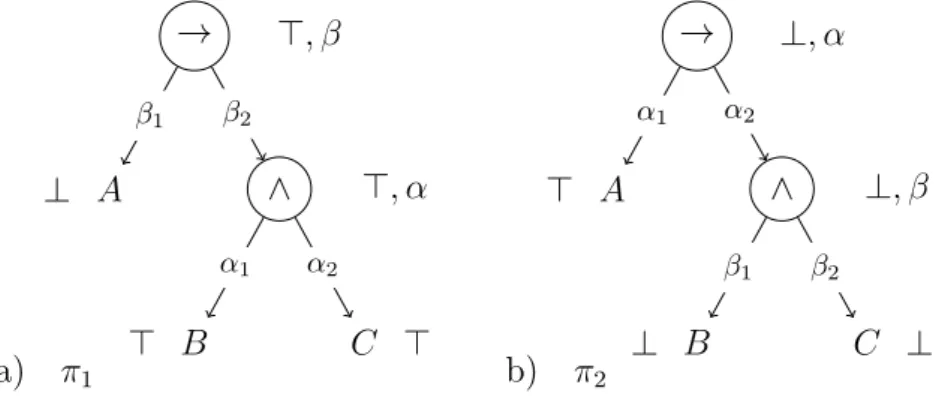
As a curiosity, semantic annotations to parsing trees of propositional formulas are presented. A recursive transformation into a satisfiability tree is described. In this section we consider propositional formulas with an additional con-nective→ (material conditional).
Recall that in Smullyan’s uniform notation every propositional formula is an α or β formula. Every α formula can be broken into a conjunction of its α1 and α2 subformulas, whereas a β formula is a disjunction of its β1 and β2 subformulas.
1. each connective is annotated with a ⊤or ⊥, and a typeα or β
2. propositional variables are annotated with ⊤or ⊥.
3. edges are annotated with αi,βi the type of a subformula
For example, (both) possible annotations for parse tree of aA → (B∧C) formula are given in Fig. 4.
a) π1
→
A ∧
B C
β1 β2
α1 α2
⊤, β
⊤, α
⊥
⊤ ⊤
b) π2
→
A ∧
B C
α1 α2
β1 β2
⊥, α
⊥, β
⊤
⊥ ⊥
Figure 4: Annotated parse trees of A→(B∧C)
Note the duality here: π2 can be obtained fromπ1 by replacing ⊤ with⊥, and βi withαi (and vice versa).
Conversion S of an annotated parsing tree to satisfiability tree can be de-fined as follows. S(A) is a singleton graph with an A node for A literal. For compound formula Awe recursively define
S(A) =
(
S(α1)∧ S(α2), if A is anα formula S(β1)∨ S(β2), if A is aβ formula
.
S maps an annotated parse tree to the satisfiability tree.
Satisfiability trees derived from parsing trees in Fig. 4 are displayed in Fig. 5.
3. Clausal Satisfiability Tree
C
¬A B
a) τ1
A
¬B ¬C
b) τ2
Figure 5: Satisfiability trees forA→(B∧C) and ¬(A→(B∧C)
Definition 7(CST). Letτ be a satisfiability tree of a clausal formC. Let Ch(v) denote the set ofv’s children forv∈τ. LetC be a set of nodes of τ. C is aclause (instance) inτ if
(i) C is a non-empty root ofτ; or
(ii) C= Ch(v) for some nodev ∈τ.
We say that τ is aclausal satisfiability tree (CST) if every clause in τ is a clause of the clausal form C.
Example 2. Trees τ1 and τ2 displayed earlier in Fig. 2 are satisfiability trees of C=X∧(Y ∨ ¬Z)∧(¬X∨Y ∨Z). τ1 is also a CST of C, whileτ2 is not.
We say that a CST of a single clause is a β-tree (see Fig. 6). A CST of a clausal form C can be constructed by adding (see definition 3) β-trees of C’s clauses.
. . . βn β2
β1
Figure 6: Aβ-tree of β =β1∨ · · · ∨βn
3.1. CST Construction via Tableau Method
use tableau method’s generalized rule for analysis of aβ (disjunctive) formula which specifies that satisfiability of β = β1∨ · · · ∨βn implies satisfiability of someβi, commonly denoted as
β β1
β2 . . .
βn
.
The β formula is analyzed in a single step: a copy of a β-tree as in Fig. 6 is added to every open branch belowβ formula node in a tableau. Sinceβ formula is a clause of a clausal form F, it follows that all βi are literals and need no further analysis.
If we remove (ignore or skip) the initial non-literal nodes from a complete clausal tableau of a clausal form C we get a CST of C. Thus, we regard the saturated clausal tableau of a clausal form as a (notational variant of) CST.
A CST of a given clausal form F is easily built directly by iterating on clauses of F – an instance of a β graph is added to each open branch of the tree (see τ1 in Fig. 2).
Obviously, a CST of a clausal form equivalent to Γ is closed if and only if a tableau of Γ is closed.
4. Matched CST
Here we are motivated to find a CST of an inconsistent clausal form that is minimal in a certain sense.
Definition 8. Let τ be a closed CST, and let A be a formula node in τ. We say A is matched inτ if A is in a closed branch of τ that contains a conjugate of A. A formula node that is not matched is open. We say that a clause instance in τ is matched if all of its nodes are matched, otherwise we say a clause is mismatched.
CSTτ is matched if all of its nodes (or clauses) are matched.
Matched formula nodes are obviously essential for the closure of the CST. We prove the opposite claim – that mismatched clauses are not essential for the closure of the CST.
Now we show how to reduce a closed CST into a matched CST.
letτP be a strict subtree ofP inτ. Now, letτ′ be a tree obtained by replacing τP withτM. We say that τ′ is reductionof τ.
Informally, we may say that reduction deletes a mismatched clause instance but keeps the strict subtree under its open node (illustrated by Fig. 7). As τ′
is derived from τ through deleting of nodes, we consider that nodes ofτ′ have
their corresponding originals inτ. In other words, every formula node in τ′ is
considered to be a formula node in τ.
P
M
τ
Mτ
PFigure 7: Reduction of a closed CST – τP is replaced by τM
τ′ is, obviously, also a CST ofC. Now, it is possible that formula node that
was matched inτ becomes open in τ′. Nevertheless, we show that τ′ is closed
if τ is closed. For any branchB′ inτ′ there are two possibilities:
Case 1. B′ is equal to some branchB of τ, therefore closed.
Case 2. B′ is equal to a B\ {M} where B is a branch inτ that contains M.
B′ is closed becauseB is closed withM open.
Therefore,τ′ is closed. Reductions are to be repeated until a matched CST
is reached.
This proves the following proposition.
Proposition 9. Let F be a propositional formula in clausal form. A matched CST of F exists if and only if F is inconsistent.
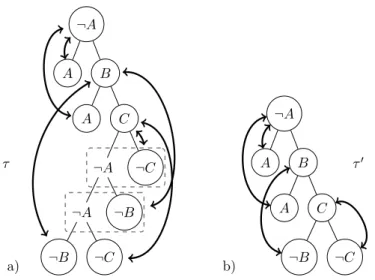
Example 3. A closed CST τ displayed in Fig. 8 a) is supplied with arcs connecting matched conjugate nodes. For emphasis, matched nodes are circled and mismatched clauses enclosed in dashed frames.
τ′ displayed on the right in Fig. 8 b) is a matched CST obtained from
reductions of τ.
¬A
A B
A C
¬A
¬A
¬B ¬C ¬B
¬C
a)
τ
b)
τ′ ¬A
A B
A C
¬B ¬C
Figure 8: Reduction (removal of framed clauses) in τ yields a matched CST displayed in b)
4.1. Connecting Satisfiability Trees
Definition 10 (Connection). Let τ1 and τ2 be satisfiability trees. Let τ1 have an open branch with a literal node A and let τ2 have an open branch with a literal nodeA′ whereA′ is the opposite literal ofA. Satisfiability treeτ
obtained by addingτ2 under everyA-labeled leaf inτ1 is called aconnection of τ1 and τ2 over A.
Here we conveniently assume that there is a single formula over which a connection is possible, and denote the connection as τ1∗τ2.
As (τ1∧τ2)4(τ1∗τ2) it follows that ifτ1∗τ2 is closed, so isτ1∧τ2. To prove C is inconsistent, it is sufficient to close the CST with connections of clauses.
τ
¬B C
A B
Figure 9: τ is a connection of satisfiability trees of {A, B} and{¬B, C}.
closest to the root in order to aggressively remove as large as possible part of the mismatched tree. Finally, we must note that a CST produced by repeated reduction need not be minimal in size (as a graph).
4.2. Resolution
Here we describe an alternative method for matching search, based on Robin-son’s Resolution (cf. [5]). Let M ∨A and N ∨ ¬A be clauses. Simultaneous satisfiability of clausesM∨AandM∨¬Aentails satisfiability of clauseM∨N. We write this as an instance of resolution inference:
M ∨A N ∨ ¬A
M ∨ N .
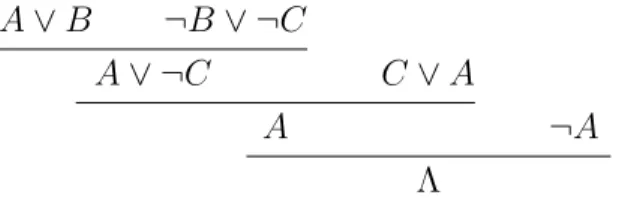
ClauseM∨N is a resolvent of parent clausesM∨AandN ∨¬A. Inconsistency of a clausal form C can be proven by a derivation of an empty resolvent via resolution. Derivation of an empty resolvent when written in the form of a binary tree is called a refutation tree(see Fig. 10).
A∨B ¬B∨ ¬C
A∨ ¬C C∨A
A ¬A
Λ
Figure 10: Refutation tree proving inconsistency ofA∨B,¬B∨ ¬C, C∨A,¬A.
(represented by the matching arc, i.e. connection).
Proposition 11. LetΠbe a refutation tree of the clausal formC. Mapping T from the clause nodes ofΠto the set of clausal satisfiability trees is recursively defined as follows:
T(C) =
(
β-tree of C , if C is a clause on the top of Π T(C1)∗ T(C2) , if C1, C2 are parents ofC . Finally, T(Λ) is a closed and matched CST of C.
Proof. We say that satisfiability treeτ isopen-leafed if every open node in τ is a leaf.
Note that a connection of open-leafed satisfiability trees is an open-leafed satisfiability tree. It follows thatT(C) is open-leafed for everyC∈Π. Formula node Ais open inT(C) if and only ifA∈C. Finally, T(Λ) is a matched CST of the clausal formC.
Thus, a resolution based proof procedure (i.e. Davis, Putnam, Logemann and Loveland’s DPLL algorithm, cf. [1, 3]) can be used for a search for a matched CST.
Likewise, a matched CST naturally converts into a corresponding resolution refutation tree by mapping matching edges to resolution inference strokes.
5. Conclusion
Satisfiability trees are a tree structure inspired by Beth’s semantic trees. From the aspect of model information, satisfiability trees are equivalent to semantic tableau but, unlike the tableau, satisfiability trees omit the history of their con-struction. Satisfiability trees offer graph operations that correspond to logical operators and rules of tableau construction.
This paper focuses on satisfiability trees of propositional formulas in nega-tion normal form (NNF) of which CNF and DNF are examples.
References
[1] M. Ben-Ari, Mathematical Logic for Computer Science, Springer, London (2012).
[2] M. D’Agostino, D.M. Gabbay, R. H¨ahnle, J. Posegga, Handbook of Tableau Methods, Springer, Netherlands (2013).
[3] M. Fitting, First-Order Logic and Automated Theorem Proving, Graduate Texts in Computer Science, Springer, New York (1996).
[4] M. Fitting, Proof Methods for Modal and Intuitionistic Logics, Synthese Library. Springer, Netherlands (2013).
[5] J. A. Robinson, A machine-oriented logic based on the resolution principle,
J. ACM,12, No 1 (Jan. 1965), 23–41.