EXPERIMENTAL RESEARCHES ON THE TECHNICAL
EQUIPMENT FOR HARVESTING MISCANTHUS RHIZOMES
SORICĂ E.1), SORICĂ C.1), PRUTEANU A.1), GRIGORE I.1)
1)INMA Bucharest;
E-mail:[email protected]
Keywords: harvesting equipment, constructive and functional parameters, rhizomes
ABSTRACT
The paper presents experimental research results under laboratory conditions of the technical equipment for harvesting Miscanthus rhizomes in order to establish constructive and functional parameters: lengths, widths, total heights, constructive working depth, clearance, ground gauge, mass values, checking the machinery coupling to the tractor, rotation frequency of separator driving shaft, amplitude and frequency of separator grate movement.
The results obtained confirm fulfilling the requirements regarding to constructive and functional parameters of Miscanthus rhizomes harvesting equipment.
INTRODUCTION
One of the renewable sources assuring the necessary biomass for bioenergy generation, wide spread in EU countries in the last decades, is Miscanthus culture. By capitalization of Miscanthus culture economic advantages can be assured, especially regarding the environment. This can be used for electrical energy producing and/or thermic both in large power plants (30 MW), using tons of biomass every year, and in small households using a few tons, during winter months. By using Miscanthus plant in the burning process, carbon dioxide emissions are reduced and methane ones, released from the deposits, are eliminated [6].
Miscanthus cultivation has a positive impact on soil erosion. One of the significant factors contributing to soil erosion is intensive agriculture. The large number of mechanised works, necessary in the most conventional agricultural works (for food industry), destroy soil structure and texture and accentuate erosion processes due to environmental factors (water, wind). It is to be expected that introducing Miscanthus culture (perennial, reduced number of soil works, high density per hectare, etc.) to lead to a significant reduction of these phenomena, described above.
A number of studies performed in the USA showed that Miscanthus cultures impact on soil erosion processes is minimum (fig. 1).
Fig. 1 - Soil loss associated with cultivation of various types of agricultural crops and Miscanthus[7]
Miscanthus plant energetic potential may be explored in three main directions: bio-ethanol obtaining, biogas or solid biomass (chopped matter, pellets, or briquettes), then converted into energy through thermal processing.
and 10 tons of oil. Miscanthus is one of the most efficient cultures. Net calorific value, relative to the dry biomass, is 17 MJ/kg or 4.75 kWh/ kg.
An extremely important role in establishing a new culture is played by the quality of the seedling material. This way, rhizome harvesting is one of the most important operations with major influence on biomass production. [1], [2], [5].
In most cases, for harvesting the seedling material are used other machines destined to harvest other crops such as potatoes and onions by adapting various constructive solutions with less satisfying results in terms of seedling material quality and energy consumption for the harvesting work. In this context, INMA proposes harvesting equipment for Miscanthus rhizomes, specially dedicated to this crop.
MATERIAL AND METHOD
Experiments under laboratory conditions to determine constructive and functional parameters of the technical equipment for harvesting Miscanthus rhizomes were carried out at INMA Bucharest – Testing Department.
An ERR-type equipment was used for harvesting Miscanthus rhizomes (fig. 2) working in aggregate with 70-80 HP tractors.
Fig. 2 - Technical equipment for harvesting Miscanthus rhizomes ERR[4]
The technical equipment ERR is an agricultural machinery of carried type, made of the following main subassemblies:
- Frame;
- Eccentric separator. - Displacement plough; - Left and right wheel; - Hydraulic motor.
Measuring equipment and devices used for testing
Measuring and control equipment and devices used to test the technical equipment for harvesting Miscanthus rhizomes, under laboratory conditions, are the following:
- for size: 3m measuring tape, 8m measuring tape, 60m measuring tape;
Fig. 3 – Determining weight of tractor aggregate with technical equipment for harvesting Miscanthus rhizomes[4]
- for speed: digital tachometer EXTECH (fig. 4) allowing to determine speed based on direct contact with the revolution surface or optically using a reflecting surface. Device using temperature is between 0 and 50oC.
Fig. 4. Electronic tachometer[4]
- to determine the amplitude and frequency of movement: displacement transducer and amplification and data acquisition system;
RESULTS AND DISCUSSIONS
To determine constructive and functional parameters the following results were obtained:
total length, width, height – overall dimensions resulted after measurements are presented in Table 1:
Table 1
No. Characteristic UM Value
1. Length mm 2090
2. Width mm 1590
constructive working depth – the values were determined by measuring the distance between plough top and the support surfaces of the wheels adjusting working depth, the technical equipment being placed on a flat, hard and horizontal surface with an admitted longitudinal and transversal inclining of maximum 0.5%. The tractor used in aggregate with the agricultural machine was a 70...80 HP wheeled tractor equipped with three-point suspension mechanism, category 2 according to SR ISO 730:2012.
Constructive working depth dimensions, resulted after measurements are:
- minimum working depth 0 mm
- maximum working depth 250 mm
clearance – the values were determined by making the measurements using a measuring tape and other helpful tools (ruler, square), the technical equipment being placed on a flat, hard and horizontal surface with an admitted longitudinal and transversal inclining of maximum 0.5%. The clearance value in transport position was of 350 mm.
ground gauge - the values were determined in operating position by measuring the distance between the median plans of the support wheels. The ground gauge was of 1868 mm.
mass values of the technical equipment in aggregate with the tractor TD 80D New Holland were determined by using platform balances RW10P. (Table 2)
Table 2
No. Characteristic UM Value
1.
Total mass of tractor TD 80D New Holland
- front, Mpf - back, Mps - total, Mpt
kg
1516 2274 3790
2.
Mass of tractor TD 80D New Holland with technical equipment ERR
- front, MTpf - back, MTps - total, MTpt
kg 1416
2869 4285
3. ERR equipment mass kg 495
Percentage value of the load on the front axle reported to the total mass of tractor TD 80D with ERR technical equipment is given by the formula: [3]
100, [%] Tpf
Tpt
M M
A value of 33.04% resulted; it satisfies the stability requirement on longitudinal plan so that the aggregate would not rear (according to internal regulations on vehicles movement, the load on the front axle must be higher than 20% of the aggregate mass)
equipment coupling to the tractor – table 3 presents the coupling elements with three-point suspension mechanism of tractor TD 80D New Holland, according to SR ISO 730:2012. [3]
Table 3
No Characteristic Symbol Value
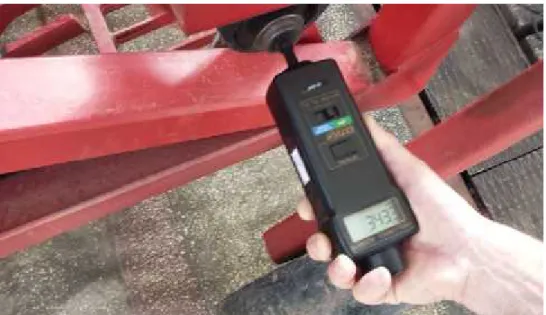
rotation frequency of separator driving shaft (fig. 5) was determined by using a digital tachometer for engine operating speed of 2200 rev/min. The average value obtained when determining the rotation frequency of separator driving shaft was of 343 rev/min.
Fig. 5. Determining rotation frequency of separator driving shaft
amplitude and frequency of separator grate movement – were determined using an amplification and acquisition system that took over data from a displacement transducer WA50; then, the system processed and saved data on a computer as graphs (fig. 6).
Fig. 6. Amplitude and frequency of oscillating separator grate movement
Data analysis shows movement frequency of 5.7 Hz and 25 mm displacement of oscillating grate tip.
CONCLUSIONS
Miscanthus is one of the most efficient cultures in terms of input amounts necessary to obtain the crop, having net calorific value, relative to the dry biomass, of 17 MJ/kg
An extremely important role in establishing the Miscanthus culture is played by the quality of the seedling material. Rhizome harvesting is one of the most important operations with major influence on biomass production.
730:2012) with a rotation frequency of separator driving shaft of 343 rev/min, a grate separator movement frequency of 5.7 Hz and 25 mm displacement of oscillating grate tip, allowing a good functioning and making possible to separate Miscanthus rhizomes.
BIBLIOGRAPHY
1.Postelnicu, E., Sorică, C., Grigore, I., Ludig, M., Niţu, M., 2012 - Methods for
obtaining seedling material in order to promote energy plant Miscanthus, Annals of University of Craiova, series Agriculture – Mountain Agriculture – Lands and Surveys,
Volume XLII 2012/2, page 419-423, Craiova,
http://cis01.central.ucv.ro/analele_universitatii;
2. Sorică, C., Voicu, E., Manea, D., 2009 - Technology for promotion in Romania of
energy crop Miscanthus, as renewable resource to increase energy competitiveness in independence purposes – in INMATEH Journal. No. 29 (2009-III), page 19-26, Bucharest, ISSN 1583-1019,http://www.inma.ro/inmateh;
3. Sorică, E., (2015), Experimental research on technical equipment for harvesting
Miscanthus rhizomes,Paper nr. 5, Doctoral School.
4. Sorică, E., 2015, Experimental research methodology on technical equipment for
harvesting Miscanthus rhizomes, Paper no. 4, Doctoral School.
5. Voicu, E., Pirnă, I., Ciurel, G., Chiţoiu, M., Brkic, M., 2010 - Researches on
harvesting of Miscanthus crop with the forage harvester, in INMATEH Journal, No. 32 (2010-III), page 37-42, Bucharest, ISSN 1583-1019,http://www.inma.ro/inmateh.
6. Voicu, E., et al., 2009 - Alternative energies based on superior capitalization of
Miscanthus plant and of biomass in Austria, AGRICULTURE MECHANIZATION Journal, No. 1, Bucharest;
![Fig. 2 - Technical equipment for harvesting Miscanthus rhizomes ERR [4]](https://thumb-us.123doks.com/thumbv2/123dok_us/8070535.2137804/2.892.253.641.502.703/fig-technical-equipment-harvesting-miscanthus-rhizomes-err.webp)
![Fig. 3 – Determining weight of tractor aggregate with technical equipment for harvesting Miscanthus rhizomes [4]](https://thumb-us.123doks.com/thumbv2/123dok_us/8070535.2137804/3.892.172.750.92.288/determining-tractor-aggregate-technical-equipment-harvesting-miscanthus-rhizomes.webp)