Parallel Processing Model for Cholesky Decomposition
Algorithm in AlgoWiki Project
Alexander S. Antonov1, Alexey V. Frolov2, Hiroaki Kobayashi3, Igor N. Konshin1,2,4, Alexey M. Teplov1, Vadim V. Voevodin1, Vladimir V. Voevodin1
c
The Authors 2016. This paper is published with open access at SuperFri.org
The comprehensive analysis of algorithmic properties of well-known Cholesky decomposition is performed on the basis of multifold AlgoWiki technologies. A detailed analysis of information graph, data structure, memory access profile, computation locality, scalability and other algo-rithm properties is conducted, which allows us to demonstrate a lot of unevident properties split up into machine-independent and machine-dependent subsets. The comprehension of the paral-lel algorithm structure enable us to implement efficiently the algorithm at hardware platform specified.
Keywords: AlgoWiki, algorithm properties, Cholesky decomposition, memory access locality, dynamic characteristics, scalability.
Introduction
The fundamental problem of high-performance computing consists in the accurate coordi-nation between algorithm and program structure and hardware features that results in high efficiency. Modern computers possess great capability, but if there is a lack of the above men-tioned coordination, the final implementation efficiency can be very low. A lot of studies are devoted to the most efficient implementation of some specific algorithm.
This paper presents a comprehensive analysis of Cholesky decomposition algorithm. The analysis is based on AlgoWiki methodology and allows specifying the most important features of the algorithm and its parallel implementation model in order to get the most efficient processing. AlgoWiki [1, 2] is an open encyclopedia of parallel algorithmic features on the Internet which provides collaboration with the worldwide computing community on algorithm descriptions. The main goal of this project is to develop fundamentals and formalize the mapping of algorithms to the architecture of parallel computers. As a result of the current research, the universal description of the structure of algorithm properties has been developed.
All fundamental algorithmic properties that determine implementation efficiencies on mod-ern computing platforms are divided into machine-dependent and machine-independent subsets. This division is made intentionally in order to separate these features of algorithms, which define their perspective implementations on parallel computational systems from a range of questions associated with consequent stages of programming and execution of the resulting programs on particular computing systems.
The AlgoWiki open encyclopedia is based on wiki technology, which allows for any researcher to add and improve the material. A pilot version of the Internet encyclopedia can be found at [3]. The main part of the AlgoWiki project is the algorithms classification and description of their serial and parallel properties. The algorithm descriptions were performed by groups
1 Moscow State University, Moscow, Russia
2 Institute of Numerical Mathematics of the Russian Academy of Sciences, Moscow, Russia 3 Tohoku University, Sendai, Japan
corresponding to the types of operations involved. It is assumed that this classification will eventually be expanded while other researchers will give their contribution to this project.
To demonstrate the analysis of the parallel processing model we have chosen one of the most popular algorithms — the Cholesky decomposition. This algorithm is widely used for the direct solution of dense and sparse linear systems. The modification of this algorithm is exploited to construct efficient preconditioners for iterative methods.
On the basis of the Cholesky decomposition algorithm properties we demonstrate a math-ematical algorithm description, the analysis of sequential and parallel complexity, the informa-tion graph of the algorithm, properties of software implementainforma-tions, analysis of data locality, scalability, as well as dynamic characteristics and performance efficiency of the algorithm imple-mentation. On the basis of the detailed algorithm analysis we give the conclusions on the most efficient algorithm implementation according to facilities of the supercomputer used.
1. Properties and structure of the algorithm
1.1. General description
The Cholesky decomposition algorithm was first proposed by Andre-Louis Cholesky in 1910 [8, 9]. The idea of this algorithm was published by Benoit in 1924 [7] and later was used by Banachiewicz in 1938 [5, 6]. The Cholesky decomposition is also known as the square-root method [10, 15, 16] due to the square root operations used in this decomposition and rarely exploited in some implementations of Gaussian elimination.
Originally, the Cholesky decomposition was used only for dense real symmetric positive definite matrices. At present, the application of this decomposition is much wider. For example, in order to increase the computational performance, its block versions are often applied.
In case of sparse matrices, the Cholesky decomposition is also broadly used as the main stage of a direct method for solving linear systems. In order to reduce the memory requirements and matrix profile, special reordering strategies (such as RCM) are applied to minimize an algorithm arithmetic complexity. A number of reordering strategies (Metis, Zoltan, etc.) are used to identify the independent matrix blocks for parallel computing systems.
Various versions of the Cholesky decomposition are successfully used in iterative methods to construct preconditioners for sparse symmetric positive definite matrices. In the case of incom-plete triangular decomposition, the elements of a preconditioning matrix are specified only in predetermined positions (for example, in the positions of the original matrix nonzero elements; this version is known as an IC0 decomposition). In order to construct a more accurate decompo-sition, a filtration of small elements is performed using a filtration threshold. The use of such a threshold allows one to obtain an accurate decomposition, but the number of nonzero elements may increase. A decomposition algorithm of the second-order accuracy is proposed in [12]; this algorithm allows one to increase the accuracy of decomposition with about the same number of nonzero elements in the factors. In its parallel implementation, a special version of an additive preconditioner is applied on the basis of the second-order decomposition [13].
Here we consider the original version of the Cholesky decomposition for dense real symmetric positive definite matrices. Let us emphasize some basic properties of the algorithm.
square-root operations when using the property of symmetry and, hence, is somehow faster than the Cholesky decomposition, but it requires storing the entire matrix.
Accumulation mode. The Cholesky decomposition allows one to use the so-called ‘accu-mulation’ mode due to the fact that the significant part of computation involves ‘dot product’ operations. Hence, these dot products can be accumulated in double precision for additional accuracy. In this mode, the Cholesky method has the least ‘equivalent perturbation’. During the process of decomposition, no growth of the matrix elements can occur, since the matrix is symmetric and positive definite. Thus, the Cholesky algorithm is unconditionally stable.
1.2. Mathematical description and information graph
The input data of the algorithm is a symmetric positive definite matrix A of size n with elements aij, while the output is the lower triangular matrixL with elementslij.
The Cholesky algorithm can be represented in the form:
l11 = √a11,
lj1 =
aj1
l11
, j= 2, ..., n,
lii =
v u u taii−
i−1
X
p=1
l2
ip, i= 2, ..., n,
lji =
aji−
i−1
X
p=1
lipljp
/lii, i= 2, ..., n−1, j=i+ 1, ..., n.
In the last formula the basic elimination step is performed which is the main computational kernel of the algorithm.
The sequential complexity of the Cholesky decomposition algorithm is as follows: n square roots,n(n−1)/2 divisions, (n3−n)/6 multiplications and (n3−n)/6 additions (subtractions). Thus, a sequential version of the Cholesky algorithm is of cubic complexity.
There is a block versions of this algorithm; however, here we consider only its standard ‘dot’ version for simplicity of its informational graph presentation.
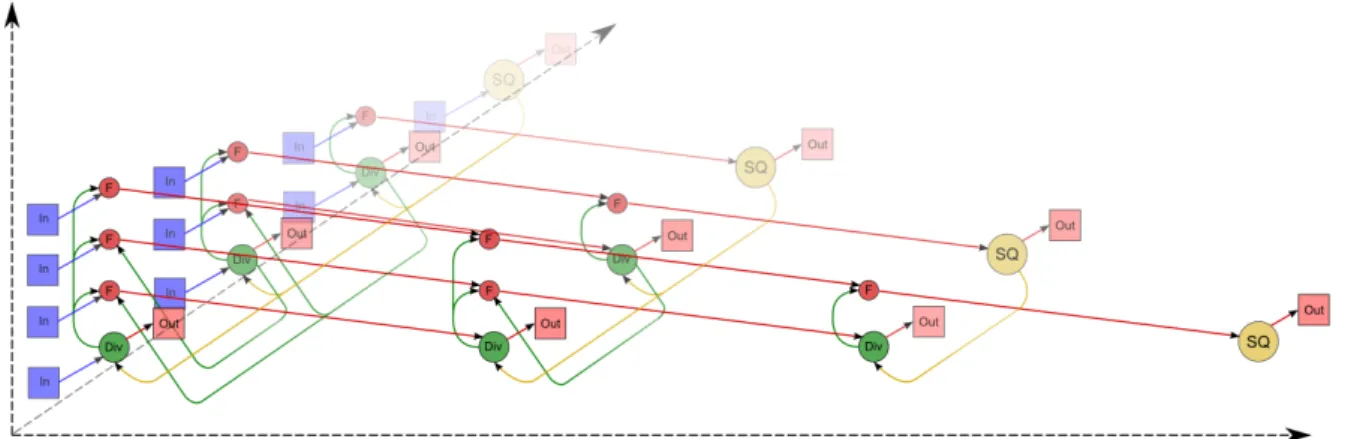
An informational graph [17] is a directed acyclic graph the vertices of which correspond to the operations of the algorithm, and the edges — to the transfer of information between them. The informational graph of the dot version of algorithm consists of three groups of vertices positioned in the three-dimensional spaces with integer coordinates. The first and the second groups of vertices belong to the one-dimensional domains corresponding to square root and divisiona/boperations, respectively. The third group of vertices belongs to the three-dimensional domain corresponding to elimination operationa−bc.
Figure 1. The informational graph of the Cholesky algorithm with input and output data: SQ is the square-root operation, F is the operationa−bc, Div is division, In and Out indicate input and output data
1.3. Parallelization resources and other properties of the algorithm
In order to decompose a matrix of order n, a parallel version of the Cholesky algorithm should sequentially perform the following layers of operations: nlayers for square roots (a single square root on each layer); n−1 layer for divisions (on every layer, the number of divisions is linear and, depending on a particular layer, varies from 1 ton−1);n−1 layer of multiplications and n−1 layer of additions/subtractions (on every layer, the number of these operations is quadratic and varies from 1 to (n2−n)/2).
Contrary to a sequential version, in a parallel version the square-root and division operations require a significant part of overall computational time. The existence of isolated square roots on some layers of the parallel form may cause other difficulties for particular parallel computing architectures. In the case of symmetric linear systems, the Cholesky decomposition is preferable compared to Gaussian elimination because of the reduction in computational time by a factor of two. However, this is not the case for its parallel version.
In addition, we should mention the fact that the accumulation mode requires multiplications and subtractions in double precision. In a parallel version, this means that almost all intermediate computations should be performed with the data given in their double precision format. Contrary to a sequential version, this almost doubles the memory expenditure.
Thus, the Cholesky decomposition belongs to the class of algorithms of linear complexity in the sense of the height of its parallel form, whereas its complexity is quadratic in the sense of the width of its parallel form.
In the case of unlimited computer resources, the ratio of the sequential complexity to the parallel complexity isquadratic with respect to the matrix sizen. That is, havingn2 processors the Cholesky algorithm can be completed innsteps, while the sequential version can be finished only inn3/6 steps.
The computational power of the Cholesky algorithm considered as the ratio of the number of operations to the amount of input and output data is only linear with respect ton.
The information graph arcs from the vertices corresponding to the square-root and division operations can be considered as groups of data such that the function relating the multiplicity of these vertices and the number of these operations is a linear function of the matrix order and the vertex coordinates. These groups may contain long arcs; the remaining arcs are local.
The most known is the compact packing of a graph in the form of its projection onto the matrix triangle, whose elements are recomputed by the packed operations. The long arcs can be eliminated and replaced by a combination of short-range arcs.
The following inequality is valid for the ‘equivalent perturbation’M of the Cholesky decom-position (see [16]):
||M||E ≤2||δA||E,
whereδAis the perturbation of the matrixAcaused by the representation of the matrix elements in the computer memory. Such a slow growth of matrix elements during decomposition is due to the fact that the matrix is symmetric and positive definite.
2. Algorithm implementation
2.1. Sequential implementation of the algorithm
In its simplest version without permuting the summation, the Cholesky decomposition can be represented as follows:
F or i= 1, ..., n Do:
s:=aii
F or k= 1, ..., i−1 Do:
s:=s−aikaik
EndDo
aii :=√s
F or j=i+ 1, ..., n Do:
s:=aij
F or k= 1, ..., i−1 Do:
s:=s−aikakj
EndDo
aij:=s/aii
EndDo
EndDo
Figure 2. Implementation of the sequential Cholesky decomposition algorithm. A general memory-access profile
A block version of the Cholesky algorithm is usually implemented in such a way that the scalar operations in its sequential versions are replaced by the corresponding block-wise opera-tions instead of using the loop unrolling and reordering techniques.
In order to ensure the locality of memory access in the Cholesky algorithm, the original matrix A and factors L and U should be stored in the lower triangle by rows (or in the upper one by columns) to exploit the sequential access to memory and to improve paging and cache memory usage.
2.2. Structure of memory access and locality estimation
which decreases the memory access locality. In this case, the structure of iterations is the main factor influencing the memory access locality.
The more detailed study of the locality can be found in [3], as well as ‘quantitative’ estima-tion of locality on the basis of daps and cvg values.
2.3. Approaches and features of parallel implementations
The analysis of algorithms structure allows making a conclusion that a large variety of its parallel implementations can be proposed. For example, in the version specified in Section 2.1 only the inner loop over j is parallel. Nevertheless, a simple parallelization technique causes a large number of data transfer between the processors at each step of the outer loop; this number is almost comparable with the number of arithmetic operations. Hence, it is reasonable to partition the computations into blocks with the corresponding partitioning of the data arrays before the allocation of operations and data between the processors of the computing system in use.
A relatively successful decision depends on the features of a particular computer system. If the nodes of a multiprocessor computer are equipped with pipeline accelerators, it is reasonable to compute several dot products at once in parallel. Such a possibility exists in the case of programmable logic devices; in this case, however, the arithmetic performance is limited by a slow sequential square-root operation. In principle, it is possible to apply the so-called ‘skew’ parallelism; however, this approach is not used in practice because of complexity in the control structure of the algorithms implementation.
2.4. Scalability and dynamic characteristics of the algorithm implementation
The scalability analysis was performed on the Lomonosov supercomputer [14] installed at the Research Computing Center of Moscow State University. For the experiments, the Intel Xeon X5570 processors with 94 Gflops peak performance and the Intel compiler with -O2 option were used. For our experiments we used the ScaLAPACK implementation for the Cholesky decomposition from the MKL library (the pdpotrf method).
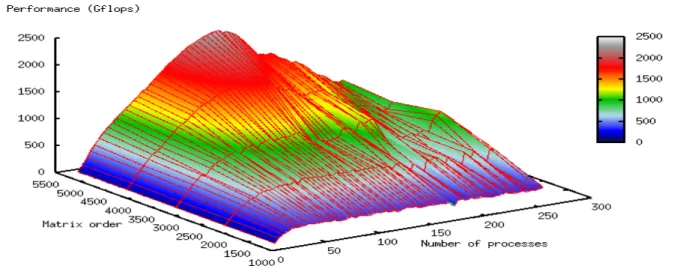
Figure 3 illustrates the performance of the parallel implementation of the Cholesky algo-rithm. The number of processors were taken from 4 to 256, the orders of matrices – from 1024 to 5120. The maximal performance achieved in this experiments was about 2.5 Tflops. We can conclude that the performance of the algorithm increases with the increase of the problem size, and otherwise, for a reasonable problem size, the performance increases with the increase of the number of processors used. Furthermore, the cache effects can be observed by the graph curvature.
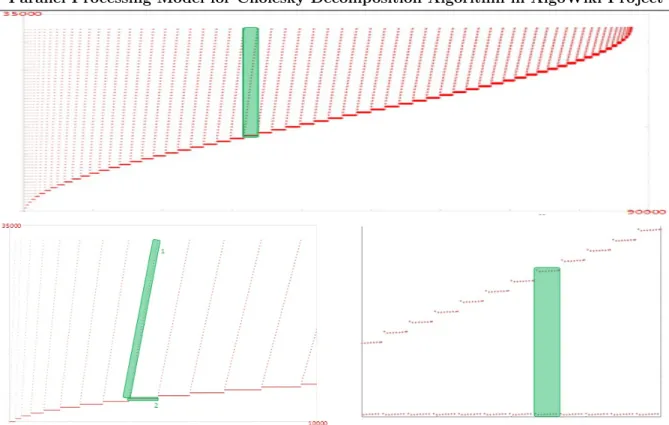
Figure 4 illustrates the Cholesky decomposition implementation efficiency (the case of lower triangular matrices) for the matrix order 80000 by using 256 processes. It is shown on the top figure that during the runtime of the program the processor usage level is about 50%. That is a quite good result for programs executed with no use of the Hyper Threading technology. The bottom figure illustrates the variation of FLOPS performance during execution time.
Figure 3. A parallel implementation of the Cholesky algorithm. Performance variation vs. the number of processors and the matrix order
Figure 4. CPU usage diagram (top) and FLOPS performance (bottom) for the Cholesky de-composition execution time
The data obtained from the monitoring system allows one to make a conclusion that the program under the study was operating in an efficient and stable manner. The memory and communication environment usage is intensive, which can lead to an efficiency reduction with the increase of the matrix order or the number of processors in use.
2.5. Computer architectures and existing implementations
Analyzing the performance of the ScaLAPACK library on supercomputers, we can conclude that for large values of the matrix order n the data exchanges reduce the execution efficiency but to a smaller extent than the non-optimality in the organization of computations within a single node. At the first stages, hence, it is necessary to optimize not a block algorithm but the subroutines used on individual processors, such as the dot Cholesky decomposition, matrix multiplications, etc.
efficiency on parallel computers, hence, it is reasonable to use not the original Cholesky algorithm but its well-known modification without square-root operations in the formLDLT.
The dot version of Cholesky algorithm is implemented in most of linear algebra libraries, such as LINPACK, LAPACK, ScaLAPACK, etc.
Only in few of libraries, the accumulation mode is implemented to reduce the effect of round-off errors. In order to save computer memory, a packed representation of the matricesA
and L is also used in the form of one-dimensional arrays.
Unfortunately, in the most of libraries the dot Cholesky implementations are based on its LINPACK implementation utilizing the conventional BLAS library. The dot product is com-puted in BLAS with no accumulation mode that may substantially reduce the accuracy of computations.
It is interesting to note that the original Cholesky decomposition is available in a majority of libraries, whereas the LDU-decomposition algorithm without square-root operations is used only in specific cases (for example, for tridiagonal matrices), when the number of diagonal elements is comparable with the number of off-diagonal ones.
Conclusion
The detailed analysis of the Cholesky decomposition algorithm properties has been pre-sented. It has been shown that the comprehensive theoretical and practical investigation is important to construct the efficient implementation of the algorithm.
The results described in all sections except 2.4 were obtained in the Moscow State Univer-sity with the financial support of the Russian Science Foundation (agreement No. 14-11-00190). The research presented in section 2.4 was supported by the Russian Foundation for Basic Re-search (No. 16-07-01003). Numerical experiments were performed in the Supercomputing Center of Lomonosov Moscow State University [14].
This paper is distributed under the terms of the Creative Commons Attribution-Non Com-mercial 3.0 License which permits non-comCom-mercial use, reproduction and distribution of the work without further permission provided the original work is properly cited.
References
1. Voevodin, V., Antonov, A., Dongarra, J.: AlgoWiki: an Open Encyclopedia of Parallel Algorithmic Features. Supercomputing Frontiers and Innovations, Vol. 2, No. 1. Pp. 4–18 (2015). DOI: 10.14529/jsfi150101.
2. Antonov, A., Voevodin, Vl., Voevodin, Vad., Teplov, A.: A Study of the Dynamic Char-acteristics of Software Implementation as an Essential Part for a Universal Description of Algorithm Properties. 24th Euromicro International Conference on Parallel, Distributed, and Network-Based Processing Proceedings. Pp. 359–363 (2016).
3. AlgoWiki: an open encyclopedia of algorithms properties. http://algowiki-project.org.
4. AlgoWiki: Cholesky decomposition. http://algowiki-project.org/en/Cholesky decomposition.
6. Banachiewicz, T.: M´ethode de r´esoltution num´erique des ´equations lin´eaires, du calcul des d´eterminants et des inverses et de r´eduction des formes quardatiques. Bull. Intern. Acad. Polon. Sci. A. 393–401 (1938).
7. Benoit, Commandant: Note sur une m´ethode de r´esolution des ´equations normales provenant de l’application de la m´ethode des moindres carr´es `a un syst`eme d’´equations lin´eaires en nom-bre inf´erieur `a celui des inconnues (Proc´ed´e du Commandant Cholesky). Bulletin G´eod´esique 2, 67–77 (1924).
8. Brezinski, C.: Andr´e-Louis Cholesky. Springer-Verlag GmbH, 311 p. (2014).
9. Cholesky, A.-L.: Sur la r´esolution num´erique des syst`emes d´equations lin´eaires La SABIX, Bulletins d´eja publi´es, Sommaire du bulletin n. 39. 81–95 (2005) https://sabix.revues.org/529.
10. Faddeev, D.K., Faddeeva, V.N.: Computational Methods of Linear Algebra. Freeman (1963).
11. Golub, G.H., Van Loan, C.F.: Matrix Computations, 3rd ed. Johns Hopkins Univ. Press, Baltimore, MD, USA (1996).
12. Kaporin, I.E.: High quality preconditioning of a general symmetric positive definite matrix based on its UTU +UTR+RTU-decomposition. Numer. Lin. Algebra Appl. 5(6), 483–509 (1998). DOI: 10.1002/(SICI)1099-1506(199811/12)5:6<483::AID-NLA156>3.0.CO;2-7.
13. Kaporin, I.E., Konshin, I.N.: A parallel block overlap preconditioning with inexact subma-trix inversion for linear elasticity problems. Numer. Lin. Algebra Appl. 9(2), 141–162 (2002). DOI: 10.1002/nla.260.
14. Sadovnichy, V., Tikhonravov, A., Voevodin, Vl., Opanasenko, V.: “Lomonosov”: Supercom-puting at Moscow State University. In Contemporary High Performance ComSupercom-puting: From Petascale toward Exascale (Chapman & Hall/CRC Computational Science), Boca Raton, USA, CRC Press. 283–307 (2013).
15. Voevodin, V.V.: Computational Foundations of Linear Algebra. Nauka, Moscow (1977) (in Russian).
16. Voevodin, V.V., Kuznetsov, Yu.A.: Matrices and Computations. Nauka, Moscow (1984) (in Russian).