ISSN 1840-3719
A QUALITATIVE STUDY REVEALING
THE RELATIONSHIP BETWEEN
CULTURAL INDICATORS AND
ATTITUDES TOWARD THE ADS
Emine Sahin
*Abstract
The companies, in International markets, are required to examine the attitudes and the behaviours to recognize the consumer to be able to make their products preferable under constantly growing competitive conditions. Therefore, it is of great importance to know cultural values of the customers in the country's where global brands compete and to shape ads which is one of the marketing communication tools in this direction. In this respect, knowing the cultural similarities or differences of the countries where the ads are used (such as that country's religion, language, norms and cultural values) gains importance. The consumer attitudes towards the ads change in accordance with their cultural similarities or dissimilarities and this attitude change determines the tendency of shopping. According to Geert Hofstede, social anthropologist who analyzes the cultural levels and the relationships among them the basic elements of the culture consists of symbols, heroes, rituals and values underlying them. Thorough symbols, a number of cultural values are conveyed to ads. The problem of this study which was carried out in order to determine attitude change towards the ads including cultural differences is “Is there a difference in the attitudes towards the ads including different cultural symbols? How it is distributed according to gender differences?" In this study, a qualitative research method was applied and interviewed with 20 test subject. 20 students studying in one of the universities in Turkey were selected with formal sampling, they were asked questions, and it was tried to determine the difference between the ad of Do÷uú Çay-a tea brand which uses the symbols and local accent of Black sea
region in Turkey in its ads- and the ad of Lipton which is an international British tea brand. At the end of the study, it was found out that sample’s the attitude was positive towards ad of Do÷uú Çay, not Lipton.
Keywords: Attitudes; Cultural Values; Hofstede; Different Cultural Symbols
* Corresponding author: Emine Sahin, Research assistant at the Gumushane University and PhD
ϲ
ƉŝƉŚĂŶLJ͗:ŽƵƌŶĂůŽĨdƌĂŶƐĚŝƐĐŝƉůŝŶĂƌLJ^ƚƵĚŝĞƐ͕sŽů͘ϳ͘EŽ͘ϭ͕;ϮϬϭϰͿΞ&ĂĐƵůƚLJŽĨƌƚƐĂŶĚ^ŽĐŝĂů^ĐŝĞŶĐĞƐ
INTRODUCTION
Foreign companies started to emerge in Turkey as well with disappearance of national boundaries after worldwide developments in marketing in 1980s. Companies have to know consumers and
analyse their attitudes and behaviours to come to a place in which they can be known and preferred in international markets. In this respect, knowing cultural values of consumers in the target country’s market and using advertisements gain importance. Cultural differences and factors such as religion, language and cultural values of the countries in which advertisements are published become important. On the other hand, Turkish companies entered into competition with foreign companies and started similar works to protect their place both in Turkish market and in the world market. Advertisement messages used to increase brand awareness must be parallel with values of the target country. Advertisement strategies are defined accordingly. Basic method to put forward Turkish identity is created by benefiting factors reflecting Turkish culture. In this respect, values which are belong to Turkish culture, language, life style, traditions and religious practices gain importance.
Factors which shouldn’t be forgotten in international companies such as country’s economic situation, target audiences’ demographic and socio-cultural situation influence advertisers. Also, messages should be arranged according to these factors. Perhaps, the most important variable among these is culture. While culture, which
ϳ
ƉŝƉŚĂŶLJ͗:ŽƵƌŶĂůŽĨdƌĂŶƐĚŝƐĐŝƉůŝŶĂƌLJ^ƚƵĚŝĞƐ͕sŽů͘ϳ͘EŽ͘ϭ͕;ϮϬϭϰͿΞ&ĂĐƵůƚLJŽĨƌƚƐĂŶĚ^ŽĐŝĂů^ĐŝĞŶĐĞƐ
civilization and mind by Hofstede and he points out that this purification can be realized by literature, art and education (Hofstede, 1997:5).
Cultural differences are important factors for global
advertisement’s messages to be understood. Commercial films in Turkey give partially foreign and Turkish brands’ demonstrations. In this respect, advertisements gain importance in cultural harmony because giving messages in advertisement based on a language and communication tools (Schütteve Ciarlante, 1998). The closer the language and the fictional scenes used in advertisement to the society, the more people understand it. Speaking the same language with the target audience, benefiting from the same sensibility and components such as names, images, behaviour patterns influence attitudes both for advertisements and companies.
Studies done on culture makes several definitions to reveal diversity of culture based on the fact that culture differs in each country. While Edward Hall defines cultural diversity according to “Information Systems Model”, Hofstede explains it according to “Cultural Dimensions Model” and Kuluckhohn and Strodbeck explains it according to “Value Tendency Model” (Kartari, 2001). When Hosftede expresses cultural diversity, he claims that culture is not only different in economical and judiciary terms but also in management system. He divides countries into two groups according to their similarities and differences and he separates these two groups
ϴ
ƉŝƉŚĂŶLJ͗:ŽƵƌŶĂůŽĨdƌĂŶƐĚŝƐĐŝƉůŝŶĂƌLJ^ƚƵĚŝĞƐ͕sŽů͘ϳ͘EŽ͘ϭ͕;ϮϬϭϰͿΞ&ĂĐƵůƚLJŽĨƌƚƐĂŶĚ^ŽĐŝĂů^ĐŝĞŶĐĞƐ
Literature Review
Advertisement, which is a marketing tool for companies in global market, is entitled as glocal advertisement and global advertisement (Elden, Eriúimtarihi: 10.08.2012). While glocal
advertisements have the same messages for all the countries that the advertisement is published, global advertisements have messages including cultural differences. Also, there are national advertisements including cultural values of local company’s target audiences.
When glocal or international advertisements ignore country’s cultural values, they get reaction from society and in the upcoming days it can even be removed because of the fact that it does not comply with publication principles. For example, in several Arabic countries using holy symbols such as cross, Mecca and using alcohol and naked women pictures unless it is obvious that she is western is forbidden. In a recognized tea company advertisement, the actor was using his left hand and Saudi Arabian people had negative attitude for the brand because of this (Dereli, 2002:95-96). Çaykur commercial film in which, Müslüm Gürses played sparked a debate. In the days when he was struggling for life after his by-pass, this commercial film was being published frequently. This situation got a big reaction in social media (http://www.haber7.com/televizyon/haber/999572-muslum-gursesin-reklami-yayindan-kaldirildi). After claims that the company takes advantage of his fans, the commercial film is removed.
ϵ
ƉŝƉŚĂŶLJ͗:ŽƵƌŶĂůŽĨdƌĂŶƐĚŝƐĐŝƉůŝŶĂƌLJ^ƚƵĚŝĞƐ͕sŽů͘ϳ͘EŽ͘ϭ͕;ϮϬϭϰͿΞ&ĂĐƵůƚLJŽĨƌƚƐĂŶĚ^ŽĐŝĂů^ĐŝĞŶĐĞƐ
of culture explains it based either on ethnic or humane or social classes (Lull, 2001:97).
Culture is transferring symbols, behavioural patterns, social lows, moral principles and religious views belong to the society to
future generations by individuals. Society’s values explain experiences in addition to learned behaviours (Giddens, 2010:30).
Anthropologist Malinowski makes a definition of culture which is in the anthropology’s area of investigation in this way; Culture is a basic complement which is composed of usage and consumption items, groups’ rights and duties, people’s thoughts, abilities, beliefs and habits (Malinowski,cited byYaylagülveKorkmaz, 2008:188). Individuals’ thoughts and beliefs lead their habits and these habits become their lifestyles. In culture’s definition which Hofstede summarizes as “unwritten rules of a social play” individual’s complying with general structure of his society (Giddens, 2010:35). Unwritten norms are valid for general individuals and force them to obey these rules. These rules can vary not only among societies but also within these societies. Therefore, Culture is a total of symbols and behavioural patterns of society’s laws, moral principles, traditions and religious beliefs. It consists of concrete and moral components. Accordingly, concrete components include art, theatre, literature, music, language, dressing, architecture, food, history, climate, and geography. Moral components include ideas, behaviours, ideals, norms, values, beliefs and habits (Ügeöz, 2003:21)
ϭϬ
ƉŝƉŚĂŶLJ͗:ŽƵƌŶĂůŽĨdƌĂŶƐĚŝƐĐŝƉůŝŶĂƌLJ^ƚƵĚŝĞƐ͕sŽů͘ϳ͘EŽ͘ϭ͕;ϮϬϭϰͿΞ&ĂĐƵůƚLJŽĨƌƚƐĂŶĚ^ŽĐŝĂů^ĐŝĞŶĐĞƐ
symbols, heroes/leaders, rituals and values (Ügeöz, 2003:21; Soydaú,
2010:56). He based this classification on his definition. The elements that he defines as culture components come from the culture’s meaning “Unwritten rules of the play”. He supports that culture come
in existence in four ways as symbols, heroes, rituals and values in “Cultural Onion”. Each layer affects the other and demonstrates itself as a symbol in the final stage. According to Hofstede what differentiates people from other people and other societies is how they interpret and code these cultural values (Soydaú, 2010:56).
There are numerous studies about culture in multi-cultural countries such as United States of America and Canada. Graham (2005) made a research by e-mail questionnaire to find out effects of advertisements using English as a first language and Spanish as a second language on acculturation in the States which has a lot of immigrants from Mexico. It is found out that Americans of Spanish origin have positive attitude towards the advertisements in Spanish and they prefer Spanish in the advertisements. Caillat and Mullar (1996) made a research on American and British accents and found out that direct statements are more effective in commercial films using American accent and indirect statements are more effective in the ones using British accent. Moreover, Cheng and Scweitzen (1996) made a research on commercial films published in primetime in China which is not an American and a Western country and found out that while symbolic values are given more importance in the country,
ϭϭ
ƉŝƉŚĂŶLJ͗:ŽƵƌŶĂůŽĨdƌĂŶƐĚŝƐĐŝƉůŝŶĂƌLJ^ƚƵĚŝĞƐ͕sŽů͘ϳ͘EŽ͘ϭ͕;ϮϬϭϰͿΞ&ĂĐƵůƚLJŽĨƌƚƐĂŶĚ^ŽĐŝĂů^ĐŝĞŶĐĞƐ
advertisements include individualism and Korean ones includecollectivism. According to him while American society is individualistic, Korean society is a collective society.
Garcia (2004) in his study revealing culture’s effects in
fashion advertisement on Mexican immigrant students living in the States and American students found out that nation is not the only variable in cultural differences. In addition, it is revealed that while students of both nations like advertisements including reasonable sexuality, they do not like the ones including high level of sexuality.
Cultural differences play an important role in international marketing as well as in international advertisements. Therefore, there is obvious link between culture and language. Understanding culture without understanding the language spoken is impossible but language is not the only determiner. Individual manners among the values are determiners of brand choosing.
One of the values determining consumers’ behaviours is attitude, but of course it is not the only one. Attitude is a tendency to react either in a negative or in a positive way to objects, beliefs and environment that people have (OdabaúıveBarıú, 2010:157). There are
numerous attitude studies in the field of social sciences but attitude first enter this field as an analysis tool by Thomas and Florian Znanienki’s (1927) studies. They define attitude as an “individual consciousness process” (Mutlu, 2008:285).
Attitudes are determiners of behaviours. Therefore, attitude
ϭϮ
ƉŝƉŚĂŶLJ͗:ŽƵƌŶĂůŽĨdƌĂŶƐĚŝƐĐŝƉůŝŶĂƌLJ^ƚƵĚŝĞƐ͕sŽů͘ϳ͘EŽ͘ϭ͕;ϮϬϭϰͿΞ&ĂĐƵůƚLJŽĨƌƚƐĂŶĚ^ŽĐŝĂů^ĐŝĞŶĐĞƐ
analyses of advertisements in literature. Because attitude alteration realized by persuasion come forward as behaviour alteration.
The most cited study in this field is Bauer and Greyer’s study. These researchers contribute to the field by the first study revealing
people’s attitudes for advertisements and they used in-depth interview method (øspir and Suher, 2009:7). The study reveals that there are
many positive attitudes to advertisements but there is also respondents’ doubt in advertisements’ persuasiveness. Also, Alwitt’s and Praphaker’s study (1992) and Andrew’s study (1989) put forward that persuasiveness of advertisement messages is low (Shavittve ark.1998:8).
Lutz (1985) supports that there are five processors and there are advertisement persuasiveness, advertisement perception, attitude for advertisers, general attitude for advertising and mood (Durvasulaakt, Onay, 2013:55). However, it is seen that culture is ignored in these processors. In attitude studies, La Tour and Henthorne’s study (1994) is an outstanding one as well. In China, Tai (1999) made an attitude research for sexual appeals and he found out that negative attitude was developed for the advertisements and brands using high level of sex appeal. It is observed that there is a positive attitude towards the advertisement having medium level of sex appeal.
In Turkey, Ödül (2008) made a research to analyses attitudes for Turkish and foreign advertisements. He applied a questionnaire to
ϭϯ
ƉŝƉŚĂŶLJ͗:ŽƵƌŶĂůŽĨdƌĂŶƐĚŝƐĐŝƉůŝŶĂƌLJ^ƚƵĚŝĞƐ͕sŽů͘ϳ͘EŽ͘ϭ͕;ϮϬϭϰͿΞ&ĂĐƵůƚLJŽĨƌƚƐĂŶĚ^ŽĐŝĂů^ĐŝĞŶĐĞƐ
in advertisements. Moreover, they say that they frequently encounter the concept of family unity in Turkish advertisements. They think that foreign ones do not appeal to every education level in Turkey. Undergraduate students find foreign advertisements more creative. In
ùener’s research (2007) related to the advertisements about sexual
appeals, he made high and medium levels of attitude analyses related to the advertisements of two national brands on students. The result is that the attitude towards the brand that uses high level of sexual appeal is positive; while, the attitude is negative towards the same brand. Women’s negative attitude turned out to be low level.
Bergman (2006) and Dursun (1997) deal with demographic elements in their studies done in two different countries. In his study, Bergman finds out that gender is not important in consumption behavior. Old consumers look for information about production in advertisements, and also individuals having low education level give importance to information in advertisements. In Dursun’s research, it is revealed that women have more positive attitude in terms of advertisement’s economical effect and men have powerful positive attitude in terms of advertisement’s social effect (Onay, 2013:56-57). As it can be seen both culture and attitude studies vary. Especially, international and global companies inevitably have to take these analyses into account to remain in the market. Professor Gray and Dr. Run made a research in 2005 to benefit from it in multiculturalism and multi-ethnicity studies. They found out that Iban, Chinese and
ϭϰ
ƉŝƉŚĂŶLJ͗:ŽƵƌŶĂůŽĨdƌĂŶƐĚŝƐĐŝƉůŝŶĂƌLJ^ƚƵĚŝĞƐ͕sŽů͘ϳ͘EŽ͘ϭ͕;ϮϬϭϰͿΞ&ĂĐƵůƚLJŽĨƌƚƐĂŶĚ^ŽĐŝĂů^ĐŝĞŶĐĞƐ
Problem
Are there any differences in attitudes towards advertisements including different cultural symbols? What is the contribution of gender to attitudes?
Purpose
The purpose of study is to prove that cultural values, which constitute the last layer, are represented differently by symbols as Hofstede says and explain differences in attitudes towards two different commercial films –one of them is an advertisement of Do÷uú
Çay which is produced in the Eastern Black Sea Region and the other is an advertisement of international brand Do÷uú Çay - .
Limitations
In addition to limitations stemming from qualitative study, this study is restricted to 20 students studying in the Department of Communication in University of Gumushane. 10 of them were born and lived in the area in which local values are symbolized and national tea company make production. Other 10 of them were born and raised in different parts of the country. 14 of the students are males and 6 of them are females. Other variables restricted the study are statements expressing cultural differences in the commercial films and gender.
Research Method
Method gains importance after literature review of the study and conception explanations is done. In-depth interview method was
ϭϱ
ƉŝƉŚĂŶLJ͗:ŽƵƌŶĂůŽĨdƌĂŶƐĚŝƐĐŝƉůŝŶĂƌLJ^ƚƵĚŝĞƐ͕sŽů͘ϳ͘EŽ͘ϭ͕;ϮϬϭϰͿΞ&ĂĐƵůƚLJŽĨƌƚƐĂŶĚ^ŽĐŝĂů^ĐŝĞŶĐĞƐ
nearly in the same ages were interviewed. Thus, age and profession factors are ignored and only the places they had lived before they came to the university became important. Interviews are carried out one-to-one in different rooms far away from the images which can
affect their concentration.
Each interview was recorded and the participants were given this information beforehand. They were also told that this is voluntary and all the information was going to be secret. Therefore, false names were used instead of their real names and findings were represented in Table-1.
Table 1-Participants’ features
Participants Nickname Gender Dateofbirth Vocation Residence income
1. Tuncay Male 1991 Student Trabzon 800 tl 2. Abdullah Male 1991 Student Trabzon 350 tl 3. Esra Female 1991 Student Artvin 500 tl 4. Erdal Male 1991 Student Trabzon 500 tl 5. Gülcan Female 1989 Student Trabzon 300 tl 6. Sümeyye Female 1992 Student Trabzon 350 tl 7. Murat Male 1992 Student Trabzon 500 tl 8. Emre Male 1990 Student Trabzon 300 tl 9. Elif Female 1988 Student Trabzon 500 tl 10. Ayça Female 1992 Student Rize 300 tl 11. Gözde Female 1990 Student Tokat 280 tl 12. Halit Male 1992 Student Erzurum 400 tl 13. Can Male 1990 Student Adana 350 tl 14. Orhan Male 1990 Student Uúak -
15. Özkan Male 1991 Student Tokat 400 tl 16. Ali Male 1991 Student Çorum 600 tl 17. Yavuz Male 1992 Student østanbul 400 tl
18. Ahmet Male 1992 Student Tokat 300 tl 19. Ercan Male 1988 Student I÷dır 800 tl
ϭϲ
ƉŝƉŚĂŶLJ͗:ŽƵƌŶĂůŽĨdƌĂŶƐĚŝƐĐŝƉůŝŶĂƌLJ^ƚƵĚŝĞƐ͕sŽů͘ϳ͘EŽ͘ϭ͕;ϮϬϭϰͿΞ&ĂĐƵůƚLJŽĨƌƚƐĂŶĚ^ŽĐŝĂů^ĐŝĞŶĐĞƐ
Before interview, two advertisements were analyzed according to Hofstede’s “Cultural Onion”. Advertisements analysis as follows:
Do÷uú Çay: (Figure 1) In the advertisement of national brand
Do÷uú Çay, which is produced in the Eastern Black Sea Region,
“yazma” a kind of scarf is used. However, “yazma” which belongs to the Black Sea Region, is a scarf that women use traditionally rather than religiously. Also, actress in the commercial film is wearing a “peútemal”. This is a cloth that is used only in the Black Sea Region.
“Peútemal” is not worn in daily life; it is worn in weddings in rural
parts of the region. On the other hand, the film is recorded in a tea garden. The actress is speaking in a Black Sea accent. She is using local statements like “daldurma, yerinkulavardur, ha buçay”.
Lipton Çay: (Figure 2) Lipton took its place in Turkish market in 1986 with its factory in Pazar, in Rize after tea sector’s being privatized. Contrary to Do÷uúÇay’s commercial films, a woman
blonde with short hair and having European appearance (probably, her role is a business woman) plays in Lipton’s commercial films. Even though, it is emphasized that the production place of tea is the Black Sea Region, the place where the film is recorded is a kitchen having the most developed kitchen tools. Moreover, voice-over is speaking in østanbul accent.
As it can be seen, both films have differences in performers, accent and the place that they are recorded. Both of the brands are produced in the Eastern Black Sea Region and have the same taste but
they are presented in different ways.
ϭϳ
ƉŝƉŚĂŶLJ͗:ŽƵƌŶĂůŽĨdƌĂŶƐĚŝƐĐŝƉůŝŶĂƌLJ^ƚƵĚŝĞƐ͕sŽů͘ϳ͘EŽ͘ϭ͕;ϮϬϭϰͿΞ&ĂĐƵůƚLJŽĨƌƚƐĂŶĚ^ŽĐŝĂů^ĐŝĞŶĐĞƐ
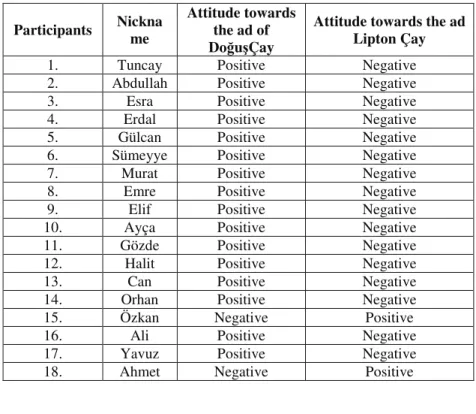
While attitudes of the participants towards the advertisements were expected “positive, negative and indecisive”, their attitudes were only positive or negative. Positive attitude means “approving the commercial film, enjoying it and finding no missing”, negative
attitude means “not approving it, not enjoying it, and finding some missing”.
Findings consist of answers of questions regard two scales used in La Tour, Henthorne and Nataraajan’s researches. The questions are such as “How do you evaluate advertisement in general terms?”, “Which advertisement is a good one, which one is interesting?”, “If s/he likes/doesn’t like, the ways s/he likes/doesn’t like”, “Which advertisement/brand is closer to you in terms of culture?”.
Table 2: Attitudes of respondents to advertisement
Participants Nickna
me
Attitude towards the ad of Do÷uúÇay
Attitude towards the ad Lipton Çay
1. Tuncay Positive Negative
2. Abdullah Positive Negative
3. Esra Positive Negative
4. Erdal Positive Negative
5. Gülcan Positive Negative
6. Sümeyye Positive Negative
7. Murat Positive Negative
8. Emre Positive Negative
9. Elif Positive Negative
10. Ayça Positive Negative
11. Gözde Positive Negative
12. Halit Positive Negative
13. Can Positive Negative
14. Orhan Positive Negative
15. Özkan Negative Positive
16. Ali Positive Negative
17. Yavuz Positive Negative
ϭϴ
ƉŝƉŚĂŶLJ͗:ŽƵƌŶĂůŽĨdƌĂŶƐĚŝƐĐŝƉůŝŶĂƌLJ^ƚƵĚŝĞƐ͕sŽů͘ϳ͘EŽ͘ϭ͕;ϮϬϭϰͿΞ&ĂĐƵůƚLJŽĨƌƚƐĂŶĚ^ŽĐŝĂů^ĐŝĞŶĐĞƐ
19. Ercan Positive Negative
20. Mahmut Negative Positive
As a result of in-depth interview all of 6 female respondents (5 of them are coming from the cities in the Eastern Black Sea Region) and 11 out of 14 male respondents like Do÷uúÇay’s advertisement. 3
of males (Ahmet, Özkan and Mahmut) like Lipton Çay’s advertisement. Ahmet and Özkanare from Tokat and Mahmut is from a place which is far away from the Eastern Black Sea Region. The
first question of the research is that whether attitudes are positive towards advertisements including local culture. The symbols and the
language used in Do÷uúÇay’s advertisements make respondents feel
the brand closer to them. The second question of the research is that whether gender has any effects on attitudes. It is answered as no, because 6 of the females like Do÷uúÇay’s advertisement.
As it can be understood from the table above, only one of 14 males (he is from Trabzon), 4 of 6 females (four of them from Eastern Black Sea Region) do not like Lipton brand. In total, 4 females and 13 males like Lipton brand. The facts that 5 of the respondents have Lipton Çay in their houses and 8 of them have difficulty in remembering advertisement are among the additional information.
Abdullah, one of the participants, described Do÷uúÇay as
“marvellous”.
He says: “It tells of our area“. However, he said that he likes Lipton more as a brand.
ϭϵ
ƉŝƉŚĂŶLJ͗:ŽƵƌŶĂůŽĨdƌĂŶƐĚŝƐĐŝƉůŝŶĂƌLJ^ƚƵĚŝĞƐ͕sŽů͘ϳ͘EŽ͘ϭ͕;ϮϬϭϰͿΞ&ĂĐƵůƚLJŽĨƌƚƐĂŶĚ^ŽĐŝĂů^ĐŝĞŶĐĞƐ
Tuncay and Murat like the advertisement of Do÷uú Çay;
however, they find clothes and language exaggerated.
Emre stated that the accent of Black Sea region makes the advertisement more attractive and he likes the advertisement.
However, he finds the advertisement of Lipton sufficient as it states the importance of hygiene and it is pure in terms of information content.
Elif, one of the participants from Trabzon, likes the advertisement of Do÷uúÇay and she adds: “The advertisement of
Lipton is chillier; the characters are European and snob. The woman from the advertisement and the environment in which she acts seem chilly to me. Whereas, Do÷uúÇay, costumes, the wasp wasted tea cup
and plateaus are closer to us”.
Ayça also finds the advertisement of Lipton chilly and she claims: “It is more elite, I think it does not tell something that belongs to us. It does not tell about Turkey, it is like a tea of another place”.
Ali, on the other hand, likes Do÷uú Çay more and emphasizes
the phrase of “daldurmaçay” and then says that the advertisement hits the target.
Ahmet, on the other hand, says that he likes the advertisement of Lipton more and thinks it is natural but he finds the advertisement of Do÷uúÇay artificial. Ercan says: “I am on the side of localness, If
Lipton came up with a local advertising campaign, it would be more successful. I look to localness; however, the one that I am satisfied
when I drink is Lipton”.
ϮϬ
ƉŝƉŚĂŶLJ͗:ŽƵƌŶĂůŽĨdƌĂŶƐĚŝƐĐŝƉůŝŶĂƌLJ^ƚƵĚŝĞƐ͕sŽů͘ϳ͘EŽ͘ϭ͕;ϮϬϭϰͿΞ&ĂĐƵůƚLJŽĨƌƚƐĂŶĚ^ŽĐŝĂů^ĐŝĞŶĐĞƐ
Although evaluating attitudes towards advertisements depending on one or several variables limits the research it reveals how culture is effective on attitudes. Besides 10 people living in the Eastern Black Sea Region, other 7 (total 17) people develop positive
attitudes towards the advertisement using local language, clothes and place. This inference shows that nationalism as well as localness gain importance. It is revealed by researches that attitudes influence shopping behaviours. However, as an answer of additional questions participants told that 3 of them had Do÷uúÇay and 6 of them had
Lipton Çay in their houses. This situation necessitates a new research centred on “Brand image” which can develop a new point of view for researches. The result is that cultural differences and cultural symbols used in advertisements is a very important factor, but it is not the only one.
Ϯϭ
ƉŝƉŚĂŶLJ͗:ŽƵƌŶĂůŽĨdƌĂŶƐĚŝƐĐŝƉůŝŶĂƌLJ^ƚƵĚŝĞƐ͕sŽů͘ϳ͘EŽ͘ϭ͕;ϮϬϭϰͿΞ&ĂĐƵůƚLJŽĨƌƚƐĂŶĚ^ŽĐŝĂů^ĐŝĞŶĐĞƐ
Figure 2
References
Barıú, G. ve Odabaúı, Y. 2010. Tüketici Davranıúları. MediaCat, østanbul
Caillat, Z. ve Muller, B. 1996. “The Influence of Culture on American and British Advertising: An Exploratory Comparison of Beer Advertising.” Journal of Advertising Research, 36(3), 79-87.
Cheng, H. Ve Schweitzer, J. C. 1996. “Cultural Value Reflected in Chinese and U. S Television Commercials.” Journal of Advertising Research, 36(39), 27-45.
Dereli, A. 2002. Uluslar Arası Reklamlarda Farklı Kültürlerin Etkileri, Marmara Üniversitesi Sosyal Bilimler Enstitüsü, Yayınlanmamıú Yüksek Lisans
Tezi, østanbul.
Elden, M. 2005. Glokal Reklam Kampanyalarında Yaratıcılı÷ın Önemi, Bilig, S.32, ss 65-82. Available at: http://www.yesevi.edu.tr/bilig/biligTur/pdf/32/65-82.pdf (10 Aralık 2012).
Garciya, E. 2004. The Effects of Cultural Values On International Advertising Effectiveness: A Study of Sex Appeals in Fashion Advertising. The University of Texas at El Paso, Unpublished Master Thesis, Texas.
Giddens, A. 2010. Sosyoloji Baúlangıç Okumaları, Say yayınları, østanbul.
Graham, K. W., 2005. Direct Mail Advertising to Hispanic. Unpublished Master's Thesis, Oklahama University, Oklahama.
Han, S. And Shavitt, S. 1994. “Persuasion and Culture: Advertising Appeals in
øndividualistic and Collective Societies.” Journal of Experimentalsocial Psychology. 30, 326-350.
ϮϮ
ƉŝƉŚĂŶLJ͗:ŽƵƌŶĂůŽĨdƌĂŶƐĚŝƐĐŝƉůŝŶĂƌLJ^ƚƵĚŝĞƐ͕sŽů͘ϳ͘EŽ͘ϭ͕;ϮϬϭϰͿΞ&ĂĐƵůƚLJŽĨƌƚƐĂŶĚ^ŽĐŝĂů^ĐŝĞŶĐĞƐ
øspir, B. N, Suher, K. H. 2009.“SMS Reklamlarına Yönelik Tüketici Tutumları”,
Selçuk øletiúim, Cilt 5, Sayı 4, (Eriúim Tarihi: 12.05.2013).
Kartari, A. 2001. Farklılıklarla Yaúamak, Ürün Yayınları, Ankara.
Korkmaz, N. Ve Yaylagül L., 2008. Medya Popüler Kültür Ve ødeoloji, Dipnot
Yayınları, 1. Cilt, Ankara.
Lull, J. 2001. Medya øletiúim Kültür, (Çev: Güngör N.), Vadi Yayınları, Ankara.
Mutlu, E. 2008. øletiúim Sözlü÷ü, Ayıraç Yayınları, Ankara
Onay, A. 2012. Reklamlara Yönelik Tutumlar: Nitel Bir Araútırma, e-gifder,
www.e-gifder.gumushane.edu.tr., Cilt:1, Sayı:4, 51-66
Ödül, D., 2008. Uluslararası Kültürel Farklılıkların Reklamlar Üzerine yansıması ve bir Uygulama, østanbul Üniversitesi SBE, Yüksek Lisans Tezi, østanbul.
Run, C. Ve Grey, B., 2005. “Attitude Towards the Ad: Assessing Measurement Invariance in Cross-Ethnic Research.” In Marketing in International and Cross-Cultural Environments, 14-20, 2005 (Anadolu Üniversitesi Veri Tabanından 22 Nisan’da Ulaúılmıútır.).
Schütte, H. Ve Ciarlante, D. 1998. Consumer Behaviour In Asia, New York University Press, (5 Eylül 2012).
Soydaú, A.U. 2010. Kültürlerarası øletiúim: Farklı Kültürel Ortamlarda Çalıúma Ve øletiúim, Parúömen Yayıncılık, østanbul.
Shavitt, S.,Lowrey, P., ve Heafney, J. 1998. “Public Attitudes Toward Advertising: More Favorable Than You Might Think”, Journal of Advertising Research, July/August, 7-22.
ùener, G., 2007. “Reklamlarda Cinsel Çekicilerin øletiúim Etkisi ile Ahlaki
De÷erlendirmesine Yönelik Tutum Araútırması”, Anadolu Üniversitesi
Sosyal Bilimler Enstitüsü Yüksek Lisans Tezi, www.Belgeler.com.
Tai, H. C. S., 1999. “Advertising Ethics: The Use of Sexual Appeal in Chinese advertising.” Teaching Business Ethics, 3(1), 87-100