101
EFFECT OF STEEL SLAG LF APPLICATION ON SOIL CHEMICAL
PROPERTIES
EUGENIA GAMENT1, MARIANA MARINESCU1, ILDIKO ANGER2, MIHALACHE, M.3, ILIE, L.3, STOICIU, FL.2 1
National Research Institute for Soil Science, Agrochemistry and Environmental Protection, Bucharest, Romania, e-mail: [email protected]
2
National Research Institute for Non-Ferrous and Rare Metals, Bucharest, Romania,
3
Faculty of Agriculture, University of Agronomic Science and Veterinary Medicine, Bucharest, Romania
Keywords: steel slag, soil, amendment.
ABSTRACT
Liming an acid soil to correct the soil acidity can influence the buffering capacity of the soil. The paper presents the effects of steel slag LF produced in the steel-making process in a Romanian steel refinery on the agricultural utilization. The treatment (an experiment with 5 doses: 0%; 0.1%; 0.2%; 0.3%; 0.4%; 0.5%) has been applied to test and to observe changes in soil pH and some other chemical properties. The pH value increased for all doses and the Cation Exchange Properties have been favorable influenced. An increasing tendency of the soluble salts content was observed under the treatment but the concentrations remained in a normal level.
INTRODUCTION
The most important source of buffering an acid soil is the exchange of the elements – mostly calcium – attached to the surface of soil particles. When you apply lime or any other by-products to amend an acid soil, it considers an influence on the reservoir or on the buffering capacity.
The soil acidity can be corrected by liming the soil or adding basic materials.
There are a lot of by-products used as amendments for soils and some of them contain alkaline compounds which can neutralize the soil acidity being a valuable source of calcium and magnesium for the soil.
MATERIAL AND METHOD
The most important lime materials used in agriculture are calcium and/or magnesium carbonates. Burnt lime, hydrated lime, and some by-products materials are also used. [Beegle and Lingenfelter, 1995] Liming an acid soil to an optimal range is the first step to offer the favorable conditions to prevent and adjust some nutrients deficiency or the nutrition disequilibrium. It is extremely important to monitor the soil characteristics evolution under the influence of application in agriculture of the industrial materials that can improve crop growth and yield.
The paper presents the effects of steel slag LF agricultural utilization produced in the steel – making process in a Romanian steel refinery.
The effects occurred at the soil material during the laboratory experiment. The soil material (preluvosoil) has been taken from Moara Domneasca area, close to Bucharest.
In 1 kg soil pots, with 6 rates of steel slag LF, 3 replicates and no mineral or organic fertilizers used, the treatment has been applied to test and to observe changes in soil pH and some other chemical properties:
Variant V0 – 0% steel slag LF
Variant V1 – 0.1% steel slag LF
Variant V2 – 0.2% steel slag LF
Variant V3 – 0.3% steel slag LF
Variant V4 – 0.4% steel slag LF
102
This is the preliminary soil test, in advance of field application and plant test to provide results and observations to decide the require amount of amendment added to an agricultural soil.
The study’s results are only a part of a national research project (PNCDI II no. 122). The chemical characteristics of the steel slag LF used in the experiment and also the physical and some chemical characteristics of the soil material taken from Moara Domneasca were presented in the last studies.
Steel Slag LF has an alkalin reaction (pH=11.96), a very high soluble salts content (717mg/100g soil – conductometric residue), an Amendment Neutralizing Power (ANP) with 114% and calcium and magnesium oxides contents, expressed as CaO of 25%.
The Steel Slag LF also contains some metals in concentrations higher than normal values in soil. [Ulmanu et al., 2013]
The typical soil analyses: pH, N, C, available P and K, heavy metals, soluble salts, exchangeable cations, etc. were presented in the preliminary obtained data. [Gament et al., 2013]
It is a preluvosoil with an actual pH value of 5.62, in an early debasification process taking into account that the Base-Cation Saturation Ratio (BCSR, named V in our paper) is 75% from CEC value, below the normal value (80-85%); normal contents of total heavy metals; low level of soluble salts concentration (conductometric residue of 15 mg/100 g soil); with Calcium Range in Percent Saturation VCa2+ and Magnesium Range in Percent
Saturation VMg2+ close to the low limits of the normal ranges.
The soil belongs of the silt-loam medium texture group class (silt-loam subclass-SL) according to Soil Taxonomy Romanian System (SRTS); it contains 0.7% coarse sand (2.0 – 0.2mm), % from mineral size – g/g, 35.7% fine sand (0.2 – 0.02mm), 33.6% silt (0.02 – 0.002mm) and 30.0% clay (< 0.002mm) [Gament et al., 2013].
RESULTS AND DISCUSSIONS
Refer to the influence of steel slag LF on the chemical properties of the soil, some chemical analyses of interest were developed at the soil samples and the results are presented below.
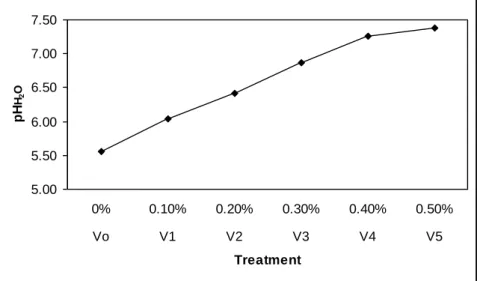
A very statistically significant increasing of soil pH value occurred after the steel slag application, even starting with the first dose (V1) with 0.1% LF; the soil pH increased at
6.04 at Variant 1 (V1) and at 7.38 at Variant 5 (0.5 % LF). These data have been clearly
illustrated in Figure 1.
Figure 1. Effects of steel slag LF application on the soil pH value
The research has shown that the steel slag LF applied reduced the level of acidity.
5.00 5.50 6.00 6.50 7.00 7.50
0% 0.10% 0.20% 0.30% 0.40% 0.50%
Vo V1 V2 V3 V4 V5
Treatment
pH
H2
103
The pH value very statistically significant increased for all treatments compared with control.
The optimal pH range of a preluvosoil is between 6.0 and 6.4 [Blaga et al., 2008]Amending the soil with steel slag LF, the pH value resulted is 6.4 at Variant 2 (0.2% LF). This result indicates that the normal value of 6.4 can be exceeded. This means that it is needed to monitor the pH values to prevent and control a very strong and fast increasing of pH level.
The soil acidity or the soil acid buffering capacity to maintain in the soil solution a specific amount of H+ ions depends of both the Base Saturation Capacity (Cation Exchange Capacity, CEC) of the argilo-humic soil complex and the soluble salts content in the soil.
The soil can be properly treated considering and knowing the amount of salt, the Cation Exchange Capacity and some other soil indicators.
These indicators have been monitored upon the experiment and their changes are shown inFig.2 and Fig. 3, Fig. 4, Fig. 5 and Fig. 6.
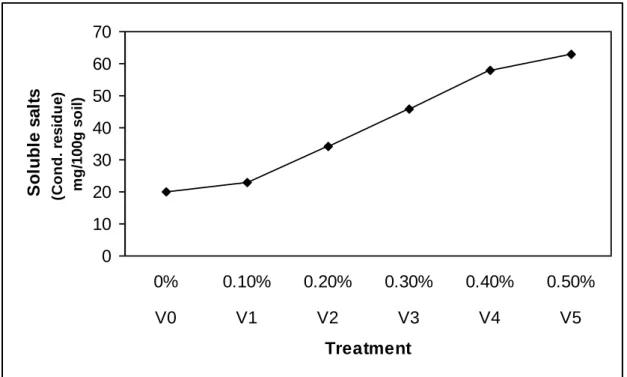
Figure 2. Effect of steel slag LF application on total soluble salts content
The soluble salts content very statistically significant increased starting with V2
(0.2% LF); between 34 mg/100g soil at V2 and 63 mg/100g soil at V5. As shown in Figure
2, an increasing tendency has been observed under the treatment with steel slag LF.
Base Saturation (BS) very significant increased for all doses, from 14.39 me/100 g soil at the control dose (0% LF) to 22.29 me/100g soil at 0.5 % LF (V5).[Fig. 3].
0 10 20 30 40 50 60 70
0% 0.10% 0.20% 0.30% 0.40% 0.50%
V0 V1 V2 V3 V4 V5
104
Figure 3. Effects on steel slag LF application on Base Saturation Capacity of the soil
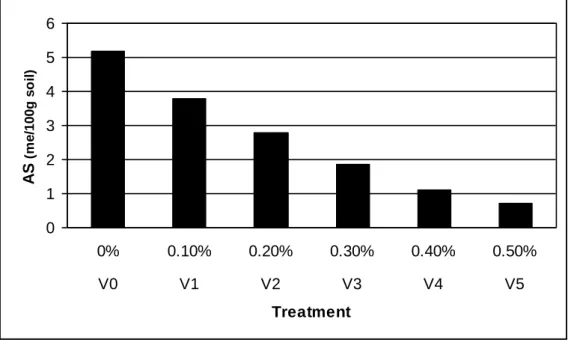
On the other hand, Acidity Saturation (AS) very significant decreased starting with V1 (0.1 % LF), from 5.17 me/100g soil representing the value of control sample to 0.70
me/100g soil at V5 (0.5% LF). [Fig. 4]
Figure 4. Effects on steel slag LF application on Acidity Saturation of the soil
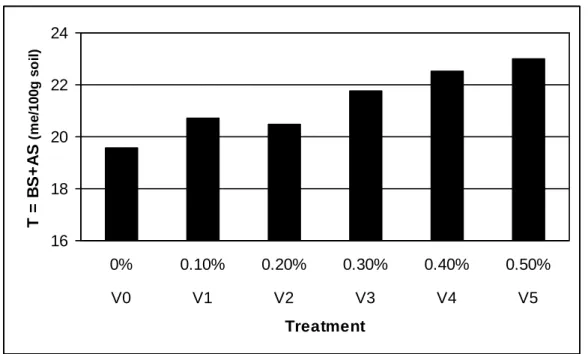
Cation Exchange Capacity (CEC=T=BS+AS) significantly increased at 0.1% LF (V1) and 0.2% LF (V2) treatments and very significant increased at the rest of doses (0.3%;
0.4%; 0.5%). [Fig. 5]
10 12 14 16 18 20 22 24
0% 0.10% 0.20% 0.30% 0.40% 0.50%
V0 V1 V2 V3 V4 V5
Treatment
BS
(m
e
/1
0
0
g
s
o
il
)
0 1 2 3 4 5 6
0% 0.10% 0.20% 0.30% 0.40% 0.50%
V0 V1 V2 V3 V4 V5
Treatment
AS
(m
e
/1
0
0
g
s
o
il
105
Figure 5. Effects on steel slag LF application on Cation Exchange Capacity of the soil
As a result of the changes of CEC (Cation Exchange Capacity=T), Base Cation Saturation Ratio (BCSR % = V %) very significant increased for all doses, between 73.5% (V0 - control) and 96.9% (V5). [Fig. 6]
Figure 6. Effects on steel slag LF application on Base Cation Saturation Ratio of the soil
CONCLUSIONS
The pH value very statistically significant increased for all doses compared with control;
An increasing tendency of the soluble salts content was observed under the treatment but in a normal level of concentration;
The Cation Exchange Properties have been statistically favorable influenced;
The soil reaction has been affected and modified due to the changing of the Base Cation Saturation Ratio and the soluble salts content;
16 18 20 22 24
0% 0.10% 0.20% 0.30% 0.40% 0.50%
V0 V1 V2 V3 V4 V5
Treatment
T
=
B
S
+
A
S
(m
e
/1
0
0
g
s
o
il
)
50 60 70 80 90 100
0% 0.10% 0.20% 0.30% 0.40% 0.50%
Vo V1 V2 V3 V4 V5
Treatment
V
(
%
d
in
T
106
The next step to evaluate the efficient use of steel slag LF as amendment for acid soil is the experiment with plants to optimize the rates and to prevent the excessive soil pH or soluble salts levels.
BIBLIOGRAPHY
1. Beegle, D. B., Lingenfelter, D. D., 1995 - Soil Acidity and Aglime, College of
Agricultural Sciences, Cooperative Extension, Agronomy Facts 3, Pennsylvania State
University;
2. Blaga, Ghe., Laura Paulette, Udrescu, S., Filipov, F., Rusu, I., Vasile, D., 2008 -
Pedologie, Ed. MEGA, Cluj Napoca, 2008, ISBN 978-973-1868-26-4.
3. Gament Eugenia, Mariana Marinescu, 2013 - Correcting the Soil pH Using a
Metallurgical Waste, Annals of the University of Craiova – Agriculture, Montanology,
Cadastre Series, vol. XLIII 1, 2013, pp. 151-154, ISSN CD-ROM 2066-950x;
4. Ulmanu Mihaela, Eugenia Gament, Mihalache, M., Lavinia Popescu, Ildiko Anger, Zaman, F., Georgiana Plopeanu, Ilie, L., 2013 - A new process for Acid Soil Amelioration
Using a Metallurgical Waste. I. Preliminary Data. XV Balkan Mineral Processing Congress,