269
PROCESSES OF PURIFICATION FOR WASTE WATERS FROM MEAT
AND MILK PROCESSING ESTABLISHMENTS
GLODEANU MIHNEA, ALEXANDRU TUDOR, VASILE CRISTIAN University of Craiova, Faculty of Agriculture Keywords: food industry, processing enterprises, waste water
ABSTRACT
The waste water from the food industry is characterized by a high content of mineral and decomposabile organic matter (which consumes oxygen), suspensions, microbial germs inhibitor, including pathogenic germs.
The main effect on receiving waters consists in the contamination with organic matter readily degradable, which causes reduction in dissolved oxygen content from the water. As a result, the richness of water with feed materials introduced in the form of mineral, or as a result of decomposition of organic matter, determine an indirect form of pollution - Eutrophication, which has an unfortunate effect on the quality of the water.
Waste waters from meat processing units are characterized by a very high content of organic matter (in the solution and suspension), large quantities of nitrogen and phosphorus, and a
temperature of 30 to 40°C. The discharge at this temperature favors the installation of a very quickly aerobically decomposition process, which consumes oxygen.
The technological processes specific for milk processing is characterized by important losses of dry matter in the waters discharged. Waste waters from the technological processes of milk processing contain significant quantities of proteins, lipids and lactose. Due to these components, simple discharge, without a prior purification would cause environmental pollution.
After the application of specific procedures of purification, the discharge of waste water into the watercourses receivers must not endanger aquatic flora and fauna, or make water unfit for use in industry, as well as for consumption (as drinking water).
INTRODUCTION
The degree of contamination of the
waste water can appreciate by
determining the following indicators (Banu
C. et al., 2002; Glodeanu M.,2003):
- Chemical oxygen demand
(CCO);
- Biochemical oxygen demand
(CBO5);
- pH;
- the solid suspensions and dissolved substances;
- the presence of the nitrogen; - presence of the phosphorus
and also of chlorides.
The purpose of the work is to analyze the characteristics of waste waters derived from meat and milk processing enterprises.
In addition to the high content of organic matter readily degradable, as well
as the substances which cause
eutrophication, many of waste waters
from slaughterhouses and meat
processing enterprises containing large amounts of fats (whose discharge to receiving waters should be prevented).
Sometimes the aerobically
decomposition process is anaerobically continued, being accompanied by the unpleasant odours. It is also possible the transmission through these waste waters of pathogenic micro-organisms.
In enterprises for obtaining
270 of the processing of milk contain significant quantities of proteins, lipids and lactose. Due to the presence of these components, simple discharge, without a
prior purification would cause
environmental pollution (Popescu C., 2005; Popescu C., 2009; Pumnea C., Grigoriu G., 1994).
From the biochemical point of view, waste waters from the processing undertakings of the milk occupies a special position, as they may move very quickly at the stage of acid fermentation. Such waste waters become acidic, and the decrease of pH below 3,5 causes the
precipitation of the protein. Also the temperature of 25-35°C of these waste water accelerates fermentative processes
(Banu C. et al., 2002; Edeline F., 1979).
The volume of industrial
wastewater from milk processing
enterprises is dependent on the type of milk product to be processed (Banu C. et
al., 2002; Levin M. A., Gealt M. A., 1993).
Depending on the characteristics of these waste water it will identify the main techniques and technologies of purification, used for the purpose of
correcting certain quality indicators.
MATERIAL AND METHODS
The experimental research has been carried out for the purpose of determining the characteristics of the waste waters from meat and milk industry.
Research consisted in the
following:
- method of field research (taking of samples resulted before and after the implementation of the purification processes, specific to the type of industry: meat, milk);
- method of research in the laboratory in order to determine in laboratory conditions the
main indicators that
characterises these waters
(before and after the
implementation of the
purification processes).
The monitoring of the quality of the effluents coming from the analyzed units it was carried out by sampling of waste water from the final point of discharge into surface waters (receiver).
The method of field research Water samples were collected in sterile bottles and their preservation has been carried out by refrigeration, freezing or the addition of certain preservatives substances, in accordance with the accepted legal norms in force.
The method of research in the laboratory
The laboratory tests have been carried out in a laboratory for the health
chemistry, in accordance with the
standardized methodology in force (CBO5
- SR 1899/2-2002; total suspension - SR EN 872-2005; pH - ISO 10523-1997; total nitrogen - SR EN ISO 11905/1-2003; total
phosphorus - SE EN 1189-2000;
chlorides - SR EN 9297-2001) (Oneț C., 2011).
The experimental research also consisted in identifying the specific purification processes and determination
in laboratory conditions the main
indicators that characterises these
waters. In this way, it can appreciate the effectiveness of the purification processes used.
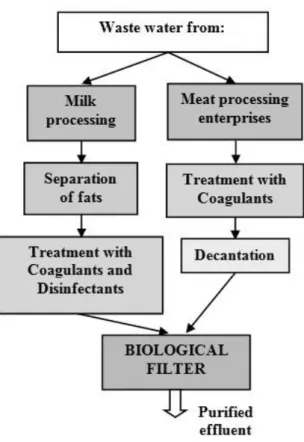
The specific purification processes identified for waste waters from the analyzed branches of the food industry are:
1. For waste waters from
slaughterhouses and meat processing enterprises (Banu C. et al., 2002; Chiriac, V et al.,1977):
- coagulation with aluminum sulfate (300 mg/l) and of the lime (500 mg/l);
- decantation;
271 2. For waste waters from the processing undertakings of the milk:
- separation of fats (passing through separators), then followed by a
treatment with Coagulants and
Disinfectants (neutralization with lime to pH = 7,6...7,8);
- cleaning through a biological filter in which the waste waters are inserted after a dilution with pre-cooling water.
In figure 1 are shown schematically the stages of the process of purification for waste waters, derived from meat and milk processing enterprises.
Figure 1. The stages of the progress of the process of purification for waste waters from meat and milk processing establishments
.
After performing the activities and the specific stages of the purification processes (in accordance with the origin of the waste water), according to the characteristics of the effluent it will determine to what extent it meets the conditions of discharge into one of three categories of receivers (Banu C. et al., 2002; Government Decision 352/2005;
International Organization for
Standardization. "13.060: Waterquality". Retrieved 29 February 2008):
- natural catchment areas for drinking water supplies (Class I);
- basins for water supply to the
food industry and fishery
centers (Class II);
- basins used only for recreation or architectural purposes (Class III).
RESULTS AND DISCUSIONS
The characteristics of the waste water from the meat and milk processing enterprises (before and after
implementation of the purification
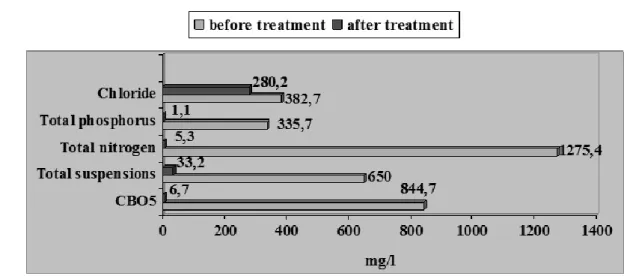
272 Comparative values of the
indicators taken in the study, before and after the application of specific treatment
processes are represented in the graph of figure 2 and figure 3.
Table 1
The characteristics of the waste water from meat processing enterprises
Physico-chemical determinations
Results of the analyzes (number of sample)
I II III IV Average values
CB05(mg/l) 724 889 904 862 844,7
6,5 5,6 7,9 6,9 6,7
Total suspensions (mg/l) 428 611 797 764 650,0
29 35 37 32 33,2
pH 7,7 8,3 7,6 7,5 7,7
7,3 6,7 6,5 6,6 6,7
Total nitrogen (mg/l) 1613 1478 1245 765 1275,4
7,2 4,8 5,6 3,9 5,3
Total phosphorus (mg/l) 393 346 429 176 335,7
1,8 0,8 0,7 1,1 1,1
Chloride (mg/l) 428 366 339 398 382,7
284 261 254 322 280,2
Before applying the treatment
After applying the treatment
Table 2
The characteristics of the waste waters from the processing undertakings of the milk
Physico-chemical determinations
Results of the analyzes (number of sample)
I II III IV Average values
CB05(mg/l) 6210 2420 4725 5230 4646,2
10 5 9 11 8,7
Total suspensions (mg/l) 6012 2986 2970 5930 4474,5
34 41 38 46 39,7
pH 8,9 6,7 8,1 7,9 7,9
7,7 7,4 7,2 7,3 7,4
Total nitrogen (mg/l) 684 850 214 270 511,2
11 15 22 17 16,2
Total phosphorus (mg/l) 104 211 82 65 115,5
6 4 2 5 4,2
Chloride (mg/l) 584 325 548 692 537,2
320 270 290 310 297,5
Before applying the treatment
273
Figure 2.The plot of the evolution of the quality indicators for waste waters from meat processing enterprises.
Figure 3. The plot of the evolution of the quality indicators for waste waters from milk processing enterprises.
From the above data base it can be observed the following (taking account the conditions of the discharge of waste waters into surface watercourses):
- the purified effluent resulting
from meat processing
enterprises meets the
conditions of discharge into
basins for water supply to the food industry (Class II);
- the purified effluent resulting
from milk processing
enterprises, also meets the
conditions of discharge into basins for water supply to the
food industry and fishery
centers (Class II).
CONCLUSIONS
The analysis of the samples of
water taken after application of
specific purification processes
shows that the waste-water plants of the enterprises have worked to optimally, in accordance with the
quality conditions of the waste waters.
The analysis of the results
274 - the waste waters from milk
processing enterprises are
characterized by higher values
of the concentrations in
chlorides, CBO5, compared
with the corresponding values of the waters resulting from the meat industry;
- the pH values of waste water resulting from the milk industry were greater compared with those originating from the meat industry;
- waste waters from the meat industry and meat preparations
have presented high
concentrations of Nitrogen and Phosphorus.
Using green-treatment of waste
water from the food industry has the following advantages:
- the treatment is completely natural: no synthetic chemicals are used (the process is not
selective); by biological
processes and non-chemical properties, biofilter can reduce
different types of odorous
compounds;
- these types of systems are easy to install and does not require any special utility or civil works;
- In case of biofilters the filter material must be replaced every 4-5 years; at the end of
the operating cycle, its
discharge has no
environmental consequences;
BIBLIOGRAPHY
1. Banu C., et al., 2002, Engineer's handbook of food industry, TECHNICAL Publishing House,
Bucharest.
2. Chiriac, V et al.,1977, Wastewater treatment and valorisation of food and animal residues, CERES Publishing House, Bucharest. 3. Edeline, F., 1979, L/epuration
biologique des eaux residuaires, Cebedoc, Liege, France.
4. Glodeanu M., 2003, Technology and equipment for environmental protection, UNIVERSITARIA Publishing House, Craiova.
5. Levin M. A., Gealt M. A., 1993, Biotreatment of Industrial and Hazardous Waste, McGraw-Hill Inc. New York, U.S.A.
6. Oneț C., 2011, Researches on the hygienic qualityof water used in the
food industry, Doctoral Thesis,
Cluj-Napoca, Romania.
7. Popescu C., 2009, Ecopedologic, UNIVERSITARIA Publishing House, Craiova, ISBN 978-973-742-984-1.
8. Pumnea C., Grigoriu G., 1994, The protection of the environment,
EDUCATIONAL and
PEDAGOGICAL Publishing
House, Romania.
9. *** Government Decision 352/2005
- Annex 3. Decree on the establishment of loading of the
pollutants of industrial and
municipal waste water into natural receivers, NTPA-001/2005.
10. *** International Organization for
Standardization. "13.060:
Waterquality". Retrieved 29