Effect of Expansion Joints on Structural behavior of RC Framed
structures
M.Pavan Kumar1, G. T. Naidu2, D.Ashok Varma3 #1. Assistant Professor, # 2 Associate Professor and Head
Dept. of Civil Engineering, SVP College of Engineering, Visakhapatnam
#3. M.Tech Scholar in Civil Engineering with specialization in Structural Engineering,SVP College of Engineering, Visakhapatnam,
Abstract
An Expansion joint are the crevices in the building structure gave to permit to the development of the working because of temperature changes. They are given regularly in the structures of pieces, extensions and different structures where there is a change of development of the structures because of temperature. Noteworthiness of these joints are for the most part to control the uneven surface in the structure when it is subjected to temperature changes. In present situation the originators of the structures are not considering extension joints while outlining a multi storied structures. Thought of extension joints in the outline can lessen the temperature burdens and relocation of R.C. encircled structures. In this perspective considered the impact of development joints in basic conduct of RC surrounded normal and unpredictable structures. For this reason considered four distinct sorts of RC surrounded structures (C,T,L and Rectangular) for every situation analyzed the parallel considering so as to uproot and amount of steel with and without extension joints by utilizing PC programming STAAD Pro.
Key words- STAAD, CTL, structural behavior.
I. Introduction
The expression "extension joint" as utilized alludes to the detachment joints gave inside of a Building to allow the different fragments of the auxiliary casing to extend and contract in light of Temperature changes without antagonistically influencing the building's basic uprightness or serviceability. The typical practice in runways, scaffolds, structures and street development is to give extension joints
between cutting chunks of fortified cement at planning interims and at convergences with different developments. These joint filers are then secured with fixing mixes. Concrete extends somewhat when the temperature rises. Likewise, solid psychologists after drying and develops consequent wetting. Procurement must provide food for the volume change by method for joint to assuage the anxieties created. An Expansion joint is really a crevice, which permits space for a working to move all through. The development of the building is created most as often as possible by temperature changes, the measure of extension and withdrawal of building relies on the sort of material it is built out of. A steel encircled building will move by an alternate sum then a solid surrounded one. If there should be an occurrence of a little building, the extent of development is less and in this way, no joint is required either in the floor or rooftop piece. Be that as it may, if there should be an occurrence of the long building, the development is expansive and might be as much as 25 mm. In this way, structures longer than 45 m are by and large furnished with one or more extension joints. Having fruitful determination the anticipated development along the three main hub of the Expansion joint hole, the fashioner and Specifier are currently confronted with a more basic decision, that of picking of material to seal the joint crevice itself from the component. This is a specific imperative building envelope plan thought, particularly when dampness and water are available.
II. LITERATURE SURVEY
Numerous studies have come with respect to development joints of structures yet not very many studies were demonstrated the impact of extension joints. In any case, in late year's examination action in this field of development joints are considered. In this study the impact of development joints was done under various sorts of unpredictable structures (i.e. C, T, L and Rectangular sort) and contrasted the structures and Expansion joints and without Expansion joints subjected to temperature stresses.
Prior STUDIES
Michael J. Pfeiffer, David Darwin13 (1987) is talked about the development, compression and extension joints in fortified solid structures. They are tended to the reason for every sort of joint and underscores the choice of joint areas and joint dispersing. A few parts of joint setup and development are additionally secured. Observational and systematic configuration methods are displayed.
HERBERT H. SWINBURNE2 (2000) the study was completed under the heading of the Federal Construction Council Standing Committee on Structural Engineering. The Committee initially analyzed in subtle element an unpublished report in which even changes in measurement in nine government structures were watched and identified with recorded temperature changes. Moreover, the Committee considered the present practices of government offices with respect to extension joint criteria. To upgrade its comprehension of the dispersion of hassles and related misshapening in casings subjected to uniform temperature change, the Committee detailed and led aninvestigative investigation of the impacts of uniform temperature change on run of the mill two-dimensional versatile edges. A hypothetical PC model was created for this reason. Watched dimensional changes brought on by temperature changes were corresponded with information acquired from the PC examination. The aftereffects of the Committee's study and examination, and additionally its aggregate experience and judgment, served as the bases for this report.
Stipend T. Halvorsen12 (2001), all structures are limited to some degree; this restriction will impel stresses with temperature changes. Temperature prompted anxieties are relative to the temperature change. Huge temperature varieties can bring about considerable hassles to represent in outline. Little temperature changes might bring about immaterial burdens.
James M. Fisher, S.E10. (2005) he has encountered a few issues in respect to development challenges connected with extension joints. The first is that temperature changes to which an unenclosed unheated structure is subjected to amid development might surpass the configuration temperature changes after culmination of the structure. These expanded temperature changes ought to be considered by the planner. The temperature to be considered amid development, obviously, differs relying on building area. Now and then it is extremely troublesome for the steel erector to conform the development joint at the coveted area, as ordinary erection resiliences might compel the extension joint to one end of its travel. This issue can be disposed of if the fashioner considers a subtle element at the most distant end of the part to which the development joint is situated, as a method for change. Along these lines, the development resistance can be adjusted
adaptable translational development, so that strengths at the association don't turn out to be pointlessly high.
Matthew D. Brady, P.E12. (2011) all structures are subjected to development and contraction because of the warm loads from introduction to changes in the encompassing temperature, both amid development and in operation. Nearby climate designs alongside the warming and aerating and cooling of atmosphere controlled spaces will manage the temperatures to which the structure is subjected. While these adjustments in temperature regularly occur gradually, the impacts are the same. Hotter materials grow and colder materials contract. Contingent upon the expected temperature variety and materials utilized, development joints ought to be utilized as a part of all structures surpassing the lengths
SPEIGHT, MARSHALL and FRANCIS15, (2012) Buildings are liable to dimensional changes created by a variety of temperatures. Appropriately assessing the measure of level development, coming about because of warm loads all through of the life of the building, is one of the more intricate errands amid the outline process. If not appropriately tended to, the inward burdens created by warm loads will discover a system for discharge, and can bring about exorbitant breaking. An extension joint is a controlled instrument permitting a structure to move all in all and keep the differential development of segments to a base. This will guarantee weak cladding, especially workmanship, is not subjected to over the top relocations and weighty detachment or splitting, along these lines permitting water to enter into inside spaces
SANJAY SHIRKE, H.S.CHORE, P.A. DODE14 (2014) Long structures with no extension joints has turned into a need in perspective of requesting building design and present Industrial pattern. According to Indian Standard code, IS-456:2000, structures longer than 45m should be investigated for the warm hassles and fitting measures might be taken amid altering the auxiliary framework. Notwithstanding, IS codes are noiseless as far as procedure to follow in such sort of plans and in addition on burden elements to be considered in outline blend of temperature burden with gravity
loads. To compound the circumstance, there are no rules accessible with the configuration architects to touch base at outline temperature esteem that ought to be considered in working out warm burdens. Three multilevel auto park structures are investigated here keeping in mind the end goal to consider the impact of temperature burden concerning length of building. Structures considered are of length approx. 80m, 160m and 240m. This paper covers the impact of temperature burden on strengths experienced by bars and general fortification utilization.
Farhana M. Saiyed, Ashish H. Makwana,
III. THEORY/METHODOLOGY
GENERAL
In this chapter, discussed about model specifications, modeling of structures, loads and load combinations. And also to give brief overview of study flow chart was prepared.
BASIC MODEL SPECIFICATIONS
Building type :RC frames with and without expansion joints
for “C”, “T”, “L”, and RECTANGULAR type buildingsFloor area
“C”type : 78.81M X 30.26 Meters
“T”type : 65.25M X 30.26 Meters
“L”type : 75.18M X 30.26 Meters
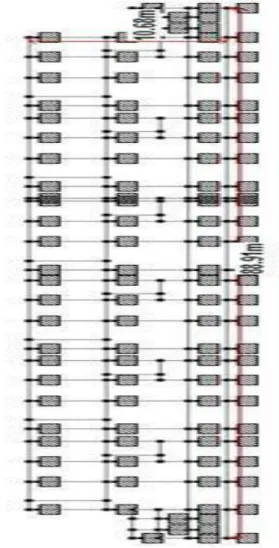
“RECTANGULAR”type : 88.41M X 10.68 Meters
Storey Height: 3m
No. of Stories: G+4.
Comparison of displacements of both the structures with and without expansion joints were done by doing analysis in STAAD PRO.
MATERIAL PROPERTIES
The material used for analysis is reinforced concrete with M-20 grade concrete and Fe-415 grade reinforcing steel.
The Stress-strain relationship used is as per IS 456-2000. The basic material properties are as follows:
Modulus of Elasticity of steel, Es = 20,000MPa
Ultimate strain in bending,∑cu = 0.0035
Characteristic strength of concrete, fck= 20MPa
Yield stress for steel, fy= 415Mpa
MODELLING OF STRUCTURE
A regular RC frame structure is chosen with and without expansion joints, the plan of the apartment shown in figure and the structure was modeled for G+4 storey. All the considered frames are assumed to be fixed at ground level and storey heights are taken as 3m . All the members of the structure are assumed to be homogenous isotropic and having elastic modulus same in compression as well as in tension.
Constant beam and column sizes were taken at all floor levels for each considered frame , however sizes of columns and beams vary with respect to number of storeys. sizes of structural members shown in table given below:
TableSizes of structural members for G+4 storey’s
MEMBER SIZE(mm)
Beam 230X450
Column 230X450
Slab thickness 150
IV. ANALYSIS AND DESIGN RESULTS
Fig:-Plan showing “C” type residential building without expansion joints
Fig: -Plan showing“L”type residential building with expansion joints
Fig: -Plan showing“T”type residential building with expansion joints
Fig:-Plan showing “rectangular” type residential building with expansion joints
V. RESULTS AND DISCUSSIONS
GENERAL
he
ig
ht
in
m
he
ig
ht
in
m
he
ig
ht
in
m
stresses using STAAD Pro. Variation in percentage of displacements and quantities of steel of these structure are discussed below:
COMPARISON OF LATERAL
DISPLACEMENT OF RC FRAMES
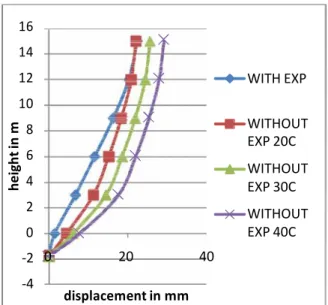
COMPARSION FOR“C”TYPE BUILDING
Comparison of lateral displacement of frames with Expansion joint and without expansion joint subjected to temperature stress (varying temperature of 200C, 300C, 400C)
20
15
10
5
0
0 20 40
-5
displacement in mm
WITH EXP
WITHOUT EXP 20C WITHOUT EXP 30C WITHOUT EXP 40C
16 14 12 10 8 6 4 2 0
-2 0 20 40
-4
displacement in mm
WITH EXP
WITHOUT EXP 20C WITHOUT EXP 30C WITHOUT EXP 40C
Fig. Comparison of lateral displacement of frames with Expansion joint and without expansion joint subjected to temperature stress (varying temperature of 200C, 300C, 400C)
From the Fig, it was observed that there was an decrease of 13.2% and increase of 0.26% and 13.75% in lateral displacement for frames with Expansion joint when compared to structure without expansion joint subjected to temperature stress (varying
temperature of 200C, 300C, 400C)
FOR“T”TYPE BUILDING
Comparison of lateral displacement of frames with Expansion joint and without expansion joint subjected to temperature stress (varying temperature
Fig. Comparison of lateral displacement of frames with Expansion joint and without expansion joint subjected to temperature stress (varying temperature of 200C, 300C, 400C)
From the Fig, it was observed that there was an decrease of 1.5% and increase of 14.2% and 30.07% in lateral displacement for frames with Expansion joint when compared to structure without expansion joint subjected to temperature stress (varying
temperature of 200C, 300C, 400C)
COMPARSION FOR“L”TYPE BUILDING
Comparison of lateral displacement of frames with
of 200C, 300C, 400C)
20
15
10
5
0
0 20 40
-5
displacement in mm
WITH EXP
WITHOUT EXP 20C WITHOUT EXP 30C WITHOUT EXP 40C
Expansion joint and without expansion joint subjected to temperature stress (varying temperature of 200C, 300C, 400C)
Type
Frame with expansi on joint
Frame without expansion joint subjected to Temperature stresses of
200c 300c 400c
quanti ty of
steel 86.155
153.1 45
157.0 9
158.2 58
he
ig
ht
in
m
Q
ua
nt
ity
of
st
ee
li
n
to
ns
subjected to temperature stress (varying temperature of 200C, 300C, 400C)
From the Fig, it was observed that there was an increase in lateral displacement of 25.77%, 44.10% and 62.43% for frames with Expansion joint when compared to structure without expansion joint subjected to temperature stress (varying temperature of 200C, 300C, 400C)
COMPARSION FOR “RECTANGULAR” TYPE
BUILDING
Comparison of lateral displacement of frames with Expansion joint and without expansion joint subjected to temperature stress (varying temperature of 200C, 300C, 400C)
FOR C TYPE BUILDING
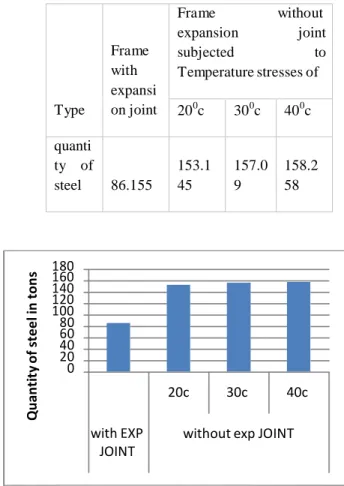
Table: quantities of steel for frame with expansion joints and without expansion joints subjected to temperature stresses ( varying temperatures of 200C, 300C and 400C).
20
15
10
5
0
0 20 40
-5
displacement in mm
WITH EXP
WITHOUT EXP 20C WITHOUT EXP 30C WITHOUT EXP 40C
180 160 140 120 100 80 60 40 20 0
with EXP JOINT
20c 30c 40c
without exp JOINT
Fig. Comparison of lateral displacement of frames with Expansion joint and without expansion joint subjected to temperature stress (varying temperature of 200C, 300C, 400C)
From the Fig, it was observed that there was an increase in lateral displacement of 19.42%, 38.8% and 58.21% for frames with Expansion joint when compared to structure without expansion joint subjected to temperature stress (varying temperature of 200C, 300C, 400C)
VI. COMPARSION OF QUANTITY OF STEEL
Comparsion of quantities of steel in frames with Expansion joints and without Expansion joints subjected to temperature stress ( varying
temperatures of 200C, 300C and 400C).
Fig comparison quantities of steel for frame with expansion joints and without expansion joints subjected to temperature stresses (varying temperatures of 200C, 300C and 400C).
From the figure 4.29, when compared to R.C frame with expansion joints and without expansion joint subjected to temperature stresses (i.e. varying temperature of 200C, 300C and 400C), there was a increase in percentage of steel of 77.75, 82.33 and 83.68 respectively.
FOR L TYPE BUILDING
Type
Frame with expansion joint
Frame without expansio joint subjected to Temperature stresses of
200c 300c 400c
quantity of steel
(ton) 64.893 61.7 61.25 61.357 Type
Frame with expansion joint
Frame without expansion joint subjected to Temperature stresses of
200c 300c 400c
quantity of steel
(Ton) 61.056 107.52 109.44 110.321
Q
ua
nt
ity
of
st
ee
li
n
to
n
Q
ua
nt
ity
of
st
ee
li
n
to
n
temperature stresses (varying temperatures of 200C, n
0 0
30 C and 40 C).
120 100 80 60 40 20 0
with EXP JOINT
20c 30c 40c
without exp JOINT
70 60 50 40 30 20 10 0
with EXP JOINT
20c 30c 40c
without exp JOINT
Fig comparison quantities of steel for frame with expansion joints and without expansion joints subjected to temperature stresses ( varying temperatures of 200C, 300C and 400C).
From the figure 4.30, when compared to R.C frame with expansion joints and without expansion joint subjected to temperature stresses (i.e. varying temperature of 200C,300C and 400C), there was a increase in percentage of steel of 76.1, 79.24 and 80.68 respectively.
FOR T TYPE BUILDING
Table: quantities of steel for frame with expansion joints and without expansion joints subjected to temperature stresses (varying temperatures of 200C, 300C and 400C).
Fig comparison quantities of steel for frame with expansion joints and without expansion joints subjected to temperature stresses( varying temperatures of 200C, 300C and 400C).
From the figure, when compared to R.C frame with expansion joints and without expansion joint subjected to temperature stresses (i.e. varying
temperature of 200C,300C and 400C), there was a decrease in percentage of steel of 4.9, 5.61 and 5.44 respectively.
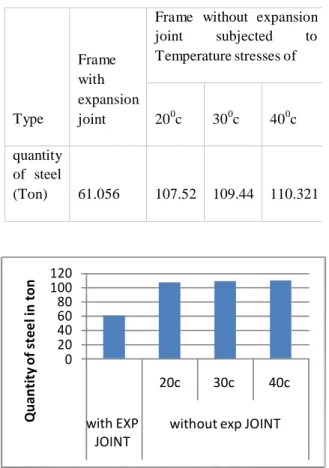
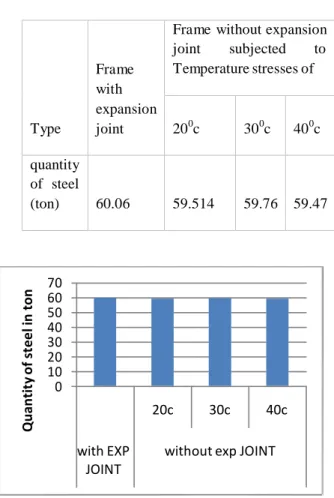
FOR RECTANGULAR TYPE BUILDING
Type
Frame with expansion joint
Frame without expansion joint subjected to Temperature stresses of
200c 300c 400c
quantity of steel
(ton) 60.06 59.514 59.76 59.47
Q
ua
nt
ity
of
st
ee
li
n
to
n
expansion joint to frame without expansion joints, there was an decrease in percentage of lateral displacement of 4.17 at a temperature stress of 200c and there was an increase in percentage of lateral displacements of 10.73 and 25.236 at a temperature stresses of 300c and 400c respectively.
70 60 50 40 30 20 10 0
with EXP JOINT
20c 30c 40c
without exp JOINT
2. For “L” type G+4 storey building, it was observed, when compared to frame with expansion joint to frame without expansion joints, there was an decrease in percentage of lateral displacements of 17.18 and 4.865 at a temperature stresses of 200c and 300c and there was an increase in percentage of lateral displacement of 7.45 at a temperature stresses of 400c respectively.
3. For “T” type G+4 storey building, it was observed, when compared to frame with expansion joint to frame without expansion joints, there was an increase in percentage of lateral displacement of 26.84, 44.63 and 62.41 at a temperature stresses of 200c, 300c and 400c respectively.
Fig comparison quantities of steel for frame with expansion joints and without expansion joints subjected to temperature stresses (varying temperatures of 200C, 300C and 400C).
From the figure, when compared to R.C frame with expansion joints and without expansion joint subjected to temperature stresses (i.e. varying temperature of 200C,300C and 400C), there was a slightly decrease in percentage of steel of 0.909, 0.49 and 0.98 respectively.
VII. CONCLUSIONS
The lateral displacements and quantity of steel for Regual and Irregular R.C framed structures with and without expansion joints were investigated using the linear static analysis. Following were the conclusions drawn from the study.
1. For “C” type G+4 storey building, it was observed, when compared to frame with
4. For“Rectangular”type G+4 storey building, it was observed, when compared to frame with expansion joint to frame without expansion joints, there was an increase in percentage of lateral displacement of 21.49, 40.619 and 59.74 at a temperature stresses of 200c, 300c and 400c respectively.
5. For“C”type building it was observed, when compared to frame with and without expansion joint subjected to temperature stresses (i.e. varying temperatures of 200c, 300c and 400c) there was an increase in percentage of steel of 77.75, 82.33 and 83.68 respectively.
percentage of steel of 76.1, 79.24 and 80.68 respectively.
7. For“T”type building it was observed, when compared to frame with and without expansion joint subjected to temperature stresses (i.e. varying temperatures of 200c, 300c and 400c) there was a decrease in percentage of steel of 4.9, 5.61 and 5.44 respectively.
8. For “Rectangular” type building it was observed, when compared to frame with and without expansion joint subjected to temperature stresses (i.e. varying temperatures of 200c, 300c and 400c) there was an decrease in percentage of steel of 0.9, 0.49 and 0.98 respectively.
REFERENCES
[1] A.Plumier, V.Denoel, L.Sanchez, C.Doneux,
“
[7] IS : 875 (part 3), “Indian Standard Code of practice for Design loads for buildings and structures, Wind load”, Bureau of Indian standards, New Delhi
[8] IS : 875 (part 5), “Indian Standard Code ofpractice for Design loads for buildings and structures, Special loads and combinations”, Bureau of Indian standards, New Delhi
[9]James M. Fisher(2005)“Expansion Joints: Where, When and How” April 2005 Modern Steel Construction
[10]Joints in Concrete Construction, Reported by ACI Committee 224 (2001)
[11]Matthew D. Brady (2011) “Expansion Joint Considerations for Buildings” Modern steel construction may 2011
[12]Michael J. Plelffer, David Darwin (1987)“Joint
W.VanAlboom Seismic Assessment and Retrofitting design for reinforced concrete buildings” structural of an S Shape Building with Expansion Joints”.
Expansion Joints in Buildings: Technical Report No. 65
[2] Farhana M. Saiyed1, Ashish H. Makwana2, Jayeshkumar Pitroda3(2014) “EXPANSION JOINT TREATMENT : MATERIAL & TECHNIQUES” 29th March, 2014, Civil Engineering Department S.N.P.I.T. & R.C., Umrakh
[3] IS: 3414 – 1968 , “Indian standard code of practice for design and insallation of joints in buildings”, Bureau of Indian standards, New Delhi
[4]IS 456: 2000, “ Indian standard plain reinforced concrete – code of practice”, Bureau of Indian standards, New Delhi.
[5] IS : 875 (part 1), “Indian Standard Code of practice for Design loads for buildings and structures, Dead load”, Bureau of Indian standards, New Delhi.
[6] IS : 875 (part 2), “Indian Standard Code of practice for Design loads for buildings and structures, imposed load”, Bureau of Indian standards, New Delhi
engineering and engineering materials sm report no 20, December 1987
[13]SANJAY SHIRKE1 , H.S.CHORE2 , P.A. DODE3 (2014) “Effect of temperature load on beam design in thermal analysis”Proceedings of 12th IRF International Conference, Pune , India