More Jobs, Less Pollution:
Growing the Recycling Economy in the U.S.
More Jobs, Less Pollution:
Growing the Recycling Economy in the U.S.
Prepared by: Tellus Institute with Sound Resource Management
Prepared for:BlueGreen Alliance
www.bluegreenalliance.org
Teamsters
www.teamster.org
SEIU
www.seiu.org
NRDC
www.nrdc.org
Recycling Works
More Jobs, Less Pollution: Growing the Recycling Economy in the U.S.
TABLE OF CONTENTS
KEY FINDINGS 1
EXECUTIVE SUMMARY 3
I. INTRODUCTION 9
II. CURRENT WASTE GENERATION, COMPOSITION & MANAGEMENT 11
A. 2008 Municipal Solid Waste (MSW)
B. 2008 Construction and Demolition Debris (C&D)
III. 2030 WASTE GENERATION, COMPOSITION & MANAGEMENT:
BASE CASE (“BUSINESS AS USUAL”) SCENARIO 17
A. 2030 Base Case – MSW B. 2030 Base Case – C&D
IV. 2030 WASTE GENERATION, COMPOSITION & MANAGEMENT:
GREEN ECONOMY (75% DIVERSION) SCENARIO 21
A. 2030 Green Economy Scenario – MSW B. 2030 Green Economy Scenario – C&D
V. EMPLOYMENT IMPACTS:
BASE CASE AND GREEN ECONOMY SCENARIOS 29
A. Methodology
B. Jobs Related to Current (2008) MSW Management System C. Base Case Scenario – MSW Management Job Creation (2030) D. Green Economy Scenario – MSW Management Job Creation (2030) E. Jobs Related to Current (2008) C&D Management System
F. Base Case Scenario – C&D Management Job Creation (2030) G. Green Economy Scenario – C&D Management Job Creation (2030) H. Summary: Total MSW and C&D Job Impacts in 2030
VI. ENVIRONMENTAL EMISSIONS:
BASE CASE AND GREEN ECONOMY SCENARIOS 41
A. Methodology
B. Results: Comparison of Emission Reductions for Each Scenario
REFERENCES 51
More Jobs, Less Pollution: Growing the Recycling Economy in the U.S.
KEY FINDINGS
This study provides strong evidence that an enhanced national recycling and composting strategy in the United States can significantly and sus-tainably address critical national priorities including climate change,
last-ing job creation, and improved health. Achievlast-ing a 75 percent diversion1
rate for municipal solid waste (MSW) and construction and demolition debris (C&D) by 2030 will result in:
•
A total of 2.3 million jobs: Almost twice as many jobs as the projected2030 Base Case Scenario, and about 2.7 times as many jobs as exist in 2008. There would be a significant number of additional indirect jobs associated with suppliers to this growing sector, and additional in-duced jobs from the increased spending by the new workers.
•
Lower greenhouse gas emissions: The reduction of almost 515 millionmetric tons of carbon dioxide equivalent (eMTCO2) from diversion
ac-tivities, an additional 276 million eMTCO2than the Base Case,
equiva-lent to shutting down about 72 coal power plants or taking 50 million cars off the road.
•
Less pollution overall: Significant reductions in a range ofconven-tional and toxic emissions that impact human and ecosystem health.
•
Unquantified benefits of reducing ecological pressures associated withuse of non-renewable resources, conserving energy throughout the ma-terials economy, and generating economic resiliency through stable, local employment.
More Jobs, Less Pollution: Growing the Recycling Economy in the U.S.
EXECUTIVE SUMMARY
We face a series of crises in America today. Nationwide unemployment currently hovers just below 10 percent. Climate change is already disrupting the American economy and will have greater impacts in coming years, and a range of pollutants continue to degrade our ecosystems and burden public health. Transforming the “waste sector” into a “materials management sector” will create more jobs, reduce greenhouse gas emissions that cause climate change, and lower other types of pol-lution and related public health consequences.While the vast majority of municipal solid waste can be readily recycled, re-used, or composted, only 33 percent is currently diverted from disposal. Most of our discards are still sent to landfills and incinerators.
While waste diversion nationally is relatively low, because of the sheer size of the waste stream, recycling has grown into an important part of the U.S. economy. Moreover, a number of cities have achieved considerably higher waste diversion rates and provide successful models that show a path to a significantly stronger recycling economy. This report assesses the impacts of implementing a bold national recycling and composting strategy in the United States over the next two decades. Specifically, we explore the impact on jobs and environmental pol-lutants if the U.S. were to achieve a 75 percent national waste diversion rate by 2030.
The report analyzes both municipal solid waste (MSW), as well as construction and demolition debris (C&D). MSW is generated by households as well as commercial and institutional entities. It does not include industrial waste. C&D is generated from construction and demoli-tion activities in the residential and commercial sectors. Although less visible than MSW, C&D debris is included in this analysis because of its importance relative to MSW (building-related C&D alone is roughly 70 percent as large as MSW generation) and because it presents strong opportunities for reuse and recycling.
To conduct the analysis, we compared two waste man-agement scenarios: the “Base Case Scenario,” character-ized by a continuation of current practices and trends over the next two decades, and the “Green Economy Sce-nario,” based on a national enhanced recycling and com-posting strategy that achieves an overall diversion rate of 75 percent by 2030.
THE CURRENT WASTE STREAM
In order to construct the alternative scenarios for 2030 we must first understand the magnitude and composi-tion of the existing waste stream. In terms of MSW, five materials comprise about 77 percent of the almost 250 million tons of total MSW generated in 2008: paper and paperboard, yard waste, food scraps, plas-tics, and metals. Organic components made up about
64 percent of total 2008 MSW generation.2
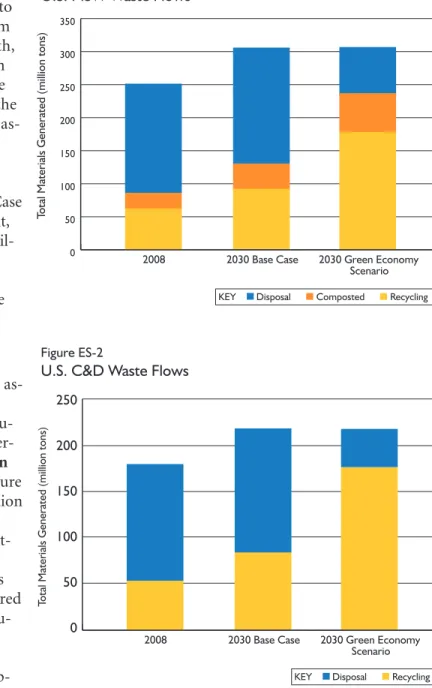
Specific materials are recovered for recycling and com-posting at very different rates. As summarized in Figure ES-1, the U.S. diverted approximately 33 percent of MSW in 2008. This is considerably below the diversion rates of many cities and states with robust recycling and composting programs, leaving considerable room for additional diversion.
In addition to MSW, 178 million tons of C&D waste was generated in 2008. The C&D stream includes wastes generated from demolition, renovation, and new construction. Two materials dominate C&D waste and comprise roughly 70 percent of the total: concrete and mixed rubble (45 percent), and wood (25 per-cent). In 2008 approximately 30 percent of C&D de-bris generated in the U.S. was diverted (recycled) and 70 percent was disposed.3Virtually all recovered C&D
waste was recycled; almost none was composted. Simi-larly, virtually all C&D disposal was via landfill and very little was incinerated. As with MSW, much higher C&D diversion rates have been achieved in various ju-risdictions throughout the U.S., indicating that there
are significant opportunities for increased diversion on a national scale.
2030 BASE CASE SCENARIO
The Base Case Scenario represents a “business as usual” approach to solid waste management in which current practices and trends continue until 2030. No major new policy interventions or lifestyle changes are introduced, and most basic assumptions remain unchanged. Based on trends over the past decade, per capita MSW generation is projected to remain unchanged
from 2008 levels (1,697 lbs. per person),4and
popula-tion is expected to grow from 304 million in 2008 to
374 million in 2030.5Thus, the overall MSW stream
is expected to grow at the rate of population growth, from 250 million tons in 2008 to about 314 million tons in 2030. In addition, the modest growth in the MSW diversion rate that has been experienced in the U.S. over the past decade (one percent per year) is as-sumed to continue, reaching 41 percent in 2030 in the Base Case Scenario.
Similar projections are made for C&D in the Base Case Scenario, based on the best available data. As a result, C&D generation is projected to reach almost 219 mil-lion tons in 2030. The diversion rate increases to 37 percent by 2030, accounting for almost 82 million tons, while 137 million tons of C&D continues to be disposed in landfills.
THE GREEN ECONOMY SCENARIO
The Green Economy Scenario is based on the same as-sumptions used in the Base Case in terms of the growth of MSW and C&D, driven by expected popu-lation growth through 2030. The fundamental
differ-ence is that the Green Economy Scenario reflects an
overall waste diversion rate of 75 percent. This figure represents what is achievable through implementation of a set of enhanced policy, regulatory, and lifestyle changes to reach this level of recycling and compost-ing. Though considered aggressive by today’s prac-tices, the policies, regulations and behavior changes driving this scenario are based on what are considered “best practices” currently in place in a number of ju-risdictions in the U.S. and abroad.
While we do not attempt to provide detailed descrip-tions of each of the specific best practices and their
respective impacts on emissions and jobs in the Green Economy Scenario, we do provide examples of the kinds of policy, regulatory, and lifestyle initiatives that will be necessary to achieve the higher level of recy-cling and composting in this Scenario.
Figures ES-1 and ES-2, below, provide a comparative summary of the MSW and C&D waste flows and management practices in 2008 and for the two sce-narios in 2030.
0 50 100 150 200 250 300 350
Figure ES-1
U.S. MSW Waste Flows
2008 2030 Base Case 2030 Green Economy Scenario
KEY Disposal Composted Recycling
0 50 100 150 200 250
Figure ES-2
U.S. C&D Waste Flows
2008 2030 Base Case 2030 Green Economy Scenario
KEY Disposal Recycling
Figure ES-1
U.S. MSW Waste Flows
Figure ES-2
U.S. C&D Waste Flows
JOB CREATION IMPACTS
Based on the waste stream characteristics and manage-ment practices developed for the Base Case and Green Economy Scenarios, the employment implications of each scenario were analyzed. The analysis includes the various stages of materials management including col-lection, hauling, and processing (if any), as well as the ultimate disposition of the collected materials through reuse/remanufacturing, new product manufacturing, composting, or disposal via landfilling or incineration. Based on several existing data sources6we derived
estimates of jobs produced per 1,000 tons of MSW man-aged for each of the diversion and disposal management activities (collection, processing, manufacturing,
reuse/remanufacturing, landfilling, and incineration), for each material in the waste stream (paper, glass, metals, plastics, rubber, textiles, wood, food scraps, yard trim-mings, miscellaneous organic wastes, and other wastes). In addition to job impacts from waste disposal (landfill-ing and incineration), we estimate job creation for three categories of recycling: (1) Recycling Industries, includ-ing collection and processinclud-ing of recyclables to make them available for use in new industrial processes; (2) Recycling Reliant Industries, including industries that purchase secondary materials from the Recycling Indus-try; and (3) Reuse and Remanufacturing Industries, in-cluding those industries that directly reuse and/or remanufacture products for their original use. The job creation data reveal that waste disposal is not labor intensive and generates the fewest jobs per ton of waste (0.1 job per 1,000 tons) for the various management activities. This is not surprising given that the capital in-tensive equipment used at disposal facilities can handle large tonnages with few employees. Materials collection also generates relatively few jobs, but more than disposal.
Processing of recyclables (2 jobs per 1,000 tons) and organics (0.5 jobs per 1,000 tons) is somewhat more
labor intensive. Manufacturing using recycled materials creates a relatively high number of jobs per 1,000 tons, varying by material/sector (e.g., about 4 jobs per 1,000 tons for paper manufacturing and iron and steel manu-facturing, and about 10 jobs per 1,000 tons for plastics manufacturing). Though relatively small tonnages of material are involved, MSW reuse and remanufacturing activities are particularly job intensive owing to the labor required for disassembly, inspection, repair/refur-bishment, reassembly, and testing.
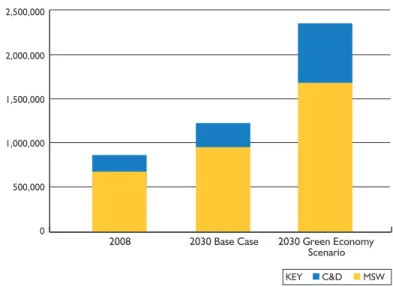
The job creation impacts of the Base Case and Green Economy Scenarios are summarized below in Figure ES-3.
In 2008 there were approximately 861,000 jobs directly associated with the management of MSW and C&D (666,000 and 195,000, respectively). Though more than two-thirds of MSW and C&D waste was disposed in 2008, only about 15 percent of the jobs associated with managing these wastes were from disposal related activities (collection and landfilling or incineration). By contrast, because of the labor intensity of waste diversion, 85 percent of the jobs were associated with various diversion activities (collection, processing, manufacturing with recycled materials, and compost-ing). Jobs associated with manufacturing using recy-cled inputs accounts for about 44 percent of the total jobs created related to MSW management and 24 per-cent of C&D management related jobs. Recycled mate-rial collection and processing also creates a significant fraction of the overall jobs for both MSW (37 percent) and C&D (33 percent).
The Green Economy Scenario with a 75
percent diversion rate generates 2,347,000
total direct jobs—over 1.1 million more
jobs than in the Base Case, and nearly 1.5
million more jobs than in 2008.
0 500,000 1,000,000 1,500,000 2,000,000 2,500,000
2008 2030 Base Case 2030 Green Economy Scenario
KEY C&D MSW
Figure ES-3
Total MSW and C&D Job Impacts
In the Base Case Scenario, due to growth in the waste stream and modest increases in the recycling and com-posting rate (from 33 percent to 41 percent), about 368,000 incremental jobs are created by 2030, resulting in a total of almost 1,229,000 jobs associated with the man-agement of both the MSW and C&D waste streams. Due to the increase in the recycling rates, diversion related ac-tivities account for about 89 percent of the total jobs. In contrast, the Green Economy Scenario with a 75 percent diversion rate generates 2,347,000 total direct jobs in 2030—over 1.1 million more jobs than in the Base Case, and nearly 1.5 million more jobs than in 2008. The combination of the higher diversion rate and the relative labor intensity of diversion activities means that in the Green Economy Scenario 98 percent of total waste man-agement jobs are related to MSW & C&D diversion activi-ties and only 2 percent are associated with disposal. Manufacturing jobs using recycled materials accounts for the largest share by far of the projected jobs in 2030; 49 percent of MSW management jobs and about 44 percent of C&D related jobs. We provide a detailed breakdown of job creation by management activity in the report.
ENVIRONMENTAL EMISSION IMPACTS
An increased diversion rate not only spurs job cre-ation, but also significantly reduces greenhouse gas emissions that contribute to climate change, as well as emission of toxic pollutants that are dangerous to human lives and our ecosystems.To assess the relative environmental impacts of the Base Case and Green Economy waste management scenarios in 2030 we utilized the Measuring Environ-mental Benefits Calculator (MEBCalc) model, a
life-cycle assessment (LCA) tool.7The model employs a
life-cycle approach to capture the input of energy and the output of wastes and pollution that occur not just at the end of use, but over the three phases of a mater-ial’s or product’s life cycle:
•
Upstream phase: resource extraction, materialsrefining, and product manufacture;
•
Use phase: product use; and•
End-of-life phase: management of productdiscards.
This approach accounts for how reuse and recycling eliminate the need for much of the upstream phase, thereby conserving energy and reducing waste and pol-lutants in the production of goods and services, in addi-tion to the benefits achieved in the end of life phase. For key materials in the MSW and C&D streams the methodology aggregates pollutants for seven environ-mental impact categories in the following indicator pollutants:
•
Climate change – carbon dioxide equivalents (eCO2);•
Human health-particulates – particulate matter lessthan 2.5 microns equivalents (ePM2.5);
•
Human health-toxics – toluene equivalents(eToluene);
•
Human health-carcinogens – benzene equivalents(eBenzene);
•
Eutrophication – nitrogen equivalents (eN);•
Acidification – sulfur dioxide equivalents (eSO2); and•
Ecosystems toxicity – herbicide 2,4-D equivalents(e2,4-D).
For each of the seven emissions categories modeled, the assessment indicates that recycling/composting reduces emissions considerably relative to waste dis-posal.These environmental benefits come primarily from pollution reductions in the manufacture of new products with recycled materials instead of virgin raw materials, and the replacement of synthetic petroleum-based fertilizers with compost. For most pollutants, the relative upstream benefits of diversion are quite dramatic. For example, recycling reduces
energy-re-lated eCO2emissions in the manufacturing process
and avoids emissions from waste management. More-over, in the case of paper, recycling maintains the on-going sequestration of carbon in trees that would otherwise need to be harvested to manufacture paper.
Given the prominence of climate change in current U.S. and global policy debates, the impacts of the
The Green Economy Scenario represents a
powerful opportunity to reduce the human
health and ecosystem impacts of pollution
from waste management activities.
The Green Economy Scenario avoids
about 515 million eMTCO
2in 2030, more
than twice as much as the Base Case.
different waste management scenarios on green-house gas emissions is important.
Figure ES-4, below, presents the relative GHG savings that accrue from diversion activities in the MSW and C&D management systems.
MSW and C&D diversion activities in 2008 reduced
GHG emissions about 153 million eMTCO2. In the Base
Case Scenario the modest growth in recycling rates combined with a growing waste stream result in annual GHG emission reductions in 2030 of about 238 million
eMTCO2, while in the Green Economy Scenario GHG
reductions of about 515 million eMTCO2 are achieved. This is equivalent to shutting down about 72 coal-fired power plants or taking 50 million cars off the road.8
The high organic content of MSW (paper and paper-board, yard waste, food scraps, and plastics) means that diversion of MSW accounts for the vast majority of GHG emission reductions. By contrast, C&D waste has a considerable fraction of inorganic material (concrete, rubble, brick), so C&D diversion con-tributes only about 15 percent of overall GHG reduc-tions in the Base Case Scenario and 25 percent in the Green Economy Scenario. The somewhat higher frac-tion from C&D diversion in the Green Economy Sce-nario is driven by the increased recycling/reuse of wood and, to a lesser extent, plastics.
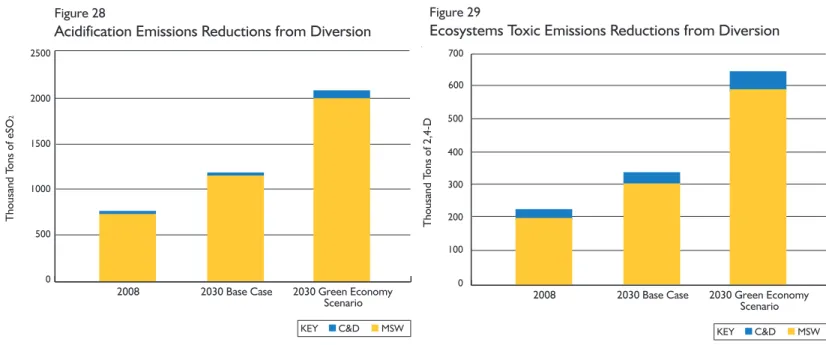
The results of the analysis are similar for human health and ecosystem related impacts.For example,
Figures ES-5 and ES-6 summarize the relative emission reduction benefits of the Base Case and Green Econ-omy Scenario for particulate emissions (less than 2.5
microns equivalents, ePM2.5) associated with
respira-tory illnesses and for sulfur dioxide (eSO2) that leads
to ecosystem degradation in terms of acidification of water bodies. As with GHGs, the reductions in emis-sions of these pollutants in the Green Economy Sce-nario are significantly greater than those in the Base Case. This trend follows for the other pollutant
emis-sions measured in this study. The Green Economy
Scenario, therefore, represents a powerful opportu-nity to reduce the human health and ecosystem im-pacts of pollution from waste management activities.
0 100 200 300 400 500
Figure ES-4
Climate Change Emissions Reductions from Diversion
2008 2030 Base Case 2030 Green Economy Scenario
KEY C&D MSW
600
0 100 200 300 400 500
Figure ES-5
Respiratory Emissions Reductions from Diversion
2008 2030 Base Case 2030 Green Economy Scenario
KEY C&D MSW
600
0 500 1000 1500 2000 2500
Figure ES-6
Acidification Emissions Reductions from Diversion
2008 2030 Base Case 2030 Green Economy Scenario
KEY C&D MSW
Figure ES-5
Respiratory Emissions Reductions from Diversion
Figure ES-6
Acidification Emissions Reductions from Diversion
More Jobs, Less Pollution: Growing the Recycling Economy in the U.S.
I. INTRODUCTION
There is growing recognition and urgency surround-ing a series of environmental and economic challenges facing the United States. In the environmental arena these include climate change, natural resource deple-tion, an increasing proliferation of wastes, toxics con-tamination and destruction of essential ecosystems. On the economic front, they include volatile energy and commodity prices as well as continued high un-employment. These challenges are multifaceted and require new approaches that transform existing prac-tices from those that are resource intensive, polluting, and produce few jobs to those that minimize use of virgin materials, are environmentally preferable and create significant job opportunities.
The current solid waste management system in the U.S. presents an excellent opportunity to encourage such a shift. A new “materials management” paradigm recognizes the important link between our consump-tion patterns, waste generaconsump-tion, environmental emis-sions and jobs. It places greater emphasis on reducing virgin material inputs; encompasses a deeper level of waste reduction through reuse, recycling and compost-ing; and has the potential for significant reductions in greenhouse gas emissions (and other toxics), while at the same time creating large numbers of new jobs throughout the U.S.
This report assesses the impacts of implementing a bold national recycling strategy in the United States over the next two decades. Specifically, we explore the impacts on jobs and on certain environmental emis-sions of achieving a 75-percent waste diversion rate by 2030. By “diversion” we mean diversion from waste disposal either in landfills or incineration facilities. Waste diversion approaches include waste reduction, reuse and remanufacturing, recycling and composting. To conduct the analysis, we compared two waste manage-ment scenarios, one based on continuing current practices,
and the other reflecting 75-percent diversion through sig-nificantly enhanced recycling and composting efforts.9
There are many data gaps and related challenges in carry-ing out such an analysis. In conductcarry-ing this study we have relied on existing data from federal, state and local agen-cies; non-governmental organizations; consultant re-ports; and academic papers. To the extent feasible, we used standard sources frequently cited in the field, such as information produced by the U.S. EPA, the U.S. Depart-ment of Labor, the U.S. DepartDepart-ment of Commerce, the U.S. Census Bureau and various state environmental agencies, as well as data developed by the National Recy-cling Coalition and others.
ORGANIZATION OF THIS REPORT
Following this Introduction, Section II presents an overview of 2008 waste generation, composition and management practices for municipal solid waste (MSW) and construction and demolition (C&D) de-bris. It documents the specific materials that comprise each of these two waste streams, how much of each material type is generated, and how much of each ma-terial is recycled, composted and disposed. This pro-vides the starting point for the assessment ofalternative future scenarios.
Section III describes the “Base Case” Scenario in which the current waste generation, composition and man-agement profile is projected to 2030. In the Base Case no major new policy interventions or lifestyle changes are introduced. Rather, it can be characterized as “business-as-usual,” where current practices and trends continue. In Section IV, an alternative scenario is presented that reflects an overall waste diversion rate of 75 percent. This Green Economy Scenario is defined normatively, meaning it represents what is achievable through implementation of an enhanced set of policy, regulatory and lifestyle changes to achieve this level of recycling and composting.
Based on the profile of waste stream characteristics and management practices developed for the Base Case and Green Economy Scenarios, Section V assesses and compares the employment implications of each scenario. This analysis covers the various stages of ma-terials management, including collection, hauling and processing, if any, as well as the ultimate management of the collected materials through reuse/remanufactur-ing, new product manufacturreuse/remanufactur-ing, compostreuse/remanufactur-ing, or dis-posal via landfilling or incineration.
Section VI assesses the life-cycle environmental impacts of the alternative scenarios. By applying the Measuring Environmental Benefits Calculator (MEBCalc), it com-pares the emissions of greenhouse gases and various other pollutants associated with the alternative materials management practices of the two scenarios.
Finally, Section VII presents a summary of our find-ings, discusses key policy implications and identifies areas requiring further research.
More Jobs, Less Pollution: Growing the Recycling Economy in the U.S.
II. CURRENT WASTE GENERATION,
COMPOSITION & MANAGEMENT
Before analyzing alternative waste managementscenar-ios, we need to understand the magnitude and compo-sition of the current municipal solid waste (MSW) and construction and demolition debris (C&D) waste streams and how they are managed. This involves char-acterizing the materials that comprise these waste streams, the tonnage of each material type that is gen-erated, and how much of each material is currently
recycled,10composted or disposed.
The waste streams considered include both MSW and C&D. It does not include industrial or agricultural wastes. As described in the report, MSW is generated by households as well as commercial and institutional entities. C&D is generated from construction and demolition activities in the residential and commercial sectors. Though it is often overlooked by the public and many policymakers, C&D debris is included in this analysis because of its importance in the overall waste stream: building-related C&D alone is roughly
70 percent as large as MSW generation.11Inclusion of
C&D, therefore, is important in assessing alternative waste management scenarios and developing a com-prehensive materials management program.
A. 2008 MUNICIPAL SOLID WASTE (MSW)
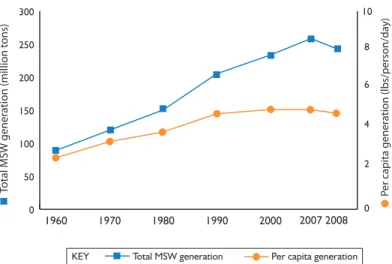
Total MSW generation in the U.S. has been steadily growing over the past several decades (notwithstanding a minor drop in 2008, likely related to the severe eco-nomic recession), with 2008 generation of about 250 million tons.12At the same time, per-capita generationhas grown much more slowly, reaching 4.5 pounds per person per day (lbs/person/day) in 1990 and it has hov-ered between 4.4. and 4.6 lbs/person/day since that time (see Figure 1). Given the known demographic trends in the U.S. over the past 20 years, it appears that increases in MSW generation over this period have been driven primarily by population growth.
As summarized in Figure 2, the EPA data reveal several trends in U.S. waste management practices over the past several decades:
•
Recycling played a minor role in wastemanage-ment through the 1970s, grew rapidly in terms of tonnage and percent of the waste stream in the 1980s and 1990s, and has leveled off since about 2000. Recycling managed about 24 percent of the waste stream in 2008.
•
Composting was negligible until the late 1980s,grew rapidly in the 1990s and has continued to grow modestly since 2000. Composting managed less than 9 percent of the waste stream in 2008.
•
MSW incineration was minimal until themid-1980s, when the vast majority of the plants cur-rently operating were constructed, grew modestly in the 1990s, and has declined modestly both in terms of tonnage and percent of the waste stream since 2000, to less than 13 percent of the waste stream in 2008.
• As the waste stream has grown over the years, the
Figure 1
MSW Generation Rates, 1960 to 2008
0
50 100 150 200 250 300
1960 1970 1980 1990 2000
KEY Total MSW generation Per capita generation 0 2 4 6 8 10
relative importance of landfill disposal in terms of the fraction of the waste stream managed declined rapidly in the 1980s and 1990s, with only very mod-est declines since 2000. As of 2008, landfills managed about 54 percent of the total waste stream. In terms of tonnage the amount sent to landfills has been re-markably stable since about 1980.
A more detailed summary table of MSW generation and management by material type is included in Ap-pendix A.
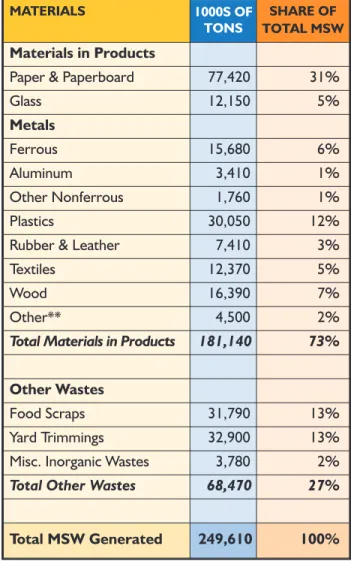
Table 1 provides a profile of more than a dozen major
types of materials generated13and the tonnage for each
material for 2008, the most recent year for which data are available.
As summarized in Figure 3, of the 250 million tons of MSW generated in the U.S. in 2008, 63 percent was disposed of in landfills or incinerators while 37 per-cent was diverted through recycling or composting.
60,770 24%
KEY Diversion Recycled Diversion Composted Disposal Landfill Disposal Incineration
22,100 9% 31,550
13%
135,190 54%
Figure 3
U.S. MSW Management, 2008
(1000 tons)
0
50 100 150 200 250 300
1960 1965 1970 1975 1980 1985 1990 1995 2000 2005
Combustion with energy recovery
Recovery for recycling
Recovery of the composting component of recycling
Landfill, other disposal
Figure 2
U.S. MSW Management, 1960 to 2008
Table 1
MSW Generation in the U.S. – 2008
MATERIALS 1000S OF
TONS
SHARE OF TOTAL MSW
Materials in Products
Paper & Paperboard 77,420 31%
Glass 12,150 5%
Metals
Ferrous 15,680 6%
Aluminum 3,410 1%
Other Nonferrous 1,760 1%
Plastics 30,050 12%
Rubber & Leather 7,410 3%
Textiles 12,370 5%
Wood 16,390 7%
Other** 4,500 2%
Total Materials in Products 181,140 73%
Other Wastes
Food Scraps 31,790 13%
Yard Trimmings 32,900 13%
Misc. Inorganic Wastes 3,780 2%
Total Other Wastes 68,470 27%
Key Points Regarding 2008
MSW Generation and Management
Based on the data summarized above, the following key points about MSW generation and management in 2008 should be highlighted:
•
Five materials comprise about 77 percent of the almost 250 million tons of total MSW generated in 2008:Material 2008 Tonnage % Total
(millions)
Paper and paperboard 77 31%
Yard waste 33 13%
Food scraps 32 13%
Plastics 30 12%
Metals (3 types) 21 8%
Totals 193 77%
•
Organic components of the waste stream (yard trimmings, food scraps, paper and paperboard, and wood) comprise approximately 64 percent of total 2008 MSW generation.•
Materials are recovered for recycling and composting at very different rates. For example, almost 69 per-cent of nonferrous metals and 55 perper-cent of paper/ paperboard is recycled, while only 7 percent of plas-tics and 10 percent of wood is recycled. About 65 percent of yard trimmings are composted compared with less than 3 percent of food scraps.•
A 33-percent MSW diversion rate lags well below what might be considered “best practice” in the U.S. Numer-ous municipalities and states (and other countries) have achieved much higher diversion rates, especially those adopting a “zero waste” or “materials manage-ment” policy framework (e.g., Massachusetts, Oregon, San Francisco, Seattle).This profile of existing generation and diversion by rial type is critical input for identifying the target mate-rials and programs that can lead to much more robust MSW recycling and composting, as described in the Green Economy Scenario in Section IV.
B. 2008 CONSTRUCTION AND
DEMOLITION DEBRIS (C&D)
C&D debris is material that is generated in the con-struction, renovation or demolition of structures. C&D debris comprise a significant fraction of the
overall solid waste stream14 (40 percent or more in
most estimates) and is, therefore, important to address in an assessment of the jobs and environmental im-pacts of alternative material management scenarios. There is not, however, a consensus definition of what is included in the C&D waste stream and what is ex-cluded. Broadly defined, structures that generate C&D include buildings (both residential and non-residen-tial), as well as infrastructure such as roads and bridges. It may also include land-clearing debris re-lated to construction-site preparation. Different juris-dictions have adopted different definitions, hampering consistent data reporting and collection. Moreover, even within building-related C&D, new construction, renovation and demolition each generate somewhat different waste streams, as do residential versus non-residential buildings. Further complicating the C&D data and analysis picture is the fact that sometimes, particularly in rural areas, C&D debris is comingled with MSW.
Thus, it is not surprising that unlike for MSW, there is not a single widely accepted source for up-to-date data on C&D debris generation, composition and management. For the current study, we have focused on building-related C&D, as this is included in virtu-ally all definitions, and to date it has been the focus of EPA’s efforts to assemble the disparate sources of data and analyze national C&D generation and man-agement activities.
EPA acknowledges that “Limited information is avail-able on the amount of C&D materials generated and managed in the U.S.” and that “efforts to improve C&D measurement are currently hampered by a general lack of data. Thus, it should be recognized that the C&D materials estimates presented to date, including those [assembled by EPA]…have some level of uncer-tainty…Nevertheless, we believe that the estimates contained in this report reflect and are based on the best data that are currently available.”15, 16
According to EPA data, demolition generates the largest share of building-related C&D (on the order of 50 percent), followed by renovation (as much as 40 percent), with new construction contributing the
smallest share.17For construction and renovation,
than non-residential buildings. The materials most com-mon in residential construction debris are wood and dry-wall. By contrast, the C&D debris from building
renovation is extremely diverse given that it is generated from all kinds of remodeling efforts – from kitchens and bathrooms to roofs and driveways – and includes both new construction waste and demolition debris. In terms of demolition, wood, concrete and drywall are the largest components of residential demolition debris while con-crete and mixed rubble comprise the largest share of nonresidential demolition debris.18
Given the various state-level definitions for which ma-terials are included in the C&D waste stream and the wide range of reporting methods, it is not surprising that there is no widely accepted standard source for national C&D composition data. For the purposes of the current analysis, C&D waste composition is based on estimates developed by U.S. EPA for building-re-lated C&D.19
Diversion rates for specific materials found in C&D are not provided by EPA. This report estimates mate-rial-specific diversion rates based on EPA’s overall C&D diversion estimate of 30 percent20and a variety
of other sources, including EPA’s 1998 and 2009 C&D studies, a study for the Massachusetts Department of
Environmental Protection21and others.22Relatively
high diversion rates (roughly 50 percent) are assumed for concrete and mixed rubble, bricks and metals, re-flecting the ease and cost-effective manner with which these materials can be recycled in much of the U.S. and their prevalence at C&D recycling facilities as reported by various states.
While some wood is diverted from the C&D waste stream, it is difficult to recycle due to contamination by paint, preservatives or metals. Thus, some of the recovered wood is sent to industrial boilers and co-fired for energy production. According to U.S. EPA, certain states count this as diverted material; others do not.23
Drywall, asphalt roofing and plastics in the C&D stream have had very low diversion rates, partly due to the lack of processing-facility infrastructure that can cost-effectively separate these materials. A very small fraction (well under 5 percent) of drywall is recovered due to the lack of processing capacity and markets for
recovered material.
As summarized in Figure 4, in 2008 approximately 30 percent of the 178 million tons of C&D debris gener-ated in the U.S. was diverted (recycled) and 70 percent was disposed. Unlike other components in the MSW stream, virtually all recovered C&D waste was recycled; almost none was composted, as only the wood waste component of the C&D stream is compostable. Simi-larly, virtually all C&D disposal was via landfill and very little was incinerated, though small amounts of recovered wood and other high-BTU materials were used in industrial boilers.
A summary of the base year C&D waste generation and management situation by material type is pre-sented in Table 2.
124,812 70%
KEY Recycled Landfill 53,414
30%
Figure 4
U.S. C&D Management, 2008
(1000 tons)
Key Points Regarding 2008 C&D
Generation and Management
The data above illustrates the following key points about C&D generation and management in 2008:
•
Two materials dominate the C&D waste stream and comprise roughly 70 percent of the total 170 million tons generated: concrete and mixed rubble (45 percent), and wood (25 percent). Drywall (10 percent) and asphalt roofing (8 percent) are also important contributors.•
Less than a third (30 percent) of C&D debris is cur-rently recycled or reused. Concrete and mixed rubble, bricks and metals are recovered at relatively high rates, around 50 percent. While roughly 15 percent ofwood is recycled, recovery rates for drywall, roofing shingles and plastics are very low.
•
The 30-percent national diversion rate for C&D lags well below what might be considered “best practice” in the U.S. Numerous municipalities and states have achieved much higher diversion rates (e.g., more than 60 percent in Massachusetts and about 80 percent in King County, Washington).This profile of existing C&D generation and diversion by material type is critical input for identifying the target materials and programs that can lead to a significantly higher diversion rate (see Section IV).
Figure 1 Source: “Municipal Solid Waste Generation, Recycling and Disposal in the United States: Facts and Figures for 2008,” U.S. EPA, November 2009. Figure 2 Source: “Municipal Solid Waste Generation, Recycling and Disposal in the United States, Detailed Tables and Figures for 2008,” U.S. EPA, November 2009, Figure 26, developed by Franklin Associates.
Figure 3 Source: Based on “Municipal Solid Waste Generation, Recycling and Disposal in the United States: Facts and Figures for 2008,” U.S. EPA, November 2009.
Figure 4 Source: Based on “Characterization of Building-Related Construction and Demolition Debris in the United States,” (p. 3-9) prepared by Franklin Associates for U.S. EPA, June 1998.
Table 1 Source: Based on “Municipal Solid Waste Generation, Recycling and Disposal in the United States: Facts and Figures for 2008,” U.S. EPA, November 2009. Details might not add to totals due to rounding.
Table 2 Sources: aTotal generation based on “Estimating 2003 Building-Related Construction and Demolition Materials Amounts,” U.S. EPA, March
2009, escalated by U.S. Census Bureau population growth rate from 2003 to 2008. Allocation by material based on EPA ranges reported at www.epa.gov/epawaste/nonhaz/industrial/cd/basic.htm.
bOverall diversion rate based on range provided in “Characterization of Building-Related Construction and Demolition Debris in the United
States,” (p. 3-9) prepared by Franklin Associates for U.S. EPA, June 1998. Diversion rates for specific materials governed by EPA’s national diversion estimate of 30 percent and based on Tellus estimates informed by C&D diversion data from EPA, Massachusetts and other states, plus personal
com-Table 2
C&D Generation and Management in the U.S. – 2008
(Thousands of Tons and Percentage of Total Generated)
MATERIALS GENERATION a DIVERTED b DISPOSED c
Total Total Diversion Rate Total Disposal Rate
Concrete & Mixed Rubble 80,202 38,497 48% 41,705 52%
Wood 44,557 6,683 15% 37,873 85%
Drywall / Gypsum 17,823 178 1% 17,644 99%
Asphalt roofing 14,258 713 5% 13,545 95%
Metals 7,129 3565 50% 3,565 50%
Bricks 7,129 3,422 48% 3,707 52%
Plastics 7,129 356 5% 6,773 95%
Total 178,226 53,414 30% 124,812 70%
More Jobs, Less Pollution: Growing the Recycling Economy in the U.S.
III. 2030 WASTE GENERATION,
COMPOSITION & MANAGEMENT:
BASE CASE (“BUSINESS AS USUAL”) SCENARIO
The Base Case Scenario represents a “business asusual” approach to solid waste management in which current practices and trends continue. No major new policy interventions or lifestyle changes are introduced and most basic assumptions remain unchanged. The modest growth in the MSW diversion rate that has been experienced in the U.S. over the past decade (1 percent per year) is assumed to continue through 2030 in the Base Case Scenario.
A. 2030 BASE CASE – MSW
Projected waste generation figures to the year 2030 are driven by two primary factors: (1) expected per capita waste generation, and (2) changes in U.S. population. It is important to note that per capita waste generation is net of any source reduction that is achieved before
materials enter the MSW management system.24While
U.S. EPA estimates that source reduction increased through the 1990s, net per capita generation has re-mained relatively stable.
(1) Projected per capita generation:According to the U.S. EPA, per capita waste generation has remained relatively constant since 2000. Thus, for the Base Case Scenario we have used a generation figure of 4.6 lbs per capita per day or 1,697 lbs per year25
from 2008 through 2030. This corresponds to the average per capita generation rate since 2000. Based on EPA’s estimates of source reduction through 2000, this reflects a source reduction rate of about 19 percent.26
(2) Projected U.S. population: For U.S. population projections we have used the U.S. Census Bureau’s 2008 national projections through 2050 for both scenarios.27These projections estimate that the U.S.
population of 304 million in 2008 will grow to
about 341 million in 2020 and to almost 374 mil-lion in 2030.
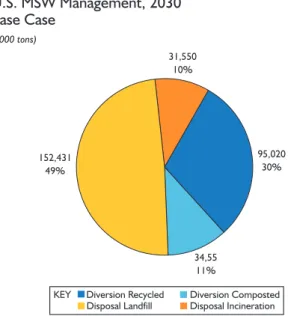
With constant per capita waste generation, overall Base Case waste generation grows at the same rate as the U.S. population. Thus, as Figure 5 shows, we project that total annual generation will grow from almost 250 million tons in 2008 to about 314 million tons in 2030. A more detailed summary of MSW Generation and Management by material type in the Base Case Sce-nario is included in Appendix B.
Given that the Base Case is defined as a “business as usual” scenario, the diversion rates for each material and the overall diversion rate are assumed to
con-tinue to grow at 1 percent per year.28By 2030 the
MSW diversion rate increases from 33.2 to 41.3
Figure 5
U.S. MSW Management, 2030 Base Case
(1000 tons)
95,020 30%
KEY Diversion Recycled Diversion Composted Disposal Landfill Disposal Incineration
34,55 11% 31,550
10%
152,431 49%
percent. This results in total diversion of almost 130 million tons of material, and total disposal of about 184 million tons.
Similarly, the fraction of diverted material that is recy-cled (73 percent) versus composted (27 percent) is as-sumed to be the same as in 2008. In terms of disposal, the Base Case assumes that the same tonnage of mate-rial is incinerated (about 31.5 million tons per year), and that the additional tonnage requiring disposal is sent to landfills. This assumption implies that what-ever incineration capacity is retired over the next two decades is replaced by an equal amount of capacity. It also recognizes that fluctuations in the tonnage of MSW disposed are more likely to impact the amount managed by landfills rather than incinerators. This is partly due to the relative difficulty of bringing new in-cineration capacity on line – because of siting issues, large capital requirements and the need for long-term disposal contracts – whereas expanding landfill capacity by opening new cells is comparatively “easier” and less costly.
B. 2030 BASE CASE – C&D
Similar to MSW, C&D generation in the Base Case is assumed to grow with U.S. population over the study period (slightly less than 1 percent per year). As de-scribed above in the discussion of C&D generation in 2008, this is likely a conservative assumption as to the size of the C&D waste stream in 2030 and is used in the current study for illustrative purposes.29
Similar to the Base Case assumptions for diversion of MSW in 2030, the C&D diversion rates for each mate-rial and the overall diversion rate is assumed to grow
from the 2008 level.30As summarized in Figure 6 and
Table 3, for the Base Case Scenario total C&D genera-tion reaches almost 219 million tons in 2030. C&D di-version reaches 37 percent by 2030, accounting for almost 82 million tons of C&D, while 137 million tons continues to be disposed.
The Base Case C&D waste stream profile for 2030 is assumed to be the same as in 2008. It is dominated by
Table 3
C&D Generation and Management in the U.S. - 2030 Base Case
(Thousands of Tons and Percentage of Total Generated)
MATERIALS GENERATION a DIVERTED b DISPOSED c
Total Total Diversion Rate Total Disposal Rate
Concrete & Mixed Rubble 98,417 58,801 60% 39,616 40%
Wood 54,676 10,208 19% 44,468 81%
Drywall / Gypsum 21,870 272 1% 21,598 99%
Asphalt roofing 17,496 1,089 6% 16,407 94%
Metals 8,748 5,444 62% 3,304 38%
Bricks 8,748 5,227 60% 3,521 40%
Plastics 8,748 544 6% 8,204 94%
Total 218,704 81,586 37% 137,119 63%
Figure 6
U.S. C&D Management, 2030 Base Case
(1000 tons)
1
137,119
63%
KEY Recycled Landfill 81,586
two materials: concrete and mixed rubble, and wood, which comprise 70 percent of total generation. About 50 percent of concrete and mixed rubble, bricks and metals are assumed to be recovered, while diversion rates for drywall, roofing shingles and plastics remain very low.
As mentioned, this relatively low diversion rate for C&D is well below rates achieved in jurisdictions with more effective C&D diversion programs and it con-trasts with the rate projected to be achieved through the set of policy, regulatory and lifestyle changes in the Green Economy Scenario, described next.
Figure 5 Sources: 2030 generation based on 2008 generation from “Municipal Solid Waste Generation, Recycling and Disposal in the United States, Detailed Tables and Figures for 2008,” U.S. EPA, November 2009, times the projected population growth rate from the U.S. Census Bureau’s “Table 1. Projections of the Population and Components of Change for the United States: 2010 to 2050 (NP2008-T1),” Release Date: August 14, 2008. Di-version rate assumed to grow 1 percent per year from 2008 levels. No net change in waste incineration tonnage is assumed.
Figure 6 Sources: Total generation as derived from “Estimating 2003 Building-Related Construction and Demolition Materials Amounts,” U.S. EPA, March 2009, escalated by U.S. Census Bureau population growth rate from 2003 to 2030. 2030 diversion rate based on range provided in “Charac-terization of Building-Related Construction and Demolition Debris in the United States,” (p. 3-9) prepared by Franklin Associates for U.S. EPA, June 1998. No change in diversion rate assumed in Base Case.
Table 3 Sources: aTotal generation based on “Estimating 2003 Building-Related Construction and Demolition Materials Amounts,” U.S. EPA,
March 2009, escalated by U.S. Census Bureau population growth rate from 2003 to 2030. Allocation by material based on EPA ranges reported at www.epa.gov/epawaste/nonhaz/industrial/cd/basic.htm.
b Overall diversion rate based on range provided in “Characterization of Building-Related Construction and Demolition Debris in the United
States,” (p. 3-9) prepared by Franklin Associates for U.S. EPA, June 1998. Diversion rates for specific materials governed by EPA’s national diversion estimate of 30 percent and based on Tellus estimates informed by C&D diversion data from EPA, Massachusetts and other states, plus personal com-munication with Kim Cochran, EPA Office of Resource Conservation and Recovery, 8/12/10.
More Jobs, Less Pollution: Growing the Recycling Economy in the U.S.
IV. 2030 WASTE GENERATION, COMPOSITION
& MANAGEMENT: THE GREEN ECONOMY
(75 PERCENT DIVERSION) SCENARIO
The Green Economy Scenario presented in this sectionreflects an overall waste diversion rate of 75 percent. This alternative scenario represents what is achievable through implementation of a set of enhanced policy, regulatory and lifestyle changes to achieve this level of recycling and composting. The policies, regulations and behavior changes driving this scenario are based on what are con-sidered “best practices” currently in place in various juris-dictions in the U.S. and abroad.
While the Green Economy Scenario does not attempt to provide detailed descriptions of each of the specific best practices and their respective impacts on emis-sions and jobs, examples of the kinds of policy, regula-tory and lifestyle initiatives that will be necessary to achieve the level of recycling and composting in the Green Economy Scenario are highlighted below. In ad-dition, detailed descriptions of three leading waste di-version programs (Massachusetts C&D, San Francisco mandatory recycling and Seattle food composting) are provided at the end of this section.
Policy Examples
•
Pay As You Throw (PAYT) programs to incentivizerecycling and composting, now in place in thou-sands of communities throughout the U.S.
•
Resource Management Contracting to incentivizecommercial waste generators and their waste man-agement contractors to reduce disposal.
•
Grants, expedited permitting and other support forthe development of MSW and C&D recycling and composting infrastructure as well as recycling-based manufacturing.
Regulatory Examples
•
Mandatory recycling and composting laws such asthe one adopted by San Francisco in 2009 (de-scribed below).
•
Disposal bans on recyclable materials, includingcertain unprocessed materials in the C&D waste stream, such as those in place in Massachusetts for several years (described below).
•
Extended producer responsibility (EPR)regula-tions to encourage changes in product and packag-ing design that reduce volume/weight and toxicity and enhance recyclability or compostability.
•
A (national) bottle bill covering not onlycarbon-ated beverages such as soda and beer, but also bot-tled water, sports drinks, fruit juice, teas, etc., as has been adopted in California, Hawaii and Maine.
Lifestyle Examples
•
Purchasing practices that give preference toprod-ucts that have less packaging and are recyclable or compostable or contain high levels of recycled material.
•
Conscientious participation in local recycling andcomposting programs by residents and businesses.
A. 2030 GREEN ECONOMY SCENARIO - MSW
The Green Economy Scenario assumes the same gen-eration and material composition as in the Base Case Scenario for 2030. Total generation is almost 314 mil-lion tons, with paper/paperboard, yard waste and food scraps, and plastics and metals (in order) having the largest shares. However, unlike the 41-percent diver-sion rate associated with business-as-usual practices in the Base Case Scenario, through implementation of a coordinated suite of policy, regulatory and lifestyle initiatives such as summarized above, the Green Economy Scenario achieves a 75-percent MSW di-version rate.Massachusetts has implemented one of the most successful statewide construction and demolition (C&D) recycling programs in the U.S. Informed by a broad stakeholder consultation process, the state’s Department of Environmental Protection (MassDEP) accomplished this through a coordinated effort comprising technical assistance, market devel-opment and a ban on unprocessed disposal of selected C&D waste materials.
In an effort to reach its goal of reducing non-municipal solid waste by 88 percent by 2010, as laid out in MassDEP’s Beyond 2000 Solid Waste Master Plan, the department instituted a disposal ban on select C&D materials in July 2006. The banned materials are asphalt paving, brick, concrete, metal and wood. Massachusetts has the only statewide ban and regulations on disposing unprocessed C&D waste (for specified materials) in the country. DEP estimates that in 2010, out of 3.8 million tons of C&D debris generated, more than 3 million tons were diverted for an overall diversion rate of about 80 percent. To develop the ban, MassDEP established a subcommittee of the agency’s Solid Waste Advisory Committee in 2001. By 2010 this subcommittee had 160 members, comprised of architects, engineers, building owners, contractors, haulers, C&D processors, landfill owners, transfer station owners, municipalities, environmental groups and trade associations. The subcommittee ultimately recommended a phased-in ban of the specific materials mentioned above rather than all unprocessed C&D debris. These materials were targeted because recycling and reuse markets exist for each of them. In addition, once the subcommittee recommended the ban, several businesses established additional facilities to recycle and/or reuse these materials, further enhancing not only the recycling and reuse markets but also the job creation po-tential of such a ban. Though this stakeholder process was successful, it took a considerable amount of time. From writ-ing regulations to infrastructure and market development, it took more than four years for MassDEP to institute the ban. To ensure the ban’s success, MassDEP provided financial and technical assistance to develop infrastructure for diversion through reduction, reuse and recycling. As of 2010, Massachusetts had more than 15 C&D processing and/or recycling facilities, which recover recyclable materials from mixed C&D debris for reuse, sale or further processing. Massachu-setts also has the first gypsum recycling facility in the U.S., modeled after a successful Scandinavian program that processes gypsum wallboard waste to produce new wallboard. The state now has one of the best C&D processing in-frastructures in the country. Although the number of direct and indirect jobs associated with this C&D infrastructure has not been quantified, numerous jobs are supported in operating facilities, processing materials and manufacturing prod-ucts from recycled materials.
MassDEP reviews and approves solid waste facility waste ban compliance plans and inspects solid waste facilities to en-sure they are in compliance with monitoring, inspections, record keeping and other facility waste ban requirements. Businesses and municipalities that do not divert banned items from their waste run the risk of having solid waste facili-ties reject their waste and charge additional handling fees, as well as potential enforcement penalfacili-ties from MassDEP. MassDEP has made available several case studies that demonstrate the waste diversion and economic benefits of the ban. Clarke Corporation, a wholesale distributer of kitchen appliances, renovated and expanded its distribution center in Milford, Mass. Ninety-eight percent of materials generated on site were recycled or reused, resulting in cost savings of $259,043. In another case, recycling during the commercial demolition of the Massachusetts Institute of Technology (MIT) Media Lab in Cambridge resulted in 96 percent waste reduction and cost savings of $17,684. For more informa-tion and the C&D recycling case studies, see http://www.mass.gov/dep/recycle/reduce/managing.htm.
Sources: http://www.mass.gov/dep/recycle/priorities/08swdata.pdf, p. 10 and http://www.gypsumrecycling.us/Pages/News/6712-1-280/
CASE STUDY:
Achieving High Rates of Construction and Demolition
The diversion rates differ by material type, depending on a number of factors including ease of recycling or composting, processing infrastructure and market value. Thus, materials such as yard waste (90 percent), paper/paperboard (85 percent), and metals (80 percent) are assumed to have high recycling/composting rates, while materials such as textiles (50 percent), rubber and leather (50 percent), and plastics (65 percent), are as-signed lower recycling rates. These diversion rates are informed by estimates of realistic potential diversion developed by Tellus Institute for the Massachusetts
De-partment of Environmental Protection31and are
up-dated to reflect a planning horizon to 2030, the likely regulation of greenhouse gas emissions in the U.S., and an assumption that commodity prices will increase in real terms over this two-decade planning period. Thus, in the Green Economy Scenario by 2030 fully 75 percent (more than 235 million tons) of the waste gen-erated is either recycled or composted, and only 25 percent (78 million tons) is disposed. A summary of the 2030 waste management situation in the Green Economy Scenario is presented in Figure 7. A more de-tailed presentation of the MSW Generation and Man-agement by material type in the Green Economy Scenario is included in Appendix C.
A comparison of the MSW flows and management ac-tivities in the Base Case versus the Green Economy Scenarios is presented in Figure 8.
B. 2030 GREEN ECONOMY SCENARIO – C&D
As with MSW, 2030 C&D generation and composition in the Green Economy Scenario is assumed to be the same as in the Base Case. However, our higher diver-sion scenario assumes a set of policy and regulatory initiatives that significantly boosts C&D material re-covery. In the regulatory arena a key driver would be adoption of disposal bans for certain unprocessed C&D materials (e.g., asphalt paving, brick, concrete, metal, wood), as has been in place in Massachusetts for several years. Such bans would need to be comple-mented by policy initiatives to establish C&D proces-sors and build markets for the recycled materials. Certain materials such as concrete/rubble, bricks and metals are projected to be recycled at very high rates (90 percent), while materials such as drywall (60 per-cent) and wood (70 perper-cent) achieve somewhat more modest diversion rates owing to factors such as lack of processing infrastructure or contamination.As summarized in Figure 9, an overall C&D diversion rate of 80 percent is achieved by 2030 in the Green Economy Scenario. This relatively high diversion rate is due to the fact that the C&D waste stream is dominated by materials that are readily recycled and reused, and the availability of work-able policy and regulatory tools to incentivize recycling. The specific diversion rates by component of the C&D waste stream is presented in Table 4. As discussed, all di-verted waste is assumed to be recycled and all disposed waste is assumed to be landfilled. The variance in
0 50 100 150 200 250 300 350 Figure 8
U.S. MSW Waste Flows
2008 2030 Base Case 2030 Green Economy Scenario
KEY Disposal Composted Recycling
Figure 7
U.S. MSW Management, 2030 Green Economy Scenario
(1000 tons)
170,294 54%
KEY Diversion Recycled Diversion Composted Disposal Landfill Disposal Incineration
46,563 15% 31,550 10% 65,150 21% Figure 8
U.S. MSW Waste Flows
Passage of San Francisco’s Mandatory Recycling and Composting Ordinance in 2009 has measurably enhanced the various benefits of the city’s already impressive solid waste management system. In addition to environmental pro-tection, these programs are resulting in cost savings for businesses and the creation of private sector jobs. The mandatory ordinance has increased participation in waste sorting programs and the city’s diversion rate is now the highest of any major city in the United States.
California law requires each jurisdiction to achieve at least 50 percent waste diversion, and many cities and counties have set higher diversion goals. San Francisco set goals in 2002 to achieve 75 percent diversion by 2010 and zero waste by 2020. In 2010, it exceeded its goal with a 77 percent diversion rate.
San Francisco requires everyone to separate refuse into recyclables, compostables and trash, and all property own-ers are required to subscribe to an adequate collection service. For most businesses, reaching high divown-ersion is achievable because so many materials in the waste stream are recyclable, compostable or reusable. Incentives in the cost structure for collection mean businesses can save up to 75 percent of service costs by participating in recycling and composting programs.
Since the ordinance passed there has been a 50-percent increase in businesses using the compost collection service and a 300-percent increase in the number of apartments using the service. As a result, the collection of compostable materials has increased by 45 percent so that nearly 600 tons per day of food scraps, soiled paper and yard trim-mings are sent to composting facilities. Keeping organics out of landfills is key to reducing methane generation and reducing climate change. During the recent economic downturn, the overall amount of waste generated in San Fran-cisco declined but the amount of recyclable materials has remained steady.
According to San Francisco Department of Environment Director Melanie Nutter, "If we captured everything going to landfill that can be recycled or composted in our programs, we'd have a 90-percent recycling rate, but we will need to work on the state and federal level to require that packaging and products are manufactured with minimal waste and maximum recyclability."
Because more recycling and composting means more jobs, San Francisco’s recycling achievements have been a bright spot in a gloomy global economy. Recology, the city's primary recycling, composting and waste company, employs more than 1,000 workers who are represented by the Teamsters. Some 118 new employees have been hired in recent years to sort recyclables and monitor the collection routes in order to meet San Francisco’s ag-gressive recycling goals. The ordinance includes fair standards for janitorial workers who are on the front lines of office waste separation.
“San Francisco is showing once again that doing good for our environment also means doing right by our economy and local job creation,” said former Mayor Gavin Newsom. “For a growing number of people, recycling provides the dignity of a paycheck in tough economic times. The recycling industry trains and employs men and women in local environmental work that can’t be outsourced and sent overseas, creating 10 times as many jobs as sending material to landfills.”
CASE STUDY:
Creating Jobs and Saving Money:
Two recent ordinances have diverted additional waste items. The Construction and Demolition (C&D) Debris Re-covery Ordinance of 2006 made recycling of C&D debris mandatory. San Francisco now sends 20 percent fewer tons of C&D waste to landfills. The Food Service Waste Reduction ordinance of 2006 bans polystyrene food take-out containers and requires containers to be recyclable or compostable in the city’s programs. Almost all restaurants are now participating in this program.
The city focuses on education and assistance through free trainings for businesses and apartment buildings to imple-ment the Mandatory Recycling and Composting Ordinance. In 2010, the city worked directly with approximately 300 apartment buildings (encompassing 21,000 units), 800 commercial accounts, 4,000 food establishments and more than 100 of the largest events. The city government is leading by example, training more than 4,000 city em-ployees to help ensure recycling and composting in city buildings. This has resulted in savings of more than half a mil-lion dollars in city trash service fees and other efficiencies.
Following San Francisco’s lead, the California Department of Resources Recycling and Recovery began developing a Mandatory Commercial Recycling Measure in 2009 to help meet the state’s greenhouse gas reduction goals, and the measure is expected to go into effect in 2012. This measure will require that all businesses in the state have a recy-cling program. The commercial sector generates more than half of the solid waste in California, and approximately 68 percent of waste disposed. This measure presents significant job growth opportunities statewide.
Sources:
San Francisco Department of Environment: www.sfenvironment.org Recology: www.recyclingmoments.org
CASE STUDY:
From Food Scraps to Compost: Waste Diversion and Job Creation in Seattle
While separating bottles and cans from garbage for recycling is common practice in the US, it has be-come clear that composting of organic waste – food scraps, soiled paper and yard debris – is the critical next step to significantly increase waste diversion rates, and reduce greenhouse gas emissions and other hazards of landfilling.
Hundreds of organics composting programs have been established in the US, including one in Seattle. Under such programs, residential and commercial customers separate food scraps and yard debris from recyclables and other solid waste. It is then collected and transported to large-scale composting operations, which turn the waste into marketable compost and fertilizer products. Because organic matter buried in landfills releases the potent greenhouse gas methane as it decomposes, the diversion of organic waste for composting not only reduces the volume of waste going to landfills, but also helps combat climate change.
Seattle has a 60 percent waste diversion goal and, as of 2009, achieved an estimated overall diversion rate of 51.1 percent. Key to these high diversion rates is the city’s food scrap diversion program, which began in 2007 and became mandatory for single-family homes in 2009. Residents separate waste into three containers: recy-clables, organic matter and all other trash. In 2009, nearly 100,000 tons of organic waste was diverted from landfills by the city of Seattle’s program. Approximately one third of this consisted of food scraps and soiled paper, the rest was yard trimmings.
Seattle contracts with Cedar Grove Composting, Inc., which operates a major composting facility in Maple Valley, Wash. to compost yard waste and food scraps from commercial and residential customers. Cedar Grove has a long-standing contract with the city of Seattle to compost yard waste, and received a permit from the state of Washington to compost food scraps in 2009. Residential food waste now represents about 10 per-cent of Cedar Grove’s collection volume, and they produce a wide range of products, including topsoil, garden fertilizer, compost and mulch for use by homeowners, gardeners, developers and contractors.
The city of Seattle’s waste diversion efforts not only benefit the environment, but also sustain family-support-ing jobs for the more than 1,000 solid waste and recyclfamily-support-ing drivers and transfer station employees in Seattle and King County who are represented by the Teamsters Union.
Teamster recycling and solid waste drivers enjoy good wages, health insurance and pension benefits. Harold Barcelou, a five-year driver at Cedar Grove Composting, said, “I’m proud to be a Teamster and proud to be helping Seattle to reach its waste reduction goals. My Teamster membership means I can afford good health care for my family and can take the time to do the job safely.” According to Brent Barrett, a Teamster member and shop steward at Waste Management, “Teamster representation ensures high safety and operational stan-dards for employees, the company and the community.”
Environmental organizations are enthusiastic about Seattle’s composting initiative. “Seattle is proving that or-ganics composting is viable on a city-wide basis,” said Mo McBroom, Policy Director of the Washington Envi-ronmental Council, “Keeping organic waste and the methane it generates out of our landfills is critical to combating climate change.”