Equity and Efficiency Considerations, with an
Illustration Using Austrian SILC Data
Unconditional Basic Income
Christian Tod
August 2008
Diplomarbeit zur Erlangung des akademischen Grades Mag.rer.soc.oec.
Johannes Kepler Universit¨at Linz
Institut f¨ur Volkswirtschaftslehre/Department of Economics
Eidesstattliche Erkl¨
arung
Ich erkl¨are an Eides statt, dass ich die vorliegende Diplomarbeit selbstst¨andig und
ohne fremde Hilfe verfasst, andere als die angegebenen Quellen und Hilfsmittel
nicht benutzt bzw. die w¨ortlich oder sinngem¨aß entnommenen Stellen als solche
Abstract
The objection to an unconditional basic income is threefold. First, uncondition-ality is unjust, because it is at odds with reciprocity. Why should society grant benefits without demanding service in return? Second, a basic income is either too low to alleviate poverty or too high to be economically feasible. The disin-centive effects caused by a tax rate necessary to sustain a basic income replacing conditional welfare would result in a reduction in economic efficiency. And third, unconditional payments are not only undeserved, but create strong incentives to drop out of the labor force, which again results in a reduction in economic ef-ficiency. The aim of this thesis is the analysis of a basic income scheme in the light of the objections formulated above. As the analysis will show, a basic in-come is compatible with libertarian theories of justice and is in principle capable of improving economic efficiency.
Contents
1 Introduction 9
2 Equity 16
2.1 Theories of Distributive Justice . . . 17
2.2 Locke’s Proviso Extended . . . 27
3 Efficiency 32 3.1 Social Choice . . . 35
3.2 (Dis)Incentives: The Equity Efficiency Tradeoff . . . 41
3.3 The Labor Market . . . 63
3.4 The Bottom Line . . . 76
3.5 The (Mis)Allocation of Talent . . . 78
3.6 Concluding Comments . . . 81
4 Empirics 83 4.1 Redistributive Effects of BIFT Schemes . . . 83
4.2 The Aggregate Behavior Response . . . 103
5 Conclusion 108
List of Figures
1.1 A Basic Income Flat Tax on the Left and a Linear Negative Income
Tax on the Right . . . 12
3.1 The Utility Possibility Frontier . . . 34
3.2 Social Welfare Functions . . . 39
3.3 The Income Leisure Tradeoff . . . 42
3.4 A Pure Income Effect . . . 43
3.5 Income and Substitution Effects with Proportional Tax on Earned Income . . . 44
3.6 Income and Substitution Effects with Basic Income and Propor-tional Tax on Earned Income . . . 45
3.7 A Corner Solution: The Conditional Welfare System . . . 46
3.8 The Efficiency Advantage of a BIFT over Conditional Welfare . . . 48
3.9 The Efficiency Disadvantage of a BIFT over Conditional Welfare . . 49
3.10 Effective Average and Marginal Tax Rates for a BIFT Scheme . . . 51
3.11 Labor Supply Functions with Proportional Income Tax . . . 54
3.12 Sustainable Basic Income with and without Labor Supply Response with γ = 3.25 and δ=.2 . . . 57
3.13 The Welfare Tradeoff . . . 61
3.14 Labor Market Equilibrium . . . 69
3.15 The Effects of an Abolishment of Unemployment Assistance Yu . . 71
3.16 Taxation-Cum Labor Market Equilibrium . . . 73
3.17 A Shift from Conditional to Unconditional Social Security, LC =LB 75 4.1 Average Gains and Losses, 31.4%e5198 Full BI . . . 90
4.3 Average Gains and Losses, 50% e7923 Full BI . . . 93
4.4 Gainers and Losers, 50%e7923 Full BI . . . 94
4.5 Average Gains and Losses, 50% e5795 Partial BI . . . 95
4.6 Gainers and Losers, 50%e5795 Partial BI . . . 96
4.7 Average Gains and Losses, 50% e5795 Partial BI . . . 97
4.8 Average Gains and Losses, 50% e6276 Partial BI . . . 98
4.9 Average Gains and Losses, 50% e6276 Partial BI . . . 99
4.10 Gainers and Losers, 50% e6276 Partial BI . . . 100
4.11 Gains and Losses per Individual and Household, 50%e6276 Partial BI . . . 101
List of Tables
2.1 The Distribution of Income in a Four Agent Economy . . . 31
3.1 Labor Supply After Taxes and Transfers Relative to Labor Supply
Without Taxes and Transfers, γ = 3.25δ =.2 . . . 53
3.2 A Simulation of Labor Supply Effects, γ = 3.25δ =.2 . . . 56
3.3 Losses Relative to Gains and Absolute Changes in Disposable Income 58
3.4 Losses Relative to Gains and Absolute Total Changes . . . 62
3.5 From Conditional to Unconditional Social Security,γ = 3.25, δ =.2 77
4.1 Average Individual and Household Characteristics of All Individuals
older than 16 by Decile . . . 85
4.2 Average Individual and Household Characteristics of the Labor Force
by Decile . . . 86
4.3 Average Individual and Household Characteristics of Retirees by
Decile . . . 87
4.4 Labor Force: Average Gross Labor Income, Marginal Tax Rate and
Average Tax Rate by Quintile . . . 104
4.5 Labor Force: Labor Supply Elasticities . . . 105
1 Introduction
The idea of an unconditional basic income can be traced back to Thomas Paine’s
plan to redistribute the 10th part of the profits from the cultivation of land to all
members of a political community, no strings attached.1 Paine’s reasoning follows
John Locke’s notion of the earth being common to all men.2 With the proposal of
a negative income tax in the 1960s, the idea of an unconditional payment found its
way into economic literature. The Nobel laureates Milton Friedman3 and James
Tobin4 were among the first to seriously consider the implementation of
uncondi-tional social security.
Still, more than any other topic in economic literature, the idea of a negative income tax or an unconditional basic income, a demogrant, a citizen’s income, a
social dividend, Grundeinkommen or B¨urgergeld, or whatever an unconditional
social security scheme is labeled, has been subject to an ongoing debate among both economists and philosophers.
The objection to an unconditional payment is threefold. First, unconditionality is unjust, because it is at odds with reciprocity. Why should society grant benefits without demanding service in return? Second, a basic income is either too low to alleviate poverty or too high to be economically feasible. The disincentive effects caused by a tax rate necessary to sustain a basic income replacing conditional welfare would result in a reduction in economic efficiency. And third, unconditional payments are not only undeserved, but create strong incentives to drop out of the labor force, which again results in a reduction in economic efficiency.
1Paine (in Foner, 1945), pp605. 2Locke (1764), sec27.
3See Friedman (1962).
The aim of this thesis is the analysis of a basic income scheme in the light of the objections formulated above. The first objection is normative. Therefore, the second chapter will provide an analysis of theories of distributive justice and will conclude with a model that is compatible with libertarian theories of justice and provides the normative basis of an unconditional income grant.
Chapter 3, labeled ‘Efficiency’, and chapter 4 address the (dis)incentive effects of unconditional social security. A model of the labor market with involuntary unemployment provides insight to the employment effects of conditional and un-conditional social security schemes. Finally, a tax/benefit analysis identifies the redistributive impact of a basic income replacing means-tested social security.
The following pages provide a formal definition of an Unconditional (or Universal) Basic Income (UBI) and compare a UBI to similar conceptions of unconditional social security.
Definition
In a nutshell, “a basic income [. . . ] is an income paid by the government to each full member of society (1) even if she is not willing to work, (2) irrespective of her being rich or poor, (3) whoever she lives with, and (4) no matter which part of
the country she lives in”5, or simplified: “A basic income is an income paid by a
political community to all its members on an individual basis, without means test
or work requirement”.6
Its abdication of means testing is the major difference between a UBI and tradi-tional benefit transfer systems like the Scandinavian welfare state or less compre-hensive schemes like the US tax and welfare programs.
Means testing or conditionality in contrast to unconditionality operates ex post,
5Van Parijs (1995), p35.
scrutinizing a household’s entitlement to benefits according to its total income, wealth and needs. A UBI, on the other hand, operates ex ante, transferring a cash grant irrespective of an individual’s or household’s income, wealth and needs.
Why Unconditionality?
The conditionality of present welfare programs gives rise to a phenomenon known as the poverty or unemployment trap. Individuals participating in means tested welfare programs often face effective marginal tax rates of up to 100 percent or more. For a family participating in three US welfare programs (AFDC, EITC and
FSP)7, the benefit reduction rate, determining the withdrawal of social benefits
for every dollar earned on the labor market, can boost the effective tax rate up to
89%.8 A rise in gross labor market earnings from $750 to $1500 per month would
raise the household’s net income by only $82. Because of the disincentives caused by high effective marginal tax rates, a household may find it optimal to supply no labor and to choose welfare instead. In a Basic Income Flat Tax scheme (BIFT), the marginal tax rate is equal for all agents. In the absence of benefit withdrawal, there is no difference between effective marginal tax rates and nominal marginal tax rates.
Further objectives of an unconditional basic income are the reduction of admin-istrative costs, the elimination of the welfare stigma, incentives for continuing education, an increase in self-employment and a reduction of involuntary unem-ployment.
UBI or NIT?
However, work incentives can alternatively be increased by a linear negative income tax policy. Given equal tax rates and transfers, a linear Negative Income Tax
7AFDC: Aid to Families with Dependent Children; EITC: Earned Income Tax Credit; FSP:
Food Stamp Program.
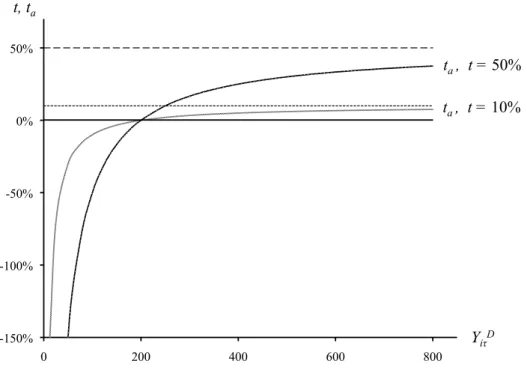
Basic income flat tax on the left and linear negative income tax on the right. Y is gross income and YD disposable income. B is the minimum guaranteed income in both schemes andE is the break-even point of being a net beneficiary to being a net tax payer. Left of E, the average tax rate is negative. At the break-even point E, the average tax rate is zero and right of E the average tax rate is positive. Thus, despite constant marginal tax rates, both schemes are progressive.
Figure 1.1: A Basic Income Flat Tax on the Left and a Linear Negative Income Tax on the Right
(NIT), often traced back to Milton Friedman9, can be designed to yield the same distribution of disposable income as a BIFT.
The NIT works like a refundable tax credit that decreases with the level of before tax income. A certain level of benefits, assumed to be equal to the level of an unconditional basic income, is provided even if an individual’s income is zero. Thus, like a BIFT, a NIT decouples the payment of benefits from the willingness to work.
In practice, however, the NIT may deviate from a BIFT scheme. While a basic income is paid ex ante in regular installments, the NIT is paid ex post, after an applicant has filed her tax return.
The main reason to choose basic income over a NIT, however, is a normative one. I will show that a BIFT scheme is consistent with a theory of justice in libertarian manner based on Lockean principles. A negative income tax scheme simply bal-ances taxes and benefits - under a basic income scheme the tax revenue is actually
raised and the basic income is paid to all independently.10 From a normative point
of view, the independent payment of a basic income can be conceived as an enti-tlement to a share of society’s natural resources. Friedman’s negative income tax, on the other hand, is primarily conceived as a pure poverty alleviation or efficiency improving measure.
UBI or Initial Endowment?
Concentrating on normative aspects and considering the notion of the entitlement to a share of society’s natural resources, wouldn’t a one time payment at, say, reaching maturity be an alternative to a regular installment (which a UBI is as-sumed to be)?
9Friedman (1962), pp192.
Ackerman and Alstott have coined the notion of the “stakeholder society”11. At age 21 each citizen should receive $80000 as an initial endowment, paid in four annual installments of $20000 each. In a first stage the cash grant is funded by a 2 percent wealth tax. Second generation stakeholders are obliged to pay back their stake upon their death, if they can afford.
From a libertarian standpoint an initial endowment may be preferred to a regular installment, since the latter could be conceived as a paternalistic measure and would therefore be at odds with the responsibility ideal central to libertarianism. Van Parijs acknowledges the paternalistic character, or as he puts it the “mildly paternalistic” character of a UBI scheme and justifies it as a means to “protect [people’s] real freedom at older ages against the weakness of their will at younger
ages”.12 Milton Friedman on the other hand argues that “those of us who believe
in freedom must believe also in the freedom of individuals to make their own
mistakes”.13
As the normative analysis of distributive justice will show, the reason to choose regular installments over an initial endowment is not a paternalistic one. In the ‘stakeholder society’ the initial cash grant can be conceived as a compensation for the part of the natural resources, say, a plot of land, an individual would be entitled to. In a ‘shareholder society’, on the other hand, an individual actually holds the share of natural resources she is entitled to and receives a regular dividend or
“ground-rent”14 from the respective property’s occupant. And just like dividends
are paid on a regular basis, so is the basic income.
The Unification of Equity and Efficiency
I will show that a basic income is compatible with classic libertarian thoughts, providing each individual with her legitimate share of natural resources while at
11Ackerman and Alstott (in Ackerman, Alstott and Van Parijs 2003), pp40. 12Van Parijs (1995), p47.
13Friedman (1962), pp188. 14Paine (in Foner, 1945), pp605.
the same time assuring a person’s right to both self-ownership and property and that a UBI can improve efficiency by abolishing the poverty trap and involuntary
unemployment in particular and by providing equality of opportunity in general.
Equality of opportunity can be a measure to abolish the prevailing “misallocation
of talent”15 by reducing the importance of an individual’s socioeconomic
back-ground to education and equal opportunity is a necessary condition for a just society. Hence, the notion of equal opportunity is the common denominator unit-ing equity and efficiency.
2 Equity
Different approaches to the question what is just have been offered. One, called the consequentialist or teleological ethics is based on the assumption that “the good is defined independently from the right, and then the right is defined as that which maximizes the good.” (Frankena as cited in Rawls 1973, p22) The other,
termed deontological ethics16, on the other hand, “either does not specify the good
independently from the right, or does not interpret the right as maximizing the good” (Rawls 1971, p26).
A prominent teleological theory that had great impact on economics is utilitar-ianism, which is “the ethical theory, that the conduct which, under any given circumstances, is objectively right, is that which will produce the greatest amount of happiness [utility] on the whole” (Sidgwick in Phelps 1973, p227) and “the striking feature of the utilitarian view of justice is that it does not matter, except indirectly, how this sum of satisfactions is distributed among individuals” (Rawls 1971, p23). However, if there is no noticeable difference of aggregated utility
be-tween two distributions, Sidgwick proposes to choose the more egalitarian one.17
But “it should be observed that the question here is as to the distribution of
hap-piness, not the means of happiness. If more happiness on the whole is produced by giving the same means of happiness to B rather than to A, it is an obvious and incontrovertible deduction from the utilitarian principle that it ought to be given to B, whatever inequality in the distribution of the means of happiness this may involve” (Sidgwick in Phelps 1973, p232).
16Deontological ethics is defined as being non-teleological and must not be confused with moral
absolutism, the latter completely ignoring an act’s consequences and focusing only on the rightness or wrongness of an act itself.
Considering the definition above, it can be asked whether utilitarianism is an ethical theory at all, since its emphasis is placed on efficiency considerations rather than providing a framework for the notion of equity. Utilitarianism in its pure form wouldn’t condemn sacrificing a few if such a measure raised aggregate utility for the majority. Thus, pure utilitarianism is incompatible with pure libertarianism, since the latter is based on the notion of a person’s inalienable rights to self-ownership and property as long as she does not infringe the inalienable rights of others.
2.1 Theories of Distributive Justice
In contrast to the utilitarian notion of maximizing happiness, most (deontological) theories of justice challenging utilitarian conceptions of justice emphasize the
im-portance of the distribution of initial resources18in a Hobbesian or Lockean ‘state
of nature’. Although the conceptions of the state of nature vary from historical fact to mere thought experiment, what the theories have in common is their focus on the distribution of natural resources in this position. Robert Nozick, for
exam-ple, developed in his major work “Anarchy, State and Utopia”19 the emersion of
the classical libertarian minimum state from the ‘state of nature’ in a laissez-faire way, guided by an invisible hand mechanism. John Rawls, on the other hand, conceived a social contract formed in the ‘original position’ by rational individuals behind a veil of ignorance.
Nozick’s entitlement theory focuses on the procedural aspects of distributive jus-tice. Three principles form Nozick’s theory of justice in holdings: the principle of justice in acquisition, the principle of justice in transfer and the principle of justice in rectification. The first two principles specify the legitimate appropriation and transfer of holdings. “A distribution is just if it arises from another just
distribu-tion by legitimate means.”20Past injustice from illegitimate acquisition or transfer
of holdings such as theft, fraud, slavery, forcibly excluding others from competing
18Speaking with Sidgwick one could say the distribution of the ‘means of happiness’. 19Nozick (1974).
in exchanges, etc., should be rectified according to the principle of justice in
recti-fication. Thus “whether a distribution is just depends upon how it came about.”21
For Nozick this is the major difference between his ‘historical’ theory of entitle-ment and what he calls ‘end state’ theories of justice like utilitarian conceptions and Rawl’s theory of justice. ‘End state’ theories observe a distribution at a spe-cific point in time ignoring the historic accumulation process eventually leading to a given distribution. For a welfare egalitarian, any two structurally identical
distributions are equally just.22 According to Nozick’s entitlement theory, this is
not necessarily true. What matters also is a distribution’s history, hence whether a distribution has arisen by legitimate means.
Locke’s Proviso
Nozick borrows the principle of acquisition of holdings from John Locke: “Though the earth, and all inferior creatures, be common to all men, yet every man has a property in his own person: this no body has any right to but himself. The labour of his body, and the work of his hands, we may say, are properly his. Whatsoever then he removes out of the state that nature hath provided, and left it in, he hath mixed his labour with, and joined to it something that is his own, and thereby makes it his property. It being by him removed from the common state nature hath placed it in, it hath by this labour something annexed to it, that excludes the common right of other men: for this labour being the unquestionable property of the labourer, no man but he can have a right to what that is once joined to, at
least where there is enough, and as good, left in common for others.”23
According to Locke, the principle of justice in acquisition is satisfied if ‘there is enough, and as good, left in common for others’. Nozick gives a weaker inter-pretation of Locke’s proviso by saying that someone is being made worse off “by
no longer being able to use freely what he previously could”24 and constrains it
21Nozick (1974), p153. 22Nozick (1974), p153. 23Locke (1764), sec27. 24Nozick (1974), p176.
to cases where someone appropriates the total supply of something indispensable to life like all drinkable water. “If the proviso excludes someone’s appropriating all the drinkable water in the world, it also excludes his purchasing it all” and since this situation is most unlikely to ever occur in a free market due to the price
mechanism, the proviso will never be applied.25 Here Nozick is very imprecise.
Although the proviso may never come into effect after the initial appropriation, it
is probably violated in the initial process of acquisition.26 Nozick states that the
principles of acquisition and transfer do not justify a more extensive state than
the minimum state, nor will the proviso override this.27 Nozick apparently thinks
that the invisible hand mechanism guiding the acquisition process is a sufficient condition to provide a just distribution of initial holdings. The idea of an invisible hand is introduced in contrast to Locke’s social contract that constitutes the initial acquisition of holdings as an agreement of agents in the state of nature. However, ‘where there is enough, and as good, left in common for others’ is a constraint that does not automatically emerge from a laissez-faire process. What is appropriated is no longer available for others.
If Nozick were to seriously include the proviso in its original formulation, he couldn’t dismiss equality of opportunity as a necessary condition for justice in holdings. Equal opportunity in the state of nature is a necessary condition to meet the requirements of the proviso. “Life is not a race in which we all compete
for a prize which someone established”28is one of Nozick’s objections to the notion
of equality of opportunity. The initial acquisition of holdings, however, is similar to the organized races for a plot of land in 19th century America that provided equal conditions for all contestants. But is providing equal opportunity a suffi-cient condition to satisfy the proviso? Even back then there were probably more settlers than available land and since there were better and worse plots of land, envy among neighbors may have existed. Therefore, equal opportunity is only a necessary and not a satisfying condition to meet the requirements of the proviso. ‘Enough, and as good, left in common for others’ justifies to go one step further
25Nozick (1974), p179.
26This applies not only to Nozick’s weaker interpretation but also to Locke’s original formulation. 27Nozick (1974), p231.
by introducing an additional condition that can provide a fair distribution along the lines of the proviso.
Equality of Resources
But what qualifies a distribution to be considered fair? Varian defines a fair
dis-tribution as a condition that is both equitable and Pareto efficient29. An equitable
distribution is an allocation that provides every agent with the same initial bundle of resources. If in a second step the bundles were traded to a market equilibrium by means of a price mechanism, the resulting allocation would by definition be efficient. A Pareto efficient allocation emerges when all possible trades have been made. Pareto inefficiency emerges when exchanges are made outside the mar-ket’s price system. The first welfare theorem states that a competitive market equilibrium allocation or Walrasian equilibrium is Pareto efficient.
Similarly, in “Equality of Resources”, Ronald Dworkin presents a thought exper-iment of shipwreck survivors landing on a desert island and agreeing on dividing
the island’s natural resources equally among them.30 Each individual is endowed
with an equal amount of clamshells serving as a currency for acquisitions in an auction of the island’s resources. The auction continues until market equilibrium is reached and the survivors are free to continue trading until no agent wishes to hold any other agent’s final bundle of resources. Dworkin calls this the envy test; nobody would envy another’s set of resources because she could have purchased another one’s bundle instead of her own. If the available resources do not meet an individual’s tastes in the first place, she will be unlucky with the auction, but
she can’t complain the distribution were unequal.31 This is a major difference
between theories of equality of resources and utilitarian theories of equality of welfare. Equality of welfare requires that all agents are equally happy with their holdings. In such a regime, an agent being unlucky because of her preferences
29A situation is Pareto efficient if it is impossible to make someone better off without making
someone else worse off.
30Dworkin (1981), p285. 31Dworkin (1981), p287.
is entitled to a welfare equalizing compensation of some sort. If somebody had ‘expensive tastes’ like a preference for caviar and the best champagne, but only eggs and water were available, she would be entitled to a compensation that raises her level of well-being to the other agents’ level.
Production and Labor
So far we have ignored the impact of production and labor on the allocation of resources. Imagine that at the end of a certain period an agent, let’s call her Busy, succeeds in accumulating a bundle of resources another agent, let’s call her Idle, envies. Busy used her initial resources for production while Idle spent her time
lying in the sun. Assuming both Busy and Idle are equally talented32, is Idle’s
envying Busy’s bundle justified? Since Idle could have chosen the same way of life Busy did, thus using her initial resources for production instead of leisure, the answer is no. If labor is present and consumption-labor bundles are being compared, the envy test succeeds and the distribution is equal.
But what if individuals had equal tastes but different talents? In the former
example Busy had a strong preference towards production while Idle preferred spending her time unproductively. Imagine two agents, Able and Disable. Able is a natural born farmer, everything he grows prospers. Disable on the other hand has a black thumb and everything he grows is of lesser quality. Both Able and Disable share the same preference for farming, but while Able has the natural ability it takes to be a successful farmer, Disable lacks the required ability. If talents are not part of the initial bundle of natural resources Disable has no more right to complain about the distribution than Idle had, because it is not merely the bundles of products that are being compared, but the combined consumption-labor bundles. Disable has to consider how much effort it would have cost her to compensate for her lack of talent and if she would have been willing to make the extra effort. There is no qualitative difference to the Busy/Idle example with equal talents and different tastes. The same is true if Disable were unable to compensate
for her poorer ability.
This might seem unfair when we think of handicapped agents. Varian addresses the issue of handicapped individuals subordinately. He considers it a secondary
issue that could be handled in a variety of other ways such as insurance.33 Let’s
assume a certain handicap is caused by someone’s way of life, hence her tastes. This could indeed be dealt with by an insurance system of some sort. If all agents had perfect information about their risks, the decision to insure or not would be a matter of tastes and preferences. A risk averse heavy smoker would probably buy an insurance for the best medical treatment in case she developed lung cancer. But what are the implications of initial handicaps or handicaps following uncalculable risk like developing lung cancer without ever having smoked?
Probably Dworkin’s solution is the most elaborate one.34 Like many resourcist
egalitarians he conceives talents as natural resources on par with a plot of land. Consequently, Dworkin defines initial handicaps a lack of talent, hence a lack of natural resources. Including ones internal endowments in the bundle of natural resources alters the outcome of the auction substantially. it is no longer only fertile land or fishing grounds that are being auctioned, but also individual talents. Auctioning off internal endowments is like trading an agent’s labor force, hence trading the command over her time. An agent with rich internal endowment has to outbid anyone else who is interested in using her labor force if she wishes to retain command over her time. Agents with poor internal endowments can buy their own time cheaply and can appropriate more external endowments instead. Probably, the richer endowed have to use all their clamshells to buy their own labor and have nothing left to gain access to the external endowments. In the worst case the talented may have to buy their own labor on credit and are required to run a debt they pay back with their expected earnings. Since the resourcist theories of justice are immune to agents’ different tastes, the richer endowed, irrespective of their preferences towards leisure or labor, are forced to work full-time in order to pay back their debt, if they want to or not. A preference towards leisure can
33Varian (1975), p244 34See Dworkin (1981).
simply be regarded an ‘expensive taste’. This procedure puts the highly talented in an unfortunate position and is denoted the ‘enslavement of the talented’.
Dworkin objects to the very implications of the auction’s outcome when talents are part of the bundle of natural resources, since the envy test would forbid both being penalized for having a talent and being allowed to retain the benefits of superior
talent.35 But his argument is contrary to his own original definition of the envy
test. Earlier, he defends the envy test by arguing that if the available resources do not meet an individual’s taste in the first place, she will be unlucky with the
auction, but she can’t complain the distribution were unequal.36 However, there
is a major inconsistency in his arguments when we conceive internal endowments as ‘available resources that do not meet an individual’s tastes in the first place’. If Grace were a talented actress but hated performing in front of an audience and would rather plant tomatoes, her acting abilities could be considered ‘available resources that do not meet her tastes in the first place’. But if her talent were known she had no choice but to become an actress, since the other agents would probably like to see her on stage and Grace would have to use her clamshells to buy her own labor force and had nothing left for bidding on a plot of land so she could grow tomatoes.
Considering the undesirable consequences for Grace’s well-being, is there a different way to correct for handicaps without auctioning off talents? On the basis of Locke’s proviso, I concluded that equality of opportunity is a necessary condition to meet the proviso’s requirements. Reconsider the analogy of the race for a plot of land in 19th century America. In this context, equality of opportunity requires that all contestants have equal starting positions and are aware of the rules and regulations. Now imagine the regulations, including the date of the race and the location of the starting point, are announced exclusively by word of mouth. Some deaf person is not able to inform about the rules and regulations of the contest and will probably miss the race. A different deaf person who is lucky to have a friend to tell her about the regulations has the opportunity to participate. Equality of opportunity
35Dworkin (1981), p312. 36Dworkin (1981), p287.
means that agents with equal talents have equal opportunity irrespective of their social background. Applied to the former example, equal opportunity requires that the announcement is made in written form additionally, even if this means that some of the initial resources have to be used to meet the requirements. This must not be confused with the implications of the extended auction. Since the auction guarantees equality of resources including talents and handicaps and not only equality of opportunity, handicapped agents would be better off in the former than in the latter case.
Applied to Dworkin’s extended auction or Varian’s equal division and trade theory of fairness, equality of opportunity necessitates that procedures are open to all agents, whether they are they handicapped or not. The resources required to meet this necessary condition are to be provided from the pool of natural resources before the procedure starts. Thus, in the context of equality of resources, equality of opportunity can be considered a right to participate in the division and trade process.
The Difference Principle
John Rawls extends the condition of equality of opportunity to the notion of ‘fair equality of opportunity’ by, like Dworkin, including a person’s internal endowments to the bundle of natural resources, but his famous ‘difference principle’ does not
require equality of resources.37 Rawls’ final formulation of his two principles of
justice is the following: First, “each person is to have an equal right to the most extensive total system of equal basic liberties compatible with a similar system of liberty for all” and second, “social and economic inequalities are to be arranged so that they are both: (a) to the greatest benefit of the least advantaged [. . . ], and (b) attached to offices and positions open to all under conditions of fair equality of
opportunity.”38 The first part (a) of the second principle of justice is the difference
principle. According to Rawls, it is not the natural distribution of talent that
37Rawls (in Phelps, 1973), p339. 38Rawls (1971), p266.
is either just or unjust, but the importance society attaches to ones abilities.39 Wilt, a gifted basketball player, wouldn’t be able to charge his fans for seeing him play if there were no society. it is the existence of society that enables Wilt to benefit from his talent. Thus, society has the right to decide on the distribution of Wilt’s profits. According to the difference principle, gifted agents are entitled to gain wealth only, if their gains help to improve the position of a society’s least advantaged members of society.
The major difference between the difference principle and the extended auction is the former’s abandonment of the notion of equality of resources. Although the difference principle shows a tendency towards equality, Rawls approves that some degree of inequality may improve society’s overall efficiency and therefore the po-sition of the least advantaged. These implications of the difference principle reveal the theory’s ‘end-state’ character. it is the usefulness to society that determines the distribution of holdings. In Rawls’ world agents with high earning power are useful as long as their gain helps improve the situation of the least advantaged members of society. The difference principle gives no guidance on how initial re-sources are to be distributed, nor does it describe how observed distributions came about. It just assumes that agents with rich initial endowment hold a greater share of society’s assets and therefore are obliged to support the least advantaged.
The Veil of Ignorance
The tool Rawls uses to derive his two principles, however, is an attempt to apply pure procedural justice: ‘the veil of ignorance’. The veil is a condition in the ‘original position’, a situation similar to the ‘state of nature’ that conceals the agents’ randomly inbred or inherited features such as their tastes, talents and social status. But they do know about the circumstances of justice, about general facts of human society, they understand political affairs and know the principles of economic theory and human psychology. It is assumed that agents in the original position are rational and know that they would prefer to have more primary goods
rather then less.40
Since the veil excludes knowledge of probabilities, agents do not have the data to calculate their expected utility. Thus, the agreement reached in the original
position is the maximin rule.41 Because everyone could be a potential member
of the least advantaged group in society, the difference principle is the result of a rational decision subject to the veil of ignorance to insure against a worst case scenario.
The Principle of Rectification
Let’s recall the conditions under which, following Nozick, rectification of past injus-tices is appropriate: theft, fraud, slavery, forcibly excluding others from competing in exchanges and the use of other illegitimate means in the process of acquisition and transfer of holdings. Two problems cross one’s mind immediately: first, it can be reasonably assumed that every single holding could in theory be traced back to some violation of the acquisition and transfer principles at some time in history, considering our mixed history strongly influenced by wars, slavery, serfdom, aris-tocracy, dictatorships, and the like, and bearing in mind that minor violations of acquisition and transfer are still present in modern societies and probably are to persist. Second, in practice it is impossible to backtrack how a specific distribution came about. Therefore Nozick proposes to use a rule of thumb. “[. . . ] assuming (1) that victims of injustice generally do worse than they otherwise would and (2) that those from the least well-off group in the society have the highest prob-abilities of being the (descendants of) victims of the most serious injustice who are owed compensation by those who benefit from the injustices (assumed to be those better off, though sometimes the perpetrators will be others in the worst-off group), then a rough rule of thumb for rectifying injustices might seem to be the following: organize society so as to maximize the position of whatever group ends
up least well-off in the society.”42
40Rawls (1971), pp119. 41See Rawls (1971), p133. 42Nozick (1974), p231
Quite astonishing, despite completely different approaches, Rawls’ difference prin-ciple and Nozick’s rectification prinprin-ciple yield similar results. Where Rawls as-sumes that better endowed agents hold a greater share of society’s assets and may only retain their profits if doing so improves the position of the worst off, Nozick virtually says that the better off are obliged to help improve the position of the worst off, since the former are assumed to be the beneficiaries of past injustices.
2.2 Locke’s Proviso Extended
The theories presented so far either concentrate on an initial generation’s appro-priation procedure or provide no coherent rules for the distribution of holdings. Following Locke, however, since “the earth, and all inferior creatures, be common to all men,” the past, current and future generations are equally entitled to the world’s natural resources. On first sight this might seem an impossible condition to satisfy. Once everything is appropriated there is nothing left for future gener-ations, not enough and definitely not as good. But there is a possible solution to this dilemma.
Think of the initial generation of agents as entrepreneurs and the initial stock of resources as the economy’s available capital stock. In the state of nature the stock is commonly owned by current and future generations. Assuming an infinite number of future agents, the initial generation is no longer entitled to the whole available stock of resources, but only to an infinitesimally share of it. Since it wouldn’t make any practical sense to restrict the initial appropriation process to a finite number of infinitesimally small properties, the initial acquisition and transfer process is conducted in the same way it would have been conducted in the special case limited to one generation of agents. The difference, though, is the fact that agents have become shareholders rather than unconfined owners of the stock.
It is reasonable to determine an agent’s share of the natural resources by dividing the initial stock by the number of agents at a specific point in time. Assuming
resources. Assuming further zero population growth, no technological progress and that the first generation ceases to exist as soon as the second generation turns up,
the agents’ starting positions differ according to their inherited wealth.43 Thus,
the distribution of wealth depends largely on the first generation’s production and trading process.
Satisfying the proviso for the second generation implies the reestablishing of an equal division of initial resources. it is extremely important to differentiate between initial resources and, as Locke puts it, wealth generated by mixing one’s labor with it. Redistributing the complete stock of holdings, including initial resources and the product of one’s labor, would violate agents’ property rights or as Thomas Paine argues, “while [. . . ] I advocate the right, and interest myself in the hard case of all those who have been thrown out of their natural inheritance by the introduction of the system of landed property, I equally defend the right of the
possessor to the part which is his”.44 Thus, agents who have inherited more than
the Nth share of initial resources have to return the excess to agents who have
inherited less or, if the respective resource has been improved by mixing labor with it, the latter become shareholders of the improved resource and are entitled to a share of the holding’s future profits, the size of the share being equal to the fraction of initial and improved value, hence being equal to the improved value
minus labor input.45
Assume an agent has built a farm on a plot of uncultivated land. She used more
than the Nth share of initial resources for her enterprise. Her beneficiary has to
either rectify the excess resources, or she has to share the excess land’s harvest with a disadvantaged agent. The latter has the right to claim a share being equal to
43Generalizing the procedure for positive population growth and/or technological progress is
straightforward. Since initial natural resources are constant, a growing population reduces per capita entitlements to initial resources. The opposite is true for technological growth. Technological progress implies productivity growth, hence makes a holding more profitable. And since agents are shareholders, technologically induced profit gains increase the value of their share in absolute terms.
44Paine (in Foner, 1945), pp605.
45This is similar to Paine’s notion of a ground-rent that every proprietor of cultivated land owes
initial boondock’s revenues divided by productive farmland’s revenues. Assuming further that the fruits of a plot of uncultivated land generate a profit of $100 and farmland’s fruits gain a $1000, the disadvantaged agent is entitled to one tenth of the excess property’s future profits. Thus, in the former example initial resources’
products are worth 10 percent of a holding’s current revenue.46
Except for the share of resources she is entitled to, only an agent’s labor share of total income is properly hers. Capital’s share is distributed to each agent who is entitled to the respective resource. In modern economies, Paine’s 90 percent probably are no longer a good approximation for labor’s share on total income, if
they ever were.47
Shareholder Value Added
The obvious policy for maintaining equality of resources is taxing away capital’s share and distributing the tax revenue equally among all agents. Conceive the
initial appropriation as a mutual entitlement to each others initial endowments.
Agents may use the Nth share of the common pool of initial resources and each
agent mutually holds a share of 1/N of each agent’s Nth share of the total stock.
If 10 percent of the total profit are due to initial resources and 90 percent are due
to an agent’s labor, each agent is entitled to 0.1/N of each other agent’s profits
and keeps 1−(N−1)∗0.1/N of her own profits. Generalizing yields
YiD =
1− N −1
N α
Yi+
1
Nα N
X
i=1
Yi−
1
NαYi, 0< α <1, (2.1)
where α is capital’s share of value added, N is the population, YiD is individual
disposable income and Yi is individual income. The first term reflects an agent’s
46“Cultivation is at least one of the greatest natural improvements ever made by human
inven-tion. It has given to created earth a tenfold value.” (Paine in Foner, 1945, pp605).
47Gomme and Rupert (2004) report a rather constant US labor share with an average rate of
71.7 percent from 1970 to 2002, Blanchard and Giavazzi (2001) analyze four OECD countries and assert a constant decline of labor’s share from the early 1980s to a low of 60 to 65 percent in the 1990s and Guscina (2006) reports roughly 52 percent for highly developed OECD countries in the second half of the 1990s.
disposable income in consideration of herNth part of theNth share of resources she may use for production without restrictions. The second and third term describe
the rent she receives from her Nth part of the other agents’ shares of resources.
Consider the example of Busy, Idle, Able and Disable who are mutually entitled to an equal share of each other’s profits. Each agent holds one forth of the other three agents’ resources additional to her own forth and is entitled to a share of the other
agents’ profits of 1/4∗0.1, hence one fortieth. Let’s assume that Busy’s profit is
$200, Idle’s profit is zero, Able earned $500 and Disable $100. According to the scheme Busy is entitled to one fortieth of Idle’s profits, hence zero, one fortieth of Able’s, hence $12.5 and one fortieth of Disable’s profits, hence $2.5. Busy can
keep 1−3/40 of her profits, hence $185. In sum, Busy ends up with $200. A tax
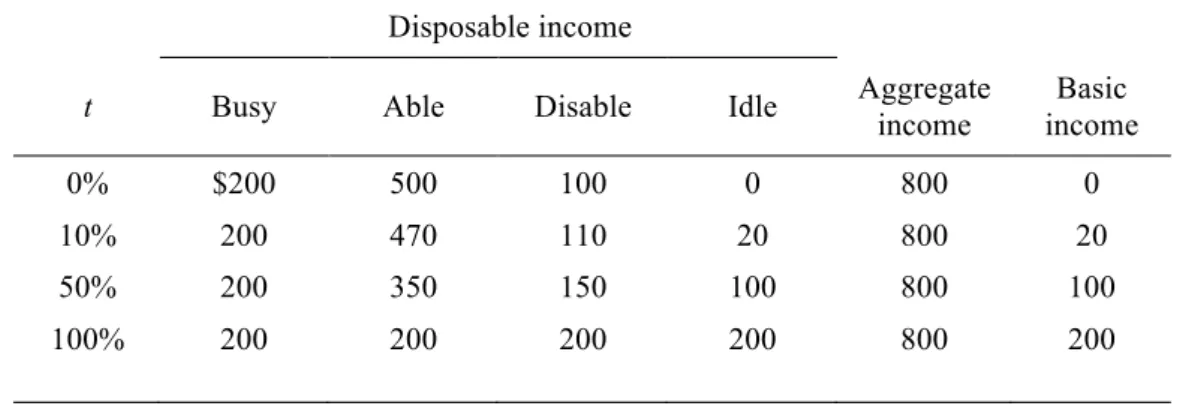
rate of 10 percent would have left her $180 at first and an equal distribution of the tax’ revenue of $80 (10 percent tax on $800 total profit) leaves her with $200. The procedure is straightforward for the other agents. Idle is entitled to $20, Able ends up with $470 and Disable holds $110. By simplifying expression (1.1), the labor and capital components of an agent’s income can be emphasized:
YiD = (1−α)Yi+
1
Nα N
X
i=1
Yi. (2.2)
The first term is an agent’s labor income and the second term is an agent’s capital income. The second term can alternatively be expressed as capital’s share of total per capita income:
YiD = (1−α)Yi+α Y
N. (2.3)
Substituting capital’s share with the tax rate, t, and labor’s share with (1−t)
respectively, yields an agent’s after tax income:
YiD = (1−t)Yi+t Y
N, 0≤t≤1. (2.4)
it is interesting to note that expression (2.4) is consistent with Rawls’ difference principle. An increase in total income automatically benefits the least advantaged
members of society.
A further implication of the tax/benefit scheme is the fact that an agent’s dis-posable income equals her income before taxes, if the latter matches exactly the economy’s per capita income. If all agents had equal external and internal
endow-ments, including their preferences, each agent’s income would be exactly Y /N. A
scheme of equality of resources includingall internal endowments would generate
exactly this outcome, or as Roemer states: “There is [. . . ] no sustainable dis-tinction between equality of resources and equality of welfare, when resources are
taken to include internal attributes of people.”48 Since equalizing incomes is not
what most people think is a just distributive policy, this is one more reason to exclude an agent’s internal endowments from the initial bundle of resources.
Table 2.1: The Distribution of Income in a Four Agent Economy
Disposable income
t Busy Able Disable Idle Aggregate income income Basic
0% $200 500 100 0 800 0
10% 200 470 110 20 800 20
50% 200 350 150 100 800 100
100% 200 200 200 200 800 200
!
The following chapter provides an overview of the economic implications and the practical execution of the scheme. The focus of the analysis is going to be on efficiency and sustainability of a basic income flat tax scheme according to the findings of the current chapter.
3 Efficiency
The second welfare theorem states that every Pareto efficient allocation can be achieved by a decentralized, competitive market mechanism leading to a market clearing, Walrasian equilibrium. It implies that distributional and efficiency con-cerns can be separated: “If an allocation is a point of maximum welfare of some particular welfare function, it can be achieved by a suitable reallocation of endow-ments followed by trading to a market equilibrium.” (Varian, 1975, p232)
it is not necessary to actually distribute physical endowments in order to estab-lish a certain distribution, it is enough to redistribute the endowments’ respective purchasing power by means of a tax/benefit system: “Equity is obtained thanks to income transfers that allow to disconnect the final distribution of welfare from the distribution of wealth that would result from the ex ante distribution of en-dowments and rights and the ex post price structure.” (Guesnerie, 1995, p356)
Unfortunately the introduction of tax financed transfers affects economic behavior. The decision to work or not to work, for example, is closely intertwined with the tax rate on labor and the level of benefits.
Taxing an agent’s internal endowment directly, however, would avoid the distor-tionary effect of taxation. If it were possible to measure all agents’ IQs, we could levy a tax on individuals with high IQs and redistribute the revenue to
individu-als with low IQs - no deadweight loss would result from this kind of taxation.49
However, aside from the practical difficulties of measuring personal endowments, such a tax scheme would be incompatible with the theory of justice outlined in
the previous chapter, since an individual’s personal endowment is properly hers and the redistribution of internal resources would violate an individual’s right to self-ownership.
Therefore, lump-sum taxation of internal endowments is neither fair nor feasible. Adding a constraint like the practical impossibility of lump sum transfers auto-matically leads to second- best solutions. The ‘Ramsey principle of equalizing tax across groups, commodities and time’, for example, states that goods with the
most inelastic demands and supplies should be taxed most heavily.50 The
ma-jor flaw of many second-best analysis, however, is their unconfined support and
implementation of what Stiglitz calls the ‘neoclassical paradigm’.51 Scrutinizing
the plausibility of the assumptions made by neoclassical economics may yield com-pletely different solutions, since Arrow-Debreu type models are heroic abstractions from real world economies.
It is due to informational constraints in a less narrowly defined economic framework that lump-sum transfers are inapplicable for the redistribution endowments in an
equitable manner.52 Furthermore, informational constraints also cause laissez faire
to be inefficient.53 Thus, the very implication of informational constraints is not
only the impossibility of first-best solutions, but also the absence of Pareto efficient allocations in a laissez faire economy.
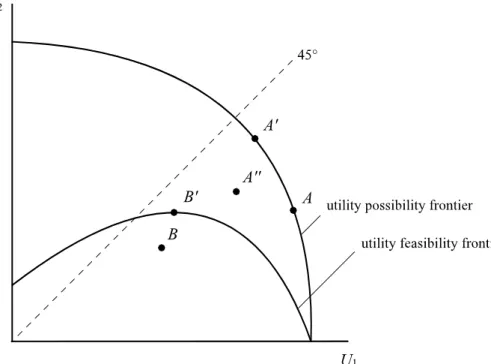
Figure 3.1 shows the utility possibility frontier for a two person economy. Ac-cording to the neoclassical paradigm, a laissez faire economy would settle at a
point like A directly on the utility possibility frontier. Lump sum transfers could
theoretically be used to achieve a more equitable allocation represented by point
A0. If lump sum transfers were not feasible, a second-best solution would lead to
a more equitable but less efficient distribution such as A00. The utility feasibility
frontier represents the economy’s utility possibility frontier given the government’s informational constraints. All points lying directly on the utility feasibility
fron-50See Ramsey (1927). 51See Stiglitz (1994). 52Stiglitz (1994), p45.
Figure 3.1: The Utility Possibility Frontier
tier are constrained Pareto efficient. Given imperfect information and incomplete
risk markets, laissez faire would not even lead to a constrained Pareto efficient allocation, but rather to an allocation inside the utility feasibility set such as point
B. Thus, government interventions could improve both equity and efficiency.
The fact that the second welfare theorem does not hold in the presence of
in-formational constraints means that efficiency and equity considerations can’t be
addressed separately. Second-best policies always make distributional judgements and applying first-best reasoning in a second-best world can yield rather awkward
results.54
3.1 Social Choice
“The principle of efficiency does not by itself select one particular distribution of commodities as the efficient one. To select among the efficient distributions some other principle, a principle of justice, say, is necessary.” (Rawls, 1971, p59)
Considering the consequences of the indefensibleness of the second welfare theo-rem in real world economies, economics has to rethink its one-sided approach to efficiency concerns, while ignoring equity considerations in its analysis. However, in order to embrace equity issues, we have to know where on the utility possibility frontier we want to be.
The normative analysis in the previous chapter concluded that a basic income flat tax scheme is a just redistributive policy, consistent with libertarian thoughts. Whether a BIFT policy is implemented or not, however, depends on individual preferences. Since the basic income is subject to a balanced budget constraint, agents simply choose between different tax rates according to the resulting utility. A common political procedure of choosing between alternatives is majority voting.
In case the voting decision is subject to a one-dimensional choice like choosing between different tax rates, individual preferences can be ranked in linear order.
If individual preferences are single-peaked55with respect to the same linear order,
the median voter model can be applied to determine a majority voting outcome. If we assume that agents with earnings below the mean income are in favor of a basic income and vote for a positive tax rate, while agents with earnings above the mean are against positive tax rates, the position of the median agent determines the tax rate chosen. Is the median income less than the mean income, the median agent prefers a positive tax rate.
Unfortunately, the median voter model is unreliable in case of multidimensional voting decisions. Atkinson gives an example of Condorcet’s paradox, which illus-trates how majority voting fails, if agents were to choose between three alternative
tax/benefit structures56. Agents choose between alternative A, a flat tax with
medium social security, B, a graduated tax with high social security, and C, a
graduated tax with low social security. There are three groups of agents, namely the poor, the rich and the middle income earners. The poor only care about the
level of social security and chooseB overA andA overC. Middle income earners
do not benefit from the social security system and prefer low tax rates. Therefore,
they prefer C over B and B over A, since middle income earners are assumed
to face tax rates below the flat tax rate in graduated tax structures. The rich,
eventually, prefer the flat tax system, A, over C and C over B. The tax rates
for the rich are assumed to be higher in graduated tax structures than in the flat tax case, which is true for both low and high social security. In pairwise votes,
B A, C B, but A C. Thus, forming a social preference relation is not
possible, since the voting’s outcome is intransitive.
With such difficulties in mind, social choice theory is concerned with functions that are able to translate a set of individual preferences into a social preference
rela-tion. According to Arrow, the minimal properties of such a social welfare function
are (1) unrestricted domain, which, together with the transitivity requirement, rules out majority voting, (2) the weak Pareto principle, which states that society
should choose state A over stateB if each agent prefers state A over state B, (3)
independence of irrelevant alternatives, stating that social preferences over any
two states A and B depend only on individual preferences over A and B, and
finally (4) nondictatorship, meaning that there is no agent who can enforce her individual preference as the social preference on every social choice to be made. The impossibility theorem states that it is impossible to satisfy all four conditions at the same time, if there are at least three alternative social states to vote for. Assuming that the first three assumptions hold, what follows is a dictatorship of
one agent, enforcing her individual preference to be the social welfare function.57
Fortunately, there is a way out of the dilemma. Arrow’s assumptions imply inter-personally noncomparable utility measured on an ordinal scale. If we relax either
56Atkinson (1995), p83.
the noncomparability or ordinality assumption or both, a sensible and nondictorial social welfare function can be constructed.
First, let’s consider the case of relaxing the noncomparability assumption, as sug-gested by Blackorby, while retaining ordinal scale utility. In contrast to the notion of cardinal utility, which states that utility is measurable in absolute levels, or-dinal utility makes judgements about welfare by comparing an agent’s possible social states and ranking the latter according to the agent’s preferences. The ordi-nal scale assumption on utility enables us to make statements like ‘Able is better
off in state A than Able would be in state B0. Relaxing the assumption of
non-comparable utility enables us to make statements like ‘Able is better off in state
A than Disable would be in state B0.
An example of a social welfare function requiring interpersonal comparison of util-ity on an ordinal scale is Rawls’ maximin criterion. The Rawlsian social welfare function represents Rawls’ difference principle. In the context of efficiency, the difference principle can be interpreted as stating that an improvement in economic efficiency has to make the least advantaged members of society better off. Iden-tifying the least advantaged members of society requires the assumption of fully comparable ordinal utility across individuals.
Blackorby gives an example of how such comparisons can be made.58 Most
west-ern economies have introduced poverty lines, measuring not only the magnitude of poverty, but also providing a benchmark for the welfare state’s decisions on the level of social benefits. These poverty lines are the result of interpersonal com-parison of utility, representing an ethical criterion for distributional judgements. Rawls suggests that the least advantaged be the ones with relative income less than
society’s median income, which is a common definition for poverty lines likewise.59
58Blackorby (1990), pp766. 59Rawls (1971), p84.
A major difference between the Rawlsian welfare function and, say, the traditional utilitarian welfare function, is the former’s retaining of ordinal utility. The purely utilitarian welfare function assumes cardinal scale utility, since it ranks social states according to the sum of utilities. Combined with the notion of ‘incrementally
comparable utility’60across individuals, statements like ‘Disable gains more utility
from a move from point B to point A than Able would’ can be made. Cardinal
utility though, is a rather dubious concept. Measuring utility like mass on a scale and equivalently making statements like ‘I lost 20 utility units’ in a week is hardly possible.
Nevertheless, following Arrow’s impossibility theorem and ‘the von Neumann
Mor-genstern theory of choices involving risk’61, the notion of cardinal utility celebrated
a revival in the 1950s. Neo-utilitarianists like Harsanyi and Vickrey applied the von Neumann-Morgenstern utility function to welfare economics, combining the
concept of risk aversion with the traditional utilitarian welfare function.62 The idea
behind a neo-utilitarian welfare function is that agents “maximize ‘moral expec-tation’, defined as a weighted average of the utilities associated with the different possible outcomes resulting from a given choice, the weights being proportional to the probabilities of these outcomes” (Vickrey in Phelps, 1973, p287). Thus a neo-utilitarian welfare function must be a constant elasticity of substitution (CES) function, such as
W =
N
X
i=1
Ui1−ρ
!1−1ρ
, (3.1)
where ρ is the parameter of a society’s inequality aversion. If ρ = 0, society is
indifferent to the distribution of welfare and the function equals the traditional
utilitarian welfare function. As ρ → ∞, society’s aversion to inequality increases
and the function becomes similar to Rawls’ maximin utility function.
60This means that utility gains (or losses) are comparable (Jehle and Reny 2001, p251). 61See Jehle and Reny (2001), pp97 for a detailed introduction to von Neumann-Morgenstern
expected utility functions.
Figure 3.2: Social Welfare Functions
Figure 3.2 shows the social optima of different social welfare functions. The purely
utilitarian welfare function, WU, implying risk-neutrality and complete social
in-difference to the distribution of welfare (ρ= 0) choosesU, hence accepting a high
level of inequality. The risk-averse neo-utilitarian optimum,N (0< ρ <∞), is left
of U. Agents in the original position, behind the veil of ignorance, would choose
R (ρ= ∞). Since they have no information on probabilities they can’t calculate
their expected utilities and agree to a more equal distribution.
Remember that the neo-utilitarian welfare function can yield exactly the same
re-sult, namely pointR, once we assumed individuals actually were in a state like the
original position. Behind a veil of ignorance risk-aversion and uncertainty would lead them to a distribution according to the difference principle. However, the reasoning for the difference principle is completely different. Even if information on probabilities were available in the original position, it wouldn’t be wanted. As stated in the previous chapter, the veil of ignorance is a tool to derive moral
con-straints society can agree on. The completely risk-phobic neo-utilitarian outcome resulting from actual informational constraints follows the utilitarian dictum of maximizing the good irrespective of moral side constraints.
The important property of a distribution based on the difference principle, on the other side, is the implementation of the notion of (fair) equality of opportunity. The resourcist egalitarian approach of both Rawls’ theory of justice and the share-holder scheme proposed in the previous chapter is different to outcome oriented
social welfare functions, be it purely utilitarian, neo-utilitarian or neo-egalitarian63
ones, even if the optimum of a neo-utilitarian social welfare function coincided with
state R, because the former’s main concern is not the distribution of welfare, but
equality of opportunity as an end in itself.
Remember from Chapter 2 though that the difference principle is not strictly re-sourcist egalitarian, since Rawls’ broad interpretation of natural resources includes a person’s internal endowment. Because of possible negative effects on efficiency, complete equality of both internal and external endowments could eventually be to the disadvantage of the least advantaged group. The shareholder approach, on the other hand, is indeed resourcist egalitarian, but contrary to Rawls excludes a person’s internal endowment from the bundle of natural resources.
Within an outcome oriented utility based framework there is no qualitative differ-ence between the differdiffer-ence principle, the shareholder approach or even Nozick’s rectification principle. In terms of utility, the maximin criterion can be applied likewise for each scheme. The advantage of the shareholder approach, however, is its endogenous derivation of a regular installment, while both the difference and
rectification principles depend on an exogenous definition of the least advantaged
members of society.
We can generalize the difference between libertarian and utilitarian (welfarist) approaches to distributional concerns by using Sidgwicks terminology: Utilitarians care about the distribution of happiness (utility), while libertarians emphasize the
importance of the distribution of the means of happiness (resources).64
3.2 (Dis)Incentives: The Equity Efficiency Tradeoff
Each of the discussed distributions can be achieved by a specific tax/benefitpol-icy. A utilitarian distribution U, for instance, requires lower and/or regressive
taxes and yields less benefits for the least advantaged than a neo-egalitarian
dis-tribution E, which can be achieved only by a highly graduated tax structure. As
stated at the beginning of this chapter, levying taxes and granting benefits alters agents’ behavior, hence distorts the labor market, at least within an Arrow-Debreu competitive economic framework. For simplicity reasons, the following analysis of basic aspects of labor supply in the context of a BIFT model remains within the limitations of an Arrow-Debreu economy.
Assumptions
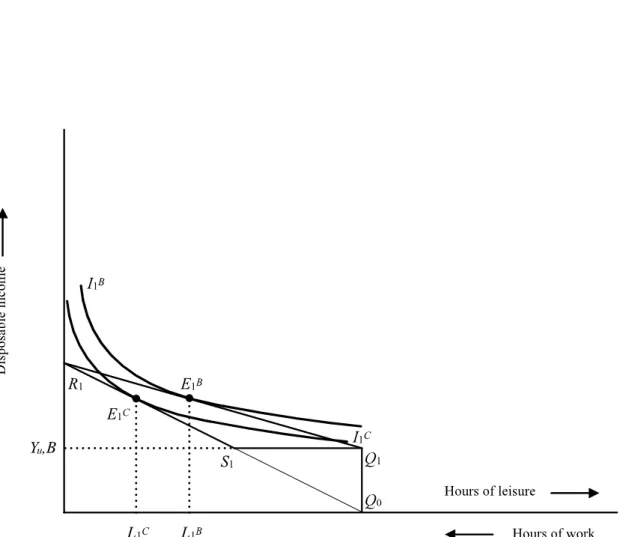
The standard textbook model of labor supply assumes that agents maximize their utility by choosing between a composite consumption good and leisure. Consump-tion is represented by disposable income. The model assumes that an agent max-imizes her utility according to her preferences between leisure and consumption
subject to her individual budget constraint QτRτ65.
Labor is assumed to be divisible. Thus, an agent may choose supplied hours of work without restrictions. If the agent’s highest attainable indifference curve is
tangential to her budget constraint at pointEτ, she supplies Lτ hours of labor.
Since we are interested in the labor supply response to changes in the tax/benefit
structure, an individual agent’s gross wage rate,wi, is assumed to be fixed
through-out the following analysis (wi = ¯wi).
64See Sidgwick (in Phelps, 1973), p232. 65Lowercaseτ is a time index.
Figure 3.4: A Pure Income Effect
A Graphic Analysis of Labor Supply Effects
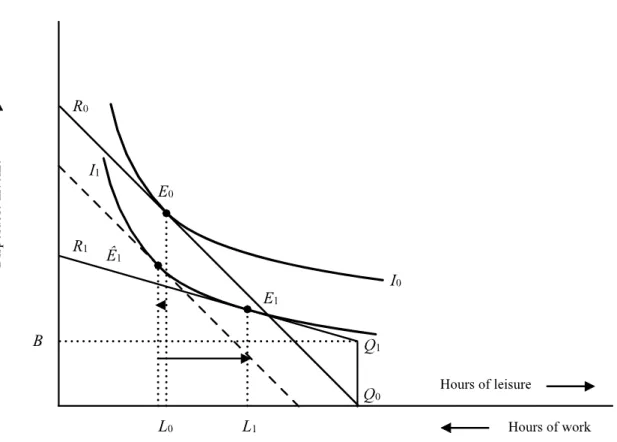
Introducing income from other sources than labor like an unconditional basic in-come shifts the individual budget constraint up by the amount of the respective
non-labor income (distanceQ0Q1 in figure 3.4). Assuming that both consumption
and leisure are normal goods, the agent will consume more of both, resulting in an increase of leisure and consequently a reduction of individual labor supply from
L0 toL1 as the agent moves from point E0 to point E1.
What we observe is a pure income effect that is not distortionary. The shift of the budget constraint does not affect the return to working more or less, because the marginal rate of substitution and the marginal rate of transformation both are
represented by the net wage rate, which is left unchanged.66 A lump-sum tax like
Figure 3.5: Income and Substitution Effects with Proportional Tax on Earned In-come
a poll tax levying an equal amount per agent works analogous, but in the opposite direction.
A proportional tax on income reduces the net wage rate, which accords to a
down-ward twist of the budget constraint from Q0R0 to Q0R1 (see figure 3.5). An
individual’s disposable income is
YiD = (1−t) ¯wiLi, (3.2)
where t (0 ≤ t ≤ 1) is a proportional tax on income and Li is hours of labor
supplied, given the level of t.
L1 can be either greater or less thanL0. The direction of the overall effect depends
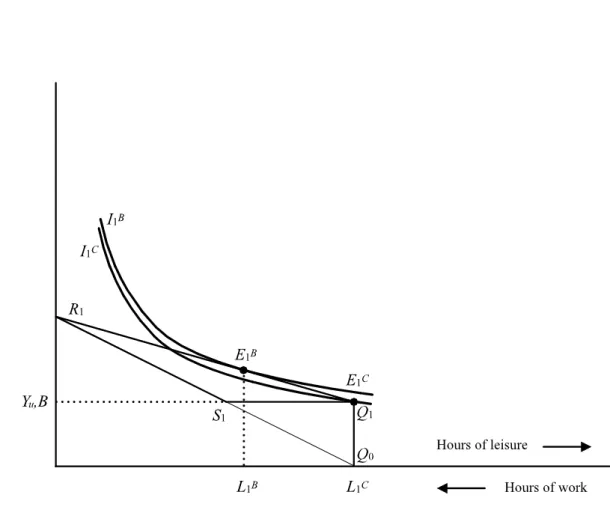
Figure 3.6: Income and Substitution Effects with Basic Income and Proportional Tax on Earned Income
income effect of a tax is assumed to be positive: a tax on income can act as an incentive, making an agent work more to compensate the loss caused by the tax (see figure 3.5). With a pure income effect, the agent would have ended up at the
tangency point ˆE1 of a lower indifference curve and the dashed budget constraint,
being parallel to the old one.
The substitution effect, on the other hand, is negative: a tax on income acts as a disincentive, reducing the value of an extra hour of work and making leisure relatively cheaper, which leads to a reduction in labor supply. In figure 3.5 the substitution effect dominates the income effect, the overall impact of the income
tax is a reduction in labor supply fromL0 to L1.