New Trade Models, New Welfare Implications
∗ Marc J. MelitzHarvard University, NBER and CEPR †
Stephen J. Redding
Princeton University, NBER and CEPR‡ August 13, 2014
Abstract
We show that endogenous firm selection provides a new welfare margin for heterogeneous firm models of trade (relative to homogeneous firm models). Under some parameter restrictions, the trade elasticity is constant and is a sufficient statistic for welfare, along with the domestic trade share. However, even small deviations from these restrictions imply that trade elasticities are variable and differ across markets and levels of trade costs. In this more general setting, the domestic trade share and endogenous trade elasticity are no longer sufficient statistics for welfare. Additional empirically observable moments of the micro structure also matter for welfare.
KEYWORDS: firm heterogeneity, welfare gains from trade, trade policy evaluation J.E.L. CLASSIFICATION: F12, F15
∗
We are grateful to Harvard and Princeton Universities for research support. This paper is a revised version of “Firm Heterogeneity and Aggregate Welfare,”NBER Working Paper, 18919. We would like to thank the editor, four referees, conference and seminar participants at AEA, Harvard, Hong Kong, LSE, Minneapolis, NBER, NYU, Paris, Princeton, UBC, Vancouver and Wharton, and Pol Antras, Costas Arkolakis, Ariel Burstein, Arnaud Costinot, Rob Feenstra, Gene Grossman, Gordon Hanson, Keith Head, Elhanan Helpman, Thierry Mayer, Gianmarco Ottaviano, Andres Rodriguez-Clare, Esteban Rossi-Hansberg, Jon Vogel and David Weinstein for helpful comments. We are also grateful to David Krisztian Nagy for research assistance. Responsibility for any results, opinions and errors is the authors’ alone.
†
Littauer Center 215, Cambridge, MA 02138. Tel: 617-495-8297. Email: [email protected]. ‡
1
Introduction
Over the last decade, new theories of trade with heterogeneous firms in differentiated product markets have been developed. These theories were designed to account for features of disaggregated trade data: only some firms export, exporters are more productive than non-exporters and trade liberalization induces intra-industry reallocations of resources between those different types of firms. These reallo-cations represent a new potential channel for the gains from trade. However, the implireallo-cations of these models for aggregate welfare (combining together all welfare channels) were left unanswered.
In a recent paper, Arkolakis, Costinot and Rodriguez-Clare (2012, henceforth ACR) show that there exists a class of heterogeneous and homogeneous firm models in which a country’s domestic trade share and the elasticity of trade with respect to variable trade costs are sufficient statistics for the aggregate welfare gains from trade. Therefore, if the different models within this class are calibrated to the same domestic trade share and the same trade elasticity, they imply the same welfare gains from trade. Based on this result, ACR summarizes the contribution of new theories of heterogeneous firms to the aggregate welfare implications of trade as “So far, not much.”
In this paper, we compare a heterogeneous firm model to a homogeneous firm model that is a special case with a degenerate productivity distribution. We use a theoretical comparative static to show that the heterogeneous firm model has an extra adjustment margin that is absent in the homogeneous firm model: the endogenous decisions of heterogeneous firms to enter and exit the domestic and export markets. Furthermore, adjustment along this margin is efficient, in the sense that the market equilibrium corresponds to the constrained efficient allocation chosen by a social planner. As a result, if the degenerate productivity distribution in the homogeneous firm model is chosen so that the two models have the same welfare for an initial value of trade costs, this extra adjustment margin implies that the heterogeneous firm model has higher welfare for all other values of trade costs. It follows that the two models have different aggregate welfare implications: there are
larger welfare gains fromreductions in trade costs and smaller welfare losses fromincreases in trade costs in the heterogeneous firm model than in the homogeneous firm model. Quantitatively, we find that this extra adjustment margin is substantial for a calibration of our heterogeneous firm model to U.S. firm-level and aggregate data.
Under additional restrictions on the parameter space, our heterogeneous and homogeneous firm models belong to the class analyzed by ACR.1 In this class of models, the elasticity of trade with respect to variable trade costs is constant (and then also serves as a sufficient statistic for welfare along with the domestic trade share). We show that this existence of a single constant trade elasticity and its sufficiency property for welfare are highly sensitive to small departures from those ACR parameter restrictions. In the heterogeneous firm model, the restrictions include an untruncated Pareto distribution for productivity. Even a slight generalization of this distribution to a truncated
1We focus on monopolistic competition models featuring imperfect competition, endogenous product variety, and
increasing returns to scale. ACR also consider perfect competition models without those features, such as Armington (1969) and Eaton and Kortum (2002).
Pareto (with a finite upper bound for productivity) implies a variable trade elasticity that differs across markets and levels of trade costs. As a result, a trade elasticity estimated from one context need not apply for the evaluation of trade policy in another context. In this more general setting, evaluating a trade policy based on an estimated trade elasticity is subject to the Lucas Critique: This elasticity is not invariant with respect to trade policy.2
Furthermore, once we move beyond those ACR restrictions on the parameter space, the trade share and (endogenous) trade elasticity are no longer sufficient statistics for welfare. Even conditional on these variables, micro structure matters for the welfare gains from trade. In this more general setting, the impact on welfare of the extra adjustment margin in the heterogeneous firm model is not captured by the trade elasticity. We develop several examples of trade liberalization scenarios in which this additional impact of the micro structure on welfare can be substantial, even for small, empirically relevant, departures from the ACR parameter restrictions.
We extend the ACR approach of expressing the welfare gains from trade as a function of ob-servable empirical moments (including the trade share and elasticity) to the more general cases of our homogeneous and heterogeneous firm models. We provide a framework for assessing whether the ACR formula provides a good approximation to the true welfare gains from trade liberalization. We quantitatively measure the discrepancies between the ACR formula and the true welfare gains using our more general model calibrated to U.S. aggregate and firm-level data. We find substantial dis-crepancies ranging up to a factor of four. Using an elasticity estimatedex post for the observed local changes in trade costs will reduce – but not eliminate – the discrepancy between the predicted and true welfare gains from trade. In addition to the two aggregate moments of the domestic trade share and trade elasticity, our more general welfare expression highlights differences in the hazard rate of the distribution of log firm size between the domestic and export markets and the response of firm entry to changes in trade costs, both of which can be examined empirically using firm-level data.
Our paper is related to other recent research on the welfare gains from trade when the ACR pa-rameter restrictions are not satisfied. ACR and Costinot and Rodriguez-Clare (2014) explore multiple sectors, tradable intermediate inputs and multiple factors of production; Arkolakis, Costinot, Don-aldson and Rodriguez-Clare (2012) and Edmond, Midrigan and Xu (2012) examine variable markups; Head, Mayer and Thoenig (2014) analyze a log normal productivity distribution; Feenstra (2014) introduces variable markups using Quadratic Mean of Orderr preferences and considers a truncated Pareto productivity distribution; and Fajgelbaum and Khandelwal (2013) investigate non-homothetic preferences. In contrast to these studies, we show theoretically that endogenous firm selection provides an extra margin of adjustment in the heterogeneous firm model. We demonstrate the fragility of a constant trade elasticity to small departures from the ACR restrictions even in the benchmark case of a single sector with no intermediate inputs, constant elasticity of substitution (CES) preferences and monopolistic competition, as considered by Krugman (1980) and Melitz (2003).
2
When there is a single constant trade elasticity – as in the class of models considered by ACR – this elasticity must be invariant so the Lucas Critique does not apply.
The remainder of the paper is organized as follows. In Section 2, we introduce the heterogeneous and homogeneous firm models. In Section 3, we use our theoretical comparative static to show that the heterogeneous firm model has an extra margin of adjustment that is absent in the homogeneous firm model. In Section 4, we extend the ACR approach of expressing welfare gains from trade as a function of observable empirical moments (including the trade share and elasticity) to the more general cases of the homogeneous and heterogeneous firm models. In Section 5, we provide several examples of trade liberalization scenarios where the additional impact of the model’s micro structure on welfare can be substantial. In Section 6, we examine the quantitative relevance of our theoretical results. Section 7 concludes.
2
Heterogeneous and Homogeneous Firm Models
We compare the canonical heterogeneous firm model of Melitz (2003) to a homogeneous firm model that is a special case with a degenerate productivity distribution (as in Krugman 1980).3 We hold all other parameters (including the trading technology) constant across the two models.
2.1 Closed Economy Heterogeneous Firm Model
The specification of preferences, production and entry is the same as in Melitz (2003).4 There is a continuum of firms that are heterogeneous in terms of their productivityϕ∈(0, ϕmax), which is drawn
from a common cumulative distributionG(ϕ) after incurring a sunk entry cost offeunits of labor. We allow the upper bound of the support of the productivity distribution to be either finite (ϕmax<∞)
or infinite (ϕmax=∞). Labor is the sole factor of production. Production involves a fixed production
cost and a constant marginal cost that depends on firm productivity, so that l(ϕ) = fd+q(ϕ)/ϕ units of labor are required to supply q(ϕ) units of output. Consumers have constant elasticity of substitution (CES) preferences with elasticityσ >1 defined over the differentiated varieties supplied by firms. Profit maximization implies that variety prices are a constant mark-up over marginal cost that is determined by the elasticityσ. The revenue of a firm with productivity ϕis then given by:
rd(ϕ) =
σ−1
σ
σ−1
ϕσ−1RPσ−1w1−σ, (1) whereR is aggregate revenue,P is the CES price index, and w is the wage. We use the subscript d
to reference the domestic market.
We begin by considering the closed economy equilibrium, which can be summarized by the following three relationships, where we use the superscript A to denote the autarky equilibrium. First, fixed production costs imply a productivity cutoff (ϕAd) below which firms exit. This cutoff is defined by a zero-profit condition equating operating profit to the fixed cost:
rd(ϕAd) σ =
R σ
σ−1
σ
P ϕAd w
σ−1
=wfd. (2)
3
A web-based technical appendix contains the derivations of all expressions in the paper.
4
Following most of the subsequent international trade literature, including ACR, we consider a static version of Melitz (2003) in which there is zero probability of firm death.
Second, free entry requires that the probability of successful entry (1−G(ϕAd)) times average profits conditional on successful entry (¯π) equals the sunk entry cost: 1−G ϕAdπ¯ =wfe. Using the relationship linking relative firm revenue to relative firm productivity and the zero-profit cutoff condition above, this free entry condition can be expressed as:
fdJ ϕAd
=fe, (3)
where
J ϕAd=
Z ϕmax
ϕA d
"
ϕ ϕAd
σ−1
−1
#
dG(ϕ), (4)
where J ϕAd
is a monotonically decreasing function of the productivity cutoff. We can then write
J ϕAd
in terms of the ratio of average productivity to cutoff productivity:
J ϕAd=1−G(ϕAd)
"
˜
ϕAd ϕAd
σ−1
−1
#
. (5)
Following Melitz (2003), we define ˜ϕAd as a weighted average of firm productivity (corresponding to a harmonic mean weighted by output shares):
˜
ϕAd =
"
Z ϕmax
ϕA d
ϕσ−1 dG(ϕ)
1−G ϕA d
#σ−11
. (6)
Third, the mass of producing firms (M) equals the mass of entrants (Me) times the probability of successful entry (1−G(ϕAd)). This mass of producing firms also equals aggregate revenue (R) divided by average firm revenue (¯r). Using the relationship linking relative firm revenue to relative firm productivity and the free entry condition, the mass of producing firms can be written in terms of the economy’s labor supply (L) relative to average fixed costs per firm:
M =
1−G(ϕTd) Me=
R
¯
r = L
σFA. (7)
In this derivation, we choose labor as the numeraire so that aggregate revenueRequals labor payments
L, and we defineFA to represent the average fixed cost paid per surviving firm:
FA= fe 1−G(ϕA
d)
+fd. (8)
Using the CES price index and the mass of firms (7), closed economy welfare can be then written in terms of the mass of firms (L/σFA) and the weighted average productivity of these firms ( ˜ϕAd):
WAHet= w P =
σ−1
σ
L σFA ϕ˜
A d
σ−1
1
σ−1
. (9)
2.2 Open Economy Heterogeneous Firm Model
We consider the case of trade between two symmetric countries. We use the subscriptx to reference the export market and the superscriptT to reference the open economy equilibrium. We assume that
there is a fixed exporting cost offx units of labor in the source country and an iceberg variable trade cost, whereby τ > 1 units of a variety must be shipped from one country in order for one unit to arrive in the other country. The open economy equilibrium is characterized by productivity cutoffs for serving the domestic market (ϕT
d) and export market (ϕTx) that are defined by zero-profit conditions equating the operating profit in each market to the relevant fixed costs:
rd(ϕTd) σ =
R σ
σ−1
σ P ϕTd
w
σ−1
=wfd, (10)
rx(ϕTx) σ =
R σ
σ−1
σ P ϕT
x τ w
σ−1
=wfx. (11)
The revenue functions rd(ϕ) and rx(ϕ) separate firm sales by destination market (domestic and ex-port). Together these two zero-profit conditions imply that the export cutoff is a constant multiple of the domestic cutoff, where this multiple depends on the fixed and variable costs of trade:
ϕTx =τ
fx fd
σ−11
ϕTd. (12)
For sufficiently high fixed and variable trade costs (τ(fx/fd)
1
σ−1 > 1), only the most productive
firms export, consistent with an extensive empirical literature (see for example the review in Bernard, Jensen, Redding and Schott 2007).
The free entry condition again equates the expected value of entry to the sunk entry cost,
1−G ϕT d
¯
π =wfe, and can be written as: fdJ ϕTd
+fxJ ϕTx
=fe, (13)
whereJ(·) is defined in (4). Using the relationship between the productivity cutoffs (12), and noting that J(·) is a decreasing function, the free entry condition (13) determines a unique equilibrium value of the domestic cutoff (ϕTd), which in turn determines the export cutoff (ϕTx). Furthermore, the domestic cutoff in the open economy is strictly greater than the domestic cutoff in the closed economy (ϕTd > ϕAd) for positive values of fixed exporting costs.
As in the closed economy, the mass of producing firms (M) equals the mass of entrants (Me) times the probability of successful entry (1−G(ϕT
d)), and is determined by the economy’s labor supply (L) relative to average fixed costs:
M =1−G(ϕTd)Me= R
¯
r = L
σFT, (14)
whereFT summarizes average fixed costs per surviving firm in the open economy:
FT = fe 1−G(ϕT
d)
+fd+χfx, (15)
andχ=1−G(ϕTx)/1−G(ϕTd)is the proportion of exporting firms. In this derivation, we choose labor in one country as the numeraire and use country symmetry, which implies that aggregate revenue
Using the CES price index and mass of firms (14), open economy welfare can be written in terms of the mass of varieties available for consumption (L(1 +χ)/σFT) and the weighted average productivity of these varieties ( ˜ϕTt):
WTHet= w P =
σ−1
σ
L(1 +χ)
σFT ϕ˜ T t
σ−1
1
σ−1
. (16)
This weighted average productivity ( ˜ϕTt) in the open economy is constructed using the same weighting scheme (6) as we used for the closed economy. However the productivity of exporters is reduced by
τ to account for the units “lost” in transit. Letting ˜ϕT
x denote the average productivity of exporters, defined as in (6), the overall productivity average for the open economy can be written:
˜
ϕTtσ−1 = 1 1 +χ
h
˜
ϕTdσ−1+χ τ−1ϕ˜Txσ−1
i
. (17)
Aggregate trade between the two countries is inversely related to the domestic trade share (the pro-portion of domestic sales in total sales):
λHet=
Rϕmax
ϕT d
rd(ϕ)dG(ϕ)
R =
1
1 +τ1−σΛ, (18)
where Λ = δ(ϕTx)/δ(ϕTd) ≤ 1 is the market share of exporters in the domestic market and δ(ϕj) =
Rϕmax
ϕj ϕ
σ−1dG(ϕ) is a function that depends only on G(·) and σ. The sensitivity of aggregate trade
to changes in variable trade costs is captured by the full trade elasticity:
θHet =−
d ln1−λHet
λHet
d lnτ = (
(σ−1)−d ln Λd lnτ >0 forτ(fx/fd)1/(σ−1)>1 (σ−1) >0 forτ(fx/fd)1/(σ−1)<1
, (19)
where d ln Λ/d lnτ <0. When trade costs are sufficiently low, all firms export and there is no extensive margin of trade. Given CES preferences, the elasticity of the intensive margin of trade is constant at
σ−1. When there is selection into the export market, the elasticity of trade θHet is the sum of the
intensive margin elasticityσ−1 and the extensive margin elasticity −d ln Λ/d lnτ. 2.3 Closed Economy Homogeneous Firm Model
We construct a homogeneous firm model that is a special case of the heterogeneous firm model with a degenerate productivity distribution. Firms pay the same sunk entry cost offe units of labor and draw a productivity of either zero or ¯ϕd with exogenous probabilities ¯Gd and
1−G¯d
respectively. Fixed production costs imply that only firms drawing a productivity of ¯ϕd find it profitable to pro-duce. Therefore producing firms are homogeneous and there is a degenerate productivity distribution conditional on production at ¯ϕd.
The closed economy equilibrium of this homogeneous firm model is isomorphic to that in Krugman (1980), in which the representative firm’s productivity is set equal to ¯ϕdand the fixed production cost is scaled to incorporate the expected value of entry costs ( ¯Fd≡fd+fe/
1−G¯d
). These values for the representative firm’s productivity and the fixed production cost are exogenous and held constant.
To simplify the exposition, we adopt this Krugman (1980) interpretation. The representative firm’s production technology is:
l= q ¯
ϕd
+ ¯Fd. (20)
Consumers have the same CES preferences that we defined previously. Profit maximization implies that equilibrium prices are a constant markup over marginal cost. Profit maximization and free entry imply that equilibrium output and employment for the representative variety are proportional to the fixed production cost:
q= ¯ϕdF¯d(σ−1), l=σF¯d.
Using equilibrium employment for the representative variety, the mass of firms can be determined from the labor market clearing condition:
M = L
σF¯d
. (21)
Using the CES price index and the mass of firms (21), closed economy welfare can be written in terms of the mass of firms (L/σF¯d) and productivity ( ¯ϕd):
WAHom= w P =
σ−1
σ
L σF¯d
( ¯ϕd)σ−1
σ−11
, (22)
where we again choose labor as the numeraire.
2.4 Open Economy Homogeneous Firm Model
We again consider trade between two symmetric countries and assume the same trading technology as in the heterogeneous firm model, so that there is a fixed exporting cost offx units of labor and an iceberg variable trade cost ofτ >1 units of each variety.
In the homogeneous firm model, the probability of successful entry and productivity conditional on successful entry are exogenous and remain unchanged and equal to
1−G¯d
and ¯ϕdrespectively. For sufficiently high fixed and variable trade costs (τσ−1fx/F¯d>1), the representative firm does not find it profitable to export. In contrast, for sufficiently low fixed and variable trade costs (τσ−1fx/F¯d<1), the representative firm finds it profitable to export, and there is trade in both models. The open economy equilibrium of this homogeneous firm model is isomorphic to a version of Krugman (1980) with the same trading technology as in Melitz (2003).
Profit maximization again implies that equilibrium prices are a constant mark-up over marginal costs, with export prices a constant multiple of domestic prices due to the variable costs of trade. Profit maximization and free entry imply that equilibrium output and employment for the representative variety are proportional to fixed costs:
q= ¯ϕd F¯d+fx
(σ−1), l=σ F¯d+fx
.
Therefore both output and employment rise for the representative firm following the opening of trade to cover the additional fixed costs of exporting.
Using equilibrium employment for the representative variety, the mass of firms can be determined from the labor market clearing condition:
M = L
σ F¯d+fx
. (23)
Using the CES price index and the mass of firms (23), open economy welfare can be written in terms of the mass of varieties available for consumption (2L/σ( ¯Fd+fx)) and average productivity ( ¯ϕt):
WTHom = w P =
σ−1
σ (
2L σ F¯d+fx
( ¯ϕt)
σ−1
)σ1−1
. (24)
where average productivity ( ¯ϕt) is constructed in the same way as in (17) for heterogeneous firms:5 ( ¯ϕt)σ−1 =
1 2
h
( ¯ϕd)σ−1+ τ−1ϕ¯d
σ−1i
. (25)
We again choose the wage in one of the symmetric countries as the numeraire. In the case of homogeneous firms, the domestic trade share simplifies to:
λHom =
1
1 +τ1−σ. (26)
There is no extensive margin of trade, so the trade elasticity is given by the constant elasticity for the intensive margin of trade (so long as there is some trade):
θHom =
σ−1 forτσ−1fx/F¯d<1
0 otherwise . (27)
3
Theoretical Comparative Static
We now show that endogenous firm selection provides a new margin of adjustment through which the economy can respond to trade liberalization that leads to different aggregate welfare implications in the heterogeneous and homogeneous firm models. Holding all other structural parameters constant across the two models (samefd, fe, fx,τ,L, σ), we first pick the parameters ¯Gd and ¯ϕd for the degenerate productivity distribution with homogeneous firms such that welfare in an initial equilibrium is the same in the two models. We next examine the effects of changes in trade costs from this initial equilibrium. We undertake this analysis both for the opening of the closed economy to trade and for changes in trade costs in the open economy equilibrium.
3.1 Opening the Closed Economy to Trade
We begin by picking the parameters ¯Gd and ¯ϕd of the degenerate productivity distribution with homogeneous firms such that the autarky equilibrium is isomorphic to that with heterogeneous firms, and examine the effect of opening the closed economy to trade.
5
With a representative firm, average productivity across domestic firms and exporters is ¯ϕt, and the proportion of exporting firms is one.
Proposition 1 Consider a homogeneous firm model that is a special case of the heterogeneous firm model with an exogenous probability of successful entry 1−G¯d
= 1−G(ϕAd) and an exogenous degenerate distribution of productivity conditional on successful entryϕ¯d= ˜ϕAd. Given the same value
for all remaining parameters{fd, fe, L, σ}, all aggregate variables (welfare, wage, price index, mass
of firms, and aggregate revenue) are the same in the closed economy equilibria of the two models.
Proof. Comparing (9) and (22), equal welfare follows immediately from ¯ϕd = ˜ϕAd and
1−G¯d
=
1−G(ϕAd)
, which implies ¯Fd = FA. This also implies equal price indices. Equal masses of firms follow immediately from equal price indices and ¯ϕd = ˜ϕAd. Equal aggregate revenue follows from R=L in both models.
This first proposition reflects the aggregation properties of the heterogeneous firm model. All aggregate variables in this model take the same value as if there were a representative firm with productivity ¯ϕd and fixed costs ¯Fd. The key difference between the heterogeneous firm model and such a representative firm model is that aggregate productivity in the heterogeneous firm model is endogenous and responds to changes in trade costs.
Proposition 2 Choosing the degenerate productivity distribution in the homogeneous firm model so that the two models have the same closed economy welfare and the same structural parameters (fd, fe, fx,τ,L,σ), the proportional welfare gains from opening the closed economy to trade are strictly larger
in the heterogeneous firm model than in the homogeneous firm model (WTHet/WAHet >WTHom/WAHom),
except in the special case with no fixed exporting cost. In this special case, the proportional welfare gains from opening the closed economy to trade are the same in the two models.
Proof. See the Appendix.
The intuition for this result involves revealed preference arguments of the kind commonly used in international trade.6 Our starting point is to note that, with CES preferences and monopolistic competition, the open economy equilibrium in the heterogeneous firm model is efficient. As shown in the web appendix, a welfare-maximizing social planner faced with the same production and entry technology would choose the same allocation as the market equilibrium. When the economy is opened to trade, the planner could choose not to adjust the set of firms selected for production and exports. Average productivity would then remain constant, and this outcome would replicate the opening to trade in the homogeneous firm case. The latter is thus a feasible allocation for the planner with the heterogeneous firm production and entry technology. However, efficiency implies that this planner chooses to replicate the market equilibrium of the heterogeneous firm model, which involves adjust-ments in the set of firms selected for production and exports – and an associated increase in average productivity. This induced allocation therefore yields higher welfare than any other feasible allocation
6
For the sake of parsimony, we focus on symmetric countries; however, this revealed preference argument applies more generally for asymmetric countries.
– including the homogeneous firm outcome. Additionally, the planner’s objective function is strictly concave. Thus, welfare in the heterogeneous firm open economy must be strictly higher than in the homogeneous firm case whenever the cutoffs adjust to the opening to trade.7
The difference in aggregate welfare implications between the two models arises because of the additional efficient adjustment margin of firm entry and exit decisions in the heterogeneous firm model (for both the domestic and export markets). In the special case with no fixed exporting cost, the domestic productivity cutoff is unaffected by the opening of the closed economy to trade. As a result, the additional adjustment margin of firm entry and exit decisions is inoperative in the heterogeneous firm model, and the welfare effects of trade liberalization are the same in the two models. We consider this special case uninteresting, since firm productivity dispersion then plays no role in the heterogeneous firm model (the exit threshold and average productivity are the same in the closed and open economies). Furthermore, this special case stands at odds with an extensive body of empirical evidence that only some firms export, exporters are larger and more productive than non-exporters, and there are substantial fixed exporting costs.8
3.2 Changes in Trade Costs in the Open Economy Equilibrium
The role of the extra adjustment margin of firm entry and exit decisions for generating different aggregate welfare implications is not limited to the opening of the closed economy to trade and also holds for reductions in trade costs in the open economy equilibrium. To show this, we recast our heterogeneous and homogeneous firm models so that they have the same welfare in an initial open economy equilibrium. In order to ensure that the two models have the same initial welfare and only differ in their productivity distribution (keeping the same structural parameters fd, fe, fx, τ, L, σ), we extend the homogeneous firm model to allow for two types of firms: exporters and non-exporters. In this extension, firms again pay a sunk entry cost of fe units of labor before observing their productivity. With probability1−G¯x
a firm draws a productivity of ¯ϕx and can export; with probability ¯Gdxthe firm draws a productivity of ¯ϕdx and cannot export; with probability
¯
Gx−G¯dx
the firm draws a productivity of zero and does not find it profitable to produce. We pick the parameters of this “extended” homogeneous firm model ( ¯ϕx,ϕ¯dx,G¯x,G¯dx) such that the open economy equilibrium features the same aggregate variables as the initial open economy equilibrium with heterogeneous firms (same welfare, price index, mass of firms, aggregate revenue, and domestic trade share).
Nevertheless these two models respond differently to changes in trade costs from this common initial equilibrium along a key dimension. In the heterogeneous firm model, the endogenous selection responses to trade costs lead to changes in the average productivity of exporting and non-exporting
7
In contrast, if the elasticity of substitution between varieties is variable, the market equilibrium is not in general efficient (see Dixit and Stiglitz 1977 for the case of homogeneous firm models and Dhingra and Morrow 2012 for the case of heterogeneous firm models). Endogenous firm selection still provides an extra margin of adjustment in the heterogeneous firm model relative to the homogeneous firm model. This again generates different aggregate welfare implications in the two models, as considered in the web appendix.
8
For reviews of the extensive empirical literatures on firm export market participation, see Bernard, Jensen, Redding and Schott (2007) and Melitz and Redding (2014). For evidence of substantial fixed exporting costs, see Roberts and Tybout (1997) and Das, Roberts and Tybout (2007).
firms and in the proportion of exporting firms. In contrast, in the extended homogeneous firm model, the average productivity levels of exporters and non-exporters and the proportion of exporting firms remain constant.9 The presence of this extra adjustment margin in the heterogeneous firm model implies that welfare following the change in trade costs must be strictly higher than in the extended homogeneous from model. This argument holds irrespective of whether trade costs decrease or in-crease. Therefore, welfaregains arelarger in the heterogeneous firm model whenever trade costs fall, and welfarelosses aresmaller in the heterogeneous firm model whenever trade costsincrease. Proposition 3 Starting from an initial open economy equilibrium with the same welfare and the same structural parameters in the two models (fd, fe,fx,τ, L,σ), a common decrease (increase) in variable
or fixed trade costs generates larger welfare gains (smaller welfare losses) in the heterogeneous firm model than in the extended homogeneous firm model.
Proof. See the Appendix.
Note that the extended homogeneous firm model is equivalent to a version of the heterogeneous firm model in which the domestic and export productivity cutoffs are held constant at their values in an initial open economy equilibrium. Put another way, consider a planner who is constrained to keep the same set of firms operating in both the domestic and export markets – i.e. the endogenous selection margin is inoperative. Under this constraint, the welfare-maximizing allocation coincides with the market equilibrium of the extended homogeneous firm model. In contrast, in the absence of this constraint, the welfare-maximizing allocation coincides with the market equilibrium of the heterogeneous firm model. Therefore, the welfare differential between the two models provides a direct measure of the impact of selection on aggregate welfare. In other words, it isolates theadditional
contribution to aggregate welfare of the new endogenous selection/productivity channel highlighted by the heterogeneous firm model of trade – this represents the new welfare implications that we refer to in the title of this paper. Later in Section 6, we show that this additional welfare channel is quantitatively substantial for a model calibrated to U.S. aggregate and firm statistics.
Atkeson and Burstein (2010) considers this welfare differential from endogenous firm selection in a model with product and process innovation. They find that this welfare differential is of second-order. Proposition 3 is consistent with this result. As discussed above and shown formally in the web appendix, the initial equilibrium of the heterogeneous firm model is efficient. Therefore the envelope theorem implies that the changes in the productivity cutoffs in the heterogeneous firm model have only second-order effects on welfare. But, as we show later, these second-order welfare effects can be quite substantial for larger changes in trade costs.
9
Unless trade costs become sufficiently high that firms with productivity ¯ϕx no longer find it profitable to export or firms with productivity ¯ϕdx no longer find it profitable to produce. In both cases, the average productivity of the two types of firms remains constant at ¯ϕx and ¯ϕdx
3.3 Untruncated Pareto Distribution
Since the homogeneous firm model is a special case of the heterogeneous firm model, our comparison of the two models above is equivalent to a discrete comparative static of moving from a non-degenerate to a degenerate productivity distribution within the heterogeneous firm model. In the special case of an untruncated Pareto productivity distribution, the degree of firm heterogeneity is summarized by a single parameter: the shape parameterk. Lower values ofk correspond to greater firm heterogeneity and the homogeneous firm model corresponds to the limiting case in whichk→ ∞. Therefore, we can complement the above discrete comparative static with a continuous comparative static in the degree of firm heterogeneity (k), holding all other structural parameters constant.
Proposition 4 Assuming that productivity in the heterogeneous firm model has an untruncated Pareto distribution (g(ϕ) =kϕkminϕ−(k+1), where ϕ≥ϕmin>0 and k > σ−1) and fixed exporting costs are positive, greater dispersion of firm productivity (smaller k) implies: (a) larger welfare gains from opening the closed economy to trade (larger WTHet/WAHet), (b) larger (smaller) welfare gains (losses)
from a decrease (increase) in variable trade costs in the open economy equilibrium.
Proof. See the appendix.
Intuitively, a larger dispersion of firm productivity (smallerk) implies greater scope for adjustment along the margin of endogenous firm entry and exit decisions, which implies different aggregate welfare effects from a change in trade costs.
4
Welfare and Trade Policy Evaluation
To isolate the extra adjustment margin from endogenous firm selection, our theoretical comparative static changes the distribution of productivity holding all other exogenous variables fixed across mod-els. This exercise does not restrict the equilibrium values of the endogenous variables (in particular the domestic trade shareλand the trade elasticityθ) to be the same in the two models. Instead the equilibrium values for these endogenous variables differ systematically across the two models. In the appendix, we show that the heterogeneous firm model generates a higher trade elasticity than either the homogeneous firm model or its extension given the same value of the exogenous variables. On the one hand, moving from the closed economy to the open economy, there isless trade (higher λ) in the heterogeneous firm model than in the homogeneous firm model. On the other hand, starting from an open economy equilibrium, trade liberalization generates more trade (lower λ) in the heterogeneous firm model than in the extended homogeneous case.10
10
For sufficiently high trade costs, the domestic trade share is higher in the homogeneous firm model than in the heterogeneous firm model, because the representative firm does not find it profitable to export. As trade costs fall below the threshold at which the representative firm exports, the domestic trade share in the homogeneous firm model falls from one to a valuebelow that in the heterogeneous firm case, and the trade elasticity jumps from zero toσ−1 (less than the trade elasticity in the heterogeneous firm case).
ACR show that there exists a restricted subset of our heterogeneous and homogeneous firm models (in terms of parameter space restrictions) in which the trade elasticity is constant. Under these parameter restrictions, this constant trade elasticity and the domestic trade share become sufficient statistics for welfare. Even then, the micro structure of the underlying model still matters for the welfare gains from trade, but only through its effect on the trade share and trade elasticity. Therefore, if aggregate data can be used to measure the trade elasticity independently of a model (the trade share, by definition, is directly observed from aggregate data) then these aggregate data can be used to accurately measure the welfare gains from trade; and this welfare computation will be independent of the micro structure of the underlying model. Furthermore, since the trade elasticity is constant under the ACR parameter restrictions, it has a structural interpretation, and hence its use in trade policy evaluations is not subject to the Lucas Critique.
The key feature of those parameter restrictions is to induce a single constant trade elasticity that can be applied across models. However, when using the ACR sufficient statistics for anex ante trade policy evaluation, one needs to assume more than a data generation process conforming to one of those models within the ACR class. One also needs to assume that these models are universal and eternal, in the sense that their structural parameters are always the same, independent of the time or country to which they are applied. If this assumption is not satisfied, and one wants to estimate the welfare gains from trade in a new context where the trade elasticity is unknown and cannot plausibly be taken from an existing context, one needs to start with a specific structural model and assumptions about its behavioral parameters. As shown in our theoretical comparative static, this structural model will generate differentex ante predictions for the aggregate welfare implications of changes in trade costs, depending on whether or not it features firm heterogeneity.
In particular, we show how the existence of a single constant elasticity breaks down under very small departures from the ACR parameter restrictions. In such a setting, a trade elasticity estimated from one context need not apply for the evaluation of trade policy in another context, even when the model parameters remain unchanged. Therefore trade policy evaluations using an estimated trade elasticity become subject to the Lucas Critique, because this elasticity is not invariant to trade policy. More fundamentally, we show that even the endogenous trade elasticity is no longer a sufficient statistic for welfare (along with the domestic trade share): even conditioning on those two aggregate moments, the micro structure influences the welfare gains from trade. The reason is that welfare depends on the entire distribution of firms producing and selling in a market – which is summarized by the domestic productivity cutoff. Therefore, changes in welfare depend on the change in the domestic productivity cutoff (which can be measured using a domestic trade elasticity). Only in the case of an untruncated Pareto distribution is the domestic trade elasticity equal to the export trade elasticity. Departing from this parametrization, these two elasticities diverge and depend on the micro structure and the level of the trade costs.
In the remainder of this section, we extend the ACR approach of expressing the welfare gains from trade as a function of observable empirical moments to the more general cases of the homogeneous and
heterogeneous firm models from Section 2 (without imposing the ACR parameter restrictions). These empirical moments include the trade share and trade elasticity, but also additional ones that capture micro structure (and differ between the two models). In Section 5, we provide several examples of trade liberalization scenarios in which the additional impact of the micro structure on welfare can be substantial, even for small empirically relevant departures from the ACR restrictions. In Section 6, we quantitatively assess these differences in welfare predictions.
4.1 ACR Welfare Derivation
ACR show how the domestic trade share (λ) and trade elasticity (θ) are sufficient statistics for the welfare gains from trade in a large class of trade models (including special cases of our homogeneous and heterogeneous firm models), so long as three macro-level restrictions are satisfied: (R1) balanced trade; (R2) aggregate profits are a constant share of aggregate revenues; and (R3) a CES import demand system with a constant elasticity of trade with respect to variable trade costs. Under these restrictions, the welfare gains from trade regimeT0 toT1 can be written:
WT1 WT0 =
λT0
λT1
1θ
. (28)
Thus, (28) will characterize the welfare gains from trade for both our homogeneous and heterogeneous firm models so long as (R1)-(R3) are satisfied. Trade is balanced in both of these models, so (R1) is always satisfied. However, the general versions of both models imply departures from a constant aggregate share of profits embodied in (R2). Given CES preferences, the constant aggregate trade elasticity restriction (R3) will be satisfied in all versions of our homogeneous firm model, whereas it will be violated along with (R2) in our general heterogeneous firm model.
4.2 Gains from Trade in the Homogeneous Firm Model
We consider a lowering of trade costs from τ0 and fx0 (trade regimeT0) toτ1 and fx1 (trade regime T1). To simplify notation, we assume that τ0 and fx0 may be high enough such that no trade is
generated in T0. Let χT0 denote an indicator variable for positive trade. Then, using the expressions
for welfare in the closed economy (22) and open economy (24) and the domestic trade share (26), we can write the welfare gains from trade in the heterogeneous firm model as:
WT1 WT0 =
" λT0 F¯
d+χT0fx0
λT1 F¯
d+fx1
#σ−11
, (29)
whereθ=σ−1 is the elasticity of trade with respect to variable trade costs.
In this more general setting, the welfare gains depend on the same two aggregate moments (the domestic trade share and trade elasticity) as in ACR (28), but also on the change in firm size (captured in (29) by the total fixed costs paid by the representative firm). This change in firm size is an observable empirical moment, but one that characterizes a change in micro structure. Even after controlling for the two aggregate moments, these changes in micro structure will affect the welfare gains from trade.
Such changes in micro structure will occur whenever the fixed exporting cost changes in an open economy with trade (χT0 = 1) or even in the presence of any positive fixed exporting costs in an
economy that opens up to trade (from χT0 = 0). These changes represent a violation of (R2) as the
share of profits in revenue changes with firm size in the homogeneous firm model. 4.3 Gains from Trade in the Heterogeneous Firm Model
We now seek to express the welfare gains from trade liberalization in terms of observable empirical moments for the general case of our heterogeneous firm model. Since trade continuously drops to zero when trade costs increase, we can start from an open economy trade regime T without loss of generality. To simplify notation, we drop the T superscript. For now, we also assume that there is export market selection in this trade regime so that ϕx > ϕd.
From (19), the full trade elasticity with export market selection is θHet = (σ−1)−d ln Λ/d lnτ,
where Λ =δ(ϕx)/δ(ϕd) represents the domestic market share of exporters (and hence changes in Λ capture changes in the extensive margin of trade). This full trade elasticityθHetincorporates the direct
effect ofτ on the extensive margin of trade via its impact on the export cutoffϕx =τ(fx/fd)1/(σ−1)ϕd (see (11)), as well as indirect effects through the price index via its impact on the domestic cutoffϕd. As argued by ACR, only thepartial trade elasticity capturing the direct effect ofτ is observed em-pirically, since it is estimated from a gravity equation with exporter and importer fixed effects. In the context of our symmetric country model, this partial elasticity can be derived from (18), which relates the domestic trade share to variable trade costs and the two productivity cutoffs (λ=λ(τ, ϕd, ϕx)), and from (12), which relates the two productivity cutoffs to one another (ϕx =ϕx(τ, ϕd)).11 Taking the partial derivative of the domestic trade share with respect toτ holdingϕd constant, we have:
ϑ=− ∂ln 1−λ
λ
∂lnτ
ϕd
= (σ−1)− ∂ln Λ ∂lnϕx
∂lnϕx ∂lnτ
ϕd ,
where the relationship between the productivity cutoffs (12) implies ∂lnϕx/∂lnτ|ϕd = 1. Therefore the partial elasticity can be further written as:
ϑ= (σ−1)− ∂ln Λ ∂lnϕx
ϕd ,
= (σ−1) +γ(ϕx), (30)
whereγ(ϕj) =−d lnδ(ϕj)/d lnϕj is the elasticity of δ(ϕj) for marketj ∈ {d, x}.
Note that δ(ϕj) is proportional to the cumulative market share (in any given market) of firms above any cutoff ϕj. Therefore γ(ϕj) represents the hazard function for the distribution of log firm size within a market. If the distribution of productivity ϕ is an untruncated Pareto(k), then the distribution of firm size (in any given market) also will be an untruncated Pareto(k−σ+ 1) and the hazard function γ(·) will be constant atk−(σ−1). In this case, the partial and full trade elasticity
11
In the web appendix, we show how a multi-country version of our model yields an expression for log bilateral trade that is linear in exporter and importer fixed effects andϑlnτ.
are equal to one another and constant atk. Even a slight departure from an untruncated Pareto to a truncated Pareto implies that the partial and full trade elasticity are distinct from one another and variable. In this case, the hazard functionγ(ϕj) becomes:
γ(ϕj) = (k−(σ−1))
ϕmin
ϕj
k−(σ−1)
ϕmin
ϕj
k−(σ−1)
−ϕmin
ϕmax
k−(σ−1), (31)
where ϕmax is the upper bound to the support of the productivity distribution. As ϕmax → ∞,
the hazard function γ(ϕj) converges to its constant value for an untruncated Pareto distribution: limϕmax→∞γ(ϕj) = k−(σ−1). More generally, for ϕmax < ∞, γ(ϕj) takes a strictly higher value
than for an untruncated Pareto productivity distribution and differs between the domestic and export market. The hazard function for each market is increasing in the productivity cutoff, attaining its minimum value as ϕj →ϕmin, and converging towards infinity as ϕj → ϕmax. Since higher variable
trade costs reduce the domestic productivity cutoff and increase the export productivity cutoff, they imply alower γ(ϕd) and ahigher γ(ϕx).
Using welfare (16) and the trade share (18), welfare in the heterogeneous firm model can be written:
WHet = σ−1
σ M
1
σ−1
e
δ(ϕd) λ
σ−11
, (32)
Since welfare (16) also implies that changes in welfare are proportional to changes in the domestic productivity cutoff (d lnW = d lnϕd and d lnδ(ϕd) = −γ(ϕd)d lnϕd), we can then write the welfare change using the (observable) partial trade elasticity from (30):
d lnW= 1
ϑ+ [γ(ϕd)−γ(ϕx)]
(d lnMe−d lnλ). (33)
As highlighted by ACR, restricting the distribution of productivity draws G(ϕ) to be untruncated Pareto and assuming that there is export market selection (ϕTx > ϕTd), ensures that the macro re-strictions (R1)-(R3) are satisfied. In this case, the hazard function is constant so that the difference
γ(ϕd)−γ(ϕx) is zero, and entry does not respond to changes in trade costs (d lnMe = 0). In this case, we recover the welfare gain derivation (28) from ACR. Since the partial trade elasticityϑis constant in this case, the welfare differential can be integrated to capture proportional welfare changes between any two trade regimes, so long as there is export market selection in both.
However, the welfare differential (33) highlights how, in the general case, the welfare gains from trade liberalization will change with the micro structure. Even after controlling for the trade share and trade elasticity, this micro structure matters for welfare through the hazard differential γ(ϕd)− γ(ϕx). In Section 6, we show quantitatively how small changes in the shape of the distribution of firm productivity G(ϕ) away from an untruncated Pareto distribution can lead to large changes in the hazard differential γ(ϕd)−γ(ϕx). This issue is distinct from the challenge of measuring the “appropriate” trade elasticity ϑ in a world where this elasticity is variable (both across countries and within each country for different values of trade costs). The predicted welfare effects of trade
liberalization based on the ACR formula will also diverge from the true welfare effects because of the variable nature of the partial trade elasticity ϑ.
Finally, the welfare differential (33) also shows that, in cases where trade liberalization leads to responses in firm entry (d lnMe 6= 0), then this change in micro structure will also affect the welfare gains from trade, even conditional on the domestic trade share and trade elasticity.
Our analysis also highlights the direction of the bias in the ACR formula. With a truncated Pareto productivity distribution, the hazard function γ(ϕj) is monotonically increasing in the productivity cutoff ϕj. Furthermore, in an equilibrium with export market selection, the domestic productivity cutoff (ϕd) is less than the export productivity cutoff (ϕx), which implies a negative hazard differential γ(ϕd) −γ(ϕx). Therefore, even with a correct estimate of the variable partial trade elasticity ϑ, an evaluation of welfare changes (33) that does not control for the hazard differential will tend to understate the absolute magnitude of changes in welfare in response to changes in trade costs, since
ϑ > ϑ+γ(ϕd)−γ(ϕx).
To make our argument as clearly as possible, we have developed these results for two symmetric countries. But the expression for welfare in the heterogeneous firm model with a general productivity distribution (32) holds more generally in a setting with many asymmetric countries, as shown in the web appendix. In such a setting, there is a separate partial trade elasticity for each exporter-importer pair. Empirical estimates of the coefficient on variable trade costs from a gravity equation including exporter and importer fixed effects capture the average value of this elasticity across all exporter-importer pairs in the regression sample. This average elasticity need not provide a good approximation to the partial trade elasticity for any one individual exporter-importer pair either inside or outside the regression sample. The appropriate elasticity for welfare in (33) is the partial trade elasticity for any one individual exporter-importer pair adjusted for the hazard differential between that exporter-importer pair and the domestic market.
A somewhat separate implication of an untruncated Pareto distribution is that the increase in product variety from imports (following trade liberalization) is exactly offset by a decrease in domestic product variety (associated with tougher selection). Hsieh and Ossa (2011) establish this result for a multi-sector setting with asymmetric countries and CES preferences (see also Feenstra 2010). Feenstra (2014) shows that this implication of the untruncated Pareto productivity distribution extends to a general class of non-CES preferences, but that it is similarly broken by small departures away from an untruncated Pareto distribution (to a truncated Pareto distribution). In our setting with a general productivity distribution, the response of firm entry to trade liberalization implies changes in product variety available for consumption.
Lastly, we briefly characterize the gains from trade (in terms of observable moments) when trade costs are sufficiently low that all surviving firms export. In other words, there is no export market selection and ϕTd = ϕTx. As we previously discussed, the equilibrium in this case will have identical aggregate properties to an equilibrium with homogeneous firms, in which all firms have a common productivity level ˜ϕTd and face a fixed cost FT = fe/
associated with a transition from trade regimeT0 toT1 can be measured using:
WT1 WT0 =
λT0FT0
λT1FT1
σ−11
, (34)
where in this case the full and partial trade elasticities are equal to one another: θ=ϑ=σ−1. As in the homogeneous firm case, we see that the welfare gains from trade depend on changes in average firm size (captured byFT) as well as the domestic trade share and trade elasticity (which is now constant atσ−1). Average firm size is now endogenous and varies with the domestic productivity cutoff (ϕT
d affectsFT). Any change in the fixed exporting costs betweenT0andT1will induce changes
in average firm size - even when productivity has an untruncated Pareto distribution (as was the case in the homogeneous firm model, this situation represents a violation of ACR’s macro restriction R2). Taking the results of this subsection together, our generalization of the ACR welfare representa-tion provides a way of quantitatively assessing whether predicrepresenta-tions for the welfare gains from trade liberalization based on the domestic trade share and the assumption of a constant trade elasticity provide a good approximation to the true welfare gains. The success of this approximation depends on the extent to which the partial trade elasticity is constant, the size of the hazard rate differential between the domestic and export markets and the degree to which firm entry responds to changes in trade costs. If firm-level data are available, these differences in hazard rates and the response of firm entry can be examined empirically. Admittedly, measuring the response of firm entry to changes in trade costs raises challenges. But these challenges are similar to those faced in estimating a partial trade elasticity and recovering the change in trade induced by a change in variable trade costs alone. Head, Mayer and Thoenig (2014) propose a goodness of fit test of firm size distribution to the Pareto distribution that is similar to checking for changes in the hazard rate (which is constant under Pareto). Even in cases where only aggregate trade data is available, one can in principle estimate differences in trade elasticities across country-partner pairs. Helpman, Melitz and Rubinstein (2008) and Novy (2013) both implement gravity estimation procedures that allow for variation in the elasticity of trade with respect to observable trade frictions (such as distance). Both papers find substantial variation in these elasticities. Unless this variation is exactly offset by an equal and opposite variation in the elasticity of trade costs with respect to the observable trade frictions, these results imply a variable elasticity of trade with respect to trade costs.
In the setting with many asymmetric countries discussed above, our generalized welfare derivations highlight that the discrepancy between the predicted and true welfare effects of trade liberalization will be minimized by choosing a trade elasticity for country-partners that most closely approximates the elasticity for a country’s trade with itself. If the hazard rate functionγ(ϕj) is monotonic in the cutoff ϕj, then the hazard differential γ(ϕii)−γ(ϕik) will be minimized when ϕik is closest to ϕii, which occurs for the trading partner with the highest share of exporting firms.
5
Trade Policy Evaluation
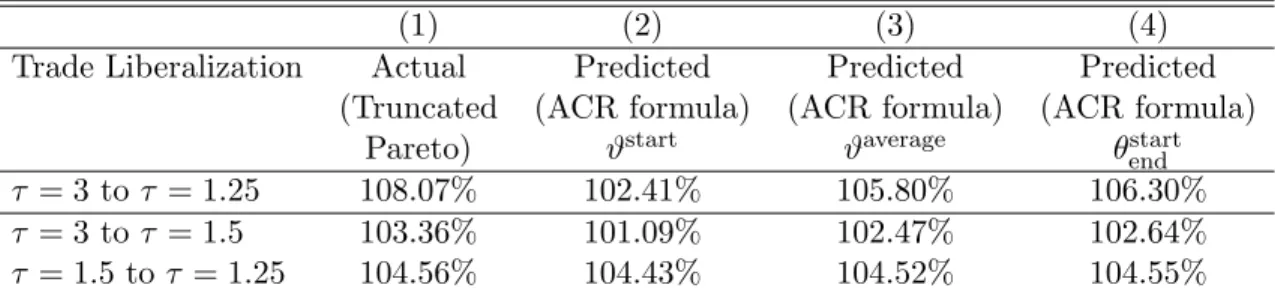
In the previous section, we introduced small deviations from the ACR parameter restrictions and showed how the micro structure then affects the measurement of the welfare gains from trade – even when conditioning on a given trade elasticity and a given domestic trade share. This led to discrepancies between the true welfare effects of trade liberalization and those predicted by the ACR formula. We now illustrate more concretely how such discrepancies may arise when evaluating the welfare gains generated from a few specific trade liberalization scenarios. Our starting point is the heterogeneous firm model with two symmetric countries developed in Section 2. We consider the welfare gains from liberalizing trade first from trade regime T0(τ0, fx0) to T1(τ1, fx1), and then to T2(τ2, fx2). We contrast the true welfare gains from (16) with those measured by a policy analyst who
applies the ACR formula (28). We also contrast the cases of ex post and ex ante policy evaluation using a similar approach to ACR and Costinot and Rodriguez-Clare (2014).
Specifically, we assume that trade liberalization from T0 → T1 is evaluated ex post so that the
domestic trade sharesλT0 andλT1 are observed, and the (arc) trade elasticity therefore can be directly
measured as:12
ˆ
θ01=−
ln
1−λT1
λT1
−ln
1−λT0
λT0
lnτ1−lnτ0
. (35)
The ACR predicted welfare gains from trade are then ˆW01= λT0/λT1
1/θˆ01
. On the other hand, we assume that trade liberalization from T1 → T2 is evaluated ex ante, so the domestic trade share λT2
is unobserved and is recovered from the model using the elasticity ˆθ01. That is, ˆλT2 solves:
ˆ
θ01=−
ln1−ˆλT2
ˆ λT2
−ln1−λT1
λT1
lnτ2−lnτ1
. (36)
Ex ante, the ACR welfare derivation yields predicted welfare gains from trade given by ˆW12 =
λT1/ˆλT2
1/θˆ01
. We assume that the trade costs in the trade regimes T0 and T1 are high enough
to generate export market selection. However, we do not impose this restriction on the hypothetical trade regime T2: A policy analyst may be interested in evaluating the welfare gains from trade for
scenarios that go most (or all) of the way to free trade.
5.1 Scenario 1: Untruncated Pareto Productivity Distribution
We assume thatG(ϕ) is distributed untruncated Pareto(k) and initially assume no change in the fixed export costs: fx0 =fx1 =fx2. Then, the measured elasticity ˆθ01will recover the constant elasticity k,
and ˆW01will exactly measure the “true” welfare gains from theex post liberalizationT0 →T1. Also, if
the hypothetical trade regimeT2 features export market selection (the trade costsτ2 andfx2 are high
enough), then ˆθ01=k will also capture the trade elasticity betweenT1 andT2, and the analyst would
12
When the distribution of productivity drawsG(ϕ) is an untruncated Pareto – a necessary condition for the ACR macro restrictions to hold – there is no difference between the full and partial trade elasticitiesθ andϑ.
also correctly predict the attained domestic trade share in regimeT2. Thus, the predicted welfare gain
ˆ
W12 will again recover the “true” welfare gain from (16).
However, if the trade costs in regimeT2 are low enough – such that all firms export inT2– then the ex ante welfare evaluation will be incorrect. The true trade elasticity drops fromktoσ−1 once there is no export market selection, and this change will not be reflected in the elasticity ˆθ01. Consequently,
the analyst will also incorrectly predict the attained domestic trade share in regimeT2. This transition
between the case of export market selection and no selection represents a violation of ACR’s macro restriction (R3). Yet, this transition occurs endogenously in our model; the only structural change is a reduction in trade costs.
We now consider the case where trade liberalization from T0−T1 involves a change in both the
variable and fixed trade cost. In this case, the measured trade elasticity ˆθ01 will be biased, because
it captures the effects of the change in both the variable and fixed trade costs. In turn, this will generate discrepancies between the true and predicted welfare gains from trade liberalization for both theex post andex ante policy evaluations. This case does not represent any violation of ACR’s macro restrictions; it represents a measurement issue for the trade elasticity.13
5.2 Scenario 2: Truncated Pareto Productivity Distribution
We now assume thatG(ϕ) is distributed Pareto, but that there is a finite upper bound to the support of the productivity distribution (ϕmax < ∞). We return to our initial assumption of no change in
the fixed exporting cost (so fx0 = fx1 =fx2). As we highlighted in the previous section, this small
departure from an untruncated Pareto distribution changes the derivation of the welfare gains from trade from the ACR formula (28) to (33). We abstract from measurement issues for the trade elasticity induced by differences between arc versus point elasticities, and between the full versus the partial trade elasticity. Thus, we assume that the measured elasticity ˆθ01 yields an accurate estimate for any
point partial trade elasticityϑbetweenτ0 and τ1.14
Nevertheless, the analyst will obtain an incorrect measure of theex post welfare gains from trade because both the difference in the hazard ratesγ(ϕd)−γ(ϕx) and the response of entry4lnMewill be non-zero. In our quantitative analysis in the next section, we find the former effect to be substantial while the latter effect is relatively small for our parametrization.
Lastly, we consider the evaluation of an ex ante hypothetical trade liberalization from T1 to T2.
The same discrepancies between the true and predicted welfare gains from trade liberalization as mentioned above for the ex post evaluation will also apply to the ex ante case. In addition, the measured elasticity ˆθ01will no longer apply to changes inτ betweenτ1 andτ2 – even abstracting from
13
ACR note that, in a multi-country world, the trade elasticity can be recovered from the estimation of a gravity equation when variations in bilateral tariffs are observed. This estimation also requires that the variation inanyfixed trade cost that is correlated with the tariffs is also observed. In the absence of controls for this variation in fixed costs, the gravity equation estimation will be subject to omitted variables bias. While the seriousness of this concern depends on the source of variation used, to our knowledge such data on fixed trade costs are not available.
14
In our calibration based on a truncated Pareto distribution in the next section, we find that differences between the arc partial elasticity and the arc full elasticity have a relatively small effect on the measured welfare gains from trade.
the differences between arc versus point elasticities and between the full and partial elasticities: All of these elasticities are different for τ ∈ (τ1, τ2) relative to τ ∈ (τ0, τ1).15 This also means that the
analyst will incorrectly predict the domestic trade share in regimeT2.
In closing, we highlight that all the different trade liberalization scenarios that we have described in this section satisfy the assumptions for our open economy comparative static exercise described in Subsection 3.2. Thus, in all these cases, the extra margin of adjustment in the heterogeneous firm model is operative. Under the ACR parameter restrictions, the trade elasticity is constant and the heterogeneous and homogeneous firm models can be calibrated to both generate the same welfare gains from trade across the two models. Even for small departures from these parameter restrictions, the trade elasticity is not constant, and is not a sufficient statistic for the welfare gains from trade (along with the domestic trade share). Instead, micro structure also matters for the welfare gains from trade and differs between the heterogeneous and homogeneous firm models, because of the extra adjustment margin in the heterogeneous firm model.
6
Quantitative Relevance
In this section, we examine the quantitative relevance of our results. In subsection 6.1, we show that the extra margin of adjustment in the heterogeneous firm model is associated with substantial differences in the aggregate welfare implications of trade between the heterogeneous and homogeneous firm models. In subsection 6.2, we show that the assumption of a constant trade elasticity when the true elasticity is variable can lead to quantitatively relevant discrepancies between the true and predicted welfare effects of trade liberalization.
6.1 Theoretical Comparative Static
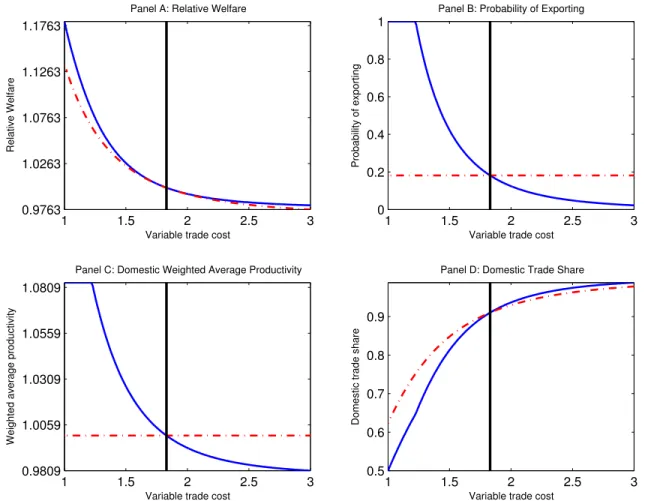
In this subsection, we compare the welfare properties of the heterogeneous and homogeneous firm models holding all structural parameters other than the productivity distribution constant between the two models. We assume an untruncated Pareto distribution for productivity in the heterogeneous firm model; this satisfies the ACR macro restrictions so long as trade costs are high enough to generate export market selection. The homogeneous firm model satisfies the ACR restrictions so long as the fixed exporting cost remains constant. We choose standard values for the heterogeneous firm model’s parameters based on central estimates from the existing empirical literature and moments of the U.S. data. Those same structural parameters then carry over to the homogeneous firm case, except that we set a degenerate productivity distribution as described below.
We set the elasticity of substitution between varietiesσ= 4, which is consistent with the estimates using plant-level U.S. manufacturing data in Bernard, Eaton, Jensen and Kortum (2003). The Pareto shape parameter for the productivity distribution (k) determines the elasticity of trade flows with
15
A growing body of empirical research reports results that are consistent with a variable trade elasticity, including Helpman, Melitz and Rubinstein (2008), Novy (2013), and Head, Mayer and Thoenig (2014). Simonovska and Waugh (2014b) provides evidence that the estimated trade elasticity is model dependent. Imbs and M´ejean (2009) and Ossa (2012) argue that aggregate trade elasticities are influenced by sectoral composition in multi-sector models.
respect to variable trade costs in the heterogeneous firm model under export market selection. We set k = 4.25 as a central value for estimates of the trade elasticity.16 A choice for the Pareto scale parameter is equivalent to a choice of units in which to measure productivity, and hence we normalize
ϕmin = 1.
We consider trade between two symmetric countries, and choose labor in one country as the numeraire (w= 1), which implies that the wage in both countries is equal to one. With an untruncated Pareto productivity distribution, scalingLand{fe,fd,fx}up or down by the same proportion leaves the productivity cutoffs{ϕTd,ϕTx}and the mass of entrants unchanged (Me), and merely scales average firm size (¯r) up or down by the same proportion. Therefore we set L equal to the U.S. labor force and normalizefd to one. With an untruncated Pareto productivity distribution, the sunk entry cost fe affects the absolute levels of the productivity cutoffs and welfare but not their relative levels for different values of trade costs. As a result, the relative comparisons below are invariant to the choice offe, and hence we normalizefe to one.
We calibrate τ to match the average fraction of exports in firm sales in U.S. manufacturing (1+τ1τ−1−σσ = 0.14, as reported in Bernard, Jensen, Redding and Schott 2007), which implies τ = 1.83
(which is in line with the estimate of 1.7 in Anderson and van Wincoop 2004). Given our choice for the parameters{σ, k, ϕmin,fd,fe, τ}, we choose fx to ensure that the model is consistent with the average fraction of U.S. manufacturing firms that export (0.18, as reported in Bernard, Jensen, Redding and Schott 2007).
We choose the degenerate productivity distribution in the homogeneous firm model so that the two models generate the same aggregate variables in an initial equilibrium. In our baseline specification here, we do so for an initial open economy equilibrium using our calibrated values of trade costs of τ = 1.83 and fx = 0.545. Thus we compare the heterogeneous firm model to the extended homogeneous firm model introduced in subsection 3.2. In the web appendix, we undertake a similar analysis for an initial closed economy equilibrium, as analyzed in subsection 3.1.
In our baseline specification here, we solve for the initial open economy equilibrium of the hetero-geneous firm model, including the probability of successful firm entryh1−GϕT0
d i
, the proportion of exporting firms
1−G ϕT0
x
/h1−GϕT0
d i
, weighted average productivity in the export mar-ket ( ˜ϕT0
x ), weighted average productivity in the domestic market ( ˜ϕTd0), and the weighted average productivity of domestic firms ( ˜ϕT0
dx). In the extended homogeneous firm model, we choose the prob-abilities of entry and exporting and the weighted average productivities for domestic and exporting firms to equal to their values in the initial open economy equilibrium of the heterogeneous firm model:
1−G¯x
= 1−G ϕT0
x
, ¯Gdx = h
G ϕT0
x
−G
ϕT0
d i
, ¯ϕx = ˜ϕTx0, and ¯ϕdx = ˜ϕTdx0. All parameters apart from the productivity distribution are held constant across the two models (samefd,fe,fx,τ, L,σ), which implies ¯Fd=fd+fe/
h
1−GϕT0
d i
. The key difference between the two models is that the market entry probabilities and weighted average productivities in each market respond to changes
16
Simonovska and Waugh (2014a) estimate a trade elasticity of 4.10 or 4.27 depending on the data used. Costinot and Rodriguez-Clare (2013)’s benchmark value for the trade elasticity is 5. Any of these values would lead to quantitatively similar results.