8
Reliability
WESTLEY WEIMER and GEORGE C. NECULA University of California, Berkeley
It is difficult to write programs that behave correctly in the presence of run-time errors. Proper be-havior in the face of exceptional situations is important to the reliability of long-running programs. Existing programming language features often provide poor support for executing clean-up code and for restoring invariants.
We present a data-flow analysis for finding a certain class of exception-handling defects: those related to a failure to release resources or to clean up properly along all paths. Many real-world programs violate such resource usage rules because of incorrect exception handling. Our flow-sensitive analysis keeps track of outstanding obligations along program paths and does a precise modeling of control flow in the presence of exceptions. Using it, we have found over 1,300 exception handling defects in over 5 million lines of Java code.
Based on those defects we propose a programming language feature, the compensation stack, that keeps track of obligations at run time and ensures that they are discharged. We present a type system for compensation stacks that tracks collections of obligations. Finally, we present case studies to demonstrate that this feature is natural, efficient, and can improve reliability.
Categories and Subject Descriptors: D.2.1 [Software Engineering]: Requirements Specifications; D.2.4 [Software Engineering]: Software Program Verification; D.2.5 [Software Engineering]: Testing and Debugging; D.3.3 [Programming Languages]: Language Constructs and Features; D.4.5 [Operating Systems]: Reliability
General Terms: Design, Languages, Reliability, Verification
Additional Key Words and Phrases: Error handling, resource management, linear types, compen-sating transactions, linear sagas
This research was supported in part by the National Science Foundation grants CCR-9875171, CCR-0085949, CCR-0081588, CCR-0234689, CCR-0326577, CCR-00225610, and gifts from Mi-crosoft Research.
The information presented here does not necessarily reflect the position or the policy of the Gov-ernment and no official endorsement should be inferred.
Authors’ addresses: W. Weimer, University of Virginia, Department of Computer Science, 151 En-gineer’s Way, P.O. Box 400740, Charlottesville, VA 22904-4740; email:[email protected]; G. C. Necula, University of California, Berkeley, 783 Soda Hall, Electrical Engineering and Com-puter Science Department, Berkeley, CA 94720-1776, USA; email:[email protected]. Permission to make digital or hard copies of part or all of this work for personal or classroom use is granted without fee provided that copies are not made or distributed for profit or direct commercial advantage and that copies show this notice on the first page or initial screen of a display along with the full citation. Copyrights for components of this work owned by others than ACM must be honored. Abstracting with credit is permitted. To copy otherwise, to republish, to post on servers, to redistribute to lists, or to use any component of this work in other works requires prior specific permission and/or a fee. Permissions may be requested from Publications Dept., ACM, Inc., 2 Penn Plaza, Suite 701, New York, NY 10121-0701 USA, fax+1 (212) 869-0481, or [email protected].
C
2008 ACM 0164-0925/2008/03-ART8 $5.00 DOI 10.1145/1330017.1330019 http://doi.acm.org/ 10.1145/1330017.1330019
ACM Reference Format:
Weimer, W. and Necula, G. C. 2008. Exeptional situations and program reliability. ACM Trans. Program. Lang. Syst. 30, 2, Article 8 (March 2008), 51 pages. DOI=10.1145/1330017.1330019 http://doi.acm.org/10.1145/1330017.1330019
1. INTRODUCTION
While software is becoming increasingly important, much of it remains unre-liable. It is easier to fix software defects if they are found before deployment. It can be difficult to use testing, the traditional approach to finding defects early, to evaluate programs in exceptional situations [Sinha and Harrold 1999; Malayeri and Aldrich 2006]. For example, testing coverage metrics may require knowledge of implicit control flow from exceptional situations, and testing er-ror handlers may require special fault-injecting test harnesses [Candea et al. 2003]. We present an analysis for finding a class of program defects that lead to resource-handling failures in exceptional situations. We also propose a new language feature, the compensation stack, to make it easier to fix such defects. We define an exceptional situation to be one in which something external to the program behaves in an uncommon but legitimate manner. For example, a file write may fail because the disk is full or the operating system is out of file handle resources. Similarly, a packet send may fail because of a network breakdown. These examples represent actions that typically succeed but may fail through no fault of the requesting program.1
Modern languages like Java [Gosling et al. 1996], C++[Stroustrup 1991] and C# [Hejlsberg et al. 2003] use language-level exceptionsto signal and handle exceptional situations. The most common semantic framework for exceptions is thereplacement model[Goodenough 1975]. Exception handlers are typically lexically scoped and may be quite labyrinthine. Language-level exceptions in-troduce implicit control flow, a potential source of software defects related to reliability. Our experiments show that some program failures arise from de-fects in the handling of multiple cascading exceptions and in the handling of multiple resources in the presence of a single exception.
Testing a program’s behavior in exceptional situations can be difficult be-cause such situations, often calledrun-time errors, must be systematically and artificially introduced. Not all run-time errors are created equal, however. We present a fault modelthat formalizes which faulty exceptional situations we are considering and when they may occur.
A program can be tested or analyzed by simulating an environment in which faults occur as dictated by the fault model. The desired faults must still be
injected during testing while the program is running. Some have used physi-cal techniques (e.g., pulling a network cable while the program is running to simulate an intermittent connectivity problem) [Candea et al. 2003]. Others have used special program analyses and compiler instrumentation approaches 1Popping an empty stack and dividing by zero are also exceptional situations: our analysis will find defects related to using language-level exceptions for such cases, but we limit our initial discussion to external conditions. See Section 3.2 for more details.
[Fu et al. 2004, 2005] to inject faults at the software or virtual machine level. These testing-based approaches still require indicative workloads and test cases.
We present a static data-flow analysis for finding program defects. The de-fects are reported with respect to both the fault model and also a formal partial-correctnessspecificationof proper resource handling. A defect report from the analysis includes a program path, one or more run-time errors and one or more resources governed by the specification. Such a report claims that if the run-time errors occur at the given points along the program path, the program may violate the specification for the given resources. The analysis is path-sensitive and intraprocedural. It models the flow of control, including the control-flow related to the exceptions in the fault model, precisely. It abstracts away data values and only keeps track of the resources mentioned in the specification. The analysis reported no false positives in our experiments but it can miss real defects. The analysis found over 1,300 defects in over five million lines of code. Based on that work finding defects we propose thecompensation stack, a language feature for ensuring that simple resources and API rules are handled correctly even in the presence of run-time errors. We draw on the concepts of compensating transactions [Korth et al. 1990], linear sagas [Alonso et al. 1994; Garcia-Molina and Salem 1987], and linear types [DeLine and F ¨ahndrich 2001] to create a model in which obligations are recorded at run-time and are guar-anteed to be executed along all paths. By enforcing a certain ordering and moving bookkeeping from compile-time to run-time, we provide more flexibil-ity and ease-of-use than standard language approaches to adding linear types or transactions. We formalize a static semantics for compensation stacks and we present case studies to show that they can be used to improve software reliability.
Aside from providing a unified overview presentation of our previously pub-lished work [Weimer and Necula 2004, 2005] on this subject, this article in-cludes:
— A more detailed fault model (Section 3.2).
— A full description of the data-flow analysis in the presence of typestate speci-fications (Section 5.3), including a discussion of its strengths and weaknesses (Section 5.6).
— Additional experiments on the importance of the defects found (Section 6.3) and effects of our filtering heuristics on false positives and false negatives (Section 6.2).
— A static semantics for compensation stacks (Section 9).
— A discussion of the tradeoffs involved in using compensation stacks to manage resources (Section 9.2).
This article deals with defects in run-time error-handling code that lead to failures under the assumptions given by a fault model. We clarify our use of the relevant terms here to prevent confusion. In this article, we usemistaketo refer to a human action that causes a software fault or defect. Adefectrefers to a flaw in the software system or program that contributes to a failure. Afailurerefers
to an observed unacceptable behavior of a system, such as violating a safety policy.Run-time errorandexceptional situationare used to refer to failures or environmental conditions in the software system or its components that are signaled at the language level. A fault modelrefers to a formal consideration of which run-time errors may occur. Finally,error-handlingcode deals with a signaled run-time error in order to prevent a true failure from occurring.
The rest of this article is organized as follows. We describe the state of the art in handling exceptional situations at the language level in Section 2. In Section 3, we motivate and describe simple specifications and present our fault model for linking run-time errors and language-level exceptions. We build a control-flow graph that includes exceptional control flow in Section 4. We present a static data-flow analysis that uses the fault model and the CFG in Section 5. In Section 6, we present the results of our analysis, including ex-periments to measure the importance of the defects found and the false pos-itives and false negatives associated with the analysis. We discuss finalizers and destructors in Section 7 and highlight some of their weaknesses in this context. In Section 8, we propose the compensation stack as a language fea-ture and describe our implementation. We present a static type system in Section 9 that tracks compensation stacks but not individual resources. In Section 10, we report on case studies in which we apply compensation stacks to run-time error-handling in real programs in order to improve reliability. Section 11 describes a number of important areas of related work and we con-clude in Section 12.
2. HANDLING EXCEPTIONAL SITUATIONS IN PRACTICE
An IBM survey [Cristian 1982, 1987] reported that up to two-thirds of a program may be devoted to handling exceptional situations. We performed a similar survey, examining a suite of open-source Java programs ranging in size from 4,000 to 1,600,000 lines of code (see Figure 9). We found that while exception handling is a lesser fraction of all source code than was previously reported, it is still significant.
We found that between 1% and 5% of program text in our survey was com-prised of exception-handlingcatchandfinallyblocks. Between 3% and 46% of the program text was transitively reachable fromcatchandfinallyblocks, which often contain calls to cleanup methods. For example, if afinallyblock calls a cleanUp method, the body of the cleanUp method is included in this count. While it is possible to handle run-time errors without using exceptions and to use exceptions for purposes other than run-time error handling, com-mon Java programming practice links the two together. Sinha and Harrold [2000] found that on average 8.1% of methods contained exception-handling constructs, while the JESP tool [Ryder et al. 2000] found that 16% of meth-ods contain some kind of exception handling. Later work [Sinha et al. 2004] found patterns associated with complex implicit control flow in all of the sub-ject programs it studied. These broad numbers suggest that handling run-time errors is an important part of modern programs and that much effort is devoted to it.
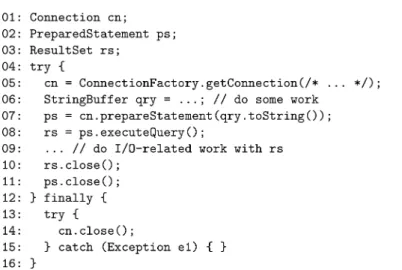
Fig. 1. Ohioedge CRM Exception Handling Code(with defect).
In general, the goal of an exception handler is program-specific and situation-specific within that program. For example, a networked program may handle a transmission exception by attempting to resend a packet, while a file-writing program may handle a storage exception by asking the user to specify an al-ternate destination for the data. We will not consider such high-level policy notions of correctness. Instead, we will consider more generic low-level policies related to resource handling and correct API usage.
2.1 Exception Handling Example
We begin with a motivating example showing how run-time error-handling fail-ures can occur in practice. Consider the Java language code in Figure 1, taken from Ohioedge CRM [SourceForge.net 2003], the largest open-source customer relations management project. This program uses language features designed to handle run-time errors (i.e., it uses nestedtryblocks andfinallyclauses rather than checking and returning error codes, as one might in a C-language program), but many problems remain.Connections,PreparedStatements and
ResultSets are resources associated with an external database. Our
specifica-tion of correct behavior, which we will formalize later, requires the program to
closeeach allocated resource.
In some situations, the exception handling in Figure 1 works correctly. If a run-time error occurs on line 6, the run-time system will signal an exception, and the program willclosethe openConnectionon line 14. However, if a run-time error occurs on line 9, the resources associated withpsandrsmay not be freed.
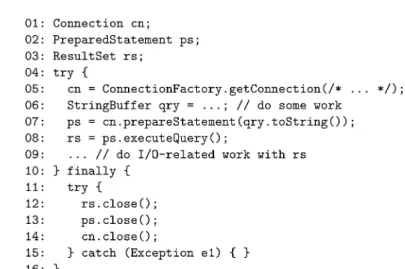
One common solution is to move theclosecalls from lines 10 and 11 into the
finallyblock, as shown in Figure 2. This approach is insufficient for at least
two reasons. First, theclosemethod itself can raise exceptions (as indicated by the fact that it is surrounded bytry-catchand by its type signature), so an exceptional situation while closingrson line 12 might leavepsdangling.
Fig. 2. Revised Ohioedge CRM Exception Handling Code(with defect).
Fig. 3. Nested Try-Finally Ohioedge CRM Exception Handling Code(correct).
The code in Figure 2 may alsoclosean object that has never been created. If a run-time error occurs on line 6 aftercnhas been created, control will jump to line 12 and invokers.close(). Sincershas not yet been allocated, this will signal a “method invocation on null object” exception and control will jump to the catch block in line 15, with the result thatcnis neverclosed.
Using standard language features there are two common ways to ad-dress the situation. The first, shown in Figure 3, involves using nested try
-finallyblocks. One block is required for each important resource that is dealt
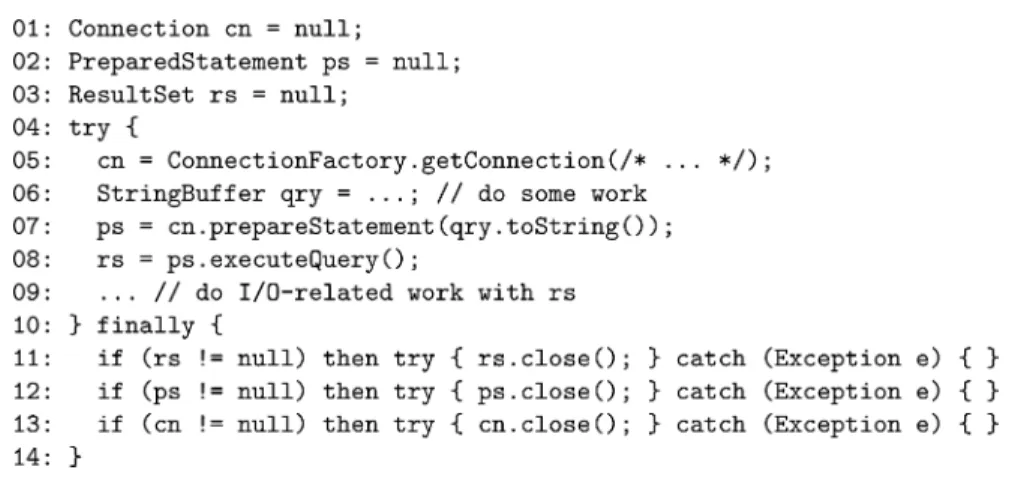
Fig. 4. Run-Time Check Ohioedge CRM Exception Handling Code(correct).
disadvantages, most notably that the code becomes confusing. For example, programs in our survey (see Figure 9) commonly use three to five important resources simultaneously but programmers are rarely willing to use three to five nestedtry-finallyblocks.
The second standard approach uses sentinel values or run-time checks. In Figure 4, the database objects are initialized to the sentinel valuenull. This approach has the advantage that onetry-finallystatement can handle any number of simultaneous resources. Unfortunately, such bookkeeping code of-ten contains defects in practice (see Section 6). For example, if the guarded code contains control-flow, that control-flow must be duplicated in thefinally
clause.
2.2 Exception Handling Example Summary
The Ohioedge CRM code is typical and highlights a number of important obser-vations. First, the programmer is aware of the safety policies:closeis common. Second, the programmer is aware of exceptional situations: language-level ex-ception handling (e.g.,tryandfinally) is used prominently. Third, there are many paths where exception handling is poor and resources may not be dealt with correctly. Finally, fixing the problem typically has software engineering disadvantages: the distance between any resource acquisition and its associ-ated release increases, and extra control flow used only for exception-handling must be included. In addition, if another procedure wishes to make use of
Connections, it must duplicate all of this exception handling code. This
du-plication is frequent in practice: the Ohioedge source file containing the above example also contains two similar procedures that contain the same defects. De-velopers have cited this required repetition to explain why exception handling is sometimes ignored [Brown and Patterson 2003]. In general, correctly deal-ing withNresources requiresNnestedtry-finallystatements or a number of run-time checks (e.g., checking each variable againstnullor tracking progress in a counter variable). Handling such exceptional situations is complicated and error-prone in practice.
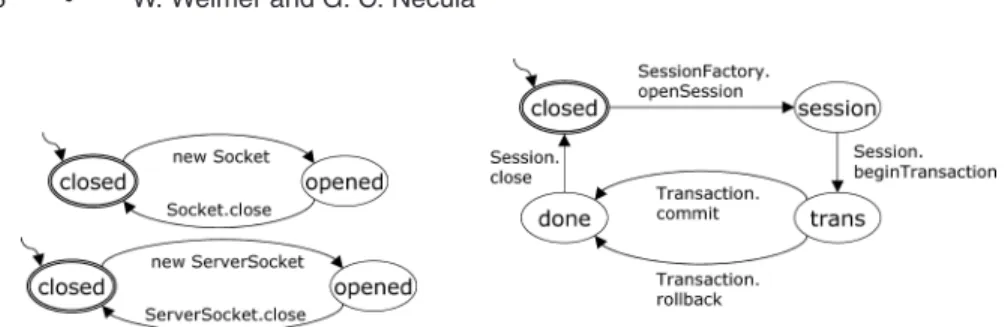
Fig. 5. A manually-derived specification for JavaSocketresources (left) andhibernate Session resources (right).
In the next section, we will use this intuition for what often goes wrong to help formalize a partial model for program behavior.
3. SPECIFICATIONS AND EXCEPTIONAL SITUATION FAULT MODELS
A specification and a fault model are used together by our static analysis to find program defects. Intuitively, the specification describes what the program must do (e.g., free every resource it acquires) and the fault model describes what can go wrong (e.g., division by zero, network congestion).
3.1 Specifications
A specification is a formal description of correct program behavior. In this ar-ticle, we will consider onlypartialspecifications: those that describe a partic-ular aspect of a program’s behavior, such as how it handles certain resources. Full functional specifications are often written in specification languages that are based on formal logic [Abrial et al. 1980]. We will use lighter-weight partial specifications based on finite state machines [Ball and Rajamani 2001a; DeLine and F ¨ahndrich 2001].
We use finite state machines (FSMs) to formalize how how programs should manipulate certain important resources and interfaces. The FSM edge labels represent program events that manipulate the internal states of resources. For example, one event may correspond to the creation of a resource and another may correspond to the disposal of a resource. We associate one FSM specifica-tion with every dynamic instance of such a resource: each resource instance is tracked separately. Resources acquired in loops are still individually governed by the specification.2 Each FSM must end the program in an accepting state or the program is said to violate the specification for that resource instance. In addition, the program violates the specification if if the FSM ever makes an illegal transition.
Figure 5 shows a simple safety specification for JavaSocket objects. Both
Sockets and ServerSockets are based on file handles and should be freed
[Campione et al. 2000]. We formally represent a specification using the 2The specification is separate from the means of enforcing or verifying it. It may be difficult to verify that every resource acquired in a loop is handled correctly, but it is easy to specify.
standard five-tuple finite state machine,S,s0,δ,F[Hopcroft et al. 2000]. The first specification in Figure 5 would be given as:
= {new Socket, Socket.close}
S = {closed, opened}
s0 = closed
δ = {closed, new Socket →opened, opened, Socket.close →closed}
F = {closed}
Figure 5 also shows a more complicated example of a finite state machine spec-ification [Weimer and Necula 2005] governing the use of sessions and transac-tions in thehibernateobject persistence framework [Hibernate 2004]. Correct usage involves opening a session via the factory, beginning a transaction, ei-ther committing or aborting the transaction, and then closing the session. The majority of our standard library policies were simple two-state, two-edge “must callAafter callingB” policies [Engler et al. 2000; Reimer et al. 2004]. Full fi-nite state machines are used instead of suchA–Bpairs in order to specify more complicated resource interactions.
Our standard set of specifications [Weimer and Necula 2004] for using Java library resources includes thesocketpolicy above as well as similar ones for
Streams [O’Hanley 2005], file handles, andJDBCdatabase connections.
As a concrete example, the Oracle9iJDBC Developer’s Guide and Reference makes clear the results of violating theJDBC policy: “The drivers do not have finalizer methods.. . .If you do not explicitly close yourResultSetandStatement
objects, serious memory leaks could occur. You could also run out of cursors in the database.” [Perry et al. 2002] Running out of database cursors lowers transactional throughput not just for the ill-behaved client but for all other clients sharing that database. Programmers are typically very concerned with closing these objects as quickly as possible.
Users of our approach can add their own application-specific specifications by listings0,δ and F (since and S can be inferred) or by using a subset of the syntax of an FSM specification language such as SLIC [Ball and Rajamani 2001b].
3.2 Exceptional Situation Fault Model
Our fault model applies to the operation of software and details which excep-tional situations might arise. Afaultcan be officially defined as “an accidental condition that causes a functional unit to fail to perform its required function.” [General Services Administration 1996] In our model a fault occurs when a method fails to adhere to a resource specification because of the implicit control flow resulting from a checked language-level exception.
Fault models are often related to the specification that is being checked. For example, a security specification related to remote buffer-overrun vulnerabili-ties may assume that an attacker has control over all packets that are received over the network [Wagner et al. 2000], and thus that those packet contents may take on any value. In reality, an attacker may only control some of the incoming packets, but a program that is robust in the worst-case scenario is also robust
under lighter attacks. We will similarly adopt a worst-case fault model based on the assumption that many unlikely or uncommon scenarios will eventually befall a program that is running for a long time.
We wish to observe program behavior in the presence of real-world excep-tional situations like network connectivity problems or database access viola-tions. Typically, however, we have access only to the program source code and cannot mechanically simulate such exceptional situations (e.g., by running the program for a time and then pulling a plug). Thus, we need a way to bridge the gap between real world events and software-level artifacts like exception handles. Previous work by Candea et al. [2003] has found such a connection: “all faults we injected at the network level (e.g., severing the TCP connection), disk level (e.g., deleting the file), memory (e.g., limiting the JVM’s heap size), and database (e.g., shutting DBMS down) resulted [in a checked exception being signaled at the language-level].”
The Java programming language features two types of exceptions:checked
and unchecked[Gosling et al. 1996].Uncheckedexceptions typically describe defects in program logic (e.g., dereferencing a null pointer). We do not include
uncheckedexceptions in our fault model, and thus do not report defects related to them, for two reasons. The primary reason is that defect reports related to hypothetical program executions that include unchecked exceptions are more likely to be false positives. Programs typically have invariants and checks to ensure that such unchecked exceptions do not occur. The presence and correct-ness of such a check is statically undecidable, however, and our fault model is designed to work with lightweight intraprocedural analyses for defect de-tection. We view the elimination of false positives as more important than the completeness of the analysis, and thus do not consider unchecked exceptions.
The second reason we avoid unchecked exceptions is that they do not al-ways have associated handling behavior. For example, our fault model does not consider run-time errors related to memory safety (e.g., array bounds-check violations or null-pointer dereferences), and many techniques already exist to ensure memory safety (e.g., Gay and Aiken [1998], Hauswirth and Chilimbi [2004], Necula et al. [2002b] and Tofte and Talpin [1997]). If desired, our fault model could be refined to include unchecked exceptions for which an enclosing handler exists. It would also be simple to extend the fault model with entire classes of unchecked exceptions (e.g., by treating integer division as a “method” that either returns normally or raises a divide-by-zero exception). In addition, the compensation stacks we will propose in Section 8 help to guard resources and restore invariants in the presence of both checked and unchecked excep-tions. For the purposes of this presentation, however, unchecked exceptions are not part of the fault model.
Checked exceptions, on the other hand, capture our notion of exceptional situ-ations that are beyond the program’s control but that must be dealt with. Among other things, they signal failures related to network connectivity, database transactions, and physical storage, as well as security violations. The Java Type System [Gosling et al. 1996] requires that programmers either catch and han-dle all declared checked exceptions that they might encounter or annotate their code on a per method basis with a list of exceptions that might propagate to
the caller. Checked exceptions are part of the contract associated with a Java interface.
In our fault model, any invoked method can either terminate normally or signal any of its declared checked exceptions. We expect the program to adhere to the specifications for its important resources (e.g.,Sockets,ResultSets) even if a method signals, for example, a checkedSecurityException. This fault model allows for multiple “back-to-back” faults, in which a method invocation inside
acatchorfinallyblock raises an exception.
As a corner case, our fault model forgives all defects when the programmer explicitly aborts the program. A call tojava.lang.System.exitterminates the program and does not flag any defects even if some of the resources have not been properly handled. Programmers are typically not careful about cleaning up resources when they abort a program. We are primarily interested in finding defects in the exception handling of long-running programs and a call toexit
almost invariably means that the programmer has given up on salvaging the situation.
Explicitthrowstatements are considered by our fault model. A program that allocates a resource, throws an exception and never cleans up the resource violates its specification under the assumptions of the fault model.
Many programs rely on proprietary third-party libraries for which neither the source code nor the byte code are readily available to outside analyses.3 Examples include programs that link against proprietary database libraries and strict subsets of commercial programs that are made publicly available. Our analysis formally requires complete interfaces. In practice, however, we have found it useful to employ a heuristic when only partial information is available.
When we do not have the declared list of checked exceptions for a method we either reject the program or adopt a fault model such that our static analysis avoids reporting spurious warnings. We assume that an unknown method can only signal an exception for which there is a lexically enclosingcatch clause. For example:
public int foo(int b) throws IOException { try { b = Mystery(); /* unknown method */ } catch (MysteryException e) { b = 0; } return b;
}
If we do not have the declaration for theMysterymethod in the above code, we will assume that an invocation of theMysterymethod can either terminate normally or signal aMysteryException. We do not assume that either it can signal anIOExceptioneven though the enclosing methodfoodeclares that it may propagate such exceptions.
Our fault model assumes that language-level exceptions can arise from the declared checked exceptions of an invoked method and from explicit throw state-ments. Under our model, every call to a method (regardless of the context or 3Non-obfuscated bytecode is just as good as source code for our purposes.
argument values) can either raise one of its declared exceptions or terminate normally. This fault model may fail to expose real defects but will avoid making hasty conclusions about the presence of defects in the program.
4. BUILDING THE CONTROL FLOW GRAPH
Our fault-finding analysis is detailed in Section 5; this section presents our treatment of control flow in the presence of language-level exceptions. Our control-flow graph (CFG) construction is standard [Aho et al. 1986] except for our handling of method invocations (including constructor calls, etc.) and our handling offinally. This done based on the fault model; our goal in construct-ing the CFG is to admit feasible paths and behaviors under the fault model’s assumptions about exceptions.
We assume a uniquestartnode associated with the method entry point and a unique endnode through which all normal and exceptional control paths must pass before exiting the method (e.g., Necula et al. [2002]): this intu-itively amounts to replacing the methodbodywithtry {start; body;} finally {end;}. For an interprocedural analysis it would be necessary to model a CFG with multiple exit nodes, one per propagated exception type [Sinha and Harrold 2000].
Following the fault model, a method invocation node has an edge leading to the subsequent statement as well as zero or more edges representing possi-ble exceptional situations. To determine these edges, we consider in turn each checked exception declared by the method. For each such exception, we inspect each lexically enclosing catch clause and determine if the type of the raised exception is a subtype of the caught exception. If it is, we add an edge from the method to that catch clause. If it is not, we consider the nextcatchclause. If there are no more enclosingcatch clauses, then the exception can propagate out of the enclosing method and we add a control flow edge to the endnode of the CFG.
Finally clauses are the second complication in our CFG construction. We
must record how control reaches afinallyblock to determine where control flows after that block. In a try-finally statement, the finallyclause is ex-ecuted either if the try clause terminates normally or if the try clause sig-nals an exception. If thetryclause does not signal an exception, control flows normally after thefinallyblock. If thetryclause signals an exception, that exception is normally “re-signaled” after thefinallyclause is executed. How-ever, if the body of the finally clause itself signals a new exception or exe-cutes a returnstatement (or a continue orbreak statement associated with a loop outside the finally), that new control flow overrides the “pending” exception.
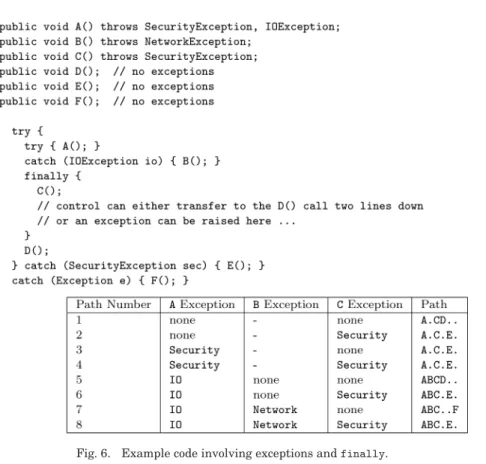
We enumerate each possible path through the example code in Figure 6 to illustrate our combined handling of exceptions andfinally. For this exam-ple we assume thatSecurityExceptions,IOExceptions andNetworkExceptions all derive directly from a base class Exception. In Figure 6, the columns 2–4 record which exceptions were signaled by the methodsA,BorC. A hyphen indi-cates that the method invocation was not reached (and thus could not raise an
Fig. 6. Example code involving exceptions andfinally.
exception) andnoneindicates that the method terminates without raising an exception.
Of the eight control flow paths through the code in Figure 6, only the first is possible if there are no exceptions. Since neitherAnorCsignaled an excep-tion, control passes from the associated finally block to the next statement:D. In all of the other paths the situation is more complicated. Path #2 demon-strates that afinallyblock can itself signal an exception. Path #3 shows that if a tryclause raises an exception thefinally clause must re-raise that ex-ception. Path #4 illustrates a common information-masking complaint about exceptions: without additional information it is not possible to tell atEwhether the exception was raised byAor C. In path #5, the exception signaled byAis caught and is thus not resignaled afterC. Path #6 shows that afinallyclause can signal an exception even after acatch clause has caught or handled one. In Path #7 the exception handler atBitself signals an exception which is resig-naled afterC. SinceNetworkExceptionis not a subtype ofSecurityException,
the catch-clause at E is not appropriate and control transfers to F. Finally,
in path #8, everything that can go wrong does and B’s NetworkException is masked byC’sSecurityException, so control transfers toEinstead of F. The
JSR(jump to subroutine) Java bytecode instruction was designed to implement this behavior [Lindholm and Yellin 1997]. Whiletry-catch-finallyis concep-tually simple, it has the most complicated execution description in the language
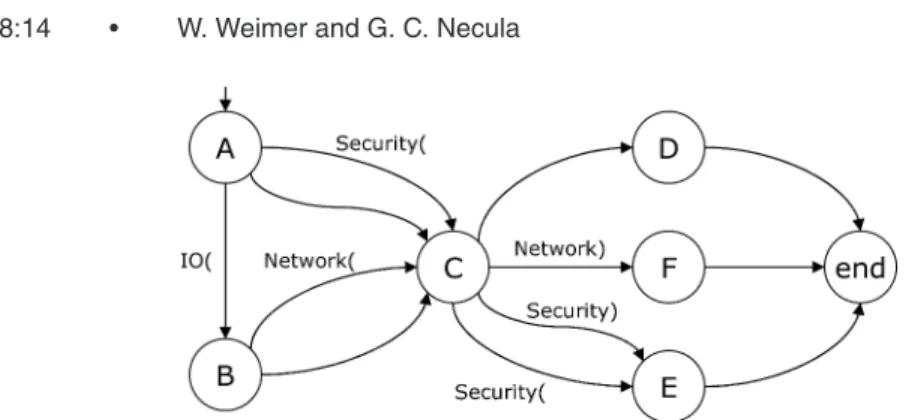
Fig. 7. A control flow graph for the example code involving exceptions and finally. specification [Gosling et al. 1996] and requires four levels of nested “if ”s in its official English description. In short, it contains a large number of corner cases that programmers often overlook.
Applying the CFG construction algorithm given above to the code in Figure 6 yields a CFG similar to the one in Figure 7. Blank edges represent normal control flow. Labeled edges represent exceptional control flow and are labeled with the associated exception. If the graph is interpreted directly it in-cludes some infeasible paths. For example, A-C-F-endis possible in the graph but is not possible in the original code because it involves thefinallyblock at
Cpropagating aNetworkexception that was never signaled along that path. We do not want our analysis to report defects along infeasible paths.
One solution is to duplicate everyfinally block once for each exception it could propagate. This is similar to the common Java compilation technique of “inlining JSRs”. We chose not to adopt that solution because we are interested in a more scalable analysis.
The solution we use involves a variant of context-free language reachability [Reps et al. 1995], as shown in Figure 7. In this framework, a path through the CFG is only valid if is described by a certain context-free language. Context-free reachability is typically used with a language of balanced parentheses to obtain a precise context-sensitive data-flow analysis by matching up method invocations and returns [Reps et al. 1995]. Here we use left parentheses to indicate “normal” or “originally-signaled” exceptions and right parentheses for exceptions that are resignaled after afinallyblock.
The language is more complicated than a simple nested “{n}n” of balanced parentheses because it allows both “{”, representing an exception that is not re-signaled after a finally, and “{}}”, representing an exception that is re-signaled after multiplefinallyblocks. For example, consider the code:
try {
try { throw new A(); }
finally { if (p == 1) throw new B(); }
} finally { p = 0; }
If p==0 on entry, the corresponding string will be “{A}A}A”. If p==1 on entry, the corresponding string will be “{A{B}B”. Both strings represent valid paths. Reps et al. allowed unbalanced parentheses to represent a path with a deeper or
shallower call stack at the end than at the beginning; we use unbalanced paren-theses to capture propagated and overridden exceptions. In our implementa-tion, we compute our path-sensitive data-flow analysis via model-checking and state-space exploration. As a result, we effectively compute the CFL inclusion check by maintaining an explicit stack of pending exceptions to re-signal.
In addition to exceptions,finallyclauses also interfere withreturn,break
andcontinuestatements in a similar manner. For example, if areturn
state-ment is executed inside thetryblock of atry-finally statement the return value is remembered and thefinallyblock is executed. If the finallyblock terminates normally the pendingreturnis “re-signaled”. If thefinallyblock signals an exception (or executes areturnstatement of its own, etc.) it over-rides the pendingreturn. We implementreturn as a special kind of pseudo-exceptionthat can only be “caught” by the end of a method body. Break and
continuestatements are handled similarly except that more types of control
flow (e.g.,whileloops) can “catch” abreak orcontinuepseudo-exception and such pseudo-exceptions do not override normal pending exceptions if the as-sociated loop occurs within the finally. This approach is similar to that of Chatterjee et al. [2001], in which data-flow elements associated withfinally
can have many different forms but the CFG construction remains normal. The CFG construction presented here is strictly less general than the fac-tored control-flow graph approach of Choi et al. [1999], and our data-flow anal-ysis could be modified to work in their context. We consider a much smaller set of exception-throwing instructions: method invocations and instructions that throw checked exceptions. Their approach uses a modified dominance relation and keeps large basic blocks. Large basic blocks are useful for compiler op-timizations and many analyses, but we are specifically concerned with what happens along exception control flow edges and not with improving the pro-gram. As a result, we found it more natural to retain a standard CFG struc-ture in which an instruction dominates all of its successors in the same basic block.
5. DEFECT-FINDING DATA-FLOW ANALYSIS
The goal of our analysis is to find a path from the start of the method to the end where a resource governed by the safety policy is not in an accepting state. The analysis uses the control flow graph constructed according to the fault model as well as the formal specification. The analysis may spuriously report correct code as having defects and may fail to report real defects.
5.1 Analysis Summary and Motivation
The analysis is path-sensitive because we want to consider control flow and because the abstract state of a resource (e.g., “opened” or “closed”) can change from program point to program point. We have chosen to take a fully static approach to avoid the problems of test case generation and the unavailabil-ity of third-party libraries. The analysis is intraprocedural for efficiency since we track separate execution paths. This leads to false positives, but a set of
filtering heuristics (see Section 5.4) does eliminate false positives for our sub-ject programs (see Section 6). Those heuristics may also mask real defects, however. The analysis abstracts away data values, keeping instead a set of out-standing resource states with respect to the specification as per-path data-flow facts. This abstraction can also lead to false positives and false negatives, but stylized usage patterns allow us to eliminate the false positives in practice. At join points we keep data-flow facts separate if they have distinct sets of resources.4We report a violation when a path leaves a method with a resource that is not in an accepting state.
5.2 Analysis Details
Our analysis considers each method body in turn, symbolically executing all code paths, paying special attention to control flow, exceptions and the specification.
Given the control-flow graph, our flow-sensitive data-flow analysis [Fink et al. 2006; Kildall 1973; Das et al. 2002; Engler et al. 2000; Reimer et al. 2004] finds paths along which programs violate the specification (typically by forgetting to discharge obligations) in the presence of run-time errors. We ab-stract away data values, and retain as symbolic data-flow facts a path through the program and a multiset of outstanding resource safety policy states for that path. That is, rather than keeping track of which variables hold important re-sources we merely keep track of a set of acquired resource states. We begin the analysis of each method body with an empty path and no obligations (i.e., resources governed by the specification that are not in an accepting state). If a data-flow fact at the end of method contains outstanding obligations, we term it aviolationand report it.
The analysis is parametric with respect to a single specification
,S,s0,δ,F(see Section 3.1). If a specification contains multiple state ma-chines we check against each one independently; it is simple to extend this algorithm to multiple simultaneous specifications. Given such a safety policy we must still determine what state information to propagate on the graph and give flow and grouping functions. Much like Fink et al. [2006], the ESP [Das et al. 2002], Metacompilation [Engler et al. 2000], and SABER [Reimer et al. 2004] projects, we combine a degree of symbolic execution with data-flow and keep state associated with multiple distinct paths that pass through the same program point.
Each path-sensitive data-flow fact f is a pairT,P. The first componentT is a multiset of specification states. So for eachs∈ T we haves∈ S. We use a multiset because it is possible to have multiple outstanding obligations with respect to a single type of resource. The second component Pis apathor list of program points Lbetween the start of the method and the current CFG edge. The pathP is used to report potential violations.
4In the analysis presented, keeping two states will usually yield a violation later. We present the general join so that if the analysis abstraction is made more precise (e.g., if it captures correlated conditionals) the join will work unchanged.
Fig. 8. Analysis flow functions.
5.3 Flow Functions
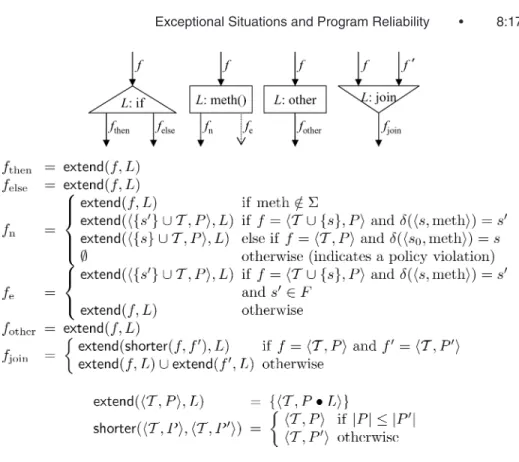
The analysis is defined by flow functions that are determined by the safety policy and are given in Figure 8. The four main types of control flow nodes are branches, method invocations, other statements and join points. Because our analysis is path-sensitive and does not always fully merge data-flow facts at join points, each flow function technically takes a single incoming data-flow fact and computes a set of outgoing data-flow facts. However, in all of the non-join cases the outgoing set is a singleton set. When an edge does contain a non-trivial set of data-flow facts the appropriate flow function is applied element-wise to that set.
We handle normal and conditional control flow by abstracting away data val-ues: control can flow from anifto both thethenand theelsebranch (assuming that the guard does not raise an exception) and our data-flow fact propagates directly from the incoming edge to both outgoing edges. We writeextend(f,L) to mean the singleton set containing fact f with locationLappended to its path. A method invocation may terminate normally, represented by the fnedge in Figure 8. If the method is not one of the important events in our safety policy (i.e., meth∈/) then we propagate the symbolic state f directly. If the method is part of the policy and the incoming data-flow fact f contains a statesthat could transition on that method we apply that transition and then append the labelL. This is similar to the way tracked resources are handled in the Vault type system [DeLine and F ¨ahndrich 2001].
The third possibility for a method involves creating a new important re-source. For example, the first time new Socket occurs in a path we create a new instance of the specification state machine to track the program’s use of
that Socket object. This case and the previous case could be ambiguous if a
constructor function like new Sockethas a separate meaning somewhere else in the specification. We have never seen such a policy in practice and techni-cally require that any outgoing edge label from the start state occur only at the start state (e.g., ∀s0,e ∈ Domain(δ).∀s,e ∈ Domain(δ).e = e → s = s0).
The final case for a method invocation indicates a potential defect in the program. In this case, we have an important event but the analysis is not tracking any resource in a state for which that event is valid. With our sim-ple two-state, two-event safety policies these violations almost always rep-resent “double closes”. With more complicated policies they can also repre-sent invoking important methods at the wrong time (e.g., trying to write to a closed File or trying to accept on an un-boundSocket). When we encounter such a path, we report it and stop processing it to avoid cascading defect reports.
A method invocation may also raise a declared exception, represented by the
feedge in Figure 8. Note that unlike the successful invocation case and as per our fault model, we do not typically update the specification state in the out-going data-flow fact. This is because the method did not terminate successfully and thus presumably did not perform the operation to transform the resource’s state. However, as a special case, we allow an attempt to “discharge an obliga-tion” or move a resource into an accepting state to succeed even if the method invocation fails. Thus, we do not require that programs loop aroundclose func-tions and invoke them until they succeed. Since no programs we have observed do so, it would create spurious defect reports. The checks ∈ F requires that the result of applying this method would put the object in an accepting state.
The join function tracks separate paths through the same program point provided that they have distinct multisets of specification states. Our join func-tion uses theproperty simulationapproach [Das et al. 2002] to grouping sets of symbolic states. We merge facts with identical obligations by retaining only the shorter path for defect reporting purposes (modeled here with the function
shorter(s1,s2)). We may visit the same program point multiple times to analyze paths with different setsT.
To ensure termination, we stop the analysis and report a defect when a program point occurs twice in a single path with different obligation sets (e.g., if a program acquires obligations inside a loop). For the safety poli-cies we considered, that never occurred. We did encounter multiple programs that allocated and freed resources inside loops, but the (lack of) run-time er-ror handling was always such that an exception would escape the enclosing loop.
For each f = T,Pthat goes in to the end node of the CFG, if∃s∈T.s∈/ F
the analysis reports a candidate violation along pathP. In addition, it is possible to report violations earlier in the process (e.g., double closes).
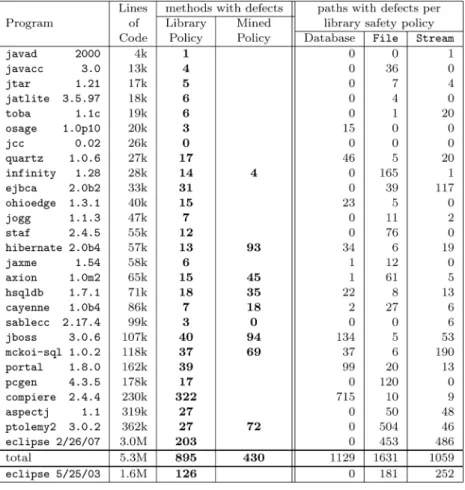
Fig. 9. Run-time error-handling defects by program and policy. The “Defects” columns indicate the total number of distinctmethodsthat contain violations of various policies. The “Database”, “File”, and “Stream” columns give the total number of acyclic control-flowpathswithin those methods that violate the given policy. Results from an older version ofeclipseare provided for comparison purposes but are not included in the “total” row.
5.4 Defect Report Filtering
Finally, we use heuristics as a post-processing step to filter candidate viola-tions. The analysis as presented finds intraprocedural violations of the policy with respect to the fault model, but it may also point out spurious warnings. A spurious defect report is called afalse positive. Based on a random sample of two of our benchmarks, 30% of the defect reports produced by our analysis as presented before are false positives. We believe that number to be unaccept-ably high. Based on an exhaustive analysis of the false positives reported by this analysis, we designed three simple filtering rules, which eliminate all false positives in our twenty-seven benchmark programs (see Figure 9) and two case studies (see Section 10).
(1) Conditional. Every time the path passes through a conditional of the formt = nullwe look for a state s∈ T where s∈/ F andsrepresents an object of typet. If we find such a state we remove it fromT. This addresses the very common case of checking fornullresources:
if (sock != null) try { sock.close(); } catch (Exception e) {}
We assume that a path in whichtwas verified to benulldoes not make any further use of it. Since our analysis ignores data values, it would report a false positive in such cases.
(2) Field. We examineLfor assignments of the formfield = t. For each such assignment we remove one non-accepting state of type t from T. When important resources are assigned to object fields, that object sometimes contains a separate “cleanup” method that is charged with releasing those resources. We assume that such a cleanup method always exists and is called later; we may thus miss real defects.5Such cleanup methods are com-mon in our experience. For example, theSessionImplclass of thehibernate
program (see Section 6) features a method calledcleanup()that sets one Boolean field to false and then invokes theclear()method of the objects associated with nine other fields.
(3) Return. If L contains a return t, we remove one non-accepting state of typetfromT. Methods with suchreturnstatements are effectively wrap-pers around the standard library constructors and the obligation for han-dling the resource falls to the caller. While we did observe many such con-structor wrappers we did not observe any “decon-structor” wrappers, so we do not similarly remove obligations based on values passed as function argu-ments. If our analysis were interprocedural we would not need this filtering rule.
If the set T has been depleted so as to contain only states s ∈ F, there is no candidate violation and nothing is reported. These three simple filters eliminate allfalse positives we encountered but could cause this analysis to miss real defects. Based on a random sample of two of our benchmarks as well as an in-depth analysis of false positives on a version ofeclipse, applying these three filters causes our analysis to miss between 5% and 10% of the real defects (see Section 6.2).
5.5 Usability
We have implemented our analysis in a tool that reports potential error-handling defects in Java programs with respect to our fault model and vari-ous safety policies. The tool comes with a predefined set of standard library policies. Users can also define additional policies by giving the policy a unique name and listing the resources and transitions involved. For simple two-state safety policies, this reduces to listing the acquire and release functions; larger 5We could refine this heuristic by searching for a “cleanup” method that calls the appropriate field.close(), but we would still need to prove that the cleanup method is eventually called later, possibly in another method, which is beyond the scope of our lightweight intraprocedural analysis.
policies are defined as a table of transitions. For example, theSocketportion of the policy in Figure 5 is represented as a small text file:
Socket // policy name
simple_policy // is a simple two-state policy
java/net/Socket.java Socket // acquire function
java/net/Socket.java close // release function
More verbose syntax is available for specifying compilation units declaring mul-tiple classes or for concepts such as “or any subclass of this class.” The tool is invoked on a set of policy names and Java files.
The analysis is exponential in the worst case but quite efficient in practice. For example, performing this analysis, including parsing, typechecking and printing out the resulting defect paths, took 104 seconds and 46 MB of memory on a 1.6 GHz machine for thehibernate program. That program has 7,038 methods, totaling 57,580 lines of code, with an average method size of 8.18 lines and a largest method size of 350 lines. As a second example,eclipse 3.2.2
involves 23,801 methods and three million lines of code. The average method size is 13.34 lines and the largest method is 1,649 lines; the total analysis time including parsing was 350.8 seconds on a 3.6GHz Pentium4.
Each defect report is given its own context listing its compilation unit and the relevant resources (policies) and exceptions involved. The path P is given using source-code line and column offsets; calls to methods, thrown exceptions and filtering heuristic information are included in the path list. Additional information, such as a ranking of exceptions by the number of times they occur in defect reports and the number of times they are handled successfully, is also given.
5.6 Analysis Weaknesses
The analysis as presented includes a number of sources of false positives and false negatives. First, even before the analysis itself is used, our fault model (see Section 3.2) does not consider implicit control flow paths from unchecked exceptions (such asDivisionByZero). The analysis may thus miss defects along such paths. Second, the filtering heuristics can introduce false negatives by masking legitimate defect reports. Third, the intraprocedural nature of the analysis can lead to false positives, as the analysis will flag both the caller and the callee procedure if a resource is passed between them.6Finally, abstracting data values can create both false positives and false negatives. For example, the analysis will not report a defect associated with creating two resources and then freeing the second one twice.
A number of simple improvements could be made to the analysis without reducing its efficiency. For example, the analysis might be combined with an alias analysis so that data values are not abstracted away completely but in-stead dealt with by equivalence classes of aliases [Das et al. 2002; Fink et al. 6Our intraprocedural analysis can also have false negatives if a called method throws an exception that is not declared in its interface, but such situations are not part of our fault model (which includes only declared checked exceptions).
Fig. 10. Example simple two-state application-specific policies.
2006]. As a second example, for method bodies without loops, the analysis might take a symbolic execution-style approach and associate predicates with data-flow facts to avoid false positives associated with correlated conditionals. Such an improvement might obviate the need for theConditionalfiltering heuristic.
Despite these weaknesses, the analysis as presented is certainly applicable to general Java programs that use standard library and program-specific re-sources in the presence of language-level exception handling, especially since most such programs treat resources in a highly idiomatic manner. We discuss the analysis results in the next section.
6. POOR HANDLING ABOUNDS
In this section we apply the analysis from Section 5 and the specifications from Section 3.1 to show that many programs have defects in their handling of ex-ceptional situations. We consider a diverse body of twenty-seven Java programs totaling over five million lines of code. Most of the programs were taken from the Sourceforge open source program repository [SourceForge.net 2003]. The programs include databases, business software, networking applications and software development tools.
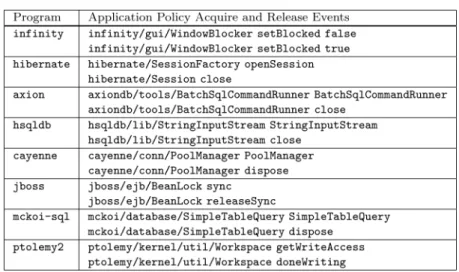
Figure 9 shows results from this analysis. The “Defects” column shows the number of methods that violate at least one policy. We applied our three library policies to all of the programs.7 The largest standard library policy used in our experiments has 11 edges and 8 states and describes the JDBC database interface. In addition, for nine of the programs, totaling 1 million lines of code, a total of 69 program-specific policies (found via specification mining [Weimer and Necula 2005]) were also available. Figure 10 shows indicative examples of some two-state application-specific policies used.
7We also applied theSocketpolicy from Figure 5 and found 14 paths with violations in 4 of the programs. Since the number ofSocketviolations is low when compared to the other policies we will not discuss them directly.
In the larger programs, much of the application logic did not interact with our library policies. For example, ineclipseandptolemy2only 10% of the source files mentioned resources covered by those safety policies. We find many more defects inptolemy2when usingptolemy2-specific specifications, and thus more frequently occurring, mined policies.
Figure 9 includes every defect report that was not filtered out using the heuristics from Section 5.4. All of the methods with defects were manually inspected to verify that they contained at least one defect. This inspection as-sumed that a method could raise any of its declared exceptions (i.e., it used the same fault model discussed in Section 3.2). The heuristics eliminate all false positives that the analysis would report on these programs. Thus, from the perspective of our fault model, there are zero false positives in Figure 9. The heuristics cause some false negatives; we present detailed results about them in Section 6.2.
All paths in Figure 9 arose in the presence of exceptions the program did not handle correctly. More than half of these paths featured some sort of exception handling (i.e., the exception was caught), but the resource was still leaked. This demonstrates that existing exception handlers often contain defects.
The most common problematic exception was the JavaIOException: it oc-curred somewhere in 597 of the defects paths and was the final, uncaught excep-tion in 474 of them. TheSQLExceptionwas a close second, occurring in 877 paths and going uncaught in 114 of them. Although theSQLException occurred on more paths, we rank by counting unique methods with errors. There were more individual methods with bad handling ofIOException, while a smaller number of methods that involvedSQLExceptiontended to feature many hidden control-flow paths involving that exception. WhileIOExceptions are more problematic in absolute terms, it appears to be more difficult to handleSQLExceptions cor-rectly. TheSecurityException was third with 86 mentions and 68 uncaught instances. These numbers show that programs have some sort of error han-dling (e.g.,SQLExceptions are caught) but that the handling code itself is not always correct.
A single path may violate multiple safety policies: for example, along an exceptional path the program might forget to close aSocketand aResultSet. Since the leftmost policy in Figure 9 is presumed to be more important, such cases are categorized in favor of it. To give one example, of the 59 possible defect paths reported in hibernate, 34 involved violating multiple policies along a single path with up to 4 forgotten resources at once. All of the defects that we report could have been fixed with flags or nestedtry-finallystatements. However, fixing those 32 paths fromhibernatewould require four nestedtry
-finallystatements or multiple separate flags. Defects that cross safety policies
argue strongly for the need to have an error-handling mechanism that supports multiple resources in sequence.
6.1 Sample Defects
We briefly illustrate two indicative defects found by our analysis. In many cases, language-level exception handling is omitted, as in this example fromaxion’s
ObjectBTreeclass:
01: public void read() throws IOException, /* ... */ { 02: File idxFile = getFileById(getFileId());
03: // ...
04: FileInputStream fin = new FileInputStream(idxFile); 05: ObjectInputStream in = new ObjectInputStream(fin); 06: // ...
07: in.close(); 08: fin.close(); 09: }
This happens even though thethrowsannotation on line 1 and extant han-dling in other methods mean that the programmer is aware of the possibility of run-time errors. Such examples show that it would be useful to have an automatic mechanism that does the right thing in common cases with no pro-grammer intervention.
We also encountered instances of try-finally statements that protect some, but not all, operations, as in this example from eclipse 3.2.2’s
JNIGeneratorAppclass (all comments added for emphasis):
01: void output(byte[] bytes, String fileName) throws IOException { 02: FileInputStream is = null;
03: try {
04: is = new FileInputStream(fileName);
05: if (compare(new ByteArrayInputStream(bytes), 06: new BufferedInputStream(is))) return;
07: } catch (FileNotFoundException e) { } // ignored exception 08: finally {
09: try { if (is != null) is.close(); }
10: catch (IOException e) {} // ignored exception 11: }
12: FileOutputStream out = new FileOutputStream(fileName);
13: out.write(bytes); // no try
14: out.close(); // no finally
15: }
Care is taken to deal with run-time errors that occur on lines 3–11 whenis
is created and used the first time, but writing toouton line 13 is done without an enclosing try-finally. Successfully opening fileNamefor reading on line 4 does not guarantee that opening it for writing on line 12 and writing to it on line 13 will succeed. Such examples show that it would be useful to have a mechanism for fine-grained control of some error handling but automatic behavior for others. Additional examples of detected errors can be found in Weimer and Necula [2004].
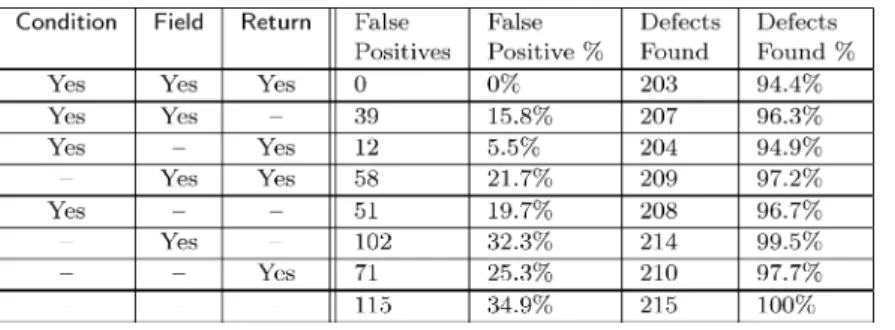
Fig. 11. Number of false positives reported and defects found oneclipse 3.2.2as a function of filtering heuristics used.
6.2 Filtering Experiments
The defects that we are prevented from seeing can be as interesting as those that are reported. We conducted a series of experiments to determine how many false positives were eliminated by our filtering heuristics and how many false negatives were created by those same heuristics. Figure 11 shows the result of turning off various combinations of our filtering heuristics when applying our analysis toeclipse 3.2.2 2/26/07. Thus theReturnheuristic eliminates at least 39 false positives (or 34% of the total potential false positives), the
Fieldheuristic eliminates at least 12 false positives (or 10%), and theCondition
heuristic eliminates at least 58 (or 50%).
Note that a candidate defect report can contain properties related to multiple heuristics and can thus be filtered by either one. For example, there are 12 false positives withoutFieldand 58 false positives withoutCondition, but if both are eliminated then there are 71 (not 70) false positives total. There is thus one potential defect report that involves both storing the object to a field and also checking the object againstnull. The total number of false positives that could be filtered by more than one rule is small (6 out of 115, or 5%).
Figure 11 shows potential incremental benefits in terms of finding more de-fects. In this experiment the false negative rate for using the three heuristics was 5.5%. If the user is willing to accept a 35% false positive rate, the number of real defect reports dropped by the filtering rules drops to zero. Disabling the
Conditionseems to be a reasonable point of compromise: the false negative rate drops below 3% and the false positive rate is just above 20%. It is our opinion that software ships with known defects [Liblit et al. 2003] and that making the tool and analysis easy to use by having no false positives is more impor-tant than finding 5% to 10% more defects. In a verification or safety-critical setting, however, removing sources of false negatives would be of paramount importance.
6.3 The Importance of Detected Defects
Even if a defect is not a false positive and represents an actual violation of the policy, it may not be worth the development organization’s time to fix the defect. Defects that are perceived as unlikely to affect real users often go unfixed at many points in the development cycle because of the perceived dangers of
code churn and because there are enough “dangerous” defects to fix to keep programmers occupied.
We report resource leaks along paths that contain one or more run-time errors. We must thus demonstrate that these defects are a serious problem “in the real world”. Unfortunately, a thorough evaluation of the importance of a defect and the frequency of its occurrence at runtime is beyond the scope of this work and is typically situation-specific. Aspects such as the performance or security impact of a defect or the cost of fixing it can be difficult to measure quantitatively. We present some evidence to suggest that the defects we report are important.
One of the authors ofptolemy2ranked the defects that we found on his own five point scale. For that program, 11% of the reported defects were in tutorials or third-party, and thus unimportant, code; 44% of them rated a 3 out of 5 for taking place in “little used, experimental code”; 19% of them rated a 4 out of 5 and were “definitely a bug in code that is used more often”; and 26% of them rated a 5 out of 5 and were “definitely a bug in code that is used often.” The 45% of the defects that rated a 4 or 5 were fixed immediately. The granularity for “code that is used often” was module-level (e.g., “engine” vs. “testing”), and thus even a defect in an important module might lie on an uncommon path. The author claimed that for his long-running servers resource leaks were a problem that forced them to reboot every day as a last-ditch effort to reclaim resources. We cannot claim that this breakdown generalizes, but it does provide one concrete example.
We also performed a so-calledtime travelexperiment to determine whether the defects found by our analysis were important enough to fix. The direct experiment of finding defects, reporting them to developers and then count-ing how many are fixed is difficult to perform, especially in the open-source community.
We used archival copies and version control systems to obtain a snapshot
ofeclipse 2.0.0from July 2002 as well as a snapshot ofeclipse 3.0.1from
September 2004. We then ran our analysis oneclipse 2.0.0and chose at ran-dom 100 of defects reported. Without reporting any of the defects toeclipse
programmers we then looked for those defects ineclipse 3.0.1to see if they had been fixed by the natural course ofeclipsedevelopment. In our case, 43% of the defects found by our tool in eclipse 2.0.0had been fixed byeclipse
3.0.1. Between those versionseclipseunderwent many refactorings, so
man-ual inspection was necessary because defective code had often moved from one class to another. Given our stated goal of improving software quality by finding and fixing defects before a product is released, this number is important and helps to validate our analysis, our fault model and our specifications. Combined with our zero false positive rate it suggests that using our analysis is worth-while because almost half of the defects it reports would have to be fixed later anyway.
It is difficult to obtain numbers indicating what fraction of the defects re-ported were later fixed for various defect-finding research projects. Our two experiments suggest that 44–45% of the defects we report are considered real by developers. As one external datapoint, the FindBugs project [Hovemeyer
and Pugh 2004] produced 300 warnings when applied to a 350,000-lines-of-code Java financial application and the development team considered 17% of them to be real defects.
7. DESTRUCTORS AND FINALIZERS
Before proposing a new language feature to simplify the programming of re-source reclamation in the presence of exceptions, we must consider the advan-tages and disadvanadvan-tages of existing approaches. Based on the defects found by our analysis, we claim thattry-finally blocks are ill-suited for handling certain classes of resources in the presence of run-time errors. A more detailed characterization of the defects found by our analysis can be found in previous work [Weimer and Necula 2004]. In essence, however, exceptions create hidden control-flow paths that are difficult for programmers to reason about [Sinha and Harrold 2000; Sinha et al. 2004; Gupta et al. 2000; Choi et al. 1999; Robillard and Murphy 2003].
Destructors and finalizers are other existing programming language features that can help programs deal with resources in the presence of run-time errors. A destructor is a special method associated with a class. Destructors are typically used with the language C++[Stroustrup 1991] but are also present in other languages like C# [Hejlsberg et al. 2003]. When a stack-allocated instance of that class goes out of scope, either because of normal control flow or because an exception was raised, the destructor is invoked automatically. Destructors are tied to the dynamic call stack of a program in the same way that local variables are. Destructors thus provide guaranteed cleanup actions for stack-allocated objects even in the presence of exceptions. However, for heap-stack-allocated objects the programmer must still remember to explicitly delete the object along all paths. We would like to extend destructors: rather than one implicit stack tied to the call stack, programmers should be allowed to manipulate first-class collections of obligations.
In addition, we believe that programmers should have guarantees about managing objects and actions that do not have their lifetimes bound to the call stack (such objects are common in practice—see, for example, Gay and Aiken [1998]). In many domains, multiple stacks are a more natural fit with the application. For example, a web server might store one such stack for each concurrent request. If the normal request encounters an exceptional situation and must abort and release its resources, there is generally no reason that another request cannot continue. Destructors can be invoked early, but would typically have to include a flag to ensure that actions are not duplicated when it is called again. We believe such bookkeeping should be automatic. Destructors are tied to objects and there are many cases where a program would want to change the state of the object, rather than destroying it. We shall return to that consideration in Section 8.2.
Afinalizeris another special method associated with a class. Finalizers are typically used with Java [Gosling et al. 1996] but are also present in other lan-guages like C# [Hejlsberg et al. 2003]. A finalizer is invoked on an instance of a class when that instance is about to be reclaimed by the garbage collector.