Digital Library Federation
Council on Library and Information Resources
Washington, D.C.
A Biography
ISBN 1-887334-95-5
Second edition December 2002 First edition September 2002
Published by: Digital Library Federation
Council on Library and Information Resources 1755 Massachusetts Avenue, NW, Suite 500
Washington, DC 20036 Web site at http://www.clir.org
Additional copies are available for $20 per copy. Orders must be placed through CLIR’s Web site. The paper in this publication meets the minimum requirements of the American National Standard for Information Sciences—Permanence of Paper for Printed Library Materials ANSI Z39.48-1984.
Copyright 2002 by the Council on Library and Information Resources. No part of this publication may be reproduced or transcribed in any form without permission of the publisher. Requests for reproduction should be submitted to the Director of Communications at the Council on Library and Information Resources.
8
About the Authors
Daniel Greenstein is university librarian for systemwide library planning and scholarly information and director of the California Digital Library (CDL). Before joining the CDL in May 2002, he served for two and a half years as director of the Digital Library Federation, during which time he conducted research for this report. Mr. Greenstein was a founding director of the Arts and Humanities Data Service in the United Kingdom, and founding co-director of the Resource Discovery Network, a distributed service whose mission is to enrich learning, research, and cultural engagement by facilitating new levels of access to high-quality Internet resources.
Suzanne E. Thorin is the Ruth Lilly University Dean of University Libraries at Indiana University. From 1980 to 1996, she served on the staff of the Library of Congress (LC). From 1992–1996 she was the LC chief of staff and the associate librarian. At LC, Thorin served as the official U.S. representative, appointed by the White House, for the G-7 electronic libraries project, one of eleven G-7 pilot projects for the Global Information Society. She was also responsible for the National Digital Library Program.
Contents
Acknowledgments...iv
Preface ... v
SECTION 1: The Biography Introduction ... 1
Aspiration and the “Skunk Works”: The Young Digital Library ... 3
Origins ... 3
Mission ... 4
Leadership and Ownership ... 4
Organizational Location ... 6
Funding ... 8
Characteristics ... 9
Innovation ... 9
Quest for “Killer Apps” ... 10
Competition ... 10
Rolling Projects into Programs: The Maturing Digital Library ... 11
Characteristics ... 12
Interest in Modular Systems Architecture ... 12
Desire for Common Standards ... 13
Focus on the User ... 14
Technical and Organizational Integration ... 15
Marketing and Promotion ... 20
From Integration to Interdependency: The Adult Digital Library ... 22
Digital Libraries as Infrastructure ... 22
Move Toward Permanent Funding ... 23
Continued Experimentation ... 23
Deep Interdependency ... 24
Off-Campus ... 24
On-Campus ... 26
Competition Within the University ... 27
Archiving University Information ... 27
Instructional Technologies ... 28
Conclusion ... 29
SECTION 2: Case Studies California Digital Library (University of California) ... 33
Harvard University ... 37
Indiana University ... 42
New York University ... 48
University of Michigan ... 52
University of Virginia ... 58
References ... 62
APPENDIXES Appendix 1: Survey Respondents ... 64
Acknowledgments
This report was born in the spirit of congenial collaboration that so character-izes the Digital Library Federation (DLF). The idea for the study took shape in a New York City steakhouse where four DLF directors met to reflect on the new roles and responsibilities that were emerging for their libraries as they entered an increasingly networked digital age.1 Realizing that lessons from the past were easier and perhaps more predictive than prognostications about the future, they suggested that a study of DLF member programs would re-veal the history, aims, organization, and immediate challenges in their libraries.
The study progressed quickly, following the development of a lengthy (104-question) survey that was received and completed without complaint at DLF member institutions. We learned subsequently that numerous hands had to be called into play to supply the answers to the questions we posed. Once compiled, the data provided a rich source of information that indicated the very different developmental trajectories and experiences in DLF institutions. Review by a slightly broader group of library directors suggested that the study be extended to include the case studies that are presented here.2 These, they argued, would breathe the life of human experience into otherwise dry, if informative, statistical data. The research was destined from this point to impose even more heavily on already overcrowded schedules that were opened graciously and with the utmost concern for congenial hospitality to accommodate the authors’ site visits.
In addition to the support we received from the library community, we acknowledge the assistance of the Center for Survey Research at Indiana Uni-versity, which produced, compiled, and analyzed the data. With a Herculean effort, Doug McKinney, Assistant to the Dean at Indiana, summarized the survey data and offered numerous insights into their meaning. The case stud-ies benefited from the wisdom, experience, and gracious hospitality of DLF colleagues too numerous to name at the California Digital Library, Harvard University, New York University, Indiana University, the University of Michi-gan, and the University of Virginia. At the Council on Library and Informa-tion Resources (CLIR), Kathlin Smith provided welcome encouragement and sound editorial direction. Cassie Savage, of CLIR, and Shawny Taysom, of Indiana University, ensured that the authors met deadlines and stayed in touch through the course of the investigation. Despite the best efforts of all the aforementioned, this report will sadly be lacking in ways that can be at-tributed uniquely to its authors.
Daniel Greenstein, California Digital Library Suzanne Thorin, Indiana University
1 Nancy Eaton, Pennsylvania State University; Tom Shaughnessy, University of Minnesota; Suzanne Thorin, Indiana University; Daniel Greenstein, DLF.
2 Peter Botticelli, Cornell University; Nancy Eaton; Elaine Sloan, Columbia University; Suzanne Thorin; Duane Webster, Association of Research Libraries; Wendy Lougee, University of Michigan; Bill Forden, University of Washington; Marty Runkle, University of Chicago; Bill Britton, University of Tennessee; and Daniel Greenstein.
Preface
Deanna B. Marcum President, CLIR
Digital libraries, once project based and largely autonomous efforts, are ma-turing. They are finding value in cooperating with other units on campus, and their services are being promoted in the broader academic community. Many are obtaining core funding. Although digital libraries have a long way to go before they reach their full potential, there has been significant devel-opment in the past decade. Nonetheless, referring to the digital library gener-ically masks the fact that digital libraries exist in diverse forms and with quite different functions, priorities, and aims. As individual programs have matured, each has developed its own personality, reflecting the circumstanc-es of its birth, its environment, its caretakers, and its leaders. This report draws on the results of a survey and case studies of DLF members to reveal how these influences have molded a range of organizational forms that we call the digital library.
Precisely because of the distinctive quality of the programs surveyed, it may seem odd that we have chosen to title this report “A Biography,” rather than “Selected Biographies.” Digital libraries are likely to retain their distinc-tiveness even as they become more deeply integrated and build upon com-monly available collections and services to meet users’ needs. But it is worth considering, as the authors do, where the developmental trajectory will lead, and it is worth thinking about how we will describe the body of information that is being made available for research and teaching through the efforts of numerous not-for-profit institutions. We have learned that users of electronic resources do not care where their information comes from, as long as it is au-thoritative and authentic. I suspect the user will refer to this rich and grow-ing body of information not as a collection of individual efforts, but as one digital library.
D
igital libraries are new, and investment in them is fraught with unknowns. Consequently, librarians and library direc-tors are hungry for information about different institutional experiences, including what digital library investments are consid-ered good, meaningful, and cost-effective, and what influences have helped shape successful digital library programs.To respond to these needs, the Digital Library Federation (DLF) undertook a study of its members’ digital library programs.1 The survey was intended to document how DLF member libraries are focusing their digital library programs: how and under what circum-stances their programs were initiated; the influences that shaped their development; the programs’ current organization and funding; and the challenges they anticipate. The primary aim of the study was to help inform libraries in their strategic planning and help them as-sess their own programs in light of what others have set out to achieve. The study had a number of secondary aims as well; for ex-ample, to identify what new roles are emerging for academic librar-ies; to assess the opportunities and pitfalls that may be associated with these new roles; and to help libraries promote themselves to their faculties and to the university administrators to whom they report.
The study began with a survey questionnaire circulated to the academic libraries that were members of the DLF in January 2001. Twenty-one institutions responded.2 The data they supplied were illuminating on several points, including the different approaches that libraries have taken to build their digital library programs and the extent to which the complexion of any program is tied to campus personalities, circumstances, and needs (Greenstein, Thorin, and McKinney 2001). The data compelled a closer look at the softer influ-ences not so readily identified by a survey. Accordingly, extensive interviews were conducted with key staff members at six DLF mem-ber libraries: the California Digital Library (CDL), Harvard
Universi-1 The survey instrument can be viewed at: http://www.diglib.org/roles/ survey1a.htm.
2 A list of these libraries appears in Appendix 1.
SECTION 1:
THE BIOGRAPHY
ty, Indiana University, New York University (NYU), the University of Michigan, and the University of Virginia.
These six programs were selected because they represented dis-tinct variations in attributes that the survey identified as being po-tentially key determinants of a program’s distinctiveness. Among those attributes is age. Virginia and Michigan are two of the oldest digital library programs in the United States. NYU was included be-cause it is a relatively new program, begun in earnest only in the last two years. Harvard and Indiana represent the middle-age members of the sample.
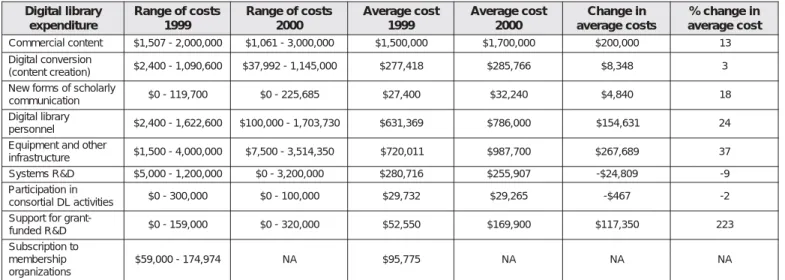
Another distinguishing characteristic is a program’s orientation— that is, the main focus of its work. Not all digital libraries focus pri-marily on digitally reformatting analog items in their collections and distributing them online. Harvard and NYU, while possessing digiti-zation capacity, focus principally on providing systems environ-ments and infrastructure capable of managing digital assets as may be acquired or used within their host institution. The CDL is similar-ly focused but is activesimilar-ly assessing funding and business models that may support more investment in digitization. Michigan has focused both on digitization and on the development of access systems. Indi-ana stresses digitization in the context of teaching and learning. Vir-ginia, on the other hand, emphasizes innovative use of information technology (IT) in support of research and teaching. Its main focus is consequently user services, with collections and system development playing a supporting role. The range in orientation of DLF digital libraries is illustrated by data from the DLF survey. In the year 2000, digital conversion costs for member libraries ranged between $38,000 and $1,145,000; the average spending on all aspects of digital library programs was $4,341,798 ($2,641,798 if the costs of acquiring access to commercial electronic content are excluded). Fewer than half of the DLF libraries surveyed invest primarily in digital reformatting programs. Most have oriented themselves toward the development of technical infrastructure and of various reference and other end-user services.
A third characteristic used to select programs for case study interviews was organization. Information about how digital library programs are organized is available for 18 of the DLF’s members. Two—Harvard and the CDL—are confederal organizations to which a number of libraries contribute at some level. Harvard’s program supports the more than 90 libraries that make up the Harvard library system. The California Digital Library is a library in its own right, but it provides services to faculty, students, and libraries at the 10 University of California (UC) campuses. As confederated organizations, Harvard and CDL are unique within the DLF as well as among academic libraries generally. An additional six DLF member digital library programs are managed as separate
departments or units within the library. Michigan and Indiana are representative of this approach. The University of Virginia
represents another organizational form—one in which digital library effort is found in several library departments but
coordinated through a committee. This distributed but coordinated approach is common to 4 of the 18 DLF members for whom
organizational details are known. Two further approaches were evident in the survey data but are not represented in the case studies because they are indicative of very small and immature programs. Two DLF member libraries reported in the survey that their programs were too small to have some determinate
organizational form, while a further four claimed that their programs comprised a range of uncoordinated activities taking place in different library departments.
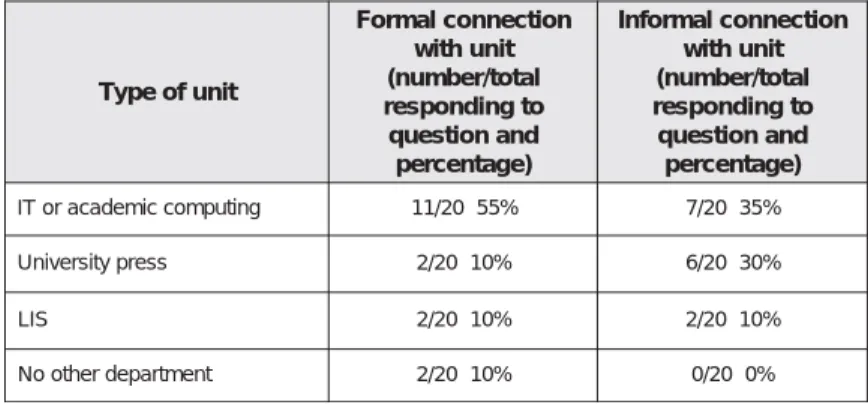
A final attribute that distinguishes a digital library program is the library’s relationship with surrounding academic departments and in-formation services, such as academic computing and IT. Although not easily quantifiable, closeness may be measured by such factors as the facility and experience of collaboration between the library and these surrounding departments, and the extent to which strategic planning in one department includes representatives from and takes substan-tive account of planning in other departments. Size may have some-thing to do with closeness. Among the surveyed institutions, Virgin-ia and NYU are the smallest and also have the closest relationship with other departments. They are joined by Indiana, however, which, at more than 33,500 students on the Bloomington campus alone, can hardly be characterized in terms that describe a liberal arts college “feel.” Harvard and CDL, because of their confederal character, are perhaps furthest from faculty and IT units.
This study, although based on the results of the survey and inter-views, has also been informed by other investigations that the DLF has sponsored in its attempt to understand various aspects of the digital library and by the numerous formal and informal discussions that have supported or resulted from those investigations.3
Origins
The circumstances surrounding the launch of a digital library pro-gram vary considerably, but it is possible to point to several impor-tant common influences. Among them are a guiding mission, an in-stitution-wide mandate, the support of library and university leaders, a protected experimental environment, and sufficient fund-ing. Each of these influences is developed in greater detail in this chapter, which will then characterize the aims and orientation of ear-ly digital library programs.
3 See Jewell 2001, Pitschmann 2001, Smith 2001, and Troll Covey 2002. The DLF also commissioned Outsell, Inc., to conduct a survey of the dimensions and use of the scholarly information landscape. A report is forthcoming.
ASPIRATION AND THE “SKUNK WORKS”: THE YOUNG DIGITAL LIBRARY
Mission
Digital library programs are initiated for different reasons, any one or more of which may be at work at a single institution. Most pro-grams derive from innovative thinking about the future role of li-braries (for example at Virginia) or the future role of the library in an extensively networked teaching and learning environment (Michi-gan), but there are other motivations. The role of blue-sky planning may be particularly significant at institutions that entered the digital library business early and had few models to draw on. Institutions that entered later could be imitative as well as creative. In this re-gard, it is worth noting that academic institutions compete at nearly every level: they compete for grant and philanthropic funding, good students, and respected faculty. Their libraries are not immune from competitive impulses, which also have a hand in initiating digital library investments. Thus, the progress of digital library programs that are located at a library’s peer institutions cannot be discounted as a powerful driver.
In sum, we encountered digital library programs that were de-veloped
• as part of a campus-wide initiative to develop as a leader in the use of information technology;
• as a means of modernizing overall university services to attract better students;
• to keep up with the digital library programs being developed at peer institutions; and
• as a commitment to the delivery of high-quality library services. Most of the programs we surveyed are at some level deploying innovative technologies to deliver very traditional library services. For example, Harvard’s Libraries Digital Initiative is preparing to collect and preserve scholarly and cultural outputs that happen to be in digital form, and to encourage their use in research and teaching. NYU’s digital library program is supporting an institution that has a strong cross-disciplinary interest in theoretical and applied aspects of the performing arts. Michigan is supporting the development and conservation of out-of-copyright monograph and serial holdings and efforts to provide highly functional access to digital content. Indiana is using streaming audio to deliver listening assignments to students in its School of Music.
Leadership and Ownership
Leadership is required at three levels: the political, the creative, and the executive. Political leadership may stem from the university li-brarian, as it has at Harvard, Virginia, Indiana, and NYU. NYU is an interesting case. It is a latecomer to the digital library arena in part because there was no IT or library leadership until a new president was appointed, who, in turn, selected a new chief information officer (CIO) and a dean of libraries.
Whether a library director’s support is sufficient to launch a suc-cessful digital library program remains an open question. The hands
of university presidents and provosts are clearly at work in our case studies. Since 1995, UC President Atkinson has been a great champi-on of the CDL. University of Michigan President Duderstadt (1988– 1996) identified issues surrounding an information and IT agenda as being among his priorities. He invested in the transformation that created a School of Information and in the aggressive development of the technology infrastructure. Both ultimately benefited Michi-gan’s digital library interests.
Creative leadership, another important ingredient, comes from a number of sources. At Michigan, it emerged from close collaboration among three people: one in the School of Information and Library Studies (now the School of Information), one in the university’s In-formation Technology Division, and one in the library. Such collabo-ration is apparent at Harvard, in a triumvirate whose members are drawn from within the university’s library system; at NYU, in a com-bination that is orchestrated and shared by the dean of libraries and the CIO; and at Indiana, in a group modeled closely on Michigan’s and comprising members of the library, the IT service, the library school, and the School of Informatics. Creative leadership can also stem from an individual. At Virginia, the digital library program owes a great deal to a single librarian who, in the 1980s, was already thinking deeply about what a twenty-first-century academic library should be.
The need for executive leadership is self-evident. No digital li-brary program, however well supported and envisioned, can devel-op without pedevel-ople who possess the apprdevel-opriate technical, tactical, and even diplomatic skills. Programs that otherwise had key ele-ments in place, such as funding and mission orientation, were de-layed to some extent until such leadership could be found. This was the case at Indiana and NYU.
Just as digital library leadership is required at several levels, ownership of the digital library program needs to be felt widely across its host institution. This may be less important for the startup phase of a digital library program than for its long-term operation. All six programs represented in the case studies traced their origins to inclusive strategic planning exercises—exercises that involved aca-demic faculty, senior university managers, some library staff, and, in some cases, representatives of other information services. Represen-tatives of Michigan’s triumvirate traced their program’s origins to a planning process that included a yearlong, campus-wide faculty symposium on electronic information and a report prepared for cam-pus administration on this process. The work included intensive analysis of distributed computing operations and the economics of campus information provision. NYU’s mandate stems from library and IT planning vetted by faculty advisory groups and university administration. Harvard’s stems from a planning committee that in-cluded deans, librarians, and faculty. CDL’s grew from a planning process that was initiated by librarians but was ultimately ceded to a committee comprising representatives of all constituencies: faculty senate, campus administration, system-wide administration,
infor-mation technologists, and libraries. The committee itself was institut-ed by the chancellors (campus chief executives) and the university provost. Of the 21 digital libraries surveyed, 76.2 percent (16) are guided by digital library development policies created as part of a broader university IT strategy. These data suggest that digital library development is at some level conceived as part of a university-wide planning process.
Organizational Location
Foundling digital library initiatives seem to favor safe-haven envi-ronments where those involved can experiment without the opera-tional demands made of other library units. Michigan created a “skunk works”—a research laboratory where digital library staff could, through a series of highly focused projects, “road test” new technologies and gain competencies in key areas. The reliance on digital library laboratories is apparent in both early- and late-starting programs. At Michigan, the early program involved a number of projects loosely coordinated by a program director and fulfilling the evolving vision of the founding triumvirate. Early work with the JSTOR project and with the Making of America provided a range of experiences associated with large-scale digital reformatting, while cooperation with Elsevier Science (in projects TULIP and PEAK) pro-vided data management experience as well as a context for a large-scale field experiment in pricing electronic journals. Crucially, the digital library program was outside the library’s normal manage-ment line: its director was responsible to the triumvirate. She was also physically independent from the library’s key operational services.
The model of a digital library program that is relatively autono-mous in its early days is evident elsewhere with significant variation. Virginia cut its digital library teeth in experimental units that were outside the normal line of management—in the library’s Electronic Text Center and, in the academic unit, the Institute for Advanced Technology in the Humanities (IATH), which is located in the main library. Through a series of digital library projects, staff (and through the staff, the library) gained competence in creating, managing, and distributing electronic information. The Electronic Text Center was located in the library but was initially independent of other library departments and services. Even IATH reported directly to the associ-ate provost for research and was thus removed to some extent from the “academic line.” Virginia continued for some time to foster ex-perimental efforts in relatively autonomous organizational units. Thus, as it sought to develop experience and capacity with new digi-tal materials (e.g., images, statistical data), it opened new media cen-ters that focused on the technical and other challenges that these ma-terials introduced without being clouded by traditional library practices or even by practices that were growing up around the Elec-tronic Text Center and IATH.
Indiana’s program introduces a variation on the same theme. Here one can point to a number of experimental initiatives, each
mounted with a considerable degree of autonomy from mainstream operational departments and from one another. VARIATIONS, origi-nally an audio e-reserve, was a flagship project run out of the Music Library as a personal project of that library’s director. The Library Electronic Text Resource Service (LETRS) is an e-text center much like the one at Virginia. It is located in the library but is relatively au-tonomous of the traditional library departments. Digital Images De-livered Online (DIDO) was an early experiment that served faculty in the School of Fine Arts.
In 1996, Indiana established the Digital Library Program (DLP), which brought together these three projects. Through amalgamation, Indiana achieved economies and cross-fertilization at virtually every level, enabling a more coherent approach to research and develop-ment, selection and deployment of digital library technologies, and staff appointments. Amalgamation was not intended to bring the DLP into a more traditional library unit and thus out of its skunk-works environment. Organizationally, the DLP reports directly to the dean of libraries rather than up the normal operational chain. More-over, the DLP is funded discretely, rather than from operational bud-gets that support traditional library services. Programmatically, initi-atives are still mounted at least in part to build on digital library competencies as they accrue, to add staff to complement skills al-ready in place, and to acquire technology as may be needed across the program.
Trajectories at Harvard and the University of California differ from those at Indiana, reflecting the programs’ confederal nature and system-wide orientation. At Harvard, the digital library program grew out of technical services developed on a system-wide basis, no-tably around shared cataloging needs. The CDL was instituted in parallel with a system-wide technical service (the Department of Li-brary Automation), which it then subsumed. Although evolving from these more established services, digital library initiatives at CDL and Harvard also took on at least some of the attributes of the skunk works. Thus, while CDL made a point of launching at least one new operational service every six months, it fashioned numer-ous experimental initiatives and even established a small unit under a director for education and strategic innovation. At Harvard, where the Library Digital Initiative was organizationally housed in the same unit that supplied system-wide technical services, the pro-gram’s emphasis on digital library infrastructure assumed a five-year development path during which time few infrastructural com-ponents became operational. The program was seen as a highly practical applied research program that would lead ultimately, but not immediately, to the development of operational systems.
The digital library’s initial locus in experimental units a step or more outside the traditional management line was important. It cre-ated a space where experimentation could happen in a way that could not disappoint the service expectations of faculty and students, or even of other librarians. In some cases, digital library staff mem-bers were spared the normal bureaucratic decision making, hiring,
staff development, and procurement procedures that applied to oth-er more traditional library soth-ervices.4 As such, they could more quick-ly populate, launch, redirect, or even end experimental initiatives, and could respond to funding, staffing, and other opportunities as they arose. This nimbleness was secured at a cost, however. With few exceptions, institutionally based digital library programs (as op-posed to programs such as those at Harvard and CDL, which operat-ed at least in part on a system-wide basis) were challengoperat-ed later to integrate their staff, work, and thinking about library collections and services into the mainstream of the library.
Funding
Funding—especially external grant funding—is critically important to the startup digital library. Because it reduces the risk inherent in highly uncertain and technologically dependent activities, external grant funding is a mechanism that is particularly appropriate for the experimental orientation of embryonic digital library programs. Grant funding also gives fledgling programs national stature and local legitimacy and helps secure subsequent funding from external and internal sources. Securing external funding depends to some ex-tent, however, on the ability to write convincing grant proposals and on the use of marketing and promotional techniques that many li-braries have not yet developed and are not yet associated with their digital library programs.
The need to promote digital library programs was felt acutely by the programs that were launched in the early 1990s. At that time, few of the agencies to which libraries had a natural or historic entrée were making any substantial investment in activities that we would today associate with the digital library. The National Science Foun-dation’s (NSF’s) DLI1 initiative changed the profile of digital library activities and the amount of federal dollars that might be available to support them. Libraries, however, did not appear on lists of the first successful NSF digital library grants. The inexperience on both sides of the funding fence only emphasized the importance of marketing, as digital libraries were forced to consider how best to present their research interests and needs to members of a scientific community with which they had hitherto had only limited contact.
The role of foundations (particularly The Andrew W. Mellon Foundation but also the J. Paul Getty Foundation and the W.K. Kellogg Foundation) was also important in kick-starting digital li-brary initiatives. Here too, however, libraries were obliged to get themselves on the agencies’ informal bidding lists and to make their case for being there. It would be interesting to know how many failed funding applications a digital library program made on aver-age before achieving its first success.5 Certainly, such failures were
5 For example, Indiana tried three times without success to obtain relatively small amounts of funding from the Library of Congress/Ameritech competition. Three years after its first attempt at that competition, the program received a $3-million grant from the National Science Foundation.
4 This is also true in the development of the Library of Congress’s American Memory program.
learning experiences that helped digital libraries focus their aims and build their technology expertise. These experiences also helped li-braries learn to present their funding cases convincingly, in a lan-guage that was comprehensible to those outside the library commu-nity and in a way that demonstrated the broader significance of their institution’s own efforts.
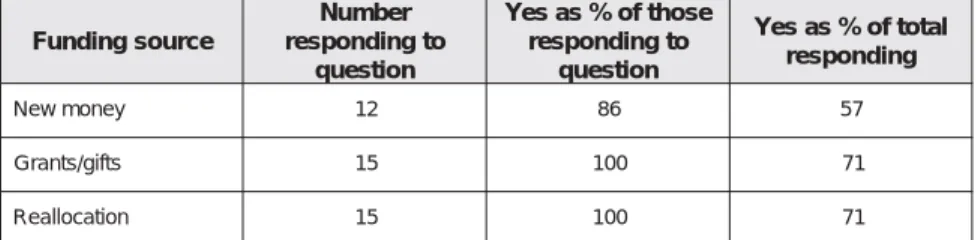
No amount of external grant funding, however, can replace the need for a substantial institutional commitment. So-called core fund-ing—whether obtained from gifts, from additions to the library’s permanent budget, or from a reallocation of existing funds—was claimed as essential by all 15 of the survey respondents who an-swered questions about how their digital library programs are fund-ed. Such commitment takes different forms. At Michigan, Indiana, and NYU, it is in the form of contributions from university depart-ments that are co-investing in the digital library’s development. At Harvard and UC, local funding flows directly to the digital library from the office of the university president. At Virginia and Indiana, most startup funding came from money the university librarian had reallocated from other library purposes. Interestingly, as digital li-brary programs mature, reallocated lili-brary funding becomes more important, at once reflecting and contributing to the challenges of mainstreaming the digital library.
Characteristics
Because startup digital libraries are fundamentally experimental, it is difficult to summarize what they do. They tend to set upon experi-mental tasks that reflect purely local circumstances and opportuni-ties. Still, looking across a range of early initiatives, it is possible to get a feel for the startup digital library’s practical orientation and for its rather severe limitations.
Innovation
Very early programs—those from the early to mid-1990s—are de-fined by the library’s effort to harness the Internet to fulfill historic roles. Although innovative in many respects, these programs may be best characterized as “old wine in new bottles.” At least initially, the digital library exploits the Internet as an additional means of deliver-ing traditional services, notably access to the library catalog and to some reference materials and scholarly journals.
Greater innovation is apparent from the mid-1990s—for exam-ple, in experimentation with digital reformatting. Surrounded with lofty rhetoric about universal access to all human knowledge, inno-vative scholarship and teaching, and national and international digi-tal libraries, some startup programs focused on providing online ac-cess to selected holdings. It is too soon to judge the results of these early initiatives. The risks involved for early adopters may have been so great that they were forced to exaggerate the claims for their work. Consequently, few of the earliest digitally reformatted collec-tions stood a chance of meeting the expectacollec-tions that grew up
around them. Judged in light of initial expectations, the earliest on-line collections are, with notable exceptions
• too small to support more than very casual kinds of browsing • too idiosyncratic to be integrated meaningfully into larger virtual
collections
• too passive to maintain a user’s interest for very long
Judged against more modest or realistic claims, however, early digital collections were remarkably successful, particularly since so many were developed as technical experiments rather than as means of redefining scholarship.
Quest for “Killer Apps”
The young digital library is also known for its quest for “killer appli-cations.” Like the Holy Grail, these killer apps were elusive and ap-peared to different seekers in very different places—in data and metadata formats, in network protocols, even in systems and system architectures. The logic of their appeal is simple enough. Digital li-braries are complicated to build and hard to maintain. Complexity is compounded by the fact that few libraries have more than a handful of appropriately skilled research and development staff. The killer app was the silver-bullet solution that promised to propel the library into a networked age without undergoing the fundamental restruc-turing, staff retraining, and soul-searching mission reorientation that information technologies seem to have forced on virtually every oth-er organization known to late twentieth-century society.
Competition
The young digital library is competitively disposed toward its peers. Competition is hardly new; research libraries have always vied for endowments, collections, and position. Where they are embedded within academic institutions, as so many are, they are part of a broader and possibly even more aggressive competitive dynamic. The competitive disposition is notable only among young digital li-braries, because it runs contrary to the deep information and service sharing that network technologies permit. Perhaps competition at this stage can be explained by the risk that early adopters embrace and by the need they feel to justify that risk in terms of demonstrable innovation. Whatever the cause, young digital libraries struggle to find distinctive furrows to plow. Some attach themselves to systems or standards that they hope will be codified in the ascendant. Others wed themselves to collections that will redefine or inform whole fields of inquiry. The competitive culture of online experimentation may help explain the slow progress of standards work into the mid-or late 1990s. Although few would question the need fmid-or standards, young digital libraries have difficulty agreeing on which standards— a question that is conceptually equivalent to “whose standards,” and that, consequently, cannot easily be addressed on the true merits of any particular case (Greenstein 2001).
The competitive dynamic is still apparent in startup digital li-braries, and it may be intensified as unsettled space on the digital
library frontier becomes more difficult to locate. Interestingly, fewer startup programs appear to be staking their claims on a particular technology or practice. Instead, they are emphasizing service orien-tation (as at Carnegie Mellon, for example, which emphasizes user support services) and local collections and scholarship (as at NYU, whose digital library program reflects a local orientation toward art and performance across disciplines).
The competitive disposition of young digital libraries may also help explain the relatively slow, sometimes fractious progress of as-sociations of digital libraries and of collaborative digital initiatives. There are, to be sure, interesting examples of fruitful information in-terchange and shared investigation, particularly in the development of metadata standards, e.g., the Text Encoding Initiative (TEI), Dub-lin Core, and Encoded Archival Description (EAD).
One can also point to early and successful information exchang-es, notably the task forcexchang-es, which still exist, sponsored by the Coali-tion for Networked InformaCoali-tion. Still, the ubiquitous penetraCoali-tion of networked technologies creates opportunities for deeper forms of association and resource sharing (with collection development, for example) that have been left almost entirely unexplored. Constrained organizationally from pushing technologies to their logical extent, young digital libraries fell back on safer modes of cooperation in talking shops that explored new ideas and in shared cataloging ac-tivities. The former resulted in statements of principle. The latter ex-tended the purview of shared cataloging to some nonbibliographic records (e.g., archival finding aids and descriptions of some digitally reformatted materials) and explored mechanisms for constructing virtual, as opposed to union catalog, databases.
The young digital library is, in summary, an immature, experi-mental organizational form. It explores new opportunities and gathers new competencies. It does this within the safe harbor of soft-money projects and other activities that are organizationally, financially, and even culturally removed from traditional library services.
The developmental trajectories of digital library programs are as di-verse as are their origins. However, common trends begin to emerge out of the experimental phases and into the mainstream of library collections and services. The digital library program’s drift into the library mainstream occurs at practical, technical, and organizational levels and requires new ways of thinking about how programs are funded and promoted. These changes are explored in this chapter, fol-lowing a brief survey of how the digital library’s practical work and its orientation are also changed as a consequence of its maturation.
ROLLING PROJECTS INTO PROGRAMS: THE MATURING DIGITAL LIBRARY
Characteristics
Practically speaking, the maturing digital library is transformed as the fruits of experimental efforts become apparent in operational on-line collections and services. Having acquired core competencies and technical understanding, the maturing digital library abandons the “build it and they will come” philosophy that characterized earlier approaches to collection development. It focuses instead on integrat-ing digital materials into the library’s collections and on developintegrat-ing (and supporting with core funding) the policies, technical capacities, and professional skills needed to sustain it. Work by Timothy Jewell, Louis Pitschmann, and Abby Smith demonstrates this trend across a range of digital information.
Jewell (2001) shows the extent to which leading research libraries have routinized the complex processes of identifying, evaluating, ne-gotiating access to, and supporting use of electronic information that is commercially supplied by third parties. Pitschmann (2001) demon-strates an evolving and highly sophisticated understanding of the pitfalls, opportunities, and real costs for libraries that choose to orga-nize access to “free” external Internet resources through various sub-ject gateways, portals, and other linking services. Smith (2001) dem-onstrates that the digital libraries that were reformatting materials from their collections in the late 1990s (and not all digital libraries were), did so strategically rather than experimentally. Reformatting was being done, for example, to profile selected rare and special col-lections, to support specific teaching and research needs, or to man-age and conserve selected general holdings.
Interest in Modular Systems Architecture
Maturing digital libraries are far less interested in killer apps than are young digital libraries. The maturing libraries view the digital library as a complex online service environment that is supported by local and global systems, each of which supplies specific functions and interrelates with others in a way that can be represented in a modular architectural schematic (Powell and Lyon 2001). The model is not only sophisticated but also practical and economical. It permits greater freedom in the selection of service components and enables the library to manage and respond to technical change with greater facility. Relying on a modular systems architecture, the digital library can select a new authentication service, for example, or integrate a new authentication technology without re-engineering its entire ser-vice environment. It can concern itself primarily with the authentica-tion system and the mechanism (the applicaauthentica-tion programming inter-face [API]) through which that system communicates with others. This modular approach is fundamentally liberating, because it per-mits libraries to think creatively about how to build on services sup-plied by others. The extent to which libraries are able to realize any part of the grander vision, however, depends almost entirely on their ability to transcend their historic organizational independence and insularity.
Desire for Common Standards
The maturing digital library’s approach to standards setting is shaped by nascent aspirations for a more deeply networked future. In brief, it becomes fashionable for digital libraries to lead from the rear with respect to the standards and practices they adopt, whether for their objects or their modular system components. That is, matur-ing digital libraries prefer to claim adherence to practices that are al-ready vetted and endorsed by at least one peer institution, rather than to make bold claims for local innovations. This approach has become increasingly apparent. DLF members have recently reached a consensus on a diverse array of essential digital library tools. These tools include the following:
• a model for negotiating access to commercial journals and data-bases
• minimum requirements for digitally reformatted book and serial publications
• minimum requirements of a digital archival repository for elec-tronic journals, and a data-encoding and transmission scheme that will serve as a means for conveying information about the structural, administrative, and technical characteristics of digital objects6
The trend is readily apparent elsewhere, for example, in a frame-work for evaluating digital collection development practices ad-vanced by a digital library forum convened by the Institute of Muse-um and Library Services (IMLS 2001).
The sea change in attitude and approach is partly economic. As part of the maturation process, digital libraries transform interesting skunk-works projects into essential library infrastructure. At this stage, failures can no longer be written off as learning experiences gained at limited cost and subsidized with external or soft money. Attitudinal shifts also reflect changing understandings of digital col-lections and digital library architectures. Where online colcol-lections are concerned, maturing digital libraries recognize that they are unable, by themselves, to supply end-users with what they really want— enough online information to meet their specific and evolving infor-mation needs. Consequently, they set a high premium on interopera-bility and on definition and adoption of the standards required to achieve it. The drift toward modular systems architecture is also re-sponsible for new attitudes that favor adoption of more established standards, since systems modules (locally and globally arrayed) must interoperate at a fundamental level. Libraries at this stage dem-onstrate a desire to pool their collective uncertainties and to define, and then frame, a broad suite of practices as benchmarks in which they can all invest and upon which they can more safely and
predict-6 DLF-endorsed standards are available at: http://www.diglib.org/
standards.htm. Criteria for a digital archival repository of electronic journals are available at: http://www.diglib.org/preserve/criteria.htm.
ably build. Attempts to develop and codify digital library standards and best practices are tapping into this very fruitful seam.
Focus on the User
The maturing digital library also seems to rediscover users. Users do not figure much in the antecedent experimental phase. Why should they? The library at that stage is experimenting with new technolo-gies—a purely internal affair—or looking for additional means of giving users access to holdings catalogs, reference materials, and some journals—areas where users’ needs are deemed to be well-known. As the integration of new technologies begins to transform the library and the possibilities for constructing innovative net-worked services, libraries see a pressing need to engage users and to reassess their interests and needs. By the late 1990s, there was al-ready evidence to suggest that the proliferation of Internet-based in-formation was fundamentally altering the expectations, behaviors, and preferences of library users.7 Accordingly, the maturing digital library needs to know what users want from the networked library and what role users perceive for the library in a constellation of net-worked information and service providers.
Some of the library associations that take the lead in quantifying traditional aspects of library use have been relatively slow to re-spond to this new and pressing need. The reasons for this are com-plicated. To begin with, the metrics are complex and difficult to agree upon. How, for example, should we define what constitutes a “use” of a networked information object? Second, the library associations that are so well suited to developing statistics for traditional library use are typically membership organizations that are driven by con-sensus, which, in this case, is difficult to engineer. Further, the mea-sures themselves can potentially disrupt the organization by funda-mentally altering the criteria by which it admits and excludes new members. Debate about e-metrics is quickly transformed into debate about what institutions should be recognized as leading research li-braries and is accordingly difficult to resolve.
Some of the best analyses of user behavior and need take place at the grassroots level in what can only be described as a series of large-ly uncoordinated guerilla attacks that are mounted at the institution-al level and by ad hoc and informinstitution-al associations. Denise Troll Covey uncovered a wealth of these in a survey of use-assessment methods at numerous digital libraries (Troll Covey 2002). Among the revela-tions emerging from these fragmented efforts is the extent to which users want to work in highly personalized and malleable online en-vironments, that is, environments that present them with the infor-mation and services they actually need at any one time. The opera-tional lessons for the library are twofold: (1) users want seamless presentation of collections and services, irrespective of where, by
7 This is becoming evident in work conducted by the DLF with Outsell, Inc. The work is described in Dagar, Greenstein, and Watson Healy (2001).
whom, or in what format they are managed; and (2) libraries should consider deploying user-profiling technologies that enable users to configure a networked information environment that meets their specific needs. Both lessons, if taken seriously and reflected in new operational services, have revolutionary implications for the library. The first would integrate the library into a globally arrayed network of information services in a way that challenges its historic organiza-tional insularity. The second potentially obscures from the user’s view the library’s importance as a portal to that global network, be-cause chunks of the library’s collections and services are removed from the library environment and placed into new contexts.
The maturing digital library takes very seriously its users’ needs and interests through its support for a suite of activities that have become known as “e-scholarship.” Although the phrase has a frus-trating tendency to take on new meaning every time it is used, its definition usually includes initiatives that enable scholars to produce and disseminate “publications” with minimal intervention from third-party commercial publishers. Overall library interest in sup-porting innovative forms of scholarly communication (or e-ship) at this point perhaps has less to do with transforming scholar-ship than it does with a strategy to increase pressure on publishers, who have increased prices dramatically in the past 10 years, particu-larly in the sciences.8
Technical and Organizational Integration
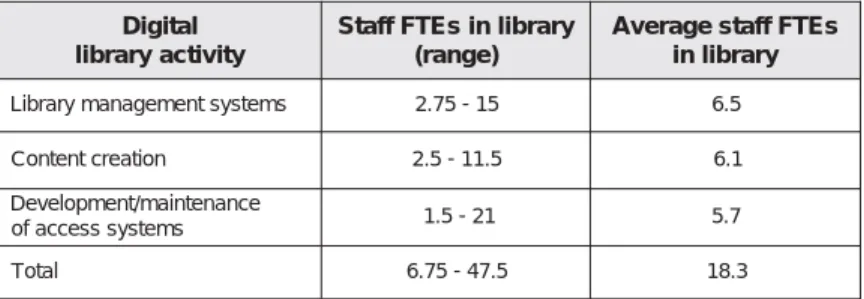
The changing practices associated with the maturing digital library have profound implications for how that library is sustained techni-cally and organizationally and for the manner in which it is promot-ed. The quest for high-level modular architectures has already been mentioned. It is arguably the most common tendency that is evident among maturing digital library programs. Interestingly, not all digi-tal library programs turn toward general technical solutions for the same reasons. At Indiana and Michigan, general technical solutions are sought for the economies they promise. Indiana, for example, is thinking hard about how to afford the technical development work it requires to integrate the diverse systems environments and data con-tent in use across its various projects. The problem had little to do with local expertise, which is amply available in seven full-time-equivalent staff members who contribute to the DLP through the li-brary and its partners. Rather, it has to do with how—without com-pletely disrupting the parallel projects where their services are
8 Libraries, as collectors of cultural and scholarly heritage, are in a strong position to supply the services that help researchers, teachers, and learners navigate, find, interconnect, interpret, and use information in whatever form it exists. Libraries are also poised to capture those interconnections and interpretations and manage them as new information. Instead of concentrating on introducing new electronic scholarly journals that attempt to compete with expensive and traditional commercial e-journals—a business that libraries know little about—libraries may find that they are better off building and exploiting traditional services to support and nurture new forms of scholarly communication.
required—skilled staff can be released to the tasks of specifying gen-eral technical requirements and investigating potential solutions. Michigan, an older program, reached the same roadblock before In-diana did and for the same reasons. After several years of project work, Michigan found itself re-engineering its online distribution services each time it launched a new digital collection. By late 1999, Michigan’s Digital Library Production Service had launched a key project—to build an access system capable of providing user access to the numerous and heterogeneous digital objects that were being supplied through various digital reformatting and other content de-velopment initiatives. The fruits of that effort are available in its Dig-ital Library Extension Service (DLXS) system. By mid-2002, Michigan was supplying support and software for that system to 27 digital li-brary efforts around the world.
Virginia’s quest for general technical solutions is more a re-sponse to users’ needs than to economic forces. The media centers at Virginia have adopted their own range of approaches to the produc-tion, management, and distribution of the electronic information for which they were responsible, and each has an independent and high-ly distinctive online presence. The problem is that, from a user’s per-spective, the fragmentation of digital collections makes little sense. As Virginia thinks about capitalizing on the mass of digital informa-tion it has created or acquired through its media centers, it is begin-ning to envision an online environment that allows patrons to search seamlessly across collections, regardless of whether they were avail-able in print or digital form, and, if in digital form, regardless of whether they were managed as texts, digital images, geospatial in-formation systems, or other types of data. Virginia’s notion of an on-line environment through which scholars can obtain high-quality in-formation—irrespective of how, where, by whom, or in what format it is managed—required it to think hard about building a technical infrastructure that could be generalized and would be capable of supporting its heterogeneous collections.9
The apparent importance to the maturing digital library of a gen-eral core infrastructure is only amplified by investigation into newer digital library programs. NYU’s initial investments in its digital li-brary have been made with explicit reference to the experiences of older programs whose project work stumbled temporarily on a pro-liferation of diverse data objects and delivery systems. Not wanting to repeat a development path that was becoming well worn, NYU focused its earliest investment (as did Harvard, Columbia, and one or two others) on the development of core infrastructure, assuming that content and services could eventually be built on top of that infrastructure.
The maturing digital library’s quest for core technologies seems to bolster rather than to undermine its emphasis on applied research. Michigan, Virginia, Harvard, and CDL, for example, have obtained
9 See details about Virginia’s work with FEDORA at: http:// fedora.comm.nsdlib.org/.
or are seeking permanent, base-budget funding for the research and development efforts that are focusing on the identification of core technology. They recognize that such research and development funding is essential to their programs’ successes, and that the pro-grams cannot be sustained exclusively, or even largely, on external funding and soft money. At Michigan, investment flows into the de-velopment of DLXS.10 At Virginia, it is reflected in the Digital Library Research and Development Unit, established in 1999. At CDL, it is evident in the establishment of a small unit under a director for edu-cation and strategic innovation. Harvard is arguably the most inter-esting example. As a service to a confederation of largely indepen-dent library organizations, the Libraries Digital Initiative (LDI) did not launch as a series of independent projects. It began instead by building a common digital library infrastructure that would support Harvard libraries in their development and exploitation of digital collections. As it reaches the end of its first four years (and the end of the $12-million, one-time funding that launched the program in 1998), the LDI has developed first-generation infrastructure. In its second phase, it will seek a means of ensuring that the infrastructure will be developed and maintained out of whatever base-budget funding is available to the program.
The digital library’s organizational integration into mainstream library services is another aspect of its maturation. In its startup phase, the program may be relatively unknown to library staff. Inter-viewees at more than one institution noted how the programs in their earliest phases were better known nationally than on campus or even within their host libraries. As digital library collections and ser-vices develop, their impacts are increasingly felt on local library staff. Reference staff find themselves fielding queries about digital library collections; catalogers consider descriptions for digital objects where once they focused exclusively on bibliographic materials; conserva-tion officers find their work flow and priorities shaped to some ex-tent by the progress of local digital reformatting activities.
The impacts do not flow in one direction only. Library staff members who are responsible for the development of print collec-tions assert their perspective in setting priorities for digital collection development decisions. Bibliographic cataloging practices are con-sidered as the library develops systems that allow users to search across collections, irrespective of their format and location. The hard-ware, network protocol, and systems choices that technical services make have implications for platform choices in the digital library. If the maturing digital library program emerges out of the skunk works and into the mainstream of library services, it does so in part because the program’s work at some stage can neither be safely ig-nored by nor conducted in isolation from other library services.
Ra-10 Core or base-budget funding is not the only means by which Michigan supports what it sees as essential technical development work. Having developed a suite of digital library tools in DLXS that can be generalized, Michigan supports their adoption by other programs, thereby supplementing its technical development funds and offsetting some of its development costs.
tionalization is encouraged by the library’s relatively inelastic per-sonnel budget. Simply put, digital library programs are able to de-velop collections and services beyond their experimental phase only by organizing themselves so they may achieve an appropriate func-tional division of labor. At the very point when a digital library pro-gram is ready to hire its second (possibly even its first) metadata li-brarian, for example, it may also be ready to think seriously about establishing a stronger liaison with the cataloging department.
Rationalization is most evident at institutions such as Michigan and Virginia, which have older digital library programs. At Michi-gan, the program that reported directly to its three founding partners from the library, the School of Information, and the campus comput-ing service was incorporated into the library, and the program’s ex-ecutive director was appointed as an associate director with respon-sibilities for IT services and electronic collections. This initial
reorganization may have had more to do with changes in the person-nel and priorities of the university’s senior management than it did with any intrinsic need to rationalize digital library programs.
Still, once implemented, this structure created opportunities for—and even required—further organizational adjustments. Once the program was embedded within the library line, senior library management took pains to smooth its operation with existing library services. New money allocated to the library by a friendly university administration helped considerably in firming up infrastructure sup-port and providing continuing funds for new program development. The library also introduced a committee structure that maximized opportunities for cross-fertilization among library managers in tradi-tional and nontraditradi-tional units. By placing the Digital Library Servic-es Division under the associate director, the digital library obtained representation on the library’s senior management group—its execu-tive council. From that perch it participated in thinking strategically and operationally about a broad array of library functions that inter-relate with digital content, systems, and infrastructure. At the same time, managers responsible for those traditional functions helped think about and shape the digital library’s future. As the program evolved, additional departments (the Scholarly Publishing Office, for example) were added as peer units to the existing operational one— the Digital Library Production Service.
Virginia’s experience of reorganization is not altogether different, though it was not quite as fundamental. Virginia’s program, unlike that of Michigan, was always represented in the library’s senior man-agement group through the deputy university librarian. One conse-quence is that the library’s senior management had early opportuni-ties to encourage the cross-fertilization of library staff in new and existing units. From an early date, the Electronic Text Center provid-ed basic HTML instruction to library staff—offerings that were as popular as they were effective in giving those staff members insight into the opportunities, as well as the pitfalls, inherent in the online environment. Virginia’s staff-share program was also effective in de-veloping mutual understanding across library units and in
support-ing two-way transfers of professional skills. Structural reorganiza-tion, which came later, focused primarily on aligning effort at Virgin-ia’s media centers and on developing common services, such as digi-tization facilities and research and development units that they can share.
The DLF survey showed some evidence that consolidation of digital library activities is beginning to take place generally, at least with respect to the development of digital collections. For example, digital library staff members have a limited role in acquiring access to commercial electronic information. At 95 percent of the libraries responding to the DLF survey, that responsibility was vested in the subject bibliographers and other professional staff who were respon-sible for acquiring print materials. With respect to selecting materials from library holdings for digital reformatting, three-quarters of the survey respondents said that such responsibility was located largely, if not exclusively, in digital library departments and initiatives. Sur-prisingly, however, in half of those institutions, responsibility was shared with subject bibliographers—that is, with staff in traditional library services.
Reorganization of the maturing digital library has a number of practical implications. As staff members from outside the original skunk works become more involved in developing or supporting the use of digital library collections, the program is at pains to document its practices in various process recommendations, including, for ex-ample, guidelines for standards implementation, flow control, and rights clearance. Indeed, the extent of this gray literature provides some measure of a program’s maturity. In the skunk works, process-es and practicprocess-es are in flux, and few are rprocess-esponsible for developing and implementing them. As the digital library matures, its collec-tions and services rely much more on professional staff who are dis-tributed across the library and who will require access to such refer-ence materials. Again, the influrefer-ences flow in two directions. While the maturing digital library typically takes responsibility for practi-cal and process guidelines, the library’s senior management, assisted by staff from across the library, supplies the policy framework in which the program’s practices are applied. Early in the adolescent stage, for example, collection policies are revised so they can govern the selection of commercial electronic resources as well as biblio-graphic materials. Later developments include preservation policies that take account of digital as well as bibliographic materials and policies that articulate the library’s orientation toward intellectual property and the exercise of the fair-use exclusion with both digital and print materials. Regardless of whether the documentation guides or reflects evolving practices, it is significant. Its very existence rec-ognizes initial thinking about how digital library activities fit into and help fulfill the library’s overall collection and service goals. For this reason, it is an important milestone of the maturing digital library.11
11 The local policies, standards documents, and implementation guidelines that have grown up around DLF members’ digital library programs are listed in a database at: http://www.diglib.org/pubs/techreps.htm.
Institutions are differently positioned to effect the reorganization that is required to integrate digital initiatives into the fabric of the library. Staff development is a significant issue. However well suited professional librarians are to developing and maintaining high-quali-ty digital libraries, they apply their skills differently in digital and traditional environments. Mastering different techniques requires training opportunities that all institutions are not equally positioned to supply. In addition, reorganization may require libraries to think anew about how, by whom, and in what combinations certain tasks are done. Here, too, there are numerous and substantial differences between institutions. Some lack the nimbleness and facility that is needed to effect such changes, which, at a fundamental level, will determine whether and at what pace a digital library program will mature.
Marketing and Promotion
As a digital library grows, there are subtle shifts in the way it is pro-moted and presented to the world. Marketing is not unknown to startup programs. Although the target audience is confined to key decision makers on campus (both inside and outside the library) and potential external funders, the marketing challenges in the early phase are important. At the University of California, it took years of committee work and a few well-placed champions to sell the CDL to key decision makers on the nine UC campuses and to the Office of the President. The case for Harvard’s LDI was similarly made through committee work, although over a much shorter period of time. Michigan relied on a yearlong symposium.
As digital library programs mature, they gain visibility through their online presence, their success in acquiring external funding, or their ability to attract regional, national, or even international ac-claim. They rely as much as ever on effective promotions to senior managers and to external funders. They also find themselves having to appeal to new audiences: to their faculty and other patrons and to other library staff whose own work, as we have seen, is influenced by and contributes to the digital library. Faculty members have a substantial stake because the campus library supports their research and teaching. They also have very different needs with respect to li-brary collections and services—needs that turn on discipline, age, and personal preference. Without exception, the programs where in-terviews were conducted took pains to promote themselves to the faculty. This was true even of Harvard’s LDI, which serves the facul-ties through the libraries.
At the institutions where interviews were conducted, promotion-al activities had three things in common. First, the programs took pains to demonstrate that digital libraries could be supported in a way that did not threaten funding for traditional library services, in particular for the development of print collections. It is unclear whether this is a realistic assessment of future funding models or merely an anticipation of future battles for the digital library.
Second, the programs capitalized wherever possible on success-ful services—that is, services that were well received by patrons, and by faculty patrons in particular. Senior managers at CDL, Harvard’s LDI, Indiana, and Virginia were well aware of how much support for their programs is built on early successes, even those successes that owed little or nothing to the digital library program. CDL claims Melvyl (UC’s union catalog) as a birthright, even though it was de-veloped by the Department of Library Automation some years be-fore the CDL’s founding. CDL’s continued maintenance and en-hancement of Melvyl (e.g., with electronic “request” services) helps garner the public support it needs to run more experimental initia-tives such as those associated with its e-scholarship program.
The credibility that Harvard’s LDI requires to develop operation-al services that do not see the light of day for severoperation-al years grows out of its host unit’s successful and timely delivery of core services such as Hollis (the university libraries’ shared catalog). Indiana’s DLP builds on the visible successes of LETRS, the audio e-reserves VARI-ATIONS, and IUCAT, its union catalog. Virginia wrapped its first digital library forays in the cloak of earlier successes, notably with VIRGO, the library’s online catalog, and with course tools, the in-structional technologies that the library supports in tandem with the university’s computing service. In addition, the programs take pains to promote new successes as they become available. In its first sever-al years, CDL as a matter of policy launched a new service or a ser-vice upgrade every six months with appropriate system-wide public-ity. Virginia’s Electronic Text Center vigorously promotes the success it has had delivering its online texts as e-books. Michigan promotes an array of digital initiatives for users, such as geographic informa-tion systems (GIS), numeric data, humanities texts, and visual re-sources that have grown out of research projects.
Early digital library experience at NYU provides an interesting counter-example of the importance of service successes in garnering support for programs that might otherwise be perceived as experi-mental, or even peripheral, to core library activities. At NYU, in an early digital library initiative supported by foundation funding, the library attempted to place records for full-text electronic resources into the OPAC catalog environment. The initiative encountered sev-eral insurmountable obstacles. The host library was inappropriately organized to support an initiative that had both research and opera-tional service components. It also lacked the needed technical exper-tise. Perhaps the largest hurdle had to do with the poor understand-ing of metadata that existed at that time. The project concluded, but it was never deemed to be successful by library staff and others who were involved in building and supporting use of the campus’s schol-arly information environment. This negative experience hampered the digital library program when it was begun again in earnest, and on a far more ambitious and comprehensive footing, years later. Pro-fessional staff had to be convinced that not all digital library initia-tives were so speculative and so unfruitful.