Leading Us Not Unto Temptation: Momentary Allurements Elicit
Overriding Goal Activation
Ayelet Fishbach
University of ChicagoRonald S. Friedman
University of Missouri—ColumbiaArie W. Kruglanski
University of Maryland, College ParkThe present research explored the nature of automatic associations formed between short-term motives (temptations) and the overriding goals with which they interfere. Five experimental studies, encompass-ing several self-regulatory domains, found that temptations tend to activate such higher priority goals, whereas the latter tend to inhibit the temptations. These activation patterns occurred outside of partici-pants’ conscious awareness and did not appear to tax their mental resources. Moreover, they varied as a function of subjective goal importance and were more pronounced for successful versus unsuccessful self-regulators in a given domain. Finally, priming by temptation stimuli was found not only to influence the activation of overriding goals but also to affect goal-congruent behavioral choices.
A delicious chocolate cake in the storefront of a bakery may remind individuals of the unfortunate fact that they should go on a diet. A thought of an exotic place, ideal for a relaxing vacation, may conjure up approaching deadlines at work. Momentarily al-luring yet morally questionable activities may spontaneously bring to mind the image of a stern parent or a religious leader. On these and similar occasions, elaborating on a seemingly desirable course of action may bring to mind the opposing, higher priority objective (e.g., of sporting a slim figure, being conscientious at work, or conducting oneself in a moral and upstanding manner). Associat-ing momentarily allurAssociat-ing tendencies with incompatible, highly valued objectives should be helpful in fostering effective self-regulation and consequently may be quite common. The purpose of the present research is to test for the presence of such associa-tions while investigating their nature and self-regulatory functionality.
The Mental Structure of Personal Goals
Everyday choice and behavior are directed by a variety of personal goals (Cantor & Langston, 1989; Emmons, 1989;
Hig-gins, 1997; Markus & Ruvolo, 1989). According to goal systems
theory (Kruglanski et al., 2002), these goal representations are
governed by the same rules as are other mental representations. Most notable is that automatic associations can develop between goals and other representations that are frequently and consistently active at the same time (see also Bargh & Ferguson, 2000; Kruglanski, 1996). Such intergoal connections may be either fa-cilitative or inhibitory, depending on the relations between the goals involved. Thus, whenever the attainment of one goal is related to the attainment of another (e.g., learning to speak French and planning the summer vacation in Paris), these goal represen-tations may facilitate one another. In this case, pursuing one goal leads to an activation of a related goal concept (Shah, Friedman, & Kruglanski, 2002).
Other intergoal connections may be inhibitory in nature. Through contextual priming, opposing personal goals may be simultaneously activated, which leads them to compete for pro-cessing resources (cf. Bargh & Chartrand, 1999; Lewin, 1946; Miller, 1944; Shah & Kruglanski, in press). Successful goal pur-suit, then, involves resolving the conflict between mutually acti-vated personal goals—for instance, by concentrating attention on a focal goal while disregarding or inhibiting interfering ones. Thus, whenever one goal (e.g., learning to speak French) interferes with the pursuit of another goal (e.g., planning the summer vacation in London) by competing with it for limited mental resources, these two goals are likely to inhibit each other.
The ability to inhibit competing alternatives to a focal goal confers clear self-regulatory advantages. It allows one to concen-trate resources on the current pursuit and, hence, efficiently pursue one’s goals. Indeed, a number of prior findings indicate that the degree to which people are able to suppress thoughts regarding alternative goals predicts their persistence and achievement on the focal goal at hand (Kuhl & Weiss, 1985; W. Mischel, Ebbeson, & Zeiss, 1972; W. Mischel, Shoda, & Rodriguez, 1989). In recent
Ayelet Fishbach, Graduate School of Business, University of Chicago; Ronald S. Friedman, Department of Psychological Sciences, University of Missouri—Columbia; Arie W. Kruglanski, Department of Psychology, University of Maryland, College Park.
This work was supported by National Science Foundation Grant SBR-9417422.
Correspondence concerning this article should be addressed to Ayelet Fishbach, Graduate School of Business, University of Chicago, 1101 East 58th Street, Chicago, Illinois 60637, or to Ronald S. Friedman, Department of Psychological Sciences, 25 McAlester Hall, University of Missouri, Columbia, Missouri 65211. E-mail: [email protected] or [email protected]
research relevant to this issue, Shah et al. (in press) identified two factors that characterize the inhibition of goal representations: First, the inhibition spreads from the focal goal to the alternative goals, and, second, the degree of inhibition increases with com-mitment to the focal goal.
What, however, might the case be when the overall commitment to a currently activated goal is appreciably lower than that to competing goals? This condition depicts a common situation wherein momentary allurements threaten to thwart the attainment of important long-term objectives. Inhibiting the latter and thus succumbing to temptation is inimical to adaptive self-regulation, signifying, as it does, the sacrifice of high-priority goals for fleetingly enticing yet ultimately insignificant pleasures. The op-posite pattern would make much more self-regulatory sense— namely, the activation (rather than inhibition) of higher priority goals on confrontation of a temptation.
Accordingly, the general notion this research sets out to explore is whether, over the course of their life, individuals learn to resist temptations by activating the higher priority goals these tempta-tions threaten to undermine. We further investigate the possibilities that such activation patterns (a) may become overlearned to the point of nonconscious occurrence and relative independence of cognitive resources, exhibiting two major properties of automatic-ity (Bargh, 1994), and (b) may ultimately contribute to effective self-control.
The Self-Control Dilemma
A self-control dilemma represents an internal conflict between the pursuit of different behavioral plans (Ainslie, 1992; Loewen-stein, 1996; Metcalfe & Mischel, 1999; Rachlin, 1997), one of which is of greater long-term importance than the other. To ac-complish the higher priority goals, individuals need to resist the momentarily salient yet low-priority enticements with which the more important goals are in conflict. Such interfering temptations are triggered by situational cues that promise immediate gratifica-tion at the cost of significant long-term outcomes. From the stand-point of adaptive self-regulation, an appropriate response to temp-tations involves the exercise of self-control (Baumeister, Heatherton, & Tice, 1994; Gollwitzer & Moskowitz, 1996; Kuhl & Beckmann, 1985; Metcalfe & Mischel, 1999; W. Mischel, Cantor, & Feldman, 1996; Thaler, 1994; Wegner, 1994).
The processes of self-control include a variety of cognitive, affective, and motivational mechanisms geared at securing the unfettered pursuit of high-priority goals. Many of these mecha-nisms concern some kind of operation with regard to the goal to be secured—for example, the formation of an implementation inten-tion concerning such a goal (Gollwitzer, 1990; Gollwitzer & Brandstatter, 1997), the bolstering of its value (Kuhl, 1986; W. Mischel, 1984; Trope & Fishbach, 2000), or the use of various metacognitive strategies aimed at keeping the high-priority goal in the focus of attention (H. N. Mischel & Mischel, 1983; W. Mis-chel, 1996; W. Mischel & Metzner, 1962; W. Mischel & Patterson, 1976).
Generally speaking, self-control efforts often can be laborious and demanding. For instance, the bolstering process may require the retrieval and/or construction of reasons for the goal’s elevated value, the formation of implementation intentions may require one to ponder detailed means of goal pursuit, and the invocation of
metacognitive strategies may require their meticulous selection to counteract the specific temptation at issue. Indeed, prior theorizing and research have tended to depict the self-control process as conscious and relatively intricate (cf. Baumeister et al., 1994; Gollwitzer, 1990; Gollwitzer & Brandstatter, 1997; Leith & Baumeister, 1996; W. Mischel, 1996; W. Mischel & Metzner, 1962; W. Mischel & Patterson, 1976; Trope & Neter, 1994). Consistent with the foregoing portrayal are findings indicating that self-control responses decrease as a function of fatigue, concurrent activity, negative affect, or immediate prior efforts, all of which may considerably tax and deplete individuals’ cognitive resources (Baumeister, Bratslavsky, Muraven, & Tice, 1998; Fishbach & Trope, 2001; Muraven, Tice, & Baumeister, 1998).
However, even before such complex operations in service of the high-priority goal (e.g., bolstering, formation of implementation intentions, distraction from or reframing of the meaning of the stimulus event) are carried out, a basic prior event may need to take place—the goal in question may need to be cognitively activated, quite possibly by the tempting stimulus itself. For in-stance, in Trope and Fishbach’s (2000) research, priming social goals before a midterm bolstered students’ evaluation of the mid-term’s importance, which in turn improved students’ performance on the exam. Presumably before such bolstering could take place, the activation of the overriding goal (the exam) must first have occurred. However, thus far, this remains a hypothetical possibil-ity, as no direct measurement of activation has been implemented in prior self-control work.
Unlike the resource-demanding self-control mechanisms inves-tigated previously, the activation of the goal by the temptation may be a relatively simple and direct affair. Indeed, we assume that with repeated attempts at self-control in a given domain, facilita-tive links are formed between cognifacilita-tive representations of momen-tary temptations and cognitive representations of the overriding goals with which they interfere. Consequently, the mere presenta-tion of a temptapresenta-tion-related cue in the environment (e.g., a vacapresenta-tion ad in the travel section of the local paper) should activate the representation of the goal that succumbing to the temptation would undermine (e.g., getting one’s work done). We assume that the facilitative links between temptations and the higher priority goals with which they conflict could be overlearned to a considerable degree (cf. Bargh & Barndollar, 1996; Posner & Rothbart, 1989). If so, even the subliminal activation of a temptation might suffice to activate its higher priority goal. Furthermore, given that such overlearning took place, the activation of goals by temptations might be relatively independent of cognitive resources. Such an activation pattern may itself come to play a functional role in successful goal pursuit. Specifically, activation of overriding goals in the face of a temptation might alert individuals that their long-term interests are threatened and prompt subsequent (and more controlled and deliberate) attempts to resist the allure of ephemeral, low-priority enticements. Essentially, then, we envi-sion that temptation– goal associations serve as a rudimentary form of self-control.
Asymmetrical Activation Pattern
If the activation of high-priority goals by low-priority tempta-tions occurs because of its self-regulatory functionality, the oppo-site activation pattern, from goals to temptations, should not occur.
In other words, we do not view temptation– goal associations as reflecting simple semantic or conceptual links but rather as emerg-ing from the self-regulatory interplay between temptations and goals. For instance, we suggest that a chocolate temptation does not activate a goal of maintaining a slim figure merely because these activities are both semantically associated to the diet con-cept; instead, we posit that the temptation of chocolate activates the goal of a slim figure through a self-control process meant to prevent the transient enjoyment of caloric sweets (“a moment on the lips”) from undermining the higher priority goal of attractive appearance (“a lifetime on the hips”). If temptations and overriding goals are indeed linked by dint of the exercise of self-control, their association should be asymmetrical. That is, temptation represen-tations should facilitate overriding goal represenrepresen-tations, whereas goal representations should not facilitate and, if anything, should inhibit temptation representations. This asymmetrical structure as well as the moderating factors described below would support the hypothesis that temptation– goal associations serve a self-regulatory function.
Moderating Factors
Although temptation– goal activation may be an important self-regulatory tool, there is good theoretical reason to believe that it should not always come into play in the course of goal pursuit. For instance, the activation of goals by temptations should be posi-tively influenced by the subjective importance of the overriding goal. Individuals only exercise self-control to the extent that it is necessary for goal attainment, and self-control efforts are known to increase with the importance of the goal (Shah et al., in press; Trope & Fishbach, 2000). Inasmuch as temptation– goal activation is an outgrowth of chronic self-control efforts, it should corre-spondingly increase in magnitude as the subjective importance of the goal increases. Thus, for example, the more individuals are concerned about watching their weight, the faster they should be to activate the goal of dieting in response to the presentation of fattening food.
Another possible moderator of temptation– goal activation may be the ability to successfully resolve the self-control dilemma. Essentially, we posit that, over the course of a lifetime, individuals who have developed efficient self-control mechanisms should be more likely to have formed strong patterns of temptation– goal activation. Therefore, inasmuch as temptation– goal activation is an important self-control device, individuals who are more effec-tive at self-control may exhibit relaeffec-tively strong (i.e., rapid) facil-itative links between their temptation and goal representations. Thus, for example, dieters who are effective at watching their weight and who thereby find it relatively easy should more rapidly activate thoughts regarding dieting in the presence of fattening food. Activation of diet-related ideation should in turn be nega-tively related to actual consumption of fattening food.
Theoretical Summary
In summary, we have postulated that with continuing attempts at self-control individuals may develop facilitative links between representations of various momentarily activated temptations and the corresponding high-priority goals with which they may inter-fere. Because of the general pervasiveness of self-control strivings,
such facilitative links may be overlearned to the point of their (a) subliminal activation, and (b) relative independence of cognitive resources. We further hypothesize that the strength of the facilita-tive links between temptations and goals (c) should depend on goal importance (i.e., the degree to which the goals in question repre-sent high-priority objectives), and (d) should be related to self-regulatory success.
The Present Research
In the five studies that follow, we subjected the foregoing notions to empirical scrutiny. Study 1 tests whether the subliminal presentation of temptation-related stimuli facilitates the recogni-tion of overriding goals and whether, as previously suggested, this activation pattern is asymmetrical. Study 2 additionally investi-gates whether the activation of goals by temptations is independent of cognitive resources. Studies 3 and 4 explore the hypothesis that the activation of goals by temptations is moderated by the impor-tance of pursuing the goals and by the ability to successfully implement self-control. Finally, Study 5 examines whether temptation– goal activation actually bolsters the ability to resist temptations. To explore the generality of the predicted effects, our studies use a wide range of qualitatively different goals and temptations.
Study 1: Self-Reported Temptations Facilitate the
Recognition of Self-Reported Goals
Our first study assesses the strength of temptation– goal associ-ations through the use of a subliminal sequential priming proce-dure. Specifically, the primes (composed of temptation- vs. goal-related words) were presented to participants for a very brief time and were immediately masked to ensure that they did not reach the threshold of conscious perception. These subliminally presented primes were predicted to influence the time for recognizing targets also composed of temptation- versus goal-related words, thereby revealing the nature of the associative relationships between temp-tations and overriding goals.
Method
Participants. Fifty-three University of Maryland undergraduates (22 women and 31 men) participated in the experiment in return for $5.
Procedure. This study used a Target (goal vs. temptation)⫻Prime (relevant vs. irrelevant) within-subject design. Participants completed the procedure on desktop computers. The computer program first instructed participants to list “a goal that you feel it is your duty or obligation to work on (something that you have to do).” Then they were asked to list a temptation, defined as “an enjoyable activity that you ought not do if you want to attain the goal you just listed.” Participants were asked to list only one-word items. This procedure resulted in a goal–temptation pair for each participant (e.g., study–basketball, work–drugs, good–sin, or faithful–sex). Participants also provided another two goals and two temptations that served as control primes in the subsequent procedure.
Next, participants completed a lexical decision task on the computer. They were presented with a series of letter strings and were asked to decide as quickly as possible whether each letter string was a word. At the beginning of each trial, a fixation point (⫹sign) appeared at the center of the white screen for 1 s. Participants were asked to focus their attention on this sign. The fixation point was then replaced by a prime word, presented for 50 ms and then replaced by a masking string (xxxxxxxxxxxxx) to ensure
that it did not reach the threshold of conscious perception (Bargh & Chartrand, 2000; Shah et al., in press). After another 700 ms, the masking string was replaced by the target word. The 750-ms interval between prime and target onsets defined the stimulus onset asynchrony (SOA). All the stimuli were presented in fixed-width black letters (0.3 cm tall) in the center of a white screen. Overall, this procedure used a relatively long prime duration and SOA (Draine & Greenwald, 1998). These aspects of the procedure were simply intended to increase our power to detect a priming effect by allowing both increased processing time for the prime and increased time for inhibitory processes to come into play. (According to a number of semantic priming studies— e.g., Burgess & Simpson, 1988; Nakagawa, 1991—inhibition may not take hold at very brief SOAs.) In fact, even constructs that eventually inhibit one another at longer SOAs may initially facilitate one another at shorter SOAs, as if the links between constructs must first be established (producing momentary facilitation) before they can be cut off.
Participants’ task was to classify the target letter strings as either words or nonwords, using the Y and N keys. Each response was followed by a 2-s pause and then the next trial. To assess whether participants were aware of the primes, we used a funneled debriefing procedure similar to that sug-gested by Bargh and Chartrand (2000). No participant in this study reported recognizing any of the primes presented on the screen prior to the masking string.1
After 10 practice trials, which included an equal number of words and nonwords, participants commenced the main part of the lexical decision task. This part included goal targets preceded by relevant and irrelevant temptation primes and temptation targets preceded by relevant and irrele-vant goal primes. The irreleirrele-vant goal and temptation primes were taken from the additional examples of goals and temptations listed by partici-pants. Presenting them controlled for the possibility that any temptation, independent of its content, might facilitate goal recognition. These exper-imental trials were embedded within other trials that included irrelevant words as primes (e.g., umbrella, noon, coffee) and either nonwords or other irrelevant words as targets. Overall, 200 experimental trials were presented, with an equal number of words and nonwords as targets. On 6 of the latter trials, targets were either goals or temptations.
Results and Discussion
Because the latency of incorrect responses would be difficult to interpret, only correct responses were used in all the subsequent analyses (see Bargh, Chaiken, Govender, & Pratto, 1992; Fazio, 1990). To lessen the influence of outliers, we first transformed all individual reaction times using a natural log transformation and then excluded them if they exceeded more than three standard deviations from the cell mean (Bargh & Chartrand, 2000; Fazio, 1990).2
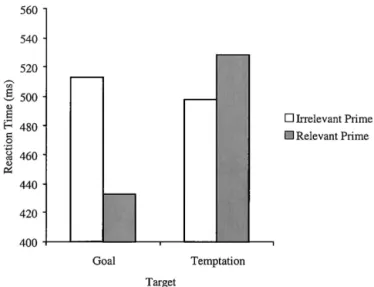
Reaction times were collapsed across conditions. A Prime (rel-evant vs. irrel(rel-evant)⫻ Target (temptation vs. goal) analysis of variance (ANOVA) yielded the predicted Prime⫻Target interac-tion, F(1, 52)⫽3.94, p⫽.05. As can be seen in Figure 1, this interaction indicated that when the target was a goal-related word, participants were faster to recognize it after having been primed with a relevant rather than an irrelevant temptation-related word (Ms ⫽ 433 and 513 ms, respectively), t(52) ⫽ 2.51, p ⫽ .01. However, when the target was a temptation-related word, partici-pants were not faster and, if anything, were slightly slower to recognize it after having been primed with the relevant rather than the irrelevant goal-related word (Ms⫽528 and 498 ms, respec-tively), t(52)⫽0.83, p⫽.40.
These results provide initial support for the notion that tempta-tions automatically activate representatempta-tions of their overriding
goals. The fleeting presentation of a temptation-related key word facilitated recognition of the opposing overriding goal, consistent with the notion that to resist the influence of temptations people may activate the higher order goals that the temptations threaten to undermine. Presenting the goal-related key word, however, did not facilitate recognition of the temptation-related key word; if any-thing, quite the opposite happened. The association between goals and temptations thus seems to be asymmetrical; whereas tempta-tions bring to mind the opposing goals, goals do not reciprocally bring to mind interfering temptations.
One weakness of the present design is that it did not allow us to test for the occurrence of goal–temptation inhibition. As alluded to above, goals have been found to inhibit activation of interfering goals (Shah et al., in press). On the basis of this finding, inasmuch as temptations quite clearly constitute goals that interfere with the attainment of other overriding goals, activation of overriding goal representations should lead to inhibition of temptation representa-tions. However, in Study 1, participants entered their own goal– temptation pairs before measures of association were administered. This initial listing of goal–temptation pairs may have effectively produced an on-line goal–temptation facilitation pattern that may have impaired the participants’ ability to detect a preexisting pattern of goal–temptation inhibition. This might have, on the one hand, inflated the tendency of temptations to activate goal repre-sentations but, on the other hand, reduced the degree to which goals inhibited temptations. Therefore, to more clearly enable the detection of preexisting temptation– goal activation and goal– temptation inhibition patterns, in our next study we provided participants with words pretested as related to their ongoing goals
1A similar debriefing procedure was used in Studies 2– 4. As in Study 1,
no participants in these studies reported recognizing any of the primes presented on the screen prior to the masking string.
2No systematic differences were found in participants’ error rates on the
lexical decision trials for any of the reported studies. The average error rate for the lexical decision trials was 1.8% for Study 1, 0.7% for Study 2, 1.5% for Study 3, 1.2% for Study 4, and 2.4% for Study 5.
Figure 1. Reaction time for recognizing self-entered temptations and goals, following relevant versus irrelevant primes.
and temptations rather than having participants generate pairs of goals and temptations on line.
Study 2: Activation of Goals by Temptations Under
Cognitive Load
The results of Study 1 are consistent with the notion that the activation of goals by temptations may be overlearned to the point of automaticity (Bargh & Barndollar, 1996): The extremely brief presentation of temptation-related concepts in a sequential priming procedure qualifies as subliminal (none of our participants re-ported awareness that a priming stimulus had been presented) and hence is unlikely to evoke deliberative or controlled processes. Our next study probes yet further the overlearned (or automatic) nature of goal activation by temptations and investigates whether this effect is relatively independent of cognitive resources and holds under cognitive load.
As in Study 1, we assessed the goal–temptation associations using a sequential priming procedure. This time, however, half the participants performed the lexical decision task under cognitive load, whereas the rest confronted no load. In contrast to Study 1, wherein participants generated successively their personal goals and temptations, in the present study we presented all participants with the same goal and temptation stimuli, which we assumed were of general relevance to persons like themselves. Specifically, those stimuli were derived from an initial survey in which a large proportion of our sample of University of Maryland students listed religious objectives among their important life goals. In addition, among the goals listed by participants in Study 1, religious objec-tives were quite frequent, with 21% of the participants spontane-ously listing a goal (key word) that could be clearly identified as religious (e.g., Jesus, Heaven). On the basis of these responses, we decided to use sin-related words (e.g., drugs) as temptations and religion-related words (e.g., bible) as moral goals. With this method, participants did not enter any of the stimuli by themselves and therefore were less likely to associate goal- and temptation-related key words within the experimental context.
Method
Pilot study. In a pilot study, we tested whether University of Maryland students commonly hold religious values. Here, 157 undergraduates were asked to rate on a 7-point scale the extent to which they see the Ten Commandments (presumably containing the core tenets of Judeo-Christian ethics) as containing moral values that are good to live by. We simply wanted to verify that these religious values, exemplified by the Ten Commandments, are commonly associated with moral goals. As expected, participants revealed a strong tendency to personally connect moral behav-ior with adherence to religious tenets (M⫽5.5, Mdn⫽6). We took this as evidence that religious values are common aspects of morality in our student population and thereby proceeded to use religion-related key words to represent moral goals in our lexical decision task.
In another survey, 21 University of Maryland students were specifically asked about the temptations that threaten to derail their attempts to uphold religious values. These students rated using drugs, premarital sex, and succumbing to temptations as activities that interfere with a religious lifestyle. The latter activities were thereby used as temptation cues in the subsequent procedure.
Participants. One hundred University of Maryland undergraduates (63 women and 37 men) participated in the experiment to fulfill a course requirement.
Procedure. This study used a Cognitive Load (present vs. absent)⫻ Target (goal vs. temptation) ⫻ Prime (relevant vs. irrelevant) mixed design. As in Study 1, temptation– goal associations were assessed with a subliminal sequential priming procedure. Each trial consisted of (a) a fixation point (⫹) that remained on the screen for 2 s, (b) a prime word presented for 50 ms, (c) a backward mask (a row of Xs) that remained for 700 ms, and (d) a target letter string. Participants’ task was to classify the target letter strings as either words or nonwords, using the Y and N keys. Each response was followed by a 2-s pause and then the next trial.
The stimuli included in the lexical decision task were words related to religious goals ( prayer, bible, religion, and god) and temptation/sin-related words (drugs, temptation, premarital, and sex). In the relevant trials, two of the goal-related words were presented as primes for the temptation/sin-related words, and two of the temptation/sin-temptation/sin-related words were presented as primes for the goal-related words (each combination was presented once, making for 16 combinations overall). In the irrelevant prime trials, neutral words (talk and friends) were presented as primes for goal- and temptation-related words (again, each combination was presented once, making for 16 combinations overall). As before, the experimental trials were presented following 10 practice trials and were embedded within other trials that presented irrelevant words (e.g., noon, basket) or nonwords as targets. To avoid response bias, half of the 128 trials presented nonword targets. On 32 of the latter trials, targets were either goals or temptations. We manipulated cognitive load by asking half of the participants to keep a nine-digit number in memory throughout the lexical decision task (see Gilbert & Hixon, 1991; Gilbert & Osborne, 1989; Gilbert, Pelham, & Krull, 1988). Under the cover of this memory task, participants were asked to rehearse the number in their mind during the entire task and to report it by the end of the procedure. Overall, then, our experimental design included three orthogonally crossed factors: (a) target (goal vs. temptation), (b) prime (relevant vs. irrelevant), and (c) cognitive load (present vs. absent). The first two factors represent within-subject factors; the third represents a between-subjects factor.
Results and Discussion
All individual reaction times were first submitted to a natural log transformation. Only correct responses that did not exceed three standard deviations from the condition mean were then used in subsequent analyses. A Target (goal vs. temptation)⫻Prime (relevant vs. irrelevant) ⫻ Cognitive Load (present vs. absent) ANOVA design yielded the predicted Target⫻Prime interaction,
F(1, 96)⫽9.74, p⫽.002. As shown in Figure 2, the same pattern emerged in the presence and in the absence of cognitive load: Participants were faster to recognize the goal following a relevant temptation prime than following an irrelevant prime (Ms⫽539 and 578 ms, respectively), t(99) ⫽ 2.38, p ⫽ .01 (one-tailed). However, they were slower to recognize the temptation after a relevant goal prime than after an irrelevant prime (Ms⫽602 and 584 ms, respectively), t(97)⫽ 1.90, p ⫽ .03 (one-tailed). This Target⫻Prime interaction was not qualified by cognitive load, as indicated by a nonsignificant Target⫻Prime⫻Cognitive Load interaction, F(1, 96)⫽0.66, p⫽.42.
In addition, a main effect emerged for cognitive load, F(1, 96)⫽ 4.79, p⫽ .03. Imposing cognitive load slowed down all reaction times (Ms⫽539 and 607 ms, in the absence and presence of cognitive load, respectively). This main effect was also found for filler words (Ms ⫽ 639 and 692 ms, in the absence and presence of cognitive load, respectively), t(97)⫽2.27, p⫽.02. This effect merely indicates that although temptation– goal activa-tion is relatively automatic, compleactiva-tion of a lexical decision task,
which requires conscious, effortful processing, is substantially retarded by the completion of a simultaneous secondary task.
The present results replicate the asymmetrical association be-tween goals and temptations found in the first experiment—in this case, in regard to experimenter-introduced goals and temptations. For participants in this study, the mere presentation of sin-related concepts (e.g., premarital ) activated overriding religious concepts (e.g., religion). This effect cannot be explained in terms of a simple content-based association between the two constructs—that is, it cannot merely reflect the fact that both goals and temptations were associated with religious values. If that were the case, pre-senting the goal would have activated the temptation construct (e.g., religion would have activated premarital) in a manner anal-ogous to that in which temptations activated goal constructs. That, however, did not happen—the presented temptations activated the overriding goal, whereas the overriding goals inhibited the temp-tations, replicating, this time, the findings of Shah et al. (in press). This asymmetrical pattern may function to promote behavior in line with the overriding goal.
Study 2 also demonstrates more clearly the overlearned, par-tially automatic nature of temptation-elicited goal activation, showing that this effect can be relatively independent of available mental resources. Cognitive load had no influence on the activa-tion of religious goals by sin-related cues, supporting the noactiva-tion that this brand of goal activation is effortless as well as uncon-scious. We next investigate the conditions under which temptation– goal activation is most expected to emerge.
Study 3: Temptation–Goal Activation
and Self-Regulatory Success
The two preceding studies provide the first empirical evidence that temptations elicit automatic goal activation. Theoretically speaking, this specialized brand of automatic goal activation is interpreted as representing a low-level self-control mechanism. Therefore, those who are more efficient at self-control should be more likely to have developed this mechanism. With respect to the
common goal of excelling at coursework, it was therefore expected that students who successfully implement self-control should be more likely to activate this academic goal in the presence of cues signaling opportunities for procrastination. That is, they should be more likely to think about completing coursework when faced with tempting activities that are at odds with attaining this goal (e.g., watching television). In corresponding fashion, students who are generally less efficient at shielding themselves against procrasti-nation cues should be less likely to think about their academic goals when faced with tempting alternative activities.
Method
Pilot study. In support of our assumption that academic goals are of primary importance among members of the population at hand, a large proportion of University of Maryland students who listed their important life goals at a mass-testing session regularly included academic success in their rosters. In line with this finding, 84% of the participants in Study 1 listed academic objectives among their goals. The purpose of the pilot study was, then, to find converging evidence for the importance of aca-demic goals while identifying some of the correspondent temptations. Twenty-one University of Maryland students, sampled from the same population as were the present participants, rated academic success as an extremely important goal (M⫽6.05 on a 7-point scale). They also rated the following activities as greatly interfering with studying: watching television, talking on the phone, surfing the web, and procrastinating. These activities were therefore used in the subsequent procedure to oper-ationally define temptations.
Participants. Seventy-seven University of Maryland undergraduates (34 women and 43 men) participated in the experiment in exchange for $5. Procedure. This study used a Perceived Self-Regulatory Success ⫻ Prime–Target Combination (goal primes temptation vs. temptation primes goal) mixed design. As in our prior studies, goal–temptation associations were assessed through a sequential priming procedure, in which partici-pants were asked to decide as quickly as possible whether a letter string was a word. To further assess the automaticity of temptation– goal activa-tion, we reduced our SOA from 750 ms to 67 ms, thereby decreasing the possibility that controlled processing could come into play in the interval between prime and target presentation. At the beginning of each trial, a prime word was presented in the center of the screen for 50 ms and was then replaced by a masking string (a string of Xs), which remained on the screen for 17 ms. Next, a target word appeared on screen. Participants’ task was to classify the target letter strings as either words or nonwords, using the Y and N keys. Each response was followed by a 400 ms pause before the start of the next trial. As in our previous studies, the trials included prime–target combinations in which goal-related targets were preceded by temptation-related primes and prime–target combinations in which temptation-related targets were preceded by goal-related primes. However, in the present study, to reduce the number of experimental trials, we did not include neutral primes, thereby limiting our focus to examining differences between goal–temptation and temptation– goal activation patterns. The goal-related targets were study, grades, homework, and graduate. These were preceded by television and procrastinate (each temptation– goal com-bination appeared once, making for 8 comcom-binations overall). The temptation-related targets were television, procrastinate, phone, and inter-net. These were preceded by study and graduate (each goal–temptation combination appeared once, making 8 combinations overall). The experi-mental trials followed 10 practice trials and were embedded within other trials in which irrelevant targets (e.g., claim, daily) and nonword targets were presented. Overall, this lexical decision task included 256 trials, with an equal number of word and nonword targets. On 16 of the latter trials, targets were either goals or temptations.
Following the lexical decision task, participants moved to another lab, where they completed what they believed constituted an unrelated study. A Figure 2. Reaction time for recognizing sin- versus religion-related
short survey, delivered by the end of that second study, assessed partici-pants’ self-regulatory success in the academic domain. Specifically, they rated on a 7-point scale the difficulty of completing their coursework and the difficulty of getting good grades (both items reverse coded). These measures of perceived success in pursuing academic goals were designed to capture the ease/difficulty of overcoming temptation (in addition to general academic ability). The items were highly correlated (r⫽.83, p⬍ .001) and were therefore combined into a unitary index of perceived self-regulatory success.
In addition, to verify our assumption that academic success was indeed important for all members of our sample, we also had participants rate the importance of excelling at their coursework. As in the pilot study, these importance ratings were extremely high, with very low variance (M⫽6.03, SD⫽0.98, mode⫽7), indicating that academic success was extremely important to most participants.
Results and Discussion
All individual reaction times were first submitted to a natural log transformation. Only correct responses that did not exceed three standard deviations from the condition mean were then aggregated in each experimental condition.
Next, we computed a difference score representing the differ-ence between temptation– goal reaction time and goal–temptation reaction time. We then correlated this difference score with the self-regulatory success measure. This difference score was posi-tively correlated with self-regulatory success (r⫽.19, p⫽.05). In line with our hypothesis, this signifies that higher self-regulatory success predicts faster temptation– goal priming and slower goal– temptation priming.3
As a means of offering converging support, we conducted an analysis of covariance (ANCOVA) to compare the reaction time difference between temptation– goal activation and goal– temptation activation (the within-subject factor) across degrees of self-regulatory success (the between-subjects factor). A Perceived Self-Regulatory Success ⫻ Prime–Target Combination (goal primes temptation vs. temptation primes goal) ANCOVA yielded the predicted Perceived Success ⫻ Prime–Target Combination interaction, F(12, 63) ⫽ 1.81, p ⫽ .06. This significant linear interaction implies that the relatively fast temptation– goal activa-tion (compared with goal–temptaactiva-tion activaactiva-tion) pattern increases with self-regulatory success (hereby providing another way of looking at our effect). No main effects of perceived success or of the prime–target combination emerged in this analysis, suggesting that goal-related and temptation-related words were equally easy to recognize overall and that the reaction times of self-perceived successful and unsuccessful students were approximately equal. Furthermore, perceived success had no effect on time for recog-nizing irrelevant words.
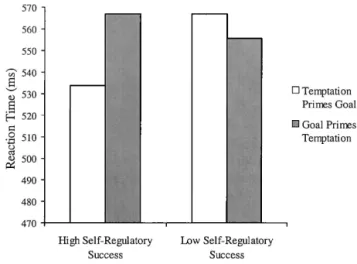
For the sake of clarity, participants were classified as high versus low on perceived self-regulatory success on the basis of a median split of the pertinent scores. As shown in Figure 3, students who perceived themselves as successful at pursuing academic goals were faster to recognize goal-related words following temp-tation primes than to recognize temptemp-tation-related words following goal primes, whereas students who perceived themselves as un-successful were slower to recognize the goal-related words fol-lowing temptation primes than to recognize temptation-related words following goal primes.
These data suggest that only students who are successful self-regulators activate academic goals in the presence of situational
cues for procrastination. As suggested by the data, students who are unsuccessful self-regulators were not as fast to recognize academic goals in the presence of temptation cues. This is true despite the fact that unsuccessful self-regulators reported an equally pronounced interest in pursuing academic goals—ratings of the subjective importance of the goal were uncorrelated with perceived self-regulatory success (r⫽ ⫺.03, p⫽.81). Thus, it is possible that students who are successful at self-control are able to put aside distracting temptations and to continue studying, at least in part because of their tendency to activate overriding goals when confronted with temptations.
Overall, the present results are consistent with the notion that temptation– goal activation is associated with safeguarding indi-viduals’ effective pursuit of their high-priority objectives. Specif-ically, we find that this mechanism characterizes individuals who, by their own testimony, are successful self-regulators in a domain to which the goal–temptation couplings were relevant—namely, the realm of academics—and it does not characterize individuals who perceive themselves as unsuccessful.
Our next study extends the investigation into a different self-regulatory domain—specifically, that of weight watching. This experiment investigates whether successful versus unsuccessful weight watchers exhibit different activation patterns of goals by temptation and vice versa. We expected that the individuals who are successful versus unsuccessful in regulating their weight would show quicker activation of goals by temptations than the other way around but would do so only under particular conditions. These conditions relate to an additional potential moderator of the
acti-3Another way to look at the data is in a mixed factorial regression model
(similar to the one presented in Study 4). This analysis fell short of yielding a significant interaction between self-regulatory success and prime–target combination ( p⫽.17). That is, the effect of self-regulatory success was not significantly different for goal–temptation priming versus temptation– goal priming. We therefore conducted an ANOVA analysis in addition to the reported correlation. This analysis shows that the relatively fast temptation– goal (compared with goal–temptation) activation pattern in-creases with self-regulatory success.
Figure 3. Target recognition time as a function of prime–target combi-nation (temptation– goal vs. goal–temptation) and perceived self-regulatory success. High and low values are based on a median split.
vation patterns investigated in the present research: the perceived importance of the goal to the individuals involved. We expected that the differential temptation– goal activation would be more pronounced for successful versus unsuccessful weight watchers only to the extent that they perceived weight watching as a par-ticularly important personal objective. Thus, whereas in Study 3 participants were only tested with respect to an academic goal that was uniformly highly valued, in Study 4, we tested for the com-bined influence of variations in subjective goal value and varia-tions in the ability to successfully implement self-control on temptation-elicited goal activation.
Study 4: Goal Activation by Temptations Depends on
Self-Regulatory Success and Subjective Goal Value
In this study, participants engaged in a lexical decision task in which the targets were words related to the goal of dieting (e.g.,slim) and the primes were either words related to tempting foods
(e.g., cake) or words related to irrelevant temptations (e.g., sex). We also measured how important it was for participants to watch their weight as well as how successful they perceived themselves to be at controlling their weight. We predicted an interaction of subjective value of dieting and perceived success at dieting in determining participants’ lexical decision times for diet-related targets following subliminal priming by food-related temptations.
Method
Participants. One hundred two University of Maryland undergraduate students (50 women and 52 men) participated in the experiment in ex-change for $5.
Procedure. This study used a Perceived Self-Regulatory Success ⫻ Subjective Value⫻Prime (temptation vs. neutral) mixed design. Partici-pants completed the procedure on desktop computers. The computer pro-gram first presented a series of questions that assessed participants’ attach-ment of subjective value to and perceived success in watching their weight. We assessed subjective value by asking participants to rate on 7-point scales the extent to which they were concerned with (a) watching their weight and (b) being slim. We assessed perceived self-regulatory success by asking participants to rate the extent to which (a) they were successful in watching their weight, (b) they were successful in losing extra weight, and (c) they found it difficult to stay in shape (the last item was reverse coded). To conceal the true purpose of the study, we embedded these questions within a set of 23 additional items that were irrelevant to the purposes of this research (e.g., “How much time do you spend on social activities?”).
Next, the degree to which the goal of weight watching was activated by food temptations was assessed through the subliminal sequential priming procedure used in our preceding experiments. Each trial included (a) a fixation point (⫹) that remained on the screen for 2 s, (b) a prime word presented for 50 ms, (c) a backward mask (a row of Xs) that remained for 700 ms, and (d) a target letter string. The participants’ task was to classify the target letter strings as either words or nonwords, using the Y and the N keys. Each response was followed by an 800-ms pause and then com-mencement of the next trial. The subliminal primes in this study consisted of either relevant temptations—that is, words related to fattening food (cake and chocolate)— or irrelevant temptations—that is, words with mo-tivational appeal for undergraduates (as revealed by a pretest) but no relevance to weight watching (i.e., sex and drugs). The target words were related to weight watching (diet, slim, thin, and fit). Each prime–target combination was presented once, making for 16 combinations overall. Experimental trials followed 10 practice trials and were embedded within
other trials that presented irrelevant words (e.g., orange, card), and non-words as targets (for an overall total of 260 trials).
Results and Discussion
The separate items assessing the subjective value of weight watching were highly correlated (r⫽.58, p⬍.001), as were the items assessing participants’ perceived self-regulatory success (␣⫽.72). Accordingly, these two sets of items were collapsed into unitary importance and perceived success scales, respectively. As in our prior studies, all individual reaction times were first trans-formed through a natural log transformation, with only correct responses less than three standard deviations from the mean in-cluded in subsequent analyses.
A regression analysis was conducted on reaction times for recognizing diet-related targets using three predictors: (a) type of prime (food vs. control), (b) perceived importance, and (c) per-ceived success. This analysis revealed a Prime⫻Perceived Suc-cess⫻Perceived Importance three-way interaction (⫽ ⫺.15),
F(1, 100)⫽4.37, p⫽.04. To explore the three-way interaction, we examined the form of the Perceived Success ⫻ Perceived Importance two-way interaction in the food and control prime conditions separately. This Perceived Success⫻ Importance in-teraction was significant in the food prime condition (⫽ ⫺.22),
F(1, 99)⫽5.13, p⫽ .02, but insignificant in the neutral prime condition (⫽ ⫺.09), F(1, 100)⫽0.80, p⫽.37.
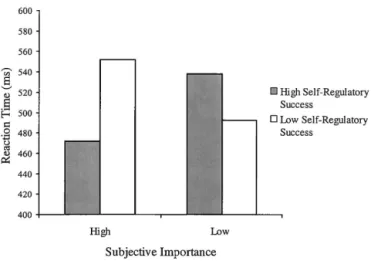
This pattern of results indicates that the more important weight watching was to them, the faster successful (but not unsuccessful) self-regulators were to recognize diet-related words following fat-tening food primes. No similar effect was obtained for either perceived self-regulatory success or perceived importance on time for recognizing targets following neutral primes.
The relevant statistics are displayed in Figure 4. Following the suggestions of Aiken and West (1991), we present the reaction times predicted by the regression model to obtain at plus or minus one standard deviation from the means of the subjective impor-tance and perceived success scores. The results of the present study extend those of its predecessors in this series by demonstrating the
Figure 4. Predicted reaction time for recognizing weight-watching tar-gets following food primes as a function of subjective goal importance and perceived self-regulatory success. High and low values represent plus or minus one standard deviation from the respective means.
combined moderation of temptation-elicited goal activation by subjective goal value and perceived self-regulatory success. Es-sentially, as in Study 3, we once again found that the magnitude of temptation– goal activation is increased by self-regulatory success. Furthermore, in the present study, we obtained evidence that this relationship increases when the goal is perceived as more impor-tant. Simply stated, this interaction suggests that temptation– goal activation is most likely to occur when the individual is better able to successfully exercise self-control and when the overriding goal is high in importance.
In our first four studies we found evidence for the existence of temptation– goal activation (Study 1 and 2) and then proceeded to examine the effects of two critical moderating factors (Study 3 and 4). However, we stopped short of demonstrating the behavioral implications of the activation of goals by temptation cues. Specif-ically, we have yet to show that the presence of real temptations in the environment leads to goal activation and, ultimately, to actual success at self-control.
Study 5: Behavioral Consequences of Temptation Priming
In our studies so far, we have presented evidence that tempta-tions may activate their overriding goals automatically and that temptation and goal representations are associated asymmetrically. Whereas temptations may activate their higher priority objectives, the latter may (if anything) inhibit the temptations. Our last study was designed to test for the behavioral implications of these activation patterns. We hypothesized that in the presence of temp-tation cues, individuals activate the overriding goals with which the temptations interfere, which thereby makes them aware of their long-term priorities and helps them resist the temptations. Thus, for example, when fattening food is served, restricted eaters should activate the goal of dieting, which in turn should enable them to avoid the forbidden culinary delights. Because of the activation of self-control processes, temptation cues are also expected to prevent people from succumbing to temptation as much as or more than are directly goal-related cues. Whereas direct dieting cues, for exam-ple, may or may not induce a resolve to abstain from specific tempting foods, the presentation of such foods per se should induce a concrete decision to forego them.To test these ideas, we exposed participants, all women con-cerned about their weight, to either diet primes, fattening food primes, or control primes. We sought to empirically assess the behavioral effects of activating the goal of weight watching by the presence of food primes versus by directly diet-related stimuli.
Method
Pilot study. Previous studies conducted in our lab have found individ-ual differences in the perceived importance of weight watching. These differences were moderated by gender. For instance, in a pilot study delivered to 20 University of Maryland students, women reported more concern with their weight than did men (Ms⫽5.56 and 3.91 on a 7-point scale, respectively), t(18)⫽2.26, p⫽.04. To maximize the number of participants in Study 5 with experience in restricting their dietary intake, we therefore recruited only women for this particular experiment.
Participants. Seventy-two women who were University of Maryland undergraduate students participated in the experiment in exchange for $5. Procedure. This study used a prime condition (diet vs. food vs. con-trol) between-subjects design. On their arrival at the experimental
labora-tory, participants were randomly assigned to one of three priming condi-tions. In the diet prime condition, meant to activate dieting goals, participants were brought into a small cubicle, ostensibly the office of a sports psychologist, in which a number of magazines and books concerning exercising and dieting (e.g., Shape magazine) were strewn about the desk and nutrition- and dieting-related flyers were mounted on the walls (e.g., advertisements for classes on weight watching). The food prime condition, meant to activate the temptation of consuming fattening food, was admin-istered in another room, in which we left a Chocolatier magazine in addition to a variety of popular fattening food items (e.g., chocolate bars, cookies, chips, and cakes). According to a note posted nearby, these food items had been left there for use at a later meeting. Finally, in the control prime condition, participants were brought into a third room that merely contained a variety of magazines about the economy and geography of the United States and was expected to elicit neither concerns with dieting nor thoughts of indulgence in fattening foods.
Participants in each condition worked alone. As an initial dependent measure, the accessibility of the goal of dieting was assessed through a lexical decision task. This task was similar to those of Studies 1 and 2, only this time it was performed without subliminal primes. Specifically, it consisted of trials including a fixation point (⫹) that remained on the screen for 2 s and a target letter string followed by a 1-s pause. The relevant target word was diet, which appeared once among presentation of other irrelevant words (e.g., stream or moment) and an equal number of non-words. Following this lexical decision task, participants’ choice and be-havioral intentions were assessed. First, participants were offered a gift and were asked to choose between a chocolate Twix bar and an apple. Our pilot sample revealed that Twix bars were seen as interfering more with the weight-watching goal than were apples (Ms⫽5.81 and 1.19 on a 7-point scale, for Twix bars and apples, respectively), t(20)⫽4.44, p ⬍.001. Next, participants completed a short survey regarding their plans to con-sume fattening food in the future. They rated (on a 7-point scale) the extent to which they should subsequently avoid (a) french fries, (b) chocolate, (c) cake, (d) chips, (e) hamburger, (f) pizza, and (g) soda.
Finally, to exclude nonrestrained eaters, we asked participants (a) whether they ever restricted what they ate and (b) whether they were ever health conscious about what they ate. Five participants who answered “no” to at least one of these questions were excluded from further analysis. Following this survey, participants were first asked whether they had any suspicions at all about the study, next asked whether they had any suspi-cions about the connection between the priming manipulation and the lexical decision task, and finally asked whether they had any suspicions regarding the connection between the priming manipulation and the food choice behavioral measure. Afterward, participants were provided with an explanation of the purpose of the study and released. No participants expressed any suspicion regarding the purpose of the primes.
Results and Discussion
Individual reaction times for recognizing diet were first submit-ted to a natural log transformation. Only correct responses within three standard deviations from the mean were used in all subse-quent analyses. A one-way prime (diet vs. food vs. control) ANOVA on reaction times yielded the expected main effect for prime condition, F(2, 63)⫽3.25, p⫽.04, with faster recognition of diet in the fattening food and diet prime conditions than in the control prime condition, t(61)⫽2.52, p⫽.01. The means corre-sponding to these analyses are given in Table 1. As shown, participants in the food-prime condition were just as quick to recognize the word diet as were individuals in the diet-prime condition, although those in the latter group were directly primed with the concept of dieting. This suggests the operation of a self-control mechanism in the food-prime condition wherein
par-ticipants confronted with a food temptation activated the overrid-ing goal of dietoverrid-ing. There was no effect of prime condition on reaction times to the irrelevant words.
Next, we assessed the behavioral intentions that were evoked in each condition. Ratings of intentions to avoid different types of fattening food were collapsed, and an ANOVA of this score yielded a significant main effect, F(2, 63)⫽4.51, p ⫽.01. It is interesting that participants in the food prime condition were more concerned about abstaining from fattening foods than were partic-ipants in both the diet and the neutral prime conditions, t(61)⫽ 2.96, p⫽.004 (see Table 1). This seems to suggest that instead of merely activating general goal representations (here, that of diet-ing), which may have a broad range of behavioral implications (e.g., the inclusion of various healthy or low caloric food items in one’s diet), temptations may activate a narrower set of self-control intentions geared specifically at exclusion of the tempting stimuli. Finally, our analysis revealed an effect of prime condition on participants’ choice of a parting gift (apple vs. Twix bar). As shown in Table 1, participants in both the food and the diet prime conditions chose an apple as a gift more frequently than did participants in the control prime condition,2
(1, N⫽67)⫽3.63,
p⫽.05.
These findings are consistent with the results of Bargh and his colleagues (Bargh, Chen, & Burrows, 1996; Bargh, Raymond, Pryor, & Strack, 1995) that mere activation of a goal representa-tion can automatically elicit behavior that is consistent with pur-suing this goal. Here, we posit that the activation of the represen-tation of the goal of dieting in both the diet and the food prime conditions led to an increased immediate tendency to select a low-fat food (i.e., to make a choice consistent with the motive to restrict food intake), as compared with the neutral prime condition. In sum, the present results complement those of our previous studies by showing that the presence of an actual temptation in the environment may lead to an activation of the higher priority goal, which then overrides the temptation’s subversive influence. When incidentally exposed to fattening food, compared with a neutral prime, participants were faster to recognize the goal of dieting. Activating this goal may have made participants more conscious about their weight when planning future food consumption, con-sequently leading to more goal-congruent behavioral choices (i.e., of apple vs. Twix bar). It is of interest that although priming the
goal directly (in the diet prime condition) evoked a congruent food choice, it did not significantly decrease intentions to succumb to specific temptations. Priming the goal thus increased immediate awareness of it, prompting goal-consistent behavior, but it did not bolster self-control attempts as such—that is, it did not motivate the formation of intentions to overcome specific temptations. Pos-sible implications of such a self-control mechanism, in contrast to direct goal activation, might include, for instance, an enhanced ability to resist temptation in a situation in which a Twix bar is offered without the healthy alternative of an apple. These notions might be profitably explored in future research.
General Discussion
In the course of their self-regulatory pursuits, individuals may often encounter temptations enticing them to stray from their chosen path and impeding progress toward goal attainment. Suc-cessful resistance of such temptations may require that one’s goal be kept firmly in focus, exerting its guiding influence on actual behavior. Repeated self-control attempts of this sort in a given domain of endeavor may result in the forging of facilitative links between temptation stimuli and the higher priority goals they threaten to undermine. In parallel, inhibitory links may develop between the cognitive representations of goals and their pertinent temptations. Over time, these facilitative and inhibitory links may become overlearned to the point of unconscious activation and considerable cognitive efficiency (hence, relative independence of cognitive resources). The development of the foregoing activation patterns (between temptation and goal representations and vice versa) may become more likely when the goals in question are more important, and the formation of these patterns may be related to self-regulatory success.
The aforementioned theoretical notions received consistent sup-port in the present series of experiments. In Study 1, self-generated goal-related key words were more quickly recognized following subliminal presentation of self-generated temptation key words than following subliminal presentation of irrelevant primes. This effect, which did not involve conscious awareness of the preceding primes, was replicated in Study 2, in which it was also shown to occur independently of residual mental resources. Unlike the first experiment, which used participants’ idiosyncratic goals, our sec-ond study involved experimenter-provided religious goals previ-ously shown to be common in our participant population. This study found that the subliminal presentation of sin-related words facilitated the recognition of words related to an overriding reli-gious goal to a similar extent in the presence and in the absence of an imposed cognitive load. Together, our first two studies addi-tionally demonstrate the asymmetry of the goal–temptation asso-ciation: Whereas goal recognition was facilitated by temptation primes, temptation recognition tended to be inhibited by goal primes.
Our subsequent studies went on to identify the moderators of temptation-elicited goal activation. Accordingly, Study 3 shows that the activation of academic goals following procrastination cues is associated with self-regulatory success. Study 4 extends this finding, suggesting that, with respect to the goal of weight watching, the degree of goal activation by food temptation is a joint function of the subjective value of the goal and the extent to which self-regulation with respect to this goal has been successful. Table 1
The Influence of Priming Condition on Reaction Time for Recognizing Diet, Intentions to Avoid Consumption of Fattening Food, and Choice of an Apple Over a Chocolate Bar
Variable
Prime condition
Fattening food Diet Control Reaction time (ms)
M 539a 528a 596b
SD 1.15 1.18 1.20
Behavioral intentions
M 4.96b 3.9a 4.12a
SD 0.93 1.45 1.38
Choice (%) 62.5a 63.1a 38b
Note. Cell means in rows not sharing the same subscript differ signifi-cantly (p⬍.05).
Presumably, temptation– goal activation is more likely to develop for highly (vs. less highly) valued objectives, and its development is likely to contribute to self-regulatory success. Finally, the be-havioral manifestations of such success were investigated in Study 5. That study found that, with respect to the goal of weight watching, fattening food primes led not only to the activation of the concept of diet, representing a relevant high-priority goal, but also to formation of self-control-related behavioral intentions with respect to specific temptations (i.e., plans to avoid various fatten-ing foods). Of additional importance, the fattenfatten-ing food primes prompted a diet-related choice of a low-calorie food (an apple) over an enticing, high-calorie temptation (a Twix bar). A similar behavioral choice was also prompted by a direct activation of the dieting objective (in the diet prime condition). However, the latter induction did not engender concrete self-control intentions with regard to specific temptation stimuli. Ironically, it is thus possible that the activation of high-priority objectives by temptation stimuli is in some sense more effective than is direct activation of such objectives, in that the former (but not the latter) may induce specific implementation intentions (Gollwitzer, 1999) aimed at resisting the temptations.
It is of interest that the present findings were replicated across a wide variety of goals and temptations, including self-generated goal–temptation couplings (Study 1), experimenter-generated re-ligious goals and relevant temptations (Study 2), academic goals (Study 3), and weight-watching goals (Studies 4 and 5). That the same theoretically coherent activation patterns emerged across such a wide variety of motivational concerns adds confidence in their validity and robustness.
Taken together, these results shed light on the unique mental organization of motivational constructs. In a cognitive representa-tion of a given individual’s goal system (Kruglanski et al., 2002), higher order goals may come to be associated not only with their means of attainment but also with obstacles or barriers to success-ful goal attainment (cf. Lewin, 1935), including competing high-priority goals (cf. Kruglanski et al., 2002; Shah & Kruglanski, in press; Shah et al., in press) as well as momentarily alluring temptations. The challenge to self-regulatory research is to under-stand the nature of such linkages, the conditions under which they may develop, and their impact on self-regulatory processes. The present findings contribute a piece to this overall puzzle.
Personal or Situational Self-Control?
These findings also are relevant to the emerging discussion regarding personal versus situational control of behavior (cf. Bargh, 1994; Bargh & Chartrand, 1999; Wegner & Bargh, 1998). The goal construct was traditionally associated with personal con-trol in that goals are assumed to represent internal, relatively stable entities that may guide one’s conduct (Cantor, Markus, Niedenthal, & Nurius, 1986; Higgins, 1987, 1989; Kruglanski, 1996; Markus & Ruvolo, 1989). Challenging this view, recent research demon-strates that motivational constructs can be activated by external stimuli and that their activation affects subsequent actions. That is, environmental cues can automatically activate goal constructs and consequently elicit goal-related behavior. Specifically, in their seminal research on these issues, Bargh and his colleagues (Bargh, 1997; Bargh & Chartrand, 1999) found that external cues activate personal goals outside the realm of awareness and that these goals,
in turn, influence information processing, choice, and behavior to the same extent as do conscious goals.
Our present findings identify an intriguing constraint on such externally dominated control of human behavior. Specifically, they suggest that, to the extent that they represent low-priority tempta-tions, external cues may set in motion self-control mechanisms designed to counteract their own influence, thus wresting behav-ioral control from the unconcerned environment and relegating it to one’s own internal priorities. Thus, rather than eliciting situ-ationally congruent behavior, automatic goal activation may coun-teract the influence of situationally primed temptations, represent-ing an automatic response that cancels out the influence of the situation. For example, in Study 2, situational cues for sin-related behavior (e.g., the words premarital sex or drugs) elicited the overriding religious values (e.g., activation of religious) that may forestall the pursuit of these sinful enticements, rather than con-gruent information processing (e.g., activation of anarchism). More generally, then, the present findings make a case for distin-guishing automatic goal activation from the concept of situational control. As we have seen, automatic goal activation may, in fact, counteract situational control and promote the personal control of behavior, if by that we mean action congruent with one’s own system of subjective values and priorities.
Alternative Explanations
We assume that the presently obtained activation patterns be-tween temptations and goals are the result of successful self-control attempts rather than of (a) similar semantic properties or (b) similar motivational content. Thus, temptation– goal associa-tions are very different in nature from semantic associaassocia-tions. In studies of semantic priming, two constructs mutually activate one another to the extent that they share similar semantic properties (e.g., a category name and a category member; cf. Meyer & Schvaneveldt, 1971; Neely, 1991). Semantically related stimuli (e.g., bird and robin), rather than unrelated stimuli (e.g., bird and
building), should facilitate the recognition of one another (Neely,
1977). Because temptations and goal-related constructs share dif-ferent and even contradictory semantic content, their mutual asso-ciation is unlikely to be explained in terms of semantic similarity as such.
Another alternative explanation is that the asymmetrical priming effects we found were due to goals and temptations sharing a hierarchical relationship in a semantic network, with goals occu-pying a higher rung of the associative ladder. According to early work by Collins and Loftus (1975) and Anderson (1983), spread-ing activation from conceptual representations becomes diluted when the representation is connected to a larger number of other concepts (e.g., bird is connected to exemplars such as robin,
sparrow, hawk). Essentially, lower concepts in the hierarchy are
posited to spread more activation to higher nodes than vice versa (e.g., robin activates bird more than bird activates robin). How-ever, this principle is not well able to account for our findings of temptation– goal activation, on the one hand, and goal–temptation inhibition, on the other. First, there is no reason to believe that temptations are subordinate constructs relative to overriding goals in a semantic network. Temptations are not a semantic subcategory of goals—for instance, the temptation of sex is not a semantic exemplar of the goal of religion. More important, even if