OMAP™ platform security features
This white paper introduces TI’s OMAP application processors
in the wireless and the embedded space and highlights their
security features. The security architecture for TI’s OMAP
platform is a combination of hardware and software
compo-nents that enforce the security policy and provide secure
functionalities to the platform.
OMAP application processors ...3
The need for security...4
OMAP security solutions...5
OMAP1510, OMAP710, OMAP310, OMAP5910 processors. ...6
OMAP161x, OMAP73x processors...6
OMAP platform security features ...7
Secure environment...7
Secure boot/secure flash...7
Run-time security...8
Crypto engine...8
Conclusion...9
References...9
Figure 1: OMAP application processors ...3
Figure 2: OMAP platform security solutions...5
Figure 3: Three layered security architecture ...6
Table of contents
Table of figures
By Harini Sundaresan
Applications Engineer, OMAP Security Texas Instruments, Wireless Terminal Business Unit
AES Advanced Encryption Standard API Application Programming Interface
DBB Digital BaseBand
DES/3DES Data Encryption Standard/ Triple-DES DRM Digital Rights Management
DSP Digital Signal Processor GPRS General Packet Radio Service
GSM Global System for Mobile communication
HW Hardware
MD5 Message Digest version 5
MPU Main Processing Unit. The main processor used in computers (and phones). NoVo Non Volatile
OS Operating System
PDA Personal Digital Assistant PKI Public Key Infrastructure
PPC Microsoft® Windows ® Pocket PC
RAM Random Access Memory – a writable memory.
RNG Random Number Generator
ROM Read Only Memory
SE Secure Environment
SHA-1 Secure Hash Algorithm. Algorithm version 1. Algorithm used to calculate highly secure hash values
SSL Secure Socket Layer
SW Software
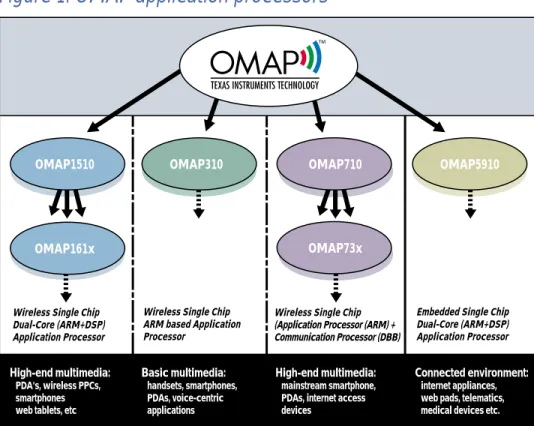
TI’s OMAP™ application processors can be broadly classified into two categories focusing on different markets: 2.5G and 3G wireless handsets and embedded applications. Wireless OMAP processors address a wide range of market segments from traditional cost-sensitive, voice-centric handsets to multimedia-rich wireless handsets and PDAs with the best combination of high-performance and ultra-low power consumption. Embedded OMAP processors are ideal for designers working with devices that require embedded applications processing in a connected environment such as Internet appliances,
web pads, telematics and medical devices.
Figure 1: OMAP application processors
OMAP1510
OMAP161x
OMAP310 OMAP710
OMAP73x
OMAP5910
Wireless Single Chip Dual-Core (ARM+DSP) Application Processor
Wireless Single Chip ARM based Application Processor
Wireless Single Chip (Application Processor (ARM) + Communication Processor (DBB)
Embedded Single Chip Dual-Core (ARM+DSP) Application Processor
High-end multimedia:
PDA's, wireless PPCs, smartphones web tablets, etc
Basic multimedia:
handsets, smartphones, PDAs, voice-centric applications
High-end multimedia:
mainstream smartphone, PDAs, internet access devices
Connected environment:
internet appliances, web pads, telematics, medical devices etc.
OMAP application
processors
The need for strong security in the OMAP platform comes from the vulnerability of the wireless space to security risks such as viruses. The mobile phone has traditionally been a closed system. In Europe, security is mainly relying on the SIM card, which provides the user of the mobile phone with a unique network identity. Due to the closed nature of the system and to the robust smart card manufacturing process, the risk for the Network Operator to suffer from hackers was limited.
The introduction of packetized services, such as GPRS, and the move to 3G systems opens the wireless industry to a new range of services and a new vulnerability to hackers. The formerly closed nature of mobile phones is changing to a more open system offering rich content and applications available over the air. With this openness a new level of security is required to protect wireless networks and handsets. Open architectures require security not least because of the threat of viruses but also because malicious software can compromise the intended commercial use of the phone and the deployment of value added services.
Japan was the setting for the first example of security weakness for current 2.5G and 3G mobile phones. There were a number of attacks with various consequences including: • malicious e-mails to wireless handsets that unleashed malicious code which took
control of the communications device and, in some cases, repeatedly called Japan’s emergency response system
• placing long distance calls without the user's knowledge
• handset lockup, making it impossible for subscribers to use any of the arrier’s services
Numerous incidents involving spamming, denial-of-service, virus attacks, content piracy and malevolent hacking are becoming rampant in the wireless field. The security breaches that have posed a constant threat to desktop computers over the last 10 years are migrating to the world of wireless communications where they will pose a threat to mobile phones, smartphones, personal digital assistants (PDAs), laptop computers and other yet-to-be-invented devices that capitalize on the convenience of wireless communications.
With over 12 years of wireless experience, TI has the depth of knowledge imperative for understanding how critically important security will be to the success of 2.5G and 3G. To meet the needs of the wireless market, in February of 2003 TI announced five new OMAP processors with on-chip hardware security.
The need for
security
OMAP1510, OMAP710, OMAP310, OMAP5910 processors
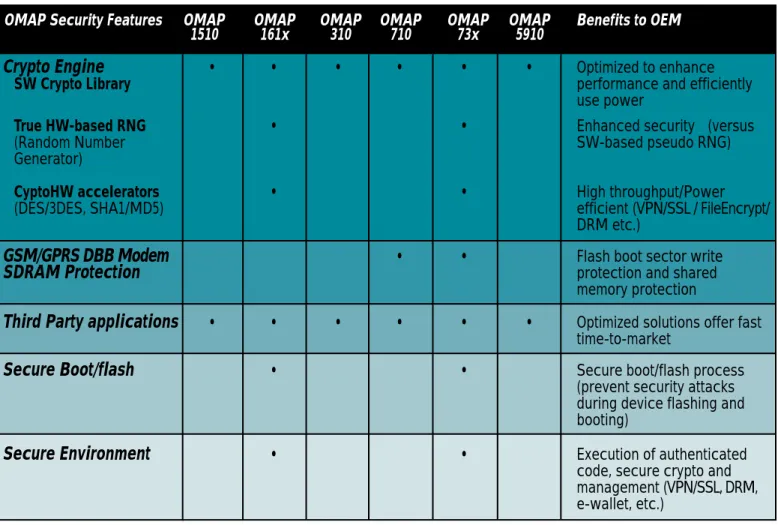
The first generation of the OMAP processors includes the OMAP1510, the OMAP710, the OMAP310, and the OMAP5910. The security solution for the first generation of OMAP processors is software based. TI, working with industry leading security providers, Certicom and Safenet, has high-performance software crypto libraries available for high level operating systems (HLOS) like Linux®, Microsoft® Windows® CE, and Symbian OS™ that are optimized for the OMAP platform. Apart from core crypto functions, TI also offers Certicom’s SSL toolkit and PKI toolkits that are optimized for the OMAP platform. These software crypto engines and toolkits have been tested with regressive tests and provide user friendly API guides and sample test frameworks enabling quick development.
OMAP security
solutions
Crypto Engine
• • • • • • Optimized to enhanceSW Crypto Library performance and efficiently
use power
True HW-based RNG • • Enhanced security (versus
(Random Number SW-based pseudo RNG)
Generator)
CyptoHW accelerators • • High throughput/Power
(DES/3DES, SHA1/MD5) efficient (VPN/SSL / FileEncrypt/
DRM etc.)
GSM/GPRS DBB Modem
• • Flash boot sector writeSDRAM Protection
protection and sharedmemory protection
Third Party applications
• • • • • • Optimized solutions offer fast time-to-marketSecure Boot/flash
• • Secure boot/flash process(prevent security attacks during device flashing and booting)
Secure Environment
• • Execution of authenticatedcode, secure crypto and management (VPN/SSL, DRM, e-wallet, etc.)
OMAP Security Features OMAP OMAP OMAP OMAP OMAP OMAP Benefits to OEM
1510 161x 310 710 73x 5910
Apart from the SW core crypto library, the OMAP Developer Network offers additional Third party security applications. These applications are optimized for the OMAP platform and offer OEMs development cost savings and faster time-to-market. A few of the offerings from OMAP developers includes:
• Biometric fingerprint recognition from Authentec • VPN application from Safenet and Certicom • Virus protection from Network Associates
• Firewall, Content Filtering and mobile data security from WhiteCell • Encrypted FAX capability from Snapshield
OMAP161x, OMAP73x processors
One of the distinguishing features of the second generation of OMAP processors, the OMAP161x and the OMAP73x devices, is the embedded on-chip security. This is described
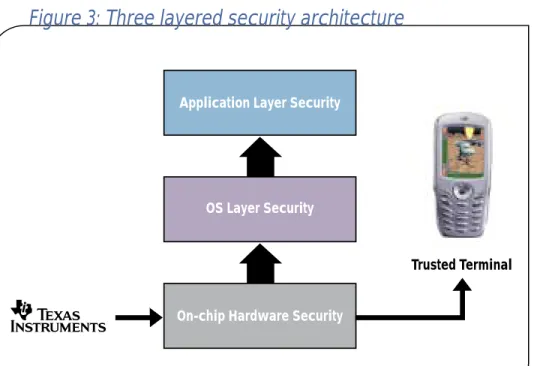
in detail in the next section. This security solution is a combination of hardware and soft-ware components used to create a “trusted device”. Today, most devices include two layers of security: application layer security and operating system layer security. While these efforts reduce risk, stand-alone they are not sufficient. TI offers a third layer of protection that integrates embedded hardware security technology. By doing this, TI enables manufac-turers to offer a new layer of defense at the chip level that is fast and serves as a security foundation for the applications and OS layers, thereby creating a “trusted” mobile device.
Application Layer Security
OS Layer Security
On-chip Hardware Security
Trusted Terminal
OMAP platform security features
Secure Environment
The Secure Environment is a feature available, where critical code and data can be executed securely and sensitive information can be hidden from the outside world with the help of the following security components:
• Secure Mode (Secure Execution Environment): Can be viewed as a 3rd privilege level allowing secure execution of “trusted” code via on-chip authentication. Its activation relies on the presence of special–purpose hardware creating an environment for protecting sensitive information from access by non-trusted software. The secure mode is set with the assertion of a dedicated security signal after a set of pre-determined security conditions are met. This signal propagates across the system and creates a boundary between resources that only trusted software can access and those resources available to any software.
• Secure Keys: OEM specific one-time programmable keys accessible only in secure mode used for authentication and encryption in a secure environment.
• Secure ROM: Accessible only in secure mode and contains security services such as secure storage mechanism using secure keys, key management and cryptographic libraries.
• Secure RAM: Accessible only in secure mode and used for running OEM specific “trusted/authenticated code”.
Secure Boot/Secure Flash
The foundation of a secure platform is the authentication of the software installed on the platform. The authentication process must guarantee the origin and the integrity of the software stored in the external NoVo memory.
In security-enabled production devices, secure flash and secure boot is enforced to achieve high level of security. Secure flash ensures that the OEM’s OS image is correctly and securely programmed into flash memory at the factory. Secure Boot ensures that the “authorized” OEM’s SW (signed by the OEM) and optionally the OS image (optionally signed by the OEM) is authenticated prior to execution. This prevents the code from being modified by unauthorized entities or the external memory NoVo from being tampered with. It also prevents the execu-tion of any forged or spoofed software code. The authenticaexecu-tion of a software module is based on a certificate associated with this module*1.
Run-time Security
The OMAP platform secure environment can be extended to OS applications during run-time for relatively short security critical tasks such as key encryption/decryption, authentication and managing other highly secure data. Such operations often require maximum security in DRM, VPN and banking applications. The run-time services require the presence of software interface components like the APIs and drivers designed to integrate the secure environment into the OS.
Crypto Engine
The OMAP161x and OMAP73x processors have HW crypto engines to achieve higher throughput and enhance security. The HW crypto engines available are DES/3DES, SHA1/MD5 and RNG. These HW crypto engines can be either configured as secure mode access only or both user mode and secure mode access based on the OEM’s preference.
1. HW Accelerators in Secure Mode: For security applications that are short and/or require high level of security (e.g.: M-wallet application, DRM key management, Point Of Sale terminal verification), the secure mode only access configuration is desirable.
2. HW Accelerators in User Mode: For security applications that are long and/or
require medium or low level security (which does not require the secure mode services) but desire higher throughput (e.g.: VPN, WLAN, bulk data encryption), the user mode access configuration is the preferable choice.
The OMAP SW crypto libraries from TI’s security providers Certicom and Safenet have an added feature allowing developers to seamlessly access the HW accelerators in user mode from their crypto libraries. Developers simply need to use the IPSec toolkit, SSL toolkit and/or the PKI toolkit running on the top of the SW crypto libraries to take advantage of the HW Accelerators. The ease of development is a great benefit to OEMs and offers faster time-to-market since TI and its security providers offer the complete, integrated, optimized solution.
Conclusion
References
Special thanks
The security architecture offered by the OMAP platform is a combination of hardware and software mechanisms for safe execution of secure services:
• On-chip security hardware offers the necessary robustness for tamper resistance • Software security provides the modularity and scalability to support numerous
cryptographic standards and security protocols for confidently running any value added application
Thus, building a security foundation on the OMAP platform, manufacturers that choose TI will meet the “trusted security” challenges of 2.5 and 3G wireless and embedded devices. The thirst for security can never be quenched completely; however strong we build a fortress, new threats will always appear. TI is determined to continue its leadership in building robust wireless/embedded security solutions for its customers for all future generations of the OMAP processors.
1. www.omap.com
2. Reducing the Security Threats to 2.5G and 3G Wireless Applications– www.omap.com 3. Wireless Security: from the inside out– www.omap.com
*1Note: There are other types of devices where secure boot and secure flash is not
enforced. It is not in the scope of this white paper to discuss them in detail.
Special thanks to the following Texas Instruments WTBU members for their contribution to this white paper either in the form of review, feedback or internal reference materials: Erdal Paksoy, Jerome Azema, Sunil Hattangady and Jason Vorel.
Important Notice:The products and services of Texas Instruments Incorporated and its subsidiaries described herein are sold subject to TI’s standard terms and conditions of sale. Customers are advised to obtain the most current and complete information about TI products and services before placing orders. TI assumes no liability for applications assistance, customer’s applications or product designs, software performance, or infringement of patents. The publication of information regarding any other company’s products or services does not constitute TI’s approval, warranty or endorsement thereof.
© 2003 Texas Instruments Incorporated
OMAP is a trademark of Texas Instruments. All other trademarks are the property of their respective owners.