Nebraska Center for Rural Health Research at the in pa rtnership with
The Nebraska Health and Human Services System h ttp ://www.un m c .e d u/n e b ra ska
University of Nebraska Medical Center
2000
Purpose
This Nebraska Health Data Reporter describes characteristics of elderly Nebraskans admitted to nursing homes from July 1, 1996 to June 30, 1997. When appropriate and available, comparisons are made to data from the nation.
Summary
This report highlights socio-demographic characteristics, functional and cognitive limitations, and diseases or medical conditions at admission for elderly Nebraskans admitted to nursing homes. The results of this study indicate that newly admitted residents are predominately female, unmarried, age 75 and older, white, and lived alone prior to admission. These findings are consistent with a comparable nationwide sample of people over age 65 admitted to nursing homes. Additionally, people admitted to Nebraska nursing homes have substan-tial health, cognitive and functional limitations, as is true of nursing home residents nation-wide.
Acknowledgements
The Nebraska Health Information Project gratefully acknowledges the following people for their contributions to this report: Bob Seiffert and Penny Beave (Nebraska Health and Human Services System), Pat Snyder and the members of the Nebraska Health Care Association, and Jaime Holoubek.
Demographic, health, and functional status characteristics of
new residents to Nebraska nursing homes: A summary
Joan Penrod, Ph.D. Jami Fletcher, B.S.
University of Nebraska Medical Center
Nebraska Health Data Reporter
Volume 3, Number 1
May 2000
Penrod and Fletcher
INTRODUCTION
Most older people who need help with activities of daily living (ADL) such as bathing, feeding, dressing, or walking prefer to receive assistance at home. However, for a variety of reasons, including high levels of disability, dementia, and the need for short or long-term extensive rehabilitation, about 1.4 million people aged 65 and over live in nursing homes in the United States (U.S. Department of Health and Human Services, 1998). Nationwide elderly nursing home residents are predominately female, age 75 and older, white (non-Hispanic), and widowed. The average age at admission is 82 years. About 42% are admitted directly from the hospital. A substantial minority (37%) lived at home prior to admission to a nursing home. The other 21% are admitted from other hospitals or rehabilitation centers. About 60% require assistance with five or more ADLs (Kane, Kane, & Ladd, 1998).
How does Nebraska’s nursing home population at admission compare to the nation? This report highlights socio-demographic characteristics, functional and cognitive limitations, and diseases or medical conditions at admis-sion for a cohort of elderly Nebraskans admitted to nursing homes. When appropriate and available, compari-sons are made of statewide to nationwide information.
FINDINGS
Socio-demographic Characteristics
The average age in this sample is 83 years. As indicated in Figure 1 this Nebraska admission cohort has a lower percentage of females and unmarried individuals compared to nursing home residents nationwide. How-ever, the picture of nursing home residents nationwide–of more females than males, more whites than nonwhites, and more widowed people than married people–holds true for Nebraska as well (National Center for Health Statistics, 1997). Finally, the Nebraska cohort was not socially isolated because the vast majority (85%) had daily contact with family or friends prior to admission.
Figure 1. Demographic characteristics of new admissions to nursing homes, Nebraska, July 1, 1996 to June 30, 1997, and United States, 1995
Source for U.S. data: National Center for Health Statistics, 1997
Source for Nebraska data: Nebraska Health and Human Services System, Minimum Data Set Long-Term Care Resident Assessment File
*Similar nationwide data are unavailable. 75%
83%
65% 67%
53%
85%
0% 100%
Female Not Married Lived Alone Prior to Admission*
Has Daily Contact with Family/Friends* US Nebraska
Nebraska Health Data Reporter 2000, Vol 3, Number 1
!
Functional and Cognitive Status
As shown in Table 1 the average Cognitive Performance Score (CPS) for new admissions to nursing homes in Nebraska was 1.6–mild cognitive impairment. About 67% of the sample required some assistance with ADLs. The average ADL score was 10.8. Considering that a score of 24 indicates total dependency, the residents in this sample are moderately to highly impaired at admission.
Figure 2 shows that the majority of new admissions to Nebraska nursing homes have mild cognitive
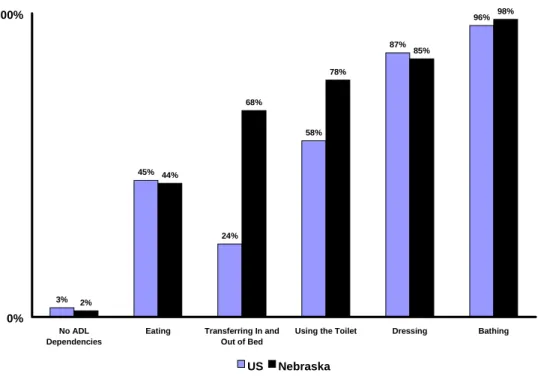
impair-ment. A comparison of U.S. and Nebraska data is shown in Figure 3. The new admissions to Nebraska nursing homes tend to have slightly more ADL dependencies than those in the national sample.
Average cognitive performance score
(possible range 0-6)
1.6
Average ADL score
(possible range 0-24)
10.8
Median number of different
medications taken over the past week
(possible range 0-over 20)
7.0
Source: Nebraska Department of Health and Human Services Minimum Data Set Long-Term Care Assessment File
Table 1. Functional status of new admissions to nursing homes, Nebraska, July 1, 1996 to June 30, 1997
"
Penrod and FletcherFigure 3. ADL dependencies of new admissions to nursing homes, Ne-braska, July 1, 1996 to June 30, 1997, and United States, 1995
Source for U.S. data: National Center for Health Statistics, 1997
Source for Nebraska data: Nebraska Health and Human Services System, Minimum Data Set Long-Term Care Resident Assessment File
36%
18%
16%
24%
6%
0% 50%
0 Intact 1 Borderline Intact 2 Mild Impairment 3 Moderate Impairment
4 Moderately Severe Impairment
5 Severe Impairment 6 Very Severe Impairment Figure 2. Cognitive performance scores for new admissions to nursing homes, Nebraska, July 1, 1996 to June 30, 1997
Source: Nebraska Health and Human Services System, Minimum Data Set Long-Term Care Resident Assessment File
3%
45%
24%
58%
87%
96%
2%
44%
68%
78%
85%
98%
0% 100%
No ADL Dependencies
Eating Transferring In and Out of Bed
Using the Toilet Dressing Bathing
Nebraska Health Data Reporter 2000, Vol 3, Number 1
#
Figure 4. Medical conditions of new admissions to nursing homes, Nebraska, July 1, 1996 to June 30, 1997
Health Indicators
Figure 4 shows the medical conditions at admission for residents in the sample. Note that the total exceeds
100% because many residents were admitted with more than one condition. The most prevelant medical conditions upon admission are hypertension, incontinence, and arthritis.
The number of different medications a person takes over a week is also an indicator of illness. In this cohort, about 1% did not require any medication over a week’s period. Fifty percent of new residents took at least seven different medications in the week prior to admission.
Source: Nebraska Health and Human Services System, Minimum Data Set Long-Term Care Assessment File
45%
41%
28%
26%
19% 19%
16%
14% 14%
13%
5%
0% 50%
Hypertension
Bowel/bladder Incontinence
Arthritis
Congestive Heart Failure
Diabetes
Alzheimer's Disease
Cancer
Depression Emphysema
Arteriosclerotic Heart Disease
$
Penrod and FletcherDISCUSSION
The results of this study of selected characteristics of people admitted to Nebraska nursing homes indicate that newly admitted residents are predominately female, unmarried, age 75 and older, white, and lived alone prior to admission. These findings are consistent with a comparable nationwide sample of people over age 65 admitted to nursing homes. Additionally, people admitted to Nebraska nursing homes have substantial health and functional limitations and mild to moderate levels of cognitive impairment, as is true of nursing home residents nationwide.
Occupancy rates in nursing homes are declining nationally (Kane, Kane, & Ladd, 1998) and in Nebraska (Seiffert, 1999). Kane and colleagues suggest this trend is the result of expanded non-nursing home alterna-tives such as home care and assisted living facilities for rehabilitation and long-term care. Nebraska has recently enacted legislation designed to promote conversion of some nursing home beds to assisted living units. The goals of this program are to decrease reliance on higher cost and less preferred nursing home care and increase care in more home-like community-based settings. If assisted living becomes a substitute for nursing home care, occupancy may continue to decline and severity of functional and cognitive impairment may increase among new admissions to Nebraska nursing homes.
References
Kane, R. A., Kane, R. L., & Ladd, R. C. (1998). The heart of long-term care. Oxford: Oxford University Press. Nebraska Health and Human Services System, Minimum Data Set, part of the Long-Term Care Assessment
File. July 1, 1996 through June 30, 1997.
Morris, C.D., Fries, B.E., Mehr, D.R., Hawes, C., Philips, C., Mor, V., & Lipsitz, L.A. (1994). MDS Cognitive performance scale. Journal of Gerontology: Medical Sciences, 49(4), M174-M182.
National Center for Health Statistics. (1997). Characteristics of elderly nursing home residents: Data from the 1995 National Nursing Home Survey (Advance Data From Vital and Health Statistics, No. 289). Hyattsville, MD: Dey, A. N.
Seiffert, R. (1999, February). Nebraska’s long-term care plan. Paper presented at the meeting of the Agency for Health Care Planning and Policy, Chicago, IL.
U.S. Department of Health and Human Services. (1998). Characteristics of nursing home residents--1996 (AHCPR Publication No. 99-0006). Rockville, MD: Krauss, N. A. & Altman, B. M.
Nebraska Health Data Reporter 2000, Vol 3, Number 1
%
DATA NOTES
Data
The data used in this report are from the Nebraska Minimum Data Set (MDS), part of the Long-Term Care Resident Assessment File used by the Nebraska Health and Human Services System (NHHSS) and required by the federal government to monitor care of nursing home residents in all states. The MDS includes compre-hensive demographic and health characteristics of all persons admitted to Nebraska nursing homes. Assess-ments are done by trained nursing staff at the time of admission, at discharge, and at other transition points in a nursing home stay.
Sample
The sample is taken from all people who were admitted into Nebraska nursing homes from July 1, 1996 to June 30, 1997. People were excluded if: (1) they were not from Nebraska, (2) under age 65, (3) had been in a nursing home before, or (4) admitted to rehabilitation hospitals with skilled long-term care beds. The final sample of 4,739 represents a cohort of new admissions to community nursing homes in the state.
Measures
Selected socio-demographic characteristics available in the MDS include age, marital status, gender, location from which admission was made (home, acute care hospital, other facility), living arrangement prior to admis-sion (by self, with family, other arrangement), and presence of daily contact with family and/or friends. Functional status, which reflects a person’s ability to manage basic physiological tasks, is measured by the number and extent of dependencies in six activities of daily living (ADLs) (bathing, dressing, eating, transferring in and out of bed, walking, and using the toilet. Specifically, for each ADL, residents could score between 0 (independent) and 4 (total dependence), which means that a resident’s total score could be between 0 (com-pletely independent in all ADLs) to 24 (total dependence in all ADLs).
Cognitive status, an indicator of memory impairment, confusion, and dementia, is measured with the Cognitive Performance Scale (CPS) (Morris, et al., 1994). On the scale, a person’s score can range from 0 (intact - no impairment) to 6 (very severe impairment).
Health at admission is also described by the illnesses present at admission and the number of different medica-tions the person took in the previous seven days, a rough proxy for severity of illness. This is measured in actual number of medications taken. Since few people took more than 20 medications, the range is reported from 0 to over 20.
Dept of Preventive & Societal Medicine Nebraska Center for Rural Health Research 984350 Nebraska Medical Center Omaha, NE 68198-4350
Order Number: 2000 00 0301
About the Nebraska Health Information Project
The Nebraska Health Information Project is a partnership project made possible with the financial support of the State of Nebraska and through additional personal and other resources provided by the University of Nebraska Medical Center. While initiated by Nebraska Unicameral, the ongoing success of the project results from cooperation and collaboration among a number of organizations and individuals, particularly those involved in delivering health care services, financing health care and analyzing health related data.
Other reports have been published by the Nebraska Health Information Project, including annual databooks which present Nebraska health and demographic data at the county, area and state levels. To find out more about these reports and future reports visit our homepage at: http://www.unmc.edu/nebraska
The Nebraska Center for Rural Health Research
http://www.unmc.edu/rural
Director: Keith Mueller Deputy Director: Joan Penrod Faculty: Li-Wu Chen and Alan Diener Analysts: Angella Bowman, Jami Fletcher, Brandi Shay, Russ Wetzel, and Wanqing Zhang Administrative Support: Laura Bashus and Sue Nardie