Application Note 340
Determination of Fat in Dried Milk Products
Using Accelerated Solvent Extraction (ASE)
INTRODUCTION
Many extraction techniques for the determination of fat in food are labor-intensive or require long extraction times. The Roese-Gottlieb (RG) method requires alkaline pretreatment of the sample before a labor intensive liquid-liquid extraction. The Schmidt-Bondzynski-Ratzlaff (SBR) method calls for acid digestion before liquid-liquid extraction of the sample. Some Soxhlet methods require extraction times from 4 to 24 hours in duration.
Because of the labor and time requirements of these fat extraction methods, many labs are investigating automated techniques that allow more efficient operation. Accelerated Solvent Extraction (ASE®) is an automated technique that can be used to replace the traditional extraction techniques. ASE uses common liquid solvents at elevated temperatures and pressures to extract analytes from solid or semisolid samples. The higher temperature increases the solubility of the analytes and the kinetics of the extraction. The higher pressure keeps the solvents in their liquid state throughout the extraction process.
Samples are placed into the extraction cells and then loaded onto the carousel. The corresponding number of collection vials are loaded onto the vial tray. The extraction cell is transferred into the oven and solvent
into the collection vial. The fresh solvent is then flushed from the cell with nitrogen gas. The extraction solvent and the dissolved analytes end up in the collection vial and are ready for analysis or further clean-up.
This Application Note describes the extraction of fat from a variety of dried milk products. The samples range from very low-fat products such as skim milk powder to very high-fat products such as cream powder. The extraction of fat from these matrices is rapid and the results are equivalent to the referenced traditional methods.
EQUIPMENT
Dionex ASE 200 Accelerated Solvent Extractor equipped with 11-mL stainless steel extraction cells
Cellulose filter disks (P/N 49458) Analytical balance (0.0001 g or better)
Solvent evaporator (TurboVap®, Zymark Corp., or dry block heater or equivalent)
Forced air oven
SOLVENTS
Hexane
Now sold under the
Thermo Scientific brand
2 Determination of Fat in Dried Milk Products Using Accelerated Solvent Extraction (ASE) EXTRACTION CONDITIONS
Temperature: 80 ˚C
Pressure: 1500 psi
Cell Heat-up: 5 min Static Time: 1 min Flush Volume: 100% Purge Time: 40 s Static Cycles: 3 Total Time: 11 min Total Solvent: <30 mL
Solvent: Mixtures of hexane, dichloromethane, and methanol in various volume ratios. See the “Samples” section below for extraction solvent ratios.
SAMPLES
Extraction Solvent Ratio (hexane: dichloromethane: methanol)
Whole milk powder (WMP) 5:2:1
Cream powder 5:2:1
Skim milk powder (SMP) 3:2:1
Whey protein concentrate (WPC) 2:3:3
Whey protein isolate 2:3:3
Sodium caseinate 2:3:3
ASE METHODS
A cellulose filter is placed in the bottom of each extraction cell before loading the samples. Samples of 2 g ± 0.2 g are placed directly into 11-mL extraction cells, which are then placed in the upper carousel. The same number of preweighed collection vials are placed in the lower carousel. The methods are entered into the ASE 200 and the extractions are started. The samples are extracted with a mixture of hexane, dichloromethane, and methanol. The extraction temperature is 80 ˚C; the extraction time is 3 cycles at 1 min each. After extraction, the solvent is evaporated at 80 ˚C under a nitrogen purge and the fat is dried according to the reference gravimetric method to which the ASE method is being compared.
REFERENCE EXTRACTION METHODS
ASE extraction results are compared to reference methods of extraction. For the cream powder, whole milk powder, and skim milk powder the reference method is Roese-Gottlieb (RG) AOAC Official Method 932.06, Fat in Dried Milk (International IDF Standard 9C:1987). For the whey protein concentrate and caseinate powders, the reference method is SBR (International IDF Standard 127A:1988) or a 24-h Soxhlet method with chloroform-methanol 2:1.1
ANALYSIS METHODS Gas Chromatography
Fatty acid methyl esters (FAMEs) were prepared from the extracted fat by an in-house method based on the work of Christopherson and Glass.2
High Performance Liquid Chromatography (HPLC)
HPLC of lipids were analyzed in the normal phase using a Lichrosorb Diol column with an evaporative light scattering detector (ELSD).3
RESULTS AND DISCUSSION
The most rapid and complete extractions to yield a fat sample practically free of nonlipid were obtained using the solvent mixtures of hexane, dichloromethane, and methanol listed in the “Samples” section above. Extractions of milk products using ASE are compared with traditional techniques in Tables 1 and 2. Table 1 shows that ASE and Roese-Gottlieb extractions of milk and cream powders yield identical results. Table 2 shows that ASE generates results similar to acid hydrolysis and Soxhlet methods. ASE solvent use per sample was less than 30 mL. For most products, fat was measured gravimetrically directly from ASE extractions. For skim milk powder and caseinate, a solvent mixture could not be found that resulted in quantitative yield of fat without significant nonlipid in the extract (evidenced by nonsoluble solids in the extract.) Fat from these dried extracts of the products was therefore redissolved in petroleum ether and determined by weight loss, similar to the Roese-Gottlieb procedure.
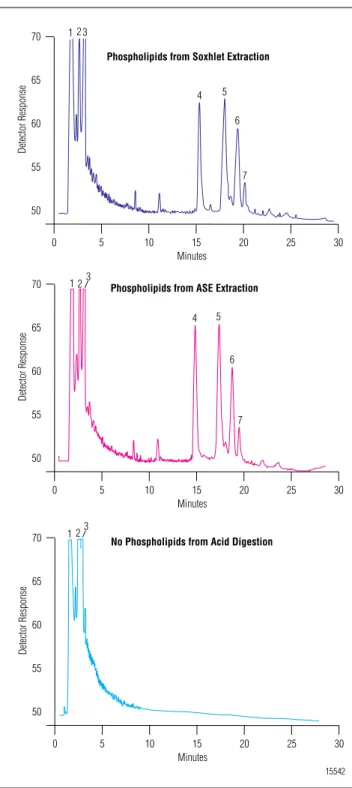
Figure 1 shows the correlation of percent fat values obtained from ASE extractions to accepted values within the New Zealand dairy industry. Roese-Gottlieb is the referenced method used for WMP and SMP. SBR is the referenced method used for WPC and caseinate. Confidence limits shown in Figure 1 represent the limits of acceptability set by New Zealand’s Inter-Laboratory Comparison Program, which are approximately ± 0.2% absolute for SMP and caseinate and ± 0.5% absolute for WPC and WMP. The higher ASE results for WPC were associated with a high proportion of phospholipid in the fat. The fate of dairy phospholipids is dependent upon the extraction technique. Phospholipids are hydrolyzed by acid digestion in the SBR method4, whereas ASE and Soxhlet methods are able to extract the phospholipids intact. The presence or absence of phospholipids in the extracts was confirmed by HPLC and is shown in Figure 2. ASE and Soxhlet extracts contain non-hydrolyzed phospholipids and represent a more accurate value of the fat.
Table 1. Gravimetric Comparison of ASE and RG Methods (Typical Single Point Data)
Sample % Fat
Cream powder 54.88 54.96
Whole milk powdera 29.41 29.45
Skim milk powder 0.96 0.95
aWMP recovery by ASE = 99.48% ± 0.15%, (n = 8)
Table 2. Gravimetric Comparison of ASE with SBR and Soxhlet Methods (Typical Single Point Data)
% Fat
Sample ASE SBR Soxhlet
Lactic WPC powder 5.47 4.95 5.50
Acid WPC powder 5.71 5.66 6.38
Cheese WPC powder 6.93 6.75 7.32
Whey protein isolate 0.45 0.58 0.50
Sodium caseinate 0.66 0.65 0.55
8 7 6 5 4 3 2 1 0
Whey Protein Concentrate
% Fat by ASE Method
30 29 28 27 26 25
25 26 27 28 29 30
Whole Milk Powder
% Fat by ASE Method
% Fat by RG Method
1.5
1.0
0.5
% Fat by ASE Method
1.5 1.0
0.5
% Fat by RG Method Skim Milk Powder
1.5
1.0
0.5
1.5 1.0
0.5
% Fat by ASE Method
Caseinate
4 Determination of Fat in Dried Milk Products Using Accelerated Solvent Extraction (ASE)
The FAME data (Table 3) revealed no significant differences in saturated, monounsaturated, and polyunsaturated ratios from ASE extraction compared with conventional extraction methods.
CONCLUSIONS
ASE can rapidly extract fat from dried milk products containing <1% to >50% fat with accuracy and precision equivalent to or better than manual gravimetric reference methods. ASE extractions are completed in 11 minutes and use only 30 mL of solvent. Extractions performed by ASE do not hydrolyze phospholipids, resulting in a more accurate value of fat than the SBR method. Because no degradation of fat results from the ASE extraction process, extracts are suitable for further lipid analyses.
REFERENCES
1. Russell, C. E.; Matthews; M. E.; and Gray, I. K. New Zealand Journal of Dairy Science & Technology1980
15, 239-244.
2. Christopherson, S. W. and Glass, R. L. Journal of Dairy Science1969 52, 1289-1290.
3. Arnoldson, K. C. and Kaufmann, P. Chromatographia
1994 38, 317-324.
4. Walstra, P. and Mulder, H. Netherlands Milk & Dairy Journal1963 17, 334-346.
Based on data from Russell K. Richardson and Colin G. Hughes, New Zealand Dairy Research Institute, presented at PittCon 98.
0 5 10 15 25 30
Minutes 70
65
60
55
50
20
Detector Response
1 23
No Phospholipids from Acid Digestion
0 5 10 15 25 30
Minutes 70
65
60
55
50
20
Detector Response
1 23 Phospholipids from ASE Extraction
4
7 6 5
0 5 10 15 25 30
Minutes 70
65
60
55
50
4
20
Detector Response
5 6
7 1 2 3
Phospholipids from Soxhlet Extraction
15542
Figure 2. HPLC with ELSD traces of lipids extracted from whey protein concentrate.
Table 3. FAME Analysis of Extracted Fat
Fatty Acid Class
Percent of Total Fatty Acids
WMP SMP WPCa
ASE RG ASE RG ASE Soxhlet
Saturated 74.1 74.1 68.8 69.2 64.4 64.4 Monounsaturated 22.8 22.9 27.4 26.7 28.8 28.8 Polyunsaturated 3.1 3.0 3.8 4.1 2.3 2.2
ASE is a registered trademark of Dionex Corporation. TurboVap is a registered trademark of Zymark Corporation.