ARTIGO ORIGINAL
Evolução Temporal da Mortalidade por Cancro do Colo
do Útero em Portugal
Cristina TEIXEIRA1,2, Ana Maria PEREIRA2, Eugénia ANES2,3, Carina RODRIGUES2,3, Maria José CASTANHEIRA2 Acta Med Port 2019 Jun;32(6):427–433 ▪ https://doi.org/10.20344/amp.8921
1. Unidade de Investigação em Epidemiologia. Instituto de Saúde Pública. Universidade do Porto. Porto. Portugal. 2. Instituto Politécnico de Bragança. Escola Superior de Saúde. Bragança. Portugal.
3. Núcleo de Investigação e Intervenção no Idoso. Bragança. Portugal. Autor correspondente: Cristina Teixeira. [email protected]
Recebido: 03 de março de 2017 – Aceite: 09 de janeiro de 2019 | Copyright © Ordem dos Médicos 2019 ABSTRACT
Introduction: The mortality rate due to cervical cancer is higher in Portugal compared to other European countries. This study aimed to evaluate the time-trends in cervical cancer mortality rates observed in Portugal over the last six decades.
Material and Methods: Age-standardized cervical cancer mortality rates reported in Portugal between 1955 and 2014, were collected from the International Agency for Research on Cancer (IARC). Joinpoint regression analysis was used to identify significant changes in mortality rates by assessing the percentage of annual variation (%AV) of the rate and respective 95% confidence interval (95%CI) according to the age groups.
Results: Among women with 30–39 years, cervical cancer mortality decreased 1.9% per year (95%CI: –2.3; –1.4) throughout the time-period, reaching 0.5/100 000 in 2014. Among women aged 40–49 years, CC mortality decreased between 1971 and 1981 (%AV = –11.6; IC 95%: –14.6; –8.6). Rates then increased by 2.4% per year (95%CI: 1.0; 3.8) until 2001 and such trend reverted from 2001 onwards (%AV = –5.2; IC 95%: –7.7; –2.6), reaching 3.0/100 000 in 2014. In women aged 50–64, 65–74 and 75 years or older, cervical cancer mortality rates decreased from 29.2 to 6.7/100 000, from 34.3 to 7.7/100 000 and from 24.7 to 9.2/100 000. The decline in mortality rates in these three age groups occurred mainly between 1970 and 1980, and there have been no significant changes in the last three decades.
Discussion: In Portugal, the most impressive decline in cervical cancer mortality rates occurred in the 1970s concurrently with changes in the National Healthcare System. The most important changes were the increased access to early diagnosis and the improvement in therapeutic approaches. The plateau that we observed among older women over the last three decades can be partially explained by factors with negative impact on adherence to cervical screening.
Conclusion: There was a marked decrease in mortality due to CC among all age groups. However, we observed a plateau of this indi-cator in more advanced age groups over the last three decades. These findings suggest the need of promoting adherence to cervical screening in Portugal.
Keywords: Mortality/trends; Portugal; Uterine Cervical Neoplasms/mortality RESUMO
Introdução: A mortalidade por cancro do colo do útero em Portugal apresenta valores mais elevados em relação a outros países europeus. O objetivo deste estudo é avaliar a variação da mortalidade por cancro do colo do útero, observada em Portugal nas últimas seis décadas.
Material e Métodos: Obtivemos taxas de mortalidade por cancro do colo do útero (padronizadas para a idade) reportadas em Portugal (1955–2014), através da International Agency for Research on Cancer. Utilizando análise de regressão linear joinpoint, obtivemos a percentagem de variação anual da taxa (%VA) e respetivo intervalo de confiança a 95% (IC 95%) de acordo com a idade (30–39; 40–49, 50–64; 65–74 e ≥ 75 anos)
Resultados: No grupo com 30–39 anos, a mortalidade por CCU diminuiu 1,9% ao ano, durante todo o período (IC 95%: –2,3; –1,4), atingindo 0,5/100 000 em 2014. Nas mulheres com 40–49 anos houve decréscimo acentuado entre 1971 e 1981 (%VA = –11,6; IC 95%: –14,6; –8,6), com subsequente aumento de 2,4% ao ano (IC 95%: 1,0; 3,8) até 2001, mas que reverteu a partir desse ano (%VA = –5,2; IC 95%: –7,7; –2,6), atingindo 3,0/100 000 em 2014. A mortalidade por cancro do colo do útero diminuiu de 29,2 para 6,7/100 000, de 34,3 para 7,7/100 000, e de 24,7 a 9,2/100 000, respetivamente, nas mulheres com 50–64, 65–74 e com 75 ou mais anos. Nestes três grupos o decréscimo ocorreu principalmente nas décadas de 70 e 80, não havendo variação significativa da taxa nas últimas três décadas.
Discussão: O maior decréscimo da mortalidade por cancro do colo do útero observada em Portugal ocorreu na década de 70 em paralelo com profundas alterações no Sistema Nacional de Saúde caracterizadas pelo aumento do acesso ao diagnóstico precoce e da qualidade do tratamento. Nas últimas três décadas, a mortalidade por cancro do colo do útero estabilizou em idades mais avança-das, o que pode ser explicado parcialmente por fatores com impacto na adesão aos programas de rastreio.
Conclusão: Houve marcado declínio da mortalidade por cancro do colo do útero em todos os grupos etários, embora com estagna-ção deste indicador desde meados da década de 80 para grupos etários mais avançados. Os resultados sugerem a necessidade de incrementar a adesão a programas de rastreio em Portugal.
Palavras-chave: Neoplasias do Colo do Útero/mortalidade; Mortalidade/tendências; Portugal
INTRODUCTION
ARTIGO ORIGINAL a great regional disparity has been found, it represents an important cause of cancer-related death in the female pop-ulation from some European countries.1 Two from each 100 cancer-related deaths affecting the Portuguese female pop-ulation in 2014 were related to CC and almost one quarter of these regarded patients under the age of 55.2
CC development is due to a combination of different factors including smoking, long-term oral contraceptive use, multiparity and immunosuppression, namely related to
human immunodeficiency virus (HIV) infection.3 However,
sexually transmitted human papillomavirus (HPV) infection is the determining factor for the development of this type of cancer.3,4
Sexually transmitted HPV infection leads to low-grade squamous intra-epithelial lesions usually showing sponta-neous regression and persistent for a long time in approxi-mately 10% of the patients and to the development of CIN-2 (cervical intraepithelial neoplasia) or higher.3,4 The transition between squamous and columnar epithelium is the zone of the uterine cervix with the highest risk of malignant transfor-mation following HPV infection.4 Squamous cell carcinomas have accounted for 75% of the cases, even though different histological subtypes have also been found.3,5
Early detection of CIN-2 or 3 allows for a timely ap-proach with excision and more frequent monitoring, which is determinant for the prevention of an invasive carcinoma3,6 reducing the chance of the development of invasive cancer. Cervical cytology is the reference approach to CC prima-ry screening.7,8 However, current molecular biology based techniques for HPV detection allow for the identification of high-risk groups3,9 and increasing screening sensitivity.10
Large-scale vaccination for HPV infection is currently in use in different countries,3,11 even though its introduction is still too recent in order to allow for an assessment of its impact on CC incidence and mortality. The introduction of well-organised screening programs, available to the whole population, including HPV detection tests, are important public health strategies with a clear impact on the reduction of CC mortality.7,11,12
Monitoring of CC mortality trends over time is a par-ticularly relevant public health measure, allowing for the identification of less favourable trends or even the search for new preventive strategies, considering that reinforced prevention will have an effect on the reduction of mortality.
This study was aimed at assessing CC mortality trend in Portugal, 1955-2014.
MATERIAL AND METHODS
This was a descriptive study of CC mortality trend in Portugal throughout the past six decades. Data were ob-tained from the International Agency of Research on
Can-cer (IARC) database13 for all the years except information on the years 2004-2006 and 2014 (unavailable from the IARC) which was obtained from the Portuguese Instituto Nacional de Estatística (INE).2 CC mortality rate for the Portuguese population between 1955 and 2014 referred to sequential five-year age groups. Mortality pattern trends for these age groups were visually assessed in order to re-group subsequent age re-groups with similar patterns of vari-ation. Patients under the age of 30 were excluded from the analysis, due to the small mortality rate in these patients. Age groups were defined by the following classes: 30–39, 40–49, 50–64, 65–74 and 75 or older. Age-adjusted CC mortality rate was obtained for each study year and each age group by use of the direct method of standardisation and the 1976 European population was used as standard.14
Joinpoint regression models applied to each age group were used to assess CC mortality trend over time. Line seg-ments separated by joinpoints corresponding to the years in which a significant change in mortality trend over time has occurred were generated by this statistical approach.15 The annual percent change (APC) of the rate was based on the slope of each line. Therefore, time-trends represented as negative APC were obtained (whenever a reduction was found over a certain time) or as positive APC (when an in-crease was found) with the corresponding 95% confidence intervals (95% CI). The Joinpoint version 4.3.1.0 software was used for this analysis.16 The mortality rates that were found and estimated by the regression model are presented as the number of deaths per 100.000 female population of the same age group, while a 0.05 significance level was considered.
Ethics committee approval was not required because the data used in this study is publicly available from the IARC and INE databases.
RESULTS
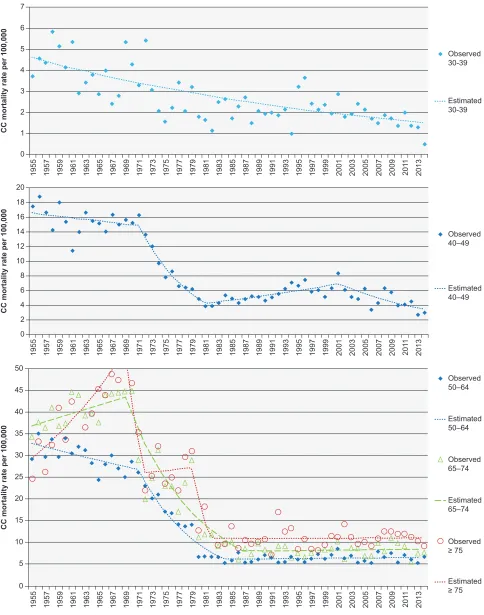
Age-adjusted cervical cancer mortality rate in Portu-guese female population aged 30 or older (1976 European population considered as standard) has decreased from 19.4 in 1955 to 4.4/100,000 in 2014. This decrease was sig-nificantly found in all ages, even though a different variation standard of this indicator has been used, according to each age group. The estimated and observed mortality rate var-iation (according to the results obtained by the regression model) is shown in Fig. 1. The APC in the rate is shown in
Table 1, with 95% CI and inflection points, showing a signifi
-cant change in trends over time for each age group. Age-adjusted mortality rate has decreased from 3.7 to 0.5/100,000 in the youngest group of female patients (Fig.
1), which has constantly (with no inflection points) and sig
ARTIGO ORIGINAL
Figure 1 – Age-adjusted CC mortality; Portugal, 1955-2014
(95% CI –2.3 - –1.4), as shown in Table 1.
Age-adjusted mortality rate has decreased from 17.4 to 3.0/100,000 (Fig. 1) in female patients aged 40-49, with points of inflection at 1971, 1981 and 2001 (Table 1). This
trend was only reversed between 1981 and 2001, showing a significant annual 2.4% increase (95% IC range – 1.0-3.8) as shown in Table 1.
CC mortality rate has changed between 1955 and 2014
CC mortality rate per 100,000
Observed 50–64
Observed 65–74
Observed ≥ 75 Estimated 50–64
Estimated 65–74
Estimated ≥ 75 50
45
40
35
30
25
20
15
10
5
0
1955
CC mortality rate per 100,000
7
6
5
4
Observed 30-39
Estimated 30-39 3
2
1
0
1957 1959 1961 1963 1965 1967 1969 1971 1973 1975 1977 1979 1981 1983 1985 1987 1989 1991 1993 1995 1997 1999 2001 2003 2005 2007 2009 201
1
2013
CC mortality rate per 100,000
Observed 40–49
Estimated 40–49 20
18 16 14 12 10 8 6 4 2 0
1955 1957 1959 1961 1963 1965 1967 1969 1971 1973 1975 1977 1979 1981 1983 1985 1987 1989 1991 1993 1995 1997 1999 2001 2003 2005 2007 2009 2011 2013
1955 1957 1959 1961 1963 1965 1967 1969 1971 1973 1975 1977 1979 1981 1983 1985 1987 1989 1991 1993 1995 1997 1999 2001 2003 2005 2007 2009 201
1
ARTIGO ORIGINAL from 29.2 to 6.7/100,000, 34.3 to 7.7/100,000 and 24.7 to 9.3/100,000 in women aged 50–64, 65–74 and ≥75, re -spectively (Fig. 1). A significant decrease in CC mortality rate in women aged 50-64 has been found between 1955 and 1984, while this was found between 1969 and 1987 in
women aged 65-74, with a significant increase in the old
-est patients between 1955 and 1969 and decreasing trends between 1969 and 1982. A similar pattern of variation in CC mortality rate has been found in the three oldest groups of patients, with no significant changes from 1984, 1987 and 1982, respectively, in the 50-64, 65-74 and ≥75 groups, as shown in Table 1.
DISCUSSION
A significant reduction in CC mortality rate has been found in the Portuguese population between 1955 and 2014. Even though a decreasing mortality rate has been found within all the age groups over the study period, a steady decline in younger patients and a stagnation in the oldest groups have been found over the last years of the study period.
Portugal is one of the Western European countries with the highest CC mortality rates, which has been particularly
significant before the 70s, a time in which a significant de
-cline in this indicator has been found in Portugal, closing the gap with other European countries. However, the stag-nation of the rates that was found from 1982 onwards made Portugal one of the countries with the highest CC mortality rates.1 This worrying situation has been already described
by other authors17,18 and is worth mentioning.
Data collected throughout six decades was involved in this study. Changes over time in the diagnostic approach to CC and in the record of the cause of death could have an impact on mortality rate trends over time.19 Changes in
the international classification of diseases (ICD) have oc
-curred over the study period, including three updates since 1970 (ICD-10 update is the most recent).20–22 There was a significant change in mortality rate trends over time during the seventies, according to the results of the study and it seems unlikely that such significant rate variation could only have been related to these changes in ICD. In addition, this rate variation was not uniform within the five age groups analysed.
In line with other European countries, the first oncologi
-cal centre has emerged in Lisbon through the first quarter of the twentieth century.23 The oncological healthcare services provided by this centre were developed with a sustained logistic and technological update over the subsequent years.24 By the end of the fifties and during the sixties and the seventies these were expanded and decentralised with the opening of new centres in Coimbra and later in Porto.
Meanwhile, there was a significant technological improve
-ment and as regards therapeutic approach to cancer, as well as the implementation of screenings aimed at early diagno-sis of suspicious pre-invasive lesions.23,24 During the sev-enties, the Portuguese healthcare system was significantly updated, particularly regarding the access to healthcare. The reform of the healthcare system was legislated in 1971 with the development of the Centros de Saúde (Healthcare
Table 1 – Annual percent change (APC) in cervical cancer mortality rate
Age group
(years) Points of inflection Period of time APC [95% CI] p-value
30–39 1955 – 2014 –1.9 [–2.3; –1.4] < 0.001
40–49
1955 – 1971 –0.6 [–1.6; 0.4] 0.208
1971 1971 – 1981 –11.6 [–14.6; –8.6] < 0.001
1981 1981 – 2001 2.4 [1.0; 3.8] 0.001
2001 2001 – 2014 –5.2 [–7.7; –2.6] < 0.001
50–64
1955 – 1971 –1.2 [–2.1; –0.4] 0.004
1971 1971 – 1984 –10.7 [–12.5; –8.8] < 0.001
1984 1984 – 2014 0.2 [–0.5; 0.9] 0.534
65–74
1955 – 1969 1.2 [–0.4; 2.8] 0.148
1969 1969 – 1987 –9.0 [–10.6; –7.3] < 0.001
1987 1987 – 2014 0.2 [–1.1; 0.5] 0.787
≥75
1955 – 1969 4.5 [2.9; 6.1] < 0.001
1969 1969 – 1972 –21.7 [–42.8; 7.0] 0.121
1972 1972 – 1979 0.7 [–5.5; 7.4] 0.819
1979 1979 – 1982 –26.2 [–55.7; 23.1] 0.238
ARTIGO ORIGINAL Centres) as a draft of the future Serviço Nacional de Saúde
(SNS), which was implemented in 1979. Despite its limit-ed implementation, the first healthcare centres had a role mainly in prevention, associated with health promotion and monitoring.25,26 The combination of these factors could have contributed to CC decreasing mortality that was found in the seventies, a greater access to early diagnosis, to treatment and to improved treatment quality, leading to improved sur-vival, in line with what was described in another European population, although almost two decades earlier when com-pared to Portugal.27
A decreasing trend in CC incidence has been found in
Portugal by a study describing the first years of this mil
-lennium, even though no decreasing trend in age-adjusted mortality rate has been found between 1980 and 2005.17 According to our findings, the stagnation in CC mortality has remained over the past 30 years in the oldest patients, in line with the results described in Spain.28
Mortality was significantly reduced by cervical cytol
-ogy (Pap test) aimed at CC screening.3,7,8 This diagnostic
test was first available in Portugal in the sixties,29 although
only used in opportunistic screening during most of the study time. Although planned CC screening strategies have emerged in the sixties, these were restricted to some ar-eas in Lisbon.23 The implementation of population based planned screenings was only started in 1990 within the cen-tral region of Portugal and was only widespread to other regions from 2008 onwards.30 In addition, a screening geo-graphical coverage of less than 50% has been found, with different compliance rates according to regions and show-ing a decreasshow-ing trend over the past four years, reachshow-ing a value close to 50% in 2014.30 This situation could only re-flect the use of an opportunistic screening, within the search for gynaecological healthcare or following the consultations of family planning, diverting patients from population-based screenings. However, this situation could be explained by non-compliance with any sort of screening. In Portugal,31,32 in line with what has been found in Spain,28 a lower screen-ing compliance rate has been found in older vs. younger pa-tients, which could explain for the stagnation of CC mortality rates in the oldest age groups.
According to Wang et al., CC development in older pa-tients depends on the level of screening compliance by the age of 50 to 60, with a higher prevalence in patients who were not adequately screened.33 Epithelial atrophy in addi-tion to regression of the transformaaddi-tion zone found in post-menopausal women have also shown a lower effectiveness for CC screening with advancing years.34 In addition, HPV infection presents with a latency status, under immunologi-cal control within the epithelial basal layer, with reactivation from latency later in life.35 Considering that post-CC survival decreases with age,36 both circumstances combined could
explain for the stagnation of the mortality rates amongst old-er patients. Thold-erefore, CC prevention strategies aimed at elderly patients are crucial.
Patients under age 40, in whom a pregnancy is more likely, with an increased contact with healthcare profes-sionals during perinatal period, will more likely undergo CC screening. This could explain for the decreasing trend in CC mortality over the whole study period which was found in the youngest age group. The pattern of variation in CC mortality rate that was found in the Portuguese population seems to show that the reduction found in younger patients is due to CC screening and to timely therapeutic approaches.
The highest incidence of CC has been found in Portu-guese patients aged 40 to 49.1 According to our findings, an increased mortality rate has been found in this age group in the eighties and in the nineties, even though this was reverted over the last years of this time series. This subop-timal trend has been described by other authors and was explained by the migration flow coming from the former Portuguese African colonies, from 1975 onwards.18 High-er prevalence of HPV and HIV infection has been found in populations with an African origin, when compared to the re-maining Portuguese population.18,37 Concomitant HPV and HIV infection is related to an increased risk of CC mortality7 in these populations.
A decreasing incidence of squamous cell and increas-ing incidence of adenocarcinoma (associated with a poorer outcome)5 has been found,38 which could be explained by
a more difficult identification of this subtype in cytology.3,5
The database that was used for this analysis did not allow for the study of the contribution of each histological subtype of CC in mortality, which is a limitation of this study. Further studies are needed for the evaluation of the incidence of adenocarcinoma and its contribution to CC mortality in the Portuguese population.
A decreasing incidence of cervical lesions has been found in geographical areas in which HPV vaccine has been introduced.39 This vaccination was introduced in Portugal ten years ago29 and studies on this subject are expected to understand its long-term effect on CC mortality in Portugal. Meanwhile, screening participation should be encouraged, leading to recommendations and promotion of screening compliance of the whole female population.
CONCLUSION
ARTIGO ORIGINAL to these findings, aimed at increasing the participation in cervical cancer screening programs.
HUMAN AND ANIMAL PROTECTION
The authors declare that the followed procedures were according to regulations established by the Ethics and Clini-cal Research Committee and according to the Helsinki Dec-laration of the World Medical Association.
DATA CONFIDENTIALITY
The authors declare that they have followed the proto-cols of their work centre on the publication of patient data.
Informed consents were obtained.
CONFLICTS OF INTEREST
The authors declare that there were no conflicts of inter
-est in writing this manuscript.
FINANCIAL SUPPORT
The authors declare that there was no public or private financial support in writing this manuscript.
REFERENCES
1. International Agency for Research on Cancer. Global Cancer Observatory. [consultado 2016 jul 6]. Disponível em: http://www-dep. iarc.fr/WHOdb/WHOdb.htm.
2. Instituto Nacional de Estatística. Base de Dados: Saúde, Mortalidade por causas de morte. [consultado 2016 jul 6]. Disponível em: https://www.ine.pt/xportal/xmain?xpid=INE&xpgid=ine_indicadores &indOcorrCod=0005052&contexto=bd&selTab=tab2.
3. Small W, Bacon MA, Bajaj A, Chuang LT, Fisher BJ, Harkenrider MM, et al. Cervical cancer: a global health crisis. Cancer. 2017;123:2404–12. 4. Gravitt PE, Winer RL. Natural history of HPV infection across the
lifespan: role of viral latency. Viruses. 2017;9:1–10.
5. Fujiwara H, Yokota H, Monk B, Treilleux I, Devouassoux-Shisheboran M, Davis A, et al. Gynecologic cancer InterGroup (GCIG) consensus review for cervical adenocarcinoma. Int J Gynecol Cancer. 2014;24:S96–101. 6. Silva DP da, Moutinho JM. Sociedade Portuguesa de Ginecologia.
Secção Portuguesa de Colposcopia e Patologia Cervico-Vulvovaginal. Consenso em Patologia Cervico-Vulvovaginal. 2004. [consultado 2016 jul 6]. Disponível em: http://www.spginecologia.pt/uploads/patologia.pdf. 7. Schiffman M, Wentzensen N, Wacholder S, Kinney W, Gage JC, Castle PE. Human papillomavirus testing in the prevention of cervical cancer. J Natl Cancer Inst. 2011;103:368–83.
8. Smith RA, Brooks D, Cokkinides V, Saslow D, Brawley OW. Cancer screening in the United States, 2013: a review of current American Cancer Society guidelines, current issues in cancer screening, and new guidance on cervical cancer screening and lung cancer screening. CA Cancer J Clin. 2013;63:88–105.
9. Goodman A. HPV testing as a screen for cervical cancer. BMJ. 2015;350:h2372.
10. Dijkstra MG, Snijders PJ, Arbyn M, Rijkaart DC, Berkhof J, Meijer CJ. Cervical cancer screening: on the way to a shift from cytology to full molecular screening. Ann Oncol. 2014;25:927–35.
11. Bosch FX, Broker TR, Forman D, Moscicki AB, Gillison ML, Doorbar J, et al. Comprehensive control of human papillomavirus infections and related diseases. Vaccine. 2013;31:S1–31.
12. Peirson L, Fitzpatrick-Lewis D, Ciliska D, Warren R. Screening for cervical cancer: a systematic review and meta-analysis. Syst Rev. 2013;2:35.
13. World Health Organization. Cancer mortality data base. Lyon, France: Internantional Agency for Research on Cancer. [consultado 2016 jul 6]. Disponível em: http://www-dep.iarc.fr/WHOdb/WHOdb.htm.
14. EUROSTAT.Revision of the European Standard Population. Report of Eurostat's task force. 2013. [consultado 2016 dez 29]. Disponível em: http://ec.europa.eu/eurostat/documents/3859598/5926869/KS-RA-13-028-EN.PDF/e713fa79-1add-44e8-b23d-5e8fa09b3f8f.
15. Bastos J, Barros H, Lunet N. Evolução da mortalidade por cancro da mama em Portugal (1955–2002). Acta Med Port. 2007;20:139–44. 16. National Cancer Institute: Statistical Research and Applications Branch.
Joinpoint Trend Analysis Software, version 4.3.1.0. [consultado 2016 abr 20]. Disponível em: https://surveillance.cancer.gov/joinpoint/. 17. Alves C, Alves L, Lunet N. Epidemiology of cervical cancer. Arq Med.
2010;24:266–77.
18. Pinheiro PS, Tyczynsky J, Bray F, Amado J, Matos E, Miranda AC, et al. Cancro em Portugal. Lyon: IARC Technical Publication; 2002. 19. Janssen F, Kunst AE. ICD coding changes and discontinuities in trends
in cause-specific mortality in six European countries, 1950–99. Bull World Health Organ. 2004; 82:904–13.
20. Diário do Governo. n.º 79/1970, 1º Suplemento, Série I de 1970–04–04. Decreto-Lei 138/70. 1970. [consultado 2016 dez 29]. Disponível em: https://dre.pt/application/file/a/219874.
21. Diário da República n.º 297/1979, 3º Suplemento, Série I de 1979–12–27. Decreto-Lei n.º 513-C1/79. 1979. [consultado 2016 dez 29]. Disponível em: https://dre.pt/application/file/a/147370.
22. Ministério do Equipamento, do Planeamento e da Administração do Território. Conselho Superior de Estatística. Deliberação n.º 131/97 de 27 de Julho. 1997. [consultado 2016 dez 29]. Disponível em: http:// portalcodgdh.min-saude.pt/index.php/Aprova%C3%A7%C3%A3o_ da_CID-10_para_utiliza%C3%A7%C3%A3o_no_Sistema_Estat%C3 %ADstico_Nacional.
23. Serviço Nacional de Saúde. Instituto Português de Oncologia de Lisboa. [consultado 2017 jan 20]. Disponível em: http://www.ipolisboa.min-saude.pt/Default.aspx?Tag=DOSSIER&DossierId=6.
24. Costa RM. Luta contra o cancro e oncologia em Portugal. Estruturação e normalização de uma área científica. Centro de Investigação Transdisciplinar Cultura Espaço Memória. Edições Afrontamento. 2012. [consultado 2017 jan 20]. Disponível em: http://ler.letras.up.pt/uploads/ ficheiros/10411.pdf.
25. Branco AG, Ramos V. Cuidados de saúde primários em Portugal. Rev Port Saúde Pública. 2001;2:5-12.
26. Sakellarides C, Reis V, Escoval A, Conceição C, Barbosa P. O futuro do Sistema de Saude Português: “Saúde 2015”. Lisboa: Escola Nacional de Saúde Pública, UNL; 2005.
27. Sparen P, Gustafsson L, Friberg LG, Ponten J, Bergstrom R, Adami HO. Improved control of invasive cervical cancer in Sweden over six decades by earlier clinical detection and better treatment. J Clin Oncol. 1995;13:715–25.
28. Cervantes-Amat M, Lopez-Abente G, Aragones N, Pollan M, Pastor-Barriuso R, Perez-Gomez B. The end of the decline in cervical cancer mortality in Spain: trends across the period 1981–2012. BMC Cancer. 2015;15:287.
ARTIGO ORIGINAL 30. Miranda N, Portugal C, Dinis A, Roldão M, Matias A. Serviço Nacional de
Saúde. Rede Nacional de Especialidade Hospitalar e de Referenciação de Radioterapia. 2a Revisão. 2015. [consultado 2017 jan 20]. Disponível em: http://www2.acss.min-saude.pt/Portals/0/RelatorioFinal Radioterapia.pdf.
31. Alves C, Alves L, Lunet N. Prevalence and determinants of cervical cytology use in an urban sample of Portuguese women. Eur J Cancer Prev. 2009;18:482–8.
32. Oliveira M, Peleteiro B, Lunet N. Cytology use for cervical cancer screening in Portugal: results from the 2005/2006 National Health Survey. Eur J Public Health. 2014;24:253–8.
33. Wang J, Andrae B, Sundström K, Ploner A, Ström P, Elfström KM, et al. Effectiveness of cervical screening after age 60 years according to screening history: nationwide cohort study in Sweden. PLoS Med. 2017;14:1–17.
34. Schlichte M, Guidry J. Current Cervical Carcinoma Screening Guidelines. J Clin Med. 2015;4:918–32.
35. Maglennon GA, McIntosh PB, Doorbar J. Immunosuppression facilitates the reactivation of latent papillomavirus infections. J Virol. 2014; 88:710–6.
36. Ioka A, Tsukuma H, Ajiki W, Oshima A. Influence of age on cervical cancer survival in Japan. Jpn J Clin Oncol. 2005;35:464–9.
37. CPLP/ONUSIDA. Epidemia de VIH nos países de língua oficial portuguesa. 2010. [consultado 2018 out 22]. Disponível em: https://www.cplp.org/Files/ Filer/VIH%20em%20pa%C3%ADses%20de%20L%C3%ADngua%20 Portuguesa%20-%202%C2%AA%20Edi%C3%A7%C3%A3o%20- %20FINAL.pdf.
38. van der Horst J, Siebers AG, Bulten J, Massuger LF, de Kok IM. Increasing incidence of invasive and in situ cervical adenocarcinoma in the Netherlands during 2004–2013. Cancer Med. 2017;6:416–23. 39. Hestbech MS, Lynge E, Kragstrup J, Siersma V, Vazquez-Prada Baillet