Proceedings of the
4th International Workshop on
Multi-Paradigm Modeling
(MPM 2010)
A generic in-place transformation-based approach to structured model
co-evolution
Bart Meyers, Manuel Wimmer, Antonio Cicchetti, and Jonathan Sprinkle
13 pages
Guest Editors: Vasco Amaral, Hans Vangheluwe, C ´ecile Hardebolle, Lazlo Lengyel Managing Editors: Tiziana Margaria, Julia Padberg, Gabriele Taentzer
A generic in-place transformation-based approach to structured
model co-evolution
Bart Meyers1, Manuel Wimmer2, Antonio Cicchetti3, and Jonathan Sprinkle4
1University of Antwerp, Belgium
2Vienna University of Technology, Austria
3M¨alardalen University, MRTC, V¨aster˚as, Sweden
4University of Arizona, United States
Abstract: In MDE not only models but also metamodels are subject to evolution. More specifically, they need to be adapted to correct errors, support new and/or update language features. The direct consequence of such evolutionary steps com-prises the problem of managing the co-evolution of existing model instances, which may no longer conform to the new metamodel version. This model migration is intrinsically complex and results in a time-consuming and error-prone process if no adequate support is provided. For tackling this problem, we introduce a new tech-nique to guide the user in solving migration issues in a step-wise manner. The aims are manifold, notably the simplification of the migration specification, the reduction of the effort for the evolver, the control of user intervention, and the optimization of the migration execution itself by allowing place adaptation of the existing in-stances.
Keywords:Metamodel evolution, model co-evolution, in-place transformations
1
Introduction
In Model-Driven Engineering (MDE) not only models but also metamodels are subject to evo-lution. Especially, when domain-specific modeling languages are employed, the necessity of language adaptations arise to reflect changes in the modeling domain as well as in technolo-gies without losing existing models. In multi-paradigm modeling, a necessary consideration is the transformation of models from one paradigm (e.g., modeling language, or semantics) into another, requiring further consideration of the impact of multi-paradigm use if one modeling language must be updated for some reason.
Figure 1 illustrates the context of this paper at a glance. Full arrows are transformations, dashed arrows indicate conformance (i.e., that a model conforms to the language constraints). After evolution∆ of a metamodel MML, the goal is to migrate models m, which conform to MML, tom0, which conform toMML0, by creating a suitable migrationM. Thus, (i) dedicated
a new language must be learned, and in the second case, a heavyweight technique is used. Cur-rently, there is no approach for step-wise migration of models in combination with systematically modeling the evolution (ensuring that the migrated models conform to the new metamodel).
MML MML'
m m'
Δ
Μ
Figure 1: Models m
have to be migrated whenMMLevolves. In this paper, we introduce a new approach to guide the user in
solving co-evolution issues in a structured, step-wise manner. First, we employ existing in-place transformation languages. As opposed to M2M transformations, in-place transformations are transformations that change the input model instead of creating an output model from scratch [KMS+09]. Second, we distinguish between syntactic and se-mantic migration. Forsyntactic migration, the goal is to make model instance syntactically conform to the new version of the metamodel.
Semantic migrationrequires manual adaptation from the evolver, as
language constructs’ meaning may have changed. Third, for dividing-and-conquering the co-evolution process, we formalize metamodel evolution as a difference model consisting of a sequence of simple
difference operations. For each difference operation or meaningful group of difference oper-ations (defined by the evolver), a migration is either automatically generated or adapted by the user. Fourth, in computing a specific merged metamodel (at each step) to allow in-place transfor-mations, we can ensure that eachmi conforms toMMi, thus after all steps each migrated model m0always conforms to theMML0.
The benefits of this technique are manifold, notably: the simplification of the migration speci-fication by reusing the well-known graph transformation formalism of in-place transformations; the ability to express every possible evolution and migration by allowing graph transformation techniques; the reduction of the effort for the user by reusing generically applicable migration rules; the control of user intervention by automated preventive and corrective mechanisms to validate that models conform to the language in each migration step; and the optimization of the migration execution itself by allowing in-place adaptation of the existing instances.
2
Example
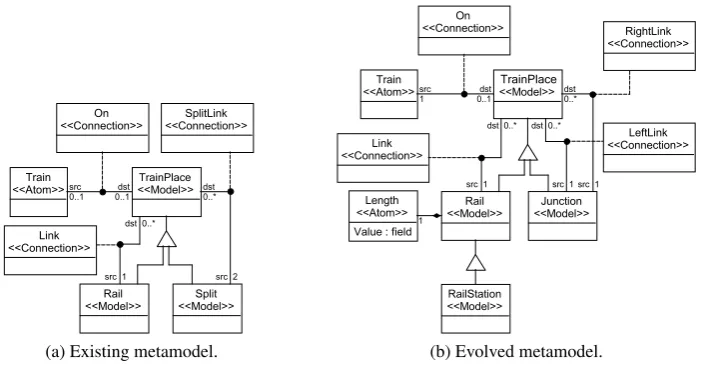
In order to illustrate our approach, we first introduce an evolution scenario on the RailRoad domain-specific language. A RailRoad model is shown in Figure2. The model can be used to analyze the behavior of trains riding on the modeled railtrack.
Figure 2: An example Rail-Road model.
A RailRoad model consists of track elements, on which trains can ride. These elements can be either rails, which point to one other element on the track, or junctions, which point to two dif-ferent elements on the track. In this example, two trains are riding on a track with one junction, and one train is not located on the track. The syntax of the RailRoad language is captured in its metamodel, shown in Figure 3a. A Train can be located On a
SplitLink <<Connection>> Link <<Connection>> TrainPlace <<Model>> On <<Connection>> Train <<Atom>> Split <<Model>> Rail <<Model>> src 0..1 0..1dst
dst 0..* dst 0..*
src 1 src 2
(a) Existing metamodel.
LeftLink <<Connection>> Rail <<Model>> RailStation <<Model>> On <<Connection>> Train <<Atom>> Junction <<Model>> RightLink <<Connection>> Link <<Connection>> Length <<Atom>> Value : field
TrainPlace <<Model>> src 1 src 1 dst 0..* dst 0..1 dst 0..* dst 0..* src 1 1 src 1
(b) Evolved metamodel.
Figure 3: (a)The existing metamodel, and(b)the evolved metamodel, both modelled in GME. Class stereotypes indicate the type of model that will be instantiated in the language.
Suppose that over time, some changes have been applied to the
metamodel. Five requirements are implemented. For each requirement it is stated how existing models should be migrated:
• Splithas been renamed to the more intuitive “Junction.” In the instance models, each exist-ingSplithas to become aJunction;
• Trainsmustbe on aTrainPlacenow. In the instance models,Trains that are not located on aTrainPlacehave to be removed;
• a notion of direction is added: instead of two outgoingSplitLinks, aJunctionnow has a
LeftLinkandRightLinkdirection. In the instance models, the two outgoing links to Train-Places must be replaced with aLeftLinkandRightLinklink. The choice of left and right is made randomly;
• a notion of track length has been added to aRail. In the instance models,Rails have a length of 1, the default length;
• aRailStationis introduced as a new kind ofRail. In the instance models,Rails with more than one incomingLinkorSplitLinkare interesting places to build aRailStation.
The resulting metamodel is shown in Figure3b1. In the remainder of this paper, this evolution scenario will be used to illustrate our structured migration approach.
3
Approach
Whenever a change ∆ is operated on a metamodel, a corresponding migration M should be operated on the existing instances. The creation of migration transformation is closely related to the changes on the metamodel however. Therefore, this section starts off with an elaboration on
1The field attribute for length is a type-safe integer, though this is not shown in the diagram due to the concrete syntax
the difference model, which is a structured representation of the changes. Next, the creation of the migration transformation is presented.
3.1 Difference model
A number of works proposed the classification of metamodel changes with respect to the effects observable for migration [GKP07,CDEP08]; in particular, the changes could require either no migrations of the instances (non-breaking operations), or simple migration adaptations (breaking and resolvable operations), or complex migrations which possibly require user input (breaking and unresolvable operations). If no user input is required, then the operation is resolvable; if a user must specify details of the operation, then it is unresolvable. As migration is directly linked to the metamodel changes, the migration transformation can be created from a difference model representing the evolution of the metamodel. In turn, the difference model is a sequence ofdifference operations, each of which mapping onto a correspondingmigration operation, as summarized in Table1.
Difference operation Migration operation
Non-breaking operations
Generalize metaproperty None
Add non-obligatory metaclass None
Add non-obligatory metaproperty None
Extract superclass None
Breaking and resolvable operations
Eliminate metaclass Eliminate instances
Eliminate metaproperty Eliminate instances
Push metaproperty Eliminate properties from superclass instances
Flatten hierarchy Eliminate superclass instances
Rename metaclass Change instances
Rename metaproperty Change instances
Breaking and unresolvable operations
Add obligatory metaclass Add default instances
Add obligatory metaproperty Add default instances
Pull metaproperty Add default properties for superclass instances
Restrict metaproperty Remove instance if non-compliant
Table 1: Difference operations based on [CDEP08], with their migration operations.
subclasses to their corresponding superclass. It is important to note that all possible changes to a metamodel can be represented by the difference operations of Table 1. If the metamodel contains static semantics, in the form of e.g., OCL constraints [Obj10], similar operations can be contrived; however, this is left for future work, and is outside the scope of this paper.
The classification proposed above highlights the criticality of the metamodel evolution de-tection and representation in order to achieve a profitable migration of the existing instances. Currently, (meta-)model comparison is an active field of research; it is an intrinsically complex task since it has to deal with graph isomorphisms, i.e., with the problem of finding correspon-dences between two given graphs. In this paper we assume that the metamodel evolution, i.e.,∆
in Figure1, is given, as reflecting the developer intentions, in terms of the operations classified in Table 1: it could be obtained as directly traced from a tool, or encoded by hand. For our approach, both techniques are applicable.
When the difference operations of Table1are used for the change∆of the RailRoad example,
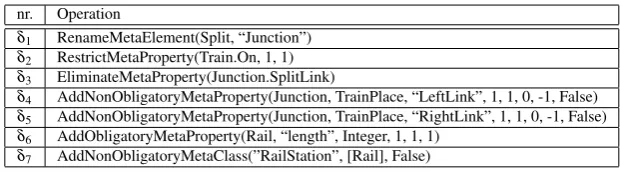
this results in the difference model in Table2, which is a sequence of method calls. The dif-ference operations are instantiated as method calls, based on the operations of [HBJ09], which are predefined migration operations that take some parameters as input. When such a method is executed on the metamodel, the change is applied. Note that operationsδ3,δ4andδ5 represent
the replacement ofSplitLink toSplitLeft andSplitRight. Other representations, such as proper difference languages [CDP07], can be used as well in our approach.
nr. Operation
δ1 RenameMetaElement(Split, “Junction”) δ2 RestrictMetaProperty(Train.On, 1, 1) δ3 EliminateMetaProperty(Junction.SplitLink)
δ4 AddNonObligatoryMetaProperty(Junction, TrainPlace, “LeftLink”, 1, 1, 0, -1, False) δ5 AddNonObligatoryMetaProperty(Junction, TrainPlace, “RightLink”, 1, 1, 0, -1, False) δ6 AddObligatoryMetaProperty(Rail, “length”, Integer, 1, 1, 1)
δ7 AddNonObligatoryMetaClass(”RailStation”, [Rail], False)
Table 2: The difference model∆of the RailRoad evolution.
3.2 Migration of Instance Models
In this section it is explained how the instance models are migrated. With our approach, we aim at a high degree of automation, a high degree of control, and high execution performance. Automation will reduce the effort for the modeller, thus increase productivity. Control will increase correctness of the migration process as well as facilitate the migration process for the evolver. Performance will affect scalability, or the time to migrate a number of instance models (out of the scope of this paper, but still a function of the automation and control). The migration process consists of three phases: automated synthesis, manual adaptation and execution.
3.2.1 Synthesis
be None, i.e., the identity transformation. Moreover, despite a metamodel manipulation could entail multiple migration policies, in general the default one is fixed once for all due to coher-ence purposes. The left part of Figure4shows the evolution∆of the RailRoad example, split up into the sevenδi, as shown in Table2. In this step-wise approach, the metamodelMMLevolves toMML0, over intermediate metamodelsMMi. For eachδi, a µi is synthesized by applying the
transformationG. Technically,Gis a higher order transformation, because it takes transforma-tion models instead of instance models as input or output [TJF+09]. The instance model mis migrated accordingly tom0. In this case,MM7=MML0 andm7=m0. The right side shows one
generic migration step, where a metamodelMMi−1evolves toMMi by applying one difference operation.mi−1is migrated accordingly.
MML δ1 δ2 δ3 δ4 δ5 δ6 MML'
m m'
μ1 μ2 μ3 μ4 μ5 μ6 Δ
Μ
G G G G G G
MM1
m1
MM2
m2
MM3
m3
MM4
m4
MM5
m5
δ7
μ7 G
MM6
m6
(a) Transformation Synthesis
MMi-1 MMi
δi
m m
μi gi
i-1 i
(b) Single-step
Figure 4:(a)Synthesis of migration transformationµi.(b)A generic migration step. A common transformationGgenerates eachµibased on the properties ofMMi,MMi+1.
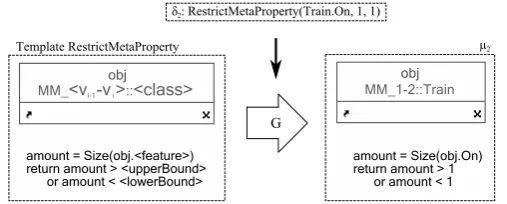
MM_1-2::Traino
G
δ : RestrictMetaProperty(Train.On, 1, 1)
amount = Size(obj.<feature>) return amount > <upperBound> or amount < <lowerBound>
amount = Size(obj.On) return amount > 1 or amount < 1 2
MM_<v -v >::<class>i-1 i
obj obj
Template RestrictMetaProperty μ2
Figure 5: Creating a migration transformationµ2from difference operationδ2and a
transforma-tion template using merged metamodelMM1,2.
Figure 5 shows an example of the synthesis of the migration operation µ2. The migration
operation is created from difference operationδ2 (shown on top) and the template (shown on
of the migration problem, lowering the degree of accidental complexity.
Length <<Atom>> Value : field
RightLink <<Connection>>
LeftLink <<Connection>> Link
<<Connection>> On <<Connection>>
Junction <<Model>> Rail
<<Model>>
TrainPlace
<<Model>> Train
<<Atom>>
0..1
src 1 dst 0..* dst
0..1 src 1
dst 0..*
src 1
dst 0..*
src 1
Figure 6: The merged metamodel
MM5,6used forµ6.
In order to allow in-place transformation, the meta-models of the source- and target meta-models must be the same. In our case, the metamodels MMi−1 and MMi are very similar but not the same. Therefore, we
merge both metamodels into one metamodelMMi−1,i, to which modelsmi−1 as well as models mi conform. MMi−1,i can be automatically generated from MMi−1
andδi, so thatMMi−1,i=merge(MMi−1,δi): initially, MMi−1,i =MMi−1. Ifδi is additive, the change is ap-plied toMMi−1,i. Ifδi is subtractive, the to be deleted element is kept inMMi−1,i. Ifδiis updative, the updated version is added to MMi−1,i without removing the old version. No matter what kind of change, the metamodel is “relaxed” so that all possiblemi−1andmiconform to
MMi−1,i. This is in particular important for obligatory changes, which are made non-obligatory in the merged metamodel by relaxing the cardinality of the involved associations. Figure6shows the merged metamodelMM5,6 that is used for the migration transformationµ6that implements
the introduction of the Length attribute. Notice that all changes δ1 to δ5 are already carried
through, as migration step 6 is reached. δ7 is disregarded for now, as this step is not reached
yet.δ6is an additive change, so the new element, i.e., theLengthfeature, is added to the merged
metamodel. Additionally, the cardinality is relaxed so that theLengthfeature is not obligatory. Once the default migration operation is synthesized for eachδi, the instance modelsmcan be migrated by executing the sequence of in-place transformationsM=µi◦µi−1◦...◦µ2◦µ1 of
Figure4a. By construction, the resultingm0=M(m)will syntactically conform toMML0.
3.2.2 Manual adaptation
Technically, the first phase fulfills the requirement for co-evolution, namely ensuring that the new models conform to the new language. Syntactic migration is thereby accomplished. In the RailRoad evolution, however, there are also cases of semantic migration. Examples are the introduction of the notion of direction and the introduction of the RailStation. Semantic migration is done during the manual adaptation phase.
In this phase, eachδi and corresponding defaultµi are one by one presented by the evolver. For eachµi, the evolver can choose from four possible actions:
• keepthe defaultµi. If the evolver is satisfied with the defaultµi, nothing has to be done for this step. This action is typically applied for non-breaking or breaking and resolvable changes;
• edit the default µi. The evolver might be satisfied with the structure of the default µi, but might wish to alterµi slightly toµ
0
i. This action is typically applied for breaking and resolvable changes or breaking and unresolvable changes;
• group the current µi with following µi+1. In some cases, a number of difference
MML δ1 δ2 δ3 δ4 δ5 δ7 MML'
m m'
μ1 μ2 μ'3,4,5 μ'7 Δ
Μ
MM1 MM2 MM5
m1 m2 m5
G
δ6
μ6
MM6
m6
G G
Figure 7: The step-wise migration after the manual adaptation phase.
• createa tailored migration for the corresponding difference operation. If the evolver has a migration transformation in mind that is completely different than the default one, he/she can create his/her own. The action is typically applied for non-breaking (if the evolver actually wants to migrate instead of doing nothing) or breaking and unresolvable changes. Note that by first grouping and next creating, the originalµi andµi+1 are replaced by one
µ
0
i,i+1that covers both the migration ofδi andδi+1. Also note that so-called model specific
migration can be introduced here, requiring user input at migration time [HBJ09].
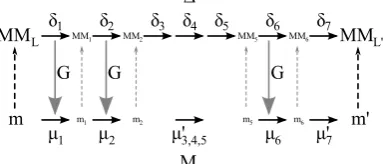
Figure7shows the result of the RailRoad migration after the manual adaptation phase. µ1,µ2
andµ6are kept, µ
0
7 is created manually andδ3,δ4andδ5 have been grouped (introducing the
notion of direction) andµ
0
3,4,5is created manually.
Figure8shows the custom migration transformationµ
0
3,4,5. TwoSplitLinks are replaced by a LeftLinkand aRightLink, which covers the migration of the three changesδ3,δ4andδ5.
sl1
RailRoad-original::SplitLink
left
RailRoad-evolved::LeftLink
split
RailRoad-original::Split
tp2
RailRoad-original::TrainPlace
sl2
RailRoad-original::SplitLink
right
RailRoad-evolved::RightLink
tp1
RailRoad-original::TrainPlace
srcLeftLink 0..*
dstSplitLink 0..*
dstLeftLink 0..* dstRightLink 0..*
dstSplitLink 0..* srcRightLink
0..*
srcSplitLink 0..* srcSplitLink
0..*
Figure 8: The customized migration transformationµ30,4,5introducing the notion of direction. In this transform, items with a check are created, and items with an X are removed from the models.
A new problem arises when allowing the evolver to manually create migration operations. After this phase, it cannot be guaranteed anymore that m0 conforms toMM0, as the evolver is allowed to implement anything he/she wants in the customized migration transformations. In our framework, we offer a solution to uphold this guarantee by providing maximal control over the creation of the migration operation, while still offering full expressiveness. This control is provided by two mechanisms, a preventive mechanism and a corrective mechanism: Restricted metamodel: as a preventive mechanism, it is only allowed to use language constructs of the corresponding difference operation(s) when editing or creating aµ
0
MMmin(S)−1 toMMmax(S)(in the case of |S|=1 this would beMMx−1 toMMx), as intended by the step-wise migration. Again, changes of a previous evolution step δi with i<min(S) are considered carried through, and changes any future evolution stepδjwith j>max(S)are not yet considered at all. For example when creatingµ
0
3,4,5in Figure7, the changesδ1andδ2are carried
through, and changesδ6andδ7are disregarded for now. Only for changesδ3,δ4 andδ5, will a
migration transformation be created, aiding transformation modularity.
Technically, this degree of control is achieved by merging the metamodels MMmin(S)−1 and MMmax(S)into a merged metamodelMMmin(S)−1,max(S). This way, an in-place transformation can be created. Since in this context it is possible that aµ
0
is created for more than oneδ, the merged
metamodel can include more than oneδ. The merging algorithm described above can be used recursively. For example ifS= (3,4,5)thenMM2,3,4,5=merge(merge(merge(MM1,δ2),δ3),δ4)
is the metamodel used in the µ
0
3,4,5 in-place transformation. MM2,3,4,5 is shown in Figure 9.
Notice the cardinality relaxation ofSplitLink,LeftLinkandRightLink;
Checkout transformation: as a corrective mechanism, full model conformance is ensured of the partly migrated instance model to the partly evolved metamodel in the checkout transforma-tion γ. This step is automatically achieved in our approach by applying the default migration
transformations of the difference operations immediately after the customized migration step, i.e.,γi◦µ
0
i. After all, the default migration transformation is constructed so that its output mod-els are syntactically correct. This way, e.g., instances of deleted metaclasses that are by accident not deleted by the customized migration transformation, are deleted by the checkout transfor-mation, thereby ensuring conformance to the partly evolved metamodel. Typically however, the evolver has designed his/her customized migration transformation so that model conformance is already ensured. The checkout transformation merely validates conformance in the general case.
Mis composed of usual transformation models, is stored as any other transformation model. Thus, future instance models conforming to the old version can be migrated later.
3.2.3 Execution Junction <<Model>> SplitLink <<Connection>> RightLink <<Connection>> LeftLink <<Connection>> Rail <<Model>> On <<Connection>> Link <<Connection>> Train
<<Atom>> TrainPlace<<Model>>
src 1 src 0..2 src 0..1 dst 0..1 src 0..1 dst 0..*
dst 0..* dst 0..*
src 1
dst 0..*
Figure 9: The merged metamodelMM2,3,4,5
used forµ
0
3,4,5.
At first glance, the execution of the migration suite
Mis straightforward. On all instance modelsm,M
is applied. More specifically a sequence of in-place transformations, likeµi, µ
0
j andγj, are applied in the given order. The ad hoc execution is not op-timal however: in order for each of the in-place transformations to be executed, the instance model must be converted to that particular merged meta-model of the step. After execution, the result must be converted to the partly evolved metamodel. For example, a model m5 conforming to MM5, must be converted first to MM5,6. Then, the in-place
transformation µ6 can be applied, and the
result-ing model must be converted to metamodelMM6.
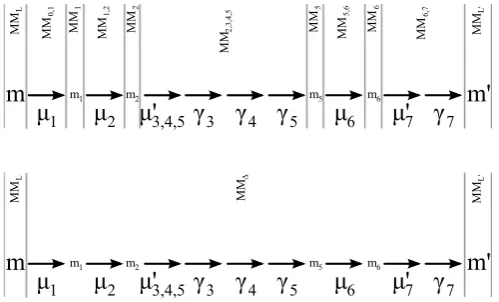
automat-ically generated. However, this can cripple the execution performance of the migration. In Figure10, a conversion is needed every time a different metamodel is used (i.e., a grey verti-cal line is crossed) throughout the execution ofM. The top of Figure 10represents the naive execution, requiring many conversions.
As a solution, after creation of migration transformationM, the different metamodels used in the in-place transformations are relaxed to the merged metamodel that spans allδiin∆. All pos-sible instance models throughout all migration steps can be expressed in the resulting metamodel
MM∆. Every in-place transformation’s used metamodel is changed toMM∆. Of course, this has to be done only once forMinstead of for all instance models. With this optimized approach, an
mthat needs to be migrated only has to be converted twice: before applying the in-place trans-formations ofM, and after applying the in-place transformations ofM. In between, all artefacts use the same metamodel MM∆, and only in-place transformations are applied. The bottom of Figure10 represents the optimized execution. The absence of model-to-model transformations adds to the execution performance of the migration because after evolution, it is probable that models only change slightly, if at all. If the evolver is confident in his/her customized migration transformation, he/she has the option to disable the execution of the checkout transformations, further improving the execution time ofM.
m
m'
μ
1 m1μ
2 m2μ'
3,4,5 m5μ'
7μ
6 m6γ
3γ
4γ
5γ
7M
M1
M
ML
M
M0,
1
M
M1,
2
M
M2
M
M2,
3,
4,
5
M
M5
M
M5,
6
M
M6
M
M6,
7
M
ML
'
m
m'
μ
1 m1μ
2 m2μ'
3,4,5γ
3γ
4γ
5 m5μ
6 m6μ'
7γ
7M
ML
M
MΔ
M
ML
'
Figure 10: The naive execution needing a lot of conversions (top) and the optimized execution needing only two conversions (bottom).
4
Related Work
Co-evolution has been subject for research since the introduction of object-oriented database sys-tems [BKKK87], consequently a significant body of knowledge exists (cf. [Rod92] for a survey) how to migrate data with the goal of preserving as much information as possible. However, in modeling language evolution, the changes to model semantics adds a new “twist” to problems faced in database schema evolution. In this section we focus on most closely related approaches dedicated to reflecting changes of metamodels on models.
the metamodel deltas. In that work as well as in [SGM09], the authors proposed that syntactical co-evolution (where the importance is only to load, but not interpret, the models) is feasible auto-matically, but it seems to be impractical for semantic evolution. In the general case of semantic evolution concerns, semantics-preserving transformations must be developed by language en-gineers manually, based on their understanding of the semantic intent of the original models. However, for specific cases, semantically-preserving co-evolution transformations are possible. In this work, we are following this distinction by proposing an approach based on in-place graph transformations (1) for providing predefined transformations for syntactical migration and (2) for developing specific transformations for semantical migration.
There are several approaches for co-evolution which are based on M2M transformations. Garces et al. [GJCB09] proposed a set of heuristics to automatically compute differences be-tween two metamodel versions in order to adapt models. The computed differences are stored in a so-called matching model, acting as input for a higher-order transformation (HOT), produc-ing a migration transformation. Cicchetti et al. [CDEP08] presented a similar approach, i.e., the approach is again based on a metamodel differences acting as input for a HOT. In [Wac07], Wachsmuth proposed to combine ideas from object-oriented refactoring and grammar adaptation to provide the basis for automatic (meta)model evolution. In this respect, metamodel relations are defined based on M2M transformations, building the basis for the definition of semantics preservation and instance preservation. Gruschko et al. [GKP07] tackled co-evolution of mod-els by using M2M transformations by following a conservative copying algorithm. Conservative copying means that for initial model elements for which no transformation rule is found a default copy transformation rule is applied. This algorithm is implemented in model migration frame-work Flock [RKPP10]. In [NLBK09] the Model Change Language (MCL) is introduced. MCL is declarative and graphical language supporting a set of co-evolution idioms and conservative copying. Co-evolution rules going beyond the supported idioms have to be defined in terms of C++ code. Most of the mentioned M2M-based approaches intend to shield a user from creat-ing standard copy rules by providcreat-ing matchcreat-ing techniques or conservative copycreat-ing techniques. However, the non-automatically derivable parts have to be manually defined which seems to be more challenging for the user compared to using in-place transformations. This is due to the fact that the user has to reason on how elements look like in the source model, how elements are represented in the target model, and how they are transformed by analyzing the trace informa-tion enforcing the user to work with three models. In contrast, in our approach, only one model is necessary for defining the co-evolution rules by using our unified metamodel in combination with in-place transformations.
well-formedness, and differs from the metamodel-independent representation of models used in COPE, which lacks the possibility for intermediate validation.
5
Conclusion
This paper presented a technique to deal with metamodel evolution and model co-evolution; de-spite the problem is an active field of research and a number of solutions have been proposed, several difficulties still demand for being alleviated. In particular, it has been illustrated a mech-anism based on in-place migrations to reduce the accidental complexity of transformation design by shifting the focus on single co-evolutionary scenarios, in a step-by-step fashion. The evolver acts in a controlled environment which is narrowed down by the metamodel merging operation, which constraints her/his operative power and ensures syntactic consistency. Moreover, thanks to the in-place co-evolution unaffected instances are left untouched allowing, for example, the propagation of external links that would be lost after a re-creation of the same model element.
The approach enjoys a high degree of modularity, as relying on small co-evolution steps, which also results in an enhancement of re-use chances of the developed migration transformations. In fact, the technique permits us to store both the manipulation a metamodel has been subject to and the corresponding countermeasures to re-establish the well-formedness of existing models.
Future investigations will be devoted to the analysis of the metamodel evolution representa-tion and default migrarepresenta-tion transformarepresenta-tions in order to further improve the degree of automarepresenta-tion and re-use. Additional work will also consider the performance characteristics of the approach. Moreover, the approach will be extended to support the co-evolution of not only instance models, but also transformation models.
Acknowledgments
This work was supported by the Austrian Science Fund (FWF) under grant P21374-N13, and the US National Science Foundation CNS-0915010 and CNS-0930919.
Bibliography
[BKKK87] J. Banerjee, W. Kim, H.-J. Kim, H. F. Korth. Semantics and implementation of schema evolution in object-oriented databases. SIGMOD Record 16(3):311–322, 1987.
[CDEP08] A. Cicchetti, D. Di Ruscio, R. Eramo, A. Pierantonio. Automating co-evolution in model-driven engineering. In12th Int. EDOC Conf.Pp. 222–231. 2008.
[CDP07] A. Cicchetti, D. Di Ruscio, A. Pierantonio. A Metamodel Independent Approach to Difference Representation.Journal of Object Technology6(9):165–185, 2007.
[GKP07] B. Gruschko, D. Kolovos, R. Paige. Towards synchronizing models with evolving metamodels. InInt. Workshop on Model-Driven Software Evolution. 2007.
[HBJ09] M. Herrmannsdoerfer, S. Benz, E. Juergens. COPE - Automating Coupled Evolution of Metamodels and Models. In23rd ECOOP Conf.Pp. 52–76. Springer, 2009.
[KMS+09] T. K¨uhne, G. Mezei, E. Syriani, H. Vangheluwe, M. Wimmer. Explicit Transforma-tion Modeling. InModels in Software Engineering. Pp. 240–255. Springer, 2009.
[NLBK09] A. Narayanan, T. Levendovszky, D. Balasubramanian, G. Karsai. Automatic Do-main Model Migration to Manage Metamodel Evolution. In Model Driven Engi-neering Languages and Systems. Pp. 706–711. Springer, 2009.
[Obj10] Object Management Group. Object Constraint Language Version 2.2. 2010.
[RKPP10] L. M. Rose, D. S. Kolovos, R. F. Paige, F. A. C. Polack. Model Migration with Epsilon Flock. In3rd Int. Conf. on Theory and Practice of Model Transformations. Pp. 184–198. Springer, 2010.
[Rod92] J. F. Roddick. Schema Evolution in Database Systems - An Annotated Bibliography.
SIGMOD Record21(4):35–40, 1992.
[SGM09] J. Sprinkle, J. Gray, M. Mernik. Fundamental Limitations in Domain-Specific Lan-guage Evolution. Technical report TR-090831, University of Arizona, 2009.
[SK04] J. Sprinkle, G. Karsai. A Domain-Specific Visual Language for Domain Model Evo-lution.Journal of Visual Languages and Computing15(3-4):291–307, 2004.
[TJF+09] M. Tisi, F. Jouault, P. Fraternali, S. Ceri, J. B´ezivin. On the Use of Higher-Order Model Transformations. In5th European Conf. on Model Driven Architecture - Foun-dations and Applications. Pp. 18–33. Springer, 2009.
[Wac07] G. Wachsmuth. Metamodel adaptation and model co-adaptation. In21st European
![Table 1: Difference operations based on [CDEP08], with their migration operations.](https://thumb-us.123doks.com/thumbv2/123dok_us/7807015.2085290/5.595.136.456.355.559/table-difference-operations-based-cdep-migration-operations.webp)