Volume 10 (2008)
Proceedings of the
Seventh International Workshop on
Graph Transformation and Visual Modeling Techniques
(GT-VMT 2008)
Dynamic Software Architectures Verification using DynAlloy
Antonio Bucchiarone, and Juan P. Galeotti
14 pages
Guest Editors: Claudia Ermel, Reiko Heckel, Juan de Lara
Managing Editors: Tiziana Margaria, Julia Padberg, Gabriele Taentzer
Dynamic Software Architectures Verification using DynAlloy
Antonio Bucchiarone1,3and Juan P. Galeotti2
IMT of Lucca, Italy1 [email protected] Universidad de Buenos Aires, Argentina2
[email protected] ISTI-CNR of Pisa, Italy3
Abstract:Graph Grammars have been often used for modeling dynamic changes in software architectures. In particular, we have previously characterized some classes of dynamicity in terms of particular aspects of graph grammars. Moreover we have identified classes of properties that can be naturally associated to any of such kinds of dynamicities. In this paper we approach the problem of verifying such prop-erties over graph grammars specifications. In particular, we use DYNALLOY for attempting this task and we have concentrated on proving properties associated to a particular programmable dynamic software architecture.
Keywords:Dynamic Software Architectures, Typed Graph Grammars, Verification and DynAlloy
1
Introduction
Software architectural models are intented to describe the structure of a system in terms of computational components, their interactions, and its composition patterns [SG96], so to reason about systems at a more abstract level, disregarding implementation details. Since GCSs may change at run-time [Ore96], software architecture models for GCSs should be able to describe the changes of the system structure and to enact the modifications during the system execution. Such models are generally referred to asDynamic Software Architecture(DSA), to emphasize that the system architecture evolves during runtime. In this paper we select graph grammars [Roz97] as a formal framework to modelDSA[BBGM07] and we approach the problem of verifying such properties over graph grammars specifications. In particular, we use DYNALLOY[FGLA05] for
attempting this task proving properties associated to a particular programmable dynamic soft-ware architecture. We use graph grammars to model programmed DSA because they provide several advantages, these include: (i) a graphical representation of architectural styles and con-figurations that is in line with the usual way architectures are represented,(ii)independence from any particular solution technique, (iii) a formal basis based on the theory of formal languages [Roz97]. From the verification point of view, we might like to guarantee that a set of architectural structure changes (e.g., adding or removing components or connectors) will preserve some ar-chitectural invariants or, in other words, that a specific sequence of structural changes will result in a new Software Architecture that satisfies a particular property of interest. For this aspect we show how to use the ALLOYlanguage to model our DSAbased on graph grammars formalism and how to use DYNALLOY[FGLA05], an extension of the ALLOYlanguage [Jac02,Jac06], to specify operations over architectures. Finally, we show how to use the ALLOYANALYZER to
check properties of interest forDSA. In Section2we introduce a running example that we use to introduce our idea. In Section3we summarize the principal elements of our formal framework that is used to representDSAusing hypergraphs. Then, in section4, we show the way in which,
using DYNALLOY structural properties of programmed dynamic SA are verified. Finally, related works are presented in Section5, conclusions and future directions are shown in Section6.
2
Running Example
We use as running example a simple scenario (see [BLMT07]) inspired by the automotive case study of Sensoria Project [Sen]. A road assistance service platform is supported by a wireless network of ad hoc stations that are situated along a road. Bikes equipped with electronic devices can access the service as they move along the road, e.g. to request a taxi in case of breakdowns. The graph in Figure1 depicts a simple configuration of such a system. Each bike (®) is
con-nected to the service access point (◦) of a station (H) which is possibly shared with other bikes.
•oo H //
•oo H //
• •oo H //
• ◦ ◦ ◦ ® O O ® c c ® O O E®E \ \ /
/•oo E®E
B
B
®
O
O
Figure 1: The road assistance scenario.
® access //
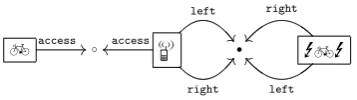
◦ H left right C C access o
o • E®E
left ] ] right
Figure 2: Type GraphTof the running example
3
Formal Model: A Typed Graph Grammar Approach
We model Software Architecture (SA) configurations using typed graph grammars [BBGM07]. Each SA is represented by an hypergraph where components (connectors) are modeled using hyperedges and their ports (roles) by the outgoing tentacles (i.e., labels). Moreover components and connectors are attached together connecting the respective tentacles to the same node. In the following we introduce the fundamental definitions that we will use in this formalization.
Definition 1(Hypergraph) A(hyper)graphis a tripleH= (NH,EH,φH), whereNHis the set of
nodes,EH is the set of (hyper)edges, andφH:EH→NH+ describes the connections of the graph, whereNH+stands for the set of non-empty strings of elements ofNH. We call|φH(e)|therankof e, with|φH(e)|>0 for anye∈EH.
The connection functionφH associates each hyperedgeeto the ordered, non empty sequence of nodesnis attached to. An architectural style is just a hypergraphT that describes only the types of ports, connectors, components and the allowed connections. A configuration compliant to such style is then described by the notion of aT-typed hypergraph.
Definition 2(Typed Hypergraph) Given a hypergraph T (called thestyle), a T -typed hyper-graphorconfigurationis a pairh|G|,τGi, where|G|is theunderlyinggraph andτG:|G| →T is a total hypergraph morphism.
The graph |G|defines the configuration of the system, whileτGdefines the (static)typingof the resources. We recall that a total hypergraph morphism f :G→G0 is a couple f =hfN : N→N0,fE :E→E0i such that: fN(φG(e)) =φG0(fE(e))(we overload fN to denote also the homomorphic extension of fNover strings).
•cp1 H s1 l1
o
o r1 //
a1
•cp2 H s2 l2
o
o r2 //
a2
•cp3
◦ap1 ◦ap2
®b1
a3
O
O
•cp4 H s3 l3
o
o r3 //
a4
•cp5 H s4 l4
o
o r4 //
a5
•cp6
•ap3 •ap4
®b2
a6
O
O
Figure 3: Reconfiguration rule that migrates a bike to the rightward station.
ports and their allowed connections. The typing morphism is defined using theτGthat maps each element of the configuration in only one element of the type graphT.
Finally, an architecture is described by aT-typed graph grammar.
Definition 3((T-typed) graph grammar) A(T -typed) graph grammarG is a tuplehT,Gin,Pri, whereGinis theinitial (T -typed) graphandPris a set ofproductions.
Notation. LetG =hT,Gin,Pribe a (T-typed) graph grammar, andGandH (T-typed) hyper-graphs. We writeG⇒pG0to denote thatGis rewritten in one step toG0by using the production p∈Pr. We abbreviate the reduction sequenceG0⇒p1G1⇒p2. . .⇒pnGnwithG0⇒p1p2...pnGn.
We writeG⇒∗G0 to denote that there exists a possible empty sequences∈Pr∗ of derivation steps such thatG⇒sG0.
3.1 Software Architecture Reconfiguration
The reconfiguration of a software architecture is described by a set of rewriting productions that state the possible ways in which a SA configuration may change. Each rule is defined as a partial, injective graph morphism p:L→R, whereL andR are graphs, called theleft- and right-handside. Give a graphGand a production p, a rewriting ofGusing pis realised using a single-pushout graph transformation approach [EHK+97]. An application of pto ahost graph Grequires a partial graph morphismmfromL toGcalled amatch. A rewriting step leads to atarget graph G0.For each node or edgexinLthere exists a corresponding node or edge inG, namelym(x). We have another morphism namedrthat maps all items fromLtoR, which are to remain inGduring the rewriting application. Elements that are considered in the matchmand that have no image underrare to be deleted. The other are preserved. Elements inRwhich have no pre-image underrare added toG0. r0 is a partial morphism, since that elements fromGmay be deleted and introduced to getG0. New nodes are not in the image ofr0 but in the image of m0. An example of production is shown in Figure3, it specifies the migration of a bike from one station to the right station in a chain.
3.2 Programmed Dynamism
• The setR(G)ofreachable configurations, i.e., all configurations to which the initial con-figurationGin can evolve. Formally,R(G) ={G|Gin⇒∗G}.
• The setDP(G) ofacceptable configurations of an architecture are defined as the graphs that have typeT and satisfies a suitable propertyP.
Formally,DP(G) ={G|G is a T−typed graph∧Pholds in G}.
Programmed dynamism assumes that all architectural changes are identified at design time and triggered by the program itself [End94]. A programmedDSAA is associated with a grammar
GA =hT,Gin,Pri, whereTstands for the style of the architecture,Ginis the initial configuration, and the set of productionsPrgives the evolution of the architecture. The grammar fixes the types of all elements in the architecture, and their possible connections, where the productions state the possible ways in which a configuration may change.
Programmed dynamism enables for the formulation of several verification questions. Consider the set of desirable configurationsDP(G), then it should be possible (at least) to know whether:
• the specification is correct, in the sense that any reachable configuration is desirable. This reduces to prove thatR(G)⊆DP(G), or equivalently that∀G∈R(G):Pholds in G.
• the specification is complete, in the sense that any desirable configuration can be reached. This corresponds to proveDP(G)⊆R(G), or equivalently thatif Pholds in G then G∈ R(G).
Hence, programmed dynamism provides an implicit definition of desirable configurations. That is, the sets of desirable and reachable configurations should coincide, i.e.,Dp(G) =R(G).
4
DSA Structural Verification
4.1 DynAlloy
DYNALLOY[FGLA05] is an extension of the ALLOYmodeling language. It allows us to define
atomic actions that modify the state and build more complex actions (programs) from the atomic actions. Atomic actions are defined by means of preconditions and postconditions given as ALLOYformulas. DYNALLOYformulas extend ALLOYformulas with the addition of a construct for building partial correctness assertions. From atomic actions we can build more complex programs as follows. Ifα is an ALLOYformula, thenα? is a test action. Operation+denotes
the nondeterministic choice between two programs, and “;” denotes their sequential composition. Finally, ∗iterates a program. A partial correctness assertion of the form{α}p{β} is satisfied when no state that does not satisfyβ. is reachable from{α}through programp.
4.2 Designing Software Architectures and Styles with Alloy.
The approach described in this section follows [BBGM07] and models dynamic software ar-chitectures using typed graph grammars (TGG). The implementation of the approach is based on ALLOY[Jac06,Jac02]. ALLOYprovides a logic, based on an extension of first-order logic with relational operators, to represent properties or constraints on the models. We have used this logic to implement concepts like architectural styles, graph transformation rules and architectural properties.
Each software architecture is represented by an hypergraph where components (or connectors) are modeled using hyperedges and their ports (or roles) by the outgoing tentacles (i.e. labels). Moreover, components and connectors are attached together connecting their respective tentacles to the same node. All basic elements (nodes, hyperedges and labels) are implemented in ALLOY
usingsignatures. Instead, tentacles are defined as ternary relations between hyperedges, labels and nodes. All these elements are part of a graph signature definition that represents an architec-ture. Below we show an excerpt of the moduleTGGimplementing the model of graphs. First we see the declaration of the basic signaturesNodeandLabelwhich stand for nodes and labels. SignatureEdgemodels hyperedges and includes a relationconnbetween signature labels and node. Note that in ALLOYsyntax→indicates a binary relation. The keywordlonepreceding
Node constraintsconn to relate each label to at most one element inNode. Thus, for each element of signatureEdge, conn is partial function mapping labels to nodes. The signature
Graphis used to define as a graph as structure composed of nodes, hyperedges and labels.
sig Node {} sig Label {}
sig Edge { conn: Label -> lone Node }
sig Graph { n: set Node, he: set Edge, l: set Label }
After the definition of the signatures, we define a predicate (a property to be checked) to determine whether a graphgis well-formed and consistently typed over a type graphhby typing morphismt.
sig Tau {
tauN: set Node -> set Node, tauE: set Edge -> set Edge, tauL: set Label -> set Label }
pred isTG [g: Graph, h: Graph, t: Tau]{...}
The signatureTau is used to define mapping functions between each SA configuration and the architectural style. Architectural styles consist of a set of elements (components, connectors, ports and roles) that can constitute an architecture (e.g.,Bike Vocabulary) plus a set of invari-ant rules indicating how these elements can be legally connected [SG96]. A SA configuration compliant to such style is then described by the notion of a T-TYPED hypergraph [BBGM07]. We define an ALLOYmodule called BIKE-STYLEthat contains all these elements. The type graph and its items are modeled as instances which we represent by using singleton extensions of signatures.
one sig bike_typegraph extends Graph{} fact Bike_Vocabulary {
bike_typegraph.n= access_point + chain_point bike_typegraph.he = bike + station + bikestation bike_typegraph.l = access + left + right
bike.conn = access -> access_point
... }
pred topology_linear[g: Graph, t: Tau]{ no e:g.he | e in e.ˆnext ... }
For instance, the nodeaccess pointthat stands for an access point is declared as a single-ton (one) signature extendingextendssignatureNode. The type graph depicted in Figure2 is defined by afact, i.e. a predicate assumed to hold in every considered model. For instance, the type graph definition states that the set of nodes of the type graph is the union (denoted by +) of access point and chain point, the signatures that stand for the access and the chain point nodes. Further properties of the style are defined via predicates. For instance,
topology linearis used to make sure that stations form an acyclic connected chain. The
predicate make use of a negative form of quantification (no) and transitive closure ˆof the rela-tion of right-neighborhoodnext. We see the first line of the predicate below where we express that no edge eof a graphgbelongs to the set of edges is reachable fromeby moving to the rightward adjacent edge.
4.3 Programmed Dynamism with Alloy
We have defined a set of rewrite rules that state the possible ways in which a software architecture configuration may change. Each rule is defined as a partial, injective graph morphismp:L→R, whereLandRare graphs, called theleft-andright-handside. Give a graphGand a production p, a rewriting ofGusingpis realised using a single-pushout graph transformation [EHK+97]. A signatureProdimplements productions as composed of graphslhsandrhs, standing for the left- and right-hand side graphs. A reconfiguration is implemented using two distinct predicates (i.e.rwStepPreandrwStepPost) that are used to verify conditions that must hold in target and the destination graph. For instance, below we see the code ofRwStepPrethat makes use of auxiliar predicates to check the well formedness of graphG1being rewritten, the left- and right-hand side graphs of productionR andR itself. In addition, it checks whether there is a match of the left-hand side inG1.
pred rwStepPre[G1:Graph, R: Prod, style: Graph, t1:Tau, t2:Tau, t3: Tau, M1: Fun, P:Fun]{ isTG[G1,style,t1]
isTG[R.lhs,style,t2] isTG[R.rhs,style,t3] isProd[R,style,t2,t3,P]
isMatch[R.lhs,G1,style,t2,t1,M1] }
An example of a production is shown in Figure3, it specifies the migration of a bike from one station to the right station in a chain. Textually, we declare the signature of the production as a singleton extension ofProdand define facts that characterize the left- and right-hand side graphs:
fact migrate_right_lhs{
migrate_right.lhs.n = cp1 + cp2 + cp3 + ap1 + ap2 migrate_right.lhs.he = s1 + s2 + b1
migrate_right.lhs.l = l1 + l2 + l3 + l4 + l5 + l6 + l7 }
4.4 Verification using DynAlloy
In the Alloy language, the assertions are used to check specifications. Using the Alloy analyzer, it is possible to validate assertions, by searching for possible (finite) counterexamples for them, under the constraints imposed in the specification of the system. DynAlloy, instead, has pro-posed the use ofactionsto model state change. An action is how it transforms the system state after its execution and moreover actions can be sequentially composed, iterated or composed by nondeterministic choice [FGLA05]. We want to specify that a given property P is invariant under sequences of applications of some operations. In our case this operation is the rewriting step that from an initial graph G and a Production P generates a new graph G’. A technique useful for stating the invariance of a property P consists of specifying that P holds in the initial Graph, and that for every non initial graph and every rewriting operation, the following holds: P(G) andrwStep(G,G0)→P(G0). For this objective we have defined a set o properties that each SA configuration, after a rewriting step must satisfy. In the following we describe each of them with the Alloy code related.
1. Property 1: Each bike can be connected to only one access point using one port of type
Access
pred Property1 [tgg: TGG]{ all g: tgg.graphs |all e1: g.he
|Type[e1,Bike] => one l1: g.l, n1:g.n
|(Type[n1,Access_Point] and Type[l1,Access]) and e1.conn = l1->n1
}
2. Property 2: The system can not have bikes disconnected and each bike has at most one connection.
pred Property2[tgg:TGG]{ all g: tgg.graphs | all e1: g.he |
Type[e1,Bike] => #(e1.conn)=1
}
3. Property 3: If one bike is connected to an access point then must exist a unique station that is connected to the same access point.
pred connected [e1: HE, e2:HE]{ univ.(e1.conn) = univ.(e2.conn) }
pred Property3[tgg:TGG]{ all g:tgg.graphs|
all e1:g.he |
Type[e1,Bike]=> one e2:g.he |
In order to have programmed dynamism and check that at each reconfiguration step a property P is valid, we proceed as follows. For example we want to provide that in each SA configuration ”if one bike is connected to an access point then must exist a unique station that is connected to the same access point”. This means to provide the predicateProperty3. For this, we have described in DynAlloy the actionrwStepthat from an initial configurationG1and a production
Prexecute a single rewriting step, generating a new set of typed graphstgg’with the new SA configurationG2. The corresponding DYNALLOYspecification is:
act rwStep [tgg: TGG, Pr: Prod]{
pre { rwStepPre[G1, Pr, style_bike, t1, t2, t3, M1, P]} post { rwStepPost[G1,G2,Pr,style_bike,t1,t2,t3,t4,P,M1, M2,F,tgg,tgg’]}
}
Moreover, by using partial correctness statements on the set of regular programs generated by the set of atomic actions rwStep[tgg,Pr1],rwStep[tgg,Pr2], we can assert the invariance of theProperty3under finite applications of functionsrwStepin a simple way, as follows:
assert Property3InvAssertion { assertCorrectness[tgg:TGG]{
pre={Property3[tgg]}
program={(rwStep[tgg,Pr1] + rwStep[tgg,Pr2])*} post={Property3[tgg’]}
}}
The DynAlloy translator allows us to produce an ALLOYmodel ready to be analyzed using the ALLOY ANALYZER. In order to do so, we need to provide a fixed length to bound the closure operator. In this example, if we set the bound to ”n”, we will analyze the following finite counterpart:
skip+(rwStep[tgg,Pr1]+rwStep[tgg,Pr2])+ (rwStep[tgg,Pr1]+rwStep[tgg,Pr2]); (rwStep[tgg,Pr1]+rwStep[tgg,Pr2])+ ...
(rwStep[tgg,Pr1]+rwStep[tgg,Pr2]);...; (rwStep[tgg,Pr1]+rwStep[tgg,Pr2])
/ --- n-times ---/
4.5 Example of Analysis
In this section we show two examples of the analysis that we have performed using the AL
-LOYANALYZER. Model findingis the main analysis capability offered by ALLOY. The ALLOY
module MODEL-FINDING ...
one sig G1 extends Graph{} fact{
G1.he=b1+s1+bs1 G1.n=cp1+cp2+cp3+ap1 G1.l=a1+a2+l1+r1+l2+r2} pred show[]{}
run show for 1 Graph, 3 Edge, 4 Node, 6 Label
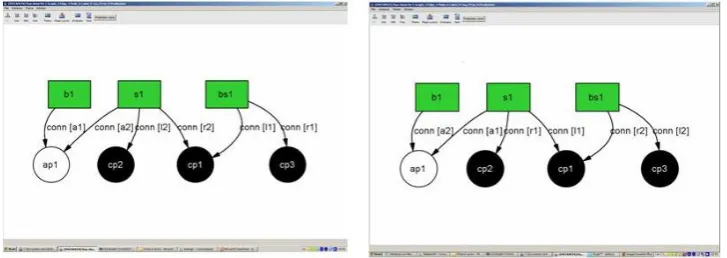
When we run the predicate show the ALLOY ANALYZER generates two different SA con-figurations that are showed in figure4. The difference between them is the attachments of the bikestation component (i.e.,bs1in figure4). In the first case it is attached in the left-side of the station, in the second in the right-side.
Figure 4: Software Architecture Configurations.
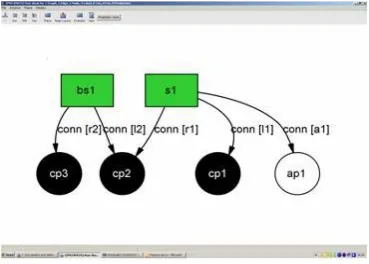
The second kind of analysis that we performed is calledInvariant Analysis; its the objective to check if a propertyPis invariant under sequences of applications of reconfigurations. In other words we have executed the analysis described in4.4. To do this we have chosen theproperty3 defined before and one initial configuration generated from the previous analysis. We have de-fined three different modules,PRODUCTIONSdefines the set of admissible SA reconfiguration (i.e.,Connect Bike,Disconnect bike, etc.),PROPERTIESdefines the set of possible properties that we want to check andEXECUTIONis the responsible of the invariant analysis. In the last module we have defined the rewriting step action and theassertthat we execute. The code below enables us to automatically elicit a reconfiguration trace taking the system from one configuration presented in Fig. 4to the configuration presented in Fig. 5. Moreover, target SA configuration satisfiesProperty3.
module EXECUTION ....
assert Property3InvAssertion { assertCorrectness[tgg:TGG] {
pre={Property3[tgg]}
program={(rwStep[tgg,Disconnect_Bike])*} post={Property3[tgg’]}
}}
Figure 5: Reconfiguration Result.
5
Related Work
Many research works are focusing on Dynamic Software Architecture specification and valida-tion, they can be sub-divided into three categories. The first, uses formal techniques [BCDW04] such as graph based techniques [M´et98,HIM99,BHTV04,TGM98,WLF01], logic based [End94, AM02] and process algebra based [MK96, ADG, CPT99a]. We use graph grammars and this representation is borrowed from Le M´etayer approach [M´et98]. Our scope of this paper are the programmedDSAbut different kind of dynamisms as Self-repairing, Ad-Hoc and Constructible have been proposed in [ADG,GS02, GMK02,SG02,Ore96,BCDW04]. The main difference w.r.t. our work is that they are aimed at providing real specification languages while we are aimed at giving an abstract representation of programmedDSA.
The second uses Architectural Description Languages (ADLs) to model adaptive SA with con-nection and disconcon-nection of components and connectors [OGT+99, MT00, MK96, CPT99b, ADG] by textual or a graphical notation and using also some specific tools to verify them. On one hand, some of the mentioned ADL like Darwin [MK96], and Dynamic Wright [ADG] mod-els DSA and verifies the models with formal techniques. However, these latter did not offer
any graphical tools to display these models. On the other hand, some others such as ACME [GMW97], AADL1,DAOP-ADL2 and Fractal3 provides graphical tools for modeling DSA but do not give mechanisms for validating these models. The third focuses on UML architecture modeling extending UML metamodels [KMJ+05,KKJD06] to ensure dynamic architecture and also providing UML diagram translation into formal notation in order to be analyzed[BA05]. An other analysis formal technique that we are thinking to use is Model-Checking. More research works have been done in this direction in the last few years. For example Heckel at al. in [Hec98] proposed an approach where graphs transformations systems are verified using model checking where graphs are interpreted as states and transformation rules as transitions. Rensink in [Ren03] presents a model-checking approach (i.e., GROOVE), based on a graph-specific model checking algorithm, for object-oriented systems. Our idea is to integrate the ”Model Finding” aspect of Alloy with Model-Checking in order to have a complete analysis framework forDSA.
1 http://www.aadl.info/
6
Conclusion and Future Work
We have presented an approach to verify Dynamic Software Architectures modeled using Typed Graph Grammars. We have considered the programmed dynamicity of a SA in which all admissi-ble changes (e.g., adding and removing of components, connectors and connections) are defined prior to run-time and are triggered by the system itself. The verification consists of representing this formalism in the ALLOYrelational language and since that this kind of dynamicity requires
the analysis of situations in which architectural state changes at run-time, we have considered the use of DYNALLOY language, an extension of ALLOY with actions, in order to represent state changes via actions and programs. This work represents our first step towards analysis of
DSA. Three important future directions are needed. The first is to extend the approach, proving properties associated to each kind ofDSAformalized in [BBGM07]. The second is to consider the verification of behavioral properties, using model-checking, of SAs that change not only the structure at run-time. Finally, in order to have an automatic and extensible framework to model and analyzeDSAwe are developing an Eclipse-based framework named ARMADA (Automated
ReMorphingAmbient forDynamicArchitectures) with the objective to facilitateDSAmodeling
and analysis within the software development life cycle.
Acknowledgements: Authors thank Hern´an Melgratti for his valuable insights about this problem. This work has been partly supported by EU within the FET-GC2 IST-2005-16004 Integrated Project SENSORIA(Software Engineering for Service-Oriented Overlay Computers) and by the Italian FIRB Project TOCAI.IT.
Bibliography
[ADG] R. Allen, R. Douence, D. Garlan. Specifying and Analyzing Dynamic Software Ar-chitectures. InProceedings of FASE’98.
[AM02] N. Aguirre, T. Maibaum. A Temporal Logic Approach to the Specification of Recon-figurable Component-Based Systems. InASE ’02. P. 271. IEEE Computer Society, Washington, DC, USA, 2002.
[BA05] B. Bordbar, K. Anastasakis. UML2ALLOY: A tool for lightweight modelling of discrete event systems. In Guimaraes and Isaeas (eds.), IADIS AC. Pp. 209–216. IADIS, 2005.
[BBGM07] R. Bruni, A. Bucchiarone, S. Gnesi, H. Melgratti. Modelling Dynamic Software Architectures using Typed Graph Grammars. InGTVC’07. 2007. To appear.
[BCDW04] J. S. Bradbury, J. R. Cordy, J. Dingel, M. Wermelinger. A survey of self-management in dynamic software architecture specifications. InWOSS. Pp. 28–33. 2004.
[BLMT07] R. Bruni, A. Lluch Lafuente, U. Montanari, E. Tuosto. Style Based Reconfigurations of Software Architectures. Technical report TR-07-17, Dipartimento di Informatica, Universit`a di Pisa, 2007.
[CPT99a] C. Canal, E. Pimentel, J. M. Troya. Specification and Refinement of Dynamic Soft-ware Architectures. In Proceedings of the TC2 First Working IFIP Conference on Software Architecture (WICSA1). Pp. 107–126. Kluwer, B.V., Deventer, The Nether-lands, The NetherNether-lands, 1999.
[CPT99b] C. Canal, E. Pimentel, J. M. Troya. Specification and Refinement of Dynamic Soft-ware Architectures. InWICSA. Pp. 107–126. 1999.
[EHK+97] H. Ehrig, R. Heckel, M. Korff, M. L¨owe, L. Ribeiro, A. Wagner, A. Corradini. Algebraic Approaches to Graph Transformation - Part II: Single Pushout Approach and Comparison with Double Pushout Approach. InHandbook of Graph Grammars. Pp. 247–312. 1997.
[End94] M. Endler. A Language for implementing generic dynamic reconfigurations of dis-tributed programs. InIn Proceedings of BSCN 94. Pp. 175–187. 1994.
[FGLA05] M. Frias, J. Galeotti, C. Lopez Pombo, N. Aguirre. DynAlloy: Upgrading Alloy with Actions. Inin Proceedings of the 27th. ACM-IEEE International Conference on Software Engineering (ICSE) 2005. Pp. 442–450. ACM Press, 2005.
[GMK02] I. Georgiadis, J. Magee, J. Kramer. Self-Organising software architectures for dis-tributed systems. InIn Proceedings of the 1th Workshop on Self-Healing Systems. Pp. 33–38. 2002.
[GMW97] D. Garlan, R. T. Monroe, D. Wile. Acme: an architecture description interchange language. InCASCON. P. 7. 1997.
[GS02] D. Garlan, B. R. Schmerl. Model-based adaptation for self-healing systems. In WOSS. Pp. 27–32. 2002.
[Hec98] R. Heckel. Compositional Verification of Reactive Systems Specified by Graph Transformation. InFASE. Pp. 138–153. 1998.
[HIM99] D. Hirsch, P. Inverardi, U. Montanari. Modeling Software Architecutes and Styles with Graph Grammars and Constraint Solving. InWICSA. Pp. 127–144. 1999.
[Jac02] D. Jackson. Alloy: a lightweight object modelling notation. InACM Transactions on Software Engineering and Methodology. 2002.
[Jac06] D. Jackson.Software Abstractions: Logic, Language, and Analysis.The MIT Press, 2006.
[KMJ+05] M. H. Kacem, M. N. Miladi, M. Jmaiel, A. H. Kacem, K. Drira. Towards a UML profile for the description of dynamic software architectures. InCOEA. Pp. 25–39. 2005.
[M´et98] D. L. M´etayer. Describing Software Architecture Styles Using Graph Grammars. IEEE TSE24(7):521–533, 1998.
[MK96] J. Magee, J. Kramer. Dynamic structure in software architectures. InSIGSOFT ’96: Proceedings of the 4th ACM SIGSOFT symposium on Foundations of software engi-neering. ACM, New York, NY, USA, 1996.
[MT00] N. Medvidovic, R. N. Taylor. A Classification and Comparison Framework for Soft-ware Architecture Description Languages.IEEE TSE26(1):70–93, 2000.
[OGT+99] P. Oreizy, M. Gorlick, R. Taylor, D. Heimhigner, G. Johnson, N. Medvidovic, A. Quilici, D. Rosenblum, A. Wolf. An Architecture-based approach to self-adaptive software. InIntelligent Systems, IEEE. Volume 14(3), pp. 54–62. 1999.
[Ore96] P. Oreizy. Issues in the runtime modification of software architecture.Elettronics LettersUCI-ICS-96-35, 1996.
[Ren03] A. Rensink. The GROOVE simulator: A tool for state space generation. 2003.
[Roz97] Handbook of Graph Grammars and Computing by Graph Transformations, Volume 1: Foundations. In Rozenberg (ed.),Handbook of Graph Grammars. World Scien-tific, 1997.
[Sen] Sensoria Project. Public Web Site.http://sensoria.fast.de/.
[SG96] M. Shaw, D. Garlan. Software Architecture: Perspectives on An emerging Disci-pline. InPrentice Hall, NJ. USA. 1996.
[SG02] B. R. Schmerl, D. Garlan. Exploiting architectural design knowledge to support self-repairing systems. InSEKE. Pp. 241–248. 2002.
[TGM98] G. Taentzer, M. Goedicke, T. Meyer. Dynamic Change Management by Dis-tributed Graph Transformation: Towards Configurable DisDis-tributed Systems. In TAGT. Pp. 179–193. 1998.