ARTIGO ORIGINAL
Revista Científica da Ordem dos Médicos www.actamedicaportuguesa.com 191
First-Trimester Biochemical Markers and
Small-for-Gestational-Age Infants
Marcadores Bioquímicos do Primeiro Trimestre e Recém-Nascidos Leves para
Idade Gestacional
1. Departamento de Obstetrícia e Ginecologia. Centro Hospitalar Tondela-Viseu. Viseu. Portugal. Recebido: 19 de Abril de 2013 - Aceite: 06 de Novembro de 2013 | Copyright © Ordem dos Médicos 2014
Cláudia ANDRADE1, Joana SANTOS1, Ana RITA PINTO1, Pedro MANSO1, Susana PEREIRA1
Acta Med Port 2014 Mar-Apr;27(2):191-195
RESUMO
Introdução: Estudos anteriores mostram uma relação dos marcadores bioquímicos do 1º trimestre, proteína plasmática A associada à gravidez e subunidade β da gonadotrofina coriónica, com o nascimento de recém-nascidos com peso abaixo do percentil 10. O nosso objectivo foi descrever a relação entre estes marcadores bioquímicos com os recém-nascidos leves para a idade gestacional, na nossa população.
Material e Métodos: Estudo retrospectivo analítico de 2 305 grávidas que realizaram o rastreio combinado do primeiro trimestre entre Março 2009 e Setembro de 2011. Comparação entre o grupo dos recém-nascidos abaixo do percentil 10 e o grupo controlo (recém-nascidos de termo com peso acima do percentil 10) e os recém-(recém-nascidos abaixo do percentil 3 e o grupo controlo. Foi realizado uma análise de regressão múltipla e logística com a utilização dos valores de proteína plasmática A associada à gravidez e subunidade β da gonadotrofina coriónica (em múltiplos da mediana) e as características demográficas maternas como etnia, peso e status tabágico.
Resultados: O estudo revelou uma contribuição independente da proteína plasmática A associada à gravidez, do peso materno e dos hábitos tabágicos para os recém-nascidos abaixo do percentil 10. Na regressão logística para o marcador proteína plasmática A as-sociada à gravidez, o risco relativo abaixo do percentil 10 foi de 2,41 e abaixo do percentil 3 de 3,41 (p < 0,01). No caso da subunidade
β da gonadotrofina coriónica, o odds ratio determinado para percentil inferior a 10 foi de 1,70 (p = 0,03) e para o percentil inferior a 3
foi de 3,22 (p < 0,01).
Conclusões: Baixos níveis da proteína plasmática A associada à gravidez e de subunidade β da gonadotrofina coriónica (valores in-feriores ao percentil 5 da população estudada) estiveram relacionados com aumento do risco do nascimento de recém-nascidos leves para a idade gestacional na população de grávidas abrangidas pelo estudo.
Palavras-chave: Diagnóstico Prenatal; Marcadores Biológicos; Portugal; Primeiro Trimestre da Gravidez; Recém-nascido Leve para a Idade Gestacional.
ABSTRACT
Introduction: Several studies suggested an association between first trimester biochemical markers (PAPP-A and β-HCG) and infants below 10th percentile. Our goal was to describe this relationship of biochemical markers with small-for-gestational-age fetuses in our
population.
Material and Methods: Retrospective analytic study of 2 035 pregnant women that underwent first-trimester screening in the period between March 2009 and September 2011. Small-for-gestational-age infants below 10th percentile were compared with control group
(term newborn with birth weight above 10th percentile). Infants below 3rd percentile and control group were also compared. Multiple
and logistic regression analysis were done with PAPP-A, β-HCG (multiples of the expected normal median) and demographic maternal characteristics (ethnicity, weight and smoker status).
Results: This study demonstrated an independent contribution of PAPP-A, maternal weight and smoker status in predicting small-for-gestational-age infants. For PAPP-A, the odds ratio for small-for-gestational age below 10th and 3rd percentile was 2.41 and 3.41,
respectively (p < 0.01). For β-HCG, odds ratio below 10th percentile was 1.70 (p = 0.03) and for birth weight below the 3rd percentile,
the odds ratio was 3.22 (p < 0.01).
Conclusions: Low levels of PAPP-A and β-HCG (values below 5th percentile of the study population) were associated with an in-creased risk of small-for-gestational-age infants in the pregnant population included in this study.
Keywords: Biological Markers; Infant, Small for Gestational Age; Pregnancy Trimester, First; Prenatal Diagnosis; Portugal.
INTRODUCTION
In the last few years, first trimester biochemical markers have been increasingly used as evidence for adverse gestational outcomes, including Small for Gestational Age (SGA) infants, preterm births, intrauterine fetal death, miscarriages and pre-eclampsia.1-10 Early detection
capability of increased risk of foetal morbidity and mortality has major clinical implications and is required to optimize prenatal surveillance.1,11
Pregnancy-associated plasma protein A (PAPP-A) is a trophoblast-derived protein acting as a protease in insulin-like growth factor binding and is theoretically responsible
for placental growth factor stimulation.12,13 Previous studies
have shown that a low PAPP-A concentration is related as an independent factor to an increased risk of SGA 1-3,5,11,14
i.e. with a birth weight less than the 10th percentile. A low concentration of β-subunit of human chorionic gonadotropin (β-hCG) is also related to SGA in the first trimester of pregnancy.1,3,5,11,14
Our study aimed to show the capacity of PAPP-A and β-hCG measurements in the first trimester of pregnancy to predict SGA infants.
anos
35
35 ano
s a p
rom ov
er
as
ciê
ncia s bio A
MÉ
DI
CA
P
ORT
UGUE
SA
ARTIGO ORIGINAL MATERIAL AND METHODS A retrospective cohort study of the clinical record of all
pregnant women completing the combined first-trimester screening has been carried out in our Foetal Medicine Unit at the Centro Hospitalar Tondela-Viseu, between March
2009 and September 2011.
The combined first trimester screening included blood sampling between 9th and 13th weeks of pregnancy in order to obtain PAPP-A and β-hCG levels, followed by foetal ultrasound obtained between 11th and 13th weeks of pregnancy, in order to assess crown-rump length (CRL), nuchal translucency (NT) and additional risk markers, when appropriate.15
Serum PAPP-A and β-hCG levels were converted in multiples of the median (MoM) adjusted for gestational age, ethnicity, maternal weight and smoking habit.16 In statistical
analysis, PAPP-A and β-hCG variables were related not only with continuous dichotomous variables, but also with cut-off values corresponding to the 5th percentile of our group of patients (0.439 MoM for PAPP-A and 0.313 MoM for β-hCG).
Demographic data (maternal age and parity) and clinical data (smoking and maternal weight) obtained in the first medical appointment as well as neonatal outcome data (gestational age of delivery, birth weight) were recorded in a restricted-access database (PIA-Fetal Database,
ViewPoint, Webling, Germany). Maternal age (in years), parity (nulliparous or not) and weight (in kg) were recorded
at the time of blood sampling. Smoking habits were classified as ‘smokers’ and ‘non-smokers’ regardless of the daily number of cigarettes consumed at the time of blood sampling. Data regarding deliveries occurring outside our hospital and respective newborns were obtained through telephone contact with mothers.
Multiple pregnancies, major structural or chromosomal foetal disorders with gestational age at or lower than 25 weeks, premature foetus with weight above the 10th percentile and incomplete data records were excluded from the study.
Our database recorded 2,305 pregnancies, which were divided in two major groups: one control group including full-term newborns (over 37 weeks) with weights in the 10th percentile or above. The study group – including SGA
newborn babies, included every newborn baby weighing below the 10th percentile at birth.17 The SGA group was still
subdivided in another group with babies weighing below the 3rd percentile for gestational age at birth (Fig. 1).
Multiple regression analysis was used in order to determine the independent contribution of individual biochemical markers (expressed as MoM) in SGA determination, as well as other variables like maternal weight, maternal ethnicity and smoking. In addition to this analysis, a logistic regression was also carried out in order to assess the relative risk of PAPP-A and β-hCG for the 10th and 3rd percentile in SGA. A p value below 0.05 was
considered statistically significant. The statistical analysis was carried out using SPSS for Windows software (version 18.0, Chicago, IL, USA).
RESULTS
Our study included 2,305 pregnant women after 1,484 were excluded due to foetal structural and chromosomal disorders, multiple pregnancies, gestational ages below 25 weeks, premature babies weighing above 10th percentile
and incomplete data. The control group included 2,024 newborn babies (87.8%) and the remaining 281 newborn (12.2%) corresponded to the group including newborn babies weighing below the 10th percentile, from which 75 babies were born weighing below the 3rd percentile
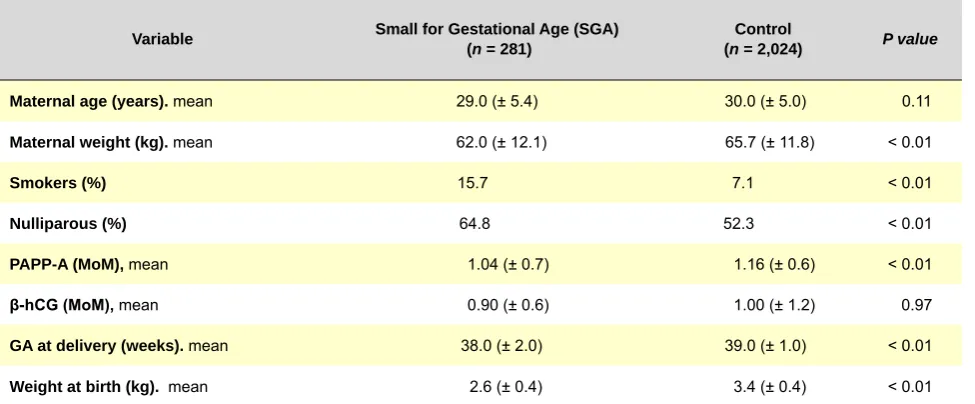
(3.3%). Maternal demographic characteristics, gestational age at delivery, newborn weight at birth and mean level of biochemical markers for each group are shown in Table 1. PAPP-A mean level was significantly lower in the SGA group, born below the 10th percentile [PAPP-A = 1.04 ±
0.67; p < 0.01] as well as below the 3rd percentile [PAPP-A =
0.92 ± 0.48; p = 0.01]. There were no significant differences
between both groups regarding β-hCG average levels in SGA group [β-hCG = 0.90 ± 0.63; p = 0.97]. With the
exception of maternal age, all remaining studied clinical variables (Table 1) were statistically significant in both groups – maternal weight, smoking, nulliparity, gestational age and weight at birth.
The multiple regression analysis showed an independent contribution of PAPP-A, maternal weight and smoking for SGA prediction [R2 0.025; p < 0.01] (Table 2). In contrast,
Figure 1 – Descriptive flowchart of the number of patients included in the study. (SGA – small for gestational age; P10 – 10th percentile; P3 – 3rd percentile) Total pregnancies 3,789 Pregnancies excluded 1,484 Pregnancies included in the
study
2,305
Control group
2,024
SGA group < P10
281
SGA group < P3
ARTIGO ORIGINAL
Table 1 - Maternal demographic and gestational characteristics and biochemical markers
Variable Small for Gestational Age (SGA) (n = 281) (nControl = 2,024) P value
Maternal age (years). mean 29.0 (± 5.4) 30.0 (± 5.0) 0.11
Maternal weight (kg). mean 62.0 (± 12.1) 65.7 (± 11.8) < 0.01
Smokers (%) 15.7 7.1 < 0.01
Nulliparous (%) 64.8 52.3 < 0.01
PAPP-A (MoM), mean 1.04 (± 0.7) 1.16 (± 0.6) < 0.01
β-hCG (MoM), mean 0.90 (± 0.6) 1.00 (± 1.2) 0.97
GA at delivery (weeks). mean 38.0 (± 2.0) 39.0 (± 1.0) < 0.01
Weight at birth (kg). mean 2.6 (± 0.4) 3.4 (± 0.4) < 0.01
The values are presented as mean ± standard deviation. GA – gestational age. PAPP-A – pregnancy-associated plasma protein A; β-hCG – β-subunit of the human chorionic gona-dotropin; kg – kilogram; MoM – multiples of the median
Table 2 – Multiple regression for the prediction of SGA newborn (n = 2,305)
Small for Gestational Age (SGA)
Variables OR (95% CI) P
PAPP-A -0.033 (-0.012; -0.054) < 0.01
β - hCG -0.007 (0.004; -0.018) 0.231
Maternal Weight -0.003 (-0.002; -0.004) < 0.01
Ethnicity 0.000 (0.081; -0.082) 0.988
Smoking 0.120 (0.072; 0.169) < 0.01
OR – odds ratio; CI – confidence interval
Table 3 – Logistic regression for the comparison of mean MoM of PAPP-A and β-hCG levels in SGA newborn
PAPP-A β - hCG
SGA MoM P OR MoM P OR
< P10 1.037 0.000 2.41 0.902 0.028 1.70
< P3 0.916 0.000 3.41 0.870 0.001 3.22
Odds ratio in SGA below P10 and below P3 (PAPP-A = 0.44 MoM and β-HCG = 0.31 MoM corresponding to the 5th percentile).
β–hCG did not show any significant contribution (p > 0.05).
In the logistic regression, when PAPP-A level corresponded to the 5th percentile of our group of patients, the relative risks for SGA below the 10th percentile and the 3rd percentile were 2.41 (OR 2.41; 95% CI, 1.6 – 3.7) and 3.41 (OR 3.41; 95% CI, 1.8 – 6.5) respectively, with p <
0.01. We also found statistically significant differences in β-hCG values for the 5th percentile of our group of patients, with a relative risk of 1.70 (OR 1.70; 95% CI, 1.1 – 2.7) for a percentile below 10 (p = 0.03) and 3.22 (OR 3.22; 95% CI,
1.7 – 6.3) for a percentile below 3 (p = 0.00) (Table 3).
DISCUSSION
Our study showed an increased SGA incidence in smoking mothers and an inverse correlation between SGA incidence and maternal weight, placing mothers with less weight at a higher risk of having SGA babies. In addition, the study showed an association between low serum PAPP-A levels in the first trimester and SGA newborn, arguing for a hypothesis of placental failure in these newborn babies, weighing below the 10th percentile.
ARTIGO ORIGINAL an independent factor, with SGA newborn babies, although with a lower statistical strength than PAPP-A. The low
number of pregnancies included in the study may explain these results which, although conflicting, are in line with previously published studies.3,5,6,14
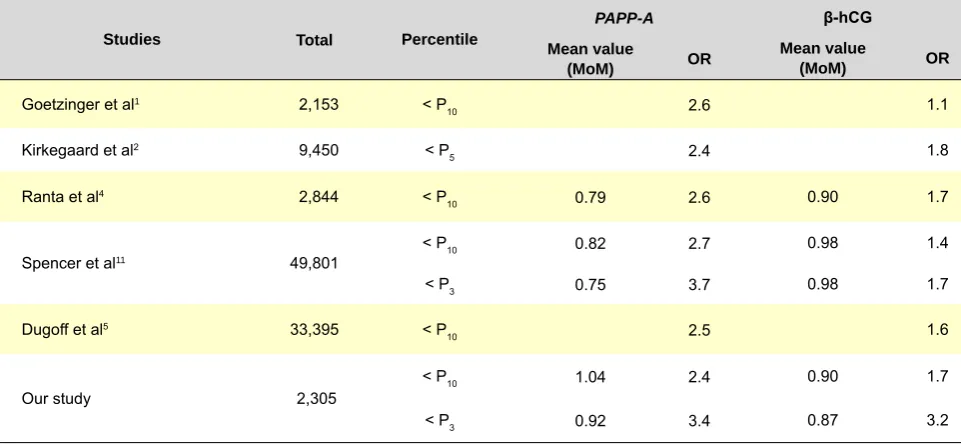
The increase in the use of biochemical markers in the first trimester led to the increase of scientific publications showing a similar relation of these markers with SGA newborn babies, mainly for PAPP-A.1-5,11-14 Table 4 shows
the data published in some of these studies regarding the value of biochemical markers and the obtained odds ratio. Although concordant, the odds ratios are low, meaning that, although increasing the probability of an SGA newborn, the presence of low levels of these markers is not equivalent to SGA. However, the higher the odds, the lower the weight percentile associated.
In addition to their relation with SGA newborn, these markers have been studied as predictive factors for other obstetric complications. Low PAPP-A concentrations are also related with preterm delivery,5-7 foetal death,8,9
pre-eclampsia and other hypertensive disorders5,10 and
spontaneous miscarriages.5 Although this association is
clear, most pregnancies with such outcomes do not present low PAPP-A levels, revealing the low sensitivity of this
marker. In addition, it has a low positive predictive value, as few pregnant mothers with low PAPP-A levels present these obstetric complications. Other obstetric complications related with low β-hCG levels have been studied, as the increased risk of SGA newborn and spontaneous miscarriages.5
CONCLUSION
We found that low PAPP-A and β-hCG levels were related with an increased risk of SGA newborn babies in our group of patients. Nevertheless, further studies are required in order to optimize obstetric complications screening. The results are in line with increasing evidence that first trimester biochemical markers will become useful tools to be included in this screening model.
CONFLICTS OF INTEREST
The authors declare that there were no conflicts of interest in writing this manuscript.
FINANCIAL SOURCES
There were no external financial sources in the writing of this manuscript.
REFERENCES
1. Goetzinger KR, Singla A, Gerkowicz S, Dicke JM, Gray DL, Odibo AO. The efficiency of first-trimester serum analytes and maternal characteris-tics in predicting fetal growth disorders. Prenat Diagn. 2010;30:1138–42. 2. Carbone JF, Tuuli MG, Bradshaw R, Liebsch J, Odibo AO. Efficiency of
first-trimester growth restriction and low pregnancy associated plasma protein-A in predicting small for gestational age at delivery. Prenatal Di-agn. 2012;32:724–9.
3. Kirkegaard I, Henriksen TB, Uldbjerg N. Early fetal growth, PAPP-A and free β-hCG in relation to risk of delivering a small-for-gestational age infant. Ultrasound Obstet Gynecol. 2011;37:341–7.
4. Ranta JK, Raatikainen K, Romppanen J, Pulkki K, Heinonen S. De-creased PAPP-A is associated with preeclampsia, premature delivery
Table 4 - Published studies on the relationship of PAPP-A and β-hCG with SGA newborn
Studies Total Percentile
PAPP-A β-hCG
Mean value
(MoM) OR Mean value(MoM) OR
Goetzinger et al1 2,153 < P
10 2.6 1.1
Kirkegaard et al2 9,450 < P
5 2.4 1.8
Ranta et al4 2,844 < P
10 0.79 2.6 0.90 1.7
Spencer et al11 49,801
< P10 0.82 2.7 0.98 1.4
< P3 0.75 3.7 0.98 1.7
Dugoff et al5 33,395 < P
10 2.5 1.6
Our study 2,305 < P10 1.04 2.4 0.90 1.7
< P3 0.92 3.4 0.87 3.2
and small for gestational age infants but not with placental abruption. Eur J Obstet Gynecol Reprod Biol. 2011;157:48-52.
5. Dugoff L, Hobbins JC, Malone FD, Porter TF, Luthy D, Comstock CH, et al. First-trimester maternal serum PAPP-A and free-beta subunit hu-man chorionic gonadotropin concentrations and nuchal translucency are associated with obstetric complications: a population-based screening study (the FASTER Trial). Am J Obstet Gynecol. 2004;191:1446–51. 6. Spencer K, Cowans NJ, Molina F, Kagan KO, Nicolaides KH.
First-tri-mester ultrasound and biochemical markers of aneuploidy and the pre-diction of preterm or early preterm delivery. Ultrasound Obstet Gynecol. 2008;31(2):147-52.
ARTIGO ORIGINAL
first-trimester low PAPP-A levels with preterm birth. Prenat Diagn. 2010;30:309-12.
8. Spencer K, Cowans NJ, Avgidou K, Nicolaides KH. First-trimester ul-trasound and biochemical markers of aneuploidy and the prediction of impending fetal death. Ultrasound Obstet Gynecol. 2006;28:637-43. 9. Smith GC, Crossley JA, Aitken DA, Pell JP, Cameron AD, Connor JM,
et al. First-trimester placentation and the risk of antepartum stillbirth. JAMA. 2004;292:2249-54.
10. Spencer K, Cowans NJ, Nicolaides KH. Low levels of maternal serum PAPP-A in the first trimester and the risk of pre-eclampsia. Prenat Diagn. 2008;28:7.
11. Spencer K, Cowans NJ, Avgidou K, Molina F, Nicolaides KH. First-tri-mester biochemical markers of aneuploidy and the prediction of small-for-gestational age fetuses. Ultrasound Obstet Gynecol. 2008;31:15–9. 12. Smith GC, Stenhouse EJ, Crossley JA, Aitken DA, Cameron AD, Connor
JM. Early-pregnancy origins of low birth weight. Nature. 2002;417:916. 13. Rutanen EM. Insulin-like growth factors in obstetrics. Curr Opin Obstet
Gynecol. 2000;12:163–8.
14. Krantz D, Goetzl L, Simpson JL, Thom E, Zachary J, Hallahan TW, et al. Association of extreme first-trimester free human chorionic gonado-tropin-beta, pregnancy-associated plasma protein A, and nuchal trans-lucency with intrauterine growth restriction and other adverse pregnancy outcomes. Am J Obstet Gynecol. 2004;191:1452–8.
15. Kagan KO, Etchegaray A, Zhou Y, Wright D, Nicolaides KH. Prospec-tive validation of first-trimester combined screening for trisomy 21. Ultra-sound Obstet Gynecol. 2009;34:14-8.
16. Kagan KO, Wright D, Spencer K, Molina FS, Nicolaides KH. First-trimes-ter screening for trisomy 21 by free beta-human chorionic gonadotropin and pregnancy-associated plasma protein-A: impact of maternal and pregnancy characteristics. Ultrasound Obstet Gynecol. 2008;31:493– 502.