International Journal of Mathematical Archive-9(1), 2018, 40-46
Available online throug
ISSN 2229 – 5046
A NEW APPROACH FOR FINDING AN OPTIMAL SOLUTION
OF UNBALANCED INTUTIONISTIC FUZZY TRANSPORTATION PROBLEMS
A. EDWARD SAMUEL
1& P. RAJA
21,2
Ramanujan Research Centre, PG & Research Deartment of Mathematics,
Government Arts College(Autonomous), Kumbakonam, Tamil Nadu, India.
E-mail: [email protected] & [email protected]
ABSTRACT
I
n this paper, a new method is proposed for solving unbalanced Intuitionistic fuzzy transportation problems by assuming that a decision maker is uncertain about the precise values of the transportation costs, demand and supply of the product. In this proposed method the transportation costs, demand and supply of the product are represented by triangular Intuitionistic fuzzy numbers. To illustrate the proposed method a numerical example is solved and the obtained result is compared with the results of other existing methods. The proposed method is very easy to understand and it can be applied on real life transportation problems for the decision makers.
Mathematics Subject Classification: 03F55, 03E72, 90B06.
Keywords: Triangular Intuitionistic fuzzy numbers, Unbalanced Intuitionistic Fuzzy Transportation Problem (UIFTP),
Optimal Solution.
1. INTRODUCTION
Transportation problem is an important network structured in linear programming (LP) problem that arises in several contexts and has deservedly received a great deal of attention in the literature. The central concept in the problem is to find the minimum total transportation cost of a commodity in order to satisfy demands at destinations using available supplies at origins. Transportation problem can be used for a wide variety of situations such as scheduling, production, investment, plant location, inventory control, employment scheduling, and many others. In general, transportation problems are solved with the assumptions that the transportation costs and values of supplies and demands are specified in a precise way i.e., in crisp environment. However, in many cases the decision makers has no crisp information about the coefficients belonging to the transportation problem. In these cases, the corresponding coefficients or elements defining the problem can be formulated by means of fuzzy sets, and the fuzzy transportation problem (FTP) appears in natural way.
methods directly attain the optimal solution namely zero suffix method [27], ASM–method [2] etc. But these two methods for finding optimal solution of a transportation problem do not reflect optimal solution proved by Mohammed [17]. In general the transportations problems are solved with the assumptions that the coefficients or cost parameters are specified precisely.
In real life, there are many diverse situations due to uncertainty in judgments, lack of evidence etc. Sometimes it is not possible to get relevant precise data for the cost parameter. This type of imprecise data is not always well represented by random variable selected from a probability distribution. Fuzzy number Zedeh [28] may represent the data. Hence fuzzy decision making method is used here. Zimmermann [29] showed that solutions obtained by fuzzy linear programming method and are always efficient. Subsequently, Zimmermann’s fuzzy linear programming has developed into several fuzzy optimization methods for solving the transportation problems. Chanas et al. [3] presented a fuzzy linear programming model for solving transportation problems with crisp cost coefficient, fuzzy supply and demand values. Chanas and Kuchta [4] proposed the concept of the optimal solution for the transportation problem with fuzzy coefficients expressed as fuzzy numbers, and developed an algorithm for obtaining the optimal solution. Saad and Abbas [24] discussed the solution algorithm for solving the transportation problem in fuzzy environment.
Edward Samuel [10, 11] showed the unbalanced fuzzy transportation problems without converting into balanced one getting an optimal solution, where the transportation cost, demand and supply are represented by triangular fuzzy number. Edward Samuel [9] proposed algorithmic approach to unbalanced fuzzy transportation problem, where the transportation cost, demand and supply are represented by triangular fuzzy number.
Liu and Kao [16] described a method for solving fuzzy transportation problem based on extension principle. Gani and Razak [12] presented a two stage cost minimizing fuzzy transportation problem (FTP) in which supplies and demands are trapezoidal fuzzy numbers. A parametric approach is used to obtain a fuzzy solution and the aim is to minimize the sum of the transportation costs in two stages.
Dinagar and Palanivel [8] investigated FTP, with the aid of trapezoidal fuzzy numbers. Fuzzy modified distribution method is proposed to find the optimal solution in terms of fuzzy numbers. Pandian and Natarajan [22] proposed a new algorithm namely, fuzzy zero point method for finding a fuzzy optimal solution for a FTP, where the transportation cost, supply and demand are represented by trapezoidal fuzzy numbers.
Atanassov [1] introduced the concept of Intuitionistic Fuzzy Sets (IFS), which is a generalization of the concept of fuzzy set. Nagoor Gani and Abbas [20] proposed a new average method for solving intuitionistic fuzzy transportation problem, there is no uncertainty about transportation costs but demand and supply are represented by triangular intuitionistic fuzzy number.
In this study, basic idea is to get an optimal solution for an unbalanced Intuitionistic fuzzy transportation problem (UIFTP). This paper presents a new method, simple and easy to understand technique for solving unbalanced Intuitionistic fuzzy transportation problems. This can be an alternative to the modification distribution method (MODI) [5]. No path tracing is required in this approach. The algorithm of the approach is detailed with suitable numerical examples. Further comparative studies of the new technique with other existing algorithms are established by means of sample problem
2. PRELIMINARIEs
In this section, some basic definitions, arithmetic operations and an existing method for comparing Intuitionistic fuzzy numbers are presented.
2.1. Definition [6, 15]: A fuzzy number
A
=
( , , )
a b c
is said to be a triangular fuzzy number if its membership function is given by( )
0
,
A
x a
if
a
x
b
b a
x c
x
if
b
x
c
b c
otherwise
µ
−
≤ ≤
−
−
=
−
≤ ≤
2.2 Definition [19, 26]: A triangular intuitionistic fuzzy number
A
−I is an intuitionistic fuzzy set inℜ
with the following membership functionµ
A−Iand non-membership functionγ
A−I are defined by1 2
1 2 1 2
2 1 2 1
3 2 2 3 2 3 3 2 3 2 , , , , ( ) ( ) 1 , 0 , I I I I I I A A
x a a x
a x a a x a
a a a a
a x x a
a x a
a x a
x and x
a a
a a
other wise other wise
µ
−γ
−− −
< ≤ < ≤
− −
− −
≤ < ≤ <
= = − −
Where
a
11≤
a
1<
a
2<
a
3≤
a
13 this TIFN is denoted by I( ,
1 2,
3;
1I,
2,
3I)
A
−=
a a a a a a
.2.3. Arithmetic operations: In this section, arithmetic operations between two triangular Intuitionistic fuzzy numbers, defined on the universal set of real numbers
ℜ
, are presented [18].Let
A
−I=
( ,
a a a a a a
1 2,
3;
1I,
2,
3I)
a n d
B
−I=
( ,
b b b b b b
1 2, ;
3 1I,
2,
3I)
be two triangular intuitionistic fuzzy numbers thenthe following is obtained.
(i). I I
(
1 1,
2 2,
3 3;
1I 1I,
2 2,
3I 3I).
A
−+
B
−=
a
+
b a
+
b a
+
b a
+
b a
+
b a
+
b
(ii)
1 3 2 2 3 1 1 3 2 2 3 1
( , , ; , , , )
I I I I I I
A− −B− = a −b a −b a −b a −b a −b a −b
(iii)
A
−I×
B
−I=
( , , ; , , , )
l l l l l l
1 2 3 1I 2 3IWhere
1 1 1 1 3 3 1 3 3 2 2 2 3 1 1 1 3 3 1 3 3
1 1
1 1 1 1 3 3 1 3 3 2 2 2 3 1 1 1 3 3 1 3 3
min [, , , ], , max [, , , ],
min [, , , ], , max [, , , ]
I I I I I I I I I I I I I I I I
l a b a b a b a b l a b l a b a b a b a b
l a b a b a b a b l a b l a b a b a b a b
= = =
= = =
2.3 Ranking function [20,26]: Let
( ,
1 2,
3;
1,
2,
3)
( ,
1 2, ;
3 1,
2,
3)
I I I I I I
A
−=
a a a a a a
a n d
B
−=
b b b b b b
be two triangularintuitionistic fuzzy numbers
1 2 3 1 2 3 1 2 3 1 2 3
( 2 ) ( 2 ) ( 2 ) ( 2 )
( ) ( ) ( ) ( )
8 8
.
I I I I
a a a a a a b b b
Then ℜ A = + + + + + andℜB = + + + b + b +b
2. PROPOSED METHOD
Step-1: Construct the fuzzy transportation table for the given unbalanced intuitionistic fuzzy transportation problem and then, convert it into a balanced one.
Step-2: (a) Perform row wise reduction.
Locate the largest element in each row of the given fuzzy cost table and then subtract that from each element of that row, and
(b) Perform column wise reduction.
In the reduced matrix obtained from 2(a), locate the largest element in each column and then subtract that from each element of that column.
Step-3: Verify if Total Demand (TD) exceeds Total Supply (TS) then calculate row penalty else calculate column penalty.
Step-4: Calculate penalties for each row (column) by taking the difference between the smallest and next smallest unit fuzzy transportation cost in the same row (column).
Step-5: Select the row (column) with the largest penalty and allocate as much as possible in the cell having the least cost in the selected row (column) satisfying the rim conditions.
Step-6: Adjust the supply and demand and cross out the satisfied the row or column.
Step-7: Repeat steps 4 to step 6 until the entire demand at various destinations or available supply at various sources are satisfied.
4. NUMERICAL EXAMPLES
4.1. Problem 1
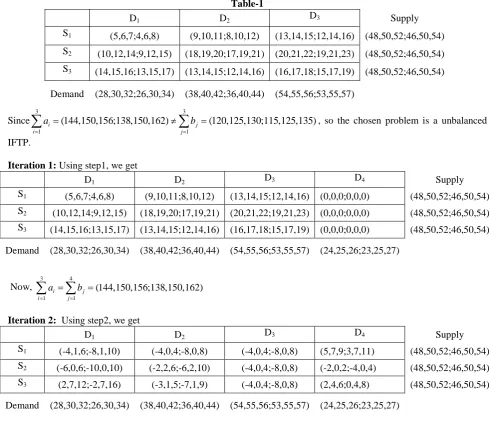
Table 1 gives the availability of the product supply at three sources S1, S2, S3 their demand at three destinations D1, D2,
D3 and the approximate unit transportation cost, demand and supply of the product from each source to each destination
is represented by triangular intuitionistic fuzzy numbers. Determine the intuitionistic fuzzy optimal transportation of the products such that the total transportation cost is minimum.
Table-1
D1 D2 D3 Supply
S1 (5,6,7;4,6,8) (9,10,11;8,10,12) (13,14,15;12,14,16) (48,50,52;46,50,54)
S2 (10,12,14;9,12,15) (18,19,20;17,19,21) (20,21,22;19,21,23) (48,50,52;46,50,54)
S3 (14,15,16;13,15,17) (13,14,15;12,14,16) (16,17,18;15,17,19) (48,50,52;46,50,54)
Demand (28,30,32;26,30,34) (38,40,42;36,40,44) (54,55,56;53,55,57)
Since
3 3
1 1
(144,150,156;138,150,162) (120,125,130;115,125,135)
i j
i j
a b
= =
= ≠ =
∑
∑
, so the chosen problem is a unbalancedIFTP.
Iteration 1: Using step1, we get
D1 D2 D3 D4 Supply
S1 (5,6,7;4,6,8) (9,10,11;8,10,12) (13,14,15;12,14,16) (0,0,0;0,0,0) (48,50,52;46,50,54) S2 (10,12,14;9,12,15) (18,19,20;17,19,21) (20,21,22;19,21,23) (0,0,0;0,0,0) (48,50,52;46,50,54)
S3 (14,15,16;13,15,17) (13,14,15;12,14,16) (16,17,18;15,17,19) (0,0,0;0,0,0) (48,50,52;46,50,54)
Demand (28,30,32;26,30,34) (38,40,42;36,40,44) (54,55,56;53,55,57) (24,25,26;23,25,27)
Now,
3 4
1 1
(144,150,156;138,150,162)
i j
i j
a b
= =
= =
∑
∑
Iteration 2: Using step2, we get
D1 D2 D3 D4 Supply
S1 (-4,1,6;-8,1,10) (-4,0,4;-8,0,8) (-4,0,4;-8,0,8) (5,7,9;3,7,11) (48,50,52;46,50,54) S2 (-6,0,6;-10,0,10) (-2,2,6;-6,2,10) (-4,0,4;-8,0,8) (-2,0,2;-4,0,4) (48,50,52;46,50,54) S3 (2,7,12;-2,7,16) (-3,1,5;-7,1,9) (-4,0,4;-8,0,8) (2,4,6;0,4,8) (48,50,52;46,50,54)
Demand (28,30,32;26,30,34) (38,40,42;36,40,44) (54,55,56;53,55,57) (24,25,26;23,25,27)
Iteration 3: Using step3 (Here, Total Demand does not exceed Total Supply, i.e., TD<TS) and step4, we get
D1 D2 D3 D4 Supply
S1 (-4,1,6;-8,1,10) (-4,0,4;-8,0,8) (-4,0,4;-8,0,8) (5,7,9;3,7,11) (48,50,52;46,50,54) S2 (-6,0,6;-10,0,10) (-2,2,6;-6,2,10) (-4,0,4;-8,0,8) (-2,0,2;-4,0,4) (48,50,52;46,50,54)
S3 (2,7,12;-2,7,16) (-3,1,5;-7,1,9) (-4,0,4;-8,0,8) (2,4,6;0,4,8) (48,50,52;46,50,54)
Demand (28,30,32;26,30,34) (38,40,42;36,40,44) (54,55,56;53,55,57) (24,25,26;23,25,27)
Column
Iteration 5: Using step5 and step6, we get
D1 D2 D3 D4 Supply
S1 (-4,1,6;-8,1,10) (-4,0,4;-8,0,8) (-4,0,4;-8,0,8) * (48,50,52;46,50,54) S2 (-6,0,6;-10,0,10) (-2,2,6;-6,2,10) (-4,0,4;-8,0,8) (-2,0,2;-4,0,4)
(24,25,26;23,25,27) (22,25,28;19,25,31) S3 (2,7,12;-2,7,16) (-3,1,5;-7,1,9) (-4,0,4;-8,0,8) (2,4,6;0,4,8) (48,50,52;46,50,54)
Demand (28,30,32;26,30,34) (38,40,42;36,40,44) (54,55,56;53,55,57) *
Column
penalty (-10,1,12;-18,1,20) (-7,1,9;-15,1,17) (-8,0,8;-16,0,16) (0,4,8;-4,4,12) Iteration 5: Using step7, we get
D1 D2 D3 D4 Supply
S1 (-4,1,6;-8,1,10)
(0,5,10;-5,5,15)
(-4,0,4;-8,0,8)
(38,40,42;36,40,44) (-4,0,4;-8,0,8) (-4,5,14;-13,5,23)
(5,7,9;3,7,11)
*
S2 (-6,0,6;-10,0,10)
(22,25,28;19,25,31) (-2,2,6;-6,2,10) (-4,0,4;-8,0,8) (-2,0,2;-4,0,4)
(24,25,26;23,25,27) *
S3 (2,7,12;-2,7,16) (-3,1,5;-7,1,9) (-4,0,4;-8,0,8)
(48,50,52;46,50,54) (2,4,6;0,4,8) *
Demand * * * *
Iteration 6: Using step 8, we get
D1 D2 D3 Supply
S1 (5,6,7;4,6,8)
(0,5,10;-5,5,15)
(9,10,11;8,10,12) (38,40,42;36,40,44)
(13,14,15;12,14,16)
(-4,5,14;-13,5,23) * S2 (10,12,14;9,12,15)
(22,25,28;19,25,31)
(18,19,20;17,19,21) (20,21,22;19,21,23)
*
S3 (14,15,16;13,15,17) (13,14,15;12,14,16) (16,17,18;15,17,19)
(48,50,52;46,50,54) *
Demand * * *
The minimum fuzzy transportation cost is
= (0,5,10;-5,5,15) x (5,6,7;4,6,8) + (38,40,42;36,40,44) x (9,10,11;8,10,12)
+ (22,25,28;19,25,31) x (10,12,14;9,12,15) + (-4,5,14;-1,5,23) x (13,14,15;12,14,16) + (48,50,52;46,50,54) x (1,17,18;15,17,19)
= (1270,1650,2070; 901,1650,2507)
R(A) = 1668.50
4.2. Problem 2
D1 D2 D3 Supply
S1 (5,6,7;4,6,8) (7,8,9;6,8,10) (2,4,6;1,4,7) (13,14,15;12,14,16)
S2 (2,4,6;1,4,7) (8,9,10;7,9,11) (7,8,9;6,8,10) (11,12,13;10,12,14)
S3 (0,1,2;-1,1,3) (1,2,3;0,2,4) (5,6,7;4,6,8) (4,5,6;3,5,7)
4.3. Comparison among different existing transportation methods:
S.NO ROW COLUMN NWCR MMM VAM Optimal Proposed Method
1. 3 4 1851.25 1816.25 1765.25 1671.25 1668.50
2. 4 3 248.75 182.25 157.50 156.25 142.00
4.4. Results and Discussion
From the investigations and the results given above, it is clear that the proposed method is better than other existing methods and our method for solving unbalanced fuzzy transportation problems and it has its merit that it produces an optimal solution.
5. CONCLUSION
In this paper a new method is proposed for finding optimal solution of intutionistic fuzzy transportation problem in which the transportation costs, demand and supply of the product are represented by triangular intuitionistic fuzzy numbers. So this technique can be applied for solving intuitionistic fuzzy transportation problems occurring in real life situations.
REFERENCES
1. Atanassov. K. T., Intuitionistic fuzzy sets, fuzzy sets and fuzzy systems, 20(1986), 87-96.
2. Abdus Quddoos, Shakeel Javaid., Khalid M.M., “A New Method for finding an optimal solution for transportation problems”, International Journal on Computer Science and Engineering, 4(2012), 1271-1274. 3. Chanas.S., Kolodziejckzy. W., Machaj. A. A., A fuzzy approach to the transportation problem, Fuzzy Sets
and Systems, 13(1984), 211-221.
4. Chanas. S., Kuchta. D., A concept of the optimal solution of the transportation problem with fuzzy cost coefficients, Fuzzy Sets and Systems, 82(1996), 299-305.
5. Charnes. A., Cooper. W.W., Henderson. A., An introduction to linear programming, wiley, New York, 1953. 6. Chen. S.H., Operations on fuzzy numbers with function principal, Tamkang Journal of Management Sciences,
6(1985), 13-25.
7. Dantzig. G.B., Thapa. M.N., Springer: Linear Programming 2: Theory and Extensions, Princeton University Press, New Jersey, 1963.
8. Dinagar. D.S., Palanivel. K., The transportation problem in fuzzy environment, International Journal of Algorithms, Computing and Mathematics, 2(2009), 65-71.
9. Edward Samuel. A., Raja. P., Algorithmic Approach To Unbalanced Fuzzy Transportation Problem, International Journal of Pure and Applied Mathematics (IJPAM), 5(2017), 553-561.
10. Edward Samuel. A., Raja. P., A New Approach for Solving Unbalanced Fuzzy Transportation Problem, International Journal of Computing and Optimization, 3(2016), 131-140.
11. Edward Samuel. A., Raja. P., Optimization of Unbalanced Fuzzy Transportation Problem, International Journal of Contemporary Mathematical Sciences, 11(2016), 533-540.
12. Gani. A., Razak. K.A., Two stage fuzzy transportation problem, Journal of Physical Sciences, 10(2006), 63-69.
13. Goyal. S.K., Improving VAM for unbalanced transportation problems, Journal of operational research society, 35(1984), 1113-1114.
14. Hitchcock. F.L., “The distribution of a product from several sources to numerous localities’’, Journal of Mathematical Physics, 20(1941), 224-230.
15. Kaufmann. A., Gupta. M.M., Introduction to Fuzzy Arithmetic’s: Theory and Applications, New York: Van Nostrand Reinhold, 1991.
16. Liu. S.T., Kao. C., Solving fuzzy transportation problems based on extension principle, European Journal of Operational Research, 153(2004), 661-674.
17. Mohammad Kamrul Hasan., Direct method for finding optimal solution of a transportation problems are not always Reliable, International Refereed Journal of Engineering and Science (IRJES), 1(2012), 46-52.
18. Mahapatra. G. S., Roy. T. K,. Reliability Evaluation using Triangular Intuitionistic Fuzzy Numbers Arithmetic Operations, World Academy of Science, Engineering and Technology, 50(2009), 574-581.
19. Nagoorgani. A ., Poonalagu. K.., An approach to solve intutionistic fuzzy linear programming problem using single step algorithm, International Journal of Pure and Applied Mathematics (IJPAM), 5(2013), 819-832. 20. Nagoorgani. A., Abbas. A., A new average method for solving intutionistic fuzzy transportation problem,
21. Nagaraj Balakrishnan., Modified Vogel’s Approximation Method for the Unbalanced Transportation Problem, Applied Mathematical Letter, 3(1990), 9-11.
22. Pandian. P., Natarajan. G., A new algorithm for finding a fuzzy optimal solution for fuzzy Transportation problems, Applied Mathematical Sciences, 4(2004), 79- 90.
23. Ramakrishnan C.S., An Improvement to Goyal’s modified VAM for the unbalanced transportation problem, Journa of operational research society, 39(1988), 609-610.
24. Saad. O.M., Abbas. S.A., A parametric study on transportation problem under fuzzy environment, The Journal of Fuzzy Mathematics, 11(2003), 115-124.
25. Shimshak. D.G., Kaslik. J.A., Barclay. T.K., A modification of Vogel’s approximation method through the use of heuristics. Can. Journal of operational research society, 19(1981), 259-263.
26. Sujeet Kumar Singh, Shiv Prasad Yadav, A new approach for solving intuitionistic fuzzy transportation problem of type – 2, Ann Open Res(springer), 2014.
27. Sudhakar. V.J., Arunsankar. N., Karpagam.T., A new approach for finding optimal solution for the transportation problems, European Journal of Scientific Research, 68(2012), 254-257.
28. Zadeh. L.A., Fuzzy sets, Information and Control, 8(1965), 338-353.
29. Zimmermann H.J, “Fuzzy programming and linear programming with several objective functions’’, Fuzzy sets and systems, 1(1978), 45-55.