
Taxonomic synopsis of invasive and native
Spartina
(Poaceae, Chloridoideae) in the Pacific Northwest
(British Columbia, Washington and Oregon),
including the first report of
Spartina
×
townsendii
for
British Columbia, Canada
Jeffery M. Saarela1
1 Research & Collections, Canadian Museum of Nature, P.O. Box 3443 Stn. D, Ottawa, Ontario K1P 6P4, Canada
Corresponding author:Jeffery M. Saarela ([email protected])
Academic editor:W. John Kress | Received 20 January 2012 | Accepted 8 March 2012 | Published 21 March 2012
Citation: Saarela JM (2012) Taxonomic synopsis of invasive and native Spartina (Poaceae, Chloridoideae) in the Pacific Northwest (British Columbia, Washington and Oregon), including the first report of Spartina ×townsendii for British Columbia, Canada. PhytoKeys 10: 25–82. doi: 10.3897/phytokeys.10.2734
Abstract
Five species of the grass genus Spartina are invading salt marshes along the Pacific coast of North America, of which three have been documented in British Columbia, Canada, in only the last decade. A taxonomic synopsis of the two native (S. gracilis, S. pectinata) and five introduced Spartina taxa (S. anglica, S. alterni-flora, S. densialterni-flora, S. patens, S. ×townsendii) in the Pacific Northwest is presented to facilitate their identifi-cation, including nomenclature, a new taxonomic key, new descriptions for a subset of taxa, and representa-tive specimens. Spartina ×townsendii is newly reported for the flora of British Columbia. The non-coastal species S. pectinata is reported from an urban site in British Columbia, the first confirmed report of the taxon for the province. Lectotypes are newly designated for S. anglica C.E. Hubb., S. maritima subvar. fal-lax St.-Yves, and S. cynosuroides f. major St.-Yves.
Keywords
invasive grasses, voucher specimens, coastal habitats, Spartina, grass taxonomy, species identification
Introduction
Spartina Schreb. (cordgrass) is a small grass genus of some fifteen species native to North America, South America, and the Atlantic coasts of Europe and Africa occur-ring in such coastal habitats as intertidal mud flats, estuaries, salt marshes, and inland
www.phytokeys.com
Copyright J.M. Saarela. This is an open access article distributed under the terms of the Creative Commons Attribution License 3.0 (CC-BY), which permits unrestricted use, distribution, and reproduction in any medium, provided the original author and source are credited.
in marshes, sloughs and dry prairie. Spartina includes several globally invasive species (e.g., S. alterniflora Loisel., S. anglica C.E. Hubb., S. densiflora Brongn.) that are rap-idly altering salt marsh and estuary ecosystems (e.g., Grosholz et al. 2009, Strong and Ayres 2009) and is an important model system for studying allopolyploid speciation and the relationship between hybridization, polyploidy, and invasion (Ainouche et al. 2004a, 2004b, 2009, Baumel et al. 2002a, Salmon et al. 2005, Fortune et al. 2007, 2008, Parisod et al. 2009, Chelaifa et al. 2010). Consequently, a large and broad body of biological, genetic, and ecological knowledge on cordgrasses has been generated. Nevertheless, identification of Spartina species can be challenging, as several are mor-phologically similar and rapidly expanding their ranges into new areas in which up-to-date taxonomic resources for the genus are not available. This is the situation in the Pacific Northwest of North America (Oregon, Washington, British Columbia), where five Spartina species are invading coastal areas (S. alterniflora, S. anglica, S. densiflora, S. patens (Aiton) Muhl., S. ×townsendii H. Groves & J. Groves).
This taxonomic study was prompted by difficulties encountered in determining recent herbarium collections of invasive Spartina from British Columbia. Existing re-gional taxonomic resources do not include all taxa known in the province (Hitchcock et al. 1969, Douglas et al. 2001, Kozloff 2005) since several species are new or recent invaders, and continent-wide treatments (Barkworth 2003) were found initially to be unsatisfactory to use in this taxonomically difficult grass genus. Since Spartina inva-sions are causing serious ecological damage on the Pacific coast, there has been consid-erable effort to develop information sources for field-based identification, probably in response to a lack of easy-to-use and easy-to-access locally relevant information in the scientific literature, in combination with an urgent need for information to facilitate Spartina identification by as broad a user group as possible to minimize the impacts of the invasions. These mostly emphasize vegetative characteristics easy to observe in the field, such as plant height, blade width and height, leaf color, and plant habit (e.g., Anonymous no date, 2009, Pfauth and Sytsma 1998, O’Connell 2005, Eissinger 2008) but, unfortunately, none of these are among the best taxonomic characters to identify Spartina species with confidence, particularly those that are closely related. Several of these resources do not clearly list authors, publication dates or places other than websites, and they do not identify the original sources (e.g., floras, the primary literature, herbarium specimens) from which the information was derived.
invaders. Unfortunately, herbaria often have relatively few specimens of weedy species, a situation recently documented for noxious weeds in Washington (Zika 2006). Accord-ingly, there are relatively few herbarium specimens for invasive Spartina taxa in the Pacif-ic Northwest, despite considerable efforts to eradPacif-icate Spartina infestations (e.g., Hedge et al. 2003), effectively representing the collection of hundreds to thousands of plants.
Here, I present a taxonomic synopsis of the two native and five introduced taxa of Spartina known from British Columbia, Washington, and Oregon (S. alterniflora, S. anglica, S. densiflora, S. gracilis Trin., S. patens, S. pectinata Link, and S. ×townsendii). I provide a new taxonomic key for the region, nomenclature for all taxa, including previously unpublished details on several type specimens and new lectotypifications, references to published illustrations that clearly show diagnostic characters, specimen citations, and notes on how to distinguish the taxa. New descriptions are given for the closely related and morphologically similar taxa S. alterniflora, S. anglica, and S. ×townsendii, and the aggressively invading S. densiflora, which has recently appeared in British Columbia. Spartina ×townsendii is newly reported from British Columbia. The descriptions and keys are based on study of specimens collected within and outside the region, in consultation with the global primary and secondary taxonomic literature; these data should be useful for distinguishing the taxa wherever they occur globally, including in Alaska where Spartina has not been reported but is anticipated to become a problem in the future (Morgan and Sytsma 2010). I also include detailed reviews of the evolutionary origins and introduction histories of the invasive Spartina taxa, with a focus on their introductions in British Columbia, Washington, and Oregon. To fa-cilitate species identification, images of exemplar herbarium specimens of each taxon are included in the main text, and images of fifty herbarium specimens (a subset of the material examined) are included as supplementary information.
Higher-level classification of Spartina
the rachis, lemmas that are similar in texture to the glumes, paleas that are relatively long and approximately equal in length to the lemma, and free (reluctantly free in Spar-tina) pericarps (Peterson et al. 2007). Sporobolinae includes the large polyphyletic genus Sporobolus R.Br. (some 200 species; Simon et al. 2011) in which the genera Calamovilfa (A. Gray) Hack. ex Scribn. & Southw., Crypsis Aiton, Pogoneura Napper, and Spartina are embedded – a phylogenetic structure that has been identified in multiple molecular studies (e.g., Hilu and Alice 2001, Columbus et al. 2007, Peterson et al. 2010). Peterson et al. (2010) recommended future expansion of Sporobolus to include all of these genera, including the monophyletic Spartina, reflecting their origins from within the Sporobolus line. If (or more likely, when) these nomenclatural changes are proposed, species current-ly treated in Spartina would be treated as species of Sporobolus, more accuratecurrent-ly reflecting our understanding of the evolutionary history of these grasses and their closest relatives.
Spartina in North America
Taxonomic revisions of Spartina have been produced by Merrill (1902), Saint-Yves (1932) and Mobberley (1956), the latter being the most recent and comprehensive, though it does not cite the specimens examined during the study. Mobberley (1956) recognized some fifteen taxa in the genus, including three native to the Old World (S. anglica, S. maritima (Curtis) Fernald, S. townsendii), and the remainder native to the New World. There are thirteen species of Spartina in North America, of which nine are native (including one natural hybrid), and four are introduced (Mobberley 1956, Barkworth 2003). They are distributed in low to high intertidal marsh (brackish), in-land brackish and freshwater habitats and dry prairie, and have been classified ecologi-cally by habitat as low marsh, high marsh, and freshwater (Maricle et al. 2009). Marsh taxa include the native species S. alterniflora, S. patens, S. bakeri Merr. (sand cordgrass), S. spartinae (Trin.) Merr. (gulf cordgrass) and S. foliosa Trin. (California cordgrass), and the introduced species S. anglica, S. ×townsendii and S. densiflora. Freshwater/inland taxa include S. cynosuroides (L.) Roth (big cordgrass), S. gracilis, S. pectinata, and the hybrid taxon S. ×caespitosa A.A. Eaton (mixed cordgrass; S. patens × S. pectinata).
origin for the hexaploid clade was proposed (Fortune et al. 2007). Further phylogenetic study of S. densiflora revealed the taxon to be of hybrid origin involving lineages related to the tetraploid species S. arundinacea and the hexaploid clade (Fortune et al. 2008).
Taxonomy
Spartina Schreb., Gen. Pl. ed. 8[a]. 43. 1789. Type: Spartina cynosuroides (L.) Roth
Ponceletia Thouars., Esquisse Fl. Tristan D’Acugna 36. 1808. Type: Ponceletia arundi-nacea Thouars.
Solenachne Steud. Syn. Pl. Glumac. 1: 12. 1855. Type: Solenachne phalaroides Steud. Plants perennial, culms cespitose from knotty bases or solitary from conspicuous creeping rhizomes. Leaves cauline; sheaths open; ligules a line of hairs; blades flat to involute. Inflo-rescences with multiple branches (i.e., spikes) inserted along a main axis, branches usually alternate, appressed to spreading. Spikelets laterally compressed, one-flowered, arranged in two rows along two sides of a more or less triquetrous axis, disarticulating below the glumes. Glumes unequal, strongly keeled; lower glumes 1-veined, shorter than upper glumes and floret; upper glumes 1–6-veined, usually longer than the floret. Lemmas 1–3-veined, keeled, shorter than the paleas. Paleas 2-veined, thin and papery, longer than the lemma. Anthers 3. Styles 2. Caryopses linear. Base chromosome number, x = 10. Named from the Greek spartine, a cord made from Spartium junceum L. (Spanish Broom; Fabaceae), and probably applied to Spartina in reference to its tough leaves (Hitchcock 1951).
Key to native and introduced species of Spartina in British Columbia, Washing-ton and Oregon
1 Leaf blades distinctly scabrous on their margins; spikelets tightly appressed and strongly overlapping ...2
– Leaf blades glabrous on their margins (occasionally with a few scattered teeth, but teeth never abundant); spikelets weakly appressed and weakly overlap-ping ...5
2 Culms growing in tufts (i.e., cespitose) from hard knotty bases, rhizomes ab-sent, rarely short; branches appressed, usually not readily discernible within an inflorescence, not distinctly one-sided ...Spartina densiflora – Culms growing from rhizomes; branches appressed, ascending, or spreading,
readily discernible within an inflorescence, distinctly one-sided ...3 3 Upper glumes distinctly awned, awns 3–8 mm long; blades 5–15 mm wide;
ligules 1–3 mm long; branches pedunculate, rarely sessile ... ...Spartina pectinata – Upper glumes unawned or short-awned, when present awns to 2 mm long;
4 Glume keels ciliate, hairs stiff, 0.5–0.8(–1) mm long; glumes with two incon-spicuous lateral veins on one side of the keel; branches appressed to the main axis; most branches 3–6 mm wide; inflorescences 8–25 cm long; spikelets ovate to lanceolate; florets more or less equaling the upper glumes in length ... ...Spartina gracilis – Glume keels scabrous, teeth 0.1–0.2 mm long; glumes with two conspicuous
lateral veins on one side of the keel; branches appressed, ascending, or spread-ing from main axis; most branches 2–2.5 mm wide; inflorescences 3–15 cm long; spikelets linear lanceolate to ovate lanceolate; florets shorter than the upper glumes ...Spartina patens 5 Spikelets 8–14(–16.5) mm long; branch rachises 0.4–1 mm wide between
spikelets; glumes glabrous or weakly pubescent; leaf blades more or less erect, forming an angle 15–18° with the culm ...Spartina alterniflora – Spikelets 14–25 mm long; branch rachises 1–2.2 mm wide between spikelets;
glumes moderately to densely pubescent; leaf blades ascending to spreading, forming an angle 30–60° with the culm ...6
6 Spikelets (15–)16.5–25 mm long; anthers 7–10 mm long, usually fully exserted at maturity; pollen fertile; ligules 1–3 mm long; upper glumes 3–6-veined, 13–22 mm long; glumes (weakly) moderately to densely pu-bescent with hairs 0.1–0.3 mm long, hairs to 0.6 mm long and usually denser proximally; calluses (1.5–)2–4.5 mm long; branches (3–)4–5(–6) mm wide ...Spartina anglica – Spikelets 14–17.5 mm long; anthers 5–7(–8.5) mm long, not or incomplete-ly exserted at maturity, indehiscent; pollen sterile; ligules 1–1.5 mm long; upper glumes 3-veined, 12.5–16.5 mm long; glumes weakly to moderately pubescent with hairs 0.1–0.2 mm long, occasionally to 0.6 mm long proxi-mally; calluses 0.6–1.5(–2) mm long; branches (2.5–)3–4 mm wide ... ...Spartina ×townsendii
Spartina alterniflora Loisel., Fl. Gall. ii. 719. 1807.
Spartina glabra var. alterniflora (Loisel.) Merr., U.S.D.A. Bur. Pl. Industr. Bull. 9: 9. 1902. Spartina maritima var. alterniflora (Loisel.) St.-Yves. Candollea 5: 25, 53, pl. 2, f. 1-4, 1932. Spartina stricta var. alterniflora (Loisel.) A. Gray, Manual (ed. 2) 552. 1856. Trachynotia alterniflora (Loisel.) DC., Fl. Franc. (ed. 3) 5: 279. 1815.
Type. FRANCE. Sur les bord de l’Odo[…?], à Bayonne, dans une prairie au bout des allées marines, 20 Jun 1803, n.c. (holotype: AV!, Appendix Fig. 1). Note: The location of the holotype in the herbarium (AV) at Museum Requien in Avignon, France, has not been reported previously in the literature.
Spartina glabra Muhl. ex Elliott, Sketch Bot. S. Carolina 1(1): 95, pl. 4, f. 2. 1816. Limnetis glabra (Muhl. ex Elliott) Eaton & Wright, Man. Bot. (ed. 8) 301. 1840. Spartina alterniflora var. glabra (Muhl. ex Elliott) Fernald, Rhodora 18: 178. 1916. Spartina maritima subsp. glabra (Muhl. ex Elliott) St.-Yves, Candollea 5: 48. 1932. Spartina maritima var. glabra (Muhl. ex Elliott) St.-Yves, Candollea 5: 24, 49, t. 1, f. b-2. 1932. Spartina stricta var. glabra (Muhl. ex Elliott) A. Gray, Manual ed. 2. 552. 1856. Type. UNITED STATES OF AMERICA.South Carolina or Georgia: S.Elliott s.n. (holotype: ChM [ChMBY4006!] (hb. Elliott), Appendix Fig. 2). Note: There is a specimen collected by S. Elliott, likely in 1810 or 1811, in the Elliott herbarium at the Charleston Museum (Charleston, South Carolina). Chauncey Beadle and Charles Boynton conducted a systematic inventory of the Elliott herbarium in the first decade of the 20th century; they determined this specimen to be Elliott’s “Spartina glabra of Sketch” and annotated it as such on the sheet (A.E. Sanders, personal communication 2011). This specimen is the holo-type of S. glabra. Material seen by Muhlenberg is housed at PA (see Hitchcock 1932: 30).
Spartina brasiliensis Raddi, Agrostogr. Bras. 21-22. 1823. Spartina maritima var. brasi-liensis (Raddi) St.-Yves, Candollea 5: 56, t. 2, f. 56. 1932. Type. BRAZIL. Rio de Janeiro, G.Raddi s.n. (holotype: PI; isotypes: FI (2 sheets), PI, US [US3376186!] (fragm. ex PI)).
Spartina glabra var. pilosa Merr., U.S.D.A. Bur. Pl. Industr. Bull. 9: 9. 1902. Spartina alterniflora var. pilosa (Merr.) Fernald, Rhodora 18: 179. 1916. Spartina maritima subvar. pilosa (Merr.) St.-Yves, Candollea 5: 51, t. 1. f. c-3. 1932. Type. UNITED STATES OF AMERICA. New Jersey: Aug 1895, F.L.Scribner s.n. (holotype: US [US81736!]). Note: Peterson (2001) identified the US specimen as an isotype, but I interpret it to be the holotype, as Merrill (1902) indicated his work was based entirely on specimens in US, and wrote type after citing this specimen in the pro-tologue.
Spartina ×merrilli A.Chev. Bull. Soc. Bot. France 80: 787. 1933. Type. UNITED STATES OF AMERICA. New York: Long Island, Rockaway Point, 22 Oct 1908, E.P.Bicknell 11300 (holotype: NY [NY431515!]; isotype: PH [PH736377!] Note: Chevalier (1933: 788) lists nine specimens in the protologue, and indicates in a figure that Bicknell 11300 is the type; the NY specimen of this collection has ‘type’ handwritten on it.
Spartina maritima subvar. fallax St.-Yves, Candollea 5: 57. 1932. Type. BRAZIL. Ba-hia: Salzmann s.n. [sheet A] (lectotype: P [P02249890!], here designated). Note: St-Yves (1932) listed twelve specimens (syntypes) in the protologue, including the one designated here as lectotype.
)6–10(–15) mm wide at midpoint, erect, with 3–9(–12) branches; branches (4)5–15 cm long × 2–4 mm wide, appressed to main axis or ascending, rachises 0.4–1 mm wide between spikelets, extending 1–20 mm beyond terminal spikelet. Spikelets 8–14(–16.5) mm long × 1–2 mm wide, alternate, weakly appressed, weakly or moderately overlap-ping, calluses 0.5–1.5 mm long. Glumes glabrous or weakly pubescent, when present hairs to 0.2 mm long, proximal hairs sometimes denser and longer to 0.5 mm, keels glabrous or ciliate, when present hairs to 0.3 mm long, margins glabrous; lower glumes 4–9 mm long × 0.2–0.5 mm wide, 1-veined, tips acute; upper glumes 7–14 mm long × 1–1.2 mm wide, 5–7-veined, tips acuminate or obtuse. Lemmas 7–12 mm long, glabrous or scabrous; paleas exceeding lemmas by up to 1 mm; anthers 3–6 mm long, yellow, exserted at maturity, dehiscent, pollen fertile. 2n = 62 (Marchant 1963, 1968b).
Common Name. Smooth cordgrass, Atlantic cordgrass, Atlantic smooth cordgrass.
Etymology. The epithet alterniflora means alternating flowers.
Illustrations. Hitchcock 1935:492, Hitchcock 1951:512, Hitchcock et al. 1969:706, Holmgren et al. 1998:749, Barkworth 2003:245, Cope and Gray 2009:543, Scholz et al. 2009:172.
Distribution. Native to the Atlantic and Gulf coasts of North America from Newfoundland and Labrador, Canada, to Texas, U.S.A. (Mobberley 1956, Barkworth 2003), and Tamaulipas and Veracruz, Mexico (Mora-Olivo and Valdés-Reyna 2011). Introduced in England, France, and Spain (Campos et al. 2004), the west coast of the United States (Washington, Oregon, California), New Zealand (Partridge 1987), and China (Bixing and Phillips 2006, An et al. 2007, Scholz et al. 2009).
Comments. Spartina alterniflora is often misspelled in the literature as “Spartina alternifolia”. Spartina alterniflora was described from Bayonne in southwestern France (Loiseleur-Deslongchamps 1807), where it has been introduced for over two centuries. The taxon was collected in France as early as 1803, and was known from southern England (Southampton Water) by 1829; it is presumed to have been introduced from North America to these European coastal regions in shipping ballast (see Bromfield 1836, Marchant 1968). Spartina alterniflora is one of the parents of the sterile F1 hybrid S. ×townsendii (see notes under this taxon), which was formed when this intro-duced species hybridized with the European Atlantic coast native species S. maritima. By 1969 S. alterniflora was extremely rare in Southampton Water, known from only a single locality (Marchant and Goodman 1969a, 1969b), and it remains rare in Britain (Cope and Gray 2009).
attached to oysters during their railway transport from the Atlantic coast to the Pacific coast. Since the mid-twentieth century S. alterniflora has expanded dramatically in Willapa Bay and northwards to Grays Harbour and the Copalis River estuary in Wash-ington (Stiller and Denton 1995), radically transforming these tidal ecosystems from mudflats to dense cordgrass swards (e.g., Feist and Simenstad 2000, Davis et al. 2004a, 2004b). Civille et al. (2005) used historical records and remote sensing to reconstruct the dramatic expansion of S. alterniflora that occurred in Willapa Bay between 1945 and 2000, and concluded that its rapid colonization likely originated from multiple introductions over several decades, as opposed to the long-standing hypothesis of post-establishment colonization following a single introduction to the region (e.g., Scheffer 1945, Stiller and Denton 1995, Feist and Simenstad 2000). Considerable research has been conducted on understanding the invasion dynamics of S. alterniflora in Willapa Bay (e.g., Davis et al. 2004a, 2004b, Taylor and Hastings 2004, Grosholz et al. 2009), and substantial efforts and resources have been directed at its management, control and eradication (e.g., Grevstad et al. 2003, Taylor and Hastings 2004). Spartina alterniflora is also known from the southern end of Padilla Bay in northwestern Washington, where it was apparently introduced independently between 1941 and 1945 to aid in beach stabilization (see Wiggins and Binney 1987, Riggs 1992). Stiller and Denton (1995) confirmed the genetic distinctiveness of this stand compared with the Willapa Bay population, supporting its putative independent origin.
In Oregon, S. alterniflora has been reported from the Siuslaw River estuary and Coos Bay (Howard 2005; Wilson et al. 2012). In California S. alterniflora occurs in southeastern San Francisco Bay (Alameda Creek Flood Control Channel and along the shoreline some three km south) where it was planted for restoration in the late 1970s (Spicher and Josselyn 1985, Ayres et al. 2003). By some 20 years later it had spread considerably, and was known from seven different areas in San Francisco Bay (Calla-way and Josselyn 1992). Spartina alterniflora has also been reported from Bolina’s La-goon and Point Reye’s National Seashore north of San Francisco Bay; these occurrences are thought to have originated from floating seed originating in San Francisco Bay, but this hypothesis has not been confirmed (Ayres et al. 2003).
The only native Spartina taxon in California is S. foliosa, and by the 1990s it was known that S. alterniflora was in the process of competitively excluding S. foliosa (Callaway and Josselyn 1992). Substantial evidence has accumulated indicating that the two taxa have successfully interbred producing a highly invasive fertile hybrid capable of backcrossing with its parental taxa, resulting in a genetically heterogeneous hybrid cordgrass swarm (i.e., S. alterniflora × S. foliosa) that is much more invasive than either parental taxon (Daehler and Strong 1997, Ayres et al. 1999, 2003, 2004, Antilla et al. 2000). Morphological variation of these hybrids is not well characterized in the literature.
for its invasion and keep watch for the species in British Columbia. In a recent study of saltmarsh diatoms in central mainland British Columbia some 40 km northeast of Vancouver Island, Roe et al. (2009) reported S. alterniflora as a dominant spe-cies in low and mid marsh components of Waump (51°11'15N, 126°55'15W) and Wawwat’l saltmarshes (51°11'36N, 126°40'5W) in Seymour Inlet, based on field-work conducted in 2002. If the species is correctly identified as S. alterniflora in this study, this would be the first known site of the taxon in British Columbia. Alterna-tively, the taxon may be S. anglica, but it is not possible to further confirm its iden-tification based on the study (voucher specimens are not mentioned). Spartina has not otherwise been reported from Seymour Inlet. This region should be re-visited for further field study and collection of voucher specimens. Whatever the identity of the species is, this report suggests that by 2002 invasive Spartina was present in coastal British Columbia at sites further north than those first documented in 2003 near the international border south of Vancouver.
Morphology. Spartina alterniflora and the European species S. maritima are the parents of the sterile F1 hybrid S. ×townsendii; unsurprisingly, S. alterniflora is mor-phologically similar to S. ×townsendii and the amphidiploid S. anglica. It can be dis-tinguished from these taxa by its shorter spikelets [8–14(–16.5) mm vs. 14–25 mm], narrower branch rachises [0.4–1 mm wide between spikelets vs. 1–2.2 mm wide], glumes glabrous or weakly pubescent [vs. glumes weakly to densely pubescent], and leaf blades erect, forming an angle of 15–18° with the culm [vs. leaf blades spreading, forming an angle of 30–60° with the culm]. Spikelets of S. alterniflora are shown in Fig. 1, and an exemplar specimen is shown in Fig. 2. Glumes in S. alterniflora vary from glabrous to pubescent (details on this variation are given in Mobberley 1956). In
individuals with glabrous glumes, this is a good character for distinguishing S. alterni-flora from S. ×townsendii and S. anglica, which consistently have pubescent glumes, but the character is more difficult to interpret and less reliable in S. alterniflora individuals with pubescent glumes. Spartina alterniflora also tends to have narrower inflorescences than S. ×townsendii and S. anglica [(5–)6–10(–15) mm wide vs. 7–25 mm wide], but there is considerable overlap in this character. Recent taxonomic keys (Barkworth 2003, Kozloff 2005) distinguishing these three taxa emphasize variation in number of panicle branches (3–25 in S. alterniflora vs. 1–12 in the other taxa). I found this char-acter unreliable in material examined here, and do not include it in the key. Spartina alterniflora can further be distinguished from S. anglica by its shorter anthers [3–6 mm long vs. 7–10 mm long], and from S. ×townsendii by its fully exserted, dehiscent anthers at anthesis and fertile pollen [vs. anthers not or incompletely exserted, indehis-cent and sterile pollen]. Spartina alterniflora is readily distinguished from S. densiflora, S. gracilis, S. patens and S. pectinata by it glabrous leaf blade margins [vs. scabrous leaf blade margins].
There is considerable morphological variation in S. alterniflora throughout its na-tive range with northern plants from Canada and Maine tending to have looser in-florescences, weakly overlapping spikelets, and less glume pubescence, and southern plants tighter inflorescences, more strongly overlapping spikelets, and more pubescent glumes. This variation has been recognized taxonomically in the past at the species and infraspecific levels; however, Mobberley (1956) demonstrated the variation to be clinal and therefore taxonomically inconsistent, and only a single taxon is now gener-ally accepted (e.g., Barkworth 2003). Specimens examined from the Pacific coast in Washington have moderately overlapping spikelets.
63°11'01"W, 25 Aug 1928, H.F.Lewis 130615 (CAN [CAN33919]); Havre des Ca-nadiens, Natashquan, 50°10'59"N, 61°49'W, 7 Sep 1915, H.St.John 90141 (CAN [CAN33922]). Gaspésie–Îles-de-la-Madeleine Region, Parc de Forillon, Penouille, 48°51'N, 64°26'W, 17 Jul 1971, M.M.Grandtner G158 (CAN); Magdalen Islands, Coffin Island, East Cape, 47°33'N, 61°31'W, 17 Aug 1912, M.L.Fernald, B.Long & H.St.John 6878 (CAN [CAN33918]); Coin du Banc, 48°33'28"N, 64°17'34"W, 31 Jul 1939, H.J.Scoggan 646 (CAN [CAN33916]); House Harbour, Alright Is-land, 47°25'59"N, 61°46'W, 17 Aug 1917, F.Johansen s.n. (CAN [CAN33917]); Carleton, 48°05'N, 66°08'W, 11 Aug 1930, F.Marie-Victorin, F.Rolland-Germain & E.Jacques 33291 (CAN [CAN513103]); Gaspé Peninsula, Bonaventure River, 48°03'N, 65°29'W, 12 Aug 1940, H.J.Scoggan 1214 (CAN [CAN220299]); près du pont de la Grosse Ile, Iles-de-la-Madeleine, 47°37'N, 61°33'W, 0.3 m, 7 Aug 1966, M.M.Grandtner 10801-V (CAN [CAN519301]). UNITED STATES
OF AMERICA. Connecticut: New London Co.: Norwich, 41°31'N, 72°04'W,
Spartina anglica C.E. Hubb., Bot. J. Linn. Soc. 76(4): 364. 1978.
Spartina townsendii var. anglica (C.E. Hubb.) Lambinon & Maquet, Nouv. Fl. Belgi-que, Luxembourg, N. France (ed. 3) 923: 1983. Type. UNITED KINGDOM. West Sussex: Bosham, fruiging shore on mud-flats and muddy shingle, extend-ing into water of Chichester Harbour, formextend-ing extensive masses, 17 Aug 1968, C.E.Hubbard S.17868A, sheet II (lectotype:K [K000710270!], here designated; isotypes: K [K000710269!], L [L100190!], US[US2907471!]). Note: The col-lection designated as the holotype by Hubbard (1978), Hubbard S.17868A, is mounted on two sheets at K: K000710269 and K000710270. The latter is clearly labeled ‘sheet II’, but the former is not reciprocally cross-labeled as ‘sheet I’ there-fore the two sheets are duplicates according to the Code. The specimen indicated as ‘sheet II” is more robust, and is here designated as the lectotype.
Description. Culms 32–104 cm tall, thick, fleshy,rhizomatous, forming clumps and dense swards. Sheaths glabrous, occasionally with short, scattered hairs, when pre-sent hairs to 0.2 mm long; ligules 1–3 mm long; blades 6–45 cm long × 4–10 mm wide, flat proximally, moderately to strongly involute distally, divergent 30–60° from culms, adaxial surfaces glabrous, occasionally sparsely pubescent proximally, when present hairs to 0.2 mm long, abaxial surfaces glabrous, occasionally sparsely pubes-cent proximally, when present hairs to 0.5 mm long, margins smooth. Inflorescenc-es 12–21.5(–31.5) cm long × 7–25 mm wide at midpoint, erect, with (2)3–5(–11) branches; branches (7–)8–15(–20) cm long × (3–)4–5(–6) mm wide, appressed to main axis or ascending; rachises 1–2.2 mm wide between spikelets, extending 2–20 mm beyond the distal spikelet, glabrous, margins glabrous, occasionally sparsely pu-bescent, when present the hairs 0.2–0.4 mm long. Spikelets (15–)16.5–25 mm long × 1.8–2.5(–2.8) mm wide, weakly appressed, weakly overlapping, calluses (1.5–)2–4.5 mm long. Glumes (weakly) moderately or densely pubescent, hairs 0.1–0.3 mm long, hairs usually denser and to 0.6 mm long proximally; keels scabrous or ciliate, hairs to 0.5 mm long; lower glumes 8–14 mm long × 0.5–0.7 mm wide, 1-veined, tips acute or obtuse; upper glumes 13–22 mm long × 1–1.5 mm wide, 3–6 veined, tips obtuse or acute; lemmas 11–17 mm long, 1–3-veined, appressed pubescent distally, glabrous proximally, margins membranous; paleas exceeding lemmas by 1–2 mm; anthers 7–10 mm long, yellowish, usually fully exserted at maturity, dehiscent, pollen fertile. 2n = 120, 122, 124 (Marchant 1963, 1968b).
Common Name. English cordgrass; common cordgrass.
Etymology. The Latin epithet anglica means English, given to the species in refer-ence to England, its place of origin.
Illustrations. Barkworth 2003:248, Cope and Gray 2009:551.
Comments. Spartina anglica is an amphidiploid taxon that arose in Britain in the 18th century from chromosome doubling of the sterile F1 hybrid taxon S. ×townsendii (see the discussion under that species for details, and reviews in Marchant 1968 and Gray et al. 1991). The origin of S. anglica is a remarkable and well-studied example of allopolyploid evolution.
Spartina anglica is a problematic invasive species in coastal areas of western North America, and has been present on the continent for over fifty years. In the United States it is known from Washington and California. It was planted in Puget Sound, Washing-ton in 1961 (Spicher and Josselyn 1985, Frenkel 1987) to provide forage for cattle and to stabilize a dike system (Hacker et al. 2001). By 1997, it had expanded substantially in Puget Sound, occurring in 73 sites and covering 397 solid hectares of intertidal habitat (Hacker et al. 2001, see Hedge et al. 2003). Eradication efforts in this region began in 1997 (Hacker et al. 2001). In 1977 S. anglica was deliberately transplanted from Puget Sound to California where it was introduced at Creekside Park Marsh in San Francisco Bay, Marin County (Spicher and Josselyn 1985), and it persists at this single location in the state (e.g., Grijalva et al. 2006, San Francisco Estuary Invasive Spartina Project 2012). Spartina anglica is mentioned, but not treated in Baird and Thieret (2012).
Spartina anglica was discovered in British Columbia in 2003 on Roberts Banks in the Fraser River estuary and in Boundary Bay along the British Columbia and Wash-ington border (Williams 2004). Williams (2004) noted the infestation to be in its early stages in 2003, and estimated the species to have arrived in the area some three to five years earlier. Additional collections were made in 2004 in Boundary Bay (Lim s.n., V-two specimens) and on Roberts Banks (Williams 2004-1, 2004-2 [Fig. 3], 2004-3). Following this initial documentation of S. anglica in British Columbia, extensive field surveys and mapping exercises were undertaken to determine the extent of the spe-cies at Roberts Bank and in Boundary Bay, and an eradication plan was implemented (Dresen et al. 2010; Williams et al. 2010). Despite removal and eradication efforts, by 2009 S. anglica had increased dramatically in these regions (Ducks Unlimited Canada 2010). It is currently reproducing by seed production and vegetatively by outward clonal growth forming meadows and by drifting plant parts (R. Knight, personal com-munication 2010). There are only a few herbarium collections documenting S. anglica in the province, collected by G. Williams and P. Lim when the taxon was first found. Additional collections should be made at these and other sites where the species is found, to properly document its continued existence and spread.
length, anther length, and anther dehiscence for identification. In addition to these characters, the key presented here includes spikelet length, upper glume venation, and upper glume length.
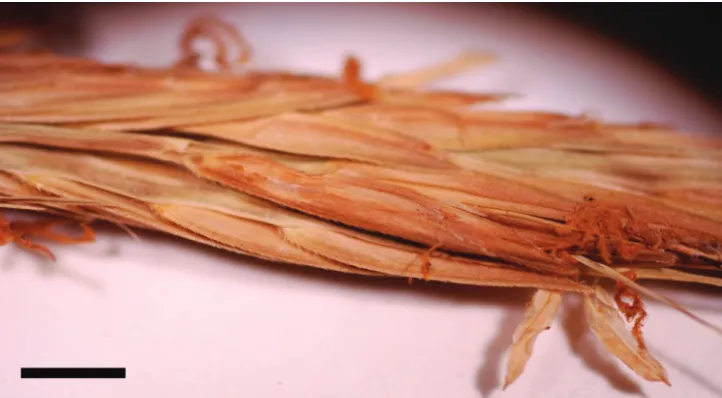
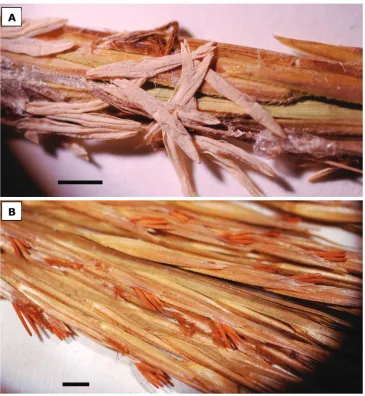
Overall, plants of S. anglica tend to be larger than those of S. ×townsendii, includ-ing the lengths of reproductive structures useful in distinclud-inguishinclud-ing the taxa. The spe-cies can be distinguished with careful measurements on herbarium specimens, though there is some overlap in the diagnostic morphological characteristics. When making a determination, multiple characters should be examined and multiple measurements should be made on a single plant when possible. Spartina anglica is distinguished from S. ×townsendii by its longer spikelets [(15–)16.5–25 mm long vs. 14–17.5 mm long]; longer anthers [7–10 mm long vs. 5–7(–8.5) mm long]; anthers that are fully exserted and dehiscent [vs. anthers that are not or incompletely exserted and indehiscent; Fig 4]; fertile pollen [vs. sterile pollen (see below and Fig. 5)]; longer ligules [1–3 mm long vs. 1–1.5 mm long]; 3–6-veined upper glumes [vs. 3-veined upper glumes]; and longer upper glumes [13–22 mm long vs. 12.5–16.5 mm long]. Marchant (1968a) observed that leaf blade angle with respect to the culm can be used to differentiate the taxa, as the blades tend to be more erect in S. ×townsendii [blades forming an angle 30–40° with respect to the culm] and more spreading in S. anglica [blades forming an angle of 30–60°with respect to the culm], and this character is noted in many of the recent field identification resources for the Pacific Northwest. Leaf angle is sometimes difficult to determine on herbarium specimens. Marchant (1968a) also noted swards of S. anglica in the field (in England) differed from swards of S. ×townsendii as being less dense in tillers (ca. 52/100 cm2 vs. ca. 96/100 cm2) and having more robust but fewer rhizomes.
Spartina anglica can be distinguished from S. alterniflora by its longer spikelets [(15– )16.5–25 mm long vs. 8–14(–16.5) mm long], moderately to densely pubescent glumes (vs. glabrous or weakly pubescent glumes) and its longer anthers (7–10 mm long vs. 3–6 mm long). Spartina anglica is readily distinguished from S. densiflora, S. gracilis, S. patens and S. pectinata by its glabrous leaf blade margins [vs. scabrous leaf blade margins].
varied with the stage of pollen development. For example, in specimens of S. anglica that had been collected during or after dehiscence, fewer pollen grains were available for study, whereas in S. ×townsendii dehiscence does not occur and abundant pollen grains were recovered from the anthers. In fertile pollen grains the cytoplasm was evi-dently visible and stained, whereas in sterile pollen there was no or little evidence of cytoplasmic staining (Fig. 5). All plants that were determined morphologically to be S. anglica had fertile pollen, and all plants determined as S. ×townsendii had sterile pollen.
Specimens Examined. CANADA. British Columbia: Greater Vancou-ver Regional District: Lower Fraser Valley, Boundary Bay, foot of 104th Street, 49°02'00"N, 122°56'00"W, 26 May 2004, P.Lim s.n. (V [V191319]); Lower Fras-er Valley, Boundary Bay, foot of 112th Street, 49°02'00"N, 122°56'00"W, 16 Jun 2004, P.Lim s.n. (V [V191320]]); Delta, Boundary Bay Regional Park, off 12th Ave-nue, 49°00'N, 123°02'W, 30 Jul 2004, G.Williams 2004-3 (UBC [UBCV220132†, Suppl. Fig. 4], V [V191495]); Delta, 50 m E of Beach Grove dike, Boundary Bay, 49°02'N, 123°03'W, 30 July 2004, G.Williams 2004-2 (CAN [CAN592131†, Suppl. Fig. 5], UBC [UBCV220131†, Fig. 3], V [V191494]); Robert Banks Causeway, S shore, 49°05'N, 123°11'W, 30 Jul 2004, G.Williams 2004-1 (UBC [UBCV220130†, Suppl. Fig. 6], V [V191493]). UNITED STATES OF AMER-ICA. Washington: Island Co.: W side of Cornet Bay mudflat N of group camp in Deception Pass State Park, NE ¼ of NE ¼ of Sec. 35, T.34N, R.1 E., 7 Aug 2008, J.Walker 382 (WTU [WTU373426†, Suppl. Fig. 7], Suppl. Fig. 7); Puget Sound, Whidbey Island, N shore of Kennedy’s Lagoon, E side of Route 525, SW of S end of Zylstra Road, 48°14'N, 122°43.9'W, 22 Aug 2002, P.F.Zika 17595 (WTU [WTU365225†, Suppl. Fig. 8); Livingston Bay, Iverson Spit, 48°13'26"N, 122°26'19"W, 20 July 1983, R.E.Frenkel 3045 (UBC [UBCV196071†, Suppl. Fig. 9], WTU [WTU305390†, Suppl. Fig. 10]). Jefferson Co.: intertidal zone on the
N side of the mouth of Chimacum Creek on the Quimper Peninsula, T29N R1W S35, 2 Aug 2004, F.Weinmann & A.Weinmann 233 (WTU [WTU370619†, Suppl. Fig. 11]). Snohomish Co.: island at W end/mouth of Ebey’s Slough, 48°02.555'N, 122°12.535'W, 15 Sep 2005, D.Giblin & B.Legler 244 (WTU [WTU364297†], Suppl. Fig. 12); mouth of Hat Slough, S side, 48°11.782'N, 122°22.463'W, 23 Sep 2005, D.Giblin & B.Legler 270 (WTU [WTU364317†], Suppl. Fig. 13); Puget Sound, Camano Island, E side of Davis Slough, N side of Route 532, 1.5 air km W of Stanwood, 48°14.4'N, 122°23.3'W, P.F.Zika 19170 (WTU [WTU355103†], Suppl. Fig. 14). DENMARK. Jutland,NE coast of Rømø, 55°08'N, 08°31'E, 25 Aug 1970, I.B.Jørgensen & J.Svendsen 368 (CAN [CAN358861†, Suppl. Fig. 15]).
ENGLAND. England, 1879, H.Groves & J.Groves s.n. (US [US747577]); Poole Harbour, Fitzworth Point, R.O.Sherring s.n. (US [US1271872]). Devon Co.: South Devon, Combeinteignhead, between Newton Abbot and Teignmouth, ca. 50°32'N, 03°32'W, 24 Aug 1979, G.A.Matthews s.n. (CAN [CAN448159†, Suppl. Fig. 16]). Dorset Co.: Poole, 50°43'N, 01°59'W, Oct 1905, W.H.J.Riddelsdell 1734 (CAN [CAN467908†, Suppl. Fig. 17]); Dorset, E of Poole Harbour, 50.6863°N, 2.0181°W uncertainty 2195 m, Sep 1910, H.S.Thompson s.n. (UBC [UBCV1679, Suppl. Fig. 18]). Hampshire Co.: Hayling Island, Hants, 50.7999°N, 0.9667°W uncertainty 7194 m, 20 July 1938, T.M.C.Taylor 5378 (UBC [UBCV69243, Sup-pl. Fig. 19, UBCV20934, SupSup-pl. Fig. 20]); between the “Sturt” Pond, [illegible], and Hurst Castle, South Hants, Sep 1910, J.C.Melvill 1841 (UBC [UBCV1678, Suppl. Fig. 21]); Lymington, towards Lymington Spit almost one mile from land, G.Stapf s.n. (US [US1271838]); Hythe, S of town and near road and Admiraly buildings, 28 Jun 1961, C.E.Hubbard 286961 (US [US3055889]). Isle of Wight, near Quarr Abbey, Oct 1907, O.Stapf (US [US1271833]). FRANCE. Baie de Mont Saint Michel, Sep 1933, P.de la Varde s.n. (US [US1611439]); mouth of river at Sa-ranelle, near Cannes, 43°33'05"N; 07°00'45"W, Oliver s.n. (CAN [CAN421006†, Suppl. Fig. 22]).
Spartina densiflora Brongn., Voy Monde 2(2): 14. 1829.
Spartina densiflora Brongn., Voy Monde 2(2): 14. 1829. Type. CHILE. D’Urville s.n. (holotype: P [P02243277!]; isotype: US [US92018!] (fragm. ex P & photo)). Chauvinia chilensis Steud., Syn. Pl. Glumac 1: 362. 1854. Type. CHILE. Concepcion,
J.S.C.D. D’Urville s.n. (holotype: P [P02243276!]; isotype: US [US865687A!] (fragm. ex P)).
branches; branches 3–6(–7.5) cm long × 2–3 mm wide, appressed, conspicuously de-creasing in length towards inflorescence apex, rachises 0.8–1 mm wide between spikelets, not extending beyond terminal spikelet, glabrous, margins glabrous or scabrous. Spikelets 9–13 mm long × 1.5–2 mm wide, tightly appressed, strongly overlapping; calluses 1–1.5 mm long. Glumes glabrous or scabrous, when present hairs < 0.1 mm long, keels scabrous, teeth 0.1–0.2 mm long, margins usually purple-tinged; lower glumes 4–7 mm long × 0.5– 0.7 mm wide, 1-veined; upper glumes 7.5–11.5 mm long × 1–1.5 mm wide, 1-veined; lemmas 6–9 mm long, glabrous or minutely scabrous, keels scabrous distally, glabrous proximally; paleas exceeding lemmas by 0.5 mm, glabrous; anthers 3–4 mm long, yellow-ish, exserted at maturity, pollen fertile. 2n = 70 (Ayres et al. 2008, Fortune et al. 2008)
Common Name. Austral cordgrass.
Etymology. The epithet densiflora refers to the densely-flowered inflorescences of the species.
Illustration. Barkworth 2003:251.
Distribution. Native to South America in temperate coastal regions of southern Brazil, Uruguay, Argentina, and on the coast of Chile (Bortolus 2006). Introduced in Spain, Portugal, the Mediterranean (see Castillo et al. 2000, Nieva et al. 2005), United States (California, Washington), and Canada (British Columbia).
Comments. The taxonomy, biogeography, and natural history of S. densiflora is re-viewed by Bortolus (2006). The synonymy presented here is not complete; several taxa described from South America are considered to be synonyms by Mobberley (1956), including S. montevidensis Arech. (see Carrasco et al. 2002 for the location of a prob-able type specimen), S. patagonica Speg., and several taxa described by St-Yves (1932). A modern taxonomic revision is needed for S. densiflora to clarify its taxonomy and morphological variation throughout its range (Bortolus 2006), particularly given its rapidly increasing global footprint.
In North America, S. densiflora is present in California, Washington, and British Columbia. It was first established in California. It occurs in Humboldt Bay, where it is thought to have been introduced by shipping in the late 1800s (Spicher and Josselyn 1985, Kittleson and Boyd 1997). Prior to the early 1980s, this population was erro-neously thought to be a native form of S. foliosa (Bortolus 2008), and seed collected from plants growing in Humboldt Bay was introduced to San Francisco Bay (see Faber 2000), and independently to Richardson Bay. Hybrids between S. densiflora and S. foliosa have been confirmed recently from San Francisco Bay in a region where both parental species are present (Ayres et al. 2008). These are not well characterized mor-phologically in the literature.
Spartina densiflora is now invading British Columbia, where it was first found in 2005 in Bayne’s Sound, a channel between Vancouver Island and Denman Island (Morgan and Sytsma 2010). It is not reported for the province in several recent floras that consider the region (Douglas et al. 2001, Barkworth 2003, Kozloff 2005), but is included in the online E-Flora BC (Anonymous 2011). In the Bayne’s Sound region, only a few herbarium collections documenting the species have been made; these are from Fanny Bay (Lomer 5723, CAN, Fig. 6) and the Buckley Bay Ferry Terminal (Lomer 7377, CAN). Some data on the extent of the invasion are given by Morgan and Sytsma (2010) and Dresen et al. (2010), who mapped the species in Bayne’s Sound where the extent of its local distribution ranges from individual plants to multiple five meter patches. Detailed characterization of this invasion has not otherwise appeared in the literature.
Morphology. The description presented here is based on the few specimens that have been collected in Washington and British Columbia and deposited in herbaria (see Specimens Examined). Variation in some characters, particularly vegetative char-acteristics such as leaf length and culm height, is probably greater than recorded here. For example, Mobberley (1956) reported that culms in the species range to 1.5 m tall. For a description based on material from the native range of S. densiflora, see Mob-berley (1956).
Spartina densiflora can be distinguished from S. alterniflora, S. anglica, and S. ×townsendii by the following combination of characters: plants cespitose [vs. strong-ly rhizomatous]; blades involute for all or most of their length [vs. blades flat prox-imally, involute distally]; blade margins scabrous [vs. blade margins smooth]; branch rachises not prolonged beyond the terminal spikelet [vs. branch rachises prolonged beyond the terminal spikelet as a bristle, rarely not prolonged]; glume margins often purple-tinged [vs. glume margins whitish, not purple-tinged] (Fig. 7); and spikelets tightly appressed and strongly overlapping, concealing the rachis between spikelets [vs. spikelets weakly appressed and weakly to moderately overlapping, with portions of the rachis usually visible between spikelets]. In the field, the leaf margins of S. densiflora may feel smooth to the touch, as the involute blades often conceal the leaf margins where the scabrous teeth are located; these scabrous teeth are best observed with a microscope (F. Lomer, personal communication, 2012). Spartina densiflora is readily distinguished from S. gracilis, S. patens, and S. pectinata by its cespitose habit [vs. rhizomatous].
Specimens Examined. CANADA. British Columbia: Vancouver Island, Fanny Bay, 500 m N of Waterloo Creek, 49°28.572'N, 124°47.494'W, 24 August 2005, F.Lomer 5723 (UBC, Fig. 6); Vancouver Island, 20 km south of Courtenay, Buck-ley Bay Ferry Terminal, north side of dock at high tide level, single clump, sea level, 49°31'32"N, 124°50'54.5"W, 12 July 2010, F.Lomer 7377 (CAN, Suppl. Fig. 23).
Spartina gracilis Trin.
Spartina gracilis Trin., Mém. Acad. Imp. Sci. Saint-Pétersbourg, Sér. 6, Sci. Math., Seconde Pt. Sci. Nat. 6,4(1-2): 110. 1845. Type. CANADA.Amer. bor., Hooker s.n. (isotypes: LE [LETRIN2058.01!], US [US92014!] (fragm. ex LE)).
Description: See Mobberley (1956), Barkworth (2003), and Douglas et al. (2001). 2n = 40 (Marchant 1968b, Reeder 1977).
Common Name. Alkali cordgrass, big cordgrass.
Illustrations. Hitchcock 1935:493, Hitchcock 1951: 513, Hitchcock et al. 1969:706, Barkworth 2003:251, Douglas et al. 2001:269.
Etymology. The Latin epithet gracilis means “thin, slender” (Stearn 1992), prob-ably given in reference to the general habit of the species.
Distribution. Southern Northwest Territories, Canada, to central Mexico (Bark-worth 2003). In the Pacific Northwest S. gracilis is distributed in the steppe and mon-tane zones of the south central and south eastern parts of British Columbia (Douglas et al. 2001), and in eastern Oregon and Washington (Barkworth 2003, Wilson et al. 2012). It is not a salt marsh species and is not invasive.
Morphology. Spartina gracilis is a distinctive taxon (Fig. 8). In the Pacific North-west it is likely to be most readily confused with S. pectinata, which also grows inland. It is distinguished from S. pectinata by the following combination of characters: up-per glumes unawned or short-awned, awns to 2 mm long [vs. distinctly awned upup-per glumes, awns 3–8 mm long], ciliate glume keels [vs. pectinate glume keels], spikelets 6–11 mm long [vs. 10–25 mm long], ligules 0.5–1 mm long [vs. 1–3 mm long], 3–12 branches per inflorescence [vs. 5–50 branches per inflorescence], and 10–30 spikelets per branch [vs. 10–80 spikelets per branch]. It is distinguished from S. patens by its ciliate glume keels [vs. scabrous glume keels], inconspicuous lateral veins on the upper glumes [vs. conspicuous lateral veins on the upper glumes], most branches 3–6 mm wide [vs. most branches 2–3 mm wide], branches closely appressed to the main axis [vs. branches appressed, ascending or spreading from main axis], and florets more or less equaling the upper glumes in length [vs. florets shorter than the upper glumes]. Spartina gracilis can be readily separated from S. alterniflora, S. anglica and S. ×townsen-dii by its scabrous leaf margins [vs. glabrous leaf margins], and from S. densiflora by its rhizomatous habit [vs. cespitose].
Specimens Examined. CANADA. British Columbia: 23 mi W of Kamloops,
Jun 1942, J.A.Munro 23 (CAN [CAN33942]); Similkameen River, 10 Jun 1905, J.M.Macoun 77227 (CAN [CAN33944, Suppl. Fig. 28]). UNITED STATES OF AMERICA. Montana: Hound Creek, 30 Jul 1883, F. Lamson-Scribner 329 (CAN [CAN162196]). North Dakota: Ward County, 26 Jul 1963, L.F.Lautenschlager 694 (CAN [CAN297003]). Utah: Death Ridge-Horse Mountain Road, near Caanan Peak, 6800 ft, 15 June 1990, M.A.Franklin & D.Atwood 7129 (CAN[CAN563733]).
Washington: Okanogan Co.: Loomiston, Aug 1897, A.D.E.Elmer 891 (CAN
[CAN162194, CAN162191]).
Spartina patens (Aiton) Muhl., Descr. Gram. 55. 1817.
Spartina juncea var. patens (Aiton) St.-Yves, Candollea 5: 86. 1932. Dactylis patens Aiton, Hort. Kew. 1: 104. 1789. Type. UNITED KINGDOM. Cultivated, na-tive of North America, introduced 1781, by Mr. William Curtis (holotype: BM-001010621!).
Trachynotia juncea Michx., Fl. Bor.-Amer. 1: 64. 1803. Limnetis juncea (Michx.) Rich., Syn. Pl. 1: 72. 1805. Spartina juncea (Michx.) Willd., Enum. Pl. 81. 1809. Spar-tina patens var. juncea (Michx.) Hitchc., Rhodora 8: 210. 1906. SparSpar-tina juncea subvar. americana St.-Yves, Candollea 5: 84. 1932. Type. UNITED STATES OF AMERICA. bord des Creeks salés Basse Caroline, Michaux s.n. (holotype: P, not seen). Note: See Hitchcock (1908:153) for notes on the type specimen. Treatment of T. juncea as a synonym of S. patens follows Mobberley (1956).
Limnetis juncea var. monogyna M.A.Curtis, Boston J. Nat. Hist. 1: 136. 1837. Spar-tina patens var. monogyna (M.A.Curtis) Fernald, Rhodora 49: 114. 1947. Type.
UNITED STATES OF AMERICA. North Carolina: M.A.Curtis s.n. (holotype: GH [GH00295532!], Appendix Fig. 3). Note: Fernald (1947:115) referred to this specimen as “The isotype of Curtis’s variety in the Gray Herbarium…” and “The Curtis type or isotype ….”; it likely is the holotype.
Spartina pumila Roth, Catal. Bot. 3: 10. 1806. Type. UNITED STATES OF AMER-ICA. New York, 1794, Schreber s.n. (holotype: B-Willd.!).
Description. See Mobberley (1956), Barkworth (2003), Douglas et al. (2001), and Lonard et al. (2009). 2n = 40 (Marchant 1968b).
Common Names. Saltmeadow cordgrass, saltmeadow grass, marsh hay, wiregrass, foxgrass, couchgrass, rush saltgrass, spartine étalée (Lonard et al. 2010).
Etymology. The Latin epithet patens means “spreading, outspread” (Stearn 1992), given in reference to the general habit of the species, which forms dense, monotypic stands.
Illustrations. Hitchcock 1935: 494; Hitchcock 1951:514; Holmgren et al. 1998:750, Douglas et al. 2001:271, Barkworth 2003:251.
1977, Howard et al. 1989, Liogier and Martorell 2000, Peterson 2001). It has been introduced to coastal regions in Spain (Campos et al. 2004, SanLeón et al. 1999, Prieto et al. 2011), China (An et al. 2007), North Africa, and the west coast of the United States (Oregon, Washington), and Canada (British Columbia).
Comments. Spartina patens grows in coastal salt marshes and brackish waters, where it usually forms dense stands above the intertidal zone and into higher and drier areas of the salt marsh (Mobberley 1956). In Europe this taxon is sometimes treated as a separate species, S. versicolor Fabre, a traditional circumscription that some con-temporary authors maintain (e.g., Sánchez Gullón 2001; Clayton et al. 2002 onwards; see SanLeón et al. 1999 and Prieto et al. 2011 for summaries of this taxonomic prob-lem). In North America S. patens hybridizes with S. pectinata in areas where they grow together, forming the hybrid taxon S. ×cespitosa. This hybrid is known from scattered locations along the Atlantic coast from Prince Edward Island to Maryland (Mobberley 1956, Dore and Marchant 1968, Barkworth 2003), but has not been recorded along the Pacific coast. The biology of S. patens is reviewed by Lonard et al. (2010).
In Oregon, Spartina patens grows in the Siuslaw estuary on Cox Island (Lane Co.), where it has been introduced since at least 1939 and has expanded considerably since that time (Frenkel and Boss 1988). It is not reported from elsewhere in Oregon (Wil-son et al. 2012). In Washington it has been reported from Dosewallips State Park on the west shore of Hood Canal (Frenkel 1987). In California it is present in Southamp-ton Marsh in San Francisco Bay (Spicher and Josselyn 1985, Baird and Thieret 2012). Spartina patens was the first of the invasive cordgrasses to be collected in British Co-lumbia. It was discovered in 1979 in the Comox Estuary on Vancouver Island (Brayshaw 79-1143, V); nearly a decade later, in 1988, it was collected on the adjacent mainland coast in Burrard Inlet, North Vancouver (Lomer 88–140, UBC, Fig. 9). Spartina patens was recognized as part of the provincial flora by Douglas et al. (1994) based on collec-tions from these two localities, and is reported for the region in recent floras (Barkworth 2003, Douglas et al. 2001). Large stands of the species were reported in 2000 at the Comox locality in the Courtenay River estuary at the delta of Brooklyn Creek to the em-bayed area of Goose Spit (Asp and Adams 2000). Spartina patens is also reported from Port Moody Arm of Burrard Inlet in British Columbia (Dresen et al. 2010). Voucher specimens from these latter two sites should be collected and deposited in herbaria.
Morphology. Spartina patens exhibits considerable morphological variation and several authors have recognized two infraspecific taxa (see Mobberley 1956). Mobber-ley (1956) studied this variation across the native range of the taxon and found plants at the northern and southern extremes of the taxon’s range to be distinct, but consider-able overlap and clinal variation from north to south in areas between the extremes. Based on these data he argued against the recognition of infraspecific taxa in S. patens, a circumscription followed by subsequent authors.
Spartina patens can be distinguished from S. densiflora by the following combina-tion of characters: branches distinctly one-sided, appressed, ascending or spreading from main axis, distant or weakly overlapping, and approximately the same length within an inflorescence [vs. branches not distinctly one-sided, appressed, strongly over-lapping, and conspicuously decreasing in length towards the inflorescence apex], rhi-zomes wiry, plants forming dense mats [vs. rhirhi-zomes absent, rarely short, plants cespi-tose, forming distinct clumps], upper glumes distinctly 3-veined [vs. upper glumes 1-veined], and ligules 0.5–1 mm long [vs. ligules 1–2 mm long].
Spartina patens can be distinguished from S. alterniflora, S. anglica and S. ×townsendii by: blade margins and adaxial surfaces scabrous [vs. blade margins and adaxial surfaces glabrous], blades 0.5–4 mm wide at base, involute for most or all of their length [vs. blades 3–10 mm wide at base, often involute distally], branches dis-tinctly one-sided, distant or weakly overlapping [vs. branches not disdis-tinctly one sided, strongly overlapping], rhizomes thin and wiry [vs. rhizomes thick and fleshy], upper glumes conspicuously 3-veined [vs. upper glumes 1–3-veined, veins inconspicuous], and spikelets usually purple-tinged [vs. spikelets rarely or never purple-tinged].
48°01'N, 69°20'W, 24 Aug 1951, L.McI.Terrill s.n. (CAN [CAN337522]); Tobin, 23 Aug 1951, L.McI.Terrill 6636 (CAN [CAN337521]); Iles-de-la-Madeleine, Cap de l’Est, 47°36'47"N, 61°27'35"W, s.d., M.M.Grandtner s.n. (CAN [CAN519307]); Dune du Nord, près de la Grande Lagune, 47°29'N, 61°45'W, 66.08.06, M.M.Grandtner 10697-V (CAN [CAN519268]); Ile-aux-Coudres, La Baleine, pointe E de l’île, 25 Aug 1977, J.Cayouette J77-133 (CAN [CAN466657]). UNITED STATE OF AMERICA. Florida: near Jacksonville, 17 Jul 1894, A.H.Curtiss 4948 (CAN [CAN373389]). Lou-isiana: Cameron Parish, along the Gulf of Mexico, S of an unnamed shell road which runs E from Cameron Parish Road 3106, on the E edge of Cameron, T15S, R9W, 30 Jun 1984, B.E.Button & D.W.Pritchett 2536 (CAN [CAN495018]); Jefferson Par-ish, roadside at Elmer’s Island, 2 Oct 1976, J.Guider 5023 (CAN [CAN432238]).
Maryland: sea coast, Sep 1863, Wm.M.Canby s.n. (CAN [CAN162200]). Massa-chusetts: Barnstable Co.: Sandy Meck, Cape Cod, 41°44'00"N, 70°19'58"W, 28 Oct 1939, J.H.Soper 1109 (CAN [CAN257821, CAN316382]). Dukes Co.: Katama Bay, Edgartown, Marthas Vineyard, 41°21'15"N, 70°28'58"W, 11 Sep 1901, M.L.Fernald s.n. (CAN [CAN162201]). New Jersey: Atlantic City, 1880, C.D.Fretz s.n. (CAN [CAN556282]). New York: Nassau Co.:Jones Beach, 40°35'40"N, 73°30'10"W, 18 Aug 1932, H.A.Gleason & A.C.Smith 149 (CAN [CAN162198]). Washington: Jef-ferson Co.: mouth of Dosewallips River, E of Route 101, SW of Sylopash Point, 1 m, T25N R2W S2, 47°41.4'N, 122°53.5'W, 9 Sep 2004, P.F.Zika & F.Weinmann 20160 (WTU [WTU359724, Suppl. Fig. 30]). Oregon: Lane Co.: Cox Island, Siuslaw Estu-ary, 2.5 km E of Florence, 43.9716°N, 124.0672°W, 9 Aug 1983, R.E.Frenkel 3060 (UBC [UBCV196070, Suppl. Fig. 31]); Lane Co.: center of Cox Island in Siuslaw River estuary, 3.5 km E of Florence, SW corner Sec 30, T. 18S, R. 11 W., W.M., 43.9716°N, 124.0672°W, 22 Oct 1977, R.E.Frenkel s.n. (WTU [WTU286900, Suppl. Fig. 32]).
Spartina pectinata Link, Jahrb. Gewächsk. 1(3): 92-93. 1820. Type.
Spartina pectinata Link, Jahrb. Gewächsk. 1(3): 92-93. 1820. Type. UNITED STATES OF AMERICA:Aus Nordamerika, Bosc s.n. (holotype: B; isotype: US-92011! (fragm. ex B)).
Spartina cynosuroides fo. major St.-Yves, Candollea 5: 61, 62. 1932. Type. UNIT-ED STATES OF AMERICA. Illinois: marais, Aug 1846, Riehl 488 (lectotype: P [P02243295!], here designated).
Spartina michauxiana Hitchc., Contr. U.S. Natl. Herb. 12(3): 153. 1908. Spartina cynosuroides var. michauxiana (Hitchc.) St.-Yves, Candollea 5: 58, t. 3, f. a-7. 1932.
Type. UNITED STATES OF AMERICA. Illinois: hauteurs des terres, Michaux s.n. (holotype: P, not seen). Note: Spartina michauxiana is treated as a synonym of S. pectinata following Hitchcock (1951) and Mobberley (1956).
STATES OF AMERICA. Michigan: Island Lake, 16 Jul 1905, Farwell 1487a (holotype: probably BLH; isotype:GH [GH24445!]).
Spartina michauxiana var. tenuior Farw., Rep. Michigan Acad. Sci 21: 352. 1920.
Type. UNITED STATES OF AMERICA. Michigan: River Rouge, 15 Sep 1918, Farwell 5138 (holotype: probably BLH; isotype: MICH [MICH1108792!]). Spartina pectinata fo. variegata Vict., Naturaliste Canad. 71: 209. 1944. Type.
CAN-ADA. Quebec: Ile Parrot (archipel d’Hochelaga’ sur le lac St-Louis), 12 Jul 1941, Victorin & Rolland 56603 (holotype: MT, not seen).
Description. See Mobberley (1956), Barkworth (2003), and Douglas et al. (2001). 2n = 40 (Marchant 1963, 1968b, Reeder 1977).
Common Name. Prairie cordgrass.
Etymology. The epithet pectinata means comb-like or tooth-like, and was given in reference to the distinctly pectinate teeth on the glume keels of S. pectinata, one of its diagnostic characteristics.
Illustrations. Hitchcock 1935:490, Hitchcock 1951:510, Holmgren et al. 1998:749, Barkworth 2003:251, Cope and Gray 2009:553.
Distribution. Spartina pectinata is widespread across much of North America north of Mexico, distributed in southern Alberta, eastern Washington and Oregon, south to Texas, and east to Newfoundland and Labrador (Barkworth 2003). It grows in marshes, slough and floodplains, in dry prairies and along roads (Barkworth 2003). It is known from a few scattered sites in Britain and Ireland where it has been introduced and escaped from cultivation (Cope and Gray 2009).
Comments. Spartina pectinata is not considered to be a problematic invasive spe-cies, though it has been introduced sporadically to other regions, such as the United Kingdom. It occurs natively in eastern Washington and Oregon (Hitchcock et al. 1969, Barkworth 2003). Spartina pectinata is grown as an ornamental.
an introduced species not collected in over 40 years. This exclusion was followed in recent treatments (Qian and Klinka 1998, Douglas et al. 2001). Attempts to locate the Brink collection in British Columbia herbaria (V, UBC) were unsuccessful, and it is therefore not possible to confirm this report.. Spartina pectinata was recently collected in a vacant lot in the city of Burnaby (Lomer 6778, Fig. 10, 6805, Suppl. Fig. 33), where it likely escaped or persisted from cultivation (F. Lomer, personal communica-tion, 2011). The clump from which these specimens were obtained no longer exists, as the site has been built over (F. Lomer, personal communication, 2012). The specimens reported here are the first confirmed records of S. pectinata for British Columbia. The species is not considered to be invasive.
Morphology. Spartina pectinata is readily distinguished from all other taxa in the Pacific Northwest by its conspicuously awned glumes [vs. glumes unawned or short-awned (awns to 2 mm long), the latter state sometimes present in S. gracilis], and glume keels with robust, comb-like teeth [vs. glume keels that are glabrous, scabrous or ciliate]. Additional characters are given under other taxa.
Specimens Examined. CANADA. British Columbia: Greater Vancouver, Burn-aby, Canada Way and Wedgewood St., NE corner, vacant lot of demolished home, 49°13'30"N, 122°56'30"W, 130 m, 01 Sep 2008, F.Lomer 6778 (UBC [UBCV227607, Fig. 10]); same location, 15 Sep 2008, F.Lomer 6805 (UBC [UBCV227406, Suppl. Fig. 33]). Manitoba: Rural Municipality of Pembina, NE of Darlingford and E of Manitou, 49°14'12"N, 98°18'04"W, 437 m, 16 Jul 2007, J.M.Saarela 1019 (CAN [CAN590577]). UNITED STATES OF AMERICA.Colorado: Fort Collins, 3 Aug 1898, n.c. 3551 (CAN [CAN162205]). Idaho: Oneida Co.: American Falls, 28 Jul 1911, A.Nelson & J.F.Macbride 1394 (CAN [CAN162207]). Kansas: S of Quinter, 16 Oct 1937, C.Brown s.n. (CAN [CAN162202]). Maine: Aroostook Co.: valley of the St. John River, Big Black River Rapids, Township xv, Range 13, 26 Jul 1917, H.St. John & G.E.Nichols 2135 (CAN [CAN162203]). Minnesota: Kittson Co.: Hallock, 16 Jul 1986, F.W.Schueler 16461 (CAN [CAN536117]). St. Louis Co.: beach of Es-quagama Lake, 4 Aug 1944, O.Lakela 5647 (CAN [CAN162197]). New Hamsphire:
Rockingham Co.: Newfields, along Squamscott River below bridge to Stratham, 8 Aug 1973, A.R.Hodgden & F.L.Steele 19838 (CAN [CAN555731]). Strafford Co.: Milton, edge of pond by railroad, 15 Jul 1959, A.R.Hodgden & F.L.Steele 11095 (CAN [CAN555851]). New York: Madison Co.: shore of Oneida Lake, South Bay, 27 Jun 1921, H.D.House 8289 (CAN [CAN162204]); St. Lawrence Co.: Morristown, 44°35'08"N, 75°38'53"W, 15 Aug 1914, O.P.Phelps 156 (CAN [CAN162209]).
Spartina ×townsendii H. Groves & J. Groves, Bot. Exch. Club Rep. 1880. 37. 1881.
Spartina ×townsendii H. Groves & J. Groves, Bot. Exch. Club Rep. 1880. 37. 1881.
Type. ENGLAND. Mud flats, near Hythe, South Hants, 1 Sep 1879, H.Groves s.n. (holotype: BM [BM001003965!]; isotypes: C, K [K000710272!], W [W19160030795!, W19160030798!] (ex hb. Groves), US [US1127161!] (fragm. ex W ex hb. Groves), US [US878793!]). Note: The location of the holotype has not been reported previously in the literature.
S. ×neyrautii Fouc., Ann. Soc. Sci. Nat. Charente-Maritime 31: 8. 1894. Type. FRAN-CE. près de Hendaye (Basses-Pyrénnées), E-J.Neyraut s.n., 24 Jul 1892 (isotypes: P [P00753804!, P03457326!, P03457334!, P03457416!], US! (fragm. ex P)]).
Description. Culms 46–100 cm tall, thick, fleshy, rhizomatous. Sheaths glabrous; lig-ules 1–1.5 mm long; blades 6.5–37 cm long × 4–10 mm wide, flat proximally, often involute distally, divergent 30–40° from culms, adaxial surfaces glabrous, occasionally with very sparse hairs proximally, when present hairs to 0.2 mm long, abaxial surfaces glabrous, occasionally with sparse hairs proximally, when present hairs to 0.5 mm long, margins smooth. Inflorescences 10.5–24(–36) cm long × 7–25 mm wide at midpoint, erect, with (2)3–6(–10) branches; branches (6–)7.5–15(–18) cm long × (2.5–)3–4 mm wide, appressed or ascending, rachises 1–1.9 mm wide between spikelets, extending 2–10(–18) mm beyond the terminal spikelet, extension occasionally absent, glabrous, margins glabrous, occasionally with a few marginal hairs, when present hairs to 0.2 mm long. Spikelets 14–17.5 mm long × 1.5–2.5 mm wide, weakly appressed, weakly overlapping, calluses 0.6–1.5(–2) mm long. Glumes weakly to moderately pubescent, hairs 0.1–0.2 mm long, proximal hairs occasionally to 0.6 mm long, keels glabrous, ciliate or scabrous, when present hairs and teeth 0.2–0.5 mm long, usually longest proximally; lower glumes 7–13 mm long × 0.5–0.7 mm wide, 1-veined, tips acuminate or obtuse; upper glumes 12.5–16.5 mm long × 1–1.5 mm wide, 3-veined, tips acumi-nate or obtuse. Lemmas 9.5–13.5 mm long, 1-3–veined, pubescent distally, glabrous proximally, margins membranous, keels ciliate distally, hairs to 0.2 mm long, glabrous proximally. Paleas exceeding lemmas by ca. 1 mm, glabrous. Anthers 5–7(–8.5) mm long, not or incompletely exserted at maturity, indehiscent, medium to dark brown, pollen sterile; caryopses absent. 2n = 62 (Marchant 1963, 1968b).
Common Name. Townsend’s cordgrass.
Etymology. The epithet townsendii was given in honour of the English botanist Frederick Townsend (1822–1905).
Illustration. Cope and Gray 2009:547.
Distribution. This species is found in England, Wales, Scotland, Ireland (Cope and Gray 2009), Italy (Scarton et al. 2003), United States (Washington), New Zealand (Partridge 1987), and Canada (British Columbia).
maritima, the single cordgrass species native to the Atlantic coast of Europe and north Africa (Marchant and Goodman 1969c), and the introduced S. alterniflora, which had been present in the region since the early part of the 19th century. The brothers Henry and James Grove (1881) described this taxon as S. townsendii from plants collected near Hythe. In the 1890s a second form of S. townsendii, which was recognized and consid-ered distinct by having fertile stamens, was collected at multiple localities in the region, and by the mid twentieth century it had expanded substantially on tidal flats across the British Isles (see Goodman et al. 1959, Hubbard 1957, 1965). For decades these two forms (one sterile, the other fertile) of S. townsendii were referred to collectively as the S. townsendii aggregate or S. townsendii sensu lato. Because of its vigorous growth and ability to rapidly colonize and stabilize mud flats, S. townsendii s.l. was considered to be a “useful” species and was distributed and planted widely for land reclamation, coastal protection, and animal feed across the British Isles, Europe, and in New Zealand (e.g., Oliver 1925, Harboard 1949, Goodman et al. 1959, Ranwell 1967).
Soon after its formal description S. townsendii was considered to be a species of hybrid origin. Foucaud (1894) suggested that S. townsendii was probably a hybrid of the native S. maritima and the introduced S. alterniflora, a hypothesis later supported by Stapf (1914) and Huskins (1930), who examined cytological evidence and hypoth-esized that fertile plants of S. townsendii s.l. originated from chromosome doubling following hybridization between its parent species. Marchant (1963) confirmed this work, and reported chromosome numbers as 2n = 62 for S. alterniflora, 2n = 60 for S. maritima, 2n = 62 for sterile plants of S. townsendii, and 2n = 120, 122, 124 for fertile plants of S. townsendii. The hybrid and chromosome doubling origins of the forms of S. townsendii have been confirmed by multiple lines of molecular evidence (Guénégou et al. 1988, Raybould et al. 1991, Ferris et al. 1997, Ayres and Strong 2001, Baumel et al. 2003). Hubbard (1957) observed the type specimen of S. townsendii to be the sterile F1 hybrid, and the taxon was subsequently referred to as S. ×townsendii. The fer-tile plants remained without a name until Hubbard (1978) later described them as S. anglica, and the two forms have since been recognized as distinct taxa. Molecular data have identified S. alterniflora as the female parent and S. maritima as the male parent in the origin of S. ×townsendii (e.g., Ferris et al. 1997).


![Figure 5. Pollen stained with lactophenol cotton blue. British Columbia, Williams 2004-3 (CAN)] 1877, Groves s.n](https://thumb-us.123doks.com/thumbv2/123dok_us/1087301.2082824/20.468.53.417.61.304/figure-pollen-stained-lactophenol-british-columbia-williams-groves.webp)


