International Journal of Mathematical Archive-9(4), 2018,
20-28
Available online throug
ISSN 2229 – 5046
International Journal of Mathematical Archive- 9(4), April – 2018 20
STOLARSKY3- MEAN LABELING
OF ARBITRARY SUPER SUBDIVISIONS OF SOME STANDARD GRAPHS
S. S. SANDHYA
1, E. EBIN RAJA MERLY
2AND S. KAVITHA
31
Department of Mathematics,
Sree Ayyappa College for Women,
Chunkankadai-629 003, Kanyakumari District, Tamilnadu, India.
2
Department of Mathematics,
Nesamony Memorial Christian College,
Marthandam-629 165, Kanyakumari District, Tamilnadu, India.
3
Department of Mathematics,
Holy Cross College, Nagercoil -629 004, Kanyakumari District, Tamilnadu, India.
E-mail: [email protected]1, [email protected]2 and [email protected]3
ABSTRACT
T
he Concept of Stolarsky-3 Mean labeling was already introduced. In this paper we introduced Arbitrary Super Subdivision in stolarsky-3 Mean graph. Further we investigate Arbitrary Super Subdivisions of Path, Cycle, H-graph (n≤10 if n is even and n≤ 11 if n is odd) and Middle graphs.Keywords: Graph Labeling, Stolarsky-3 mean labeling, Super subdivision of graphs, Arbitrary Super subdivision of
graphs, H graph, Middle graph.
1. INTRODUCTION
The graph G= (V, E) is considered here will be finite, simple and undirected. We follow Gallian[1] for all detailed survey of graph labeling and we refer Harary [2] for all other standard terminologies and notations. The concept of “Mean labeling” has been introduced by S.Somasundaram and R.Ponraj in 2004[7]. The concept of “ Harmonic Mean Labeling” has been introduced by S. Somasundaram, R. Ponraj and S.S. Sandhya in [8].The concept of “Stolarsky-3 Mean Labeling” has introduced by S.S. Sandhya, E.Ebin Raja Merely and S.Kavitha in [6]. G. Sethuraman and P.Selvaraju have introduced a new method of construction called Super subdivision of graphs and prove that arbitrary super subdivisions of paths are graceful in [9]. Motivating these results we investigate Stolarsky-3 Mean labeling of Arbitrary super subdivisions of some standard graphs. Following definitions are useful for the present investigations.
Definition 1.1: A graph G with p vertices and q edges is said to be Stolarsky-3 Mean graph if each vertex x∈V is assigned distinct labels f(x) from 1, 2,... q+1 and each edge e=uv is assigned the distinct labels
f(e=uv) = ��𝑓(𝑢)2+𝑓(𝑢)𝑓(𝑣) +𝑓(𝑣)2
3 � (or) ��
𝑓(𝑢)2+𝑓(𝑢)𝑓(𝑣)+𝑓(𝑣)2
3 � then the resulting edge labels are distinct. In this case f
is called a Stolarsky-3 Mean labeling of G.
Definition 1.2: A walk in which all the vertices 𝑢1,𝑢2, … ,𝑢𝑛are distinct is called a path. It is denoted by𝑃𝑛.
Definition 1.3: A closed path is called a cycle. A cycle on n vertices is denoted by𝐶𝑛.
Definition 1.4: The H-graph of a path𝑃𝑛 is the graph obtained from two copies of 𝑃𝑛 with vertices v1,v2,v3, ... , 𝑣𝑛 and
𝑢1,𝑢2, … ,𝑢𝑛 by joining the vertices 𝑣𝑛+1
Definition 1.5: The Middle graph M (G) of a graph G is the graph whose vertex set is V(G) ∪E(G) and in which two vertices are adjacent if and only if either they are adjacent edges of G or one is a vertex of G and the other is an edge incident with it.
Definition 1.6: Let G be a graph. A graph H is called a super subdivision of G if H is obtained from G by replacing
every edge 𝑒𝑖 of G by a complete bipartite graph 𝑘2,𝑚𝑖 for some𝑚𝑖, 1≤ 𝑖 ≤ 𝑞 in such a way that the ends of 𝑒𝑖 are
merged with the two vertices part of 𝑘2,𝑚𝑖 after removing the edge 𝑒𝑖 from graph G.
Definition 1.7: A Super subdivision H of G is said to be an Arbitrary super subdivision of G if every edge of G is
replaced by an arbitrary 𝑘2.𝑚𝑖 where 𝑚𝑖 may vary for each edge arbitrarily. It is denoted by ASS (G).
2. MAIN RESULTS
Theorem 2.1: Arbitrary Super subdivisions of path are Stolarsky- 3 mean graphs.
Proof: Let Pn be the path with successive vertices u1, u2, u3,…,un and let ei denote the edge uiui+1 of Pn for 1≤i≤n-1
Let H be an arbitrary super subdivision of a path Pn, where each edge ei of Pn is replaced by a complete bipartite graph
𝑘2,𝑚𝑖where mi is any positive integer.
V(H) = {u1,u2,u3,..,un, v1,v2,v3,…, 𝑣𝑚1,𝑣𝑚1+1,𝑣𝑚1+2, … ,𝑣𝑚1+𝑚2 ,…, 𝑣𝑚1+𝑚2+𝑚3+⋯+𝑚𝑛−1}
Figure-1: Arbitrary Super subdivision of Pn
Here we consider two different cases
Case-(i): m1=m2=m3= … =mn-1 = 4
Figure-2: Arbitrary Super subdivision of P4
Define φ: V(H)→{1,2, …, q+1} by
𝜑(𝑢1) = 1.
𝜑(𝑢𝑖) = 8(i-1), 2≤ 𝑖 ≤n.
𝜑(𝑣1) = 2.
𝜑(𝑣𝑖) = 2i-1, 2≤ 𝑖 ≤ 𝑚1+𝑚2+⋯+𝑚𝑛−1.
© 2018, IJMA. All Rights Reserved 22
In this case H is Stolarsky-3 mean graph.
Case-(ii): m1=m2=m3= ... =mn-1 =5
Figure-3: Arbitrary Super subdivision of P4
Define 𝜑: V(H)→{1, 2,…, q+1} by
𝜑(𝑢1) = 1.
𝜑(𝑢𝑖) = 10(i-1), 2≤i≤n.
𝜑(𝑣1) = 2.
𝜑(𝑣𝑖) = 2i-1, 2≤ 𝑖 ≤ 𝑚1+𝑚2+⋯+𝑚𝑛−1.
Then the edge labels are distinct.
From case (i) and (ii) we can conclude that Arbitrary super subdivisions of path are Stolarsky-3 mean graphs.
Remark 2.2: The above result is true for all values of n’s and𝑚𝑖’s with the condition 𝑚1≤8 and 𝑚𝑖’s, 2≤ 𝑖 ≤ 𝑛 −1.
Theorem 2.3: Arbitrary Super subdivisions of cycle are Stolarsky- 3 mean graphs.
Proof: Let Cn be a cycle with consecutive vertices u1, u2, u3,...,un and let ei denote the edge ui-1ui of Cn for 1≤i≤n-1.
Let H be an arbitrary super subdivision of a cycle Cn, where each edge ei of Cn is replaced by a complete bipartite graph
𝑘2,𝑚𝑖where mi is any positive integer.
V(H) ={u1,u2,u3,…,un, v1,v2,v3,..., 𝑣𝑚1,𝑣𝑚1+1,𝑣𝑚1+2, … ,𝑣𝑚1+𝑚2 ,…., 𝑣𝑚1+𝑚2+𝑚3+⋯+𝑚𝑛−1 }
Case-(i): m1=m2=m3= ... =mn-1 = 3
Figure 5: Arbitrary Super subdivision of C4
Define𝜑: V(H)→{1, 2,…, q+1} by
𝜑(𝑢1) = 1.
𝜑(𝑢𝑖) = 6i-5, 2≤ 𝑖 ≤n.
𝜑(𝑣𝑖) = 2i, 1≤ 𝑖 ≤ 𝑚1+𝑚2+⋯+𝑚𝑛−1.
𝜑�𝑣𝑚1+𝑚2+⋯+𝑚𝑛−1+1�=𝜑(𝑢𝑛) + 1.
Then the edge labels are distinct.
In this case H is Stolarsky-3 mean graph.
Case-(ii): m1=m2=m3=…….=mn-1 = 4
Figure-6: Arbitrary Super subdivision of C5
Define 𝜑: V(H)→{1, 2, …, q+1} by
𝜑(𝑢1) = 1.
© 2018, IJMA. All Rights Reserved 24
𝜑(𝑣𝑖) = 2i, 1≤ 𝑖 ≤ 𝑚1+𝑚2+⋯+𝑚𝑛−1.
𝜑(𝑣𝑚1+𝑚2+⋯+𝑚𝑛−1+1)= 𝜑(𝑢𝑛) +1.
Then the edge labels are distinct.
From case (i) and (ii) we can conclude that Arbitrary Super subdivisions of cycle are Stolarsky-3 mean graphs.
Remark 2.4: The above result is true for all values of n’s and mi’s with the condition m1≤ 4 and mi’s, 2≤ 𝑖 ≤ 𝑛 −1.
Theorem 2.5: Arbitrary Super subdivision of H-graph is Stolarsky-3 mean graph ( n≤11 if n is odd, n≤10 if n is even).
Proof: Let G be a H-graph with vertices 𝑣1,𝑣2, … ,𝑣𝑛and 𝑢1,𝑢2, … ,𝑢𝑛 and let 𝑢𝑖𝑢𝑖+1, 𝑣𝑖𝑣𝑖+1,1≤ 𝑖 ≤ 𝑛 −1, 𝑣𝑛+1 2 𝑢𝑛+12
if n is odd and 𝑣𝑛
2+1𝑢𝑛2if n is even be the edges of a H-graph G.
Let H be an Arbitrary super subdivision of a H-graph G, where each edge ei of G is replaced by a complete bipartite
graph 𝑘2,𝑚𝑖 where 𝑚𝑖 is any positive integer.
V(H) = {v1,v2,v3,…., 𝑣𝑛,u1,u2,u3,….un,𝑤1,𝑤2, … . ,𝑤𝑚1
𝑤𝑚1+1,𝑤𝑚1+2, … ,𝑤𝑚1+𝑚2,𝑤𝑚1+𝑚2+𝑚3+⋯+𝑚𝑛−1, x1,x2,x3,…, 𝑥𝑚1,
𝑥𝑚1+1,𝑥𝑚1+2, … ,𝑥𝑚1+𝑚2,𝑥𝑚1+𝑚2+𝑚3+⋯+𝑚𝑛−1,𝑥𝑚𝑘}
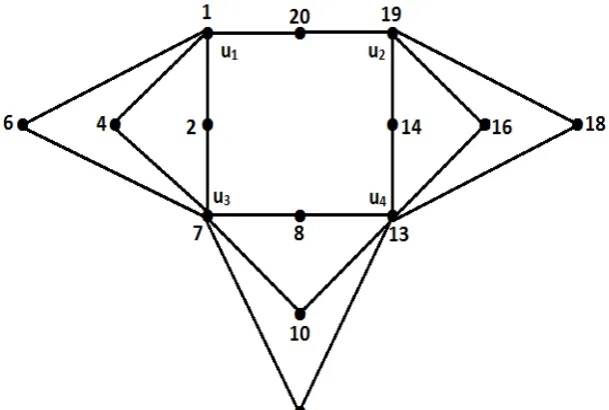
Figure-8: Arbitrary Super Subdivision of H- graph ( n is Even )
Case-(i): When n is odd (n≤11) and m1=m2=m3= …. =mn-1 = 3
© 2018, IJMA. All Rights Reserved 26
Define a function 𝜑: V(H)→{ 1,2,…, q+1} by
𝜑(𝑣1) = 1.
𝜑(𝑣𝑖) = 6(i-1), 2≤ 𝑖 ≤n.
𝜑(𝑢1) = 𝜑(𝑣𝑛)+1.
𝜑(𝑢𝑖) = 𝜑(𝑢𝑖−1) +6, 1≤ 𝑖<𝑛+1
2 &� 𝑛+1
2 � +1≤ 𝑖 ≤ 𝑛. 𝜑(𝑢𝑖) = 𝜑(𝑢𝑖−1) +7, 𝑖 =𝑛+1
2 . 𝜑(𝑤1) = 2.
𝜑(𝑤𝑖) = 2i-1, 2≤ 𝑖 ≤ m1+m2+m3+…+mn-1.
𝜑(𝑥1) = 𝜑(𝑢1)+1.
𝜑(𝑥𝑖) = 𝜑(𝑥𝑖−1) + 2, 2≤ 𝑖 ≤ m1+m2& m1+m2+2≤ 𝑖 ≤ m1+m2+m3+….+mn-1
𝜑(𝑥(𝑚1+𝑚2)+1) =𝜑 �𝑢𝑛+12 �+ 1.
𝜑(𝑥(𝑚𝑘)) =𝜑(𝑥𝑚1+𝑚2) + 1.
Then the edge labels are distinct.
Case-(ii): When n is even (n≤10) and m1=m2=m3= … =mn-1 = 3
Figure-10: Arbitrary Super subdivision of H-graph with n=6
Define a function 𝜑 : V (H)→{ 1, 2, …, q+1} by
𝜑(𝑣1)= 1.
𝜑(𝑣𝑖) = 6(i-1), 2≤ i≤ n.
𝜑(𝑢1) =𝜑(𝑣𝑛) + 1.
𝜑(𝑢𝑖) = 𝜑(𝑢𝑖−1) + 6, 2≤ 𝑖<𝑛2&�𝑛2+ 1� +1≤ 𝑖 ≤ 𝑛. 𝜑(𝑢𝑛
2) = 𝜑(𝑢𝑛2−1) +7.
𝜑(𝑤1) = 2.
𝜑(𝑤𝑖) = 2i-1, 2≤ 𝑖 ≤ m1+m2+m3+...+mn-1.
𝜑(𝑥1) = 𝜑(𝑤𝑚1+𝑚2+⋯+𝑚𝑛−1) +3.
𝜑(𝑥𝑖) =𝜑(𝑥𝑖−1) + 2, 2≤ 𝑖 ≤ m1+m2& m1+m2+2≤ 𝑖 ≤ m1+m2+m3+...+mn-1.
𝜑(𝑥𝑚1+𝑚2+ 1) =𝜑(𝑢𝑛2) + 1.
𝜑(𝑥(𝑚𝑘)) =𝜑(𝑥𝑚1+𝑚2) + 1.
Then the edge labels are distinct.
From case (i) and (ii), Arbitrary Super subdivision of H-graph is stolarsky-3 Mean graph.
Remark 2.6: The aboveresult is true for allvalues ofn’s if n is odd (n≤11) and n is even (n ≤ 10) and 𝑚𝑖’s with the
Theorem 2.7: Arbitrary Super Subdivision of Middle graph M(Pn) is Stolarsky-3 Mean graph.
Proof: Let 𝑢1,𝑢2, … ,𝑢𝑛 be the vertices and 𝑒1,𝑒2, … ,𝑒𝑛−1 be the edges of path Pn and G=M(Pn) be the middle graph of
path Pn. V(G) = V(Pn)∪ E(Pn) and let uixi (1≤i≤n-1) ,uixi-1, 2≤ 𝑖 ≤ 𝑛, xixi+1, 1≤ 𝑖 ≤n-2 be the edges of M(Pn).
Let H be an arbitrary super subdivision of M(Pn), where each edge of M(Pn)is replaced by a complete bipartite graph
𝑘2.𝑚𝑖 where mi is any positive integer.
V(H) ={𝑢1,𝑢2, … ,𝑢𝑛,𝑥1,𝑥2, … ,𝑥𝑛−1, ,𝑣1,𝑣2, … ,𝑣𝑚1
, 𝑣𝑚1+1,𝑣𝑚1+2, … ,𝑣𝑚1+𝑚2,𝑣𝑚1+𝑚2+𝑚3+⋯+𝑚2𝑛−2, 𝑤1(𝑘), 𝑤2(𝑘),….,𝑤𝑛−2(𝑘)}.
Figure-11: Arbitrary Super subdivision of M(Pn)
When m1=m2=m3= … = m2n-2 =3.
Figure-12: Arbitrary Super subdivision of M(P3)
Define a function 𝜑: V(H)→{1, 2,…, q+1} by
𝜑(𝑢1) = 1.
𝜑(𝑢𝑖) = 14(i-1) - 2, 1≤ 𝑖 ≤ 𝑛.
𝜑(𝑥1) = 6.
𝜑(𝑥𝑖) = 14(i-1) + 6, 1≤ 𝑖 ≤ 𝑛 −1.
𝜑(𝑣1) = 𝜑(𝑢1) + 1. 𝜑(𝑣2) = 𝜑(𝑣1) + 1.
𝜑(𝑣𝑖) = 𝜑(𝑣𝑖−1) + 2, 3≤ 𝑖 ≤ 𝑚1+𝑚2+𝑚3+⋯+𝑚2𝑛−2
But i≠(𝑚1+𝑚2)+1, (𝑚1+𝑚2+𝑚3)+1,…
(𝑚1+𝑚2+𝑚3+⋯+𝑚2𝑛−3) + 1
𝜑(𝑤𝑖(𝑘)) = 14i+5, 1≤ 𝑖 ≤ 𝑛 −2.
𝜑(𝑣�∑𝑘 𝑚𝑖
𝑖=1 �+1) = 𝜑(𝑣∑𝑘𝑖=1𝑚𝑖) +3, k = 2,3,4,…….,2n-3.
Then the edge labels are distinct.
Hence Arbitrary Super subdivision of Middle graph M(Pn) is stolarsky-3 Mean graph.
Remark 2.8: The above result is true for all values of n’s and𝑚𝑖’s with the condition 𝑚1≤8 and 𝑚𝑖’s, 2≤ 𝑖 ≤ 𝑛 −1.
CONCLUSION
© 2018, IJMA. All Rights Reserved 28
REFERENCES
1. J.A. Gallian, “A dynamic survey of graph labeling”, The electronic Journal of Combinatories 17(2017), #DS6.
2. F.Harary, 1988, “Graph Theory” NarosaPuplishing House Reading, New Delhi.
3. K.M. Kathiresan and S. Amutha, Arbitrary Super subdivisions of stars are graceful, Indian J.Pure Appl.Math.,
35(1) 81-84(2004).
4. V.Ramachandran and C.Sekar, One Modulo N Gracefulness of Arbitrary Super subdivisions of graphs,
International J. Math. Combin. Vol.2 (2014), 36-46.
5. V.Ramachandran and C.Sekar, , Graceful labeling of Arbitrary Super subdivision of disconnected graph, Ultra
Scientist of Physical Sciences, Vol. 25(2) A.Aug. 2013,315-318.
6. S.S.Sandhya, E. Ebin Raja Merly and S.Kavitha “Stolarsky-3 Mean Labeling of Graphs” Communicated to
Journal of discrete Mathematical Sciences and Cryptography”.
7. S.Somasundram, and R.Ponraj 2003 “Mean Labeling of Graphs”, National Academy of Science Letters Vol.
26, p.210-213.
8. S.Somasundram, R.Ponraj and S.S.Sandhya, “Harmonic Mean Labeling of Graphs” communicated to Journal
of Combinatorial Mathematics and combinational computing.
9. G.Sethuraman and P.Selvaraju, Gracefulness of arbitrary Super subdivisions of graphs, Indian J.Pure Appl.
Math., 1059-1064 (2001).