ISSN: 2347-7474
International Journal Advances in Social Science and Humanities
Available online at: www.ijassh.com
RESEARCH ARTICLE
Multimedia and E-learning Integration in the FFS Gulf College
Classrooms
Joseph Bangayan Cuarteros1*, Ronel Mondragon Sapungan2 Rosanna Manalo3, Daisy L.
Talattad4
1Quality Assurance Coordinator, Gulf College, Muscat, Sultanate of Oman.
2Assistant Professor, Department of Social Sciences, AMA International University-Bahrain, Salmabad, Bahrain 2 3Lecturer, Gulf College, Muscat, Sultanate of Oman.
4Principal, Lagum Elementary School, Penablanca, Cagayan, Philippines.
Abstract
Multimedia technology and e-learning resources have become prevalent and accessible to all students who in their creative and innovative ways make learning opportunities more engaging and relevant. These electronic resources have also played vital roles in learning English as a Foreign Language (EFL). As these technologies create impact among the Faculty of Foundation Studies (FFS) Gulf College students in EFL classrooms, this study was conducted to find out their perceptions of multimedia and e-learning utilized in the classrooms. A duly-validated researcher-made questionnaire-checklist was utilized as the research tool. Focused group discussion and semi-structured interviews were used to corroborate obtained data. Results revealed that the Gulf College students “sometimes utilized” multimedia and e-learning in learning English. The popular computer/laptop/netbook and internet were among the top-rated multimedia and e-learning resources in terms of use. The students have not realized yet the impact of other multimedia resources and e-learning services on learning the English language. Students perceived multimedia technology and e-learning facilities as highly effective in facilitating English language acquisition. Furthermore, there was a significant relationship between the extent of integration and utilization and the level of effectiveness of multimedia and e-learning resources. The participants liked to see Ipads, laptops, cell phones, videos, e-books and Smart Boards being used as learning tools in the future.
Keywords: Multimedia, E-learning, Integration, FFS classrooms, English as a Foreign Language
(EFL).
Introduction
The fast evolution of multimedia technology and e-learning services creates vital impact in our society today. The same technology and web-based resources have become widespread and available to students and educators in schools and universities.
As this technological breakthrough in information technology has developed into more prevailing and handy to students, lecturers need to find novel and inventive ways to integrate these multimedia and e-learning resources technology into the teaching and learning process. The integration of these technological breakthroughs would make homework, class work, and other knowledge and experience opportunities more appealing and significant in today’s educational setting. Multimedia and e-learning services have an incredible advantage to learners to enhance
involvement in the class setting; however, many lecturers have not considered the benefits of this novel and innovative teaching-learning [1].
are integrated with color, pictures, graphs, illustrations and animations. The researcher quoted further that students learn more when the variety of their senses are utilized in class discussions; and the rich learning experience helps absorption, retention and recall by involving the human senses, namely: social, emotional and intellectual senses [2].
Ludwig and his fellow researchers state that studies of Astleitner & Wiesner and Yarbrough [3] have found that the use of multimedia materials posted higher satisfaction and motivation among college students. In the same study, he also mentioned Shuell and Farber’s significant research on the impact of multimedia to education. Shuell and Farber’s investigation on the attitude of hundreds of college students toward the use of computer technology in twenty courses representing a wide range of academic disciplines revealed that the participants were generally very optimistic about the utilization of technology. The said investigation further explained that the girls placed the utilization of technology for learning and classroom lessons fairly lower than did their male counterparts [3].
Another study conducted on the use of technology among eighty-three students investigating their attitude, perceived utility, and intention to use Computer Assisted Language Learning (CALL). The study revealed that students in the experimental group had a positive attitude toward CALL, perceived its utility for helping them learn English as a Foreign Language (EFL), and had a strong intention to use it in the future. Results of this study have provided evidence of the effect of CALL on learning English as a foreign language [4].As to its effect on the academic performance, multimedia has undoubtedly proven effective and created huge impact to students’ academic performance. In her quasi-experimental study conducted on two groups of college students in literature classes Glomo-Narzoles revealed that students who were exposed to multimedia instruction had enhanced academic performance. The post-test mean results affirmed that there was a significant effect on the academic performance of the
experimental group in which the multimedia instruction had been employed. Glomo-Narzoles’ research which was conducted among Filipino learners corroborates the current study; it further gives the idea that her study is different from the present study; hence, provides comparison and contrast [5].
This study follows the theory of Ellis for establishing precisely the value of multimedia in enhancing learning. This theory is about any study of the effectiveness of multimedia as a tool to enhance learning must specify the following: learning in a manner that is consistent with accepted learning theory, the student population under consideration, the subject matter being studied, which media elements are being studied, at what level of interactivity, and toward what end [6].
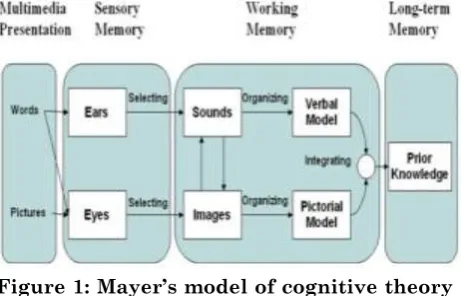
Mayer’s Model of Cognitive Theory of Multimedia, as also used by Glomo-Narzoles in her research, supports the present study. This theory is epitomized in Figure 1 below. The theory offers three hypotheses when it comes to learning with multimedia: [1] People utilize two channels namely, auditory and visual, for processing information; [2] People have limited capacity for each channel to process the amount of information at a given time; and [3] People enjoin in the active processing of information by filtering, selecting, organizing, and integrating knowledge.
Figure 1: Mayer’s model of cognitive theory of multimedia
(Source: http://arcmit01.uncw.edu/erg1602/Glossary.html).
Available online at: www.ijassh.com
tertiary EFL classroom learning and their level of effectiveness among the FFS Gulf College students, where relevant researches on both multimedia technology and e-learning resources as variables have not fully been explored.
Literature Review
English as a LanguageThe field of English is intimately concerned with language and through interaction with and reflection on texts, language, people and the world. English as a learning area focuses on the four macro skills, such as listening, speaking, reading, and writing. Developing proficiency in English enables students to become critical, imaginative, and reflective thinkers, effective communicators and active, lifelong learners. By engaging with, analyzing and composing a diverse range of text, students develop increasing control over the cultural, social and technical dimensions of language. Today’s English classroom reflects the changing nature, contexts, and uses of texts in an increasingly globalize world [7,8].
The Significance of the English Language
The significance of the English language which is now used very commonly in EFL classrooms is exemplified in the following statements; to wit: a working knowledge of English has become a requirement in a number of fields, occupations and professions such as medicine and computing; as a consequence, more than a billion people speak English to at least a basic level. One impact of the growth of English is the reduction of native linguistic diversity in many parts of the world. The influence of English continues to play an important role in language attrition. Conversely, the natural internal variety of English along with creoles and pidgins have the potential to produce new distinct languages from English over time [9].
The Role of English in Higher Education
As English language has become a basic requirement for academic and non-academic endeavours and is of great influence in the other language attrition, it plays significant role in how universities respond to the increasingly global context in which they
operate. According to British Council Report, as “there are more universities use English as a Medium of Instruction (EMI), the need for structural changes, different methodologies and a fundamental change in mind-set is becoming more urgent.” [10].
This means that the knowledge of the English and of various methodologies to learn effectively has been a key to unlock difficulties in any student’s undertaking in the school and university. This has been an answer to academic collaboration, through research activity, events and communications, both inside and between institutions themselves. It is therefore believed that the role of English in higher education is placing huge impact on English and non-English academics. As the role of English language is emphasized then the English lecturers’ role has also been equally accentuated. Hence, as the lecturers design English programs, aside from choosing the content, language and learning processes, they also think of including instructional materials, not the traditional ones, but making use of emerging technologies, specifically the use of multimedia in teaching. The more varied the instructional materials the better is the teaching-learning processes. Incorporating multimedia in teaching would facilitate learning; thus, will result to improved achievement in the academics.
New Roles of English Lecturers
and transmit. In fact, students are needed to explore other vast information presently available in different modalities. The lecturer and technology, specifically the use of multimedia, should collaborate in supporting the learners in knowledge acquisition and construction.
Supporting the above contention was the study conducted Li Baoping and Wang Yan in four universities in Jiaozuo, China. They concluded that multimedia teaching method has its own advantages. It is not only necessary but also beneficial to use multimedia equipment in class. The study emphasized that “only if the lecturers use this method properly it brings us more benefit. In order to fully utilize the power of multimedia equipment, lecturers must organize class procedure in accordance with teaching contents and objects, choosing, designing, evaluating and using the proper equipment to optimize teaching results. Using multimedia equipment are subsidiary methods in teaching.” The study further underscored that “the effect and quality of a class don’t rely on multimedia equipment that lecturers have used in class [11]. The key point is lecturers should prepare carefully before class, provide students not only with knowledge but also creative thinking ability. Lecturers must have the ability to stimulate potential in students [12].
The author of this present research agreed on Baoping and Yan final statement in the conclusion saying that “our lecturers should not only master professional knowledge of their own fields, but also be familiar with teaching theory, psychological theory to use teaching method more scientifically and skillfully. What’s more important, lecturers must committed to their profession and career, promote themselves in professional fields. Thus multimedia technology could wield its magnificent power in education.” The Multimedia
Multimedia has been considered a fancy name for modern technology. Several decades ago, many classroom lecturers, including this author, can still understand how the current technology had evolved from the time when they used a 35-mm slide-tape with a projector-viewer in their classes. As
this author could still vividly remember, this old technology showed still pictures as a projector, usually accompanied with sounds that play on a cassette tape player. The sound of a beep signified the display of the next slide. Since the invention of computers and mini-gadgets, the use of “modern technology” or the multimedia has been observed up to the smallest and remotes classroom in the school or university.
What is Multimedia?
Multimedia is simply the integration of text, graphics, animation, sound, and/or video. Using this very broad definition of multimedia, multimedia in the classroom could include Power Point presentations that are created by the lecturer, commercial software (such as multimedia encyclopedias) that is used for reference or instruction, or activities that directly engage the students in using multimedia to construct and convey knowledge. For the purposes of this course, we will focus on the final category engaging students in the use of multimedia to construct and convey knowledge [13]. Multimedia in EFL Classrooms and Lecturer’s Attitude
Multimedia activities in English are changing the way students are taught, from a totally lecture environment to a learner-centered one. With multimedia, English lecturers are more of a resource person. It is important to note that use of multimedia in English is not meant to replace lecturers, nor can it replace them. Instead, multimedia is only a tool to help English lecturers teach in more imaginative and creative ways. Today’s students have grown up with technology and are accustomed to a multi-sensory environment and some of them would be bored with traditional, “chalk and talk” teaching methods. Hence, the lecturers have to be fully aware that multimedia in EFL classrooms bring bigger advantage on student’s learning.
Available online at: www.ijassh.com
'humanware' must be in position too. Lecturers play an essential role in this respect.
This necessitates that they be receptive in their attitudes to the technology. In this case, a positive attitude indicates a higher level of knowledge and vice versa. But a possibility that the higher level of knowledge in technology use contributes to having positive attitudes cannot be ruled out as well.” In the conclusion of this study, the researcher stated that “both the components
of attitude and knowledge are
complimentary.” He said that “it is imperative that in introducing and gradually integrating multimedia technology in the
English Language Classroom, a
consideration of lecturers' attitudes and knowledge is essential to ensure that the multimedia will achieve the potentials it deserves. He further said that “this requires time, concentration and support, involving long term viable efforts [14].”
Student’s Perception on Multimedia and E-Learning
As multimedia and e-learning create immense impact to student optimal learning, educators at all academic levels are encouraged to consider students preference to effective learning; hence, incorporating technological learning tools into their curriculum and daily activities deserves definite considerations.
With the fast evolution of technology and eLearning devices and online services in the cyberspace, benefits and further development can be achieved when school systems are utilizing these facilities to encourage student’s active participation and optimal learning.
This contention has been affirmed by study conducted by Sivakumaran and other four researchers. Their study on the students’ perception on the integration of multimedia in classroom learning asserted that using technology can promote learning in the classroom, and that students have a strong desire to gain knowledge of new programs.
According to the results of their survey, “technology can increase participation and
motivation of students in project assignments because students can freely express their ideas in innovative ways by utilizing multimedia technology.” The study further elucidated that “although students commented positively toward the use of technology, many students were unaware of certain programs and software that could greatly enhance the learning environment. Additionally, many students are only using computers at schools in a limited way. Surveyed students perceived the use of multimedia technology as a way of make learning easier and more interesting. They preferred using technology to present their ideas rather than writing papers and doing more traditional projects. Moreover, technology can also be used as a communication tool between lecturers and students. Upon review of the presented material, it is clear that educators must become aware of the rise in demand for such teaching tactics and incorporate the utilization of multimedia in the classrooms. Many training tools are available to help teach educators how to utilize and implement these latest technologies [15].”
Research Methodology
This study was investigated in order to find out the students’ perceptions of multimedia and e-learning integrated and utilized in the EFL classrooms and to determine the level of effectiveness of these instructional media and e-learning resources as perceived by the FFS Gulf College students.
To realize the objectives of the study, the quantitative and qualitative descriptive survey methods of research were used. This study made used of descriptive research method which is designed for the researchers to gather information about present existing conditions needed in the chosen field of study. This method entitles the researchers to interpret the theoretical meaning of the findings and hypothesis development for further studies.
processes that are going on; effects that are being felt, or trends that are developing. The process of descriptive research goes beyond mere gathering and tabulation of data. It involves the elements or interpretation of the meaning or significance of what is described. Thus description is often combined with comparison and contrast involving measurements, classifications, interpretation and evaluation [16].
On the other hand, Creswell defines qualitative study as a qualitative inquiry that employs different philosophical assumptions; strategies of inquiry; and methods of data collection, analysis and interpretation [17].
Respondents of the Study
The respondents of the study were the 116 FFS students from selected Pre-IFP, Semester 1 and Semester 2 classes. The participants were chosen through proportionate random sampling and were classified according to programme and gender.
Research Instruments
Utilized for this study was a questionnaire-checklist, constructed by the researcher, underwent content validation by experts, tested its reliability, and administered for the purpose of gathering the quantitative data. The researcher also utilized semi-structured interview and focused group discussion to corroborate and substantiate the obtained data.
The research instrument has five (5) parts: Part I gathered data about personal information about the respondent’s gender and programme enrolled in. Part Two captured the data on the types of multimedia resources and e-learning resources in the college. Part Three obtained the data on the extent of integration and utilization while Part IV gathered the data on and level of effectiveness. Part V collected responses from the qualitative questions given during the focused group discussions and interviews with the selected respondents.
Results and Discussion
Multimedia Technology and E-learning Resources
As to the frequency distributions of multimedia and e-learning resources, ‘Computer/laptop/notebook’ is the most integrated and utilized in the EFL learning, as revealed by 94 or 22% responses of the respondents. ‘Cellphone/Ipad/IPod’ takes the second rank as proved by 84 or 20% acceptance. Sixty nine of 16% agreed ‘camera’ was utilized in the English class. ‘IPTV’ ranks fourth, taking 64 or 15 % recognition from the respondents. ‘Audio-video’ receives 56 or 13% of the respondents’ favor. Placed at sixth place is ‘CDRom/DVD/Flash Drive/External Storage Device’ while ‘Smart Board’ went at the bottom of the survey with 21 or 21% frequency.
On the distribution of e-Learning as used by the respondents, Figure 6 indicates that 94 or 30% used ‘Youtube/internet’ in learning the English language. Eighty-one or 26% of the participants signified the use of ‘text, graphics and animation’. Sixty-three or 20% signified the use of ‘e-library’. There were 14 or 5% stipulated they used Turnitin. Some claimed that ‘blogs/podcast/Videocast’ were used as revealed by 14 or 5% responses. Lastly, 10 or 3% of the respondents admitted ‘iMovie’ was integrated and utilized to improve learning in English.
Extent of the Integration and
Utilization of Multimedia Technology and E-learning
Presented in the table above are the mean scores of the respondents’ perception on the utilization of multimedia resources and e-learning services in tertiary EFL classroom to promote quality learning.
Available online at: www.ijassh.com
Multimedia Resources Mean Descriptive Interpretation
1 Computer/Laptop/Notebook for doing homework etc. 4.27 Often Utilized
2 Cellphone/Ipad/IPod for word improvement 2.46 Seldom Utilized
3 IPTV for clearer understanding of lessons 4.24 Often Utilized
4 Camera for project presentation and writing development. 2.27 Seldom Utilized
5 Flash Drive/External Storage Devices/CD/ DVD for storing learning materials 2.14 Seldom Utilized
6 Audio-Video (TV, Casette, etc.) for listening & speaking development 1.60 Seldom Utilized
e-Learning Services/Resources Mean Descriptive Interpretation
1 Internet(Youtube) for viewing to enhance English learning 3.67 Often Utilized
2 E-library for searching vital materials for learning English 2.93 Sometimes Utilized
3 Turnitin for checking of plagiarism 2.40 Often Utilized
4 Dynamic Multi-media (text, graphics, animation), for learning English in a more creative and innovative ways
3.34 Sometimes Utilized
5 Blogs, Podcast, Videocast for sharing, posting and publishing English language outputs
1.15 Never Utilized
6 iMovie for more innovative, more creative and more advanced presentation 1.03 Never Utilized
College students conveyed that they often used ‘IPTV’ as revealed by mean score of 4.24. The survey unveiled that respondents seldom utilized the following multimedia, as indicated, ‘Cellphone/Ipad/IPod’ (2.46), ‘Camera’ (2.27), ‘Audio-video’ (1.60), and ‘Flash Drive/External Storage Device/CD/DVD’ (2.14). It can only infer that these resources were used but in cases they were applicable.
As shown in the table, the participants held that ‘Internet/Youtube’ was frequently utilized, as specified by the mean score of 3.67. The result implies that ‘Internet’ was an important medium in learning English in the tertiary classrooms. The survey indicated that ‘e-library’ and ‘Text/Graphics/Animations’ were sometimes utilized, as specified by the mean score of 2.93 and 3.34 respectively. As revealed in the survey the respondents held that ‘Blogs/Podcast/Videocast’ (1.15) and ‘iMovie’ (1.03) had never been utilized.
The foregoing findings disclosed the certainty that multimedia and e-learning resources had frequently been utilized as indicated by the
two variables, such as ‘Computer/Laptop/Notebook’ and ‘Internet/Youtube’. This result implies that ‘Computer/Laptop/Netbook’ and ‘Internet/Youtube’ were the most useful media while learning English as foreign language. However, there were multimedia and e-learning facilities that had rarely been utilized, as unveiled by the results of most variables, namely, ‘Cellphone/Ipad/IPod’, ‘Camera’, ‘Audio-video’, and ‘Flash Drive/External Storage Device/CD/DVD. The item with 4.40 was ‘Turnitin for checking plagiarism’ which means this media was often utilized. Furthermore, there were multimedia and e-learning resources that had never been utilized, as specified by the results of some variables, such as ‘Blogs/Podcast/Videocast’ and ‘iMovie’. This finding was supported by participants’ responses during semi-structured interviews stating that they rarely used cellphones, camera and other devices in class as some classes infrequently required them. Effectiveness of Multimedia and E-learning Resources as Learning and
Teachingtools
Indicators: Level of Effectiveness Mean Descriptive Interpretation
1 Computer/Laptop/Notebook makes learning English easier. 4.38 Highly Effective
2 Internet and its facilities provide many resources for doing assignments in English.
4.23 Highly Effective
3 Cellphone/Ipad/IPod helps in finding English word meaning and its
pronunciation. 4.16 Highly Effective
4 IPTVs facilitate efficient learning of English in the classroom. 3.60 Highly Effective
5 Audio-video equipment help achieve the objectives of the English lessons.
3.38 Moderately Effective
6 E-library provides adequate resources for English homework and
researches. 2.92 Moderately Effective
7 Turnitin enhances student’s learning experience. 3.24 Moderately Effective
8 Text, Graphics, Animation create active interaction and class participation.
2.92 Moderately Effective
9 Blogs, Podcast, Videocast cater the students’ different learning styles. 3.38 Moderately Effective
10 Multimedia greatly improves English class performance. 3.87 Highly Effective
11 Multimedia and e-learning resources and services optimally increase
student’s creativity and innovation. 3.94 Highly Effective
12 Multimedia and e-learning enhance student’s efficiencies and capabilities.
3.94 Moderately Effective
13 Multimedia and e-learning help students to be more independent and more competitive.
4.11 Highly Effective
14 Multimedia and e-learning help students widen professional and career
Presented in the table above are the mean scores of the respondents’ perception on the level of multimedia resources and e-learning services in FFS classroom. As indicated in the table, it is apparent that multimedia and e-learning resources are effective learning tools in EFL classrooms, as perceived by the respondents, specified by mean scores of nine out of fifteen variables.
It can be gleaned from the table that the foremost indicator perceived by the students was ‘Multimedia and e-learning help students widen professional and career perspective.’ (WM-4.45), verbally interpreted as Highly Effective. This only means that the students believed that technology facilities used in the class has a very good effect on chosen profession and on their future career. During interviews, the students disclosed that multimedia and e-learning resources help them broaden the horizon of learning, thereby clearing the path of bright profession ahead.
This was followed by ‘Computer/Laptop/Notebook which makes learning English easier.’ (WM-4.38), verbally interpreted as Highly Effective with second in rank. Similarly, some students considered ‘Internet/Youtube and its facilities provide many resources for doing assignments in English.’ (WM-4.23), verbally interpreted as Highly Effective and recorded third in rank. In this regard, students recognized internet and its programs could offer resources for their class works. By utilizing internet alone could help them acquire needed information and most likely use information to improve learning in English.
Fourth in rank is the item, ‘Cellphone/Ipad/Ipod helps in finding English word meaning and its pronunciation.’ (WM-4.16) with verbal description of Highly Effective. This explains that when mobile phones and similar gadgets like Ipad or Ipod were used, these could help the students understanding meaning and pronunciation of the English words. Hence, there should be clear a clear manifestation of improved learning of English in the classroom. This note was supported by the students stating that cellphones, iPhones and other small gadgets
were very useful as they can be used anytime, anywhere.
Rank fifth explains that students held ‘multimedia and e-learning help students to be more independent and more competitive.’ with a weighted mean of 4.11. Taking sixth place were the two variables, namely, ‘Multimedia and e-learning resources and services optimally increase student’s creativity and innovation.’ and ‘Multimedia and e-learning enhance student’s efficiencies and capabilities.’ The composite mean scores of 3.94, verbally interpreted as Highly Effective tell that students agreed that multimedia and e-learning don’t only provide them information but also teach them how to be imaginative and innovative. They could possibly attain efficiency and capabilities if they maximize the use of the technology.
‘Multimedia greatly improves English class performance.’ (WM-3.87) ranked eighth. The item implies that multimedia is highly effective when it comes to improving class standing. There is a strong indication that utilization of multimedia gizmos can enhance subject performance. This assumption was proven true by the respondents, stating that when the lecturers used IPTV or graphics and animation in the class they could easily understand the lessons, thereby getting good marks in class works and exams.
Placed ninth is ‘IPTVs facilitate efficient learning of English in the classroom.’ This typifies that respondents perceived IPTVs effective in English learning, revealed by weighted mean of 3.60, interpreted as Highly Effective.
Available online at: www.ijassh.com
Participants in the FGDs disclosed that audio-video and blogs were rarely introduced in the class. They further revealed that they didn’t even know how podcast and Videocast looked like and how they can use them.
With weighted mean of 3.24, verbally interpreted as moderately effective, the indicator ‘Tunritin enhances student’s learning experience.’ ranked eleventh. This elucidates the fact that students fairly used turnitin in English classes.
Two indicators that joined in rank thirteenth were ‘Text, Graphics, Animation create active interaction and class participation.’ And ‘E-library provides adequate resources for English homework and researches.’ (WM-2.92), Moderately Effective. The results imply that students had fairly used these electronic resources in their classes. Some participants corroborated disclosing that e-library had rather been utilized in learning English lessons.
Looking into the average weighted mean, WM-3.60, interpreted as Highly Effective, this can be inferred that participants of this present survey knew the presence of multimedia and e-learning resources in the university and they were fully aware the impact of these technologies to their education particularly in improving their English competencies. Hence, maximized utilization of multimedia and e-learning resources should be done to achieve higher satisfaction and motivation and maximum potential learning in English of the Bahraini college students. Several researches backed up these findings: Astleitner & Wiesner, Ogunbote and Adesoye, Almekhlafi, A.G. and Glomo-Narzoles.
How FFS Gulf College Students Like to see Multimedia Technology and E-learning Resources Being Used as Learning Tools in the Future
Research Question Seven obtained varied responses from the focused group discussion (FGD) with the surveyed students. The FGD sessions were focused on the question:
“How would you like to see multimedia technology and e-learning resources being used as learning tool in the future? “ The participants looked forward to see the
following technology gizmos being used by the lecturers in the English classes: IPods, laptops, cellphones, videos, e-books and Smart Boards. Participant 17 wished to see one day that Smart Board is being used by his English lecturer in the class. Participant 11 would like to see the future classroom with Smart Board and electronic books for learning English lessons in the university.
Some participants had conveyed their views, such as, “I hope that all the students and professors will use Ipad”, There should be Smart Board and laptop or Ipad in every class to motivate the students to understand the lessons”, “We want to use Ipad in the class; this is very light to carry everywhere”, “I hope to see ourselves using laptop, no heavy books to carry to the university,” “Ipad is better than big books, papers and pens”, “I wish that one day all students and lecturers communicate together through multimedia; we can learn faster and more organized with laptops or Ipad; less books, lecture notes, and pens,”.“Students should have Ipad especially in Lab classes in order to make lessons simple. Also I think IPod will improve the student’s learning style and know well how to pronounce the words; it will make the learning procedure more easy and fun”, “Multimedia technology has dramatically improved and jumped to the higher level; that will enhance the e-learning worldwide and open new door of opportunities for students.”
When asked why they do like multimedia and e-learning resources to be used in the class, students believed multimedia and e-learning resources are very important learning tools in learning English. They believed that advantages could be gained when the university professors are utilizing these technologies to improve their knowledge and class participation. Participant 74 commented that the technology the lecturer used in the class made them listen and participate actively.
Participants 14 and 76 unflinchingly said:
“The lecrurers must try paperless
instructions,” “Looking forward to stop using paper notes and use the smart devices instead.”
What are the Impacts of Multimedia Technology and E-learning Resources on Your Personal Learning of English as a Second Language?
When participants were asked about the multimedia technology and e-learning resources on their personal learning of English as a second language (Research Question Eight), some of them boldly confessed that multimedia technology and e-learning resources have greatly improved their learning of the English language. Participants admitted that just by using the gadgets they have, like cell phones and computer, they could easily learn new expressions which they could use in their communication. Participant 7 enthused that when she started using the internet at the university or in her house, she noticed that she became comfortable with the English language. She even prided herself to have become creative and innovative using the English language. Participants 10 and 21 said that exposing themselves with the technology created in them the passion to learn new words and improve their English grammar. Participant 22 humbly declared that the multimedia he was exposed with developed in her the love of English language and the motivation to finish her career with flying colors. Other participants had expressed their different views, such as,
“My day is incomplete without using cell phone or laptop beside me. These gadgets help me a lot in my studies, especially in English classes.” “I know for sure I am learning much English while using my IPod and IPhones.” “It is very helpful; as the technology is opening new doors to learn better and faster.” “It helps me a lot to improve my language skills.” “I am using
various gadgets to improve my English because I know English helps me in everything.” “Learning English through technology makes me more independent.”
Conclusion
In the course of the study, the researchers arrived at the following conclusions: Regardless of the gender and the programme enrolled in, the FFS students “sometimes utilized” multimedia and e-learning as tools in learning English. Despite the presence of multimedia and e-learning resources in the college, students “only utilized” them sometimes. The popular computer/laptop/netbook and internet were among the top-rated multimedia and e-learning resources in terms of its use. Other multimedia resources and e-learning services had not fully utilized; hence, the surveyed students have not yet realized their impact on learning the English language.
The data revealed that there were no significant differences in the level of effectiveness in the integration and utilization of multimedia and e-learning resources in EFL classroom and the FFS Gulf College students when classified as to gender and programme enrolled and there was no significant relationship between the integration and utilization of multimedia and e-learning resources and the level of effectiveness of multimedia and e-learning resources as learning tools. Thus, both hypotheses indicated earlier were accepted.
Since the students generally perceived multimedia technology and e-learning facilities as highly effective in facilitating English language acquisition, more meaningful lessons could possibly be presented in EFL classrooms through multimedia technology and e-learning; thereby, lessons learned can be made more permanent among the EFL college learners.
References
1 Sivakumaran T, et al. (2012) Student
Perceptions of Multimedia Technology
Integrated in Classroom Learning,
International Journal of Humanities and Social Science Vol. 2 No. 11.
Available online at: www.ijassh.com
3 Ludwig T, et al. (2004) Using Multimedia In Classroom Presentations: Best Principles, Society for the Teaching of Psychology Pedagogical Innovations Task Force.
4 Almekhlafi AG (2006) The Effect of Computer Assisted Language Learning (CALL) on United Arab Emirates English as a Foreign Language (EFL) School Students’ Achievement and Attitude. Journal of Interactive Learning Research, 17(2):121-142.
5 Glomo-Narzoles D (2012) The Effect of
Multimedia Instruction on Student Learning 6 Ellis T (2004) Animating to Build Higher
Cognitive Understanding: A Model for
Studying Multimedia Effectiveness in
Education, Journal of Engineering Education, 93(1):59-64.
7 Meaning of Effectiveness, Retrieved from http://en.wikipedia.org/wiki/Effectiveness, 25 March 2014.
8 Reddi S (2003) Selecting, Using and Producing
Classroom-Based Multimedia. London:
Routledge Company.
9 Significance of English Language, Retrieved from
http://en.wikipedia.org/wiki/English_language on 10 April 2014
10 The Role of English in Higher Education.
Retrieved from
http://www.britishcouncil.org/education/ihe/kno wledge-centre/role-english-higher-education on 10 April 2014
11 Multimedia in the Classroom. Retrieved from http://fcit.usf.edu/multimedia/overview/overvie wa.html on 10 April 2014
12 Baoping L, Yan W (2010) Analysis of the Advantages and Disadvantages of Multimedia Teaching in Colleges. M & D Forum, China, p. 266.
13 Wang Y et al., (2010) Different viewpoints on the drawbacks of multimedia-aided teaching. Northwest Medical Education. (01):13-14. 14 Ramanair, J (2007) Multimedia technology:
lecturer’s knowledge and attitudes. CALL-EJ Online, 8(7):14-15.
15 Sivakumaran T et al., (2012) Student
perceptions of multimedia technology
integrated in classroom learning, International Journal of Humanities and Social Science, 2(11):70
16 Calderon JF (2007) Methods of Research and Thesis Writing, pp. 61-80