SYNTHESIS AND STUDIES OF SOME cis-MoO2(VI)
COMPLEXES WITH NITROGEN DONOR MACROCYCLIC
LIGANDS
Ramesh K. Gautam
[a], Chandra P. Singh
[b], Rajul Saxena
[a]and
Devendra P. Rao
[a]*Keywords: Dioxomolybdenum(VI), di-2-thienylethanedione, 1,3-diketones, macrocyclic complexes, Schiff base.
A complex of formula [MoO2(L)](acac)2 is obtained on treating molybdenyl acetylacetonate with di-2-thienylethanedione with
2,3-diaminotoluene This complex was reacted with four 1,3-diketones to yield four new complexes, [MoO2(ML)](acac)2, The complexes were
characterized by elemental analysis, spectral studies and molar conductance. In these compounds, molybdenum exhibited a coordination number of six. Distorted octahedral environment surrounds molybdenum in these complexes. The ligand geometry was completed by two oxo O-atoms and four N-atoms. The synthesized complexes show moderate activity versus S. aureus and S. typhi.
*Corresponding Authors
E-Mail: [email protected]
[a] Department of Chemistry, D.A-V. (P.G.) College, Kanpur-208001, U.P., India.
[b] Department of Chemistry, D.B.S. (P.G.) College, Kanpur-208006, U.P., India.
INTRODUCTION
A macrocyclic complex is marked as a cyclic complex with at least 9 individuals (counting all hetero atoms) and with at least 3 donor atoms. The field of coordination chemistry of macrocyclic complexes has experienced tremondous improvement during the last quarter of a century.1-4 A number of reports about synthetic work,
physicochemical studies5 and biochemical applications of
metal complexes6-10 has appeared. Some Schiff bases had
been utilized as fungicidal, which has been correlated with their chemical structure.11-13 One of the examples is the
transamination reactions, catalyzed by metals ions template through the formation of intermediate Schiff bases containing vitamin B6.14 Schiff base complexes were used as
medicines and show e antiviral,15,16 anti-inflammatory 17 and
antitumor activities.18
In bioinorganic chemistry, Schiff base complexes are used as artificial models for the metal containing sites in metallo-proteins and enzymes.19 Various Schiff base ligands show
anticancer activity and this activity of their metal complexes is greater in comparison to that of the free ligands.20,21
Additionally they exhibit catalytic activity in different chemical reactions,22 surfactant activities23 and as memory
storage devices in electronics.24-26
Schiff bases have been used as stable complexes with transition metal in many applications in chemical studies. Intense efforts has been directed to study the transition metal complexes of excessive denticity ligands with a view to obtain the metal complexes of unusual geometry and coordination number.27 Molybdenum is adaptable in nature
because of its diverse oxidation states ranging from –2 to +6 just as coordination numbers which fluctuate from four to eight.28 The capability of molybdenum to form complexes
with nitrogen, oxygen and sulfur containing ligands resulted in development of molybdenum Schiff base edifices that are efficient in homogeneous and heterogeneous reactions.29-34
The dioxomolybdenum(VI) complexes with high denticity ligands have importance in theoretical and practical chemistry mainly for biological processes. Mo(VI) complex is extracted as molybdate [MoO4]2- ion in aqueous medium
be based on the concentration and pH of the solution. The [MoO4]2- ion can act as oxygen atom transfer agents.35 Their
O-atom transfer properties play a critical role in functioning of molybdenum oxotransferase.36,37 It is present in the
oxidized states of a number of redox enzymes, in which their active sites consist of a cis-dioxomolybdenum moiety.38-40
In the second series of transition metals, only molybdenum is crucial for human, animal and vegetation pathogenic microorganisms.41,42 The Mo(VI) coordination
chemistry is interesting because of their catalytic activities and biological properties.43-46 Physiological functions of
oxomolybdoenzymes are set up via molybdenum.47-49
Di-2-thienylethanedione is a versatile chelating agent. This ligand has two reactive carbonyl groups also which are capable of undergoing Schiff base condensation with several di- and polyamines. Therefore, di-2-thienylethanedione is a useful synthon for the synthesis of macrocyclic ligands.
Some dioxomolybdenum(VI) complexes with high denticity ligands can be synthesized by condensation of di-2-thienylethanedione with a diamine. The synthesized complex has functionality of undergoing cyclization with 1,3-diketones via the metal template impact. It can be prepared, characterized and their provisional structures are supported by way of molar conductivity, elemental analysis, electronic, infrared and nuclear magnetic resonance spectroscopy.
condensation of di-2-thienylethanedione with 3-methylbenzene-1,2-diamine and 1,3-diketones have been synthesized.
EXPERIMENTAL
All chemicals, used in the preparation of Schiff base (ligands) and complexes, were of reagent grade and were used as obtained from business resources. Starting chemicals like [MoO2(acac)2], the diamine,
di-2-furanylethanedione and 1,3-diketones (2,4-pentanedione, 1-phenyl-1,3-butanedione, 4,4,4-trifluoro-1-(2-thienyl)-1,3-butanedione, and 1,3-diphenyl-1,3-propanedione were obtained from Aldrich. They were utilized without further purifications.
The elemental examinations of carbon, hydrogen and nitrogen is done for the ligand and MoO2(VI) complexes by
using CHN analyser at CRF, NERIST, Nirjuli, Itanagar, Arunachal Pradesh, India,. To estimate nitrogen Kjeldahl’s method is used. After decomposition of the complex, molybdenum was assessed gravimetrically by standard technique.50 Sulfur was estimated as barium sulfate.51
Uncorrected melting points were determined with the assistance of sulfuric acid bath. The UV-Visible spectra of the complexes have been recorded on Labinda-UV 3000
+
UV/VIS spectrophotometer in the 1100 - 220 nm range in ethyl alcohol as solvent at UPTTI Kanpur, U.P., India. IR spectra of the ligand and complexes of MoO2(VI) wererecorded at IIT Kanpur on Perkin-Elmer spectrophotometer (10.03.06) in the range of 4000-400 cm-1 with KBr pellet.
1HNMR spectra were obtained on JMM ECS-400 (JEOL)
spectrometer at 400 MHz with DMSO-d6 and were
expressed in δ (ppm) relative to TMS. TGA/DTA of the parent complex [MoO2(L)](acac)2 were performed on Perkin
Elmer (USA) thermal analyzers, under N2 atmosphere in the
temperature range of 50-600 °C at the heating rate of 10 °C min-1.
Synthesis of MoO2(VI) complexes
A solution of di-2-thienylethanedione (0.5570 g, 2.5 mmol) and 2,3-diaminotoluene ( 0.61164 g, 5 mmol) in 50 mL ethanol was refluxed. This solution was then added to an ethanolic solution of molybdenyl acetylacetonate (0.81537 g, 2.5 mmol) drop by drop. The reaction mixture was refluxed for 3 h. The solution turned brown. The solid complex formed was filtered and washed with ethanol. The yield was 46 %. This product was placed in ethyl alcohol and treated for 3 h with one of the 1,3-diketones viz. 2,4-pentanedione, 1-phenyl-1,3-butanedione, 4,4,4-trifluoro-1-(2-thienyl)-1,3-butanedione or 1,3-diphenyl-1,3-propanedione, in molar ratio 1:1, to obtain the macrocyclic dirty yellow solid product. TLC was used to ascertain the purity of the products. The 1:1 stoichiometry of Mo and the ligand was confirmed by elemental analyses (Table 1).
Antibacterial activity for the testing of 4-bacterial strains
The antibacterial action of the synthesized complexes of MoO2(VI) was examined by in vitro test. This test was
performed against four bacterial strains viz., Staphylococcus aureus, Salmonella typhi, Enterobacter aerogene and
Bacillus subtilis. Cup and agar-well diffusion technique was used for the antibacterial test of synthesized MoO2(VI)
complexes.42-44 Doxycycline was taken as the standard
material. For this purpose we made trench having dimensions of 6 mm in diameter inside the agar media with the help of a metallic borer. The concentration of bacterial solution in every channel was 3 × 10⁵ colony forming units
(CFU) mL-1. The MoO
2(VI) complexes were dissolved in D
to make an 1 % solution. The concentration of the test complex was 300 µg mL-1. The test samples have been
added within the corresponding wells. The rest of the wells were packed with DMSO and antibacterial standard doxycycline (0.05 %). Growth inhibitions were tested after 30 h incubation at 35 °C.
RESULTS AND DISCUSSION
The reaction of a mixture of di-2-thienylethanedione, 2,3-diaminotoluene and molybdenyl acetylacetonate in 1:2:1 molar ratio in aqueous ethyl alcohol yielded the macrocyclic complexes of MoO2(VI) with Schiff base. IR frequencies of
the ligand and the MoO2(VI) complexes and their
assignments are recorded in Table 2.
Lowering of νC=N frequencies is the major evidence for the proof of the coordination of nitrogen atoms of azomethine groups to the molybdenum in all macrocyclic complexes. 52-55 The spectral bands placed at 1604-1645 cm-1 is related to
>C=N absorption, which is usually seen at 1665 cm-1 in
isolated ligands.52-54 New absorption band at 508-591 cm-1
may be allocated to νMo-N vibration,56 that is absent in free
ligands. The linkage of both keto groups of di-2-thienylethanedione via >C=O oxygen with diamines is proved by the presence of >C=N band and the absence of >C=O band around 1710 cm-1.57,58
IR spectra of the ligand and its complexes of MoO2(VI)
are complex as a result of the nearness of various ring vibrations and C-H vibrations. A wide band located at 3433 cm-1 is due to νasym (N-H) and that at 3065 cm-1 is due to νsym
(N-H). Within the complex [MoO2(L)](acac)2 these bands
remain unchanged but are absent in complex
[MoO2(ML)](acac)2, this implies non-participation of the
NH group in the bonding.59 The dioxomolybdenum(VI)
complexes form preferentially a cis-dioxo group because of the preferential usage of the d-orbital for bonding. The dioxomolybdenum(VI) complexes revealed two Mo=O stretching bands at 893-910 cm-1 and 964-981 cm-1 due to
asymmetric and symmetric stretching vibrations of the cis-[MoO2]2+ moiety with C2V symmetry.60 Those two IR
spectral bands are allocated to νasym(O=Mo=O) and νsym(O=Mo=O) vibrations, respectively.60-66 νasym(O=Mo=O) vibrations are lower than ones of νsym(O=Mo=O).67,68
The presence of acetylacetonate group in the MoO2(VI)
complexes is inferred from the bands round 1552 - 1569 cm-1 and 1467-1480 cm-1, attibuable to νC=Oand νC=C
vibrations.69 Infrared bands of the MoO
2(VI) macrocyclic
Table 1. Elemental and physical data of the ligand and MoO2(VI) complexes.
Complex Empirical formula F.W. Yield, %
M.p., °C
Elementary analysis: calculated (found)
C% H% N% Mo% S%
L C24H22N4S2 430.59 45 115 66.94
(66.93)
5.14 (5.15)
13.01 (13.00)
-- 14.89 (14.87) [MoO2(L)]
(acac)2
C34H36N4MoS2O6 756.75 50 125 53.96
(53.98)
4.79 (4.78)
7.40 (7.41)
12.67 (12.64)
8.47 (8.46) [MoO2(ML1)]
(acac)2
C39H40N4MoS2O6 820.84 52 110 57.06
(57.05)
4.91 (4.91)
6.82 (6.81)
11.68 (11.69)
7.81 (7.80) [MoO2(ML2)]
(acac)2
C44H42N4MoS2O6 882.91 53 120 59.85
(59.86)
4.79 (4.78)
6.34 (6.34)
10.86 (10.85)
7.26 (7.24) [MoO2(ML3)]
(acac)2
C42H37N4MoO6S3F3 942.91 58 118 53.50
(53.48)
3.95 (3.96)
5.94 (5.95)
10.17 (10.16)
10.20 (10.22) [MoO2(ML4)]
(acac)2
C49H44N4MoS2O6 944.98 55 122 62.28
(62.29)
4.69 (4.67)
5.92 (5.90)
10.15 (10.14)
6.78 (6.75) L= ligand derived via condensation of di-2-thienylethanedione with 2,3-diaminotoluene (1:2)
ML1 = macrocyclic ligand derived via condensation of ligand (L) with 1,3-diketone: 2,4-pentanedione;
ML2 = macrocyclic ligand derived via condensation of ligand (L) with 1,3-diketone: 1-phenyl-1,3-butanedione
ML3 = macrocyclic ligand derived via condensation of ligand (L) with 1,3-diketone: 4,4,4-trifluoro-1-(2-thienyl)-1,3-butanedione
ML4 = macrocyclic ligand obtained by the reaction of ligand (L) with dibenzoylmethane
Table 2.IR spectral bands (ν cm-1) of the ligand and dioxomolybdenum complexes.
Complex νC=N νMo-N νC=O of
acac
νC=C of
acac
νasym
(O=Mo=O) νsym (O=Mo=O)
νasym
(N-H)
νsym(N-H)
L 1665s --- --- --- --- --- 3323br 3130br [MoO2(L)](acac)2 1604s 508m 1569s 1467m 893s 981s 3433br 3065br
[MoO2(ML1)](acac)2 1645m 580m 1555m 1470m 902s 975s
[MoO2(ML2)](acac)2 1640s 591s 1564s 1480s 905m 964s
[MoO2(ML3)](acac)2 1644m 585s 1552m 1475m 910s 965m
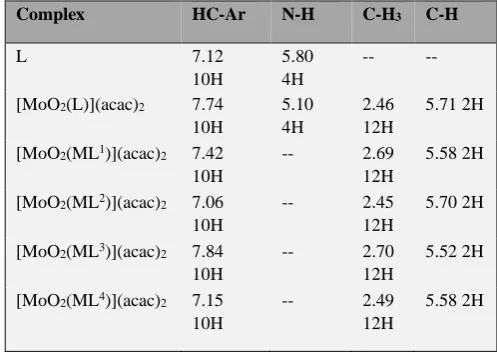
[MoO2(ML4)](acac)2 1640s 524m 1560s 1472m 902m 968s 1H NMR spectrum of the free ligand exhibits signal of
NH2 protons at 5.80 which is present in [MoO2(L)](acac)2 at
5.10 but missing in the four macrocyclic complexes [MoO2(ML)](acac)2 which indicates a cyclization by
1,3-diketones. The ten protons present as multiplets inside the
range
of
7.06-7.84 for the ligand and molybdenumcomplexes.
The protons of aromatic ring appeared by peaks at about 7.26. 1H NMR signal about 3.29-3.82 are due to the CH
2N
fragment. These chemical shifts might be a direct result of arrangement of two types of azomethine that is ingaged in the formation of the macrocyclic complex. The sharp singlet signal at 2.47 might be because of the water present in DMSO-d6 sample used. The 1H NMR data of the ligand and
complexes are summarized in Table 3.
The UV-Vis spectra of the tetradentate tetraaza ligand and the dixomolybdenum(VI) complexes had been recorded in ethanol and these spectral bands are consistent with suggested strength energy level scheme.71,72 The spectra of
the dixomolybdenum(VI) complexes with tetradentate ligand are comparable to each other thereby suggesting a common structure for all. In view of the fact that Mo(VI) ion has no d-electron, the absorption bands of pure d-d origins are not expected to appear. The bands for all complexes may perhaps to be attributed to charge transfer transition from nitrogen orbital to a molybdenum metal
d-orbital [N(π)→d(Mo)]. The UV-VIS spectra are similar to those of other complexes of dioxomolybdenum(VI) having nitrogen donor atoms. The UV-VIS spectra of these complexes are distinguished by strong absorption bands within the UV region at ≈ 292 nm and at ≈ 311 nm, which appear to be due to intraligand transition and n→π*/π→π* transitions. A fairly intense band appearing in the vicinity of
≈380-395 nm is attributed to N(π)→d(Mo).
Table 3. 1HNMR spectral data of the ligand and
dioxomolybdenum complexes (in δ ppm).
Complex HC-Ar N-H C-H3 C-H
L 7.12 10H
5.80 4H
-- -- [MoO2(L)](acac)2 7.74
10H
5.10 4H
2.46 12H
5.71 2H [MoO2(ML1)](acac)2 7.42
10H
-- 2.69 12H
5.58 2H [MoO2(ML2)](acac)2 7.06
10H
-- 2.45 12H
5.70 2H [MoO2(ML3)](acac)2 7.84
10H
-- 2.70 12H
5.52 2H [MoO2(ML4)](acac)2 7.15
10H
-- 2.49 12H
Table 4. Antibacterial activities of the MoO2(VI) complexes.
Complex Staphylococcus
aureus
Enterobacter aerogenes
Salmonella typhi
Bacillus subtilis
Doxycycline
[MoO2(L)](acac)2 17 17 19 20 26
[MoO2(ML1)](acac)2 14 20 17 22 23
[MoO2(ML2)](acac)2 14 17 16 20 24
[MoO2(ML3)](acac)2 15 19 19 -- 25
[MoO2(ML4)](acac)2 17 19 -- 22 25
The band due to the transition 2B
2→2A1 (dxy→dx2-y2) is
perhaps covered by the above bands and ought be attributed to L→M charge - transfer transition among the lowest unoccupied molybdenum d-orbital and highest occupied ligand molecular orbital.73,74 Ballhausen-Gray energy level
diagram is applicable to the energy level scheme for these complexes. The electronic spectra represent a distorted octahedral configuration for all the complexes.75
Molar conductance and magnetic and measurements
These complexes are diamagnetic, as obvious for d0
configuration. Since no electron is present in orbital, no d-d transitions are observed-d for these complexes. The molar conductivity (ΛM) values for all MoO2(VI) complexes in
DMF at ca. 10-3 molar solution indicate to be 1:1 electrolytes. The conductance (ΛM) estimations of prepared MoO2(VI) complexes ranges between the 100 - 115 Ω-1 cm2
mol-1. The molar conductance supports the tentative
structures of dioxomolybdenum(VI) complexes of the type (I) and macrocyclic complexes of the type (II) as shown in the schemes.
Thermogravimetric analyses
The thermogravimetric investigation of [MoO2(L)](acac)2
complex has been studied in the temperature range of 50- 600 °C at the rate of 10 °C min-1. No apparent
decomposition ocurred beneath 170 °C. The
[MoO2(L)](acac)2 complex undergoes decay in one step.
After that it ignites and decomposes giving a sharp weight loss.
Antibacterial activity
The MoO2(VI) complexes had been tested for antibacterial
test towards Staphylococcus aureus, Bacillus subtilis, Enterobacter aerogenes and Salmonella typhi (Table 5). The
higher in the antibacterial activity of the
dioxomolybdenum(VI) complexes can be explained on the basis of chelation hypothesis.47,48 The reference material was
doxycycline. Nearly all the complexes showed low to moderate activity towards S. aureus and S. typhi.
CONCLUSIONS
In absence of crystal structure study, which is due to of the amorphous nature of the synthesized molecules, we cannot suggest exact structures of these compounds. However, in view of the elemental and spectral studies, we
suggest that all the synthesized complexes may be represented as [MoO2(L)](acac)2 and [MoO2(ML1)](acac)2.
The study of antibacterial activity indicated that the complexes are biologically active.
The present study established new synthetic paths to get novel dioxomolybdenum(VI) complexes with Schiff base. The applied spectroscopic methods confirmed the condensation of di-2-thienylethanedione, which is a flexible chelating agent having two responsive carbonyl groups, with diamines and their cyclizations with 1,3-diketones leading to the formation of macrocyclic products of assured geometry around MoO2(VI) centre. The arrangement around
Mo is distorted octahedral geometry. The kinetic template impact of dioxomolybdenum(VI) cation assumes a considerable function in the condensation of Schiff base using diamines and di-2-thienylethanedione in ethanol. Bonding of the metal ion with the azomethine N-atoms proved that Schiff bases act as tetradentate ligands. The analytical data confirmed the existence of one metal ion per ligand molecule. The distorted octahedral shape have been suggested for all the prepared cis- MoO2(VI) complexes.
ACKNOWLEDGMENTS
The authors want to thank the Secretary, Board of Management, D.A.V. P.G. College, Kanpur, U.P., India for providing laboratory facilities to work. Analytical facilities extended by IIT Kanpur and UPTTI Kanpur India are gratefully acknowledged.
REFERENCES
1Healy, M. D. S., Rest, A. J., Template Reactions, Adv. Inorg.
Chem. Radiochem., 1978, 21, 1-40.
https://doi.org/10.1016/S0065-2792(08)60277-0
2Melson, G. A., Coordination Chemistry of Macrocyclic
Compounds, New York, 1979.
3Lindoy, L. F., Busch, D. H., Preparative Inorganic Reactions, vol.
6, 1. Ed.: Jolly, John Wiley & Sons, 1971, ISBN 10: 0471446882; ISBN 13:9780471446880
4Lindoy, L. F., Busch, D. H., Metal ion controlled syntheses of
novel five-coordinate zinc and cadmium complexes containing a helical coordination geometry and their template reaction to form complexes of a pentadentate macrocyclic ligand, Inorg. Chem., 1974, 13(10), 2494-2498.
https://doi.org/10.1021/ic50140a037
5Luo, X. F., Hu, X., Zhao, X. Y., Goh, S. H., Li. X. D., Miscibility
6Murthy, A. S. N., Reddy, A. R., Electronic absorption
spectroscopic studies of enolimine-ketoamine equilibria in Schiff bases, J. Chem. Sci., 1981, 90(6), 519.
7Razakantoanina, V., Phung, N. K. P., Jaureguiberry, G.,
Antimalarial activity of new gossypol derivatives, Parasitol. Res., 2000, 86(8), 665.
https://doi.org/10.1007/PL00008549
8Royer, R. E., Deck, L. M., Vander Jagt, T. J., Synthesis and
anti-HIV activity of 1,1'-dideoxygossypol and related compounds,
J. Med. Chem., 1995, 38(13), 2427.
https://doi.org/10.1021/jm00013a018
9Flack, M. R., Pyle, R. G., Mullen, N. M., Oral gossypol in the
treatment of metastatic adrenal cancer, J. Clin. Endocrinol. Metab., 1993, 76, 1019.
https://doi.org/10.1210/jcem.76.4.8473376
10Baumgrass, R., Weiwad, M., Erdmann, F., Reversible inhibition
of calcineurin by the polyphenolic aldehyde, gossypol, J. Biol. Chem., 2001, 276(51), 47914.
https://doi.org/10.1074/jbc.M103273200
11Al-Shihri, A. S. M., Abdel Fattah, H. M., Thermogravimetric and
Spectroscopic characterization of trivalent lanthanide chelates with some Schiff base, J. Therm. Anal. Calorim,
2003, 71(2), 643.
https://doi.org/10.1023/A:1022880615841
12Raman N., Sakthivel A., Rajasekaran, K., Synthesis and spectral
characterization of antifungal sensitive Schiff base transition metal complexes, Mycobiology, 2007, 35(3), 150.
https://doi.org/10.4489/MYCO.2007.35.3.150
13Creaven, B. C., Czeglédi, E., Devereux, M., Enyedi, É. A.,
Foltyn-Arfa Kia, A., Karcz, D., McClean, S., Nagy, N. V., Noble, A., Rockenbauer, A., Szabó-Plánka, T., Walsh, M., Biological activity and coordination modes of copper(II) complexes of Schiff base-derived coumarin ligands, Dalton Trans., 2010, 39(45), 10854.
https://doi.org/10.1039/c0dt00068j
14Doctor, V. M., Oro, J., Mechanism of non-enzymtic transition
reaction between histidine and alphaoxoyglutaric acid, J. Biochem., 1969, 112(5), 691.
https://doi.org/10.1042/bj1120691
15Jarrahpour, A., Khalili, D., De Clercq, E., Salmi, C., Brunel, J.
M., Synthesis, antibacterial, antifungal and antiviral activity evaluation of some new bis-Schiff bases of isatin and their derivatives, Molecules, 2007, 12(8), 1720.
https://doi.org/10.3390/12081720
16Bharti, S. K., Patel, S. K., Nath, G., Tilak, R., Singh, S. K.,
Synthesis, characterization, DNA cleavage and in vitro antimicrobial activities of copper(II) complexes of Schiff bases containing a 2,4-disubstituted thiazole, Transit. Met. Chem., 2010, 35(8), 917. https://doi.org/10.1007/s11243-010-9412-8
17Manjunatha, M., Naik, V. H., Kulkarni, A. D., Patil, S. A., DNA
cleavage, antimicrobial, antiinflammatory anthelmintic activities, and spectroscopic studies of Co(II), Ni(II), and Cu(II) complexes of biologically potential coumarin Schiff bases, J. Coord. Chem.,2011, 64(24), 4264.
https://doi.org/10.1080/00958972.2011.621082
18Amer, S., El-Wakiel, N., El-Ghamry, H., Synthesis, spectral,
antitumor and antimicrobial studies on Cu(II) complexes of purine and triazole Schiff base derivatives, J. Mol. Struc.,2013, 1049, 326.
https://doi.org/10.1016/j.molstruc.2013.06.059
19Ohashi, M., Koshiyama, T., Veno, T., Yanase, M., Fujii, H.,
Watanabe, Y., Preparation of artificial metalloenzymes by insertion of Chromium(III) Schiff base complexes in to apomyoglobin mutants, Angew. Chem. Int. Ed., 2003, 42(9), 1005.
https://doi.org/10.1002/anie.200390256
20Dongfang, X. X .V., Shuzhi, M. A., Guangyinng, D. V.,
Qizhuang, H. E., Dazhi, S., Synthesis,Characterization and anticancer properties of rare earth complexes with Schiff base and O-phenanthroline, J. Rare Earth., 2008, 26(5), 643.
https://doi.org/10.1016/S1002-0721(08)60153-2
21Etain, S. E., Abd El-Aziz, D. M., Abd El-Zaher, E. H., Ali, E. A.,
Synthesis spectral, antimicrobial and antitumor assessment of Schiff base derived from 2-aminobenzothiazol and its transition metal complexes, Spectrochim. Acta. Mol. Biomol.
Spectr. A., 2011, 79(5), 1331.
https://doi.org/10.1016/j.saa.2011.04.064
22Cozzi, P. G., Metal-Salen Schiff base complexes in catalysis:
practicalaspects, Chem. Soc. Rev.., 2004, 33(7), 410.
https://doi.org/10.1039/B307853C
23Singh, R. K., Kukrety, A., Saxena, R. C., Thakre, G. D., Atray,
N., Ray, S. S., Novel Triazine Schiff Base-Based Cationic Gemini Surfactants: Synthesis and their evaluation as antiwear, antifriction, and anticorrosive additives in polyol,
Ind. Eng. Chem. Res.,2016, 55(9), 2520.
https://doi.org/10.1021/acs.iecr.5b04242
24Sathya, N., Raja, G., Padma Priya, N., Jayabalakrishnan, C.,
Ruthenium(II) complexes incorporating tridentate Schiff base ligands: Synthesis, spectroscopic, redox, catalytic and biological properties, Appl. Organomet. Chem., 2010, 24(5),
366. https://doi.org/10.1002/aoc.1621
25Arun, V., Sridevi, N., Robinson, P. P., Manju, S., Yusuff, K. K.
M., Ni(II) and Ru(II) Schiff base complexes as catalysts for the reduction of benzene, J. Mol. Catal. A Chem.,2009, 304(1-2), 191. https://doi.org/10.1016/j.molcata.2009.02.011
26Segura, J. L., Mancheño, M. J., Zamora, F., Covalent organic
frameworks based on Schiff-base chemistry: synthesis, properties and potential applications, Chem. Soc. Rev.., 2016, 45(20),5635.
https://doi.org/10.1039/C5CS00878F
27Yadav, H. D. S., Sengupta, S. K., Tripathi, S. C., Syntheses and
spectroscopic studies on dioxouranium(VI), oxovanadium(IV) and oxozirconium(IV) complexes with tetradentate macrocyclic ligands, Inorg. Chim. Acta, 1987,
128, 1. https://doi.org/10.1016/S0020-1693(00)84685-X
28Crans, D. C., Fifteen years of dancing with vanadium, Pure Appl.
Chem., 2005, 77, 1407.
https://doi.org/10.1351/pac200577091497
29Bagherzadeh, M., Latifi, R., Tahsini, L., Amani, V., Ellern, A.,
Woo, L. K., Synthesis, characterization and crystal structure of a dioxomolybdenum (VI) complex with a N,O type bidentate Schiff base ligand as a catalyst for homogeneous oxidation of olefins, Polyhedron, 2009, 28(12), 2517.
https://doi.org/10.1016/j.poly.2009.05.036
30Moradi-Shoeili, Z., Zare, M., Bagherzadeh, M., Kubicki, M.,
Boghaei, D. M., Synthesis, structural characterization, and catalytic reactivity of a new molybdenum(VI) complex containing 1,3,4-thiadiazole derivative as a tridentate NNO donor ligand, J. Coord. Chem., 2015, 68(3), 548.
https://doi.org/10.1080/00958972.2014.993321
31Bagherzadeh, M., Amini, M., Parastar, H., Synthesis, X-ray
structure and oxidation catalysis of a oxido–peroxido molybdenum(VI) complex with a tridentate Schiff base ligand, Inorg. Chem. Commun., 2012, 20, 86.
https://doi.org/10.1016/j.inoche.2012.02.023
32Aziz, A. A. A., Synthesis, spectroscopic characterization, thermal
studies, catalytic epoxidation and biological activity of chromium and molybdenum hexacarbonyl bound to a novel N2O2 Schiff base, J. Mol. Struct., 2010, 979(1-3), 77.
https://doi.org/10.1016/j.molstruc.2010.06.004
33Chakravarthy, R. D., Suresh, K., Ramkumar, V., Chand, D. K.,
New chiral molybdenum complex catalyzed sulfide oxidation with hydrogen peroxide, Inorg. Chim. Acta., 2011, 376(1), 57.https://doi.org/10.1016/j.ica.2011.05.033
34Rayati, S., Rafiee, N., Wojtczak, A., cis-Dioxo-molybdenum (VI)
Schiff base complexes: Synthesis, crystal structure and catalytic performance for homogeneous oxidation of olefins,
Inorg. Chim. Acta., 2015, 386, 27.
35Pushie, M. J., George, G. N., Spectroscopic studies of
molybdenum and tungsten enzymes, Coord. Chem. Rev.,
2011, 255(9-10), 1055.
https://doi.org/10.1016/j.ccr.2011.01.056
36Rao, C. P., Sreedhara, A., Rao, P. V., Verghese, M. B., Rissanen,
K., Kolehmainen, E., Lokanath, N. K., Sridhar, M. A., Prasad, J. S., Syntheses, structure, reactivity and species recognition studies of oxo-vanadium(V) and -molybdenum(VI) complexes, J. Chem. Soc., 1998, 14, 2383.
https://doi.org/10.1039/a801226a
37Hahn, R., Herrmann, W. A., Artens, G. R. J., Kleine, M.,
Biologically relevant metal coordination compounds: MoVIO
2 and nickel(II) complexes with tridentate aromatic
schiff bases, Polyhedron, 1995, 14(20-21), 2953.
https://doi.org/10.1016/0277-5387(95)00133-D
38Mendel, R. R., Bittner, F., Cell biology of molybdenum, Biochim.
Biophys. Acta Mol. Cell Res., 2006, 1763(7), 621.
https://doi.org/10.1016/j.bbamcr.2006.03.013
39Sigel, A., Sigel, H., Metal Ions in Biological Systems,
Molybdenum and Tungsten: Their Roles in Biological Processes, Marcel Dekker, New York, 2002, 39.
https://doi.org/10.1201/9780203909331
40Maurya, R. C., Shukla, B., Pandey, A., Synthesis, magnetic, and
spectral studies of cis-dioxomolybdenum(VI) complexes derived from N,O- and N2O2-type Schiff bases, Indian J.
Chem., 2002, 41A, 554.
41Rousso, L., Friedman, N., Sheves, M.,Ottolenghi, M., pK a of the
protonated Schiff base and aspartic 85 in the bacteriorhodopsin binding site is controlled by a specific geometry between the two residues, Biochemistry, 1995,
34(37), 12059. https://doi.org/10.1021/bi00037a049
42Bassov, T., Sheves, M., Alteration of pKa of the
bacteriorhodopsin protonated Schiff base. A study with model compounds, Biochemistry, 1980, 25(18), 5249.
https://doi.org/10.1021/bi00366a040
43Mimoum, H., Roch, I. S. D., Sajus, L., Epoxydation des olefines
par les complexes peroxydiques covalents du molybdene-VI,
Tetrahedron, 1970, 26(1), 37. https://doi.org/10.1016/0040-4020(70)85005-0
44Conte, V., Furia, F. D., Catalytic Oxidations with Hydrogen
Peroxide as Oxidant, Kluwer Academic Publisher, Berlin.,
1992,
45Mimoum, H., Saussine, L., Daire, E., Postel, M., Fisher, J., Weiss,
R., Vanadium(V) peroxy complexes. New versatile biomimetic reagents for epoxidation of olefins and hydroxylation of alkanes and aromatic hydrocarbons, J. Am.
Chem. Soc., 1983, 105(10), 3101.
https://doi.org/10.1021/ja00348a025
46Nair, M. L. H., Thankamani, D., Vanadium(V) peroxy complexes.
New versatile biomimetic reagents for epoxidation of olefins and hydroxylation of alkanes and aromatic hydrocarbons,
Indian J. Chem., 2009, 48A, 1212.
47Garner G. D., Molybdenum, special topics in Comprehensive
Coordination Chemistry, Wilkinson G, Ed., Pergamon press, Oxford., 1987, 6, 1421.
48Niasari, M. S., Davar, F., Bazarganipour, M., Synthesis,
characterization and catalytic oxidation of para-xylene by a manganese(III) Schiff base complex on functionalized multi-wall carbon nanotubes (MWNTs), Dalton Trans., 2010, 39(31), 7330. https://doi.org/10.1039/b923416k
49Ambroziak, K., Mbeleck, R., He, Y.,Saha, B., Sherrington, D. C.,
Investigation of batch alkene epoxidations catalyzed by polymer-supported Mo(VI) complexes, Ind. Eng. Chem. Res.,
2009, 48(7), 3293. https://doi.org/10.1021/ie801171s
50Vogel, A. I., A Text Book of Quantitative Inorganic Analysis, 4th
Edn., Longmans Green Co. Ltd., London., 1978.
51Vogel, A. I., A Text book of Practical Organic Chemistry, 4th
Edn., Longmans Green Co. Ltd., London., 1978.
52Rana, V. B., Singh, P., Singh, D. P.,Teotia, M. P.,Trivalent
chromium, manganese, iron and cobalt chelates of a tetradentate N6 macrocyclie ligand, Transit. Met. Chem.,
1982, 7(3), 174. https://doi.org/10.1007/BF01035836
53Chandra, S., Sharma, K. K., Synthesis and characterization of
copper(II) complexes of a macrocyclic ligand, Transit. Met. Chem., 1983, 8(1), 1. https://doi.org/10.1007/BF00618784
54Malik, W. U., Bembi, R., Singh, R., Preparation and
characterisation of some new 12- and 14-membered dibenzotetraaza macrocyclic complexes of iron(III), Inorg. Chim. Acta, 1983, 68, 223. https://doi.org/10.1016/S0020-1693(00)88965-3
55Owaik, T. G., Sobczak, L. J. J. M., Kowski, J. J. Z., New insights
into the chemistry of oxomolybdenum(VI) complexes with N-salicylidene-2-aminoethanol, Inorg. Chim. Acta, 2003, 356, 387. https://doi.org/10.1016/S0020-1693(03)00301-3
56Ferraro, J. R., Low Frequency Vibrations of Inorganic and
Coordination Compounds, Plenum, New York, 1971,
57Dyer, J. R., Applications of absorption spectroscopy of organic
compounds, Prentice-Hall, Inc., Englewood Cliffs, USA,
1965,
58Singh S., Yadav, H. S., Yadava A. K., Rao, D. P., Synthesis and
characterization of oxovanadium(IV) complexes with tetradentate Schiff base ligands having thenil as precursor molecule, Curr. Res. Chem., 2011, 3(2), 106.
https://doi.org/10.3923/crc.2011.106.113
59Willis, L. J., Loehr, T. M., Miller, K. F., Bruce, A. E., Stiefe, E. I.,
Raman and infrared spectroscopic studies of dioxomolybdenum(VI) complexes with cysteamine chelates,
Inorg. Chem., 1986, 25(23), 4289.
https://doi.org/10.1021/ic00243a045
60Ceylan, B. I., Kurt, Y. D., Ulkuseven, B., Synthesis and
characterization of new dioxomolybdenum(VI) complexes derived from benzophenone-thiosemicarbazone (H2L).
Crystal structure of [MoO2L(PrOH)], J. Coord. Chem., 2009,
62(5), 757. https://doi.org/10.1080/00958970802339669
61Rao, S. N., Kathale, N., Rao, N. N., Munshi, K. N., Catalytic air
oxidation of olefins using molybdenum dioxo complexes with dissymmetric tridentate O,N,S-donor Schiff base ligands derived from o-hydroxyacetophenone and S-benzyldithiocarbazate or S-methyldithiocarbazate, Inorg. Chim. Acta, 2017, 360(14), 4010.
https://doi.org/10.1016/j.ica.2007.05.035
62El-Medani, S. M., Aboaly, M. M., Abdalla, H. H., Ramadan, R.
M., Reactions of group 6 metal carbonyls with salicylaldehyde hydrazone, Spectrosc. Lett., 2004, 37(6), 619.
https://doi.org/10.1081/SL-200037610
63Zhu, X. W., Synthesis, crystal structures and catalytic property of
dioxomolybdenum(VI) complexes derived from tridentate Schiff bases, Acta Chim. Slov., 2018, 65(4), 939.
https://doi.org/10.17344/acsi.2018.4607
64Maurya, R .C., Verma, R., Singh, T., Synthesis, magnetic, and
spectral studies of some mono‐ and binuclear dioxomolybdenum(VI) complexes with chelating hydrazones derived from acid hydrazides and furfural or thiophene‐2‐aldehyde, Synth. React. Inorg. Met-Org. Chem.,
2003, 33, 309. https://doi.org/10.1081/SIM-120017789
65Wang, X., Zhang, X. M.,Liu, H. X., Synthesis, characterization
and crystal structure of cis-dioxomolybdenum(VI) complexes of the Schiff base Girard reagent (T) salt, J. Coord. Chem.,
1994, 33, 223. https://doi.org/10.1080/00958979408024280
66Rao, D. P., Yadav, H. S., Yadava, A. K., Singh, S., Yadav, U. S.,
Syntheses and spectroscopic studies on macrocyclic complexes of dioxomolybdenum(VI) with di-2-furanylethanedione as precursor, E-J. Chem., 2012, 9(2), 497.
https://doi.org/10.1155/2012/205123
67Cotton, F. A., Wilkinson, G., Murillo, C. A., Bochmann, M.,
AdvancedInorganic Chemistry, 6thEdn., Wiley, New York,
68Nakamoto, K., IR and Raman Spectra of Inorganic and
Coordination Compounds, part A and B, John Wiley and Sons, New York., 1998,
69Gehrke, H., Jr., Veal, J., Acetylacetonate complexes of
molybdenum(V) and molybdenum(VI), Inorg. Chim. Acta,
1969, 3, 623.
https://doi.org/10.1016/S0020-1693(00)92563-5
70Yadav, H. S., Synthesis of spectroscopic studies of
oxovanadium(IV) complexes with 16- and 18-membered macrocyclic ligands, Polyhedron, 1993, 12(3), 313.
https://doi.org/10.1016/S0277-5387(00)81729-5
71Rao, D. P., Yadav, H. S., Yadava, A. K., Singh, S., Yadav, U. S.,
In-situ preparation of macrocyclic complexes of dioxomolybdenum(VI) involving a heterocyclic precursor, J.
Coord. Chem., 2011, 64(2), 293.
https://doi.org/10.1080/00958972.2010.544037
72Sakata, K., Kuroda, M., Yanagida, S., Hashimoto, M.,
Preparation and spectroscopic properties of oxovanadium(IV) and dioxomolybdenum(VI) complexes with tetraaza[14] annulenes containing pyridine rings, Inorg.
Chim. Acta, 1989, 156(1), 107.
https://doi.org/10.1016/S0020-1693(00)90375-X
73Garg, R., Saini, M. K., Fahmi, N., Singh, R. V., Spectroscopic
and biochemical studies of some manganese(II), oxovanadium(V) and dioxovanadium(VI) complexes S/O and N donor agents synthesized under microwave conditions,
Transit. Met. Chem., 2006, 31, 362.
https://doi.org/10.1007/s11243-005-0001-1
74Kahroic, E., Molcanov, K., Tusek-Bozic, L., Kojic-Prodic, B.,
New complexes of Mo(V) with Schiff bases: Crystal structure of butylammonium di-μ-oxo-μ -acetato-bis[(N-butylsalicylideniminato-N,O)oxomolybdenum(V)]benzene, acetic acid solvate, Polyhedron, 2006, 25, 2459.
https://doi.org/10.1016/j.poly.2006.02.008
75Ballhausen, C. J., Gray, H. B., The electronic structure of the
vanadyl ion, Inorg. Chem., 1962, 1, 111.
https://doi.org/10.1021/ic50001a022