International Journal of Advances in Management and Economics
Available online at:
www.managementjournal.info
RESEARCH ARTICLE
Gupta & Gaur| July-August 2019 | Vol.8| Issue 4 |67-72
67
An Empirical Study on Adoption of IFRS by Indian Companies
Kanishka Gupta*, Dolly Gaur
Amity College of Commerce and Finance, Amity University, Noida, India.
*Corresponding Author: Kanishka Gupta
Abstract: Institute of Chartered Accountants of India (ICAI) issued a particular set of standards and ideas in order to keep up the consistency with regard to the financial statements of the companies. As economy is changing drastically, it is important for India to implement International Financial Reporting Standards (IFRS). The present study investigates the implementation and adoption of IFRS in India. The study is conducted by collecting data through questionnaires from 35 Chartered Accountants. The study applies paired t-test. Professional bodies have taken numerous initiatives for adoption of IFRS such as conducting educational programs for imparting knowledge and making companies aware. Though, implementing IFRS in the country is not effortless and simple, it involves a lot of cost and understanding of the enforcement procedures. This paper aims at highlighting the importance of IFRS and their implementation in India. Also, the extent to which it has been adopted and how effective and successful it will be for Indian companies to imply IFRS.
Keywords: Financial statements, Financial reporting, IFRS, India.
Article Received: 30 May 2019 Revised: 10 June 2019 Accepted: 25 June 2019
Introduction
International Financial Reporting Standards (IFRS) is approved by the International Accounting Standards Board (IASB) which provides a consistent format of financial reporting that is becoming popular and is being accepted by various nations throughout the world. The regulators have found that the adoption of IFRS by the companies strengthens the comparison of financial statements, enhances the transparency, and builds the base for common financial reporting. Worldwide literature on accounting indicates that quality of reporting has its consequences on the allocation of capita [1], cost of capital [2], and mobility of capital [3].
Prior to 2005, organizations use to adhere to the country-specific accounting standard such as Indian Accounting Standards (In AS), U.S. Generally Accepted Accounting Principles (GAAP), etc. The global adoption of IFRS will develop an important evolution in corporations. Nonetheless, it has been observed that accounting standards showcases a defined part in determining the reporting element as it involves knowledge and experience for the use of any exclusive
data, and therefore, IFRS gives management considerable attention. How this attention is utilized relies upon the company-specific qualities [4]. In order to contribute to improved performance of capital markets, a single set of standards must be applied for the preparation of financial statements for all the listed companies [5].
Hence, IFRS builds the base for overall comparison and enhances competitiveness. The compulsory adoption of IFRS was generalized in 2005; however, there are few countries where alternative or country-specific accounting standards are still being followed. As of late, China, India, Russia, Malaysia, and Brazil have devoted to the formal course for adopting IFRS. The US Securities and Exchange Commission (SEC), acknowledged to take out its reporting criteria and with quick impact, SEC agreed to consider the proposal for US companies to prepare their statements as per IFRS [6].
Gupta & Gaur| July-August 2019 | Vol.8| Issue 4 |67-72
68
brings out positive development in the quality of reporting, but on the contrary, consistency in auditing practices and costly affair for small businesses has been the topic of debate [7]. The Government of India to simplify and narrow down the accounting practices had set up the Institute of Chartered Accountants of India (ICAI) by passing the ICAI Act, 1949.
The institute was formed with the perspective of integrating divergent accounting strategies, procedures, and policies in India. Over the last few decades, financial reporting in India has seen a different change. In late 1980s, financial and economic reforms lead to the transformation in the procedure of reporting.
In accordance with the worldwide pattern, ICAI has recommended all the listed companies and banks to adopt and implement IFRS from the beginning of 1st April 2011. However, it has been found that various companies fail to do the same and are still reporting as per Indian Accounting Standards. There are many benefits of implementing IFRS in India. The benefits include the following:
Accessibility to International Capital Markets
Eliminating Duplication of Financial Reporting
Superior Financial Reporting Practices Easier Comparability Internationally These are just the mere benefits of adopting IFRS still, actual benefits with respect to the Indian economy needs to be studied. This paper aims at showcasing the effect of the adoption of IFRS in Indian companies and how its implementation will benefit the Indian economy in this era of globalization, development, and convergence.
Acceptance of IFRS would mean the utilization of the International Financial Standards by all the Indian companies in their combined financial articulations for the outer financial reporting.
Literature Review
The accounting system implemented plays a complementary role in an economy's all-inclusive institutional system and is impacted by companies' inducement for financial reporting [8].
With the increasing inter-linkage between world economies, attempts have been made by a number of nations to synchronize their accounting standards with others for which they are also agreeing on embracing a common set of reporting standards [7]. Uniform financial reporting helps in shrinking irregularities in information availability by imparting material and timely information [9].
As expected, in recent times, revenue management has attracted many researchers and stakeholders, which has brought this subject matter under the limelight. Before IFRS was adopted voluntarily, researchers worldwide investigated the value addition done by the relevance of book value and revenue generation by applying cross-sectional research designs.
Taking a sample from 21 countries over a period of 6 years (1991-1997), and employing "perfect foresight returns approach," Hung [10] concluded that the relevance of financial statements bears more value for Common law countries as compared to countries with Code law. In order to uncover the accounting manipulations activities of the public companies of emerging economies, the extensive literature available has examined accounting accruals [11], non-operating income [12], and related party transactions [13].
Carrying out a study for a sample of select Chinese companies, Zhou et al [14], found that the companies implementing IFRS generally have rough and irregular earning patterns in the period post-IFRS adoption. With the introduction of internationally accepted accounting standards and practices in emerging economies, a positive change has been brought to market liquidity, transaction costs, and pricing efficiency [15].
There is a very limited number of studies concerning the implementation of IFRS and its impact on the quality of accounting information. Many studies concentrating on developed economies have concluded that accounting standards applicable worldwide, do value addition to the accounting information [16].
Using the linear pricing model, Bartov et al
Gupta & Gaur| July-August 2019 | Vol.8| Issue 4 |67-72
69
Accounting Standards (IAS) and compared it with that of German GAAP.
The study found that the switch from German GAAP to IAS enhances the potential of information provided by financial statements to express and encapsulate firm value. Studying select 327 companies for the time span covering 1994-2003, Barth et al
[18], stated that the quality of accounting information rises with the implementation of IAS.
While studying seven different countries, Capkun et al [19] provided similar results, stating that financial reporting as per IFRS provides information which is more relevant for firm value, as compared to local GAAP.
Examining the impact of IFRS reporting on returns, Wang [20] states that net income reconciliation as per IFRS bears a positive influence on returns. With the mandatory adoption of IFRS, comparability of financial statements becomes easier, which enhances cross-border investment [21].
However, in their study of Australian firms, Ahmed and Goodwin [22] provided that IFRS does not provide any additional information for a price, over general GAAP. Also, while analysing Norwegian companies Gjerde et al
[23] found that value relevance of revenue and equity book value increases marginally after the implementation of IFRS.
However, there exists a scarcity of studies concerning transitional economies like India. Thus, the present study seeks to investigate the effectiveness with which Indian companies and their efficiency have implemented IFRS.
Research Questions
In light of the investigations mentioned above, the research gaps have been identified for understanding the benefits of implementation of IFRS and how effective and successful will it be in India.
Benefit of Implementation of IFRS RQ1
IFRS would bring improvement and simplification in the procedure of recording individual and consolidated books of accounts?
RQ2
Do you think IFRS adoption will ensure more disclosure practices and transparency in Indian companies?
RQ3
Will it improve the analysis of information for Decision Making?
RQ4
Better inter-company comparison of financial statements will take place?
Effective and Successful Implementation of IFRS in India
RQ5
It will reduce the cost of capital?
RQ6
Merger/Acquisition will become easy?
RQ7
IFRS will bring better corporate governance?
RQ8
The adoption of IFRS in India will make the internal audits easier and less costly?
Methodology
In line to analyse the impact of the adoption of IFRS and its benefits in India, the present study considers a sample of Chartered Accountants located in Delhi. Using non-probability convenience sampling, the online questionnaires were distributed to 50 Chartered Accountants through Google forms. Out of the total, 35 Chartered
Accountants responded to the questionnaire. Hence, the response rate was 70 percent. To investigate the impact, the paired t-test was performed using SPSS 21.0. The questionnaire was divided into two major parts. Firstly, the benefits of the implementation of IFRS were asked. Secondly, how effective and successful will it be for India to adopt IFRS.
Results and Discussion
Gupta & Gaur| July-August 2019 | Vol.8| Issue 4 |67-72
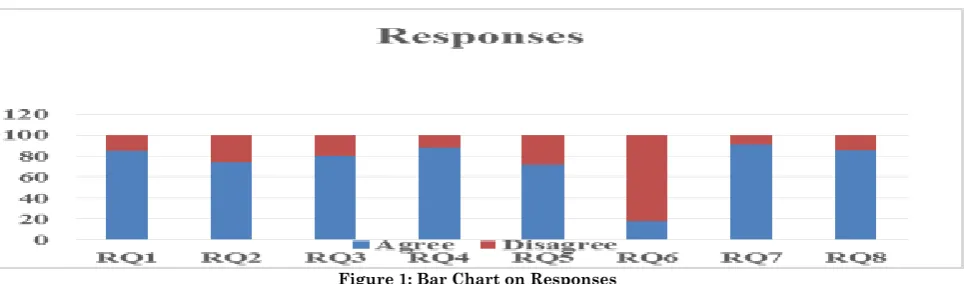
70 Table 1:Responses on Research Questions
Research Questions Agree
(%) Disagree (%)
RQ1: Simplification in the procedure of recording individual and
consolidated books of accounts 85 15
RQ2: Disclosure practices and Transparency 74 26
RQ3: Improvement in information for Decision Making 80 20 RQ4: Better inter-company and intra-company comparison 88 12
RQ5: Reduction in cost of capital 72 28
RQ6: Easier Merger & Acquisitions 18 82
RQ7: Better corporate governance 91 9
RQ8: Easier Internal audits 86 14
Source: Authors’ Calculation
Simplification in the Procedure of Recording Individual and Consolidated Books of Accounts
IFRS being the set of standards that needs to be followed uniformly by all the companies will improve the process and bring consistency in the financial reporting. The results of the analysis show that the majority of respondents (85 percent) felt that the implementation of IFRS would simplify the procedure of preparing individual and group financial statements. While 15 percent of the respondents do not agree on the same, the knowledge regarding the process of implementing IFRS also needs to be imparted.
Disclosure Practices and Transparency
Disclosure practices and transparency allows stakeholders to access financial information about the company [24]. Adoption of IFRS will ensure a better picture of firms’ financial statements. The respondents (74 percent) agreed that adopting IFRS will help make organizational and financial decisions as it will ensure higher disclosure and transparency with financial reporting. On the contrary, some respondents (26 percent) felt that the adoption of IFRS wouldn't make any difference in the disclosure practice, and companies will still report limited information in their financial statements.
Improvement in Information for Decision Making
The information regarding the declaration of assets and liabilities in the balance sheet of the company will improve if the companies report as per IFRS [25]. Eighty percent of the respondents suggested that decision making will be enhanced. The findings reported during the survey recommend that statistically the males (Mean= 2.68, Standard Deviation= 1.18) have significantly higher agreement on the improvement in information disclosure as compared to females (Mean= 1.08, Standard Deviation= 0.277) with t-value= 6.532 and p-value <0.005.
Better Inter-company and Intra-Company Comparison
The stronger unification of IFRS will grow by creating awareness about the benefits of adopting IFRS by Indian companies. The inter-company and intra-company comparison will become easy because of the similar style of reporting. The majority of respondents (88 percent) felt that organized reporting practices would improve the inter-company and intra-inter-company comparison while the other 10 percent doesn't strongly agree to that.
Gupta & Gaur| July-August 2019 | Vol.8| Issue 4 |67-72
71
Reduction in Cost of Capital
One of the specific outcomes with acceptance of IFRS will be the reduction in the cost of capital of the company [26]. The cost of capital is considered to be important while making financial decisions, as it is treated as a discount rate for free cash flow for the company. As per the survey results, respondents (72 percent) felt that IFRS would reduce the cost of capital.
Easier Merger & Acquisitions
Business combination summarizes the method when an acquirer accesses full control over a business (i.e., merger or acquisition). IFRS 3 is drafted with regard to business a combination which was revised recently. The standard uses the "acquisition method," i.e., acquiring assets and liabilities at the fair value prices. The major proportion of respondents (82 percent) felt that IFRS would not make mergers and acquisitions easy; rather, it may complicate the procedure.
Better Corporate Governance
Managing interest of many stakeholders of the company, corporate governance provides a structured set of rules and regulations to protect the integrity, accountability, and liquidity of the organization. The greater part of the respondents (91 percent) supported the statement and identified that corporate governance would enhance with the adoption of IFRS in India. The other 9 percent felt that corporate governance wouldn't be affected. Though, corporate governance presents various benefits, i.e., stronger confidence of investors, a positive effect on the share prices, brand formation & development and corporate success & economic growth.
Easier Internal Audits
Internal audit helps to assess and promote the efficiency of risk management and regulate policies in the firm. It provides the company with the laws and regulations, maintaining authentic and appropriate financials. The internal members of the company do internal audits. The dominant portion of the respondents (86 percent)
agrees that after a single set of standards are adopted in India; it will become easier for the auditors to determine the effectiveness of the firm.
Conclusion
This paper offers insights into the opinions of Chartered Accountants on the adoption of IFRS. These standards are still not been fully implemented in India. The gap that prevails globally in the reporting structure because of financial, social, political, and legitimate diversification between countries can be cut down by bringing consistency in the accounting practices. The purpose for strengthening the system is to encourage the financial specialists and stakeholders to get a far-fetched image of the economic assets of the country.
Many organizations have put in continual attempt in achieving the worldwide harmony in accounting and reporting practices. Though, full concordance has not been accomplished because some countries still don’t have forceful professional bodies, financial awareness, divergent in intent of reporting practices and pervasiveness of various legitimate frameworks in various nations. The paper raised eight research questions and opinions of Chartered Accountants were then interpreted.
The results show that adoption and implementation of IFRS will be successful in India, and it should be adopted by all the listed companies so that uniformity in the reporting can be achieved. Therefore, from the above survey and analysis, it is clear that IFRS and its adoption in India are not only beneficial to Indian companies but also will facilitate entering in the foreign capital market as a harmonized standard for accounting will lead to better, efficient and effective accounting in all the companies.
The study suffers from some limitations; IFRS is in its initial stages in India. , and knowledge on IFRS is lacking in small scale businesses. The study is limited to only 35 respondents. Chartered Accountants denied filling the questionnaire. Also, the study is only limited to Delhi.
References
1.Bushman R, Piotroski J, Smith A (2005) Capital allocation and timely accounting recognition of economic losses: International
Gupta & Gaur| July-August 2019 | Vol.8| Issue 4 |67-72
72
2.Leuz C, Verrecchia R (2000) the economic consequences of increased disclosure, Journal of Accounting Research, 38(Suppl.):91-124. 3.Young D, Guenther DA (2003) financial
reporting environments and international capital mobility. Journal of Accounting Research, 41(3):553-579.
4.Burgstahler DC, Hail L, Leuz C (2006) the importance of reporting incentives: Earnings management in European private and public firms. The accounting review, 81(5):983-1016. 5.Quigley J (2007) Deloitte & Touch world
meeting. Berlin, Germany.
6.Street DL, Linthicum CL (2007) IFRS in the US: It may come sooner than you think: A commentary. Journal of International Accounting Research, 6(1): ix-xvii.
7.Jeanjean T, Stolowy H (2008) Do accounting standards matter? An exploratory analysis of earnings management before and after IFRS adoption. Journal of accounting and public policy, 27(6):480-494.
8.Ball R (2001) Infrastructure requirements for an economically efficient system of public financial reporting and disclosure. Brookings-Wharton papers on financial services, 1:127-169.
9.Frankel R, Li X (2004) Characteristics of a firm's information environment and the information asymmetry between insiders and outsiders. Journal of Accounting and Economics, 37(2):229-259.
10. Hung M (2001) Information and trading risks in global investing: an empirical analysis of research location and Pacific Rim mutual fund performance. Journal of International Financial Management & Accounting, 12(1):1-23.
11. Aharony J, Lee CWJ, Wong TJ (2000) Financial packaging of IPO firms in China. Journal of Accounting Research, 38(1):103-126.
12. Chen KC, Yuan H (2004) Earnings management and capital resource allocation: Evidence from China's accounting-based regulation of rights issues. The Accounting Review, 79(3):645-665.
13. Wong TJ, Jian M (2003). Earnings management and tunnelling through related party transactions: Evidence from Chinese corporate groups. In EFA, Annual Conference, 549.
14. Zhou H, Xiong Y, Ganguli G (2009) does the adoption of international financial reporting standards restrain earnings management? Evidence from an emerging market. Academy of Accounting and Financial Studies Journal, 13-43.
15. Feldman RA, Kumar MS (1995) emerging equity markets: growth, benefits, and policy concerns. The World Bank Research Observer, 10(2):181-200.
16. Hung M, Subramanyam KR (2007) financial statement effects of adopting international accounting standards: the case of Germany. Review of accounting studies, 12(4):623-657.
17. Bartov E, Goldberg SR, Kim M (2005) Comparative value relevance among German, US, and international accounting standards: A German stock market perspective. Journal of Accounting, Auditing & Finance, 20(2):95-119. 18. Barth ME, Landsman WR, Lang MH (2008)
International accounting standards and accounting quality. Journal of accounting research, 46(3):467-498.
19. Capkun V, Jeny A, Jeanjean T, Weiss LA.(2008) Earnings management and value relevance during the mandatory transition from local GAAPs to IFRS in Europe. Available at SSRN 1125716.
20. Wang S, Welker MA (2008) Timing equity issuance in response to mandatory accounting standards change in Australia and the European Union.
21. DeFond M, Hu X, Hung M, Li S (2011) the impact of mandatory IFRS adoption on foreign mutual fund ownership: The role of comparability. Journal of accounting and economics, 51(3):240-258.
22. Ahmed K., Goodwin J (2007) an empirical investigation of earnings restatements by Australian firms. Accounting & Finance, 47(1):1-22.
23. Gjerde Ø, Knivsflå K, Saettem F (2008) the value-relevance of adopting IFRS: Evidence from 145 NGAAP restatements. Journal of International Accounting, Auditing and Taxation, 17(2):92-112.
24. Tsalavoutas I, Dionysiou D (2014) Value relevance of IFRS mandatory disclosure requirements. Journal of Applied Accounting Research, 15(1):22-42.
25. Ball R (2006) International Financial Reporting Standards (IFRS): pros and cons for investors. Accounting and business research, 36(sup1):5-27.