Volume 25 (2010)
Proceedings of the Workshop
Visual Formalisms for Patterns
at VL/HCC 2009
Pattern Catalogs using the Pattern Language Meta Language
Andreas Wolff, Peter Forbrig
11 pages
Guest Editors: Paolo Bottoni, Esther Guerra, Juan de Lara
Managing Editors: Tiziana Margaria, Julia Padberg, Gabriele Taentzer
Pattern Catalogs using the Pattern Language Meta Language
Andreas Wolff1, Peter Forbrig2
1[email protected]2[email protected] http://wwwswt.informatik.uni-rostock.de
Universit¨at Rostock, Germany Institut f¨ur Informatik
Abstract: This article focuses on the pattern language PLML. Some enhancements and corrections to it are proposed to make use of PLML in pattern catalogs. Addi-tionally, a textual domain specific language as human-readable variant of PLML is proposed. Supporting editors, textual and graphical, which were developed using model-based techniques are presented.
Keywords: HCI pattern, pattern language, model-based editor
1
Introduction
Object-oriented design patterns, as introduced by Gamma et al. [GHJV02], are considered a valuable aid in software development. Patterns were identified in many other domains of com-puter science. One such domain is human comcom-puter interaction (HCI). HCI patterns do exist for many different aspects of the user interface of an application. For example for navigation through an interface, its layout, input modalities or presentation.
A number of pattern catalogs has been compiled by the HCI community. Well known exam-ples are the catalogs of Tidwell [Tid] and Van Welie [vW]. On examining HCI patterns in those catalogs one soon discovers certain problems:
• There is no consistent naming of patterns across those collections. Multiple entries for what is essentially the same pattern are likely.
• Intra-catalog references are rare, cross-catalog references almost non-existant.
• Aspects of a pattern that are detailed in a pattern entry differ. This is not only in naming but also in extent. (e.g. a problem or solution description is omitted)
• The abstraction level differs from pattern to pattern.
• The pattern solution is given very informal, mostly text accompanied by pictures for illus-tration purposes.
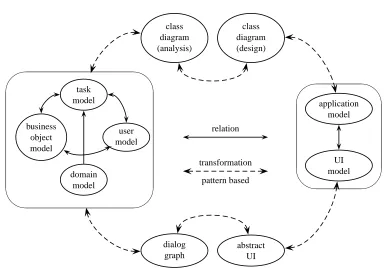
task model user model business object model domain model ' & $ % dialog graph abstract UI class diagram (analysis) class diagram (design) application model UI model ' & $ % relation transformation pattern based
Figure 1: General view on a transformational model-based development process
basic constraints. Therefore PLML itself does not overcome the lack of formalization problem mentioned earlier. Section 2 of this paper presents PLML in some detail and also introduces some enhancements proposed by us.
In our research we develop a pattern-based approach to model-driven user interface engi-neering. Therein we consider software development as a sequence of transformations of models. Figure 1shows the source and target models and the in-between transformations of our approach. Further details of this process are described for example in [WFDR05].
More important, than the details of our approach, for the scope of this paper is the ubiquitous use of pattern-based transformations. One consequence of this was the need to specify those transformations. Our goal always was to create a semi-automatic human-controlled overall pro-cess, which will be supported by appropriate tools for every transformation step. Therefore we had to store patterns in a machine readable manner.
The current focus of our research is the lower part ofFigure 1, the generation of user inter-faces (UI). We attempt to represent HCI-patterns for UIs in a suitable way so they can be used within our MDA process. This is done by transforming the pattern idea into a so-called pattern instance component (PIC). Such a PIC is basically an attributed template that may include some programming logic. It is called instance component, since we consider the template to be already an instance of the pattern that is described through this component. We are aware of the fact that, due to their nature, not all known HCI patterns can be treated as or translated into an algorithm or a PIC.
investigated and, where possible, created usable components of design patterns for the Eiffel programming language.
The language used for our pattern instance components is domain specific to user interfaces, it was outlined in [RWF06]. Nevertheless, it is a XML-based language and therefore it is possible to contain it in or link to it from most existing pattern languages.
As our whole approach is model-based, we developed a pattern language that also is based on models. It is compliant to PLML and able to hold PICs. Also it is possible to store pattern descriptions of patterns whose solution cannot be specified using a PIC. The rest of this paper presents this pattern language. Section 3 shows a textual domain specific language (DSL) as interface to our catalog. InSection 4a possile graphical interface is discussed and generated as model-based graphical editor.
2
Pattern Language Meta Language
2.1 Overview PLML
The pattern language meta language PLML was developed by a group of stakeholders during a workshop. The idea behind, was to formalize the description of patterns to eventually merge all existing pattern languages or at least to have a general interchange format. It was designed to be able to describe patterns on any abstraction level and of any domain. Beside the pure pattern description a number of identifying meta data became standardized.
<!ELEMENTpattern (
name?, confidence?, alias∗, synopsis?, illustration?,
context?, problem?, forces?, evidence?, solution?, diagram?, implementation?, related−patterns?, pattern−link∗,
literature?, management?)> <!ELEMENTmanagement (
author?, revision−number?, creation−date?, last−modified?, change−log?, credits?)>
<!ATTLISTpattern
patternIDCDATA #REQUIRED collectionCDATA #REQUIRED
>
<!ATTLISTcontext mylabelCDATA #IMPLIED> <!ATTLISTpattern−link
typeCDATA #REQUIRED patternIDCDATA #REQUIRED collectionCDATA #REQUIRED labelCDATA #REQUIRED
>
Listing 1: DTD of the PLML standard [PLM]
Element Description
patternID Collection-unique id of a pattern name Name, as short as possible alias Alternative names
illustration Picture that illustrates a particularly good pattern instance problem Design situation which the pattern addresses
context Conditions when application of a pattern is most useful forces Forces which are resolved by application of the pattern solution Instructions to follow the idea of the pattern
synopsis Summary of the pattern idea
diagram Schematic visualization of the pattern, sketched or formal evidence Justification that a pattern actually is a pattern by:
example - known uses
rationale - principled reasons, axioms, common sense or the like confidence Star rating whether the entry is a true pattern (0 to 2 stars) literature References to related work
implementation Code or fragments of code or other technical documentation related-pattern Container for connections to other patterns
pattern-link Connection to other pattern:
type - kind of connection, either of is-a, is-contained-by, contains patternID - connection endpoint
collectionID - connection endpoint in collection named collectionID label - descriptive text of connection
Table 1: Summarization of the meanings of PLML’s language elements [Fin03]
explanatory.
As mentioned before, the degree of freedomListing 1permits was modeled deliberately. How-ever, some aspects that are discussed in the workshop report [Fin03] were not put into the stan-dard. Additionally there is a lack of meta-data storage area if PLML is used to actually build a pattern catalog.Subsection 2.2outlines our enhancements to PLML and provides a rationale for each amendment.
2.2 Enhancing PLML
Building a pattern catalog using PLML, as defined inSection 2, quickly reveals a first problem. There is no root element to attach the entries to. Also no XML-tags are reserved to describe the catalog itself, i.e. its authors, revision or certain dates. Listing 2introduces such a catalog root element to meet these basic requirements. Attributes are provided to name a catalog and assign a global identificator to it. The latter feature is needed for cross-catalog pattern-links. Other, catalog describing, meta-data is stored using the already existing element management.
idCDATA #REQUIRED nameCDATA #IMPLIED>
Listing 2: Introducing catalog meta information into PLML
The PLML explanation in [Fin03] explains that the confidence, whether an entry is a true pattern, is expressed using a star rating. It is possible to include this into the document type definition of PLML.Listing 3defines an attribute level for the element confidence and limits its value space to one of the three entries. The element confidence is redefined to not contain content any more. Through this amendment the notation of confidence levels is fixed and therefore easy to parse.
<!ENTITY % confidenceLevels”(0|∗|∗∗)”> <!ELEMENTconfidenceEMPTY>
<!ATTLISTconfidence level %confidenceLevels;#REQUIRED>
Listing 3: Narrowing the value space of confidence information
The PLML standard often refers to illustrations to describe certain aspects of a pattern. Nev-ertheless, there was little support to actually integrate pictures or at least resource locators of pictures in a catalog. While it is possible to include pictures as binary data in an XML docu-ment, we resorted to annotate URLs of pictures in our pattern entries. Listing 4defines optional url attributes for three PLML elements.
<!ATTLISTcontext urlCDATA #IMPLIED> <!ATTLISTdiagram urlCDATA #IMPLIED> <!ATTLISTexample urlCDATA #IMPLIED>
Listing 4: Annotating picture URLs to certain elements
Another notable change to the original standard was to allow pattern-link only as subelements of related-pattern. Also there were minor changes to the representation of management meta-data.
3
PLML as textual DSL
PLML was designed as storage and interchange format, human-readability was not of primary concern. But, when writing and maintaining a catalog it is sometimes inconvenient and error-prone to edit in XML structures. There are different ways to cope with this situation. One solution is to use dedicated XML editors or to develop a specialized editor.
Since we work in a model-based context we decided to create a dedicated PLML editor using model-based technology. We defined a grammar for a textual domain specific language (DSL) resembling PLML. From this grammar we generate a fully featured text editor and a meta-model of PLML. Having a proper meta-model enables us to easily include the patterns of the catalog within our software engineering approach ofFigure 1. The meta-model also is a prerequisite to keep our pattern catalog compliant to PLML standard. Using the model it is very straightforward to generate valid PLML from our modified pattern language and thus adhere to the interchange-ability concept of PLML.
generates a text editor and an EMF Ecore [emf] meta-model. Through simple customizations this text editor supports:
• Syntax highlighting, keywords or structuring elements are emphasized
• Syntax completion, there is an editing help which offers keyword completion within the text editor
• Error checking, the text is permanently checked against the language grammar and viola-tions are marked within the editor.
• A structured outline view provides an overview and simple navigation through the catalog.
A xText grammar is context-free and its notation is EBNF-like. Nonterminal symbols start with a capital letter, terminal symbols are in quotation marks. Several syntax elements and predefined types were introduced through xText to derive better meta-models.
RelatedPatterns:
”RelatedPattern” ”{”(references+=PatternLink)∗”}”; PatternLink:
type=PatternLinkType”id=”targetId=STRING (hasCollection?=”collection=”collection=ID)? (hasLabel?=”label=”label=STRING)?; EnumPatternLinkType:
isA=”is−a”|containedIn=”is−contained−by”|contains=”contains”;
Listing 5: Grammar for a pattern-link entry
Listing 5is an excerpt from the xText grammar of PLML. It shows the specification of pattern re-lations. A pattern-link is specified using the nonterminal PatternLink. PatternLinks occur within the nonterminal RelatedPatterns. RelatedPatterns is defined as starting with the terminal (or String) ”RelatedPattern” followed by zero-to-many PatternLinks included in curly braces within the text. In the meta-model every PatternLink will be stored in the references aggregation of the RelatedPatterns type. HasCollection and hasLabel are simple markers, they are interpreted as boolean values to easily check whether a collection or label value was set at all. The enumer-ation type PatternLinkType restricts the value space of the PatternLink type to one of the three values, this is very much like inListing 3for confidence level stars.
The xText framework parses the grammar into an ANTLR grammar. ANTLR [ant] is an object oriented parser generator. XText uses ANTLR to generate parser and lexer for the text editor.
CatalogSampleCatalog MasterData{
Author”Andreas Wolff”
CreationDate2008−12−31 Revision1.0.2
}
Alias”feedback”collectionhciPatterns
Problem”Decide a binary question or cancel the current operation”
Evidence{ Rationale
”A user should be able to cancel an operation,
not only decide between two possibly undesired consequences”
}
Confidence∗∗ RelatedPattern{
containsid=”yn”
}
MasterData{ Author”andreas”
CreationDate2009−02−15 Revision1.0
} }
Listing 6: Catalog containing one pattern entry using our textual DSL
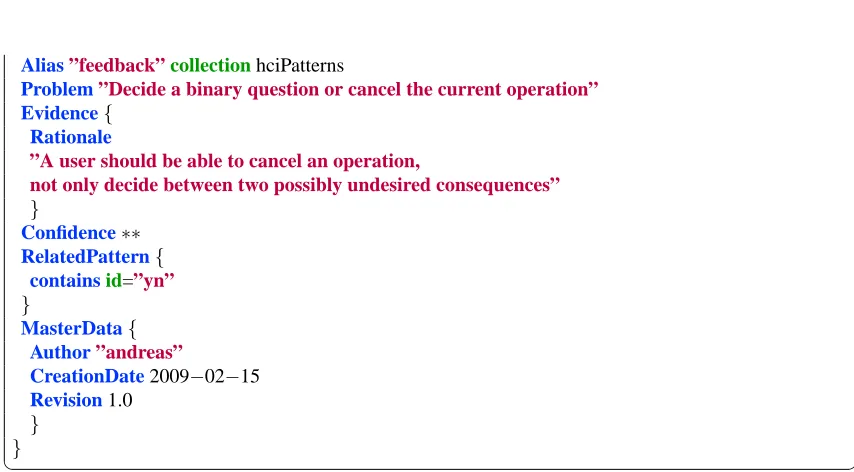
InListing 6a sample catalog can be seen. This catalog contains only a single pattern description, the ”Yes-No-Cancel” pattern [Pet] which got the id ”ync” assigned. The confidence in ”ync” be-ing a pattern is high and it is related to a pattern ”yn” within the same catalog. ”ync” is also known as the pattern ”feedback” in another catalog which has the id ”hciPatterns”. A problem description and a rationale for this pattern are given textually, no illustration or diagrams are used.Listing 6is a minimum example to illustrate the idea.
Figure 2shows the meta-model which was derived from the grammar. Again, to reduce com-plexity, it is only an excerpt of the complete model. Type Management is actually not an empty class. Catalog management data has been left out too. The enumeration PatternLinkType which consists of three constant values is also not displayed.
While the pattern catalog itself is a plain-text file, the data it contains is accessed via instances of the meta-model. XText parses the catalog text file and builds such instances from the textual entries. The root class of the model is the type Pattern, whose objects have an association to an object of class PatternDescription. PatternDescription is a container class where most aspects of a pattern are defined by creating aggregrations to their respective types.
4
Graphical representation of PLML
The meta-model of PLML is a useful tool. It can be used to generate a graphical editor or viewer for PLML based catalogs. There is another model-based framework to construct such editors from EMF Ecore models, the Eclipse Graphical Modeling Framework (GMF) [gmf]. GMF pro-vides runtime components and a generator framework to build graphical editors, these editors are generated as Eclipse plugins. A number of auxiliary models are necessary within this process:
Figure 2: Overview of the meta-model of PLML
described here.
• GMFTool describes the various menus, toolbars and the palette of an editor.
• Ecore is the underlying meta-model of the application domain.
• Genmodel is for generating source code for access and modification of the model
in-stances.
• GMFMap merges above four models. The mapping model defines how meta-model
ele-ments are mapped on diagram nodes or connections. Other mappings include the connec-tion between menu entries and diagram nodes.
• GMFGen is the basis for editor generation. It is derived from the mapping model GMFMap.
As it is the very last step before generating the actual editor, a lot of fine tuning can be ex-ecuted here.
An important decision for every meta-model class and attribute is whether and how to display it in an editor. Basically every such element can be a free-form figure or a connection link or a label or a composed figure or have no figure at all. Property sheets are assigned to every class figure. This way properties that are not displayed as a figure are editable anyway. In GMF-editors we can also choose to display elements as container, i.e. that they can have children within their graphical representation.
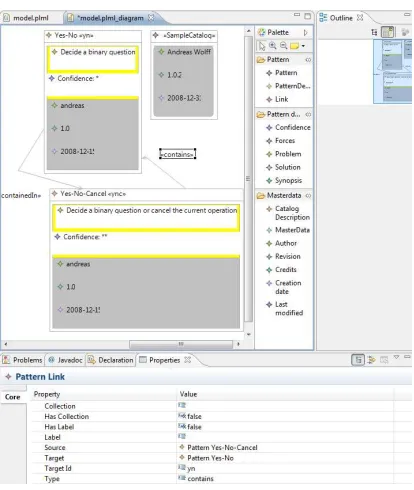
Figure 3: Graphical PLML editor in Eclipse
sheet.
After all mappings are done GMF generates a complete graphical editor as Eclipse plugin. Figure 3is a screenshot of such an editor. For this specific editor the master data of the catalog itself was mapped to an own graphical element. Two patterns are defined in this catalog and a bi-directional relation exists between them. The lower pattern node (Yes-No-Cancel) is the re-sult of the textual definition inListing 6. The other pattern node for a Yes-No pattern is defined very similar. Only the containment relation was reversed and the confidence for Yes-No to be a pattern was set to 1-star. InFigure 3the pattern relation ”contains” between Yes-No-Cancel and Yes-No was selected within the editor window. The property sheet below shows all attributes of this relation. Changing the attribute values here directly effects the content of the editor.
The property sheet of the link reveals two attributes which are not defined in the meta-model of Figure 2. Attributes source and target were introduced while preparing the GMFMap mapping model, both are of type Pattern. They were specified to be derived and transient, i.e. their value is a direct consequence of other attribute values and they therefore need not to be serialized. The value of target for example is the pattern object whose id equals the targetID of the PatternLink. Another notable difference is in Confidence. The meta-model declares three boolean at-tributes, this is a direct result from xText’s grammar to model transformation. I.e. these attributes are a technical necessity, but somewhat impractical. To visualize the true confidence level a star-like labeling was desired. So again an transient derived attribute label was introduced whose value is displayed instead of the booleans.
modification of the meta-model edit code, which was generated using the Genmodel, getting and setting the value of the derived attributes also modifies the underlying data attributes.
Using GMF for the graphical editors enables us to quickly modify the editors. Since most of the editors source code is generated from the models we can easily try out many kinds of visualizations. This is not only about the layout or form or color of a certain diagram node. Through changes in the mapping model we could pursue a completely different idea of graphical containment. But of course, all such editors would only be different views on the very same data. The catalog data itself will always be serialized using the textual DSL ofSection 3.
5
Conclusion
This paper describes the pattern language PLML. It is a XML-based language which can be used to define pattern catalogs. Certain modifications to its original standard were proposed in the paper to repair some issues with applying PLML in a real catalog.
PLML is used as the pattern container in an integrated model-based environment. Therefore the pattern language was backed with model-based editing tools. A textual DSL has been presented that makes it easy to edit the pattern catalog using standard text editors. At the same time this DSL is the meta-model or rather forms the foundation of an EMF Ecore meta-model of the pattern language.
Two separate editors for the DSL where derived from models. The first is an advanced text editor, that supports typical developer features like syntax highlighting and auto-completion. A second editor is a graphical editor that was developed using the eclipse graphical modeling framework. It was shown that such generated editors are highly flexible in terms of the graphical representation of the language elements.
Bibliography
[ant] ANTLR - Another Tool for Language Recognition.http://www.antlr.org, last visited 6th June 2009. University of San Francisco.
[Arn04] K. Arnout. From Pattern to Components. PhD thesis, ETH Zurich, 2004.
[emf] Eclipse Modeling Framework Project. http://www.eclipse.org/modeling/emf/? project=emf, last visited 6th June 2009. Eclipse Foundation.
[EV] S. Efftinge, M. Voelter. oAW xText: A framework for tex-tual DSLs. http://eclipsesummit.org/summiteurope2006/presentations/ ESE2006-EclipseModelingSymposium12 xTextFramework.pdf, last visited 6th June 2009.
[Fin03] S. Fincher. Perspectives on HCI patterns: concepts and tools (introducing PLML). In Workshop at CHI 2003. Sept. 2003.
[gmf] Eclipse Graphical Modeling Framework Project.http://www.eclipse.org/modeling/ gmf/, last visited 6th June 2009. Eclipse Foundation.
[Pet] R. Petrasch. Model Based User Interface Design: Model Driven Architecture und HCI Patterns. http://pi.informatik.uni-siegen.de/stt/27 3/03 Technische Beitraege/ MDA HCI Patterns Petrasch Short.pdf, last visited 6th June 2009.
[PLM] DTD of PLML. http://www.hcipatterns.org/tiki-download file.php?fileId=7, last visited 6th June 2009.
[RWF06] R. Rathsack, A. Wolff, P. Forbrig. Using HCI-Patterns with Model-based Generation of Advanced User-Interfaces. In Pleuss et al. (eds.), Proceedings of the MoDELS’06 Workshop on Model Driven Development of Advanced User Interfaces. Genova, Oct. 2006.
http://sunsite.informatik.rwth-aachen.de/Publications/CEUR-WS/Vol-214/
[Tid] J. Tidwell. Pattern library.http://www.designinginterfaces.com, last visited 6th June 2009.
[vW] M. van Welie. Pattern library.http://www.welie.com/patterns/index.php, last visited 6th June 2009.
![Table 1: Summarization of the meanings of PLML’s language elements [Fin03]](https://thumb-us.123doks.com/thumbv2/123dok_us/7812876.2086371/5.595.114.473.154.460/table-summarization-meanings-plml-s-language-elements-fin.webp)