Mobile Library Service Strategy
Final Report
March 2013
1. Introduction and Context
1.1 The primary duty of Libraries NI, as set out in the Libraries Act (Northern Ireland) 2008, is to provide a comprehensive and efficient public library service for persons living, working or studying in Northern Ireland.
1.2 One of the key targets established for Libraries NI by the Department of Culture, Arts and Leisure (DCAL) from the outset was to undertake a strategic review of library provision within Northern Ireland with a view to ensuring it is fit for purpose and sustainable. Following the strategic reviews of branch libraries, Libraries NI turned its attention to mobile library services. 1.3 In July 2011 the Board considered a report which gave an overview of
current mobile library services, identified the issues which needed to be addressed and set out a process for addressing these issues. This report, which provides the context for the development of the strategy, appears at Appendix One.
1.4 At this stage Libraries NI considered the four services that fall under the broad heading of ‘mobile services’.
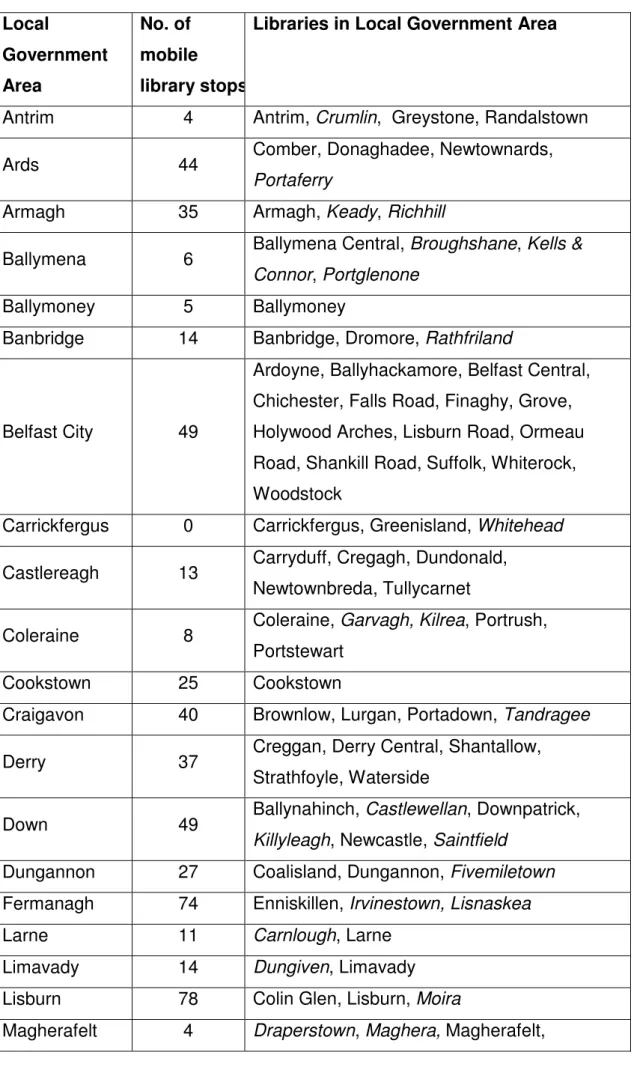
a) the ‘general mobile library’, the service which is most familiar, i.e. a vehicle which visits locations some distance from a branch library to lend books and other stock and, in some cases, to provide access to ICT. Libraries NI has 18 such vehicles, which cost an average of £50,000 per annum and generate an average of 16,000 loans. They serve the general population on a weekly, fortnightly or three weekly basis and visit a limited number of schools and playgroups
b) the Homecall service, the service which is provided for “anyone who has significant difficulty in visiting a branch or mobile library due to ill health, disability or lack of mobility and who does not have anyone who can collect library materials for him/her”. This may be provided via a dedicated mobile library, a dual purpose mobile library or a delivery van c) a service, normally a collection of books which is retained for three
months, to nursing homes, folds and day centres
d) the E Express, a mobile with 8 computers on it and satellite connectivity.
1.5 A way forward was agreed for each service and the need to develop a new strategy for the general mobile library service was identified.
1.6 The need for a new strategy stemmed from a number of factors including: • the very different approaches to mobile services inherited from the five
Education and Library Boards (differences include frequency and length of stops, criteria for stops, loan period, staffing, access to ICT, stock provision)
• relatively low levels of use (though customer satisfaction was very high) • lack of clarity about the intended users of the service
• lack of clarity about the services required. 1.7 The Board agreed that the service strategy should:
• identify the target groups to be served by mobile libraries
• identify the services that are required (particularly in the context of the limited space available on a mobile library)
• identify the most appropriate approach to ICT provision, taking account of customer need and the practical constraints on service provision • take account of equality and rurality issues
• seek to maximise access to services • seek to maximise use of mobile libraries • deliver a harmonised and equitable service
• identify criteria for mobile library stops (e.g. distance from branch library, TSN, minimum use level, minimum population level)
• consider whether schools and/or playgroups should be served • consider how mobile library services can be promoted.
1.8 In December 2011 the Services Committee considered the findings of the mobile user survey which had been undertaken in June 2011. This revealed high satisfaction levels and provided further insights into the demographics of mobile users.
1.9 The customer survey informed the development of the service proposals which formed the basis of the draft strategy.
1.10 At the meeting of the Services Committee in December 2011 it was agreed that consultation on the draft mobile library strategy should be deferred until September 2012. This was to ensure an effective consultation process with maximum participation, clearly separated from the consultations in 2011 on the Strategic Review Stage Two and the Opening Hours Review and the local consultations in January 2012 on the patterns of opening hours.
2. Consultation Proposals
2.1 The draft mobile library service strategy was based on five service proposals: • target groups (Mobiles to primarily serve the needs of older people,
children and their carers)
• services to be provided (Mostly books and talking books rather than ICT)
• criteria for service delivery (Rural areas – 3 miles from a branch library, minimum 5 users. Urban areas – area of social need, minimum of 5 users, not within easy access of a branch library)
• services to schools and playgroups (Service currently in some areas and not others, to be extended)
• increasing usage (Suggestions sought for achieving this) 2.2 The proposals appear at Appendix Two.
3. Consultation
3.1 Public consultation on the proposals ran from 24 September 2012 to 14 December 2012 and included the following:
• publication in hard copy and on the Libraries NI website of the consultation document
• questionnaires which were made available on every mobile library and on the public access computer terminals in branch libraries and online on the Libraries NI website. A copy of the adult and children’s questionnaires is included as Appendix Three
• briefing the Culture, Arts and Leisure Committee twice • meetings with the recognised trades unions
• a draft Equality Impact Assessment, published at the same time as the proposals, which has since been updated to take account of the comments received and through engagement with Section 75 consultees
• a draft Rural Impact Assessment. published at the same time as the proposals, which has since been updated to take account of the comments received and through engagement with rural consultees • letters to Section 75 and rural consultees.
3.2 The purpose of the public consultation process was to seek views on the proposals and to obtain any additional information which the Board of Libraries NI should consider in coming to a decision on the way forward. 3.3 The consultation was widely publicised. A press release was issued at the
start of the consultation process and part way through. In addition details of the proposals were sent to all Councils, MPs, MLAs and MEPs, also to the main education bodies.
4. Analysis of Responses to the Public Consultation
4.1 953 responses were received to the adult questionnaire and 255 to the children’s questionnaire. A summary of the report on the analysis of questionnaires in relation to each question appears at Appendix Four.
4.2 A number of submissions, letters and postcards were received from councils, politicians, rural organisations and individuals. A list of these, together with organisations which submitted a questionnaire response, appears at Appendix Five.
4.3 NIPSA was briefed on the proposals and, following detailed consideration, decided not to respond at this stage in the process.
4.4 As a result of the comments received throughout the public consultation process the draft EQIA has been updated and is included as Appendix Six to this report.
4.5 As a result of the comments received through the public consultation, including those from organisations with a specific rural remit such as the Ulster Farmers Union and South Antrim Community Network, the draft Rural Impact Assessment has been updated and is included as Appendix Seven to this report.
5. Analysis of Responses and Resulting Recommendations 5.1 Proposal One: Target groups
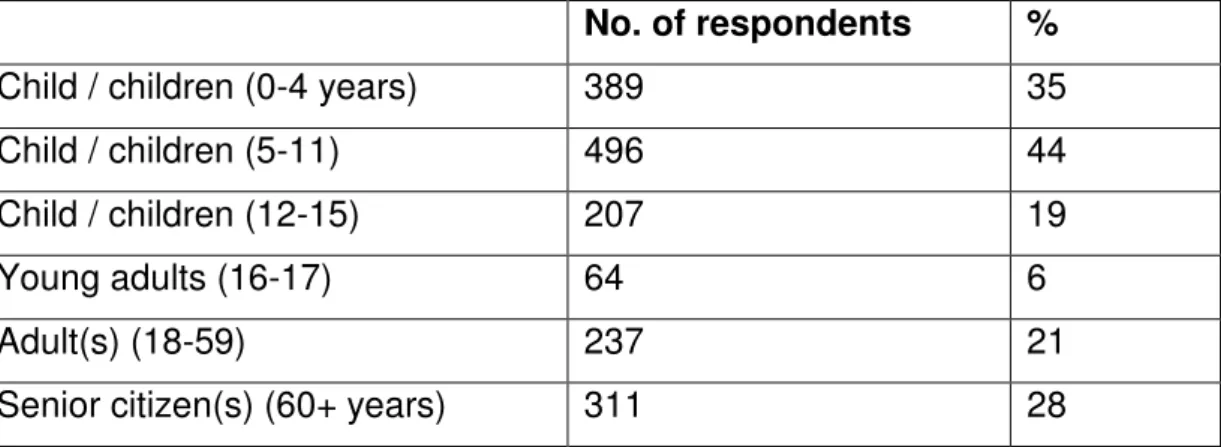
The recent customer survey shows that the mobile library service is primarily used by older, retired people and children of various age groups and their carers. Space on mobile vehicles is limited and it is not practical to carry an extensive range of materials for all age groups and interests.
5.2 In order to make the best use of the service, we propose that the space on mobiles will mainly be used to provide services for the target groups identified above. This would mean that more large print and talking books and more novels and popular non-fiction would be on the shelves, and a greater number of books for pre-school and early primary children would be available.
5.3 85.2% of the adult respondents agreed or strongly agreed with this proposal. The most frequent comment from those who disagreed was that the service should be for everyone. None of the written submissions disagreed with the proposal. Disability Action stressed the importance of ensuring that the needs of people with disabilities are met.
5.4 Recommendation
It is recommended that Libraries NI mobile services should mostly serve the needs of older people, children and their parent/carers. In doing this the needs of people with disabilities will be taken into account as with all library services e.g. stock for people with visual impairments, access for people who use wheelchairs, appropriate staff training.
5.5 Proposal Two: Services to be provided
The mobile library service has tried to provide the same range of services as a small branch library, including some access to the Internet as well as books, CDs, DVDs etc. A computer is currently provided on a small number of mobiles and this service is rarely used. The machine takes up valuable space that would otherwise be used for books. There are issues relating to connectivity, lack of privacy and the need to use the Internet more frequently than the mobile calls. Our view, confirmed by the results of the recent customer survey, is that mobiles serve people best for borrowing books including talking books and large print books.
5.6 We propose that mobile libraries should mainly deliver book lending services and should not provide Internet access.
5.7 90.3% of adult respondents agreed or strongly agreed with making books the main service on mobiles. 17.5% thought that Internet access should be provided whilst 36.5% thought it should not be provided. A number of organisations highlighted the importance of Internet access in rural areas. 99.6% of child respondents use the mobile library to borrow books.
5.8 Recommendation
It is proposed that mobile libraries should mainly provide book lending services. However, given the response to the consultation and the opportunities afforded by e2, it is recommended that the Libraries NI strategy
should be to provide Internet access on mobile libraries, where possible and where there is a demand, but in a way that does not reduce the provision of books.
5.9 Proposal Three: Criteria for service delivery (a) Setting criteria for determining mobile stops
Libraries NI needs to establish criteria for stops in order to provide an equitable service.
Our view is that criteria should be set for determining mobile stops and that they should focus on distance from branch libraries, customer demand and continued levels of use.
5.10 67.8% of adult respondents agreed or strongly agreed that there should be criteria for stops. The most frequent comment made by those which disagreed reflected concern that a current stop would be removed.
(b) Criteria for mobile stops in rural areas
The mobile library service strategy proposes the following criteria for a mobile stop in a rural area:
• at least 5 regular customers on an on-going basis with continued levels of use
• at least 3 miles from a branch library.
5.11 58.4% agreed with the proposed criteria for stops in rural areas. Those who disagreed suggested that 3 miles was too far, that 5 customers was too high or both. Again, the comments reflected concern that a current stop would be removed.
(c) Criteria for mobile stops in urban areas (i.e. the Belfast Metropolitan Urban Area and the Derry Urban Area).
The mobile library service strategy proposes the criteria for a mobile stop in an urban area to be:
• not within easy access of a branch or central library
• in an area of social need (i.e. within the top 10% most deprived wards)
• at least 5 regular customers on an on-going basis with continued levels of use.
5.12 61.3% of adult respondents agreed or strongly agreed with the proposed criteria for stops in urban areas. The comments from those who disagreed varied greatly. The most frequent comments were concern about the requirement for 5 people and opposition to limiting the service to the 10% most deprived wards. Some respondents thought that there should be no stops in urban areas. Again, the comments reflected concern that a current stop would be removed.
5.13 Recommendation
It is recommended that the proposed criteria for proposed stops should be implemented but that special circumstances may need to be recognised from
time to time e.g. the closure of a branch library, the commitment to existing customers, temporary circumstances that may reduce the accessibility of a branch library, DCAL or Board priorities.
5.14 Proposal 4: Services to schools and playgroups
At present some mobile libraries visit a number of schools and playgroups along the route. Capacity for providing this service is limited and we are aware that we cannot call at all the schools and playgroups that might be interested in the service. We do not wish to establish limiting criteria but we propose to make future decisions on whether individual requests can be met on the basis of:
• the level of need established by the school or playgroup, e.g. distance from a branch library
• whether the stop fits into the mobile route on a suitable day and time • whether the stop would adversely affect the use of a branch library • how well used the mobile would be.
5.15 69.1% of adult respondents agreed with the provision of services to schools and playgroups based on clear principles. It was suggested that the purpose of this service should be set out clearly.
5.16 Recommendation
It is recommended that the service to schools and playgroups should be extended with the aim of increasing access to library services for children and schools which have difficulty in accessing branch libraries, with account also being taken of social need.
5.17 Proposal 5: Increasing use
The mobile library service is valued by our customers but the overall level of use of the service is not high. We intend to do more promotion of the service and to ensure that the mobile libraries are used to capacity by making arrangements to visit more schools and playgroups, to provide services to individual children and their families.
5.18 Respondents made a number of suggestions for promoting the service. 5.19 Recommendation
It is recommended that following the implementation of the mobile strategy that, a promotional plan is developed and implemented.
5.20 Equality Issues
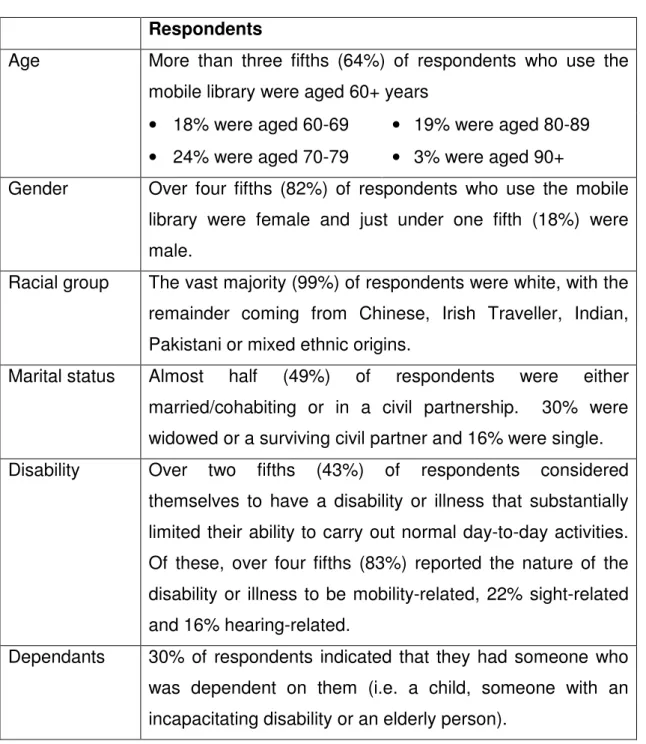
The EQIA concludes that the service proposals may result in some adverse differential impacts for existing customers in a number of Section 75 groups namely racial group, age, disability and dependants. This is because of the current profile of customers and these impacts would only occur in the situation where a local mobile stop was removed.
5.21 The EQIA also highlights the importance of ensuring the service meets the needs of people with disabilities, an important point which is addressed in paragraph 5.4 above.
5.22 There is no intention to disadvantage any existing customers as a result of the mobile strategy. Where a stop does not meet the criteria, Libraries NI will talk to customers about how they can continue to avail of library services. In many cases this may mean transferring to the Homecall Service, designed for people who cannot easily travel, usually for health related reasons.
5.23 Recommendation
It is recommended that, in implementing the mobile strategy, Libraries NI will take into account the evidence available from the EQIA and will consider what alternative measures might be put in place in order to reduce the impact of the removal of stops on people in the various Section 75 categories.
5.24 Rural Issues
The Rural Impact Assessment concludes that the proposals are generally beneficial for those who live in rural areas. The service proposals have the potential to produce some adverse impacts for customers in rural areas but these are not considered to be significant and will, in any case, be mitigated by the actions which Libraries NI proposes to take.
5.25 Some rural dwellers are concerned that they may lose their local mobile stops. However, there is no intention to disadvantage any existing customers as a result of the mobile strategy. Where a stop does not meet the criteria, Libraries NI will talk to customers about how they can continue to avail of library services. In many cases this may mean transferring to the Homecall Service designed for people who cannot easily travel, usually for health related reasons.
5.26 Some respondents, especially organisations, highlighted the importance of Internet access in rural areas. This can be addressed as set out in paragraph 5.8.
5.27 Recommendation
It is recommended that in implementing the mobile strategy Libraries NI will take into account the evidence available from the Rural Impact Assessment. 5.28 Support for the Mobile Library Service
Respondents, both adult and children, expressed a high level of appreciation of the service. Typical comments include:
“I enjoy visiting the mobile library. Apart from getting books myself I also get books for my grandchildren I look after them a few days per week. If they are here in the morning, they love to pick their own books.”
“We really think it’s great that the mobile library calls every 3 weeks. Reading is one of my hobbies so I really appreciate the call. The staff are really nice and friendly and this helps a great deal.”
“The mobile library is great, I can get my reading books or anything else that I require for my work at school and the staff are helpful and kind.”
The mobile library is really cool and I love going onto it to pick my books. The man who drives it is really helpful and I just love it! I’d really miss it if it wasn’t there every week.”
“The staff are friendly and helpful. There is also a great choice in books and I have gone there since I was little.”
5.29 It will be important to retain this level of support and commitment throughout the implementation of the strategy.
5.30 Delivering Tomorrow’s Libraries
DCAL has been considering its policy framework for public libraries, Delivering Tomorrow’s Libraries (DTL). Public Library Standard 2 in DTL relates to access to services and states: Percentage of households living within a specified distance of a static library or a scheduled mobile stop offering a range of library services open to the general public.
Target – 85% of households should have access to a library service within two miles.
This encompasses the mobile library service so that 85% of households are within two miles of a library, either mobile or static. A mobile stop should be for at least half an hour and call at least every two weeks. All types of service outlets will be calculated on the basis of postcodes returned by library authorities.
5.31 Currently some mobile stops are three weekly and do not count towards this standard.
5.32 The result of this is that Libraries NI fails to meet the standard currently, achieving 81.1% based on network analysis i.e. following roads rather than as the crow flies.
5.33 It is likely that DCAL will retain this standard and Libraries NI will need to factor this into the implementation of the mobile strategy.
5.34 Recommendation
It is recommended that the implementation of the mobile strategy should take account of the standard in Delivering Tomorrow’s Libraries.
6. Conclusion
6.1 In general there has been a high level of support for the draft mobile strategy. Some concerns have been expressed about some aspects of the proposals and mitigations for these concerns have been set out in section 5 above. 6.2 It is, therefore, proposed that Libraries NI adopts the strategy set out below
for its general mobile library service and that an implementation plan should be developed and brought to the Services Committee in April 2013.
Strategy
6.3 The mobile service is an integral and important part of Libraries NI’s service provision.
6.4 The service will mostly serve older, retired people and children of various age groups and their carers.
6.5 Mobile libraries will mostly provide book lending services. However, Internet access will be provided, where possible and where there is a demand, in a way that does not reduce the provision of books.
6.6 Criteria will be deployed for the location of mobile stops as follows: Rural areas
• at least 5 regular customers on an on-going basis with continued levels of use
• at least 3 miles from a branch library. Urban areas
• not within easy access of a branch or central library
• in an area of social need (i.e. within the top 10% most deprived wards) • at least 5 regular customers on an on-going basis with continued levels
of use
• at least 3 miles from a branch library.
However, special circumstances may need to be recognised from time to time.
6.7 The service to schools and playgroups should be extended with the aim of increasing access to library services for children and schools which have difficulty in accessing branch libraries, with account also being taken of social need.
6.8 Mobile services will be promoted to potential customers. Implementation of the Strategy
6.9 In implementing this strategy Libraries NI will:
• take into account the evidence available from the Equality Impact Assessment and the Rural Impact Assessment
• take account of the access standard in Delivering Tomorrow’s Libraries • be mindful of the goodwill and support shown by the current customer
base
• continue to monitor the costs and use of the service.
7. Decisions
7.1 At its meeting on 14 March 2013 the Board approved the Mobile Library Service Strategy set out in paragraphs 6.3 to 6.8 above with the addition of one further recommendation namely that the costs and usage of the mobile library service should be reviewed on a regular basis.
Appendix One Review of Mobile Library Services
Report to Board July 2011
1. Introduction
1.1 The term ‘mobile library services’ can in its broadest sense be used to describe four services:
a) the ‘general mobile library’, the service which is most familiar, i.e. a vehicle which visits locations some distance from a branch library to lend books and other stock and in some cases to provide access to ICT. Libraries NI has 18 such vehicles, one of which serves Libraries NI customers for 50% of the time as a cross border service provided to Donegal County Council under a service level agreement. They serve the general population on a weekly, fortnightly or three weekly basis and visit a limited number of schools and playgroups;
b) the Homecall service i.e. the service which is provided for “anyone who has significant difficulty in visiting a branch or mobile library due to ill health, disability or lack of mobility and who does not have anyone who can collect library materials for him/her”. This may be provided via a dedicated mobile library, a dual purpose mobile library or a delivery van;
c) a service, often a collection of books which is retained for three months, to nursing homes, folds and day centres; and
d) the E Express, a mobile with 8 computers on it and satellite connectivity. 1.2 The five Education and Library Boards took different approaches to many
aspects of mobile library services. Since 2009 Libraries NI has addressed a number of urgent operational and harmonisation issues and has procured new vehicles and provided staff training. However, most harmonisation issues can only be addressed sensibly once the strategic issues have been considered in the Review of Mobile Library Services scheduled for 2011/12.
1.3 In preparation for the Review the Services Committee received a presentation on mobile libraries in January 2011 and members availed of the opportunity to visit a mobile library. The key points of this presentation appear in Appendix A. Further information about mobile library services appears in Appendix B.
2. The Review of Mobile Library Services – Proposed Purpose and Methodology
2.1 The review relates in the main to the ‘general mobile library service’. Its purpose is to develop a service strategy for mobile libraries which:
• determines their role and purpose;
• identifies the contribution of mobile libraries to Libraries NI’s overall service provision in both rural and urban areas;
• identifies the services that are required (particularly in the context of the limited space available on a mobile library);
• identifies the most appropriate approach to ICT provision, taking account of customer need and the practical constraints on service provision;
• takes account of equality and rurality issues; • seeks to maximise access to services; • seeks to maximises use of mobile libraries; • delivers a harmonised and equitable service;
• identifies criteria for mobile library stops (e.g. distance from branch library, TSN, minimum use level, minimum population level);
• considers whether schools and/or playgroups should be served; and • considers how mobile library services can be promoted;
2.2 It is proposed that a consultation document be produced which sets out the issues relating to all of the above including an equality impact assessment and a rural issues statement. This would be made widely available and be used as a basis for discussions with interested organisations including councils, equality groups and rural groups as well as including a questionnaire to elicit views on the various issues.
2.3 Following a 12 week consultation period the findings would be analysed and a report brought to the Services Committee for consideration.
2.4 It is proposed that the other issues relating to mobile library services be addressed as follows:
E Express Explore how it can be used to deliver the Health in Mind project and Got IT sessions as per the Service plan for Key Themes. Evaluate.
Service to
residential homes and day centres
Develop a more efficient and effective approach to deposit collections based on as service level agreement.
Homecall Service No substantial change to the nature of the service received is planned. The way in which it is delivered is one of the operational issues to be addressed. Use of a smaller vehicle will be piloted.
Operational and harmonisation issues
Some should begin to be addressed now eg staffing roles, level and grades and data gathering. Others e.g. route planning can only be addressed once the general review has been concluded addressed.
3. Recommendations
It is recommended that the proposed approach to the review of mobile library services set out above be approved.
Appendix A
Key Slides from Presentation to Services Committee
Libraries on the Move
Books Plus
• Other formats of stock • ICT
• Events • Partnerships • Staff
Facts and Figures
• 18 mobile libraries • £50K each per annum • 8 are seven or more years old • 2 on order
• 16K average loans per annum (6K - 29K)
Facts and Figures
• 18 mobile libraries • £50K each per annum • 8 are seven or more years old • 2 on order
• 16K average loans per annum (6K - 29K)
The Big Questions
• Who should the mobile library serve? • What services do they require? • ICT?
Appendix B Additional Information about Mobile Library Services
Overview of services inherited by Libraries NI:
Former Board Area Criteria for Stops (Minimum Distance from Libraries) Number of Mobiles Late Nights – 8pm Saturdays Frequency of stops No. of staff per vehicle
BELB 2 Yes No weekly 2
NEELB 2 miles 3
Yes (Summer
only)
No 3 weekly 2
SEELB 2 miles urban
3 miles rural 4 Yes No 3 weekly 2
SELB 3 miles 4 No No 2 weekly 2
WELB 3 miles 5 No Yes 2 weekly 1
Vehicles
The majority of vehicles are under 7.5 tonnes which means that they can be driven by any driver with a pre 1997 driver’s licence and are suitable for most roads in Northern Ireland. It is intended that in future all vehicles should be less than 7.5 tonnes.
All vehicles should be less than 10 years old to ensure a reliable service which is not currently the case. A replacement programme is under way but the required capital funding is not available to sustain this.
ICT
There are connectivity issues for computers on mobile libraries which means that staff have to operate the Galaxy system in ‘back up’ rather than online. A limited number of mobile libraries provide public access to ICT. The level of use of this service is low.
Appendix Two Service Proposals
To achieve the objectives, the strategy is based on 5 proposals. Proposals 1 and 2 aim to make the best possible use of the space available on our mobile libraries. Proposal 3 is intended to make sure the service is equitable. Proposals 4 and 5 are designed to increase use.
Proposal 1: Target groups
The recent customer survey shows that the mobile library service is primarily used by older, retired people and children of various age groups and their carers.
Space on mobile vehicles is limited and it is not practical to carry an extensive range of materials for all age groups and interests. In order to make the best use of the service, we propose that the space on mobiles will mainly be used to provide services for the target groups identified above. This would mean that more large print and talking books and more novels and popular non-fiction would be on the shelves, and a greater number of books for pre-school and early primary children would be available.
Proposal 2: Services to be provided
The mobile library service has tried to provide the same range of services as a small branch library, including some access to the Internet as well as books, CDs, DVDs etc. Our view, confirmed by the results of the recent customer survey, is that mobiles serve people best for borrowing books including talking books and large print books. We propose that mobile libraries should mainly deliver book lending services (including talking books) and should not provide Internet access.
Proposal 3: Criteria for service delivery
(a) Setting criteria for determining mobile stops
Libraries NI needs to establish criteria for stops in order to provide an equitable service.
Our view is that criteria should be set for determining mobile stops and that they should focus on distance from branch libraries, customer demand and continued levels of use.
(b) Criteria for mobile stops in rural areas
The mobile library service strategy proposes the following criteria for a mobile stop in a rural area:
• at least 5 regular customers on an on-going basis with continued levels of use; and
• at least 3 miles from a branch library.
(c) Criteria for mobile stops in urban areas (i.e. the Belfast Metropolitan Urban Area and the Derry Urban Area).
The mobile library service strategy proposes the criteria for a mobile stop in an urban area to be:
• not within easy access of a branch or central library;
• in an area of social need (i.e. within the top 10% most deprived wards); and • at least 5 regular customers on an on-going basis with continued levels of use. Proposal 4: Services to schools and playgroups
At present some mobile libraries visit a number of schools and playgroups along the route. Capacity for providing this service is limited and we are aware that we cannot call at all the schools and playgroups that might be interested in the service. We do not wish to establish limiting criteria but we propose to make future decisions on whether individual requests can be met on the basis of:
• the level of need established by the school or playgroup, e.g. distance from a branch library;
• whether the stop fits into the mobile route on a suitable day and time; • whether the stop would adversely affect the use of a branch library; and • how well used the mobile would be.
Proposal 5: Increasing use
The mobile library service is valued by our customers but the overall level of use of the service is not high. We intend to do more promotion of the service and to ensure that the mobile libraries are used to capacity by making arrangements to visit more schools and playgroups, to provide services to individual children and their families.
Appendix Three
Consultation Questionnaire
If you are at 16 years of age or older, Libraries NI would welcome views on all aspects of the consultation document but in particular on the service proposals.
Proposal 1: Target Groups
Q1. To what extent do you agree or disagree that Libraries NI’s public mobile library service should mostly serve the needs of older people, children and their parents/carers?
Strongly agree Agree Neither agree nor disagree Disagree Strongly disagree
Q2. If you disagree or strongly disagree with the proposal, please explain why:
Proposal 2: Services to be provided
Q3. To what extent do you agree or disagree that Libraries NI should make lending of books (including talking books) the main service provided on public mobile libraries?
Strongly agree Agree Neither agree nor disagree Disagree Strongly disagree
Q4. If you disagree or strongly disagree with the proposal, please explain why:
Q5. To what extent do you agree or disagree that Libraries NI should stop providing Internet access as a service on public mobile libraries?
Strongly agree Agree Neither agree nor disagree Disagree Strongly disagree
Q6. If you disagree or strongly disagree with the proposal, please explain why:
Proposal 3: Criteria for Service Delivery
(a) Setting criteria for determining public mobile stops
Q7. To what extent do you agree or disagree that Libraries NI should put in place criteria for deciding public mobile library stops both in rural and urban areas?
[Such criteria may include distance from branch or central libraries, customer need/demand and continued levels of use]
Strongly agree Agree Neither agree nor disagree Disagree Strongly disagree
Q8. If you disagree or strongly disagree with the proposal, please explain why:
(b) Criteria for public mobile stops in rural areas
Q9. To what extent do you agree or disagree that Libraries NI should put in place the criteria outlined below for deciding public mobile library stops in rural areas?
Mobile stop must have at least 5 regular customers on an on-going basis with continued levels of use;
Mobile stop must be at least 3 miles from a branch library. Strongly agree Agree Neither agree nor disagree Disagree Strongly disagree
Q10. If you disagree or strongly disagree with the proposal, please explain why:
(c) Criteria for public mobile stops in urban areas (i.e. the Belfast Metropolitan Urban Area and the Derry Urban Area).
Q11. To what extent do you agree or disagree that Libraries NI should put in place the criteria outlined below for deciding public mobile library stops in urban areas?
Mobile stop must be in an area of social need (i.e. within the top 10% most deprived wards); and
Mobile stop must have at least 5 regular customers on an on-going basis with continued levels of use.
Strongly agree Agree Neither agree nor disagree Disagree Strongly disagree
Q12. If you disagree or strongly disagree with the proposal, please explain why:
Proposal 4: Services to Schools and Playgroups
Q13. To what extent do you agree or disagree that Libraries NI should apply clear principles when deciding whether to meet requests for mobile stops at schools or playgroups?
[Principles may include the suitability of available days and times, the effect on branch libraries, the potential level of use and the level of need, e.g. distance from a branch library]
Strongly agree Agree Neither agree nor disagree Disagree Strongly disagree
Q14. If you disagree or strongly disagree with the proposal, please explain why:
Proposal 5: Increasing usage
Q15. Do you think there is anything Libraries NI can do to increase use of public mobile libraries?
Yes → Go to Q16 No
Don’t know/no opinion
Q16. If ‘Yes’, please explain how you think Libraries NI can increase use of public mobile libraries:
About you
Q17. Are you responding to this questionnaire as an individual or on behalf of an organisation? (Tick one only)
Individual → Go to Q20
Organisation → Go to Q18 & Q19 Q18. What is the name of your organisation?
………. Q19. Please provide contact details:
Name: ……….. Address: ..………... ………. ………. Telephone: ……… Fax: ……….. Email: ……….. → Go to Q33 → Go to Q17
Q20. Are you a member of a library in Northern Ireland? Yes
No
Q21. How often do you use Libraries NI’s public mobile library service? Once a week
Fortnightly
Once every 3 to 4 weeks Less frequently
Never
Q22. How often do you use a branch or central library in Northern Ireland? More than once a week
Once a week Fortnightly
Once every 3 to 4 weeks Less frequently
Never
Q23. Are you a member of Libraries NI staff? Yes
No
Q24. Are you male or female? Male
Female
Q25. Which age range do you fall under? 16-24 years
25-34 years 35-49 years 50-59 years
60 years and over
Q26. Are you… (Tick one only)
Single
Married/cohabiting
Widowed
Civil partnership
Civil Partnership Dissolution/Annulment
Surviving Civil Partner
Q27. Do you have someone who is dependent on you, i.e. a child, someone with an incapacitating disability, an elderly person?
Yes No
Q28. What is your country of birth? (Tick one only) Northern Ireland
England Wales Scotland
Republic of Ireland
Other (write in country) _______________________ Q29. What is your ethnic group? (Tick one only)
White Chinese Irish Traveller Indian Pakistani Bangladeshi Black African Black Caribbean Black Other Mixed Origin
Other (please specify) _______________________ Q30. Are you currently… (Tick one only)
In full time employment In part time employment Self employed
Unemployed Student
Looking after home/family Temporarily sick/injured
Permanently sick/disabled Retired
Other (please specify) ___________________
Q31. Do you consider yourself to have a disability or illness that substantially limits your ability to carry out normal day-to-day activities?
Yes → Go to Q32
No → Go to Q33
Q32. What is the nature of this disability or illness? (Tick all that apply) Mobility
Learning Hearing Mental Health Sight
Other (please specify) ___________________
Equality Considerations
Q33. Under our commitment to promoting equality of opportunity between certain groups within society, Libraries NI needs to consider the equality implications of the proposed changes to the public mobile library service. A report on the potential equality implications is available on the Libraries NI website.
Do you believe some or all of the proposed changes to the public mobile library service would have an effect on you (or your organisation) because of any of the following…religious belief; political opinion; racial group; age; marital status; sexual orientation; gender; disability; or dependants?
Yes → Go to Q34
No → Go to Q35
Q34. If ‘Yes’, in which regard would you (or your organisation) be affected? (Tick all that apply)
Religious belief Political opinion Racial group Age Marital status Sexual orientation
Gender Disability Dependants
Please give the reason(s) for your answer(s):
Rurality Considerations
Q35. Under our commitment to considering the impact of our strategy on rural dwellers, Libraries NI needs to consider the rural implications of the proposed changes to the public mobile library service. A report on the potential rural implications is available on the Libraries NI website. Would you describe the place where you live (or where your organisation is based) as… (Tick one only)
A big city
→Go to Q37 The suburbs or outskirts of a big city
A small city or town A country village
→Go to Q36 A farm or a home in the country
Q36. If you live in a country village, a farm or home in the country (or your organisation is based in a rural area), to what extent would you or your local community be affected if some or all the proposed changes to the public mobile library service were introduced?
A lot Quite a bit A little Not at all Don’t know
If you consider that you (as a rural dweller) or your local community will be affected a lot or quite a bit, please give the reason(s) for your answer:
General Comments
Q37. Are there any other comments you would like to make or is there anything else you think Libraries NI should be aware of with regard to the public mobile library service?
Yes → Go to Q38 No → Go to end Q38. If ‘Yes’, please give details:
You have now reached the end - Thank you for taking the time to complete this questionnaire!
This questionnaire asks for your views on the proposals, including any potential equality or rural proofing issues which you think might arise as a result of the proposals. We would be grateful if you would complete the questionnaire and return it to us either by:
• handing it in at your local library; OR
• online at www.librariesni.org.uk; OR
• by post to: Ms Helen Osborn
Director of Library Services
Omagh Regional Administrative Centre 1 Spillars Place
Omagh Co Tyrone BT78 1HL
The closing date for receipt of completed questionnaires is 14 December 2012 If you require this questionnaire in an alternative language or format, please contact Anne Todd on 028 25 664 137.
Mobile Library Service Questionnaire
Consent Form
(for children under 16 years of age)
I give consent for my child to take part in this public
consultation on the Mobile Library Service.
Date:………
Signed: ………
(Parent/guardian)
Please answer the following questions about your child.
A. What country was your child born in? (Tick one box only)
Northern Ireland England
Wales
Scotland
Republic of Ireland
Other (write in country) _______________________
B. What is your child’s ethnic group? (Tick one box only)
White Chinese Irish Traveller Indian Pakistani Bangladeshi Black African Black Caribbean Black Other Mixed Origin
Other (please specify) _______________________
C. Does your child have a long-term disability or illness that substantially limits their ability to carry out normal day to-day activities?
Yes → Go to D
No
D. What is the nature of this disability or illness? (Tick all boxes that apply)
Mobility Learning
Hearing Mental Health
Sight Other ______________
(please specify) ______________
Children’s Questionnaire
Section 1 – Mobile Library
Q1 Why do you visit this mobile library?
(Tick as many boxes as you need)
It stops in my village/town/area
There is no branch library nearby
I can’t get to a branch library easily
Other reason (please tell us)
_____________________
Q2.
What do you use this mobile library for?
(Tick as many boxes as you need)
To borrow books
To borrow Talking books
To borrow CDs/DVDs
To use a computer/Internet
Something else (please say what)
_____________________
Q3. Is there anything else you would like to use or borrow from the
mobile library?
Yes
→Go to Q4
No
→Go to Q5
Q4. If ‘Yes’, please tell us what else you would like to use or borrow
from the mobile library?
_____________________________________________________________ _____________________________________________________________ _________________________________________________________
Q5.
What type of books do you like to read (or listen to)?
(Tick as many boxes as you need)
Spy/adventure books
Fairy tales (e.g. Cinderella)
Fantasy books (e.g. Harry Potter)
Scary/ghost stories
Funny stories/books
Real-life stories/books
Animal books
History books (e.g. Horrible Histories)
Geography books (e.g. mountains/rivers/
planets etc.)
Other (please tell us)
_________________
Q6.
Do you think there is a good choice of children’s books on this
mobile library? (Tick one box only)
Yes, always
Yes, sometimes
No
Don’t know
Q7.
Do you think there is a good choice of CDs/DVDs on this mobile
library? (Tick one box only)
Yes, always
Yes, sometimes
No
Q8.
Do you think the way the children’s books/CDs/DVDs are set
out on the shelves makes it easy or hard to find what you are
looking for on this mobile library? (Tick one box only)
Easy
Hard
Q9.
How much would you be affected if there was no mobile library
service in your area?
(Tick one box only)
A lot
If you ticked one of these boxes
Go to Q10
Quite a bit
A little
If you ticked one of these boxes
Go to Q11
Not at all
Don’t know
Q10. If you ticked ‘A lot’ or ‘Quite a bit’, please tell us how you would
be affected.
___________________________________________________________ ___________________________________________________________ _______________________________________________________
Section 2 – About you
Q11. Are you a boy or girl? (Tick one box)
Boy
Girl
Q12. How old are you? (Tick one box only)
8 – 9 years old
10 - 11 years old
12 - 13 years old
14 - 15 years old
Q13. Are you a member of a library in Northern Ireland?
Yes
No
Q14.How often do you use a mobile library in Northern Ireland?
(Tick one box only)
Once a week
Once every 2 weeks
Once every 3 to 4 weeks
Less often
Never
Q15. How often do you use a branch library in Northern Ireland?
(Tick one box only)
More than once a week
Once a week
Once every 2 weeks
Once every 3 to 4 weeks
Less often
Never
Q16. How do you usually travel most of the way to this mobile library
stop? (Tick one box only)
Walk
Car
Public transport (i.e. bus/train/taxi)
Bicycle
Q17. Would you describe the place where you live as… (Tick one box)
A big city
The outskirts of a big city
A small city or town
A country village
A farm or a home in the country
Section 3 – And finally…
Q18. Is there anything else you want to say about the mobile library
service?
Yes
→
Go to Q19
No
→
Go to end
Q19. If ‘Yes’, please tell us.
____________________________________________________________ ____________________________________________________________ ____________________________________________________________ ________________________________________________________
You have now reached the end of the questionnaire - thank you
for taking the time to complete it!
Appendix Four
Report on the responses to Libraries NI
Mobile Library Service Strategy Public
Consultation 2012
Executive Summary
(Adult and Child questionnaire)
February 2013
Executive Summary – ADULT QUESTIONNAIRE
Proposal 1: Target Groups
• Overall, 85% of adult respondents (aged 16 years and over) agreed that Libraries NI’s
public mobile service should mostly serve the needs of older people, children and their parents/carers.
Proposal 2: Services to be provided
• Overall, 90% of adult respondents agreed that Libraries NI should make lending of
books (including talking books) the main service provided on public mobile libraries.
• Overall, 36% of adult respondents agreed that Libraries NI should stop providing
Internet access as a service on public mobile libraries while 46% neither agreed nor disagreed and 18% disagreed.
Proposal 3: Criteria for Service Delivery
(a) Setting criteria for determining public mobile stops
• Overall, 68% of adult respondents agreed that Libraries NI should put in place criteria
for deciding public mobile library stops in both rural and urban areas.
(b) Criteria for public mobile stops in rural areas
• Overall, 58% of adult respondents agreed that Libraries NI should put in place criteria
for deciding public mobile library stops in rural areas.
(c) Criteria for public mobile stops in urban areas
• Overall, 61% of adult respondents agreed that Libraries NI should put in place criteria
for deciding public mobile library stops in urban areas.
Proposal 4: Services to Schools and Playgroups
• Overall, 69% of adult respondents agreed that Libraries NI should apply clear principles
when deciding whether to meet requests for mobile stops at schools or playgroups.
Proposal 5: Increasing Usage
• Two fifths (40%) of adult respondents think that Libraries NI could do something to
increase use of public mobile libraries, the majority of whom suggested a need for more advertising and better publicity about the service.
About you
• The vast majority (96%) of adult respondents indicated that they are responding to the
questionnaire as an individual and 4% on behalf of an organisation.
• 91% of adult respondents are a member of a library in Northern Ireland.
• 56% of adult respondents use Libraries NI’s public mobile library service at least
fortnightly, while 40% use it once every 3 to 4 weeks and 4% use it less frequently (3%) or never (1%).
• Almost one quarter (23%) of adult respondents use a branch or central library in
Northern Ireland at least once every 3 to 4 weeks while 77% use one less frequently (32%) or never (45%).
• 2% of adult respondents are members of Libraries NI staff.
1
Executive Summary – ADULT QUESTIONNAIRE (continued)
• Over half (55%) of adult respondents are 60 years of age and over, 22% are in the
35-49 years age group, 12% are in the 50-59 years age group, 7% are aged 25-34 years and 4% are aged 16-24 years.
• 57% of adult respondents are either married/cohabiting or in a civil partnership, 21%
are widowed or a surviving civil partner, 16% are single and 6% are divorced/separated.
• Just over one third (34%) of adult respondents have someone who is dependent on
them (i.e. a child, someone with an incapacitating disability, an elderly person), while 66% indicated that they have no dependants.
• 87% of adult respondents were born in Northern Ireland. • Almost all adult respondents (99.7%) are of white ethnic origin.
• Just over half (51%) of adult respondents are retired, 27% are employed (10% full time,
13% part time and 4% self-employed), while 10% are looking after the home/family.
• Just over one quarter (26%) of adult respondents consider themselves to have a
disability or illness that substantially limits their ability to carry out normal day-to-day activities.
o Of these, 78% reported the nature of the disability or illness to be
mobility-related, 13% sight-related and 13% hearing-related; 14% reported other health issues including heart problems, breathing difficulties and cancer.
Equality Considerations
• 13% of adult respondents believe the proposed changes to the public mobile library
service would have an effect on them (or their organisation) in terms of at least one Section 75 equality category.
o Of these, the vast majority (97%) said they (or their organisation) would be
affected with regard to age.
Rurality Considerations
• Over two thirds (69%) of adult respondents describe the place where they live (or
where their organisation is based) as a rural location (i.e. country village or a farm/home in the country).
o Of those who live in a rural location (or whose organisation is based there),
over half (53%) said that they, or their local community, would be affected “A lot” (30%) or “Quite a bit” (22%) if some or all of the proposed changes to the public mobile library service were introduced.
General Comments
• Just over one quarter (26%) of adult respondents provided other comments with
2
Executive Summary – CHILD QUESTIONNAIRE
Section 1: Mobile Library
• Four fifths (80%) of the children/young people (under 16 years of age) visit the mobile
library because it stops in their village/town/area, 37% because they can’t get to a branch library easily and 28% because there is no branch library nearby.
• Almost all of the children/young people (99.6%) use the mobile library to borrow
books, 10% to borrow CDs/DVDs, 3% to borrow talking books and 2% for something else (including using a computer/Internet).
• One fifth (20%) of the children/young people said they would like to borrow other
items from the mobile library such as games/puzzles, computer games (and CDs/DVDs - as not all mobile libraries stock these items).
• Just over three quarters (76%) of the children/young people like to read (or listen to)
funny stories/books, roughly half like spy/adventure books (51%) or animal books (50%), roughly two fifths like fantasy books (43%), scary/ghost stories (39%), real-life stories/books (39%) or history books (38%), one third (33%) like fairy tales and 22% like geography books.
• The vast majority (96%) of the children/young people think there is always (61%) or
sometimes (35%) a good choice of children’s books on the mobile library.
• Just over one quarter (27%) of the children/young people think there is always (11%)
or sometimes (16%) a good choice of CDs/DVDs on the mobile library, while 57% do not know.
o Removing those children/young people from the analysis who said “Don’t
know”, 63% think there is always (26%) or sometimes (37%) a good choice of CDs/DVDs on the mobile library
• 87% of the children/young people think the way the children’s books/CDs/DVDs are
set out on the shelves makes it easy to find what they are looking for on the mobile library.
• 71% of the children/young people said that they would be affected “A lot” (49%) or
“Quite a bit” (22%) if there was no mobile library service in their area.
Section 2: About You
• 88% of the children/young people are a member of a library in Northern Ireland. • Two thirds (67%) of the children/young people use a mobile library at least once every
2 weeks, while 29% use it once every 3 to 4 weeks and 4% it less often.
• Almost one quarter (24%) of the children/young people use a branch library in
Northern Ireland at least once every 3 to 4 weeks while 76% use one less often (36%) or never (39%).
• 70% of the children/young people usually walk most of the way to the mobile library
stop while 20% travel by car; 10% travel by other means including public transport, by bicycle or the mobile stops at their school.
• Three quarters (75%) of the children/young people describe the place where they live
as a rural location (i.e. country village (41%) or a farm/home in the country (33%)).
• 58% of the children/young people are female and 42% are male.
• Almost half (49%) of the children/young people are aged 8-9 years, 30% are aged
10-11 years, 10% are aged 12-13 years and 10-11% are aged 14-15 years.
3
Executive Summary – CHILD QUESTIONNAIRE (continued)
• The vast majority (99%) of the children/young people are of white ethnic origin.
• 5% of the children/young people have a disability or illness that substantially limits
their ability to carry out normal day-to-day activities; such disabilities or illnesses relate to learning, mobility, hearing and sight.
o Other disabilities or illnesses cited include asthma, autism and diabetes.
Section 3: And finally…
• Two fifths (40%) of the children/young people provided other comments about the
4
Appendix Five Mobile Library Service Strategy – Written Submissions
Submissions were received from: Ards Borough Council
Banbridge District Council Cookstown District Council Donegal County Council * Omagh District Council
South Antrim Community Network Ulster Farmers Union
Ian Paisley MP Mervyn Storey MLA
Donagh Wee Folk Playschool Hollybush Daycare Nursery Kindertee Community Playgroup Little Angel's Den
Little Flower Playgroup Little Rascals Playgroup Little Treasures Day Nursery Oakwood Childcare Centre
Roslea Cross Community Playschool Roundabout Playgroup
Small Fry Playgroup
St. Josephs Community Playgroup Belleek Primary School
Gaelscoil na Daroige
Jonesborough Primary School Kesh Primary School
St Laurence O'Tooles Primary School St Matthew’s Primary School
Pomeroy After Schools
Cloughreagh Residential Home Inverary Fold
Montlin Court Residential Home
Upper Andersonstown Community Forum Clanrye Group
Dennett Interchange
Maydown Community Association Individual members of the public
* Libraries NI currently provides a mobile library service to parts of East Donegal under a service level agreement.
5
Appendix Six
Mobile Library Service Strategy
Equality Impact Assessment
Final Report
March 2013
6 CONTENTS
Page
1 Background 3
2 Definition of the aims of the policy 5
3 Consideration of available data and research 6
4 Consultation on the EQIA 12
5 Key findings 18
6 Conclusions 22
7
1. BACKGROUND
Section 75 duties
1.1 Section 75 of the Northern Ireland Act 1998 requires all designated public authorities carrying out functions in Northern Ireland to have due regard to the need to promote equality of opportunity –
• between persons of different
o religious belief o political opinion o racial group o age o marital status o sexual orientation
• between men and women generally
• between persons with a disability and persons without • between persons with dependants and persons without.
1.2 Without prejudice to these obligations, public authorities are also required to have regard to the desirability of promoting good relations between persons of different religious beliefs, political opinion or racial group.
1.3 Schedule 9 of the Act sets out the detailed procedure for the implementation of these duties including the conduct of screening exercises and Equality Impact Assessments (EQIAs) of policies.
1.4 Screening and EQIAs are conducted in accordance with the guidance issued by the Equality Commission for Northern Ireland (ECNI); the relevant guidance currently in place includes –
• Guide to the statutory duties (April 2010)
• Practical guidance on equality impact assessment (February 2005) • Promoting good relations – a guide for public authorities (October
2007)
8 The policy
1.5 The mobile library service is an integral and essential part of the provision of public library services in Northern Ireland. Libraries NI is seeking to establish a new strategy for mobile library service provision which ensures that use of the service increases and that it meets the needs of current and future users.
1.6 The strategy focuses on the mobile library service which serves the general public by visiting locations some distance from a branch library to lend books and other stock and, in some cases, to provide access to ICT. This service stops at agreed locations in settlements of various sizes (both rural and urban) and also visits a limited number of schools and playgroups.
1.7 Libraries NI determined that an EQIA of the proposed strategy should be carried out to determine any potential differential impacts on people in different Section 75 groups. The EQIA report was consulted upon over a 12 week period in parallel with consultation on the proposed strategy.
EQIA process
1.8 When undertaking an EQIA, Libraries NI closely follows the ECNI guidance which recommends that there should be seven steps in the EQIA process: Step 1: Definition of the aims of the policy
Step 2: Consideration of available data and research Step 3: Assessment of potential and actual impacts Step 4: Consideration of measures
Step 5: Formal consultation
Step 6: Decision and publication of the results of the EQIA Step 7: Monitoring for adverse impact.
1.9 This report has been written to assist the Board of Libraries NI to make a decision on the proposed strategy.
2. DEFINITION OF THE AIMS OF THE POLICY
2.1 The new Mobile Library Service Strategy is being developed principally to ensure that the use of the service increases, that it meets current and future
9
customers’ needs and makes a significant contribution to the achievement of the Libraries NI Vision.
2.2 Libraries NI has the vision of being a flexible and responsive library service which provides a dynamic focal point in the community and assists people to fulfil their potential. Its mission is to enrich and enhance the lives of individuals and communities through providing and promoting a range of high quality library and information services.
2.3 The objectives of the proposed strategy are: • to increase use of mobile libraries • to ensure that the service is accessible
• to maximise the contribution of mobile libraries to Libraries NI’s overall service provision in both rural and urban areas
• to deliver value for money services
• to deliver a harmonised and equitable service
• to deliver a service which is appropriate for target users.
2.4 The proposed strategy includes five service proposals which formed the main focus of the consultation.
Summary of proposals 1 Target
groups
The limited space on public mobiles should be used to provide services mainly for the key target groups, namely older, retired people and children of various age groups and their carers.
2 Services to be
provided
Public mobile libraries are best designed for and should primarily deliver book lending services (including talking books) and should not provide Internet access.
3 Criteria for service delivery
A mobile stop in a rural area must have at least 5 regular customers on an on-going basis with a sustained level of use and must not be within 3 miles of a branch library.