O
NLINE
B
ANKING
F
RAUD
M
ITIGATION
A Quantitative Study for Extracting Intelligence about Target Selection by Cybercriminals from Zeus
Financial Malware Files
Samaneh Tajalizadehkhoob- 4181301
Engineering and Policy Analysis (ICT Management Specialization)
Faculty of Technology, Policy and Management
Delft University of Technology
THESIS COMMITTEE
C
HAIR: MICHEL VAN EETEN
(PROFESSOR OF PUBLIC ADMINISTRATION, SECTION POLG)F
IRSTS
UPERVISOR:
MARTIJN GROENLEER
(ASSISTANT PROFESSOR OF PUBLIC ADMINISTRATION, SECTION POLG)S
ECONDS
UPERVISOR:
JAN VAN DEN BERG
(PROFESSOR of INFORMATION & COMMUNICATION TECHNOLOGY, SECTION ICT)E
XTERNALS
UPERVISOR:
MICHAEL SANDEE (
PRINCIPAL SECURITY EXPERT, FOX-IT)Daily
S
UPERVISOR:
HADI ASGHARI
(PHD CANDIDATE, SECTION POLG)Page | 1 “Only amateurs attack machines; professionals target people.”
Page | 2
A
CKNOWLEDGMENTS
I would not have been able to complete this dissertation without the help and support of the kind people around me. Above all, I would like to thank my parents, brother and sister who not only provided me the opportunity to start with my higher education studies at Delft University of Technology, but also, support me all the way with their continuous encouragements.
The idea of this thesis topic has primarily been brought up by Prof. Michel van Eeten. From early moments in my thesis project, I have found myself lucky for working under his supervision. Thanks to Michel in both personal and academic level for his very positive role who provided me constant support and for the help in many ways throughout my project while giving me the opportunity to work in my own way.
The good advice and guidance of my first and second supervisors Dr. Martijn Groenleer and Prof. Jan van den Berg has been very valuable on academic level, for which I am deeply grateful. The thesis would not have been possible without the help, patience and friendship of Hadi Asghari as my daily supervisor. I attribute the level of my master thesis to his constant encouragements, great ideas, and his friendly daily supervision.
I would like to thank my dear supervisors at Fox-IT, Michael Sandee and Maurits Lucas. Thanks to them for providing me the opportunity of having access to the (or a) Zeus malware dataset which I have used as the foundation of my analyses. I was most grateful of having their great expertise and continuous help throughout my project and during my internship at Fox-IT.
I would also like to thank my dear friend Siamak Hajizadeh for his kind personal and academic help in many moments during my project especially during the process of learning the Python programming language. Special thanks to Ir. Armin Parnia for his kind and quick help in finding out external information concerning the targeted domains in my dataset. Likewise, I would like to thank Rolf van Wegberg for his useful guidance in regards to the field of criminology.
Last, but not least, I thank all my caring friends and companions Dena, Delaram, Leila, Armin, Siavash, Gert and some of whom have already been named, whose help sustained me with hope and passion during my studies in the Netherlands.
Page | 3
E
XECUTIVE
S
UMMARY
The thesis is about online banking fraud. Online banking fraud is about committing fraud or theft using the characteristics of Internet to illegally remove money from, or transfer it to, a different bank account. In general, online banking fraud is executed for the ultimate goal of gaining access to the user’s bank account. How this access is obtained differs between different attack vectors. In some cases, cybercriminals trade a users’ banking credentials such as PIN, password, certificates etc. for anywhere around $10-$2000 per account.
Until now, several technical security improvements have been achieved for securing the online banking sessions. Most of the research in this filed study the vulnerabilities that exist in the defense systems and others study the ways to increase user awareness in regards to online banking fraud. However, in this research we investigated the problem more proactively by exploring the reasons why certain banks are selected as targets for online attack and some banks are not.
It should be noted that target selection is as a socio-economic problem as technical. Reviewing economics of information security literature, we realized that some targets may be selected due to the herding behavior among cybercriminals that copycat each other’s target list. To gain more systematic insights about the situations in which an online banking attack may occur and about the properties of a suitable target, we studied Routine Activity Theory (RAT) from criminology literature. As for the empirical data of our investigations, we used our unique opportunity of having access to Zeus financial malware files provided by Fox-IT Security Company.
Thus, our research question was born as “can we extract intelligence on criminal attack patterns and target selection from the files which financial malware use as instructions for their operations?” To answer this research question, we built a conceptual framework based on RAT. As the starting point of our research, the raw data provided by Fox-IT needed to be aggregated. In the first step of data preparation, we extracted a number of preliminary information points from the Zeus malware data files: domains targeted, active botnets (RC4keys that send configuration1 file) and infection times (the first time that a configuration file is seen).
As for the core work in this research, by exploring the primary information from the Zeus malware data files, we identified eleven variables extractable from Zeus malware files that can provide intelligence about target selection either directly or indirectly through other variables. For each variable we have discussed the intelligence that it is able to provide.
In the process of looking at the variables, some interesting empirical patterns were found:
Our dataset confirms the 80-20 power law distribution: a smaller group of domains (15%) attract almost 90% of the attacks.
There are a small number of domains (88 domains- ‘always-attacked’ group) that are attacked over the whole time span of our data from Jan 2009 to March 2013.
There is a large group of domains (1170 domains- ‘rarely-attacked’) that has been attacked less than 10 times in the whole period from Jan 2009 to March 2013. This implies huge target availability for cybercriminals. It could be attributed to huge amounts of trial and error and R&D by the cybercriminals. Or, the attacks are executed very selectively for specific social/political/personal reasons.
The number of active botnets had a decreasing trend from mid-2011 onwards, which might be attributed to the Zeus take down efforts being done by national governments and security firms.
1 A configuration (config) file gives instructions to the malware. The specifications of Zeus malware configuration file are explained in in chapter
Page | 4
Botnets differ in their attack strategy in regards to the geographical location of the target. The data indicated that among the 10 most active botnets, some attacked a wide variety of countries while others attacked more concentrated and only to a small number of countries with similar attributes
We argued that current interpretations extracted from configuration files of financial malware in regards to targeted domains in different online banking attack are incomplete. Accordingly, we intend to find a dependent variable to represent number of times a target is attacked more accurately. Therefore, we selected the variable
‘average number of botnets attacking a domain’ among all of the variables introduced to be our dependent variable that is able to address target selection by cybercriminals. This variable is selected as a method for extracting and counting attacked domains from malware configuration files primarily because it was in line with the scope of our research and secondly because using this variable, the limitations of over/under counting would be mediated.
In addition, we identified a number of explanatory factors through interviewing experts of the field that may influence cybercriminals’ decisions in selecting their targets. As for the ‘proof of concept’, a series of six hypotheses were built based the empirical model presented in chapter six of this report, were statistically tested in this research. Among them, we noticed that banks with the English option in their banking webpages are attacked more within the EU region. Also countries with higher rate of GDP and broadband penetration were attacked more globally. The result of our decision tree analysis also confirms this.
Looking back at the research question, we can state that yes it is possible to find intelligence on criminal attack patterns and target selection from the Zeus financial malware configuration files. One of the variables being extracted from the files is statistically test in this research as the dependent variable. However, several other variables are introduced that can explain target selection by cybercriminals from different aspects and thus could be interesting topics for future research.
Two discussion points can be raised based on the results of this research. As the results of our analysis indicate, among all of the relations that are tested, many of them did not hold. Primarily, this might imply that attack decisions of cybercriminals are dynamic and complex to the extent that even for the people in the front line, it is hard to see the patterns in the online banking attacks. Moreover, the results can potentially question the extent of which RAT is exposable to problems in cyberspace.
Page | 5
Table of Contents
Acknowledgments ... 2 Executive Summary ... 3 List of Figures ... 8 List of Tables ... 11 Chapter 1 - Introduction ... 12 1.1 Research Problem ... 12 1.2 State-of-the-Art Literature ... 131.2.1 Economics of Information Security ... 13
1.2.2 Criminology Theories: RAT ... 13
1.3 A Unique Opportunity for Research ... 14
1.4 Research Question ... 14
1.5 Outline of the Thesis ... 14
Chapter 2 - A Study of the Literature ... 17
2.1 Online Banking Today: A Brief History ... 17
2.2 Online Banking ... 18
2.3 Cybercrime and the Problem of Online Banking Fraud ... 18
2.4 Actors of Online Banking Fraud ... 20
2.4.1 Malicious Exploiters ... 20
2.4.2 Money Mules ... 20
2.4.3 Victims ... 20
2.4.4 Security Guardians ... 21
2.5 The Most Common Online Banking Attack Vectors ... 21
2.5.1 Server Side attacks ... 22
2.5.2 Client Side Attacks ... 22
2.6 Review of Economics of Information Security Literature ... 26
2.6.1 Online Banking Fraud as a Wicked Problem ... 26
2.6.2 Herding Behavior in Target Selection in Online Banking Fraud ... 29
2.6.3 Concluding Remarks ... 30
2.7 Review of Criminology Literature ... 31
2.7.1 Routine Activity Theory ... 31
2.7.2 Is RAT Applicable to Cyberspace? ... 31
2.7.3 RAT and Online Banking Fraud ... 32
2.8 Building A Conceptual Framework ... 34
2.8.1 A Research Gap ... 34
2.8.2 The Research’s Unique Opportunity ... 34
2.8.3 Formulating the Research Question ... 35
2.8.4 The Conceptual Framework ... 36
Chapter 3 - Methodology ... 40
Page | 6
3.2 Extracting Intelligence from Zeus Malware Configuration Files ... 42
3.3 Building the Empirical Model ... 42
3.4 Data Analysis ... 43
Chapter 4 - Data Preparation ... 45
4.1 Zeus Banking Trojan Malware ... 45
4.1.1 Zeus Technical Facts ... 45
4.1.2 Citadel ... 49
4.1.3 Ice IX... 51
4.1.4 Peer-to-Peer (P2P) Zeus ... 51
4.2 Overview of Fox-IT Malware Dataset ... 51
4.2.1 General Specifications ... 52
4.2.2 Data Collection Method ... 52
4.2.3 Data Format ... 52
4.3 Building the Research Dataset ... 55
4.3.1 Extracting the Key Values ... 55
4.3.2 Infection Time ... 61
4.3.3 RC4 Key (Botnet key) ... 61
4.4 Summary ... 62
Chapter 5 - Extracting Intelligence from Zeus Configuration Files ... 64
5.1 Discussions on Interpretations of Malware Configuration Files ... 64
5.1.1 Current Interpretations ... 64
5.1.2 Why Are the Current Interpretations Incomplete? ... 64
5.2 List of Extractable Intelligence from Zeus Data ... 65
5.3 Concluding Remarks ... 78
Chapter 6 - Building the Empirical Model ... 81
6.1 Interviewing Experts to Identify Independent Variables ... 81
6.2 The Identified Independent Variables ... 81
6.3 The Empirical Model ... 83
6.4 Proposed Hypotheses ... 84
Chapter 7 - Analysis ... 86
7.1 Descriptive Analysis... 86
7.2 Population of the Targeted Domains ... 86
7.3 Botnet Activity Trends ... 88
7.4 Attack Persistence ... 90
7.5 Bivariate Statistical Analysis ... 92
7.5.1 Specifications of the Dataset ... 92
7.5.2 Level of Analysis ... 92
7.5.3 Determining location & language Information ... 92
7.5.4 Selecting Geographical Region ... 92
7.5.5 Pooled Data on All Years Versus Focusing on a Single Year ... 93
7.6 Test of Individual Hypothesis ... 93
Page | 7
7.6.2 Comparison of Means ... 99
7.6.3 Measures of Association ... 103
7.6.4 Correlation Matrix ... 110
7.6.5 EU Versus Global ... 112
7.7 Decision Tree Analysis ... 113
7.7.1 Building the Dataset... 113
7.7.2 Random Forest Test ... 113
7.8 Summary of Findings ... 115
Chapter 8 - Discussion and Implications ... 117
8.1 Reviewing the Findings ... 117
8.1.1 A Method for Expressing Popularity of Targets ... 117
8.1.2 Intelligence Extracted from Zeus Malware Configuration Files ... 118
8.1.3 Test of Hypotheses ... 119
8.1.4 Summary ... 120
8.2 Recommendations and Practical Implications ... 120
8.2.1 Scientific Recommendations ... 120
8.2.2 Recommendations for Fox-IT ... 121
8.3 Discussion ... 122
8.4 Limitations and Suggestions for Further Research ... 123
8.4.1 Reliability of Instruments ... 123
8.4.2 Validity ... 123
8.4.3 Recommendations for Further RSesearch ... 125
Literature List ... 126
Page | 8
L
IST OF
F
IGURES
Figure 1- Routine Activity Theory (Offendet+ Target- Gaurdian =Crime) ... 13
Figure 2- online banking general components (Adopted from Hutchinson & Warren, 2003) ... 18
Figure 3- Online fraud actors (Adopted from FBI, 2012) ... 21
Figure 4- Phishing targets byindustry and country (McAfee, 2012) ... 23
Figure 5- Example of Phishing email that contains disguised link ... 23
Figure 6- Man-in-The-Browser attack operation (Utakrit, 2009) ... 24
Figure 7- Routine Activity Theory (offender+ target- guardian =crime) ... 31
Figure 8- Online Banking Fraud using RAT framework ... 33
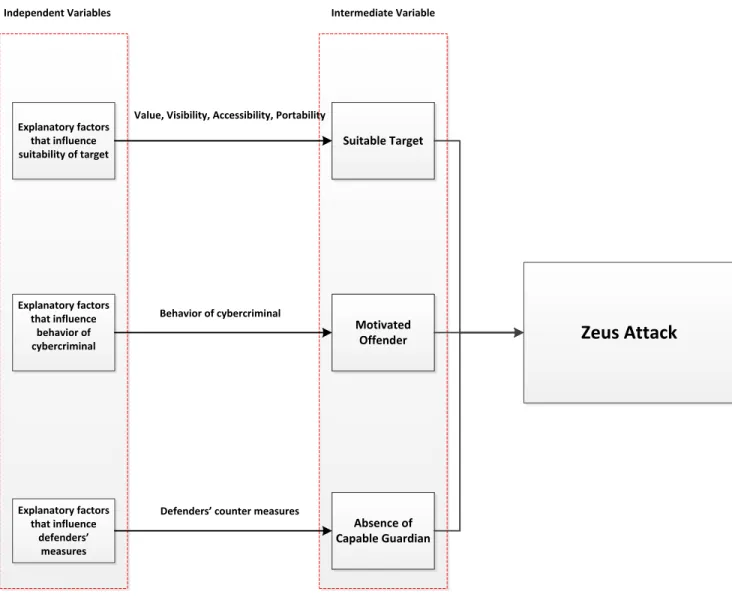
Figure 9- Initial conceptual framework ... 37
Figure 10- Overview of the research steps ... 41
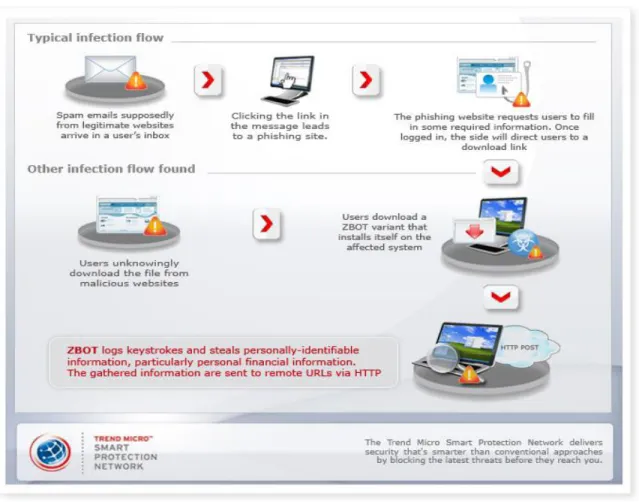
Figure 11- Zeus Infectioini cycle (Trendmicro, 2010) ... 47
Figure 12- Example of a webpage after Zeus web injection (Macdonald, 2011) ... 48
Figure 13- Zeus variants' distribution (TrendMicro, 2010) ... 49
Figure 14- Citadel distribution in Europe (Sherstobitoff, 2013) ... 50
Figure 15- Worldwide Citadel distribution (Sherstobitoff, 2013) ... 50
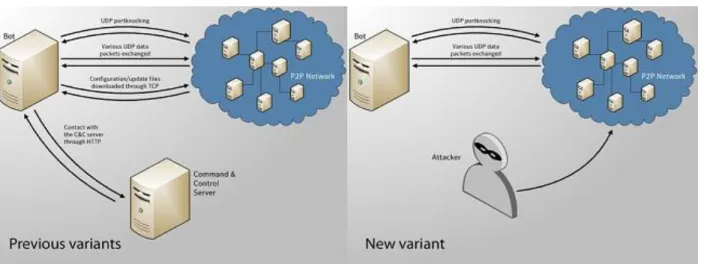
Figure 16- The P2P C&C paradigm has shifted from central server to botnet (Symantec, 2012) ... 51
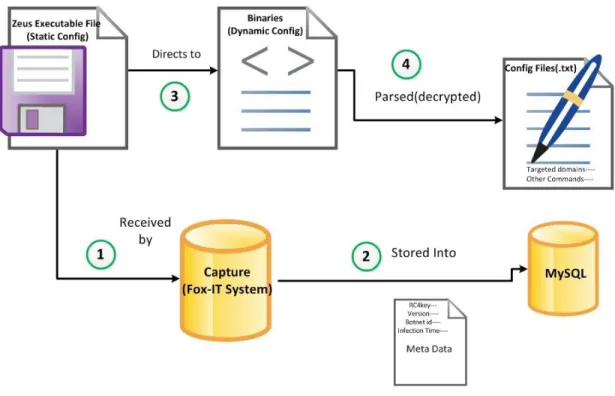
Figure 17- The process of aggregating the Zeus malware configuration files ... 53
Figure 18- tables in the MYSQL Zeus database (red circles indicates the variables that are used for this research from each table) ... 54
Figure 19- Preview of Zeus malware configuration file ... 55
Figure 20- Overview of the main tables used in the research ... 62
Figure 21- Example for displaying why 'raw counts' are incomplete ... 65
Figure 22- Intermediate framework based on the relations in the conceptual framework ... 66
Figure 23- Top 10 domains attacked by Zeus Malware Jan 2009-March 2013 ... 67
Figure 24- Top 10 most targeted domains attacked by Zeus malware Jan 2009-March 2013 ... 67
Figure 25- Power law (cumulative percentage of domains count for percentage of attacks) ... 68
Figure 26-Number of weeks that domains were under attack ... 69
Figure 27- Top 10 domains attacked by Zeus malware Jan 2009-March 2013 ... 70
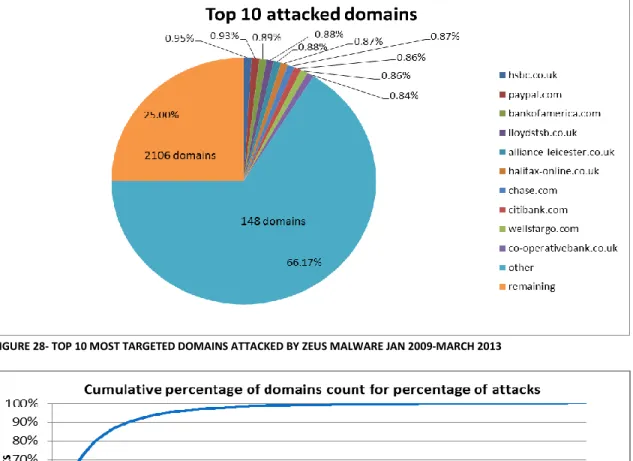
Figure 28- Top 10 most targeted domains attacked by Zeus malware Jan 2009-March 2013 ... 71
Figure 29- Power law distribution (cumulative percentage of domains count for percentage of attacks) ... 71
Figure 30- Number of active botnets per week... 72
Figure 31- Number of config files vs. number of active botnets per week ... 73
Figure 32- Average number of configs per botnet per week ... 73
Figure 33- Number of domains attacked by all botnets per week ... 74
Figure 34 Number of domains sent per botnet per week vs. number of botnets active ... 75
Figure 35- Botnets lifespan vs. activity (In terms OF NUMBER of config files they sent) ... 76
Figure 36- The empirical model ... 83
Figure 37-Top-10 attacked domains by Zeus financial malware ... 87
Figure 38- Top-10 attacked domains by Zeus financial malware ... 87
Figure 39- Distribution of the Top-10 attacked domains by Zeus financial malware ... 88
Figure 40- Number of active botnets per week... 88
Figure 41- Number of config files vs number of active botnets per week ... 89
Figure 42- Average number of config files per botnet per week... 89
Page | 9
Figure 44- Amount of weeks domains were under attack ... 90
Figure 45- Alexa ranks vs. Zeus ranks ... 91
Figure 46- Result of test of normality ... 93
Figure 47- Histogram of variable ‘Attacks’ ... 94
Figure 48- Descriptives of variable ‘Attacks’ ... 94
Figure 49- Result of KS test of normality... 94
Figure 50- Histogram of variable ‘Sum of Attacks’ ... 95
Figure 51- Descriptives of variable ‘Sum of Attacks’ ... 95
Figure 52- Result of the comparison of means test for H1 ... 99
Figure 53- Result of the comparison of means test FOR H1 ... 99
Figure 54- Result of the comparison of means test FOR H1 ... 100
Figure 55- Result of the comparison of means test FOR H1 ... 100
Figure 56- Result of the comparison of means test for H2 ... 101
Figure 57- Box plot of som of attacks within two groups of with/without English webpages ... 101
Figure 58- Result of the comparison of means test for H2 ... 102
Figure 59- Result of the comparison of means test for H2 ... 102
Figure 60- Box plot of som of attacks within two groups of with/without English webpages ... 102
Figure 61- Result of the comparison of means test for H2 ... 103
Figure 62- Result of Spearman's bivariate correlation test for H3 ... 103
Figure 63- Result of Spearman's bivariate correlation test for H3 ... 104
Figure 64- Scatter plot of broadband users versus sum of attacks on different countries ... 104
Figure 65- Result of Spearman's bivariate correlation test for H3 ... 104
Figure 66- Result of Spearman's bivariate correlation test for H3 ... 105
Figure 67- Scatter plot of broadband users versus sum of attacks on different countries ... 105
Figure 68- Result of Spearman's bivariate correlation test for H4 ... 106
Figure 69- Result of Spearman's bivariate correlation test for H4 ... 106
Figure 70- Scatter plot of GDP versus sum of attacks on different countries ... 107
Figure 71- Result of Spearman's bivariate correlation test for H4 ... 107
Figure 72- Result of Spearman's bivariate correlation test for H4 ... 107
Figure 73- Scatter plot of GDP versus sum of attacks on different countries ... 108
Figure 74- Result of Spearman's bivariate correlation test for H5 ... 109
Figure 75- Result of Spearman's bivariate correlation test for H5 ... 109
Figure 76- Result of Spearman's bivariate correlation test for H5 ... 110
Figure 77- Result of Spearman's bivariate correlation test for H5 ... 110
Figure 78- Result of Spearman's correlation test for categorical independent variables ... 111
Figure 79- Result of Spearman's bivariate correlation test for non-georaphical independent variables ... 111
Figure 80- Descriptive Statistics within the EU region ... 112
Figure 81- Descriptive statistics for the global region ... 112
Figure 82 -Visual tree (Left part) ... 114
Figure 83- Visual tree (Right part) ... 114
Figure 84- Top-10 attacked domains (old metric) ... 118
Figure 85- Top-10 attacked domains (New metric) ... 118
Figure 86- Fox-IT (Left) versus F-Secure (Right) ... 132
Figure 87- F-Secure P2P Zeus top attacked countries (Left) AGAINTS FOX-IT ZEUS top attacked countries (Right) (F-Secure, 2012b) ... 133
Page | 10
Figure 88-Proportion of email traffic containing URL malware from Symantec data (Left) againts Fox-IT number of Zeus configuration files(Right)(Symantec, 2013) ... 133
Page | 11
L
IST OF
T
ABLES
Table 1- Screen Shot from a carding website (Paget, 2010) ... 19
Table 2- Summary of online banking attack vectors ... 25
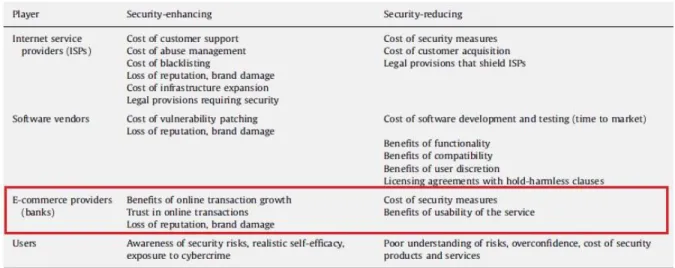
Table 3- Security incentives of players in the ICT value chain (Bauer & Van Eeten, 2009) ... 28
Table 4- List of factors that influence online banking crime ... 38
Table 5- General specifcations of the research dataset ... 52
Table 6- Number of targeted domains in different years ... 52
Table 7- Preliminary infromation extracted from the malware configuration files ... 55
Table 8-Exmaple of targeted Obfuscated URls in the configuration FILES ... 56
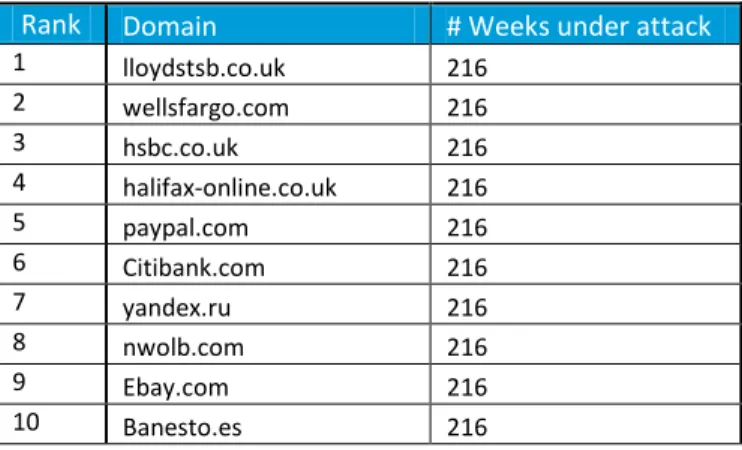
Table 9- Number of weeks top-10 domains are under attack ... 68
Table 10- Information about geographical locations attacked by the top-10 most active botnets ... 77
Table 11-Independent variables extracted from Zeus configuration files based on RAT’s three categories ... 79
Table 12- List of independent variables based on interview results, grouped using RAT categories... 82
Table 13- Spearman’s correlation test between Alexa ranks and Zeus ranks of attacked domains ... 91
Table 14- List of hypotheses ... 92
Table 15- List of EU countries in/out of our sample ... 92
Table 16- Attacked domains per region per year... 93
Table 17- Summary of the findings ... 111
Table 18- Countries in our dataset ... 113
Table 19- Summary of the findings ... 115
Table 20-Limitations of the research ... 124
Table 21-Suggestions for further research ... 125
Page | 12
Chapter 1
- Introduction
1.1
R
ESEARCH
P
ROBLEM
Around mid-1990’s, banks started to offer Internet banking mainly to increase customer reach and cost-effectiveness (Jaleshgari, 1999). Electronic banking platforms act as efficient channels throughout which transactions could be done with less effort (Vrancianu & Popa, 2010). However, as these web-based, ‘online banking’ platforms have become popular among citizens and e-businesses that use them more and more in their daily activities; ‘Online Banking Fraud’ increased likewise (Alaganandam, Mittal, Singh, & Fleizach, 2007). Cybercriminals started to use the characteristics of Internet to generate very costly scams to steal banks’ costumers account information and ultimately their money (Choo, 2011). In a study Anderson et al. (2012) indicate that the global financial losses of such activities are in the magnitudes of billions of euros per year. The study provides widespread details about cybercrime losses by categorizing them into direct losses, criminal revenue, indirect losses and indirect costs. Therefore, there is a collective consensus among defenders and policy makers that measures have to be taken to protect the online banking platforms from such threats (Anderson et al., 2012). Although, a lot of different technical controls and defense measures were taken by banking sector and security firms for instance through increased real-time supervision on transactions, yet the online banking fraud exists as a big problem (Premchaiswadi, Williams, & Premchaiswadi, 2009). The problem is that defense measures are often reactive, time consuming, public and thus accessible for anyone. However, attackers are proactive; they allocate their time investigating the already existing defense knowledge and measures to find solutions to bridge these defense measures. So it is like an iterative loop; usually attackers find the weakest links to attack (the most vulnerable link), defenders fix the problems, attackers find a new and so a strong dynamic process is at play (Böhme & Moore, 2009).
One of the ways for designing mitigation strategy for online banking sector is to primarily investigate why certain banks are selected as targets for online attack and some banks are not. Different banks from all around the world become targets of financial banking attacks and their users suffer from malware attacks in the form of online phishing2, keystroke-logging3 malwares, identity theft etc.; A study done by Moore and Clayton (2007) indicates that some banks are targeted much more frequently than others. However, there does not seem to be a clear pattern in which banks are attacked by financial malware. For instance, the attacked banks differ in terms of their size (market share) or number of users, their authentication mechanisms, their money transfer policy, regulation, the statistics of the countries they are located in and many other characteristics. Some reports published in 2012 claimed that result of their analysis on some malware samples showed that online banking attacks are getting more target-specific (Sherstobitoff, 2013; TrendMicro, 2013). However, we still do not know about whether or not cybercriminals indeed select their targets based on specific characteristics and what their rationale is for selecting their banking attack targets.
2
Based on Wikipedia definition, “Phishing” is the act of attempting to acquire information such as usernames, passwords, and credit card details (and sometimes, indirectly, money) by masquerading as a trustworthy entity in an electronic communication (Wikipedia, 2012).
3 Keystroke logging (more often called keylogging or "keyloggers") is the action of tracking (or logging) the keys struck on a keyboard, typically in
Page | 13
1.2
S
TATE
-
OF
-
THE
-A
RT
L
ITERATURE
1.2.1
E
CONOMICS OFI
NFORMATIONS
ECURITYTo tackle the problem just has been explained, we will start by reviewing the main literature of the field, economics of information security. Internet security became an interesting topic for social scientists from 2000 onwards because not so many satisfactory results were produced by employing technical solutions alone (Haukson, 2006). According to Anderson and Moore (2006), in order to be able to implement efficient solutions in the field of Internet security, economic insights should be integrated into technical designs. Schneier (2011) discussed that “people often represent the weakest link in the security chain and are chronically responsible for the failure of security systems”. Here is one of the situations where economics comes in the financial online crime where multiple different actors are involved. Economics intends to explain the behaviors and incentives of attackers and defenders and consequently helps to build a safer Internet environment (Hammock, 2010).
Therefore, economics of information theories has been used many times by multiple authors such as Anderson et al. (2012) and Van Eeten, Bauer, Asghari, Tabatabaie, and Rand (2010) to address cyber-security problems in general, including online banking fraud. In regards to the online banking fraud problem, economic theories are useful to explain the main goal of the attackers in an online banking attack that is economic and for the main reason of financial gains. However, yet economic theories alone are not able to provide the required information to explain why certain targets are selected by cybercriminals. For gaining more insight about ‘target selection’, we need to refer to a similar field, which actually deals with the same issue as we are dealing here in this research.
1.2.2
C
RIMINOLOGYT
HEORIES:
RAT
In general, criminology field covers several well-known theories in which situations where crime occurs are explained. ‘Routine Activity Theory’ (RAT) defined by Cohen and Felson (1979) is one of the most important criminology theories which explains that a crime happens when the three components ‘Attractive Target’, ‘Motivated Offender’ and ‘Lack of Capable Guardian’ meet each other in a specific location and time (Figure 1). Although the theory was developed for offline crime, it can similarly explain the occurrence of online banking attacks and the associated underlying reasons that resulted in online attacks. As it is obvious, using this theory, we might be able to address what makes a target attractive and how it is selected by cybercriminal in an online banking attack. Of course, exposing RAT into a virtual problem, requires it to be adjusted to the specific characteristics of cyberspace (such as existence of many-to-many connectivity, collapse of spatial-temporal barriers and anonymity of mutually dependent actors).
FIGURE 1- ROUTINE ACTIVITY THEORY (OFFENDER+ TARGET- GUARDIAN =CRIME) Motivated Offender A Suitable Target Absence of Capable Guardian CRIME EEMM e
Page | 14
1.3
A
U
NIQUE
O
PPORTUNITY FOR
R
ESEARCH
In the previous sections we introduced the problem of online banking fraud and we argued that after all improvements in defense measure by defenders, they still do not have any clue how the attack target are selected by cybercriminals.
In order to obtain information about how targets are selected by criminals and in general online banking attacks, their technical specification and their previously selected targets, we need to have access to records of a financial malware as a case study for this research. In this research, a unique opportunity of having access to records (configuration files) of Zeus financial malware is existed. Zeus is one of the most important and wide-spread malware, first exposed on October 2006. It mostly works on computers using Microsoft Windows operating systems and since 2012, also on Blackberry and Android phones. The Zeus malware files (configuration files) contain all of the instructions that are provided by cybercriminals to the infected machines including target domains4.
The dataset is provided by Fox-IT for Delft university of Technology. Fox-IT is a security company located in the Netherlands, Delft that provides security solutions for more than 20 countries world-wide.
The opportunity of having the dataset provided by Fox-IT is unique primarily because normally finding information about a malware configuration file which may contain confidential information about different companies and financial institutions is hard for independent researchers. Moreover, the dataset covers Zeus records of wide variety of countries and a sufficient time span (2009-2013).
1.4
R
ESEARCH
Q
UESTION
According to the discussions above, our goal in this research is to gain possible insights about how targets are selected by cybercriminals in online banking fraud. We are mainly interested in seeing whether a clear pattern/intelligence can be found from the way cybercriminals select their targets. Therefore, in line with our goal we need to perform an explorative research on the available Zeus malware data provided by Fox-IT database (Kothari, 2009). To gain any insight, we need to primarily develop a method for extracting meaningful information that could explain target selection by cybercriminals from the Zeus malware data. After realizing the best variable for delineating the information available in Zeus malware data into meaningful terms, a framework can be built containing a dependent and a number of independent variables to determine what factors have the most influence on target selection by cybercriminals. The starting point for realizing this goal is to grasp the primary datasets and meanwhile to understand the dynamics of the Zeus attacks in more details. Therefore, the above research goal can be translated into the leading research question:
Research Question: Can we extract intelligence on criminal attack patterns and target selection from the files which financial malware use as instructions for their operations?
1.5
O
UTLINE OF THE
T
HESIS
The thesis report is structured as follows: In the second chapter, a review of the current literature on online banking fraud will be provided, and we shall reflect on the state of the art in different online banking attacks, economics of information security literature and Routine Activity Theory from criminology literature. The chapter will start with a look at the online banking history, and gradually shift its focus on online banking attacks and its
Page | 15 different types, and target selection. The chapter will end by recognizing the research gap, developing the research question and its associated sub questions and the conceptual framework.
In the third chapter, the methodology that is used to carry out the research is presented, and the sources of data used for compiling a usable dataset are introduced. The fourth chapter complements the third chapter by explaining what Zeus malware is, how it works and how the raw malware data is aggregated and prepared along with looking at a number of special issues involved in preparing the data.
Chapter five will present the methodological core of the thesis. The chapter mainly contains different methods in term of intermediate variables that are able to extract intelligence from Zeus malware data. The chapter will finish by selecting the best fitted intermediate variable capable of delineating target selection by cybercriminals in line with our research question. This variable will then be used in later chapters as a dependent variable for empirical analysis. Chapter six and seven actually act as the proof of concept we introduced in chapter five (the methodology for extracting intelligence from data). Chapter six contains a list of independent variables identified through conducting qualitative interviews with experts from security and criminology fields. These variables will later be used to develop a number empirical hypotheses and an empirical model for illustrating the relations between variables. The hypotheses would ultimately be tested, using the empirical model that is built in the last section of chapter six with dependent and independent variables defined earlier in the report. Chapter seven starts with the section where we will finally reach the stage of data analysis. Different sets of statistical instruments are employed, and the results are interpreted. The thesis concludes with chapter eight, which summarizes all of our findings and looks at their implications. The chapter ends by a brief review on limitations of the work that is done in this thesis and a number of suggestions for further research.
Page | 17
Chapter 2
- A Study of the Literature
Introduction
As it is shortly discussed in the introduction chapter, in this report we are going to address the problem of online banking fraud from target selection perspective. In the current chapter, primarily we will review a short history of online banking and its different components. Next will discuss what online banking fraud is and how it can be executed. The next section contains a short review on economic and criminology theories in regards to the cyber security problems. In this section, we aim to find out to what extent these theories can help us to build a conceptual framework for addressing the research problem that is introduced earlier in the chapter.
2.1
O
NLINE
B
ANKING
T
ODAY
:
A
B
RIEF
H
ISTORY
As technology advanced, most of our life’s daily activities moved online. Online banking was not exceptional from this fashion. Around mid-1990s, Internet brought new alternatives to the financial markets and banks started to experience the potential of the Internet (Calisir & Gumussoy, 2008; Jaleshgari, 1999).
With new technological developments, banks started to provide online banking services that enabled customers to get connected to the bank’s computer systems via Internet connections through a browser or specific application (Claessens, Dem, De Cock, Preneel, & Vandewalle, 2002). Offering online banking channels not only provides an opportunity for customers to have easy access to their banking activities but also creates cost-effectiveness for financial institutions (Claessens et al., 2002; Jaleshgari, 1999). By now, performing electronic banking activities via mobile phones through Internetaccess is also possible for bank’s customers.
Nowadays, almost every bank provides its clients with access to their accounts over the Internet. Banks provide a different range of financial services through their Internet banking channels. Different financial Internet banking applications mostly contain money transferring services, investment services (stock, bond, and mutual funds) and currency exchange services. According to the Amit and Zott (2001) definition of value creation, Internet banking services bring efficiency mostly in terms of convenience, cost-effectiveness, functionality, speed, 24/7 availability, while requiring less staff and fewer physical branches than other customer-contact channels. Since the banking industry is highly competitive, cost management is not a luxury but a necessity for financial institutions. Study of Nevens (1999) indicates that a bank’s transaction costs can drop 80% or more when handled electronically. However, as new technologies upset traditional power balances and so does the Internet. The Internet empowers everyone including cybercriminals. Ten years ago, hackers hacked systems only to satisfy their curiosity and to gain fame and so no damage was involved. However, advancement of technology and rapid progression of the hackers’ ability to access various users’ systems maliciously altered their motivations from curiosity to financial motives (Alaganandam et al., 2007).
Among all, online banking platforms were not exceptional and like other online-based services have become the target of various online attacks. Although banks increased their cost-effectiveness considerably by moving their consumer and business operations to the Internet environment, online banking platforms created a new risk profile for the banking section. Cybercriminals use the characteristics of Internet to perform online scams on online banking transactions. According to the Anderson et al. (2012) study on ‘measuring the cost of cybercrime’ , the annual global financial losses of financial fraud activities are in the magnitudes of billions of euro.
Clearly, banks desire their customers to continue using online banking. However, whether online banking sessions are safe remains one of the biggest issues that the banking sector and security firms face. If customers would not be sure that the online banking sessions are secure, they could not trust the online banking system and might
Page | 18 move back to the traditional way of banking which ultimately would impose higher costs on banks. Thus, banks need to provide reasonable assurance for their customers to use online banking sessions. Before going more into the details about online banking fraud, we first need to understand the basic components of an online banking session. The next section will elaborate more on the definition of online banking and its associated components.
2.2
O
NLINE
B
ANKING
Primarily, we need to explicitly know about “online banking” and the different sides that are involved in it. An online banking platform consists of the following three main components:
1. Bank (server side)
2. Network infrastructure (Internet)
3. Bank users (client side which connect to banks via network infrastructure and via personal computers, mobile phone, tablet etc.)
FIGURE 2- ONLINE BANKING GENERAL COMPONENTS (ADOPTED FROM HUTCHINSON & WARREN, 2003)
A bank’s user connects to the Internet typically via her personal computer, and then starts communicating with her bank via a web browser, hence banking through the World Wide Web. The standard protocol for secure online communications, HTTPS is then used (HTTP with an extra security layer).
After connecting to the main page of the bank’s online banking system, the user has to go through an authentication process to gain access to her account details and perform online any kind of transactions. Authentication methods and their level of security can differ from static (fixed) username and passwords to two step authentication which requires a token, a password (or pin) and a human being to use the token and enter the password (Claessens et al., 2002).
Indeed, each of the above-mentioned components could be potential targets for attacks by cybercriminals. However, it is logical that criminals choose the easiest way to perform an online attack and people appear to be the weakest links in this online banking value chain, since many of them do not have the required technical knowledge to protect themselves from online fraud. However, what is online fraud and how is it executed via the different components of an online banking session? In the next section, we will elaborate on these issues in more details.
2.3
C
YBERCRIME AND THE
P
ROBLEM OF
O
NLINE
B
ANKING
F
RAUD
Douglas and Loader (2000) define, cybercrime as “computer-mediated activities conducted through global electronic networks which are either illegal or considered illicit by certain parties”. Online Banking Fraudis about committing fraud or theft using online technology to illegally remove money from, or transfer it to, a different
Page | 19 bank account. Wall (2001) divides cybercrime into four different categories: cyber-trespass, cyber-deceptions and thefts, cyber-pornography and cyber-violence. Online banking fraud is best fitted in the cyber-deceptions category defined as “stealing (money, property), e.g. credit card fraud, intellectual property violations (a.k.a. ‘piracy’)”. Anderson et al. (2012) differentiate online banking fraud from card fraud while both target financial systems and banks. They argue that in online banking fraud only customers and banks suffer while this is different in the case of card fraud where merchants also suffer from the fraudulent activity.
In general, online banking fraud is executed for the ultimate goal of gaining access to the user’s bank account. How this access is obtained differs between different attack vectors. In some cases, cybercriminals trade users’ banking credentials such as PIN, password, certificates etc. for anywhere between $10-$2000 per account. In other cases, the goal of the cybercriminal is to steal the victim’s money and transfer it through so called money mule accounts. Whereas other times, online banking attacks are not just about money but about harming a bank’s image by making the bank server unavailable to the real clients. An example of the first group in indicated in Table 1. The table displays a list of bank accounts for sale with different ranges of prices according to the fund available in the account.
TABLE 1- SCREEN SHOT FROM A CARDING WEBSITE (PAGET, 2010)
Till now, several security improvements have been achieved for securing online banking sessions. Most of the research in this filed study the vulnerabilities that are existed in the defense systems (Claessens et al., 2002; Florêncio & Herley, 2011; Hutchinson & Warren, 2003; McCullagh & Caelli, 2005). Other studies focused on user part of the banking platforms and investigate the ways to increase user awareness in regards to online banking fraud. However, not so many studies, if any, look at this problem proactively by investigating the ways that target banks are selected by cybercriminals.
One of the ways for designing mitigation strategy for online banking sector is to primarily investigate why certain banks are selected as targets for online attack and some banks are not. Different banks from all around the world become targets of financial banking attacks and their users suffer from malware attacks. A study done by Moore and Clayton (2007) indicates that some banks are targeted much more frequently than others. However, there does not seem to be a clear pattern in which banks are attacked by financial malware. For instance, the attacked banks differ in terms of their size (market share) or number of users, their authentication mechanisms, their money transferring policy, regulation, the statistics of the countries they are located in and many other characteristics. Some reports published in 2012 claimed that result of their analysis on some malware samples showed that online banking attacks are getting more target-specific (Sherstobitoff, 2013; TrendMicro, 2013). However, we still do not know about whether or not cybercriminals indeed select their targets based on specific characteristics and what their rationale is for selecting their banking attack targets.
Page | 20 In order to be able to understand online banking fraud and the behavior of the attackers and defenders in this environment, we first need to describe the main actors involved in that space, i.e. who are the cybercriminals. The next section describes the different actors that are involved in online banking fraud value chain.
2.4
A
CTORS OF
O
NLINE
B
ANKING
F
RAUD
Actors in a malicious transaction in online banking fraud can be categorized into four main groups namely,
malicious exploiters, money mules, victims and security guardians5. Below a brief description in regards to each group of actors is provided:
2.4.1
M
ALICIOUSE
XPLOITERSAccording to the anonymity that the Internet environment provides for its users, tracking people who conduct criminal activities in cyberspace is difficult. Likewise, defining a set of fixed characteristics of individuals or groups of people involved in different kinds of online fraud is a difficult task. However, According to an OECD (2007) report, based on their capabilities and motivations, malicious exploiters can be categorized into five below groups:
Innovators are challenge seeking individuals who spend their time finding security holes in systems to overcome protection measures.
Amateur Fame Seekers are beginners in the security world with limited programming and computing skills. Their main motivation is fame in media and they mostly use ready-made tools and tricks for executing their malicious activities.
Copycats are hackers and malware authors who desire celebrity status in the criminal community and are interested in recreating simple attacks.
Insiders are defined as ex-employees and ex-contractors of financial institutions or companies who are motivated to take revenge or to steal money from where they worked. Most of the times they execute their attacks by abusing their security privileges.
Criminals are highly motivated, highly organized, very knowledgeable and powerful individuals or group of individuals and are playing the game for profit using advanced human and computer resources.
2.4.2
M
ONEYM
ULESBy definition of OECD (2007), Money Mules are “individuals recruited wittingly and often unwittingly by criminals, to facilitate illegal funds transfers from bank accounts”. FBI defined a money mule network as a network of compromised individuals who engage in transferring the stolen money from the victim’s account in exchange of gaining a percentage of that money. According to a Fox-IT security expert, in some of the reported cases, money mules are young high school boys who have been paid for lending their debit card for a certain amount time. Florêncio and Herley (2010) mentioned that the key role of money mules is to convert “reversible traceable transactions into irreversible untraceable ones”.
2.4.3
V
ICTIMSBased on the OECD (2007) report victims can be categorized into two main groups: End users and Banks. End users then are categorized as home users (and individuals), small to medium Enterprises (SMEs) and large end users (public institutions and global corporations).
Home and SME users create the most negative externalities among the legitimate actors. Part of the externalities is absorbed by other players, such as ISPs (Internet service providers) and FSPs (financial service providers). Risky
Page | 21 online behavior of these users along with them not employing security software creates negative externality6. Different reasons may be able to explain this behavior of users: many times users do not have the required knowledge about how malware works, and thus they may not understand when they become infected. Moreover, everyone perceives the chances of being hit by a malware as low, for example they believe that it should be already included on the computer. Finally, following the above points, they do not find paying for security software convenient. Moreover, because they are the weakest link in cyber security environment since most of them are not familiar with information technology and security requirements are too difficult for them to follow to protect themselves from Internet threats (Asghari, 2010; Mannan & van Oorschot, 2008). Considering that, some of the online threats like spamming and botnet activities are performed by acquiring users’ device.
2.4.4
S
ECURITYG
UARDIANSSecurity guardians are also one of the main actors in the online banking fraud field. They improve the existing banking systems and their vulnerabilities and develop more sophisticated security systems for mitigating the online fraud on the financial institutions. This security guardians in this problem is either the banking sector itself or 3rd party security firms who provides security services for the banking sector.
FIGURE 3- ONLINE FRAUD ACTORS (ADOPTED FROM FBI, 2012)
2.5
T
HE
M
OST
C
OMMON
O
NLINE
B
ANKING
A
TTACK
V
ECTORS
In general, online banking attacks can take place using different attack methods. There is no clear-cut list of different types of online banking attacks. Primarily, because online banking attack types are not static and they evolve over time. Secondly, because categorizing different attack vectors is not an easy task to do due to the elements different attacks may have in common with each other. However, based on the targeted side, online banking attacks can be categorized into two groups: 1. Attacks that are executed on the bank’s servers; 2. Attacks that are executed on the bank’s clients or users.7
6 Wikipedia defines externality as a cost or benefit which results from an activity or transaction and which affects an otherwise uninvolved party
who did not choose to incur that cost or benefit.
7 We will not include card skimming and/or attacks on merchants (third-parties) that are then used to steal credit card data in this research
Se
cu
ri
ty
G
u
ar
d
ia
n
s
Page | 22
2.5.1
S
ERVERS
IDE ATTACKSOne of the types of the online banking attacks on the server side is directly hacking a bank which normally does not frequently happens because it is hard to be executed due to sophisticated banks’ security infrastructure. Another type is to target bank’s servers through DDoS attacks to either block the communication between the server and its real clients or to make the server unavailable to its real clients.
‘Denial of Service’ (DoS) or Distributed Denial of Service (DDos) attack is to temporarily make a service or machine unavailable for its users. This is done through different ways, one of the most popular ways of DDoS attack is saturating the target service or machine through multiple anonymous service requests which ultimately result in the targeted service getting overloaded by requests. It can be a “single-source” attack, originating from only one host (attacker), or “multi-source”, in which a group of hosts collaborate to flood the system with several requests (Hussain, Heidemann, & Papadopoulos, 2003). The goal of such an attack is either to interrupt the service that is provided by the target or to interrupt communication of the target with other users of the network so that it will not be able to communicate anymore. Slow network performance and speed, unavailability of some specific websites, several disconnections of one’s wireless or wired network connection and receiving several spam email in a specific time are the symptoms of a DDoS attack.
This type of attack cannot easy to be executed since bank’s servers are mostly well protected8. The fact that banks’ servers are in the control of banks and more security measures are implemented for them compared to the clients’ PCs make them less vulnerable targets for the attacks (although still several server side attacks are reported each year).
2.5.2
C
LIENTS
IDEA
TTACKSMost of the online banking attacks being executed on the client side are based on deceiving users to steal their banking credentials, PIN and ultimately their money. However, the whole process is not that easy. Several different techniques exist for each of these steps. Generally, as Anderson et al. (2012) argue in their article ‘Measuring the cost of Cybercrime’, online banking fraud is carried out in two ways:
Attacks utilizing phishing
Attacks utilizing malware
In the following section each of the above methods will be explained in more details.
O
NLINEB
ANKINGA
TTACKU
TILIZINGP
HISHINGIn a phishing attack, cybercriminals imitate a bank’s website and create a fake webpage identical to the original banking page, to deceive users to provide their login credentials (Anderson et al., 2012). In their study, Moore and Clayton estimated that between 280,000 and 560,000 people gave away their credentials to phishing websites each year (Moore & Clayton, 2007).
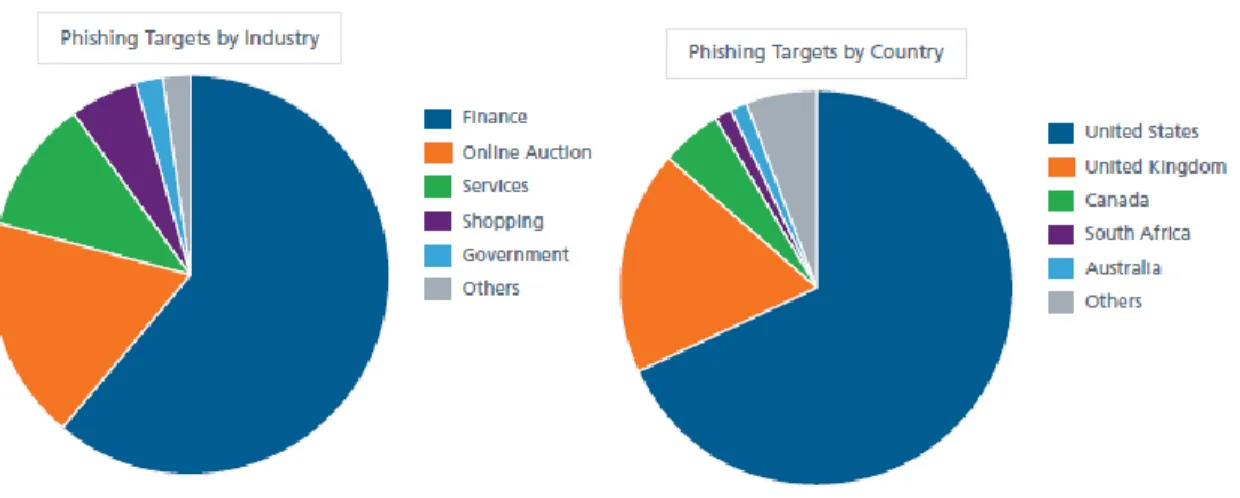
What is a phishing attack? ‘Phishing’ is a type of online threat and an example of a social engineering technique in which the attacker also known as the phisher attempts to fraudulently extract users’ sensitive confidential information such as password, credit card information, online banking credentials etc. or to direct clients through links to download a Trojan-family on their computers for other fraudulent activities by masquerading itself as a trustworthy entity in an electronic communication (Jakobsson & Myers, 2006). Figure 4 displays the major phishing targets in 2012.
Page | 23 FIGURE 4- PHISHING TARGETS BYINDUSTRY AND COUNTRY (MCAFEE, 2012)
Usually, the electronic communication is done via spam emails or instant messaging. Phishing occurs by clicking on the links that are normally existed in the spam emails received by clients in their mailbox. The spam emails are normally distributed via bot or zombie computers in a botnet9. Figure 5 displays an example of a phishing email containing a disguised link that directs users to a malicious website where malware is then downloaded automatically to the user’s computer.
FIGURE 5- EXAMPLE OF PHISHING EMAIL CONTAINS DISGUISED LINK
Previously, in online banking fraud, phishing websites only present the bank’s login webpage and it was the exact copy of the original bank’s online login webpage. However, as phishing attacks are becoming more sophisticated, they rely more on malicious proxy or auto-configuration scripts that are remotely hosted by C&C servers and instruct the victim's web browser to proxy certain requests according to the specified configuration.
9 A ‘botnet’ is a flexible remote-controlled network containing computers that function together to make a platform available for fraudulent
and criminal purposes (Bauer & van Eeten, 2009). In a botnet, bots are connected to the botmaster through a command and control (C&C) channel. The main value of this channel is its ability to broadcast the botmasters’ commands to their bot armies (Fabian & Terzis, 2006).
Page | 24
O
NLINEB
ANKINGA
TTACKU
TILIZINGK
EYSTROKE-L
OGGINGM
ALWAREAnother way of performing online banking fraud is to install keystroke-logging malware on the victim’s computer. Zeus malware is an example of such a malware. In October 2010, the bot master of Zeus botnet (Zbot) malware, the financial malware that harvests credentials from many banks was arrested by FBI.
Based on a McAfee report, this type of online fraud is mainly based on downloading malicious software or ‘malware’ , typically a Trojan, on the victim’s computer to control his browsers through injected scripts (Marcus & Sherstobitoff, 2012). The malware may log a user’s keystroke to harvest credentials for electronic banking (Moore, Clayton, & Anderson, 2009).
The malware is normally downloaded through a link in a phishing email (spam email) that is generated by the relevant botnet (Mavrommatis, Provos, Monrose, & Abu Rajab, 2008; Moore & Clayton, 2007). The Trojan then installs the malware on the victim’s device. The Next time that the victim tries to login to his/her bank account, the malware detects the victim’s information and credentials. Typically, a man-in-the-browser (MitB) attack is executed by injecting scripts into the user’s browser and manipulating the victim by displaying fake bank errors and a fake account balance. The malware then uses the victim’s credentials to transfer money from the victim’s account to a money mule account and finally forward it to a specific destination via an anonymous money transfer service, such as Web Money, e-gold, or Western Union (Paget, 2010). These mules are persons typically duped to accept stolen money and then forward it to specific destinations. The mules can easily be recruited via job ads sent in spam e-mails or hosted on websites such as Craigslist or Monster. The whole process takes 1-3 days.
What is a ‘man-in-the-browser’ attack? The ‘man-in-the-browser’ attack also called ‘Proxy Trojan’, functions on Internet browser of users’ computer and controls the ingoing and outgoing content of information at the system level (Utakrit, 2009). Therefore, it has the ability to take control over data or steal data either passively through key-loggers or actively through phishing. In fact, the attacker has access to whatever data that is communicated through the user’s browser while he can also be selective in choosing the target domains (webpages) and the type of data he intends to steal from users in that website (Dougan & Curran, 2012).
FIGURE 6- MAN-IN-THE-BROWSER ATTACK OPERATION (UTAKRIT, 2009)
Moreover, the attacker is able to inject new scripts into the user’s browser and modify the HTML of specific pages to ask extra information from users. The same process could be done by the attacker for the outgoing data. This means that with MitB attacks, the attackers are able to compromise the outgoing data - the data that user submits to the server.
Table 2 provides the summary of specifications of attacks vectors explained above. Also, the associated security techniques and mechanisms that are used in each of the attack vectors are explained.
Page | 25 TABLE 2- SUMMARY OF ONLINE BANKING ATTACK VECTORS
Attack Goal Attack Type Tools and Techniques that are
used
Attacked Point
Blocking the ingoing and outgoing communication of the bank’s server/ harming a bank’s image/ Stealing info, payment history etc.
Denial-of-Service Malware
Botnet
Server
Credential/Money theft Online banking attack utilizing phishing
Phishing
Social engineering
Spam email (containing fake website)
Botnet (sending spam emails)
Client
Credential/Money theft Online banking attack utilizing keystroke-logging malware
Man-in-the-browser
Proxy Trojan malware (e.g. SpyEye ,Zeus)
Key-logger
Client
In this section, we looked at online banking platforms and its different components. We discussed the ways that online banking attacks are mostly executed. We also discussed that most of the studies until now focused on the defense measures employed by the banking sector and the users themselves (users’ online awareness). However, not any known study worldwide focuses on the ways criminals behave in selecting their targets. Or more specifically no studies till now investigates the patterns in which the targets are selected by cybercriminals. In order to find out the specific theories or concept that could be helpful in addressing the target selection in online banking fraud, in the next sections of the report we are going to review two relevant fields to our research namely economics of information security and criminology.
Page | 26
2.6
R
EVIEW OF
E
CONOMICS OF
I
NFORMATION
S
ECURITY
L
ITERATURE
In the previous sections of this chapter, we discussed online banking fraud and the different attack vectors that are existed for executing online banking attacks. In this section, we will now shift to study the relevant literature to find out the explanatory factors that would possibly influence specific targets to be selected by cybercriminals. For this, we will start by reviewing Economic of Information Security literature because several times it has been argued by well-known authors of the field like Ross Anderson that information security should not be studied only as a purely technical problem but as socio-economic problem.
2.6.1
O
NLINEB
ANKINGF
RAUD AS AW
ICKEDP
ROBLEMPart of the deficiencies in the decisions regarding online banking fraud problem can be attributed to the nature of this problem. The problem of online banking fraud and selection of the targets by cybercriminals is not simple but rather a complex problem. According to Rittel and Webber (1973), science is developed to deal with ‘tame problems’ while not all of the problems are tame but ‘wicked problems’. De Bruijn and Ten Heuvelhof (2012) defined two characteristics for wicked Problems: there is no consensus about the norms regarding the problem and the information available is not objectifiable. This is true in the case of online banking where no predefined norm exists. The reason could be attributed to the facts that:
1. Online banking fraud is a new field and it influenced by several unique characteristics of cyberspace. 2. Involvement of several different actors with different interests makes this problem complex. Online
banking fraud is like a game between defenders and attackers that suffers from a series of socio-economic structural asymmetries which ultimately makes the information around the game hard to objectify. In the following section, we will review how Economic of Information Security scholars have tried to understand the complexity of online banking fraud beyond the technical explanations until now. The main goal of our review in this section is to find out the relevant factors that can influence the attack decisions of cybercriminals in selecting the target domains in online banking crime through understating the complexity of the online banking fraud problem.
R
EASON ONE:
U
NIQUEC
HARACTERISTICS OFC
YBERSPACEThe first reason why online banking is a wicked problem can be attributed to the unique characteristics of cyberspace. Primarily, the fact that cyberspace provide opportunity for its users to interact with spatially distant actors, apart from its novel benefits, makes users in the cyberspace more vulnerable to a range of potential cybercriminals; Considering the fact these cybercriminals have instant reach, unimpeded by the normal barriers of physical distance.
Secondly, the ability of communicating with thousands of individuals instantaneously empowers individuals with minimal resources to create potentially huge negative effects .The instances could be realized in ‘spam’ or ‘phishing’ emails and DDOS attacks (Yar, 2005). In addition, the anonymity provided by cyberspace that allows users to reinvent new social identities far from their real-world identities is another factor that makes cyber-security problems more complex and thus harder to solve.
R
EASONT
WO:
E
XISTENCE OFS
OCIO-E
CONOMICS
TRUCTURALA
SYMMETRIESAs Anderson et al. (2012) mentioned in their paper, the security world is similar to a structured game in which some structural asymmetries are exist. We divide these asymmetries into four main groups as below: Information, innovation, incentive and evaluation.